
Lindybeige
Published on 17 Jun 2018The command bunker ‘Western Approaches’ is now a museum in Liverpool. I was invited to take a look before it re-opened.
Support me on Patreon: https://www.patreon.com/LindybeigeThe Museum’s website: http://www.liverpoolwarmuseum.co.uk
Many thanks to Richard MacDonald for inviting me and showing me around (you saw him plugging the big fuse in).
Lindybeige: a channel of archaeology, ancient and medieval warfare, rants, swing dance, travelogues, evolution, and whatever else occurs to me to make.
July 8, 2018
Western Approaches – the bunker from which they won the war
Comments Off on Western Approaches – the bunker from which they won the war
July 6, 2018
Funny British Army Recruitment Video
Matsimus
Published on 9 Jun 2018
Some old school British Army recruitment video which was very well made but also just hilarious lol!Hope you enjoy!!
(DISCLAIMER: This video is for entertainment purposes only. The views and opinion come from personal experience or information from public accessible sources.)
Comments Off on Funny British Army Recruitment Video
July 5, 2018
Tales of Cromwell tanks
Lindybeige
Published on 6 Apr 2016War memoirs are filled with amazing anecdotes. Here I relate two, and ramble a bit about British WW2 tank units.
Support me on Patreon: https://www.patreon.com/LindybeigeI am likely to return to this topic – anecdotes from war memoirs. It is a rich vein of stories. These come from Troop Leader by Bill Bellamy, which describes the author’s time commanding a trio of fast Cromwell tanks in World War Two, when fighting the Germans in Holland.
Lindybeige: a channel of archaeology, ancient and medieval warfare, rants, swing dance, travelogues, evolution, and whatever else occurs to me to make.
Comments Off on Tales of Cromwell tanks
July 4, 2018
The War of 1812 on the frontier
Danny Sjursen on what he calls the “Forgotten and Peculiar War of 1812”, specifically the odd situation on the US/Canadian border:
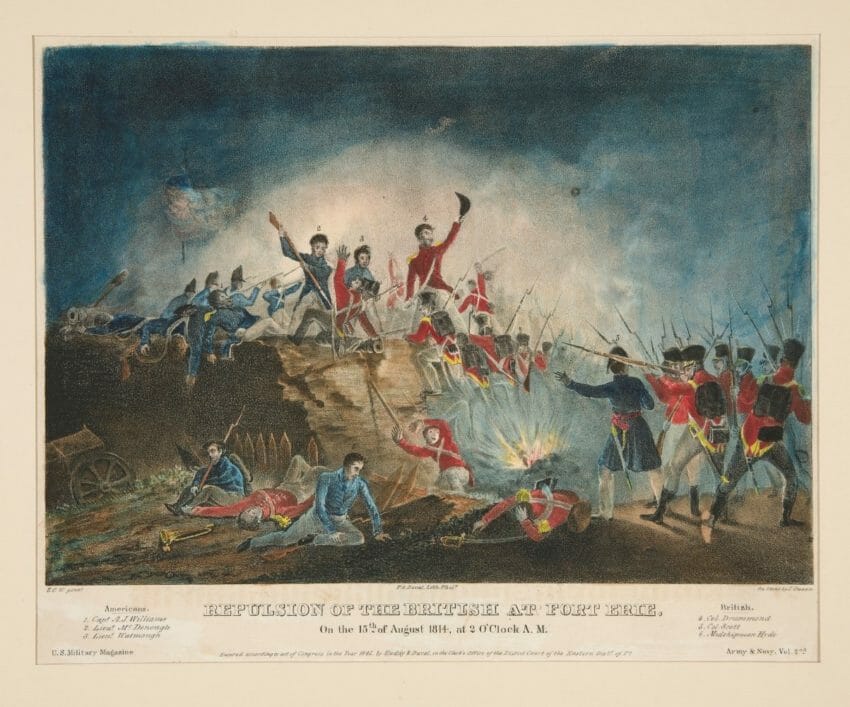
A lithograph based on an E.C. Watmough painting titled “Repulsion of the British at Fort Erie, 15 August 1814.” It depicts an attack that occurred at the U.S.-Canadian border during the War of 1812.
Image via AntiWar.com
“The acquisition of Canada, this year, as far as the neighborhood of Quebec, will be a mere matter of marching.” —Thomas Jefferson (1812)
“People speaking the same language, having the same laws, manners and religion, and in all the connections of social intercourse, can never be depended upon as enemies.” —Baron Frederick de Gaugreben, British officer, in 1815
No one seems to know this (or care), but the United States had long coveted Canada. In two sequential wars, the U.S. Army invaded its northern neighbor and intrigued for Canada’s incorporation into the republic deep into the 19th century. Here, on the Canadian front, the conflict most resembled a civil war.
Canada was primarily (though sparsely) populated by two types of people: French Canadians and former American loyalists — refugees from the late Revolutionary War. Some, the “true” loyalists, fled north just after the end of the war for independence. The majority, however, the “late” loyalists, had more recently settled in Upper Canada between 1790 and 1812. Most came because land was cheaper and taxes lower north of the border. Far from being the despotic kingdom of American fantasies, Canada offered a life rather similar to that within the republic. Indeed, this was a war between two of the freest societies on earth. So much for modern political scientists’ notions of a “Democratic Peace Theory” — the belief that two democracies will never engage in war. Britain had a king, certainly, but also had a mixed constitution and one of the world’s more representative political institutions.
In many cases families were divided by the porous American-Canadian border. Loyalties were fluid, and citizens on both sides spoke a common language, practiced a common religion and shared a common culture. Still, if and when an American invasion came, the small body of British regular troops would count on these recent Americans — these “late” loyalists — to rally to the defense of mother Canada.
And came the invasion did. Right at the outset of the war in fact. Though the justification for war was maritime and naval, the conflict opened with a three-pronged American land invasion of Canada. The Americans, for their part, expected the inverse of the British hopes — the “late” loyalists, it was thought, would flock to the American standard and support the invasion. It never happened. Remarkably, a solid base of Canadians fought as militiamen for the British and against the southern invaders. Most, of course, took no side and sought only to be let alone.
It turned out the invading Americans found few friends in Canada and often alienated the locals with their propensity for plundering and military blunder. Though the war raged along the border — primarily near Niagara Falls and Detroit — for nearly three years the American campaign for Canada proved to be an embarrassing fiasco. Defeats piled up, and Canada would emerge from the war firmly in British hands. In the civil war along the border, the Americans were, more often than not, the aggressors and the losers.
[…]
The Treaty of Ghent, which ended the war, changed nothing. There was no change of borders, and the British said nothing about impressment — the purported casus belli! So just what had those thousands died for?
Certainly it was no American victory that forced the British to the peace table. By 1814 the war had become a debacle. Two consecutive American invasions of Canada had been stymied. Napoleon was defeated in April 1814, and the British finally began sending thousands of regular troops across the Atlantic to teach the impetuous Americans a lesson — even burning Washington, D.C., to the ground! (Though in fairness it should be noted that the Americans had earlier done the same to the Canadian capital at York.) The U.S. coastline was blockaded from Long Island to the Gulf of Mexico; despite a few early single ship victories in 1812, the U.S. Navy was all but finished by 1814; the U.S. Treasury was broke and defaulted (for the first time in the nation’s history) on its loans and debt; and 12 percent of U.S. troops had deserted during the war.
The Americans held few victorious cards by the end of 1814, but Britain was exhausted after two decades of war. Besides, they had never meant to reconquer the U.S. in the first place. A status quo treaty that made no concessions to the Americans and preserved the independence of Canada suited London just fine.
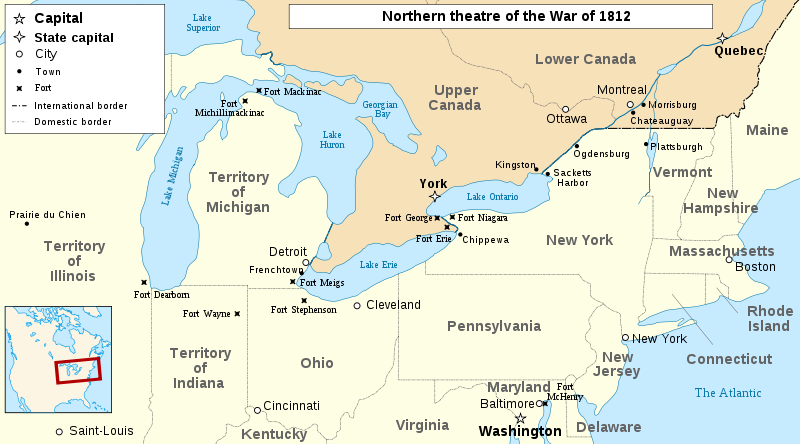
Northern theatre of the War of 1812 (note that Ottawa was not founded until 1826 and shouldn’t appear in this view, and the Niagara River is shown at least 45 degrees off its actual course)
Image via Wikimedia Commons
Comments Off on The War of 1812 on the frontier
Tank Chats #32 Cromwell | The Tank Museum
The Tank Museum
Published on 24 Feb 2017The thirty second in a series of short films about some of the vehicles in our collection, presented by The Tank Museum’s historian David Fletcher MBE. The Second World War, British, Cromwell tank was one of the fastest tanks of the war.
Comments Off on Tank Chats #32 Cromwell | The Tank Museum
July 3, 2018
The Animals – The House of the Rising Sun
José Antonio
Published on Sep 3, 2010By José Antonio…. Because the original version of this video, has low quality in both audio and video, I took the trouble to improve with better sound, better image quality, better zoom and better edition with the best of intentions, thanks.
En vista de que la versión original de este video, tiene baja calidad tanto en audio como en video, me tomé la molestia de mejorarlo con mejor sonido, mejor calidad de imágen, mejor zoom y mejor edición con la mejor de las intenciones, gracias.
Comments Off on The Animals – The House of the Rising Sun
July 1, 2018
Over-generous subsidies encourage fraud and waste
At Catallaxy Files, Rafe Champion continues discussing Matt Ridley’s book Climate Science: The Facts:
Ridley went on to criticise biodiesel programs and the promotion of diesel cars. Then he mentioned one of the most outlandish schemes – the clearing of forests on the west coast of the US to convert into wood pellets to burn in British furnaces instead of coal to generate electricity. The Daily Mail reported that this was one of the legacies of Energy Secretary Chris Huhne.
Mr Huhne, who served in the coalition government and was later jailed for perverting the course of justice, championed the energy source in office and is now European chairmen of Zilka Biomass, a US supplier of wood pellets.
Nice work if you can get it.
And then there are the household biomass furnaces in Britain, promoted by Huhne under the Renewable Heat Incentive (RHI) scheme whereby businesses and households pay for a renewable energy boiler upfront then receive payments for up to 20 years depending on the amount of heat they produce.
Some unscrupulous homeowners can double the amount they produce by using heat generated under the RHI to dry wood or other materials.
This can then be fed back into the boiler to burn it and generate even more heat – and money from the public purse.
The scheme was started in 2011 by Chris Huhne, then Liberal Democrat energy secretary, for businesses then extended to domestic customers three years later. Households and firms can apply for grants to switch from fossil fuel heating systems to renewable ones such as biomass boilers, which burn wood pellets, chips or logs.
As the scheme is open to applications until 2021, final payments to participants will run to at least 2041. By this time, the bill for taxpayers is expected to hit £23billion.
Closely related is the the Irish “Cash for Ash” scandal that paid more than the cost of the fuel. An orgy of corruption was sparked by renewables in Spain and there was the strange phenomenon of solar power generated in the dark because the Spanish subsidy was initially so generous is was worthwhile to shine diesel-powered lights on the panels overnight.
Comments Off on Over-generous subsidies encourage fraud and waste
June 28, 2018
Mary Seacole – II: Mother Seacole in the Crimea – Extra History
Extra Credits
Published on 16 Jan 2016Unable to find any official sponsors, Mary Seacole decided to send herself to the Crimea. She recruited her husband’s cousin, a fellow business person, and the two of them set off for the war zone. Unlike London, where she’d met a chilly reception, Mary’s help was welcomed by the overworked doctors and suffering soldiers. She built a new version of her British Hotel and invited officers to dine or shop there, using their money to buy medical supplies and creature comforts for the poorer soldiers. She had set herself up next to the army camp, and during battles she helped provide emergency care. But when at last the city of Sevastopol fell, Mary’s medical services were no longer in much demand. She enjoyed a few months of prosperity as the soldiers celebrated their newfound time off, but in March of 1856, a treaty was signed and troops began returning home. Many of them left unpaid debts, and Mary could no longer sell her supplies, so she and her business partner were forced to return home to London and declare bankruptcy. When that news got out, the soldiers she’d cared for rallied to her aid, donating money to help pay her debts. Although Mary tried to continue serving soldiers in warzones, the government never recognized her and in the end, only her homeland of Jamaica remembered her contributions after her death. In the 2000s, her story came back to light in the United Kingdom and she was recognized in 2004 as the Greatest Black Briton.
Comments Off on Mary Seacole – II: Mother Seacole in the Crimea – Extra History
June 27, 2018
Mary Seacole – I: A Bold Front to Fortune – Extra History
Extra Credits
Published on 9 Jan 2016Mary Seacole treated soldiers during the Crimean War – but she took a long path to get there. She grew up in Jamaica, the daughter of a local hotel owner and a Scottish soldier. She admired her doctress mother and wanted to be like her, but she also yearned to travel and see the world. In 1821 she accepted a relative’s invitation to visit London, and turned herself from a tourist to a businesswoman by importing Jamaican food preserves. She traveled with her business for several years before returning home to Jamaica, where she married a white man named Edwin Seacole and started a general store. Their venture failed, and disaster struck: fire destroyed most of Kingstown, and both Mary’s husband and her mother died in 1843. Mary survived and rebuilt the hotel, but she set out to start a new life in Panama and was immediately greeted by a cholera epidemic. She helped contain it, and earned a reputation that helped her start her own business across the street from her half-brother’s. When word reached her that the Crimean War back in Europe needed nurses, she left her business behind and went to sign up. Both the War Office and Florence Nightingale’s expedition rejected her, but Mary determined to find her own way there.
Comments Off on Mary Seacole – I: A Bold Front to Fortune – Extra History
June 26, 2018
Saragarhi – The Last Stand – Extra History
Extra Credits
Published on 5 Aug 2017A humble signal station manned by only twenty one Sikh soldiers of the British Empire finds itself beset by 10,000 attackers. There is no hope for relief, but even knowing it will come at the cost of their lives, the Sikhs refuse to stand down.
Twenty one men in the 36th Sikh Regiment stand against thousands of attackers, prepared to make their final stand.
Comments Off on Saragarhi – The Last Stand – Extra History
June 25, 2018
The oddly variable careers of Royal Navy ships named HMS Lion
Every now and again, a random question leads me to odd results … in this case I wondered about the Royal Navy ships named HMS Lion, which I remembered as being used for a First World War battlecruiser (Vice-Admiral Beatty’s flagship through the actions at Heligoland Bight and Jutland) and a Cold War light cruiser (whose sister ships were converted into hybrid light cruiser/amphibious assault ships). Earlier ships of that name had even more interesting careers (from the Wikipedia disambiguation page):
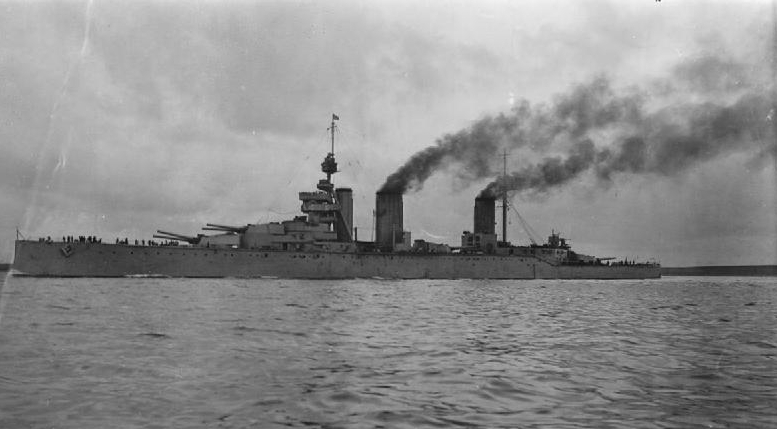
HMS Lion, lead ship of the Lion-class of Royal Navy battlecruisers.
Photo from the Imperial War Museum, via Wikimedia Commons.
- English ship Lion (1511) was a 36-gun ship of the Royal Scottish Navy captured in 1511 and sold in 1513.
- English ship Lion (1536) was a 50-gun ship built in 1536 and on the navy list until 1559.
- English ship Lion (1547) was a Scottish ship captured in 1547 and later lost off Harwich.
- English ship Lion (1557) was a 40-gun ship, also known as Golden Lion. She was rebuilt four times, in 1582, 1609, 1640 and 1658. After her 1609 rebuild she was renamed Red Lion, but this was reverted to Lion after the 1640 rebuild. She was sold in 1698.
Modern naval ships are considered long-in-the-tooth after 25-30 years of service. HMS Lion (the HMS was not consistently applied to royal ships until the eighteenth century, but let’s just let that slide here) of 1557 was only undergoing her first rebuild/life extension at the point a modern ship would already be under consideration for dismantling. She was still in royal service for three more rebuildings, and was sold (not scrapped) after 141 years of active service. But the Royal Navy was far from done with using this name:
- HMS Lion (1665) was a 6-gun ketch, also known as Young Lion. She was captured from the Dutch in 1665, sold in 1667, repurchased in 1668 and sunk as a foundation at Sheerness in 1673.
- HMS Lion (1683) was a fifth rate captured from the Algerians in 1683 and sold the same year.
- HMS Lion (1702) was a 4-gun stores hoy of 99 tons burthen purchased in 1702. A French privateer captured her off Beachy Head in 1708, but she was recaptured in 1709.[1]
- HMS Lion (1709 hoy) was a 4-gun hoy launched in 1709. She was wrecked in 1752.[2]
- HMS Lion (1709) was a 60-gun third rate launched in 1709, rebuilt in 1738 and sold in 1765.
Another longer-service veteran than the vast majority of modern naval ships.
- HMS Lion (1753) was a transport launched in 1753, hulked in 1775, and sold in 1786.
- HMS Lion (1763) was a cutter purchased in 1763 and sold in 1771.
- HMS Lion (1774) was a discovery vessel in service from 1774 to 1785.
- HMS Lion (1777) was a 64-gun third rate launched in 1777. She was used as a sheer hulk from 1816 and was sold for breaking up in 1837.
One assumes the name was changed before 1781, even though the hull was still in use for long after other ships named HMS Lion were respectively in commission and then out of service with the Royal Navy:
- HMS Lion (1781) was a schooner purchased around 1781 and sold in 1785.
- HMS Lion (1794) was a 4-gun vessel, originally a Dutch hoy. She was purchased in 1794 and sold in 1795.
- HMS Lion (1823) was a schooner in service from 1823 and sold in 1826.
- HMS Lion (1847) was an 80-gun second rate launched in 1847. She was converted to screw propulsion in 1859 and became a training ship after 1871. She was sold for breaking up in 1905.
- HMS Lion (1910) was a Lion-class battlecruiser launched in 1910 and sold in 1924.
- HMS Lion (1939) was to have been a Lion-class battleship. She was laid down in 1939, but work was suspended later that year, and again in 1942. The order was finally cancelled in 1945 and she was broken up on the slipway.
- HMS Lion (C34) was a Tiger-class cruiser launched in 1944 as the Minotaur-class HMS Defence. She was finally completed to a revised design in 1960. She was placed in reserve in 1964 and was scrapped in 1975.
Comments Off on The oddly variable careers of Royal Navy ships named HMS Lion
June 20, 2018
Tank Chats #31 Mark IX | The Tank Museum
The Tank Museum
Published on 3 Feb 2017The thirty first in a series of short films about some of the vehicles in our collection, presented by The Tank Museum’s historian David Fletcher MBE. The First World War Mark IX, the first armoured personnel carrier, was designed to solve the problem of moving infantry across the battlefield with the fighting tanks.
Comments Off on Tank Chats #31 Mark IX | The Tank Museum
June 17, 2018
Blackmailing the Bishop – Blackadder – BBC
BBC Comedy Greats
Published on 11 Jan 2010The baby-eating Bishop of Bath and Wells comes to collect a debt, but finds himself the victim of a fiendish plot.
Comments Off on Blackmailing the Bishop – Blackadder – BBC
June 15, 2018
QotD: Churchill on Montgomery
There was a brief firestorm in Britain when a photograph appeared in the press of Montgomery and Gen. Wilhelm Ritter von Thoma, the commander of the Afrika Korps and the highest-ranking German captured at Alamein. After his capture Thoma was brought to the Eighth Army command post, where Montgomery accorded him the respect of one honorable professional soldier to another. The two dined that night, and the photograph of the two generals led Brendan Bracken to send Churchill a memo criticizing Montgomery’s naïveté and noting that it created a bad impression with the public. Churchill merely commented: “I sympathize with Gen. von Thoma. Defeated, humiliated, in captivity, and,” after pausing for effect, “dinner with General Montgomery.”
Carlo d’Este, Warlord: A life of Winston Churchill at war, 1874-1945, 2008.
Comments Off on QotD: Churchill on Montgomery
June 10, 2018
The Landings At Cape Helles 1915 I THE GREAT WAR On The Road
The Great War
Published on 9 Jun 2018Thank you to Mr Ali Serim for making this trip possible.
Indy and our guide Can Balcioglu explore the southern tip of Gallipoli where the British Army landed in April 1915.
Comments Off on The Landings At Cape Helles 1915 I THE GREAT WAR On The Road


