
Ontario Regiment Museum
Published Mar 14, 2024First look at the newest addition to the museum collection: LAV III RWS (Remote Weapon System variant) aka NANUK.
This Canadian designed and built military vehicle just arrived at the museum. Executive Director Jeremy Neal Blowers (aka @Tank_Museum_Guy) gives a very quick talk on the vehicle and a comparison with the original LAV III in the museum.
(more…)
June 27, 2024
LAV III RWS NANUK – A Closer Look
Comments Off on LAV III RWS NANUK – A Closer Look
June 26, 2024
The Toronto-St. Paul’s by-election, part two
Continuing on from yesterday’s initial post on the outcome of the by-election in Toronto-St. Paul’s — which until 4:30 on Tuesday morning might have been the dictionary definition of a “safe Liberal seat” — as comments from vengeful anti-Liberal and whistling-past-the-graveyard pro-Liberal commentators appear. Here’s noted anti-Liberal David Warren from Parkdale which more often elects NDP candidates over Liberal ones:
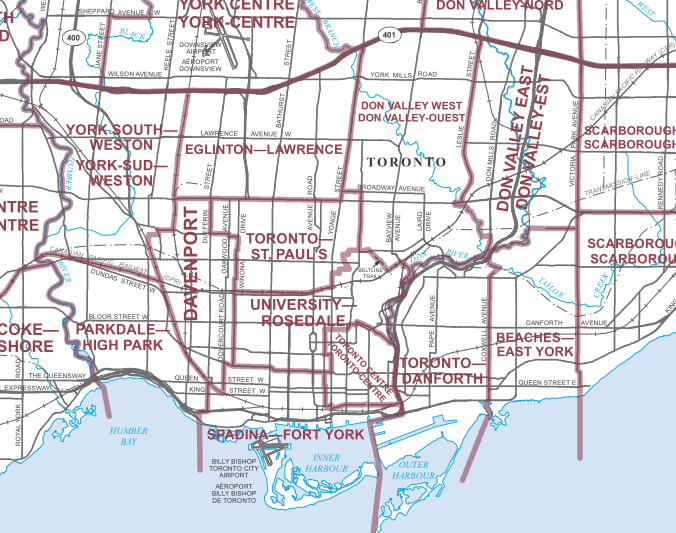
The electoral boundaries of Toronto-St. Paul’s and nearby downtown Toronto ridings.
Detail of an Elections Canada map of Toronto.
Toronto-Saint Paul’s is defined, among the political experts, as a “safe Liberal seat”. For one thing, it is in the middle of Toronto, where the Conservatives have no members. (The NDP occasionally wins ridings like Parkdale.) According to a pollster, who is (in my opinion) a Liberal party hack, if the Liberals were to lose Saint Paul’s, it would mean that there were no safe seats left for them in Canada. None is the same as zero, incidentally.
Late last night, we learned that the Liberals had lost Saint Paul’s.
It was just a by-election, however. Toronto’s electorate enjoys the kind of deep somnolence that is not permanently correctible. Its people are typical of urban voters everywhere: they are easily convinced by “progressive” fantasists, and environ-mental snake-oil salesmen. Hence, liberal-lefties control all the big-city municipal governments, and provide marionettes to all the national puppet theatres. Those who voted against them will return to snoring mode after just a moment’s consciousness.
At The Line, a rare Jen Gerson column outside the paywall:
The goose. She cooked.
The toast. It burnt.
The frog. It boiled.
[…]
Anyway, my lack of political dedication was well rewarded because I’m now refreshed and well positioned to opine on the great momentous meaning of Don Stewart’s election to the House of Commons to represent the fine people of this section of midtown Toronto. Normally I wouldn’t get too fussed over a by-election anywhere, but in this case a fuss is impossible to avoid.
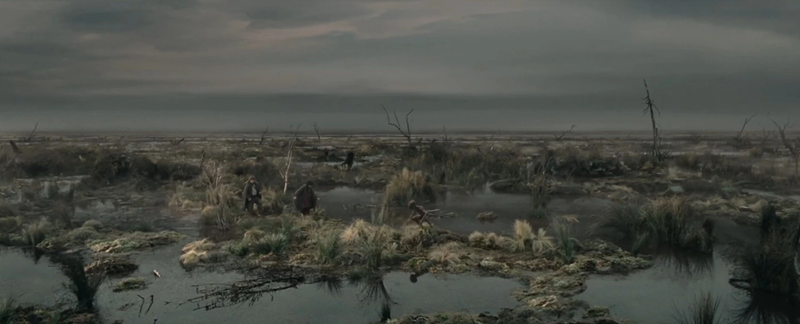
Two reasons; the first is that I have — in my lovingly Albertan way — referred to this riding as the Dead Marshes. For those who are not Lord of The Rings fans, this section of land is technically considered a reeking wetland that stretches to the south-east of Emyn Muil; a terrible stretch of land that sits just outside Mordor, and final home to the preserved corpses of many Conservative candidates, staffers, volunteers, and hopes and dreams. Every once in a while, their enchanting methane soul lights flare forth, entrancing the unwary or the naïve into the swamp.
Which is a very nice way of saying that St. Paul’s is a bastion of the ruling Laurentian Consensus, a Liberal fortress long held by Carolyn Bennett, and untainted by the stain of Conservative voting intentions since 1993. And yet, Mr. Stewart ventured forth undaunted, and found his path into Mordor (a metaphorical stand in for either Toronto, or Parliament. Interpret as you see fit).
The second reason that this election cannot be ignored is that both the Liberals and the Conservatives have invested it with so much symbolic weight, that the outcome will herald political changes of one kind or another. A 43 per cent turnout rate in a by-election is healthy — even high. Nobody can chalk that outcome up to numerical wonkery. Conservatives were motivated, and progressives were not. The signal is clear.
It is now impossible for an increasingly unglued Liberal caucus to overlook that they are losing. They are losing very badly. A sustained 20-point Conservative lead has been made manifest. If St. Paul’s can crash, they are all at risk. And they can no longer wave that fact away by sniping at pollsters, or blaming misinformation. A plurality of Canadians think they suck at governmenting. This must now be addressed.
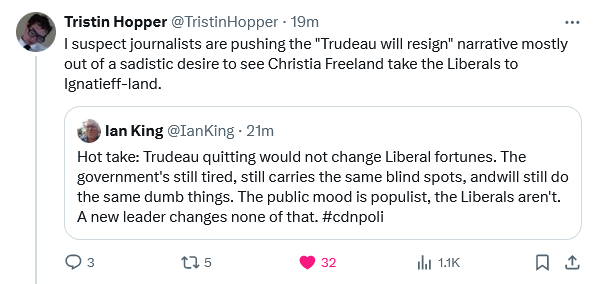
Tristin Hopper on the social media site formerly known as Twitter:
June 25, 2024
The Toronto-St. Paul’s by-election
Paul Wells uncharacteristically posted his initial reaction to the Toronto-St. Paul’s by-election after the polls closed, but before the counting was over. He chose … poorly:
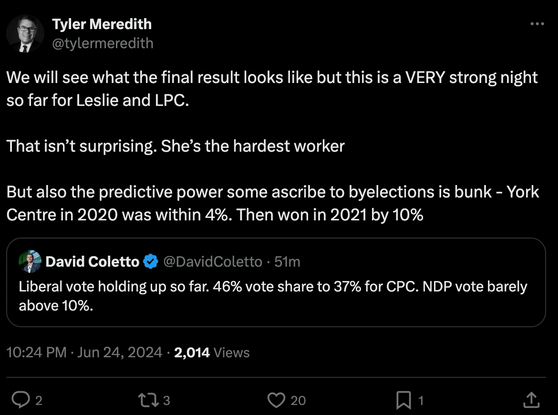
[Liberal candidate Leslie] Church’s margin of victory over Conservative candidate Don Stewart bounced around 10 points all Monday night. As I get ready to hit Send on this post, it’s closer to 6 points, and I have no way of knowing whether it will shrink or expand as more results come in. But if it were 10 points, that would be 9.9-ish points more than you need for a victory. I’m especially pleased to report that the result constitutes yet another glorious victory for Wells’s First Rule, which holds that for any given situation, Canadian politics will tend toward the least exciting possible outcome. In particular, in the last several days, I’ve been telling friends that this would be a particularly solid Wells’s Rule victory if the night ended with Tyler Meredith boasting on X. Et voilà:
If you slice the returns finely enough, pace Tyler, they might yield more omens and portents. Ten points would be the Liberals’ narrowest margin in TSP (as I’ll call the riding for short) since 2011, and the second-lowest in 31 years. In 2008, when the Liberals under Stéphane Dion were reduced to 77 seats out of 308, the Liberal margin of victory was more than twice what it was in Monday’s by-election. A 10-point margin of victory in TSP is what Liberals get when there’s almost no water left in the pool.
But so what. A win’s a win. By-elections are a blunt measuring tool. Paying subscribers will fill this post’s comment board with theories to explain away the night’s results, and for all I know, some of them might even be correct. Besides, for a few weeks I’ve believed that even if the Liberals had managed to lose TSP, there would have been no public or organized effort within the party to remove Justin Trudeau as leader. You can’t teach an elephant to dance, or a Trudeau Liberal to abandon the internal loyalty that has been one of the hallmarks of his leadership.
So if I’m a Liberal MP — humour me, it’s a thought experiment — I now know what the next year looks like. Justin Trudeau has spent his adult life waiting for the rest of us to realize he was right all along, as we saw in a book that was published last month to extravagant praise. The returns from Toronto will comfort the big guy’s belief that the scales have again begun to fall from Canadians’ eyes, and that therefore this is absolutely the worst time to mess with a winning formula.
He’ll stay. Katie will stay, Ben will stay, Chrystia will stay, Mélanie and Seamus and Max and Clow and all the cats will stay, and the Trudeau team will show new spring in its step as it prepares to get, once more, off the ropes and back into the fray.
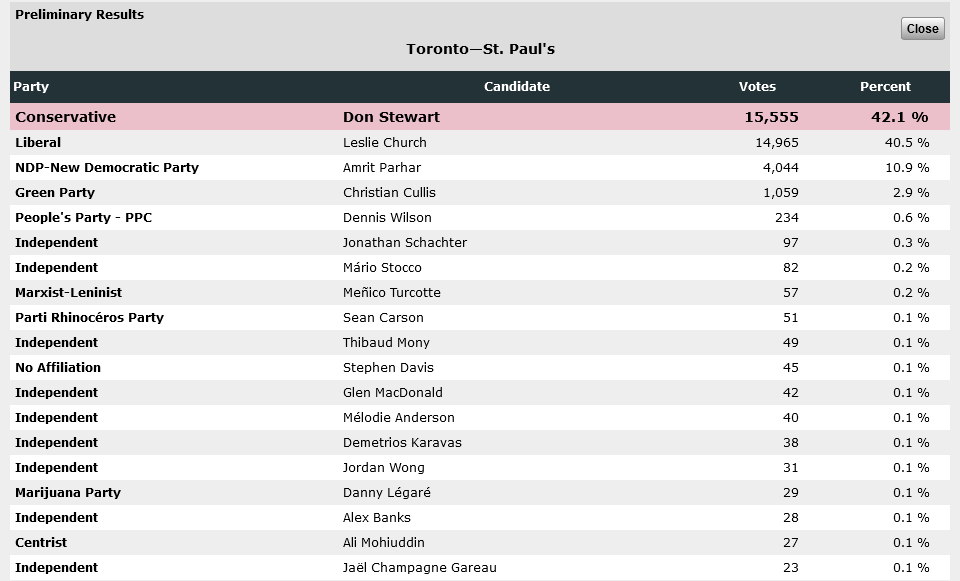
To be fair, he did add an update overnight indicating that Stewart had pulled ahead but the counting was still ongoing, and a link to the Elections Canada preliminary results, which I screencapped here just after 9am:
This morning, Mr. Wells posted a follow-up to yesterday’s ever-so-slightly misleading article:
Well, of course I saw it coming all along. What kind of fool could have imagined the Liberal in Toronto — St. Paul’s had any chance?
Hang on. I’m just getting word that I didn’t see it coming. In fact, as recently as Monday night I wrote a post I’ll be hearing about until the cows come home. Sorry about that!
Here are the actual final results, barring any recounts, which may not happen because Conservative Don Stewart’s margin of victory, while slim, is too large to trigger an automatic recount.
Congratulations, Don Stewart! I never doubted you’d win. Hang on. I’m just getting word that I doubted you’d win as recently as last night.
Things will now start to happen quickly. Expect Liberals to work their way through four of the five Kübler-Ross stages of grief before lunch. Denial will come easily, benefiting as it does from long practice. Acceptance may take longer.
In part this is because on paper there isn’t that much to accept. The day’s news is not earth-shaking and, in isolation, should not be taken as definitive. It’s true that by-elections are strange events, though if you add them together they do have some predictive power. It’s true that Leslie Church’s long service as Chrystia Freeland’s chief of staff turned out to be more of a hindrance than a help, a data point whose implications the Deputy Prime Minister won’t want to think much about today. It’s true the Liberals didn’t even try all that hard, if by “didn’t try all that hard” you mean “they tried as hard as they possibly could, my God they tried so hard, my God.”
But a single off-season defeat in a riding the Liberals have, in fact, previously lost during the Paleozoic era is not a larger thing to accept than, say, a punishing loss to Ireland and Norway in a Security Council vote at the UN. Or the loss of two senior cabinet ministers in a controversy in which the ministers who quit were radiantly, obviously in the right. Don’t take my word on that, incidentally: ask David Lametti, who agreed with Jody Wilson-Raybould but managed to keep his job anyway. For a while.
I imagine there’ll be a lot of interesting commentary from other Canadian sources as the day rolls on and the immediate horror starts to recede…
Comments Off on The Toronto-St. Paul’s by-election
June 24, 2024
June 20, 2024
Canadian Armed Forces – Snow Machines
Ontario Regiment Museum
Published Mar 7, 2024During the TANK SATURDAY — Winter Warfare event in 2024, we had special guests from the Hussars Military Vehicle Club. They brought their fully restored CAF Arctic equipment to the museum and spoke to our visitors about the history and use of these unique vehicles.
(more…)
Comments Off on Canadian Armed Forces – Snow Machines
QotD: Canadian soldiers of the 1950s and early 1960s
In the field in summer, [Canadian] soldiers wore bush clothes, which were adequate enough, though multi-hued depending on how often they had been washed. There were no winter field uniforms, and soldiers wore U.S. Army field jackets. On exercises, black coveralls were the usual dress, the sloppiest uniform in any army at the time. Until the army introduced combat clothing in the mid-1960s, Canadian soldiers looked as though they had been kitted out by a second-hand clothing store.
J.L. Granatstein, Canada’s Army, 2002.
Comments Off on QotD: Canadian soldiers of the 1950s and early 1960s
June 19, 2024
Toronto “atones for slavery” by renaming Yonge-Dundas Square. They chose … poorly.
In the never-ending quest for moral superiority, the City of Toronto decided to rename a downtown landmark — Yonge-Dundas Square — after allegations were made that British Home Secretary Henry Dundas was against the abolition of slavery in the 1790s. (In fact, it was partly his efforts to mediate between the abolitionists and their opponents that actually got the first anti-slavery bill through Parliament, but who cares about his actual work when we can issue blanket condemnations hundreds of years later?)
In a twist worthy of the Babylon Bee, it turns out that the new and improved name proposed has a much more direct connection with slavery:
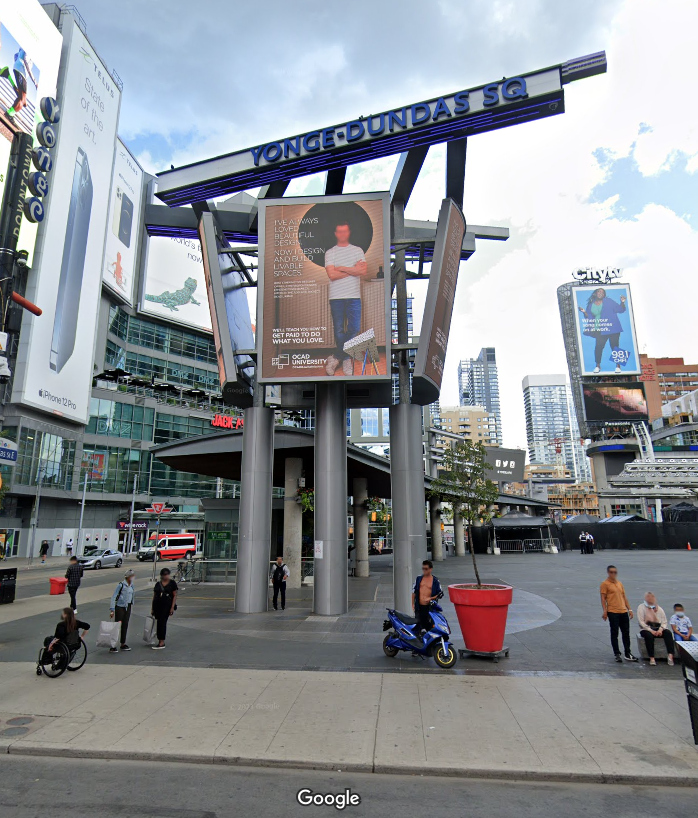
The Yonge-Dundas Square sign on the southeast corner of the intersection in downtown Toronto.
Detail of an image from Google Street View.
There is a lot wrong both with the name that Toronto city council chose to replace Yonge-Dundas Square and the burden that the name change will place on taxpayers.
Originally budgeted at $335,000, the new estimate is $860,000 — and who is to say it won’t go higher? That would be a lot of money even for a desirable name, but the name the city chose, Sankofa Square, is problematic.
The term is Ghanaian and means “learning from the past.” But while it is intended to replace the name of Henry Dundas, who some blame for delaying the abolition of slavery in the British Empire, the term “Sankofa” has its own connection to the slave trade.
Slavery was rife throughout Africa, and much of the world, for centuries past, but Ghana’s version included the execution of the slaves of chiefs who died, so that they could serve him in the afterlife. […]
The basic fact, ignored by Toronto’s mayor and city councillors, is that the Gold Coast, the earlier name for Ghana, was a notorious slave society. Leading Ghanaians were prominent in the slave trade and were themselves slave owners. For years after slavery was abolished elsewhere, they fought its abolition in Ghana. It wasn’t until 1874 that the slave trade in Ghana was abolished — nearly a century after Britain.
Compare Ghana’s record with that of Ontario, where a process of gradual abolition was started in 1793, 81 years before Ghana. That, notably, was thanks to the efforts of Upper Canada’s first lieutenant governor, John Graves Simcoe, an appointee of Henry Dundas, no less.
So Dundas was not only instrumental in getting slavery abolished in Scotland, acting as a lawyer in the appeal of a case dealing with a runaway slave, he also sent a dedicated abolitionist to Upper Canada to take the top post. He deserves a better square than Yonge-Dundas!
Comments Off on Toronto “atones for slavery” by renaming Yonge-Dundas Square. They chose … poorly.
QotD: Canada’s Liberal Party
Honestly, now, if you moved this metaphor any closer to the bathroom, there’d be no room for anybody to sit down. What have we come to when the communications director for the prime minister of Canada comes within an ace of referring to his own party as a filthy toilet in need of some elbow grease?
Colby Cosh, ColbyCosh.com, 2005-04-09.
Comments Off on QotD: Canada’s Liberal Party
June 18, 2024
Freddie deBoer contra J.J. McCullough on Conspiracy Theories
I saw JJ’s latest video pop up on my YouTube subscriptions page, read the headline and winced slightly. I generally like JJ’s videos even when I disagree with his presentation or interpretation and from the title, I thought “No, ‘many conspiracy theories’ did NOT ‘turn out to be true'” would require a fair bit of, uh, curation of the theories that get discussed. Freddie deBoer — who I disagree with much more than I do with McCullough — had a similar reaction:
The latest video from conservative Canadian YouTuber JJ McCullough displays many of the attributes that make his perspective unique — he’s genuinely a right-wing figure but an arch institutionalist, a gay Millennial with the kind of vague social libertinism common to a lot of libertarian-leaning conservatives but something of a scold, a Canadian patriot who relentlessly defends the United States from the kinds of criticism of Americanah that you might associate with Europe or, well, Canada — critiques of our provincialism, our consumerism, our boorish tendency to shove the rest of the world around. McCullough likes all of that stuff, more or less, while living a cosmopolitan and vaguely-arty lifestyle in groovy Vancouver. He’s perhaps best known for his war with Montreal, Francophone Canadians, and the entire province of Quebec, which fits his general esteem for a certain kind of capital-R Reasonable Anglophilia.
He reminds me, strangely, of a certain kind of secular anti-atheist, the type who still gets mad about the New Atheists despite the complete collapse of that subculture and whose own lack of belief doesn’t prevent them from waxing poetic about the glories of religion. I have a friend from grad school who grew up in an extremely repressive Christian community when she was young, and who describes leaving as an “escape”. (The kind of community where she and her sisters wore wrist-to-ankle dresses every day of their lives no matter the Oklahoma heat, weren’t allowed TV or radio, absorbed lots of corporal punishment, that sort of thing.) She has very, very little patience for people who are so annoyed by internet atheists that they become in effect advocates for religion; as she says, this kind of vague fondness for religion among the irreligious could only occur to someone who never had to live the way she did. I sort of see the same thing in McCullough — he idealizes certain aspects of America’s ethos because he has never had to live with the consequences of being surrounded by people who believe in it, who consciously or unconsciously demand that everyone else believe in it.
Anyhow, this new video is about conspiracy theories. Conspiracy theories are a good topic for understanding McCullough’s very particular ideological makeup. Conspiracy theories are famously a cross-ideological phenomenon, with both left conspiracy theories and right conspiracy theories but also conspiracy theories that don’t fit neatly into either, like 9/11 trutherism. As I said, McCullough is an institutionalist, a small-but-good government sort of guy (or so I take it) who places a great deal of value in official claims, institutions, and experts, and so he’s naturally distrustful of conspiracy theories. And he demonstrates that antipathy in this video through poking holes in a few clickbaity articles listing conspiracy theories that turned out to be true. This all amounts to feasting on a banquet of low-hanging fruit, but it’s not an illegitimate way to approach the question. I just don’t like his conclusions.
The key to McCullough’s bit here is that he doesn’t dispute that the named conspiracy theories (or “conspiracy theories”) that are asserted to be true are true. Rather, he operates by insisting that every identified conspiracy theory is in fact not a conspiracy theory according to his preferred definition. It’s not sufficient for a conspiracy theory to be broadly thought of as a conspiracy theory; it has to comport to specific rules he has devised for what a conspiracy theory entails. Effectively, that means that a conspiracy theory is only a conspiracy theory if it satisfies criteria endorsed by no one but JJ McCullough. I can’t decide if this is an isolated demand for rigor or a No True Scotsman, but either way, McCullough is here insisting on an unusually stringent definition of a conspiracy theory for the purpose of dismissing the idea that any conspiracy theories are true. And there’s a version of this that isn’t entirely wrong; there’s a tautological sense in which all conspiracy theories are false because being false is part of that definition of a conspiracy theory. But McCullough isn’t using that definition, just a particularly odd one that makes his task easier.
So the fact that cigarette manufacturers knew that cigarettes were very bad for your health but conspired to hide this fact from the public is not a conspiracy theory, according to McCullough, because other people of that era suspected that cigarettes caused lung cancer. (Actually proving that took a very long time, at least according to modern standards of causality.) I find this argument powerfully strange! You had a group of powerful people, they indisputably knew that cigarettes were very bad for your health, they indisputably conspired to suppress that information, they were fairly effective at that task. The fact that some early whistleblowers tried to raise the alarm is simply irrelevant. Check out my own proprietary formula.
Group of Powerful or Influential People + Nefarious Intent + Secrecy + Active Conspiring + Negative Consequences, Real or Potential = Conspiracy TheoryThat’s a conspiracy, brother, and the tobacco company bad behavior fits. Long before information about their coverups became public knowledge, people were talking about the possibility that the tobacco companies were up to that exact bad behavior. Theorizing, you might say.
Comments Off on Freddie deBoer contra J.J. McCullough on Conspiracy Theories
June 17, 2024
For want of a security clearance, the (potential) traitors escaped scot-free
In the free-to-cheapskates section of this week’s Dispatch from The Line, we get a summary of the state of brain-freeze in Parliament over the NSICOP (National Security and Intelligence Committee of Parliamentarians) report, that in a functioning state would have triggered much more action than it has in the dysfunctional Dominion:
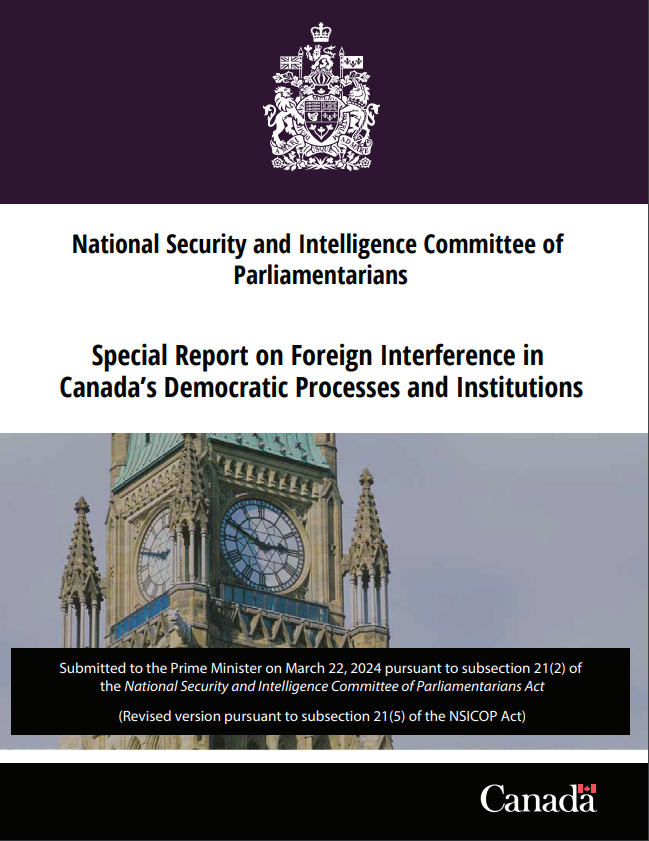
The cover of the NSICOP special report on foreign interference (PDF – https://nsicop-cpsnr.ca/reports/rp-2024-06-03/special-report-foreign-interference.pdf )
The lead story this week, clearly, was the continuing fallout from the NSICOP report last week. Because of this report, even though there is much that we do not know, there are absolutely some things that are clearly established. Let’s run through some of the key points that are uncontested and draw some very modest and safe conclusions from them.
Here are facts.
- There are multiple parliamentarians, meaning members of the House of Commons and the Senate, who have been deemed by eight of their colleagues to be engaged in activities with hostile foreign powers on either a witting or semi-witting basis.
- The prime minister and the PMO have been aware of who these individuals are for at least a month, if not longer. That is when NSICOP filed its unredacted report to them for review, as required.
The above facts are unchallenged. Now let’s draw a few conclusions.
The phrasing of the NSICOP report, as well as both Elizabeth May’s and Jagmeet Singh’s press conferences this week, led us to believe some of these individuals are still sitting in both the House of Commons and the Senate. We acknowledge that Elizabeth May and Jagmeet Singh differ considerably on the severity of what these individuals are alleged to have done, but both seem to agree that the relevant parties, in at least some cases, remain in Parliament.
The prime minister, as the person responsible for the administrative and legal apparatus of government, could call the Clerk of the Privy Council, the Director of CSIS, the minister of public safety and others as necessary into his office today, and inform them that he would be making the names public, and that it would be the responsibility of those individuals to figure out how that could be accomplished while protecting intelligence sources and methods. At this time, there is no indication that he has done so, or has any interest in doing so.
So we got the grotesque theatre that was the House of Commons this week. The government has spent the last week and change challenging various opposition leaders to obtain security clearances so that they could view information that the prime minister has had for at least a month, and perhaps longer, even though both the Security of Information Act and the National Security and Intelligence Committee of Parliamentarians Act (depending on the auspices under which their security clearances were issued) prevents them from disclosing what they read.
And, therefore, doing anything about it. Because to remove a caucus member would be to reveal it, and if a leader has no caucus members that are implicated, there is no urgency to their reading the report.
Protecting the national security of Canada, and the democratic institution of parliament itself, is the prime minister’s job before it is anyone else’s. And the prime minister has had this information for at least a month.
It’s worth repeating that because we want you to envision something. Imagine there are three U.S. Senators accused of aiding and abetting a foreign power, and Joe Biden knew about it for a month.
When do you think impeachment proceedings would start?
Boris Johnson was unceremoniously dumped by his party for lying about throwing a party during COVID lockdowns (and we have no problem with that). Our prime minister has known that there are people currently sitting in parliament that have turned themselves into intelligence assets for hostile foreign powers for a month, and …
… the government would like you to know that it thinks Pierre Poilievre should get a security clearance so that he can read the documents.
We think Poilievre should, too. Because here’s the thing. The Security of Information Act says right there in Section 24 “No prosecution shall be commenced for an offence against this Act without the consent of the Attorney General”.
That reads to us like so: Pierre Poilievre can read those documents, release the names, and then dare Justin Trudeau to prosecute him. Indeed, anyone with the names could.
Your Line editors have raised this before on the podcast, but it bears repeating. Canada’s international reputation has taken a lot of hits lately. So imagine if you would, gentle reader, a situation where Justin Trudeau’s Attorney General signs off on having his political opponent arrested for revealing that hostile foreign powers have coerced sitting MPs into becoming intelligence assets … especially if one or more of those MPs is revealed to be a Liberal.
That’s a front page international news story. We’d look like a banana republic. Our international reputation would take decades to recover.
Spoiler: we already do look like a banana republic and our international reputation is lower than it has ever been. Trudeau isn’t a dummy: he figures that our reputation literally can’t get much worse no matter what he does, so he’s choosing to protect … someone … and what’s Poilievre going to do? He proved during the lockdowns that he’s not willing to get arrested on a matter of principle (unlike Maxime Bernier), so he’s likely to just posture endlessly until something new pops up in the silly season news rotation.
Comments Off on For want of a security clearance, the (potential) traitors escaped scot-free
Inside the deputy PM’s thoughts
In the National Post, Tristin Hopper imagines what Deputy Prime Minister Chrystia Freeland might be thinking as she pushes her capital gains tax increase:
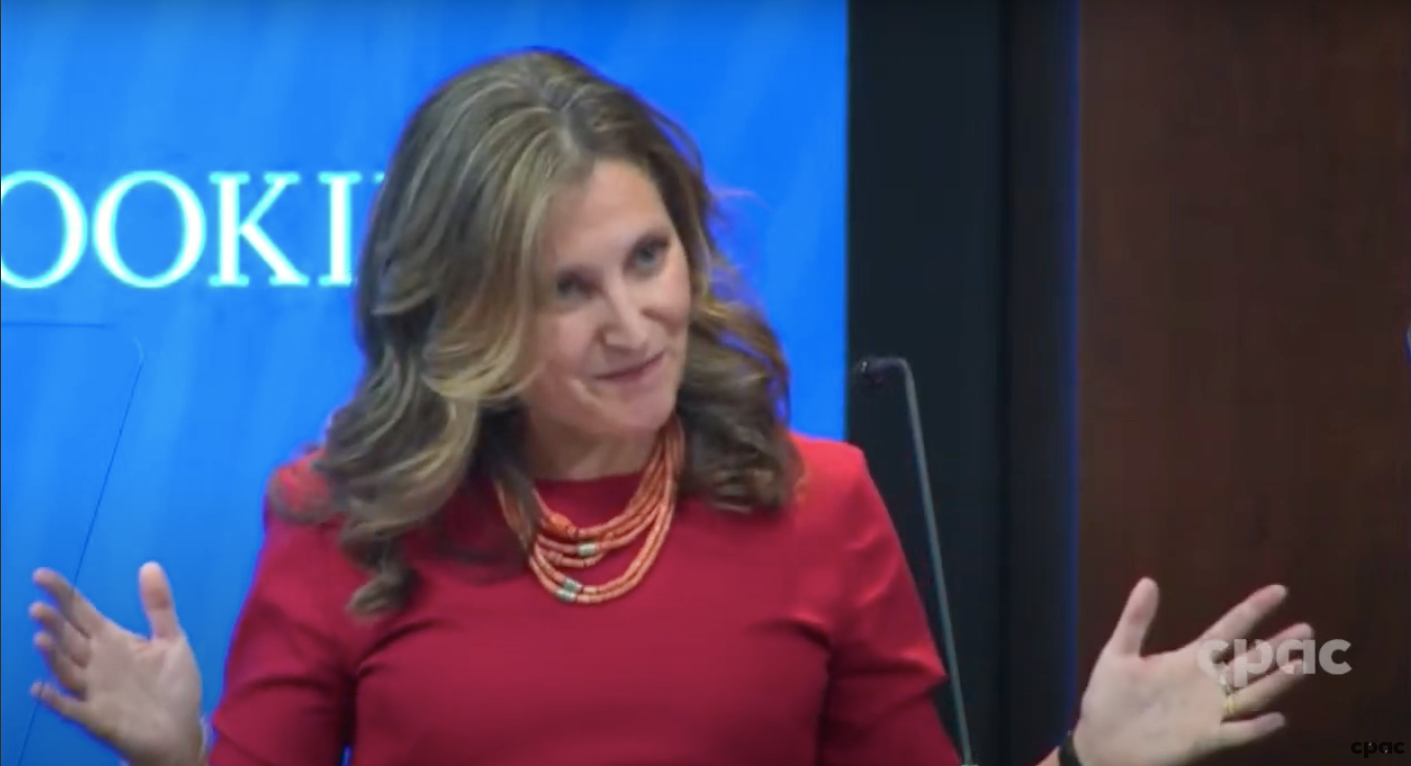
Screencap from a CPAC video of Chrystia Freeland speaking in October, 2022.
On Monday, Deputy Prime Minister Chrystia Freeland defended her government’s raising of the capital gains tax by delivering a weirdly catastrophic lecture speaking of a Canada beset by poverty, division and angry mobs.
“Do you want to be in a country where those at the very top live lives of luxury but must do so in gated communities behind ever higher fences using private health care and airplanes because the public sphere is so degraded and the wrath of the vast majority of their less privileged compatriots burns so hot?” she said.
[…]
Monday
Rivers of blood. Mothers consuming their offspring. Houses of worship employed only as makeshift storehouses for the dead.Abundance will cease. Colour will vanish. The people you now know as loved ones will first become strangers, and then they will become enemies.
These are but some of the fates that realistically lie in store for a Canada that refuses to raise its capital tax inclusion rate from 50 per cent to 67 per cent on gains realized after June 25, 2024. While I am sympathetic to those who have worked hard and wish to retain what they have earned, I would urge them to consider the value of money in a Canada where the only remaining currency is one’s readiness to kill.
Tuesday
As deputy prime minister of Canada, I am fully aware that carbon taxes are an electoral liability for this government. But this is a problem not of policy, but of messaging.If we’re not able to tax carbon-emitting fuels to a rate of $170 per tonne by 2030, the most optimistic scenario I can offer is the complete breakdown of the natural world as we know it.
Agriculture will become a memory. Cities will become unapproachable due to the overwhelming smell of decay. Language will devolve and then disappear. Any surviving art or culture will only inspire fear, because people will not know what it is.
The air may be breathable, but we will wish it was not.
Comments Off on Inside the deputy PM’s thoughts
June 16, 2024
“What the hell is going on in Canada?”
If you’re not Canadian or have any Canadian friends, you may not understand just how badly broken the country is — and the federal government is still desperately pretending that we’re all onboard with the Net Zero/Carbon Tax/”you’ll own nothing” bullshit and piling on the long-term debt:
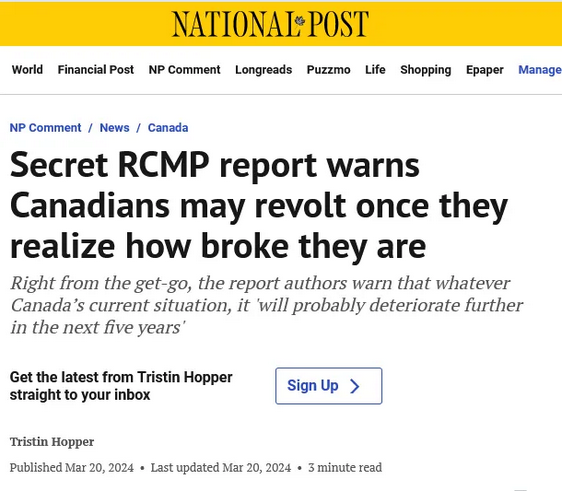
One of Canada’s intelligence agencies, a couple of months ago, sent a memo to the Liberal federal government informing them that, in the near-future years to come, they are worried about revolutionary activity. I believe Canada is a good case study because it seems the country has been a sociological testing ground for the powers that be to see what happens. Canada is a surreal twilight zone where it feels like every psyop known to man is hurled its way. Canada unquestionably has the worst demographic and immigration issues, the worst housing issues, the worst social stability, and upwards mobility issues, all adjusted and proportional to its population and size, of course. For our purposes, I believe Canada serves as the worst-case scenario of how bad the dating market can be, and how bad it will continue to get.
Canada has some of the lowest upward social mobility among developed nations, especially for young people, particularly within the OECD and G8. This means that young people in Canada find it relatively difficult to move up the economic ladder compared to their parents.
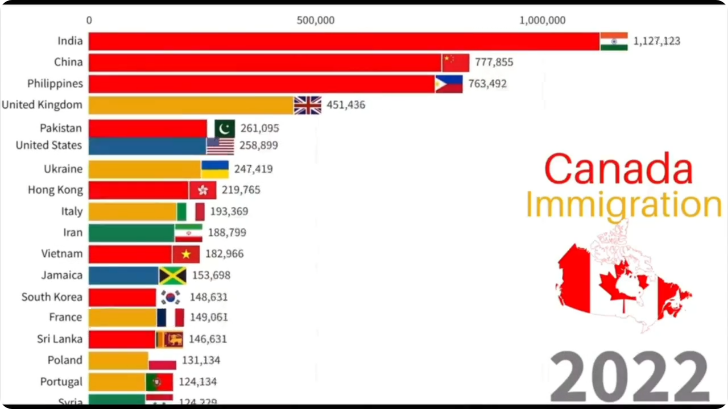
In 2022, Canada’s population growth was significantly driven by immigration. According to Statistics Canada, approximately 95% of the population growth in that year was attributed to immigration. This includes both permanent and temporary residents, with a notable influx of international students, temporary workers, and permanent residents. Only a meagre 5% of Canada’s population growth, including recent immigrants, was from organic growth and childbirth. Below are the national origins of immigrants over the last twenty-four years. The combined total number of people entering Canada per year, including international students, temporary foreign workers, legal immigrants, and refugee claimants, is approximately 1,133,770 individuals officially. In reality, the government over the last four years has lost count.
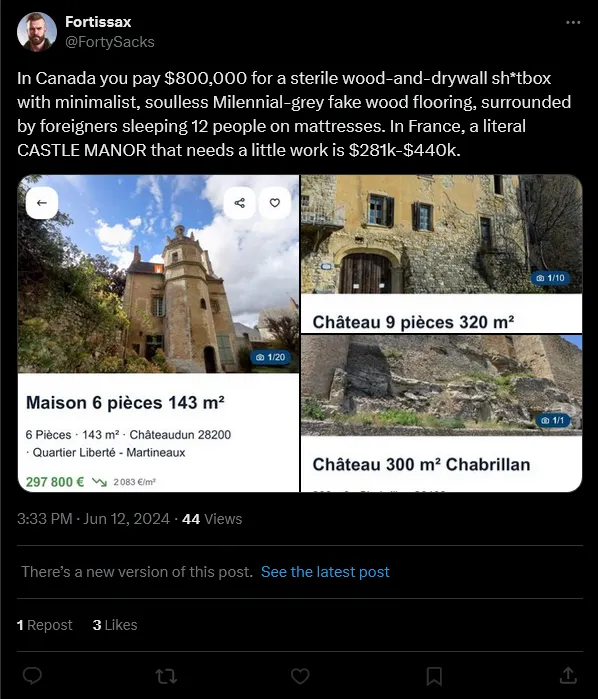
As of April 2024, the average home price in Canada is approximately CAD $703,446. This is €477,121.93 and USD $511,466.93. Would you like to see what $703k CAD can get you in France? Hint: a lot more than in Canada.
This has been noticed so much by Canadians that it is now a meme, with Conservative Party and opposition leader Pierre Poilievre pointing it out in the House of Commons. You can compare the price of homes and the cost of living with Canadian wages. You can also compare how far those meagre wages would go in other first-world countries like France, Germany, or Sweden. The answer is much farther. Much, much farther. There is currently no hope, short of radical action by the government unheard of in Canadian history, for this situation to be rectified. The only other option is best left unsaid.
“Educated” Women Lead
In Canada, among ethnic Canadians, a significant portion of the female population is more educated and makes more money than Canadian men. Canadian men make, on average, CAD $48,500, while women make CAD $42,000. However, only 56% of men have post-secondary education, while 68% of women do. Men have completed higher levels of high school, and women have completed higher levels of college or university. This has led to a massive gap in socioeconomic status between men and women. It gets worse when you include non-ethnic Canadians. Completed levels of post-secondary education for men remain at 56%, while women’s rise to 73%.
We know that in our post-industrial world, resources translate to money. Money and completed levels of education translate to status. Women are 50% more likely to divorce men when they make more money. When women are already the initiators of divorce 70% of the time, it starts looking pretty ugly, fast.
Comments Off on “What the hell is going on in Canada?”
June 14, 2024
When propaganda wins over historical facts, Ontario public schools edition
To someone of my generation (late boomer/early GenX), the history of the Residential School system was taught, at least superficially, in middle school. Along with the early settlement of what is now Canada by the French and later the English (with a very brief nod to the Vikings, of course), we got a cursory introduction to the relationships among the European settlers and explorers and the various First Nations groups they encountered. It wasn’t in great depth — what is taught in great depth in middle school? — but we got a rough outline. In my case, details about the Residential School system came more from a “young adult” novel about a young First Nations student running away from his school and trying to find his way back to his home and family. My best friend in school had First Nations ancestry, so I felt a strong desire to understand the book and the system and culture portrayed in it.
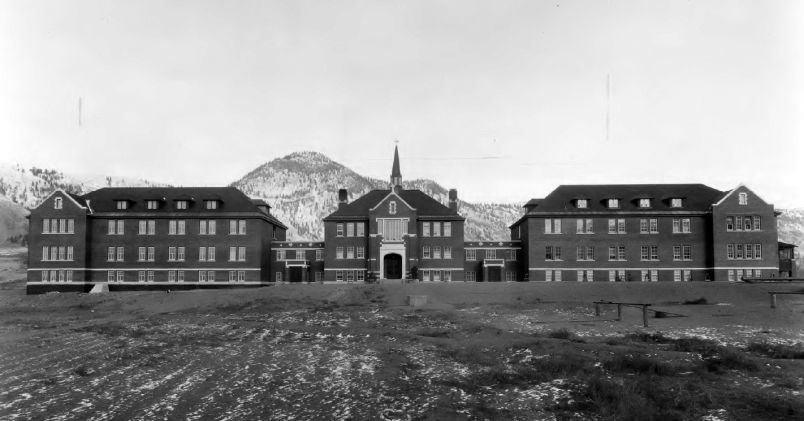
Kamloops Indian Residential School, 1930.
Photo from Archives Deschâtelets-NDC, Richelieu via Wikimedia Commons.
If, in the early 1970s, the Ontario school system taught at least a bit about the history of the First Nations peoples, how is it possible that they stopped doing so and my son’s generation were utterly blindsided by the sensationalist treatment of the students at a particular Residential School in British Columbia? And as a result, were far more credulous and willing to believe the worst that the “anticolonialist” propagandists could come up with.
“Igor Stravinsky” is a teacher in the Ontario school system who writes under a pseudonym for fairly obvious reasons, as he’s not a believer in the modern narrative about the history of First Nations children in the Residential School system:
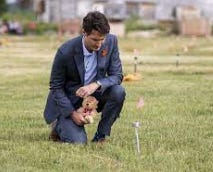
This will be my last instalment of this series. I have attempted to shed light on the poor quality of information students are receiving in Ontario schools with regard to Indigenous history and current issues. It is important to note that this is being done intentionally. It is to the advantage of the leaders of the Indigenous Grievance Industry to characterise Canada and the pre-Canadian colonies of this land as genocidal oppressors, and our politicians have exploited this situation for crass political gain. This was perhaps epitomised by Prime Minister Justin Trudeau’s photo op of himself holding a teddy bear in the proximity of a soil disturbance in a field at the site of a former residential school in Cowessess First Nation, Saskatchewan on Tuesday, July 6, 2021:
Prime Minister Justin Trudeau holding a teddy bear in Cowessess First Nation, Saskatchewan.
July 6, 2021.Are there actually human remains there? If so, of whom? Is this evidence of any kind of foul play? These are questions he was not about to bother to ask. Why would he, when such a golden opportunity to score political points presented itself?
We now know all this murdered Indigenous children stuff was a big hoax but don’t hold your breath waiting for Trudeau to issue an apology for staining the international reputation of Canada and triggering a knee-jerk vote by our Parliament declaring Canada a genocidal state and adopting the The United Nations Declaration on the Rights of Indigenous People (more on that below). Undoing all this damage will be a herculean task.
Just as students are fed simplistic, misleading, and false information about the past with regard to Indigenous people (the focus being the Indian Residential Schools) they are being presented with the point of view that human rights violations against the Indigenous people are ongoing, and are the reason for the poor quality of life in which such a disproportionate number of Indigenous people find themselves.
The claim of generational trauma
On Apr. 27, 2010, speaking as chair of the Truth and Reconciliation Commission and for the people of Canada, Sinclair told the Ninth Session of the United Nations Permanent Forum on Indigenous Issues: “For roughly seven generations nearly every Indigenous child in Canada was sent to a residential school. They were taken from their families, tribes and communities, and forced to live in those institutions of assimilation.”
This lie is promoted in the schools. It is the foundation of the generational trauma claim but in fact, during the IRS era, perhaps 30% of Status Indians (you can cut that figure in half if you include all people who identify as Indigenous) ever attended, and for an average of 4.5 years.
Even if it were true that most Indigenous people who attended the IRS suffered trauma, there is no evidence or logical reason to believe that trauma could be transferred down the generations. If generational trauma is a thing, why have the descendants of the victims of the holocaust been doing so well?
If there is generational trauma, the culprit is alcohol. Alcohol abuse has been a major problem in Indigenous communities since first contact but rarely comes up these days, certainly not in schools. Fetal Alcohol Syndrome (FAS), which occurs when a mother consumes alcohol during pregnancy, is also a major problem and the children born with it suffer from mental and emotional challenges throughout their lives. It impacts their social life, education and work. Girls who suffer from the condition all too often end up drinking during pregnancy themselves and the cycle continues.
Comments Off on When propaganda wins over historical facts, Ontario public schools edition
June 13, 2024
Fun new family game – Who’s the Parliamentary Traitor?
In the National Post, Tristin Hopper presents the rulebook for an exciting new family game literally “ripped from the headlines” – Who’s the Parliamentary Traitor?
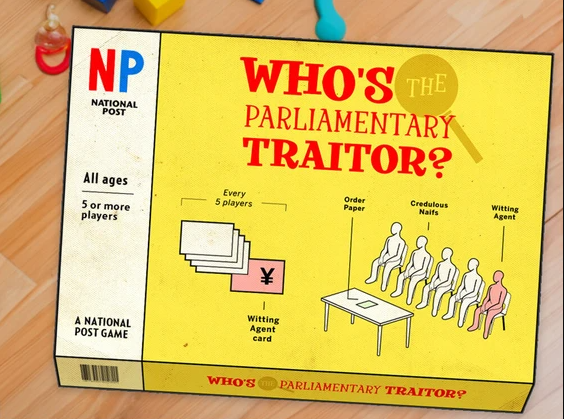
“To simulate what it’s like to go to work in a national parliament secretly housing foreign agents, the National Post presents a tongue-in-cheek instruction manual to play this group game: Who’s the Parliamentary Traitor?
Photo by Brice Hall”
WHAT YOU NEED TO PLAY:
- One large writing surface, such as a chalkboard, whiteboard or flip chart (THE ORDER PAPER)
- 20-70 note cards
- A timer
SETTING UP PLAY:
Gather at least five of your closest friends and have them sit in a line facing the ORDER PAPER. They will be divided into two categories: The WITTING AGENTS and the CREDULOUS NAIFS.To choose who among them will be the WITTING AGENTS, prepare a stack of IDENTITY CARDS equal to the number of players. On every fifth card, mark the symbol for the Chinese yuan (¥). In the case of five players, mark a single card, for 10 players, mark two, etc.
Shuffle the IDENTITY CARDS and distribute them among the players. Anyone receiving a “¥” is now a WITTING AGENT.
Set aside another stack of note cards to serve as MANDATE LETTERS. The text for each card is below. Shuffle the MANDATE LETTERS and place them face down.
RULES OF THE GAME:
Each round begins with a CANADA IS NOT BROKEN phase in which all players close their eyes, put their thumbs in their ears and bury their face for two minutes (the elapsed time to be marked with a timer). During this phase, the WITTING AGENTS open their eyes, stride over to the ORDER PAPER and write down a piece of binding public policy that damages Canada to the advantage of a hostile government (suggestions below).Once this act of treachery is done, the WITTING AGENTS return to their seats will pretend to wake up alongside them as if nothing happened.
Now begins the CONCERNED FOLLOW-UP phase. First, players must pull a MANDATE LETTER card that will determine conditions of discussion. Now, the parliamentarians must decide who among them is the foreign cat’s paw who has defaced their ORDER PAPER with disloyal policy. Uncomfortable questions are asked, accusations are made, and at the end of the round the players vote on who among them will be ejected as a traitor.
Only after the accused traitor is exiled will they show their IDENTITY CARD, revealing whether the accusations have been true, or whether they have been unjustly maligned.
Ejected players are then exiled to THE SENATE, a separated area of chairs where they are served port, ginger ale and black liquorice. They continue to participate in the CANADA IS NOT BROKEN and the CONCERNED FOLLOW-UP phases, but they no longer have a vote.
Comments Off on Fun new family game – Who’s the Parliamentary Traitor?
June 12, 2024
“Treason never prospers” … except in Canadian politics, apparently
Justin Trudeau and his unindicted co-conspirators in Canada’s federal parliament don’t think the names of Members of Parliament who have been acting as enablers or actual agents of foreign powers — that is, possible traitors — should be made public. The National Security and Intelligence Committee of Parliamentarians (NSICOP) Even the least cynical may be forgiven for thinking that this isn’t what a mature country would do in similar circumstances:
The cover of the NSICOP special report on foreign interference (PDF here)
… MPs have an obligation to protect the institution that is the House of Commons. Every MP is required as a condition of taking their seats, to swear the following oath: “I, [name], do swear that I will be faithful and bear true allegiance to His Majesty King Charles the Third, King of Canada, his heirs and successors. So help me God.”
The violation of that oath, or the suspected violation of that oath, is absolutely arguably contempt against the House of Commons. We don’t have a ton of precedent for that, because MPs who have been alleged to have collaborated, even unwittingly, with a foreign power in the past usually have the good sense to resign. But MPs should absolutely be allowed to pass judgment on the actions of their colleagues, with the express intent of expelling from the House any members who have transgressed against their oath to King and Country. This isn’t just their duty, it is a duty that they are uniquely positioned and obligated to perform. Until we know exactly which parliamentarians we’re talking about, a spectre hangs over all 400-plus of them. That very much compromises the public’s opinion of Parliament and has a demonstrable impact on their ability to do their jobs as parliamentarians.
Once upon a time, children, ministers of the Crown would offer their resignations for mistakes made by members of the civil service in the ministry for which he or she held responsibility, never mind mistakes of their own. In modern times, of course, it’s rare to find a minister resigning voluntarily until the RCMP is literally knocking on the door, and sometimes not even then.
Second, we are a large and multicultural country. MPs are expected to represent members of any diaspora community which may exist in their constituency. If you’re a Tibetan or Uyghur activist, how can you be represented by an MP who’s demonstrated a willingness to collaborate with the government of the People’s Republic of China? If you’re an Iranian democracy and reform activist, how can you be represented by an MP who has close ties to Iran’s diplomatic and intelligence operation?
The answer, of course, is that you can’t be. The government has a greater responsibility to the democratic rights of those Canadians than it does to protecting the identity of any single unscrupulous or otherwise compromised parliamentarian. With every day that passes, Ottawa looks more like it has an interest in partisan butt-covering than it does in maintaining the long-term faith that democracy requires for our institutions to survive.
A good Member of Parliament recognizes the responsibility to the constituents — whether they voted for that particular MP or not — and would keep that responsibility as faithfully as possible. On that reckoning, we have fewer good MPs than we should have … and if the intelligence turns out to be fully supported upon full investigation, there should be a lot of open seats to run by-elections for (even if no formal charges of treason are ever laid).
Finally, I accept that intelligence is not evidence. I also accept, as noted in the Globe by Philippe Lagassé and Stephanie Carvin, that we must be cautious to not compromise intelligence sources and methods, or compromise ongoing investigations. Parliamentarians should not replace the criminal justice system or undercut our defence, but they what they are capable of doing, and indeed are required to do because no one else can do it for them, is broadly defining what the acceptable behaviour for parliamentarians should be. If an MP or a senator has engaged with a foreign power’s diplomatic or security services and they do not believe they have crossed the line for what we deem to be acceptable behaviour, they will be more than welcome to go on Power and Politics, or take to social media, or show up at what I’m sure will be many committee hearings, and make their case.
It is not a hardship to ask them do so. They are not being hard done by. The question here is not whether what they’ve done is criminal. It wasn’t criminal when Bev Oda billed the taxpayers for her juice. It wasn’t criminal when Bill Morneau forgot to leave a cabinet meeting where a decision was made that was a perceived conflict of interest. But both of those parliamentarians were forced to accept that their behaviour had failed the people they were sworn to represent. They resigned.
And the idea that orange juice crosses the line, but aiding a foreign intelligence service — even “semi-wittingly” — does not, will fail to pass the smell test with a very large number of Canadians. And that is entirely correct. The public is well ahead of the politicians on understanding this.
Public trust in politicians has been ebbing for quite some time and was fading even before the pandemic exposed so many of them as would-be dictators, poltroons, and idiots. There is no deep reservoir of respect for politicians that can be drawn on at this point. Swift action is the only thing that Parliament can do and by “swift”, I don’t mean setting up a Royal Commission with a multi-year remit to bury the issue until after the next federal election.
Comments Off on “Treason never prospers” … except in Canadian politics, apparently


