Quotulatiousness

May 25, 2024

Justin Trudeau – “a large percentage of small businesses are actually just ways for wealthier Canadians to save on their taxes”

Filed under: Business, Cancon, Government — Tags: , , , — Nicholas @ 03:00

Even before he became Prime Minister, the signs were there that Justin Trudeau was instinctively anti-small-business and that this would inform his approach to taxation and regulation of the private sector:

Changes to capital gains tax in this year’s budget were aimed at the wealthy, said the Trudeau Liberals, but the move has angered small businesses owners who have been snared by the increase.

Maybe that was part of the plan, since Justin Trudeau appears to view small business owners as rich Canadians trying to dodge taxes.

In an illuminating interview with the CBC’s Peter Mansbridge in 2015, Trudeau didn’t directly answer a question about whether he would lower taxes for small businesses.

But he did say, “We have to know that a large percentage of small businesses are actually just ways for wealthier Canadians to save on their taxes and we want to reward the people that are actually creating jobs and contributing in concrete ways.”

It was a remarkable denigration of small business owners and may have passed unnoticed because Trudeau was still a month away from becoming prime minister.

For the record, businesses with fewer than 100 people employ almost 12 million private workers in this country.

And the government’s own statistics state that in the 20 years up to 2020, the number of small businesses increased every year except for three — 2013, 2016 and 2020 — so a decrease in two of the Trudeau years.

Meanwhile, Trudeau’s apparently tax-dodging wealthy small businesses seem to be having a hard time of it. Businesses that began with four or less employees were only 62 per cent likely to still be operating five years later.

Earlier this year, Reuters news agency warned that a 38 per cent spike in bankruptcies of small businesses in the first 11 months of 2023 could rise even further.

Small businesses are “an integral engine of Canada’s economy,” said the budget, but 72 per cent of the owners fear that the new changes to capital gains tax will harm the climate for investment and growth.

Interestingly, when Trudeau was asked in that 2015 interview how he planned to balance the budget by 2019, because that was what he promised, it was investment and growth that was the answer.

Then prime minister Stephen Harper had tried to cut his way out of the deficit, said Trudeau. “That doesn’t work.”

“He has been unable to create growth. He has the worst record on growth of any prime minister in 80 years.”

But as the Fraser Institute has pointed out, in the last nine years under Trudeau, Canadian living standards have declined.

May 23, 2024

Where does a former general go to get his reputation back?

Filed under: Cancon, Law, Media, Military, Politics — Tags: , , — Nicholas @ 04:00

The National Post reports on a former Canadian senior officer launching a lawsuit in an attempt to clear his reputation after an abortive court martial brought his career to an end:

Lt.-Gen. Steven Whelan, a three-star general who was accused of sexual misconduct in what he claims was a politically motivated prosecution that was then abandoned before he was able to defend himself, is looking for his day in court.

“I didn’t get a chance to tell my side of the story,” he told me.

Whelan’s lawyer, Phillip Millar of Millars Lawyers, has just filed a bruising statement of claim with the Federal Court in Ottawa, naming a who’s who of Canada’s military establishment as defendants; a litany that makes allegations of abuse of office, negligent investigation, malicious prosecution and involvement in media leaks that destroyed Whelan’s reputation and career.

Defendants named in the lawsuit include His Majesty the King in Right of Canada (the Crown) and top brass in the Department of National Defence (DND) and Canadian Armed Forces (CAF): Jody Thomas, former deputy minister of National Defence and former national security advisor to the Prime Minister; General Wayne Eyre, chief of the defence staff; Lt.-Gen. Frances Allen, vice chief of the defence staff; and Lt.-Gen. Jennie Carignan, CAF’s chief of professional conduct and culture.

The allegations stretch all the way to the Prime Minister’s Office.

Last September, Whelan faced a court martial, accused of sexual misconduct purported to have taken place more than a decade ago.

At the trial’s outset, military prosecutors dropped the more serious allegation of improperly communicating with a female subordinate (flirting, in colloquial terms). A week later — following the testimony of the complainant and minutes before Whelan’s lawyers could cross-examine her or hear from other witnesses — prosecutors dropped the remaining charge accusing Whelan of doctoring the same subordinate’s performance evaluation in 2011, allegedly fearing she would disclose their friendly but not physical relationship to others. The court martial came to an abrupt end. Notwithstanding the technical win for Whelan, the allegations effectively sidelined the three-star general.

Casual observers, seeing just how many Canadian generals’ and admirals’ careers have run aground in scandal of one sort or another, might draw conclusions about the quality of the leadership and the deep culture of the Canadian Armed Forces at both military and political levels.

The “post-national” entity formerly known as “Canada”

You have to hand it to the Trudeau family (and all their sycophantic enablers in the legacy media, of course). What other Canadian family has had such an impact on the country? By the time Justin Trudeau’s successor is invited to form a government, Canada will have changed so much — to the point that he could describe us as the first “post-national” country thanks to his unceasing effort to destroy the nation. At The Hub, Eric Kaufmann points the finger at Trudeau’s “Liberal-left extremism” as the motivating factor in Trudeau’s career:

Justin Trudeau has always had a strong affinity for the symbolic gesture, especially when the media are around to record it.

Canada is currently suffering from left-liberal extremism the likes of which the world has never seen. This excess is not socialist or classically liberal, but specifically “left-liberal”. It is evident in everything from this country’s world record immigration and soaring rents to state-sanctioned racial discrimination in hiring and sentencing, to the government-led shredding of the country’s history and memory. Rowing back from this overreach will not be the work of voters in one election, but of generations of Canadians.

The task is especially difficult in Canada, because, after the 1960s, the country (outside of Quebec) transferred its soul from British loyalism to cultural left-liberalism. Its new national identity (multiculturalist, post-national, with no “core” identity) was based on a quest for moral superiority measured using a left-liberal yardstick. Canada was to be the most diverse, most equitable, most inclusive nation in world history. No rate of immigration, no degree of majority self-abasement, no level of minority sensitivity, would ever be too much.

In my new book The Third Awokening, I define woke as the making sacred of historically marginalized race, gender, and sexual identity groups. Woke cultural socialism, the idea of equal outcomes and emotional harm protection for totemic minorities, represents the ideological endpoint of these sacred values. Like economic socialism, the result of cultural socialism is immiserization and a decline in human flourishing. We must stand against this extremism in favour of moderation.

The woke sanctification of identity did not stem primarily from Marxism, which rejected identity talk as bourgeois, but from a fusion of liberal humanism with the New Left’s identitarian version of socialism. What it produced was a hybrid which is neither Marxism nor classical liberalism.

Left-liberalism is moderate on economics, favouring a mixed capitalism in which regulation and the welfare state ameliorate the excesses of the market, without strangling economic growth. Its suspicion of communist authoritarianism helped insulate it from the lure of Soviet Moscow.

On culture, however, left-liberalism has no guardrails. When it comes to group inequality and harm protection, its claims are open-ended, with institutions and the nation castigated as too male, pale, and stale. For believers, the only way forward is through an unrestricted increase in minority representation. They will not entertain the idea that the distribution of women and minorities across different occupations could reflect cultural or psychological diversity as opposed to “systemic” discrimination. This is the origin of the letters “D” and “E” in Diversity, Equity, and Inclusion (DEI). Rather than seeking to optimize equity and diversity for maximal human flourishing, these are ends in themselves that brook no limits.

Left-liberals fail to ring-fence the degree of sensitivity that majority groups are supposed to display toward minority groups. Their emphasis on inclusivity through speech suppression rounds out the “I” in DEI. From racial sensitivity training (starting in the 1970s) to the “inclusive” avoidance of words like “Latino” or “mother” that offend and create a so-called hostile environment that silences subaltern groups, majorities are expected to police their speech.

May 19, 2024

Rush Meets LOONEY TUNES???

Filed under: Cancon, History, Media, USA — Tags: , , , — Nicholas @ 02:00

pdbass
Published Jan 4, 2024

Remember that time Rush worked music from cartoons into one of their greatest recordings?

Digging into “La Villa Strangiato” from 1978’s Hemispheres, breaking down Geddy Lee’s wicked bass solo (and its Jazz connections) and showing you how pianist/composer Raymond Scott will always be linked to this iconic prog rock instrumental.
(more…)

May 17, 2024

Lies my teacher taught me

Filed under: Cancon, Education, History — Tags: , , , , , — Nicholas @ 04:00

A Peel District School Board teacher using the pseudonym “Igor Stravinsky” explains the sort of indoctrination high school students are receiving about First Nations and the development of Canada:

Previously in this series, I have discussed some of the things students are learning, and not learning, about Indigenous people in the Peel District School Board:

  • Indigenous people are the true owners of the land; the rest of us are just settlers
  • Indigenous people should be able to continue to practice their traditional ways while being provided all the amenities commensurate with living in a modern, first world country
  • Indigenous people are victims, other Canadians are oppressors
  • The disproportionately poor quality of life which characterizes the lives of many Indigenous people today is the result of past and current injustices by non-Indigenous people, chiefly the Indian Residential Schools
  • Life was good for Indigenous people, who were wise and peaceful, before Europeans showed up
  • The goal of the Europeans who arrived in Canada was the genocide of Indigenous people
  • The settlers failed in their quest for genocide due to the courage and resilience of the Indigenous people

As I have demonstrated, all of the above is simplistic, misleading, or false.

Why teach students a false narrative?

The ahistorical Indigenous genocide narrative started out in academia where Grievance Studies (Indigenous Studies, Black Studies, Queer Studies, Fat Studies, etc.) have a massive presence. These post-modernist inspired programs, collectively referred to as “Critical Theory” have influenced all areas of academia and spread to Canadian institutions generally. Grievance studies programs can only exist so long as there are grievances, which necessitates re-writing history and putting people into oppositional groups of victims and oppressors. Academics had to either get on the bandwagon or keep their mouth shut if they disagreed with this new paradigm. Those who did not, such as Frances Widdowson, were attacked and paid a massive price for speaking freely about the lies on which grievance studies programs are based.

Left-leaning politicians have been keen to get on board with Critical Theory. It wins them support from the academics and well-meaning (but poorly informed) members of the public who want to be “on the right side of history”. Even conservative politicians tend to look the other way, seeing taking on the well-organized, well-funded, academia-based activists as an overall vote loser. After all, they can count on the conservative vote. To whom else can such voters turn? Consequently, school boards and the authors of school curricula are captured by Critical Theory and teachers are expected to tow the line. Anyone who doesn’t is said to be “causing harm” and faces harsh discipline.

Entrenchment of the Indigenous genocide narrative ensures ever increasing payments from Canadian taxpayers in the form of rent and compensation. The lion’s share of these payments go to the Grievance Industry Tzars- Corrupt Indigenous leaders and their non-Indigenous allies, with little trickling down to the average Indigenous person. That is why, in spite of the fact that an ever-increasing part of our federal budget is dedicated to payments to Indigenous groups (to reach 7.7% – $74.6 billion annually by 2026-27), many Indigenous people live in squalor on reserves without basic amenities like clean water, while many others live on the street in urban areas. How can this be happening when taxpayers are handing over more than $40 thousand per year per each Indigenous person?

Is it reasonable for people who want to live in remote areas engaged in low value hunting, gathering, and horticulture activities, declining to integrate into the modern Canadian socio-economic system, to expect 21st century amenities and services paid for by other Canadians? If non-Indigenous people balk at funding this economically unviable mode of existence, does that make us guilty of racism or genocide? That is the impression kids in school are left with after the “education” they receive on the matter.

Canada Post is in deep, deep trouble

Filed under: Business, Cancon, Government — Tags: , , — Nicholas @ 03:00

I was vaguely aware that Canada Post has been in financial difficulties for a while, but I had no idea things were quite this dire:

You’d better believe that the Canada Post Corporation is in very deep trouble. Here’s how they phrased it in their 2023 annual report:

    Canada Post’s financial situation is unsustainable.

“Unsustainable”. Well that doesn’t sound good. Think they’re just putting on a show to carve out a better negotiating position? Well, besides for the fact that they’re not currently negotiating with anyone, the numbers do bear out the concern:

    For 2023, the Corporation recorded a loss before tax of $748 million, compared to a loss before tax of $548 million in 2022. From 2018 to 2023, Canada Post lost $3 billion before taxes. Without changes and new operating parameters to address our challenges, we forecast larger and increasingly unsustainable losses in future years.

In other words, it’s madly-off-in-all-directions panic time.

Hey! You know I can hear your condescending sniff: “I’m sure this is just a temporary disruption. They’ll figure out how to fix the leak and get themselves back on the road like always. They’re too big to fail.”

Yeah … not this time. The competition from digital communications (i.e., the internet), FedEx, and UPS isn’t going anywhere. Letter delivery nosedived from nearly 5.5 billion pieces in 2006 to just 2.2 billion in 2022. And vague references to “major strategic changes to transform our information technology model” don’t sound much like magic bullets for reversing the decline.

But Canada Post’s labour and pension costs sure are marching bravely forward. In fact, if it wasn’t for Parliamentary relief in the form of Canada Post Corporation Pension Plan Funding Regulations, the Corporation would have had to pay $354 million into the pension plan in 2023 alone. But that $354 million — plus whatever additional amounts show up in 2024 and besides the $998 million in existing general debt — are still liabilities that’ll eventually need paying.

QotD: Canadian socialism

Filed under: Cancon, Politics, Quotations — Tags: — Nicholas @ 01:00

Canada is being destroyed by a form of socialism, but it is not called socialism. Even the NDP shy away from the s-word, and did so long before the fall of the Berlin Wall. How do you fight an idea, or even examine it, when there is a tacit social convention not to speak about it. Forget the Victorian morality brigades fainting at the mention of sex or women’s suffrage. Our modern moralists, who, in this country, are mostly on the left, will not let you use the s-word when talking about issues of public policy. To do so is to be an extremist. A sin at least as bad as immodesty a century ago.

We are a nation of muddlers. Until we grow out of that I’m afraid the words “American-style” and “ideologically driven” will continue to frighten us away from seriously debating issues of public policy.

“Depart, I say, and let us have done with you. In the name of God, go!”, Gods of the Copybook Headings, 2005-05-14.

May 16, 2024

The Canadian Senate is an anti-democratic fossil … that might totally frustrate a future Conservative government

Filed under: Cancon, Government, Politics — Tags: , , , , , — Nicholas @ 03:00

Tristin Hopper considers the constitutional weirdness of Canada’s upper house, an appointed body that has the power to block a popularly elected House of Commons:

“In the east wing of the Centre Block is the Senate chamber, in which are the thrones for the [King and Queen], or for the federal viceroy and his or her consort, and from which either the sovereign or the governor general gives the Speech from the Throne and grants Royal Assent to bills passed by parliament. The senators themselves sit in the chamber, arranged so that those belonging to the governing party are to the right of the Speaker of the Senate and the opposition to the speaker’s left. The overall colour in the Senate chamber is red, seen in the upholstery, carpeting, and draperies, and reflecting the colour scheme of the House of Lords in the United Kingdom; red was a more royal colour, associated with the Crown and hereditary peers. Capping the room is a gilt ceiling with deep octagonal coffers, each filled with heraldic symbols, including maple leafs, fleur-de-lis, lions rampant, clàrsach, Welsh Dragons, and lions passant. On the east and west walls of the chamber are eight murals depicting scenes from the First World War; painted in between 1916 and 1920”
Photo and description by Saffron Blaze via Wikimedia Commons.

By the anticipated date of the 2025 federal election, only 10 to 15 members of the 105-seat Senate will be either Conservative or Conservative appointees. The rest will be Liberal appointees. As of this writing, 70 senators have been personally appointed by Trudeau, and he’ll likely have the opportunity to appoint another 12 before his term ends.

What this means is that no matter how strong the mandate of any future Conservative government, the Tory caucus will face a Liberal supermajority in the Senate with the power to gut or block any legislation sent their way.

“If a majority of the Senate chose to block or severely delay a Conservative government’s legislative agenda, it would plunge the country into a constitutional crisis the likes of which we have not seen in more than a century,” reads an analysis published Tuesday in The Hub.

Constitutional scholars Howard Anglin and Ray Pennings envisioned a potential nightmare scenario in which the Senate casts themselves as “resisting” a Conservative government. Given that senators are all permanently appointed until their mandatory retirement at age 75, it would take at least 10 years until a Conservative government could rack up enough Senate appointments to overcome the Liberal-appointed majority.

“Canadian politics would grind to the kind of impasse that is only broken by the kind of extraordinary force whose political and social repercussions are unpredictable,” they wrote.

The piece even makes a passing reference to 1849, when mobs burned down Canada’s pre-Confederation parliament.

The prospect of an all-powerful Senate able to block the mandate of an elected government is a legislative situation almost entirely unique to Canada.

New Zealand abolished its Senate and is now governed by a unicameral legislature. Australia and the United States both employ term-limited elected senates. The U.K. House of Lords – on which the Canadian Senate is closely modelled – is severely constrained in how far it can check the actions of the House of Commons.

But in Canada, the Senate essentially retains the power of a second House of Commons; it can do whatever it wants to legislation that has passed the House of Commons, including spike it entirely.

May 15, 2024

Canada’s Minister of National Defence says new submarines are “inevitable”

Filed under: Cancon, Government, Military — Tags: , , , , — Nicholas @ 05:00

Bill Blair regrets earlier comments that some read as weakening the government’s already feeble commitment to re-equipping the Royal Canadian Navy’s submarine branch:

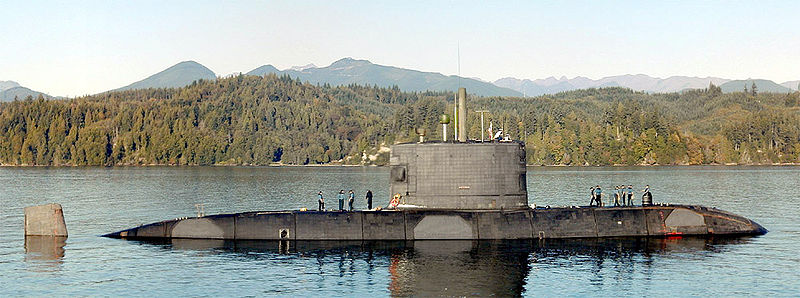
HMCS Victoria, one of the four submarines currently in service with the Royal Canadian Navy. She was originally commisioned into the Royal navy as HMS Unseen in 1991 and re-commissioned as HMCS Victoria in 2000.
Image via Wikimedia Commons.

Bill Blair, the federal defence minister, made a rare admission of Liberal fallibility in Washington on Monday when he said he regrets using the word “explore” when talking about renewing Canada’s submarine fleet.

Ottawa’s recent defence policy update said the government will “explore options for renewing and expanding the submarine fleet”, a form of words that was criticized for lacking urgency.

“It’s certainly not my intention to be wishy-washy. What I’ve tried to articulate very, very clearly and strongly in the document is, we know we have to replace our submarine fleet, and we’re going to do that,” Blair said.

Replacing the four Victoria-class subs is necessary, he said. “It is, I might suggest, inevitable.”

That is absolutely the case, if Canada is committed to maintaining its submarine capability. The Victoria-class subs date back to the late 1980s and are due to be taken out of service at the end of the 2030s.

Submarines are seen as a crucial defence against incursion by hostile powers, as the polar ice melts and opens up northern waterways. The Northwest Passage is forecast to be the most efficient shipping route between Asia and Europe by 2050.

But Blair admits “there is a lot of work to do”, not least convincing his cabinet colleagues of the “business case for the capability”.

“One of the greatest challenges of being a defence minister is to secure funding and the second one is actually spending it”, he said on Monday.

He gave a sense of the struggles around the cabinet table last month in a speech in Ottawa, where he admitted: “I had to sort of keep on pushing my issue forward about the importance and the need to invest in defence”. He made it sound as if he was a lone voice in the wilderness.

[…]

Retired captain Norman Jolin recently wrote an analysis for the Naval Association of Canada that noted if Canada wants to maintain submarine capability, it needs to place a contract with a proven builder by 2027 at the latest. He said the lack of domestic submarine-building capacity means there is neither the time nor resources to even think about a made-in-Canada solution.

The typical procurement process takes 18 years to get from cabinet approval to delivery, which would mean if an order was placed tomorrow, we wouldn’t get new subs until 2042.

Based on that timeline, “it is clear that the decision to replace the submarines is considerably overdue,” Jolin wrote.

There’s little chance that this will move closer to completion during the remaining life of the current government, with an election due before the end of 2025, and Blair is already on the record emphasizing how little the Liberals would relish spending any money on military equipment even in good economic times. Oddly, the fact that there are no domestic shipyards currently capable of building submarines may be a positive — building the RCN’s ships in Canadian yards always means that each ship costs much more than if the hull is built in a foreign shipyard. Canada doesn’t have the facilities and trained workforce to build naval vessels, so every time a new class of ships is needed, the cost of building/refurbishing the shipyards and hiring and training-from-scratch a new workforce balloons the total cost of the program.

May 13, 2024

“Our NATO allies are despairing. Our American friends are frustrated … all the officers are extraordinarily polite in public. But in private, the conversations are quite brutal.”

Filed under: Cancon, Government, Military — Tags: , , , , , , — Nicholas @ 03:00

Former Liberal MP and retired Lt.-General Andrew Leslie has few illusions about the current Liberal government’s approach to military issues:

Lt.-Gen. (ret’d) Andrew Leslie is keen to talk about the embarrassing state of Canadian military preparedness.

“The current prime minister of Canada is not serious about defence. Full stop. A large number of his cabinet members are not serious about defence. Full stop,” the former Liberal MP tells me.

“Our NATO allies are despairing. Our American friends are frustrated. But because NATO and Norad (North American Aerospace Defense Command) are both essentially voluntary organizations, in which other people cannot give Canada orders,” the retired general explains, “all the officers are extraordinarily polite in public. But in private, the conversations are quite brutal.”

I have asked Andrew to explain our federal government’s foot-dragging on military spending — despite significant changes in risk — and what we should expect from our allies. This 35-year veteran of the Canadian Armed Forces (CAF), former chief of staff of the Canadian Army and one-time MP for Orleans is well-placed to decipher what’s really going on and in our frank conversation, he doesn’t pull any punches. I connect with Andrew at his home in Ottawa; behind him, the walls of his spacious office are sheathed in medals and awards, testimony to decades of decorated service in places like Afghanistan and Yugoslavia.

We get to the heart of the matter. Canada’s allies are pressuring Prime Minister Justin Trudeau’s government to get serious about military spending. And with a relentless war in Ukraine, a thawing and more vulnerable Arctic, unrest in the Middle East, and a general shakeup of the world order, Canadians are waking up to the risks of not being ready to defend ourselves.

Recently, U.S. Air Force Gen. Gregory Guillot (who took over leadership of Norad in February) has put his Canadian counterparts on notice that he aims to have U.S. troops training, not just in Alaska, but in the Canadian Arctic. A good idea, or the thin edge of a wedge?

It’s totally sensible, Andrew replies, because Canada has “no permanently stationed combat capability in the Arctic.” After a pause to let that sink in, he repeats that fact and elaborates. “Just in terms of numbers, there’s about 22,000 professional men and women in the U.S. Armed Forces based in the Arctic, mainly in Alaska. There’s about 30,000 to 35,000 Russian armed forces based in the Arctic. Canada has about 300 people.”

May 12, 2024

Whitneyville Rolling Block for the Montreal Riot Squad

Filed under: Cancon, History, USA, Weapons — Tags: , , , — Nicholas @ 02:00

Forgotten Weapons
Published Feb 2, 2024

In 1875 the Montreal City Police decided that they wanted to equip a riot squad in case of public disturbance. They initially requested funds for 50 revolvers, but this changed to 60 carbines instead, and these were purchased via broker in 1876 from the Whitneyville Armory. Whitneyville was a factory that made a variety of independently patented designs, and their rolling block design was actually protected by a different patent (the Whitney-Laidley) than Remington’s, despite the very similar appearances of the two guns.

The Montreal Rolling Blocks were carbines, fitted with long bayonets and chambered for a .43 caliber black powder cartridge. They were engraved “Montreal Police” on the barrels, and were actually never fired in anger, nor even deployed. They remained in government possession until the 1960s, when they were finally sold off. This example is here for me to film courtesy of Mike Carrick of Arms Heritage Magazine.
(more…)

May 11, 2024

Rex Murphy, RIP

Filed under: Cancon, Media, Politics — Tags: , , , — Nicholas @ 03:00

Canadian political commentator Rex Murphy has died at 77:

Tributes and remembrances from across the political spectrum have poured in for Rex Murphy, who died aged 77.

Mark Critch, a fellow Newfoundlander who parodied Murphy on the CBC program This Hour Has 22 Minutes, recalled that Murphy had worked with his father at VOCM radio in St. John’s, N.L. “You might not always agree with what he had to say but oh, could he say it”, Critch wrote on X, formerly Twitter. “I hope he makes it home to Gooseberry Cove.”

That theme — of not always agreeing with Murphy, but admiring his style — has been frequent in remembrances of his life.

Bob Rae, a long-time Liberal member of Parliament, former premier of Ontario and now Canada’s ambassador to the United Nations, wrote of meeting Murphy on television in 1978: “He stole the show”.

“We disagreed about many things, but I never lost my affection and admiration for him,” Rae wrote on X.

In a video posted Thursday evening, which had been recorded for an award Murphy received prior to his death, Conservative Leader Pierre Poilievre praised Murphy’s “verbal ninja moves”.

“You are a national treasure. You are a voice of reason. You are a champion of all things that are great in our country,” Poilievre said.

    Canada has lost an icon, a pioneer of independent, eloquent, and fearless thought, and always a captivating orator who never lost his touch.I was honoured to toast to Rex a few months ago on receiving the Game Changers Award for one of this country’s true game changers.

    Rex,… pic.twitter.com/Nz8fWBPv7F

    — Pierre Poilievre (@PierrePoilievre) May 10, 2024

On Friday, the House of Commons held a moment of silence in honour of Murphy.

“Few gifts from the rock rival that of the now-departed Rex Murphy,” Conservative MP John Williamson said in the House. “Rex stood on guard for all of us with great wit and wisdom throughout his many newspaper columns and on-air commentaries. Rex was brave but without pretence. He despised the smug.”

Murphy’s writing, which appeared for more than a decade in National Post, was always fierce, often controversial, and liberally peppered with the sort of language that has the feel of an age gone by.

May 9, 2024

The Liri Valley: Canada’s Breakthrough to Rome

Filed under: Britain, Cancon, History, Italy, Military, WW2 — Tags: , , — Nicholas @ 04:00

WW2TV
Published 8 May 2024

The Liri Valley: Canada’s Breakthrough to Rome
With Mark Zuehlke
Part of our “Italy 1944 – Monte Cassino and Beyond” series
Monte Cassino and Beyond

For the Allied armies fighting their way up the Italian boot in early 1944. Rome was the prize that could only be won through one of the greatest offensives of the war. The Liri Valley was a long, flat corridor through miles of rugged mountains. At one end stood the formidable Monte Cassino, at the other, Rome. In May 1944, I Canadian Corps drops up this valley toward the Italian capital, facing the infamous Hitler Line — a bastion of concrete bunkers fronted by wide swaths of tangled barbed wire, minefields, and “Tobruk” weapon pits. The ensuing battle resulted in Canada’s single bloodiest day of the Italian campaign. But the sacrifice of young Canadians during the twenty-four days of relentless combat it took to clear the valley paved the way for the Allies to take Rome.

Mark Zuehlke is an award-winning author generally considered to be Canada’s foremost popular military historian. His Canadian Battle Series is the most exhaustive recounting of the battles and campaigns fought by any nation during World War II to have been written by a single author.
(more…)

May 6, 2024

The Canadian Army defiles updates its online branding

Filed under: Cancon, Media, Military — Tags: , , , — Nicholas @ 05:00

Shady Maples isn’t too impressed with the new corporate image “icon” the Canadian Army extruded onto their TwitX account last week:

The Canadian Army’s dysenteric moose shitting itself to death, er, I mean “The Canadian Army’s latest supplementary icon for online use”

The Canadian Army needs to get its shit together on Twitter, not because Twitter is important, but because people believe that Twitter is important. If you follow official accounts, then you’re probably tracking the Army’s latest update to its corporate branding.

Within hours the Army was furiously backpedaling clarifying that our new digitalized Rorschach test wasn’t a replacement logo, but an “icon” that “will be used in the bottom left corner of certain communications products and in animations for videos”. This was a bigger news event than the announcement itself.

When I first saw this thing, I thought it was a maple leaf blowing past north Africa. Could this be Straussian commentary on our National Defence Strategy? Perhaps, but now thanks to Twitter all I see when I look at it is a dysenteric moose shitting itself to death (and now you do too).

The hook in all this isn’t the new branding, which is just a drop in CAF’s vast ocean of PowerPoint phluff, the visual equivalent of white noise. It’s also not in the backlash either, because that’s just another Tuesday on Twitter. You see, unlike the Iranian nuclear program or whatever’s happening between Drake and Kendrick Lamar, the CAF is not a topic of serious international concern.

Come for the mocking of the icon, stay for the contrasting social media appearances of Canadian and Israeli Lieutenants General.

May 5, 2024

Trudeau’s shameful role in promoting “the blood libel against Canada”

Conrad Black believes that Justin Trudeau owes Canadians an apology for his role in pushing the most extreme version of the Residential Schools propaganda:

A very well-informed friend of many years, a contemporary of mine, wrote me the other day that “The blood libel against Canada of this monstrous fiction of thousands of secretly buried Indigenous victims of residential schools may be the single worst injustice this country has suffered in our lifetimes. It is now a conspiracy of silence involving both federal and provincial governments, the RCMP (shameless and useless as ever), and the media, and ‘let’s be frank’, (quoting a Soviet diplomat many years ago whom we both always found rather entertaining in the utter nonsense he used to recite at international meetings), a large section of the public, which knows this to be a falsehood but chooses to side with the silent forces”.

Almost all readers will be aware of the tidal wave of self-mutilating hysteria that inundated this country when, on the basis of apparent anomalies detected by underground radar close to a former Indian Residential School site at Kamloops, British Columbia, a couple of years ago. Immediately, the theory took hold that thousands of native children in those schools had died because of negligence or outright homicide, were buried secretly in unmarked graves, their deaths never recorded and no account given to their families. There is no evidence to support this, yet the prime minister led the nation in an almost medieval circular mass pilgrimage of self-flagellation. In order to impress upon ourselves and the entire world the profundity of our self-humiliation, all official Canadian flags everywhere were lowered to half-mast and maintained in that condition for an unheard-of period of six months.

Parliament voted to spend $27 million to conduct the excavations necessary to verify or otherwise the existence and extent of these graves. This work could have been accomplished by a small group for a few thousand dollars, but the suggestion of actually establishing what happened set up the customary cacophony of complaints about the sacred untouchability of burial grounds, even though it was not clear that there was burial ground at the Kamloops site, and if it was it was rank speculation about who might be buried there if it was. It is not conceivable to me that the country could dress itself out in sackcloth and ashes and flay the flesh off its own back before the bemused or astonished eyes of the entire world and then produce no evidence whatever of the unspeakable outrages that allegedly occurred and gave rise to this conduct, and then simply lapse into Sphinx-like incommunicability: a pristine silence of perfect ambiguity followed a near-terminal St. Vitus dance of window-rattling ululations of national guilt, shame, and self-hate.

Kamloops Indian Residential School, 1930.
Photo from Archives Deschâtelets-NDC, Richelieu via Wikimedia Commons.

Various parts of this macabre fable have been precisely and publicly put to rest: children in residential schools were not buried secretly and records were not destroyed; residential school students were accounted for and if they died while at the schools the reason was typically provided and it was almost invariably as a result of illnesses that were not as well treated in those times, and particularly tuberculosis. Beyond that, there has been silence: the febrile allegations of hideous wrongdoing vituperatively hurled at Canadian history and society – at the ancestors of English and French Canadians, at the main Christian churches, at the principal founder of our country whose distinguished name (John A. Macdonald) has been taken down from public buildings, statues of him overturned or removed, and effigies of him burned at festivities of confected righteous anger from coast to coast; all just mysteriously stopped. It is a sonic version of the celebrated poem by Shelley about the fallen monument of a once great King: “Round the decay of that colossal wreck, boundless and bare, the loan and level sands stretch far away.”

« Newer PostsOlder Posts »

Powered by WordPress