Quotulatiousness

March 4, 2024

“Whatever his flaws, Brian Mulroney was a serious person”

Filed under: Cancon, Government, History, Politics — Tags: , , , — Nicholas @ 05:00

In the free-to-cheapskates teaser from this week’s dispatch from The Line, nice words are said in memory of the late Brian Mulroney, former Prime Minister of Canada:

Prime Minister Brian Mulroney, Mila Mulroney, Nancy Reagan, and President Ronald Reagan at the “Shamrock Summit”, 18 March, 1985.
Photo from the Ronald Reagan Presidential Library via Wikimedia Commons.

Brian Mulroney died last week. He was 84.

The first thing you could be forgiven for taking away from the news coverage is how far we have fallen.

Brian Mulroney did big things. Negotiating Free Trade. Fighting Apartheid. Getting the Americans to crack down on acid rain. Comprehensive tax reform that saw the old Manufacturers’ Sales Tax (which taxed productivity) replaced with the GST. Sending Canadians to war in Desert Storm. Striking the Royal Commission on Aboriginal People which led to many of the legal advancements Indigenous communities were able to make through the 90s and into this century.

Even when he failed, as he did at Meech Lake, Brian Mulroney was trying to do something fundamentally transformative in Canadian politics.

And nobody who came after him had anywhere near that kind of guts. Not one of them.

There are things people will gripe about when it comes to Mulroney. Karlheinz Schreiber will be pretty close to the top of that list. Mulroney also tends to poll pretty poorly out west for any number of reasons ranging from a perceived over-emphasis on Quebec via Meech Lake and Charlottetown, to awarding the CF-18 maintenance contract to Montreal’s Canadair after (allegedly) promising it to Winnipeg-based Bristol Aerospace.

Mulroney was not beloved when he left office, to put it mildly. His party was basically annihilated in 1993, and the Canadian conservative movement shattered — it has still, in some ways, yet to fully recover. These are facts about which no one made more, or better, jokes than Mulroney himself. But that fall from esteem was almost never seen internationally. As he watched his contemporaries pre-decease him, Canadians got to see how respected the man was on the world stage. Mulroney was asked to eulogize American presidents Ronald Reagan and George H.W. Bush as well as British prime minister Margaret Thatcher. In this, Mulroney embodied one of the greatest cultural cynicisms of this country: sometimes, the only way for us to claim a Canadian as one of our own is to first watch them make it abroad.

Mulroney’s great triumph is free trade. Yes, because it meant jobs for millions of Canadians. Yes, because it locked us into an economic pact with the world’s powerhouse economy. But also because, in doing it, he went head-on at one of this country’s great cliches: the idea that reflexive, Laurentian, anti-Americanism was somehow a basis for governing instead of just the hallmark of a deeply insecure cultural elite.

Nobody is picking those fights now. Nobody is taking on the big battles to remake the country. We have been treated to almost 30 years of some of the pettiest, small-ball sniping imaginable. Various wedge issues are dusted off by either side, and hurled like stale buns at their opponents. Culture wars are imported for the purposes of giving our political class something about which they can feign moral outrage. Our leaders are afraid of big things either because they’re hard, or because they are unlikely to pay off in a single four-year election cycle. Mulroney is, arguably, the last Canadian prime minister whose vision of what Canada is, or could be, was not limited by a four-year horizon.

We are a serious country that is not led by serious people. And that is brought into focus when you lose a serious person.

Whatever his flaws, Brian Mulroney was a serious person.

The Line‘s editors say that Mulroney wasn’t well liked on leaving office, but the utter obliteration of the Progressive Conservatives in the 1993 federal election can’t be completely blamed on him. His successor as PC leader, Kim Campbell, went out of her way to alienate western conservatives and libertarians during her brief time in office and during the election campaign that followed. She became Prime Minister with a surprising level of tentative support that she jettisoned in record time, taking her party from a majority in the House of Commons to two (2) seats — only one other Canadian PM has ever been defeated in their own riding (Arthur Meighen … but he had it happen twice, first in 1921 and again in 1926).

March 3, 2024

From bank robbery to church burning to welfare state collapse

Filed under: Cancon, Law, Media, USA — Tags: , , , , , — Nicholas @ 05:00

Kulak talks about an old Canadian TV show episode and how the lessons learned could be (and arguably are already being) used to undermine any western welfare state:

In a show that had helicopter escapes, motorcycle chases, modded out James Bond spy cars, teenage money forgers, veteran jewel thieves, super hackers, aviation engineer super smugglers … This one stood out for its nigh stupid simplicity.

He treated bank robbery as a literal door to door business.

Gilbert Galvan’s great innovation wasn’t any innovation, it was stripping bank robbery itself down to its barest essentials. And then repeating it at scale. To the point where he could rob one bank, and then rob the bank across the street whilst police were still in the first investigating (literally! this was how they found out he existed).

He’d line up with the rest of the customers, wait his turn, approach the teller, and then quietly show her his pistol before demanding the money, and WALKING out the front door of the bank, the person behind him in line never knowing that the robbery had even happened.

The limitation was of course he never hit the safe, and only got one teller’s worth of cash, about 5-20k per robbery (1980s dollars, so double or triple modern dollars), but wearing elaborate theatrical disguises for every heist the chance of of him ever being tracked down were effectively Zero. And needing only one man, there was no accomplice to rat him out.

He carried out FIFTY heists this way, and to this day this remains the greatest lesson I’ve learned from the show… The devastating effect of simple marginally effective things, done at scale. It’s certainly served me well marketing this blog.

Now apply this lesson to the modern Cradle to Grave Total State

Since the Trudeau government funded media started promoting a blood libel against Christian church run Residential schools, falsely alleging ground penetrating radar had found “mass graves” at the site of the schools from the first half of the 20th century, over 100 churches have been attacked or burned in Canada.

Whilst the first few fires were probably set by the same person in British Columbia, once it became a national story with political valence disaffected copycats quickly sprung up around the nation. There is basically a zero percent chance the vandals on one end of the country know or have ever met the vandals on the other side. And basically no way that catching even one group of vandals or arsonists would stop the attacks.

Now I would like you to imagine the implications for civil strife in the US, and western welfare states, when this starts happening to government offices or schools which get embroiled in LGBTQ or Childhood transition scandals.

Remember that the average public elementary or high school has 1000+ students in it, the bottom 10-20% of whom absolutely despise the place. People always wonder at how many mass shootings there are in the US, I’m always shocked at how few there are. there are 40,000 suicides a year in the US, and while the numbers are hard to grab at least 10,000 of those are youth suicides. That so few decide to take classmates with them always struck me as bizarre, given human beings have killed 100s of millions of each other in the past 100 years, but then isn’t it also interesting the number of mass shootings has risen so rapidly since Columbine and the media cycle popularization of it public conciousness?

Likewise half a million Americans are treated for self inflicted injury every year, of which over 100k are Youth, and 424,000 youth are arrested on some crime or other every year.

I’m going to call it right now:

In the next 5 years someone out there, might be in America, might be Europe, is going to start burning down schools for some ideological reason, we might never even know why if they are never caught.

And At that point copycat school burnings will become one of the most dramatic and prominent trends in western life as it’s quickly copied around the western world. In the past 3 years of those 100 Canadian churches vandalized, 33 burnt right to the ground (10 per year). If you assumed the same number with no boost from all the students/parents who despise their school or maybe even feel mortal danger from them, that’d still be (population adjusted) something like 100 schools per year burning in America, probably til the end of time. Assuming those government buildings have the usual ludicrous construction costs of 20ish million … that’d be about 2 billion dollars per year in lost buildings, which lets be honest probably won’t get replaced in a timely manner.

There are 97,500 public schools in America, assuming just that Canadian Church burning rate of attacks that’d be more than 1% of American public schools gone in a decade.

March 2, 2024

Brian Mulroney, RIP

Filed under: Cancon, Government, History — Tags: , , , — Nicholas @ 04:00

In a guest post at Paul Wells’ Substack, Ian Brodie describes former Prime Minister Brian Mulroney’s role in ending the Cold War:

Prime Minister Brian Mulroney, Mila Mulroney, Nancy Reagan, and President Ronald Reagan at the “Shamrock Summit”, 18 March, 1985.
Photo from the Ronald Reagan Presidential Library via Wikimedia Commons.

Mulroney’s role has long been poo-poohed by intellectuals on the Canadian left. He was said to have an unhealthy obsession with pleasing the Americans. As a young boy, his fine voice won him an opportunity to entertain visiting American executives with a song. Amateur psychologists diagnosed a disturbing link between Mulroney’s having grown up in a company town, under the shadow of a US owned mill, and his reinvigoration of St. Laurent’s post-war grand strategy.

Mulroney never automatically fell in with US positions on the global issues of the day. His opposition to the apartheid regime in South Africa ran counter to the positions of both Reagan and Thatcher. But he drove the effort to link the American and Canadian economies through the free trade agreement. He backed our allies in the strategic competition with the Soviet bloc. And in helping to create the International Democratic Union, he helped put the west’s centre-right parties on the side of international political cooperation on the side of democracy, liberty, and the rule of law. The contrast with an earlier prime minister who could not bring himself to condemn the declaration of martial law in Poland a few years earlier was clear.

His personal relationships with a generation of American leaders gave substance to the transactional successes. As the Soviet Union came apart, he secured a spot for Canada as the first NATO country to recognize Ukraine’s independence and bolstered the independence movements of the Baltic republics. When Iraq tried to establish a precedent that, following the Cold War, large, powerful countries could invade their neighbours with impunity, Mulroney backed the US led coalition to liberate Kuwait with all the diplomatic and military power he had on hand.

And along the way, he so closely befriended both Reagan and the first Bush that he was given a privileged platform at two US state funerals, an honour never extended to a Canadian leader before and unlikely to be extended to one again soon.

Mulroney deserves to be remembered along with St. Laurent as Canada’s grand strategist of the 20th century. A trusted confidant of world leaders.

March 1, 2024

Online “harmful content” is in the eye of the beholder

It’s almost refreshing to find so many people realizing just how dystopian the Trudeau government’s proposed Online Harms Act could be if implemented in its current form. Ezra Levant on Twit-, er, I mean “X” points out to Jordan Peterson just how the system would be set up to suppress and punish online speech the complainant didn’t like:

For years the Canadian Human Rights Act (CHRA) has banned discrimination against people based on “gender identity or expression”. You of course have never discriminated against anyone.

But this new bill adds s. 13 to the CHRA, which now says that mere speech is considered discrimination if it is “likely to foment detestation or vilification of an individual or group”.

So now, if someone watches one of your YouTube videos or reads on of your tweets about, say, transgender athletes changing in the girls change room, and as a result is “likely” to have hard feelings towards trans people, that’s hate speech.

That’s step 1. Here’s step 2.

Any member of the public (including non-citizens) can lodge a complaint against you to the Canadian Human Rights Tribunal — an activist quasi-judicial tribunal run by non-judges, appointed by Trudeau.

They can get up to $20,000 per complaint from you — and they don’t have to be the “victim”. (There doesn’t have to be a victim at all — remember it’s a future crime. They only have to show that your tweet or video is “likely to” (i.e might) cause one person to have hard feelings about another person. $20,000 that you’d pay the complainant — plus $50,000 in fines to the government.

Per complaint.

So there could be a new complaint for every tweet you make. Every video. And the complainants can be professional busybodies and activists — they don’t have to be a “victim”.

Why wouldn’t woke activists literally file a CHRA complaint after every single thing you do or say on social media? It’s free. There’s no limit. Even if you “win”, you lose — the process is the punishment. And of course, they’re going to win. This will become an industry — to enrich woke grifters and destroy you financially.

But here’s the truly amazing part: the complainants can keep their identity a secret from you. Secret testimony from secret witnesses — who get paid up to $20,000 to take a run at you.

That’s how they’re going to come for you — and for us at @RebelNewsOnline

In the National Post, Jamie Sarkonak considers how the “digital safety” provisions of the Online Harms Act might be implemented:

The law would put “harmful content” in scope of government regulation by way of “arm’s-length” agencies. Targeted content would include media depicting sexual abuse (and understandably so), as well as any content that “expresses detestation or vilification” of any group considered by human rights legislation to be vulnerable and is likely to foment such feelings given the context of the communication (less understandably so). Identity-based protections are inherently more subjective, and they aren’t afforded equally to everyone: human rights law tends not to protect white people, for example.

The bill states that expressing disdain and dislike — or discrediting, humiliating, hurting or offending — is not necessarily hateful for the purposes of online regulation. Critically, it’s silent on what does make speech cross over into unacceptable territory. There’s no hard threshold.

At what point does discussion of the fact that most gender-diverse sex offenders in federal prison are transwomen (male) cross over into “harmful content” territory? Or the fact that Black people make up only three per cent of the population, but represent six per cent of all accused in criminal courts? Or the fact Eritreans in Canada, half of whom arrived after 2016, and who come from a country known for not cooperating with the deportation process, are increasingly rioting in response to politics back home?

Regardless, the promotion of actual hate propaganda, and the incitement of genocide, are already crimes in Canada, so the very worst speech was already covered by the current law and enforceable by the police. If the Liberals wanted better work done on these fronts, they could have simply raised police funding and staffed the courts with judges, as manpower is a primary constraint in dealing justice.

Instead of maintaining the systems that exist, the online harms law would add proactive measures in the form of a new bureaucracy to ensure that everything from genocide advocacy to the insulting recitation of upsetting facts don’t get out of hand. These will work in tandem with reactive measures: the crime of “hate crime” will be enforceable at criminal law, and the Canadian Human Rights Commission will be empowered to adjudicate cases of rights-violating content online.

Was JUNO BEACH The Deadliest On D Day? | Canadian Army | Normandy WW2

Filed under: Cancon, France, Germany, History, Military, WW2 — Tags: , , , — Nicholas @ 02:00

The History Explorer
Published Oct 27, 2023

During the invasion of Fortress Europe the casualty figures sustained on Omaha beach were terrifying; approximately 2,500 US casualties were sustained of which around 800 were killed, depending on which source you use. The ratio was said to be 1 in 19 soldiers would become a casualty.

But it was at Juno beach where the fighting Canadians landed that the casualties were 1 in 18. The fighting on Juno beach resembled modern urban warfare – silencing fortified residential houses, clearing rooms and bunker busting. So was this the more deadly beach? This is the story, of Juno beach and the brave sons of Canada.

On June 6th, 1944, the 3rd Canadian Infantry Division and the 2nd Armoured Brigade were tasked with establishing a bridgehead on the beach codenamed “Juno”. This was an eight-kilometre long stretch of beach between Sword beach to the East and Gold beach to the West.

Come with me as we walk the beaches and take a look at what made this beach so well defended.
(more…)

QotD: Canadian neuroticism

Filed under: Cancon, Media, Quotations — Tags: — Nicholas @ 01:00

Canada remains unmatched in its ability to turn somebody else’s tragedy into a debate about our own neuroses.

Paul Wells, quoted by Mark Steyn, Western Standard 2005-01-31.

February 29, 2024

The incredibly harmful Online Harms Act

Michael Geist thinks a substantial part of the Online Harms Act should be removed:

Having a spent virtually the entire day yesterday talking with media and colleagues about Bill C-63, one thing has become increasingly clear: the Criminal Code and Human Rights Act provisions found in the Online Harms Act should be removed. In my initial post on the bill, I identified the provisions as one of three red flags, warning that they “feature penalties that go as high as life in prison and open the door to a tidal wave of hate speech related complaints”. There is no obvious need or rationale for penalties of life in prison for offences motivated by hatred, nor the need to weaponize human rights complaints by reviving Human Rights Act provisions on communication of hate speech. As more Canadians review the bill, there is a real risk that these provisions will overwhelm the Online Harms Act and become a primary area of focus despite not being central to the law’s core objective of mitigating harms on Internet platforms.

Indeed, these concerns are already attracting media coverage and were raised yesterday in columns and commentary from Andrew Coyne and Professor Richard Moon, who I think rightly describes the core provisions of the Online Harms Act as “sensible and workable” but notes that these other provisions are troubling. Bill C-63 is effectively four bills in one: (1) the Online Harms Act, which forms the bulk of the bill and is focused on the duties of Internet platforms as they respond to seven identified harms, (2) the expansion of mandatory child pornography reporting requirements to include those platforms, (3) the Criminal Code provisions, which opens the door to life in prison for committing offences that are motivated by hatred of certain groups, and (4) the changes to the Canadian Human Rights Act, which restores Section 13 involving communicating hate speech through the Internet as a discriminatory practice. The difference between the first two and the latter two is obvious: the first two are focused on the obligations of Internet platforms in addressing online harms, while the latter two have nothing directly to do with Internet platforms at all.

The Criminal Code and Human Rights Act changes originate in Bill C-36, which was introduced in 2021 on the very last sitting day of the Parliamentary session. The bill died on the order paper with an election call several weeks later and did not form a core part of either the online harms consultation or the 2022 expert panel on online harms. These provisions simply don’t fit within a legislative initiative that is premised on promoting online safety by ensuring that social media services are transparent and accountable with respect to online harms. Further, both raise legitimate concerns regarding criminal penalties and misuse of the human rights complaint system.

At the National Post, Carson Jerema points out that under the Online Harms Act, the truth is no defence:

As much as the Liberals want everyone to believe that their proposed online harms act is focused almost exclusively on protecting children from predators, and that, as Justice Minister Arif Virani said, “It does not undermine freedom of speech,” that simply isn’t true. While the legislation, tabled Monday, could have been much worse — it mercifully avoids regulating “misinformation” — it opens up new avenues to censor political speech.

Under the bill, condemning the Hamas massacre of 1,200 people on Oct. 7, could, under some circumstances, be considered “hate speech”, and therefore subject to a human rights complaint with up to $50,000 in penalties. As part of the new rules designed to protect Canadians from “online harms”, the bill would reinstate Section 13 of the Canadian Human Rights Act, the hate speech provision repealed under the Harper government.

The new version is more tightly defined than the original, but contains the same fatal flaws, specifically that truth is no defence and that what counts as hate speech remains highly subjective.

Under the new Section 13: “it is a discriminatory practice to communicate or cause to be communicated hate speech by means of the Internet or any other means of telecommunication in a context in which the hate speech is likely to foment detestation or vilification of an individual or group of individuals on the basis of a prohibited ground of discrimination”.

It is distressingly easy to imagine scenarios where everyday political speech finds itself under the purview of the Canadian Human Rights Commission. Criticizing Hamas and the murderous ideology that motivates it could, to some, be seen as “likely to foment detestation or vilification” against a group, especially if the condemnation of Hamas notes that Palestinians generally support the terrorist group or that Hamas is driven by religious fanaticism.

Dan Knight calls it “the sequel no one asked for”:

Morning my fellow Canadians and lets break into the liberals latest sequel with Bill C-63 the its failed predecessor, Bill C-36, which is a sequel nobody asked for in the saga of online hate speech legislation. We’re witnessing a government’s second attempt to police what you can say online.

Now, the Liberal government in Canada initially put forward Bill C-36. This bill aimed to tackle extreme forms of hate speech online. It sought to bring back a version of a section that was repealed from the Canadian Human Rights Act in 2013. Why was it repealed, you might ask? Because critics argued it violated free speech rights. But here we are, years later, with the Liberals trying to reintroduce similar measures under the guise of combating hate speech. Under the proposed changes, folks could be fined up to $20,000 if found guilty of hate speech that identifies a victim. But here’s the kicker: the operators of social media platforms, the big tech giants, are initially left out of the equation. Instead, the focus is on individuals and website operators. Now, the government says it plans to hold consultations over how to make these social media platforms more accountable. But the details are hazy, and the timeline is, well, as clear as mud.

The justice minister of Canada has framed these amendments as a way to protect the vulnerable and hold individuals accountable for spreading hatred online. But let’s be clear: there’s a thin line between protecting individuals and infringing upon free speech. And that line is looking blurrier by the day in Canada. Critics, including the Opposition Conservatives, have voiced concerns that these measures could curb freedom of speech and be difficult to enforce. They argue that the government’s efforts might not just be about protecting citizens but could veer into controlling what can and cannot be said online. And when the government starts deciding what constitutes “hate speech”, you have to start wondering: Who gets to draw that line? And based on what standards?

And, just when you thought it couldn’t get any more Orwellian, enter the pièce de résistance: the Digital Safety Commission of Canada. Because, clearly, what’s missing in the fight against “hate speech” is another layer of bureaucracy, right? Another set of initials to add to the alphabet soup of governmental oversight. So, here’s the deal: this newly minted commission, with its CEO and officers — oh, you better believe there will be officers — is tasked with overseeing the online speech of millions. And let me tell you, nothing says “independent” like a government-appointed body policing what you can and cannot say on the internet. I can just imagine the job postings: Now Hiring: Online Expression Regulators, proficiency in silencing dissent highly valued.

Ukraine asks for mothballed Canadian missiles that should have been destroyed 20 years ago

Filed under: Cancon, Europe, Military, Russia, Weapons — Tags: , , , , — Nicholas @ 03:00

In The Line, Alex McColl makes a case against granting a Ukrainian request for obsolete CRV7 70mm air-to-ground rockets:

An SUU-5003 bomblet dispenser with six CRV7 air-to-ground rockets (left) and six BDU-33 bombs (right).
Photo by Boevaya mashina via Wikimedia Commons.

Canadian parliamentary committees — and even the leader of the official opposition — are endorsing a request by the Ukrainian military to send that beleaguered country thousands of mothballed rockets that have not been adequately stored or maintained. The plan has received nothing but approval from Canadians; however, according to multiple sources I have interviewed, the rockets in question are probably useless. In a worst case scenario, a few could go off and hurt or kill the Ukrainians trying to jury rig them into a short-range rocket artillery weapon.

This is about Canada’s stockpile of expired CRV7 rocket motors, which were slated for environmentally responsible disposal twenty years ago. Despite this, these weapons are being requested by the Ukrainian military, which is desperate for any kind of munitions as the war with Russia drags on.

[…]

During the Cold War, the Canadian-made CRV7 was one of the best 70mm NATO rockets thanks to its powerful motor, high speed, and consistent accuracy. It was carried by NATO fighter jets and attack helicopters. In the early 1970s, it could outrange most Soviet short-range man-portable surface-to-air missiles (MANPADS), giving pilots an advantage in air-to-ground missions. Our pilots could shoot at the bad guys from far enough away that the bad guys couldn’t shoot back.

That was then. Today, surface-to-air weapons have advanced to the point where unguided rocket attacks are rarely worth the risk, which is why these rockets were retired 20 years ago.

One of the CAF officers I interviewed reached out again the next day to get in the final word. Here’s what I was told:

“In general, I’d say that the phase when donating from existing inventory was relevant ended in early 2023. Canada has donated many useful things, but focussed on what Canadian industry can provide, not what Ukraine desperately needs. Unarmed ACSVs and drone cameras are useful, but Ukraine needs predictable and reliable supplies of battle decisive munitions, most of all air defence missiles and artillery ammunition. The conversation Canada should be having isn’t about rotten surplus, but how we support new production of key ammunition, ideally at home but ultimately whoever we can fund to get it to Ukraine fastest.”

I couldn’t agree more.

February 28, 2024

The rise of the “Pretendian” is an inevitable consequence of academia’s ultra-woke culture

Filed under: Bureaucracy, Cancon, Education, Media, Politics, USA — Tags: , , , , , , — Nicholas @ 05:00

Freddie deBoer summarizes why we’ve seen a vast increase in the number of Pretendians in western academia, but especially in Canada and the United States (and we can be almost certain that there are a lot more who haven’t yet been revealed, because the incentives to pretend are so enticing):

“The Pretendians”, a CBC documentary – https://www.cbc.ca/passionateeye/episodes/the-pretendians

  1. Certain jobs in academia are highly prized
  2. There are far more applicants than openings for those jobs and so competition for them is incredibly fierce
  3. Representing yourself as a member of an underrepresented minority significantly improves your odds of getting such a job, and in certain fields representing yourself as a person of indigenous descent improves those odds dramatically
  4. Indigenous identity is easy to fake and difficult to disprove, and the cost of accusing someone else of faking it, in academia, can be very high indeed
  5. Most crucially of all, the social culture of academia strongly prohibits speaking frankly about these facts

Jay Caspian Kang’s new piece on the “Pretendian” crisis in academia is deeply researched and compulsively readable, and read it you should. But fundamentally everything you need to know about the problem is in the numbered list above. You’ve created a fiercely competitive process in which a segment of people are given a very large advantage, there are few if any objective markers that can disprove that someone is a member of that segment, and you’ve declared it offensive to question whether someone really is a member of that segment, outside of very specific scenarios. (When I was in academia people spoke very darkly about the concept of ever questioning someone’s indigenous identity, called it the act of a colonizer, etc etc.) The obvious question is … what did you think was going to happen? Humanities and social sciences departments have, through the conditions described above, rung the dinner bell for people pretending to have indigenous heritage. They now act shocked when such people show up. I find it disingenuous and untoward. This behavior is the product of the incentives that you yourself built. Of course it’s a stain on the integrity of the fakes. But you made it inevitable that this would happen. Reap what you sow.

Accusations aplenty, but still no clear evidence

Michelle Stirling outlines the establishment of the North West Mounted Police (today’s Royal Canadian Mounted Police) and their role in driving out American whiskey traders and criminal gangs who had invaded the Canadian west, and the initial role of Sir John A. Macdonald in setting up the first residential schools for First Nations children:

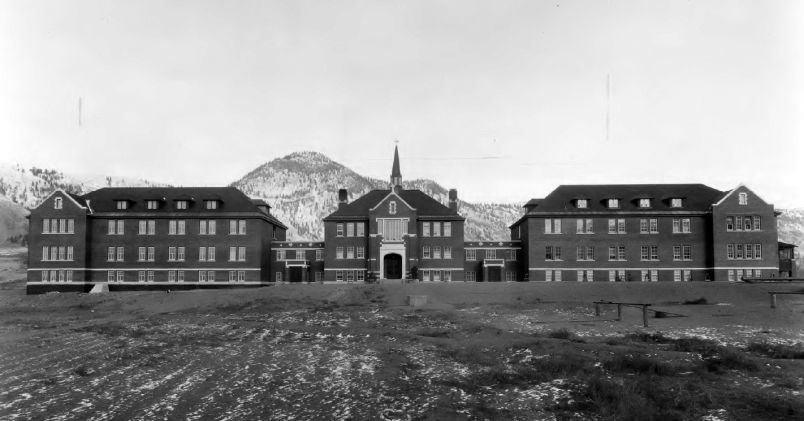
Kamloops Indian Residential School, 1930.
Photo from Archives Deschâtelets-NDC, Richelieu via Wikimedia Commons.

It is clear that the claim of “mass graves” of children allegedly found by Ground Penetrating Radar (GPR) at the former Kamloops Indian Residential School is false. The main reason is that there is no list of names of missing persons — over the course of 113 years of Indian Residential Schools, which saw 150,000 students go through the system, some staying for a year, most for an average of 4.5 years, some staying for a decade or more and graduating, and some orphans being taken in to the school as children, then remaining to work as Indigenous staff — these many thousands of children passed through Indian Residential Schools, their parents enrolling and re-enrolling them year after year.

And there is no list of names of missing persons.

There are many claims of missing persons.

Some of these claims are quite fatuous — with one person claiming that in their Band, every family had four or five children who went missing at that school. Another person claimed that their grandfather had ten siblings disappear in that school.

If that were true, the Band would have ceased to exist.

Despite these claims, there are no missing persons records.

And every student who went to that school is documented on the Band’s Treaty rolls, in documents of the Indian Agent, in the enrollment forms at the Department of Indian Affairs, along with the student’s medical certificate for entry, and in the quarterly reports of the department.

In fact, the Indigenous population of Canada grew from about 102,358 in 1871 to now 1.8 million.

It seems that the claim of a “mass grave” on the former Kamloops Indian Residential School site was timed to “nudge” the approval of the United Nations Declaration of the Rights of Indigenous People through parliament — which it did! The bill had been “stuck” as six provinces had requested delay and clarity on key issues. Once the claim of “mass graves” surfaced — boom!

Less than a month after the “mass graves” news shot round the world, shocking the global community that Canadians — once known as international peacemakers, were actually hideous murderers of Indigenous children — UNDRIP swept through the Canadian Parliament with no objection.

A day later, China accused Canada of genocide, citing the Kamloops “mass graves” find as proof. For those of you following the concerns about China’s alleged interference in elections in Canada, this rather convenient timing might set off some alarm bells.

If anything, the RCMP should be investigating this matter on grounds of false pretences or fraud. But the RCMP appear to have transferred the investigation of the Kamloops “mass grave” to the people who claimed to have found them! Ground Penetrating Radar (GPR) can only identify “disturbances” under ground, not bodies or coffins. In fact, based on previous land use records, most likely the GPR found 215 clay tiles of an old septic trench.

February 27, 2024

Thank goodness we don’t get all the CBC we pay for!

Filed under: Cancon, Government, Media, Politics — Tags: , , , , , — Nicholas @ 05:00

In the dim, dark recesses of history … say twenty-five years ago … the CBC was what the government still seems to believe it is: a credible, trusted source of news and entertainment. In truth, it was never as loved as some might claim, as it had a deep bias in favour of Quebec and Ontario issues and tended to only occasionally remember the rest of the country. The federal government has been subsidizing the CBC, yet the network’s audience has shrunk to the point that it’s rare to encounter anyone who consumes very much of the programming on offer. Part of that is just the sheer variety of other options available to Canadians and part of it is the CBC’s sour, toxic, hectoring tone when lecturing about “the current thing”. Far from being a major player in upholding Canadian culture, the CBC is clearly one of the major factors that are destroying it:

… looking at the viewer and listener stats for the CBC, our national behemoth, which eats up $1.5 billion annually, and which amounts to 50% of the media dollars spent, is equally disheartening. The state spends another $600 million supporting once-successful media because “internet”. CBC television is watched by 3.9% of Canadians and only 0.8% watch CBC News. Again, half of all media dollars, half. Half is spent engaging less than 4% of Canadians. CBC radio is considered reasonably good, and is listened to by 10%, despite its vindictive calling out of anyone who disagrees with their hard socialist stance. As to other mainstream media, propped up by government via hundred of millions, it is still shedding staff and readers in double digits.

Despite every conceivable advantage, advertising on the CBC dropped 20% during the pandemic. In fact, they are so disliked that CBC is hiring “close protection security” for the next two years. They are so disliked, they have turned off commenting on their various programs. They are so disliked that there is a brand of coffee called “Defund the CBC”. This isn’t passive ignoring, this is active dislike to the point of needing bodyguards.

Why? Because our media show us to ourselves as racist, stupid, sexist, stupid, stupid and more stupid. And while they are at it, shallow and violent. That is the real reason, and the only reason CanCon is dying. They hate us. Why? The only people who have thrived during the past twenty years in Canada when private and public wealth doubled then doubled again, are the ones who live off the government, whether through mandated consulting in the enviro and other business, or direct granting or though quasi-private-sector jobs that are heavily subsidized. Public Private Partnerships have to be the most fiendish way to flat out loot the public ever been invented. Or straight up public sector jobs which are among the most lushly funded and unionized in the known universe, the number of which have grown 400% in the last ten years. Do or did you get six weeks of paid holiday a year?

And do they hate us, in fact correcting us is how they get the grants, the jobs, the subsidy. Everything they do is meant to fix us deplorable Canadians.

Sit at a downtown Toronto dinner party as I have, with say, the head of CBC drama, as I have and listen to just how much they hate the rest of Canada. Why? They hate the rest of Canada because they feel guilty. They know they are cheating and they know they are stealing. I tell ya, I needed close protection security — this woman was terrifying. “Sit Down While I’m Talking to You“, she roared at me.

The Company that Broke Canada

BobbyBroccoli
Published Nov 4, 2023

For a brief moment, Nortel Networks was on top of the world. Let’s enjoy that moment while we can. Part 1 of 2.

00:00 This is John Roth
02:04 The Elephant and the Mouse
12:47 Pa without Ma
26:27 Made in Amerada
42:15 Right Turns are Hard
57:43 Silicon Valley North
1:07:37 The Toronto Stock Explosion
(more…)

February 25, 2024

Who Killed Canadian History?

I was not aware that it has been a full twenty-five years since J.L. Granatstein published his polemical Who Killed Canadian History?:

In that work, Granatstein asserts that the rationale for the history taught in Canadian schools was political, not historical. And sexism and racism were being taught, not history.

In the postmodern era, the priority of vast areas of history teaching and historiography, and Granatstein is far from the only academic who noticed this, transitioned from evidence and facts, to morals and emotions. Western oppression became the source of historiographical obsession. And the practice, which has shaped Western historiography since at least the turn of the twentieth century, of injecting moral judgements adjacent to facts and timelines, became entrenched.

This has happened because important areas of historiography, and historical pedagogy, have been subsumed into social sciences. My 9 and 11 year old children do not have a history class. What they learn about history, which isn’t much, is in a class called “social studies”. My son, who is in grade 6, and who was never previously taught anything about the Holocaust, is learning about Nazis Germany’s persecution of the Jews in the most obscure way. His introduction to the Holocaust included a lesson pertaining to the MS St. Louis, a passenger ship carrying 907 Jewish refugees fleeing Nazi persecution that was refused entry into Canada in 1939.

The ship’s Jewish passengers were safely returned to four European countries, but tragically 254 were later killed in the Holocaust. A terrible outcome. Indeed, one of the rare dark stains on Canada’s otherwise quite exemplary record of offering sanctuary to refugees. But if Canadians at the time had known that refusing entry to the MS St. Louis would result in the cold-blooded murder of 254 innocent people, would they have allowed entry? A question not raised in my son’s class.

As well, what Canadians knew or didn’t know about the genocidal ambitions of the Nazis did not come up in my son’s classroom discussions. Indeed, that would be too complex and nuanced for 12 year old’s. They also did not discuss conditions in Canada at the time that may have played a role in the consequential decision to turn away the MS St. Louis. Nor did they mention the Evian Conference, which occurred the year prior to the MS St. Louis‘ ill-fated arrival to Canada.

The Evian Conference of 1938 was held in the French resort town of Évian-les-Bains. There were 32 participating nations, including Canada, who were “to seek, by international agreement, avenues for an orderly resettlement of (Jewish) refugees from Germany and Austria”. Shockingly, at the close of the talks, none of the nations involved had offered to accept any Jewish refugees.

From the London Spectator (1938):

    If the Conference has not been a complete failure, it has achieved little to boast about, all the States sympathizing and none desiring to admit refugees. Even the United States, as prime mover, offers no more than the quota.

My son did not come away from his class with an impression that Canada was not alone in its reluctance to accept refugees. This, and other such lessons, seem as if they are designed to implant a sense of revulsion over Canada’s past failures, instead of patriotism over its achievements and victories. What a disservice to young Canadian learners.

This cherry-picked event from history, which doesn’t really deal with the Holocaust, but assumes kids will appreciate related events that occurred over the backdrop of the Holocaust, is doubly misleading in that it presents Canada as a racist country hostile to refugees, before establishing that the opposite was (and is) overwhelmingly true throughout the arc of Canadian history up to the present.

It’s not even clear if my son took away from the lesson that Hitler was the far bigger villain, compared to his “racist colonial” country of Canada.

Clearly, Canada eventually let in Jewish people, and people from all ethnicities. We became the world’s first multiculturalism, and our large cities are among the most cosmopolitan and multicultural places in the world. This needs to be established first for young learners of Canada’s story. Clearly established, before one starts teaching the exceptions to the rule. But my son is getting some weird blend of oddities presented as introductory material to larger subjects which hold historical conclusions opposite to the ones the cherry-picked exceptions portray. It only makes sense that these exceptional events are selected deliberately for political, not educational, reasons.

Twenty-five years ago, Granatstein wrote of Canadian schools,

    The material taught stressed the existence of anti-Aboriginal, anti-Metis, and anti-Asian racism, as well as male sexism and discrimination against women, as if these issues were and always had been the primary identifying characteristics of Canada … The history taught is that of the grievers among us, the present-day crusaders against public policy or discrimination. The history omitted is that of the Canadian nation and people.

Who Killed Canadian History? also criticized the teacher-curated practice whereby early exposure to Canadian history is random and discontinuous concerning time periods and individuals, and “without much regard for chronology”. Exactly what I have been experiencing with my kids, decades after Granatstein identified the problem.

Canadian publishing “has been decimated since Ottawa took an active interest in it and while federal policies haven’t been the whole problem, they’ve been vigorous contributors”

In the latest SHuSH newsletter, Ken Whyte contrasts the wholesome intentions of the Canadian federal government on cultural issues with the gruesome reality over which they’ve presided:

Even James Moore, [Liberal cabinet minister Melanie] Joly’s Conservative predecessor in the heritage department, applauded her initiative as good and necessary, although he warned it wouldn’t be easy. Moore had wanted to do the job himself, but his boss, Stephen Harper, didn’t want to waste political capital on fights with the arts community. He told Moore his job in the heritage department was to sit on the lid.

Joly got off to a promising start, only to have her entire initiative scuppered by a rump of reactionary Quebec cultural commentators outraged at her willingness to deal with a global platform like Netflix without imposing on it the same Canadian content rules that Ottawa has traditionally applied to radio and television networks. Liberal governments live and die by their support in Quebec and can’t afford to be offside with its cultural community. Joly was shuffled down the hall to the ministry of tourism.

She has been succeeded by four Liberal heritage ministers in five years: Pablo Rodriquez, Steven Guilbeault, Pablo Rodriguez II, and Pascale St-Onge. Each has been from Quebec and each has been paid upwards of $250,000 a year to do nothing but sit on the lid.

The system remains broken. We’ve discussed many times here how federal support was supposed to foster a Canadian-owned book publishing sector yet led instead to one in which Canadian-owned publishers represent less than 5 percent of book sales in Canada. The industry has been decimated since Ottawa took an active interest in it and while federal policies haven’t been the whole problem, they’ve been vigorous contributors.

Canada’s flagship cultural institution, the CBC, is floundering. It spends the biggest chunk of its budget on its English-language television service, which has seen its share of prime-time viewing drop from 7.6 percent to 4.4 percent since 2018. In other words, CBC TV has dropped almost 40 percent of its audience since the Trudeau government topped up its budget by $150 million back in the Joly era. If Pierre Poilievre gets elected and is serious about doing the CBC harm, as he’s threatened since winning the Conservative leadership two years ago, his best move would be to give it another $150 million.

The Canadian magazine industry is kaput. Despite prodigious spending to prop up legacy newspaper companies, the number of jobs in Canadian journalism continues to plummet. The Canadian feature film industry has been moribund for the last decade. Private broadcast radio and television are in decline. There are more jobs in Canadian film and TV, but only because our cheap dollar and generous public subsidies have convinced US and international creators to outsource production work up here. It’s certainly not because we’re producing good Canadian shows.

[…]

When the Trudeau government was elected in 2015, it posed as a saviour of the arts after years of Harper’s neglect and budget cuts. It did spend on arts and culture during the pandemic — it spent on everything during the pandemic — but it will be leaving the cultural sector in worse shape than it found it, presuming the Trudeau Liberals are voted out in 2025. By the government’s own projections, Heritage Canada will spend $1.5 billion in 2025-26, exactly what it spent in Harper’s last year, when the population of Canada was 10 percent smaller than it is now.

That might have been enough money if the Liberals had cleaned up the system. Instead, they’ve passed legislation that promises more breakage than ever. Rather than accept Joly’s challenge and update arts-and-culture funding and regulations for the twenty-first century, the Trudeau government did the opposite. Cheered on by the regressive lobby in Quebec, it passed an online news act (C-18) and an online streaming act (C-11) that apply old-fashioned protectionist policies to the whole damn Internet.

This comes on top of the Liberals transforming major cultural entities, including the CBC and our main granting bodies, The Canada Council and the Canada Book Fund, into Quebec vote-farming operations. The CBC spends $99.5 per capita on its French-language services (there are 8.2 million Franco-Canadians) and $38 per capita on Canadians who speak English as the first official language. The Canada Council spends $16 per capita in Quebec; it spends $10.50 per capita in the rest of Canada. The Canada Book Fund distributes $2 per capita in Quebec compared to $.50 per capita in the rest of the country. Even if one believes that a minority language is due more consideration than a majority language, these numbers are ridiculous. They’re not supporting a language group; they’re protecting the Liberal party.

February 24, 2024

Justin Trudeau is his own Messiah

Filed under: Cancon, Economics, Media, Politics — Tags: , , , , — Nicholas @ 04:00

In The Line, Jen Gerson gets up a full head of steam (to borrow Matt Gurney’s phrase) over the Prime Minstrel’s brief visit to Alberta and what he revealed about his worldview and his sense of his own importance in an interview with a non-mainstream journalist:

Watching Prime Minister Justin Trudeau give an extended interview to Alberta’s Ryan Jespersen is the first time I’ve ever felt visceral concern about the man leading this country.

I genuinely don’t mean this in any mean or partisan sense. What I mean is that this interview raised serious concerns about Trudeau’s headspace, his judgment, and whether or not this man in particular should be leading the country right now.

The interview wasn’t a disaster: Trudeau brought up fair points that deserve more consideration in Alberta, and I will discuss them here.

But on the whole, what I see here is a man who has wildly inflated his own policy achievements while in office. What I see is a man who cannot accept responsibility for his shortcomings, nor for the real decline in both state capacity and quality of life now affecting Canadians. What I see is a man who won’t take accountability for his own unpopularity.

And, most concerning, what I see is a man who thinks of himself as a messianic figure; a man blind to his own partisan ideology and bad behaviour, but hyper attuned to the same in others. A man who divides the world between black hats and white, and cannot admit the possibility of a legitimate alternative viewpoint — and can, in fact, only explain the very existence of such viewpoints by resorting to the belief that all of his critics have been fooled. Fooled. A word he uses over and over and over again, without realizing the contempt this word betrays of his own feelings toward his audience.

This is a prime minister who cannot see the beam in his own eye; who exemplifies the trait — best summed up by National Post columnist Chris Selley and cited often here at The Line — that Liberals are the sort of people who are sincerely convinced they would never do the sorts of things they routinely do, or are in fact currently doing.

Let’s start with the quotes.

Trudeau starts out by noting that right-wing politicians create wedge issues. “A lot of what the right is doing is about stoking up anger without offering any solutions.” And insisting that right-wing politicians have “realized it’s easy to instrumentalize anger and outrage to get people to vote in a way that is not necessarily in their best interests”.

The last two elections called, Mr. Trudeau. They would like to discuss guns, abortion, vaccine mandates, and pretty much every single other ballot question the Liberals have abused to squeak out minority victories by maximizing vote efficiency in crucial central Canadian ridings.

Of course, it doesn’t count when Liberals court disinformation, or stoke irrational fear about their opponents, because when they do it, they have Canadians’ best interests at heart. They’re the good people, you see.

For when you’re on the side of the angels, on a mission to preserve democracy itself from the manipulative wiles of right-wing politicians out to fool people from holding wrong opinions, what means are not justified?

I would also point out that in the same way that it would be insulting and inappropriate for me to delegitimize Trudeau’s authority by arguing that he obtained two weak majorities by fooling Canadians via manufactured outrage on wedge issues, so too is he required to show some deference to the will of the voters of Alberta. One does not have to agree with everything Premier Danielle Smith does or says or proposes to demonstrate respect for the fact that she is the elected leader of the province, a role she secured in a free and fair election. But, alas.

Donna LaFramboise also reacted to the Ryan Jesperson’s interview of Justin Trudeau, saying that he’s like the Borg from Star Trek:

While visiting Alberta this week, Justin Trudeau was interviewed live by Ryan Jespersen, a former Edmonton morning show host whose podcasts are available on YouTube and elsewhere. That’s when our Prime Minister said the following:

    There is, out there, a deliberate undermining of mainstream media. There are the conspiracy theorists, there are the social media drivers who are trying to do everything they can to … prevent people from actually agreeing on a common set of facts — the way CBC and CTV, when they were our only sources of news (and Global) used to project across the country at least a common understanding of things.

Screen capture from a YouTube compilation – “The Borg Collective Speaks”

Mr Trudeau referred to “people on the fringes” who eschew the “mainstream view”. He said his government’s trying to “make sure Canadians understand the importance of not being fooled by misinformation, by disinformation”. Earlier in the interview, he said Albertans were being “fooled by right-wing politicians” and that oil sands workers have “been fooled” by energy companies.

Mr Trudeau is the Borg from Star Trek. He doesn’t respect alternative views. He has zero interest in listening or negotiating. If your analysis conflicts with his, you’re the problem. Renounce the fringe. Fall into line like the other Borg drones. Adopt the common understanding of things being fed to you by the government funded mainstream media.

« Newer PostsOlder Posts »

Powered by WordPress