Quotulatiousness

August 30, 2021

The Worst Withdrawal from Afghanistan? (330 BC)

Filed under: Asia, Europe, Greece, History, Middle East, Military — Tags: , , , — Nicholas @ 04:00

Invicta
Published 28 Aug 2021

Afghanistan has a long history of foreign invasions and withdrawals. Today we explore the first of these chapters with the campaigns of Alexander the Great. Signup for your FREE trial to Wondrium here: http://ow.ly/C3xs30rNLaU

As the last chapter of the US war in Afghanistan appears to draw to a close, the world watches armed and civilian forces alike conduct their final evacuations. However in these moments we hear echoes of the past. The history of the so-called “Graveyard of Empires” is filled with many chapters that tell of yet another major power that has been forced to withdraw after years of spilled blood and treasure. The most well-known instances have occurred in recent memory. However the pages of Afghan history go back thousands of years. Today I wanted to take a look at one of these first major military withdrawals that may just be the most FUBAR one on record; The evacuation of Alexander the Great’s Macedonian army from Afghanistan.

In order to contextualize this conflict we first begin with a quick overview of the history of Afghanistan. No country existed by that name or with those borders in antiquity and it was instead made up of a variety of tribal coalitions and minor kingdoms for much of its early history. However it would first see foreigners begin to claim its lands with the rise of the Median Empire and the succeeding Achaemenid Empire. The lands of modern Afghanistan would now be carved into a series of Satrapies such as Bactria, Gandara, Arakhosia, Drangaian, and Areia.

Following the Ionian Revolt and the Greco Persian Wars, the Kingdom of Macedon would rise to power and take on this ancestral conflict as a way to unify the Hellenic world behind its rule. Phillip II first began to plan and invasion of the Achaemenid Empire but it would be Alexander the Great who carried out this vision. He would campaign for several years through Anatolia, the Levant, Egypt, and Mesopotamia, consuming vast swaths of the enemy’s domains. However King Darius would escape to the east. Alexander initially pursued the Great King but when he was killed by his own Lieutenant, Bessus, Alexander set off against this traitor.

In this chase, Alexander the Great would be sucked into a multi-year war to subdue the eastern satrapies that made up modern Afghanistan. We cover the most significant events of this campaign, the establishment of occupying forces, and the eventual withdrawal of the army following the death of Alexander the Great. The ensuing settler revolt would make it (in my eyes) one of the most FUBAR Afghanistan withdrawals in history that would certainly be worthy of a Vice news documentary had it existed.

The Campaigns of Alexander the Great by Arrian
In the Footsteps of Alexander the Great by Michael Wood
Alexander the Great and Bactria: The Formation of a Greek Frontier in Central Asia by Frank Holt
The Greeks in Bactria and India by W. W. Tarn
On the revolt of the Greek settlers by Diodorus

Credits:
Research: Invicta
Script: Invicta
Narration: Invicta
Artwork: Penta Limited

#History
#Afghanistan
#Documentary

August 29, 2021

Justin Trudeau discovers for himself the truth of Harold Macmillan’s dictum on the most difficult thing about being Prime Minister

Filed under: Asia, Cancon, Politics — Tags: , , , , — Nicholas @ 05:00

Former British Prime Minister Harold Macmillan was asked what was the most difficult thing about his job and is reported to have said, “Events, my dear boy, events.” Justin Trudeau had everything he wanted in the Canadian political situation in early August so he put his early election plans into action … and along came those unpredictable events:

“2019 Canadian federal election – VOTE” by Indrid__Cold is licensed under CC BY-SA 2.0

What would have happened in the election of 2021 if Afghanistan hadn’t fallen? If the writ had been drawn up just a few weeks before, or a few weeks after August 15, the day Kabul fell to the Taliban?

This is the sort of question political science nerds will debate over weak beer for decades to come. It’s no great mystery why the Liberals went forward with the election even as armed fighters began to stream into the capital city of a country in which Canadians have sacrificed so much time, blood and treasure.

But I can picture the scene in the war room now and the logic is inescapable. The meeting with the governor general had been set, the news leaked, the campaign messaging laid out, the suits pressed and the planes booked. Besides, as we all know: “nobody cares about foreign affairs.” That old cant, repeated, like a charm.

Most of the time, it’s true.

Canadians hadn’t thought about Afghanistan for a decade. We’d all stopped paying any mind to some poor nation on the dark side of the world, that disputed chunk of mountain and desert besieged by misery and war since the time of Alexander the Great.

Nobody cares about such things. Until they do.

And what’s the difference between a foreign affair that we care about, and one that we do not? The answer is not flattering. We are selfish and solipsistic creatures. We care about current events abroad when what’s happening has some connection to ourselves or our interests — or when the news reflects something about ourselves.

I would not be the first pundit to point out the parallel between the fall of Kabul and the death of Alan Kurdi, the three-year old Syrian refugee boy whose body washed ashore after drowning in the Mediterranean Sea in September of 2015, in the midst of the federal election that brought Justin Trudeau to power. That child’s doll-like body, face-down on a beach, destroyed us, and the tragedy was made more pointed with the discovery that his family had been trying to reach Canada. And that his asylum application had been rejected by officials in Stephen Harper’s government.

In our own bureaucratic nightmare, and Harper’s dispassionate response, we saw reflected our own lack of compassion.

What we are confronting now in Kabul is our lack of competence.

Yamamoto: Midway Round Two? – World War Two – 157 – August 28, 1942

World War Two
Published 28 Aug 2021

The Battle of the Eastern Solomons takes place this week — another carrier battle. As for the Germans, they’re advancing on Stalingrad, slowing down in the Caucasus, and Erwin Rommel is preparing to launch another assault in North Africa.
(more…)

The competing English and Dutch East India companies

In his latest Age of Invention newsletter, Anton Howes considers the odd fact that although the Dutch were the last major seafaring power to extend to the East Indies, they quickly became the most powerful European traders and colonialists in the region:

By the mid-seventeenth century, although the trans-Atlantic trades were still almost entirely in the hands of the Spanish, the European trade to the Indian Ocean had come to be dominated by the Dutch — which is quite surprising, as they had arrived so late. The high-value exports of the Indian Ocean — particularly pepper — had anciently arrived via the Red Sea, the Persian Gulf, or overland, and then been bought up in Egypt or Syria by the Venetians and Genoese, who then sold them on to the rest of Europe. It was then the Portuguese who had supplanted that trade in the late fifteenth century by discovering the direct route to the Indian Ocean around the Cape of Good Hope. The Portuguese monopolised the new sea route around Africa for a century, almost totally undisturbed by other Europeans, entrenching their position by building forts — occasionally with the permission of local rulers, but often without.

The Portuguese seem to have spread the rumour in Europe that they had effectively conquered the entire region, presumably to dissuade others from even trying to break their monopoly. Even as late as the 1630s, when other nations were already regularly trading there, foreign writers took the time to mock such assertions. As the Welsh-born merchant Lewes Roberts put it, the Portuguese “brag of the conquest of the whole country, which they are in no more possibility entirely to conquer and possess, than the French were to subdue Spain when they possessed of the fort of Perpignan, or the English to be masters of France when they were only sovereigns of Calais.” Quite.

[…]

But for all their tardiness, the Dutch arrival in the Indian Ocean was dramatic. The English may have been the first to threaten the Portuguese monopoly, but in the whole of the 1590s they sent a mere two expeditions out east, and in 1600-10 sent only a further eight (seven by the newly-chartered East India Company (EIC), with a monopoly over English trade with the region, and another voyage licensed to break that monopoly in 1604 by the king, which unhelpfully spoiled the company’s relations with local rulers by turning pirate and plundering Indian and Chinese ships). What the English sent out over the course of twenty years, the Dutch exceeded in just five. Between just 1598 and 1603, after the successful return of de Houtman’s first voyage, they sent out a whopping thirteen fleets — and this despite their merchants not even pooling their efforts like the English had until the very end of that period, when in 1602 the various small and city-based Dutch companies were merged to form a single, national joint-stock monopoly, the Verenigde Oost-Indische Compagnie (VOC). The founding of the VOC accelerated the divergence. Between 1613 and 1622 the EIC sent out a paltry 82 ships compared to the VOC’s 201.

The sheer quantity of Dutch ships heading for the Indian Ocean meant that they were soon dominant amongst the European merchants there, capturing forts from the Portuguese, founding further bases of their own, and able to forcibly keep the English out — sometimes by attacking the English directly, other times by simply threatening any of their would-be trading partners. The steady stream of Dutch ships also allowed them to resupply and maintain their factors — the key infrastructure of long-distance commerce, as I explained in last week’s post for subscribers. They were able to have a presence, and project force, in a way that the English could not. By 1638, Lewes Roberts, despite often lauding England’s commercial achievements, and being an EIC official himself, had to concede that in the Indian Ocean “the English nation are the last and least”.

That English weakness was reflected in how EIC merchants had to comport themselves in the region so as to have any share in the trade at all. Despite the EIC’s later reputation for bloodthirsty rapaciousness, in the early seventeenth century they were highly reliant on good relations with the locals. Whereas the Dutch could often afford to use force and bear the repercussions, the English more or less only held on in the early days by ingratiating themselves with local rulers — often by finding common cause against the aggressive and domineering Dutch. The infrequently-supplied English factors were often heavily indebted to local merchants too, including the Indo-Portuguese — a group that they often married into, for access to social networks and support. As the historian David Veevers argues in a new overview of the early EIC (a relatively pricey academic book, but compellingly argued and juicy with detail), the English often went further than just friendliness or integration, subordinating themselves to local rulers too. Of the few early forts that the English managed to establish, for example, that at Madras in 1640 was only built because the local ruler encouraged it, treating the English there as his vassals.

August 28, 2021

The name “Afghanistan” is becoming a badge of shame for western politicians, and deservedly so

Filed under: Asia, Britain, Cancon, Military, USA — Tags: , , , , , , — Nicholas @ 03:00

In The Line, Matt Gurney points out that while it was probably beyond the capabilities of the Canadian government to evacuate all Afghanis who had assisted Canadian efforts in that country, the actual efforts fell very far short of even “adequate”:

On the second day of the Taliban’s rule in Kabul, the front of Hamid Karzai International Airport was crowded with people trying to travel abroad, but were stopped by Taliban militants, 17 August, 2021.
Public domain image from VOA via Wikimedia Commons.

We have to cut through the fanatics on both sides and be very clear about this: the evacuation was always going to be messy. We were never going to get everyone out. But it is obvious that we did not get out as many people as we should have. It’s clear that we made major errors, including failing to work with veterans and aid groups on the ground; we did not lift bureaucratic hurdles quickly enough. We lost time dithering. That is our shameful failure.

It is not the Canadian government’s fault that our American allies decided to pull out of the conflict. Frankly, I still can’t entirely blame either the Trump or Biden administrations for that decision, although the execution of that decision has been catastrophic.

This was not a decision made in Ottawa, but in Washington, and for entirely American reasons. Further, the Liberals are not to blame for the U.S. government’s massive intelligence failure. We were caught totally flatfooted by the rapid and total collapse of the former Afghan government — what had been expected to take months took days. Canada, a member of both NATO and the Five Eyes, relies heavily on the intelligence gathered by our larger, more powerful ally. I do not fault Liberal party leader Justin Trudeau or his government for being caught unprepared.

So let’s dispense with that nonsense right away. In the big picture, there is not a whole hell of a lot Canadian governments could have done to avoid this crisis.

But we could’ve managed the crisis much better.

Over the last 10 days, we’ve had repeated reports of bottlenecks caused by over-restrictive paperwork requirements. We’ve seen other allies flying helicopters into Kabul to allow them to retrieve their people from sites around the city; Canada has helicopters and the ability to deploy them, but we didn’t follow suit.

Reports indicate that there was a gap of several days in any meaningful Canadian Armed Forces presence on the ground — and that gap set us back in terms of intelligence and planning. Canadian officials reportedly worried about the number of seatbelts on our transport planes even as other allies were loading their aircraft up with as many people as they could (we eventually began cramming evacuees into ours, as well). In several recent pieces here at The Line, Kevin Newman has described the struggle faced by those those trying to escape — people to whom we had had promised safe haven as their lives were now in peril due time they spent helping us during our missions in Afghanistan. There are numerous reports of our government telling these people to show up at gas stations and hotels — only to ghost them.

Facts beyond our control limited how effective we were ever going to be at getting people out, but we did not max out our effectiveness within those constraints. As a result, people will die who did not have to. The gap between the best-possible Canadian response and the actual Canadian response is a gap measured in lives.

I’m always happy to point the finger at Prime Minister Trudeau for his mistakes, but as Matt Gurney writes above, there was little that Trudeau could have done to avert the humanitarian disaster still unfolding around Kabul. The blame for deciding to pull out without adequate (or any) notice to allies or competent logistical and administrative planning lies with Joe Biden, as Conrad Black explains [this was written before the bomb attacks outside the airport in Kabul]:

Biden, in his address last Monday, in his midweek interview with George Stephanopoulos, and in his address on Friday, uttered a series of egregious falsehoods that were quickly exposed. He said there was no expression of discontent from America’s allies. For the first time in history, references to an American president in the British Parliament were met with shouts of “shame”. When Thomas Tugendhat, the chairman of the House of Commons Foreign Relations Committee and a retired colonel who served with distinction in Afghanistan and was decorated by the U.S. 82nd Airborne Division for combat bravery, said that it was shameful for a commander-in-chief who has not served under his own colors to mock the sacrifice of men who have, all parties in the British House agreed. No American president has been so severely or — unfortunately — deservedly insulted.

No American, consuming only mainstream media narratives, would realize that there were three times as many allied forces from assorted NATO countries in Afghanistan as there were Americans, or that they were not consulted before the Americans abruptly departed and brought the roof down on all of them. The Western alliance, as former President Trump emphasized, has its problems. Most of the members were not pulling their weight. Germany, the strongest NATO country after the United States, has almost disarmed and has effectively made itself a Russian energy satellite through the Nord Stream 2 natural gas pipeline. But they did not deserve this.

After this horrifying fiasco, where the Americans scuttled and turned tail and left their European allies and Canada to fend for themselves, the NATO members have already indicated that they are in no mood to follow this administration anywhere. No one can blame them. Biden said on Friday that the United States was not sending armored vehicles to collect its citizens and bring them to Kabul airport as the British and French were doing because, he explained, Americans were not being stopped by Taliban checkpoints. Half an hour later, the inarticulate Pentagon spokesman John Kirby squarely contradicted his commander-in-chief, and the official explanation was changed to advise Americans not to try to reach the airport because of the danger.

Biden said the Afghans wouldn’t fight so they weren’t worth the risk of American lives; but 50,000 Afghan soldiers and scores of thousands of civilians have died in this war. No Americans ha[d] died in Afghanistan in 18 months (in stark contrast to the soaring crime rates in almost all American cities). As Tugendhat told the House of Commons, it is not for the commander-in-chief of this cowardly, shameful, and disastrous flight from American national responsibilities, who has never served in his own armed forces, to disparage those who have died in allied forces for a cause that he has abandoned and doomed.

The one potentially positive aspect of this horrible debacle has been the unarguable revelation that the president is not up to his job.

Russo-Japanese War 1904-1905 – Battle of Tsushima

Filed under: China, History, Japan, Military, Pacific, Russia — Tags: , — Nicholas @ 02:00

Kings and Generals
Published 16 Dec 2018

In our new historical animated documentary, we will cover the Russo-Japanese War of 1904-1905 with a focus on the naval engagements at Tsushima, the Yellow Sea, and Port Arthur. This conflict between Russia and Japan was unique due to the heavy usage of the battleships and its results influenced the First and Second World Wars.

Support us on Patreon: http://www.patreon.com/KingsandGenerals or Paypal: http://paypal.me/kingsandgenerals

Check out our Merch Store: teespring.com/stores/kingsandgenerals

We are grateful to our patrons and youtube members, who made this video possible: https://drive.google.com/open?id=1Tff…

This video was narrated by Officially Devin (https://www.youtube.com/user/OfficiallyDevin)

✔ Merch store ► teespring.com/stores/kingsandgenerals
✔ Podcast ► Google Play: http://bit.ly/2QDF7y0 iTunes: https://apple.co/2QTuMNG
✔ Twitter ► https://twitter.com/KingsGenerals
✔ Instagram ► http://www.instagram.com/Kings_Generals

Sources:
Robert Forczyk – Russian Battleship vs Japanese Battleship
William Koenig – Epic Sea Battles
Левицкий – Русско-японская война 1904—1905
Сорокин – Оборона Порт-Артура. Русско-японская война 1904—1905

Production Music courtesy of Epidemic Sound: http://www.epidemicsound.com

#Documentary #RussoJapaneseWar #KingsAndGenerals

August 23, 2021

Canada is extremely good at posturing on the international stage … not so good at performing

Kevin Newman on the continuing failure of the Canadian government and Canadian Armed Forces to protect and retrieve the people in Afghanistan we’ve promised to help:

On the second day of the Taliban’s rule in Kabul, the front of Hamid Karzai International Airport was crowded with people trying to travel abroad, but were stopped by Taliban militants, 17 August, 2021.
Public domain image from VOA via Wikimedia Commons.

It is impossible to piece together, or understand, why no one from Canada would come out of the military protection of the airport to speak to them over the past two days. Because there must have been a whole lot of talking happening on the safe side of the razor wire barrier separating the Afghans from the terminal. Late Friday, a Canadian C-17 carrying more soldiers and a few diplomatic and immigration staff arrived at Kabul’s military air terminal. They had a plan to work with American forces to get some of the gas station people out of the country. There seemed to be renewed confidence expressed in media interviews by Immigration Minister Marco Mendicino that, finally, things would happen.

Instead the Americans started executing rapid-retrieval missions into Kabul to get their own people out, sealed the entrance where Canada’s gas station people were waiting, and co-operation with Canadian forces seemed to disintegrate.

In the meantime, there was a game of numbers to play. With so few Canadian cases on that C-17 ready to return to a third country, the big grey plane was loaded with Afghans that other countries had successfully brought to the airport. A picture and story was fed to political reporters on the campaign trails in Canada declaring broadly that “106 Afghans have been flown out on a Canadian C17” – but National Defence would not reveal if any of those passengers had been Canadian cases.

According to the Globe and Mail‘s Stephen Chase there had been none on the only other Canadian flight of 175 to leave the airport twenty-four hours earlier, even as the government boated of another “success”. For weeks, the Prime Minister and his besieged cabinet had also been talking about 20,000 refugees coming to Canada. That too was misleading in is vagueness, according to Global News’ Mercedes Stephenson, as all but a handful are coming from outside Afghanistan and even then, it’s over many years.

There is zero evidence from multiple Afghan sources around the airport that any of those the Prime Minister boasts they’re “rescuing”, (LGTBQ2, human rights advocates, women and journalists) have come from Kabul or any part of Afghanistan in the past month.

With all that, the government continues to claim a C-17 will come and go each day. But do the math. If even a hundred daily Canadian cases make those flights, (no where near that many have so far), there is no way the vast majority of applicants will make it here before the window closes for evacuations. Canada’s commitment of men and materials in no way matches the need. So, will Immigration officials those with no hope now of rescue and admit that they won’t get out in time? That number is likely in the thousands. They need to develop a more realistic way to survive the Taliban.

The mystery in this deadly absurdity is the government’s obsession with paperwork. Even today Canadian officials on the safe side of the airport controlling who might get through were reported by eyewitnesses to be taking an “extremely strict” approach to paperwork verification. Only those granted full Canadian citizenship under the government’s Special Immigration Measure are being told they qualify to leave. That requires a lot more work to process and is perhaps less than a tenth of all the Afghans who are known to have applied and are in various stages of completing multiple forms.

Other countries have also been willing to grant refugee status to their interpreters and families, which doesn’t guarantee citizenship, but is it is a much faster way to process many more people, and it gives Afghans more choices should air rescue be impossible. In a news conference, Mendicino claimed his department’s agent in Kabul has authority to overlook the passport and biometric fingerprint requirements. But the evidence on the ground suggests he is being ignored.

Swastika Raised on Highest Point in Europe – WW2 – 156 – August 21, 1942

World War Two
Published 21 Aug 2021

The Axis advance in the Caucasus takes Mt. Elbrus, and the one on Stalingrad continues, and there are several raids of note this week- a Japanese one on Guadalcanal is destroyed, an Allied one on Dieppe is badly savaged, and an American one at Makin Atoll is successful in the short term, but with bad long term ramifications.
(more…)

August 21, 2021

In this matter Canada apes the US rather than following the great example provided by France

Filed under: Asia, Cancon, France, Military — Tags: , , , , , — Nicholas @ 05:00

In The Line, Kevin Newman highlights the stark difference between what France has been doing to rescue their own citizens and Afghani civilians with ties to France with the utterly feckless Canadian government’s “effort”:

On the second day of the Taliban’s rule in Kabul, the front of Hamid Karzai International Airport was crowded with people trying to travel abroad, but were stopped by Taliban militants, 17 August, 2021.
Public domain image from VOA via Wikimedia Commons.

Ten buses screamed out of France’s embassy in Kabul early this week, past every Taliban checkpoint along the way, and according to eyewitnesses, zipped confidently through a back-entrance gate and straight onto the chaotic tarmac at Hamid Karzai International Airport. Five hundred exhausted and terrified passengers were then loaded onto a French military aircraft which quickly took off.

And then it happened again on Thursday, four buses this time, under the guard of French special forces. As with the first convoy, Paris newspapers reported the buses carried French nationals stranded in Kabul, and hundreds of Afghans and their families the French embassy had given shelter to since before the Taliban roared into and re-occupied the city. Two ballsy airlifts took them to safety at a French military base in the United Arab Emirates, where hundreds of desperate people were given a hot meal, questioned about their identities and had their documents confirmed. Most were then sent on to Paris, where they received physical and mental-health support as well as cash, clothing, and places to stay as they begin their new lives.

On those same days in Kabul, another country tried to rescue its citizens and hundreds of Afghan interpreters and their families hiding throughout the city. I’ve pieced together what happened to them from texts and video Canadian veterans have been receiving every hour from people they know in Kabul, and I am sharing them with permission. I have verified each of these facts (from the peace of Canada) with multiple sources on the ground.

There were no buses, soldiers or escorts for these terrified people. Thursday they received a short text from Immigration, Refugees and Citizenship Canada (IRCC). They were instructed (in English only) to urgently head to the airport on their own, try to find a way through multiple Taliban checkpoints searching for them, and then if they survived that kilometres-long trip, figure out a way through thousands of desperate Afghans trying to flee. They were told by IRCC to carry documents to identify themselves to a gate agent, but because those same documents would be used to identify them by the Taliban, it was up to them to decide whether to carry them. With that, IRCC wiped its hands of responsibility. No direction on where to avoid Taliban checkpoints, no specific gates to head to (there are eight), and no Canadians on site to help. In fact there hadn’t been any Canadian officials in Kabul for a week, and when a few arrived hours after that text blast, reporters said they had travelled on an American military flight because their Canadian C-17 needed servicing somewhere else.

Needless to say, no one got through the airport, so they returned to their safe houses — wondering if their last flight to freedom had left without them.

It hadn’t. It never existed. Later that night another set of blasts went out again telling Afghans to move on their own to the airport. This time they were told to shout “Canada” and hope a soldier would hear them and help them through the airport gates. Taliban guards could hear them as well there, which would ensure that the target on their backs they had been trying to hide came completely into focus.

August 20, 2021

“They were there to debate Afghanistan, a far-away country of which it turns out that we know even less than we thought”

Filed under: Asia, Britain, Government, Military — Tags: , , , , , — Nicholas @ 03:00

The British government recalls Parliament to debate the situation in Afghanistan (not that there’s much to be done at this late stage, but formalities are at least being observed in a perfunctory manner):

The House of Commons was full, for the first time since last March. Members of Parliament had been brought back from their holidays, from West Country campsites and from Greek resorts, in a repatriation operation that puts the Foreign Office to shame.

They were there to debate Afghanistan, a far-away country of which it turns out that we know even less than we thought. It was only last month that Boris Johnson was assuring MPs that “there is no military path to victory for the Taliban”, although we now know that path was straight along the road to Kabul, as fast as their trucks could carry them.

Now Johnson was back to explain that things had turned out to be a bit more complicated than he thought. Or perhaps a bit simpler: we’ve gone, they’re back. Parliament was getting eight hours to discuss this, although it was too late to do very much about it. It wasn’t so much shutting the stable door after the horse had bolted as holding a long discussion about the history of equine care as the stallion in question disappeared over the horizon.

Still, the atmosphere was jolly. Many of these MPs haven’t seen each other in over a year. There was a first-day-of-term feel to things. With Parliament’s Covid restrictions lapsed, the Conservatives were wedged in together in the small, windowless chamber, barely a facemask in sight. The government’s instructions are still to wear masks in crowded places, but the Conservatives view Covid as some sort of socialist conspiracy that will go away if they ignore it. Or maybe they just feel that rules are for the little people.

Labour MPs had at least nodded to social distancing, sitting about 18 inches apart from each other. This is, admittedly, easier when there aren’t very many of you. The opposition benches were a sea of masks. Only the Democratic Unionists, who like the Tories see illness as a sign of moral failure, were a lone island of uncovered faces.

Johnson’s statement was, as ever, a masterpiece of bare adequacy. It eloquently just about dealt with the matter in question, magisterially pretty much covering the bases. The speechwriters, one sensed, must have been working on the words late into the previous afternoon. They had gone through as many as one draft as they tried to come up with something that, if it didn’t deal with every complex nuance of the Afghan tragedy, at least asked the question that Johnson lives by: “Will this do?”

The situation in Afghanistan was a “concern”, the prime minister explained, with what might, in another context, have been a brilliantly comic understatement. Over the past 20 years, the British had worked for a better future for the people of Afghanistan. “Some of this progress,” the prime minister said, “is fragile”, which is certainly one way of putting it.

What had gone wrong with our intelligence services, several people asked, that they had so comprehensively failed to see this coming? Be fair, replied Johnson, even the Taliban had been surprised by the speed of their own advance.

On the US Naval Institute Blog, CDRSalamander notes the only speech in the House of Commons during that debate that grabbed and held the attention of the entire body:

Let’s back away from the problem at hand a bit … and then back up further. I mentioned it earlier, but let’s bring it up again; national humiliation. There are different aspects of this growing humiliation that are already manifesting itself, the first of which is how others look at us.

Let’s start with our closest friend and take a moment to listen to a speech earlier today in the British House of Commons by Tom Tugendhat, MP.

    The mission in Afghanistan wasn’t a British mission, it was a Nato mission. … And so it is with great sadness that I now criticise one of them. … To see their commander-in-chief call into question the courage of men I fought with — to claim that they ran. It is shameful. … this is a harsh lesson for all of us and if we are not careful it could be a very, very difficult lesson for our allies. … to make sure we are not dependent on a single ally, on the decision of a single leader, but that we can work together with Japan and Australia, with France and Germany, with partners large and small, and make sure we hold the line together.

That is our closest friend outlining a loss of confidence. That is just one datapoint from a friend, but it is safe to say that it is probably somewhere in the center of opinion.

What are those nations who are not our friends thinking? I don’t think I need to spend all that much time on discussing how emboldened they are. It is self-evident to anyone who reads USNIBlog.

On the ground, troops of 2nd Battalion, The Parachute Regiment are actively involved in escorting British and Afghani civilians from safe houses to Kabul airport for evacuation:

At least one NATO country hasn’t forgotten the civilians who have been left behind during the precipitate withdrawal by US troops.

August 18, 2021

Historically, empires have fallen over decades or centuries …

Filed under: Asia, History, Media, Politics, USA — Tags: , — Nicholas @ 03:00

… today, however, everything seems to move much faster than it used to:

The War on Terror began with men plunging to their deaths from the highest floors of skyscrapers hit by airplanes; it ended with men plunging to their deaths from the undercarriage of a US airplane taking off from what’s left of “Hamid Karzai International Airport” (the signs will be coming down even as you read this).

America is a global laughingstock right now, but that’s no reason not to give Chairman Xi and Putin and every up-country village headman in Helmand a few more yuks. Step forward, State Department spokeswanker Ned Price:

    State Department calls for Taliban to include women in its government

The United States is dead as a global power because of this kind of indestructible stupidity. You’ve lost, you blew it, it’s over: The goatherds just decapitated you; could you at least have the self-respect not to run around like a headless chicken too stupid to know it’s nogginless? Or like a broken doll lying on its back with its mechanism jammed on the same simpleton phrases: “Diversity is our strength… diversity is our strength…”

Contrast the Washington presser with that in Kabul:

    Taliban spokesperson Zabiullah Mujahid says ‘We have defeated a great power.’

Hmm. Ned Price vs Zabiullah Mujahid: tough call. The mountain of non-existent dollar bills that the bloated husk of federal government blows through every minute surely should buy sufficient self-awareness to know that, whatever else it may be, this is not a day for wankery as usual. Even CNN has a more proximate relationship to reality. Here is their Kabul correspondent, Clarissa Ward, reporting on Sunday:

And here is the same Miss Ward reporting on Monday:

Gee, did anyone back at the anchor desk ask her what’s with the wardrobe switcheroo?

Just for the record, the Kingdom of Afghanistan introduced votes for women in 1964 – whereas Switzerland did not get even a very limited female franchise until 1971, and full suffrage not until the Nineties.

Yet, oddly, every Pushtun warlord prefers to keep his retirement account in Zurich.

Maybe, after taking twenty years to lose to goatherds with fertiliser, you State Department arses might have enough humility to recognize that that that big messy world is subtler than your one-size-fits-all clichés.

August 17, 2021

Mark Steyn – “The scale of America’s global humiliation is so total that I see my friends at Fox News cannot even bear to cover it”

Filed under: Asia, History, Media, Military, USA — Tags: , , , — Nicholas @ 03:00

The collapse of western — specifically American — control in Afghanistan got put on fast forward and the US dying media can’t be bothered to give it much attention. Mark Steyn didn’t explicitly predict this particular high-speed collapse, but he’s been warning about the Afghan situation for over a decade:

A Boeing CH-47 Chinook transport helicopter appears over the U.S. embassy compound in Kabul, 15 Aug 2021. Image from Twitter via libertyunyielding.com

To reprise a line from a decade-old column of mine:

    Afghanistan is about Afghanistan – if you’re Afghan or Pakistani. But, if you’re Russian or Chinese or Iranian or European, Afghanistan is about America.

That’s the point to remember: if you’re an Afghan schoolgirl, today is the fall of Kabul; elsewhere, in the chancelleries of allies and enemies alike, it’s the fall of America. Even by their usual wretched standards, the world’s most somnolent media are struggling to stay up to speed on the story. Here’s the scoop from USA Today:

    Taliban’s Afghanistan Advance Tests Biden’s ‘America Is Back’ Foreign Policy Promise

You don’t say! Did he misread the prompter, or mishear the guy in his ear? “America is on its back”, surely?

But don’t worry, the world’s most lavishly over-funded “intelligence community” is on the case:

    Kabul Could Fall To The Taliban Within 90 Days, U.S. Intelligence Warns

Thank you, geniuses. That was Thursday. So it turned out to be well within ninety hours — which is close enough for US intelligence work.

Was this the same “seventeen intelligence agencies” who all agreed Russia had meddled in the 2016 election — and with whose collective intelligence only a fool would disagree?

Or perhaps it was only one intelligence agency — most likely the crack agents of the highly specialized Federal Unitary Central Kabul Western Intelligence Tracking Service.

To modify Hillary Clinton, what difference at this point would it make if the US government simply laid off its entire “intelligence community”?

Indeed, what difference would it make if it closed down its military? Obviously, it would present a few mid-life challenges for its corrupt Pentagon bureaucracy, since that many generals on the market for defense lobbyist gigs and board directorships all at once would likely depress the going rate. But, other than that, a military that accounts for 40 per cent of the planet’s military spending can’t perform either of the functions for which one has an army: it can’t defeat overseas enemies, and it’s not permitted to defend the country, as we see on the Rio Grande.

So what’s the point?

Oh, oh, but, if a nation doesn’t have an army to defend it, a quarter-of-a-million foreign invaders could just walk into the country with impunity every month!

The scale of America’s global humiliation is so total that I see my friends at Fox News cannot even bear to cover it. As I write, every other world network — the BBC, Deutsche Welle, France 24, not to mention the Chinese — is broadcasting the collapse of the American regime in real time; on Fox, meanwhile, they’re talking about the spending bill and the third Covid shot and the dead Haitians … as if the totality of the defeat is such that for once it cannot be fixed into the American right’s usual consolations (“well, this positions us pretty nicely for 2022”).

On the leftie side, of course, the court eunuchs have risen as one to protect the Dementia Kid, and are working as hurriedly as the Kabul document-shredders in an effort to figure out a way to blame it all on Trump.

Of course, retreating from Kabul is kind of a western military tradition:

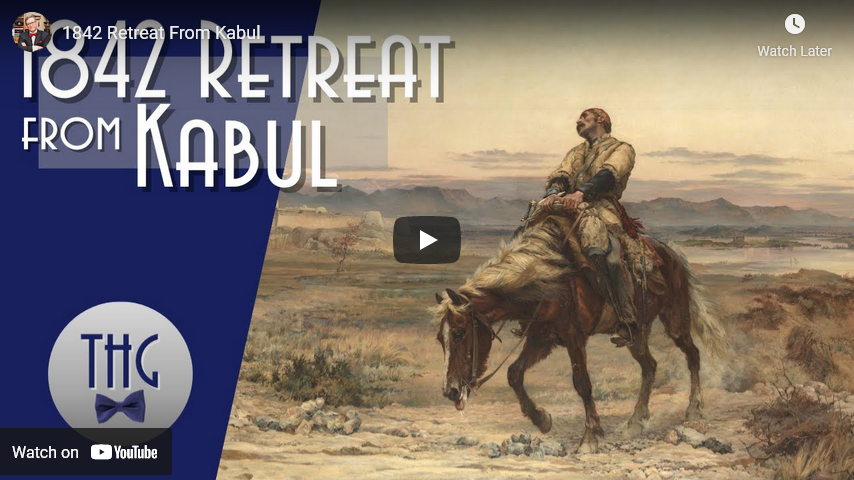
Remnants of an Army (1879) by Elizabeth Butler portraying William Brydon arriving at the gates of Jalalabad as the only survivor of a 16,500 strong evacuation from Kabul in January 1842.
Public domain image via Wikimedia Commons.

The remnants of an army, Jellalabad (sic), January 13, 1842, better known as Remnants of an Army, is an 1879 oil-on-canvas painting by Elizabeth Thompson, Lady Butler. It depicts William Brydon, assistant surgeon in the Bengal Army, arriving at the gates of Jalalabad in January 1842. The walls of Jalalabad loom over a desolate plain and riders from the garrison gallop from the gate to reach the solitary figure bringing the first word of the fate of the “Army of Afghanistan”.

Supposedly Brydon was the last survivor of the approximately 16,000 soldiers and camp followers from the 1842 retreat from Kabul in the First Anglo-Afghan War, and is shown toiling the last few miles to safety on an exhausted and dying horse. In fact a few other stragglers from the Army eventually arrived, and larger numbers were eventually released or rescued after spending time as captives of Afghan forces.

August 15, 2021

No Soviet Oil for Hitler – WW2 – 155 – August 14, 1942

World War Two
Published 14 Aug 2021

The Axis advance into the Caucasus is going great … except the oil towns they take have no oil, and wasn’t that the whole purpose? Meanwhile in the Pacific, the US Navy is suffering perhaps its greatest defeat ever off Savo Island, even as the Marines take Tulagi, Gavutu, and Tanambogo.
(more…)

August 14, 2021

Infantry Weapons at Guadalcanal – WW2 Special

Filed under: History, Japan, Military, Pacific, USA, Weapons, WW2 — Tags: , , , , , , , — Nicholas @ 04:00

Update: The folks at the World War Two channel have taken down this video due to technical errors in the script. Here’s their explanation.

World War Two
21 hours ago
Video on Infantry Arms at Guadalcanal retracted. Indy explains why:

Hi everyone. Indy here. As most of you know, I do the research and writing for all of the regular weekly episodes here. I host many of the specials as well, though I do not do the research for most of them- occasionally so, if it’s something that’s really in my field of expertise, like geopolitics, strategy, personal stories, communications, and international relations. The research for the other specials is done by a variety of specialists in their fields or historians, so we can maintain the quality you’ve come to expect from us. I understand, though, that many of you have serious issues with the research for the Guadalcanal infantry special. Our apologies for that- the research was done by an historian, a PhD [student], actually, and we also ensured it was double fact-checked, but obviously some serious mistakes slipped through. Live and learn. I will say that I think it is important that you continue to tell us when you take issue with something we present, since we strive to make the most complete and accurate documentary series possible, so although some of them are hard to read we appreciate such feedback from our community.

And this is from the researcher who worked on the script:

Marlon Londoño
18 hours ago
Hey guys! This is Marlon, the PhD student in question who helped with the researching and writing of the episode. Just to give a little background, I’m a volunteer researcher who helps with the channel over the summer while I’m not teaching/researching/taking coursework. I’m a military historian and my main academic focus is on social and cultural military history (i.e. what people’s wartime experiences were like and why. I’m especially interested in how people justify wartime violence and oftentimes the types of weapons they use play a role in that mental process, so that’s the context in which I usually think about weapons on the battlefield).

I’m sorry that I let a lot of you down with the mistakes about the Garand and Arisaka, among others. To be honest, I was surprised to learn they were myths. But I certainly know now, and I don’t think I’ll be forgetting any time soon 😅 One thing that I firmly believe as a researcher and educator is that nobody has a monopoly on the truth, least of all me. I tell that to my students on the first day of class each semester. I certainly don’t presume that the degree I’m pursuing makes me infallible or instantly qualified for anything. And this was a classic example of just how wrong I can be sometimes!

For what it’s worth, I love war history just as much as anyone else in the community, and I’m sorry that my research wasn’t as rigorous as it might otherwise have been. I hope you all might be willing to give any future episodes of mine a second chance, and of course I’m all ears for any mistakes that you want to point out!

August 12, 2021

QotD: Ignoring the warnings

Filed under: History, Japan, Middle East, Military, Pacific, Quotations, USA, WW2 — Tags: , , , , — Nicholas @ 01:00

… on Dec. 7, 1941, a U.S. Army Air Force lieutenant was spending his first-ever shift with a radar unit atop some Hawaiian high ground. Radar was brand new technology, and the U.S. was still figuring out how to best use it. The poor lieutenant watched on a scope as a big blob of something approached the naval base. He assumed it was a bunch of friendly planes coming in from the U.S. — what else would it be, right? Besides, even if he had been worried, there was no established protocol to sound an alarm. Forty-some-odd years before the release of Ghostbusters, the poor lieutenant was living the iconic tagline — when there’s a big mass of planes flying toward your base, who ya gonna call? And so the lieutenant and his men could only watch Japan’s massively successful attack on the U.S. fleet, an attack that caught the American defenders totally unprepared, with sailors asleep in their racks and senior officers golfing or breakfasting. There had been some intelligence warnings that Japan was up to something, but no one guessed that an attack on Hawaii was imminent. Not even the guys who quite literally saw it coming.

Let’s jump forward a few decades: in 1973, Israeli military intelligence was fully aware of a huge build-up of men and weapons on its borders with Syria and Egypt. The mobilizations were impossible to hide — tens of thousands of troops, tanks, artillery, the whole apparatus of modern warfare was lining up across Israel’s borders. But Israel’s top military intelligence officer concluded that the build-up was intended to apply political pressure ahead of negotiations, not actually to prepare for an assault. Israel was militarily superior, after all, and had handily defeated the combined Arab armies before, including just six years prior. The Arabs simply wouldn’t dare try again. Right?

Wrong. They dared, Israel was caught totally by surprise, and the Jewish state came shockingly close to defeat and likely destruction.

Ideally, these kinds of mistakes — mistakes of preparedness, mistakes of erroneous conclusion — are studied, learned from and then never repeated. In the real world, of course, we tend to make the same mistakes over and over.

Matt Gurney, “How the COVID crisis broke our leaders’ minds”, The Line, 2021-04-23.

« Newer PostsOlder Posts »

Powered by WordPress