
World War Two
Published 18 Dec 2021Just a few weeks ago massive offensives were launched in North Africa and the Soviet Union, against the Axis. These operations and offensives have now morphed into fully fledged campaigns, and the nature of these theatres of the war has been transformed.
(more…)
December 19, 2021
Guadalcanal Life Expectancy: 30 Days- WW2 – 173 – December 18, 1942
Comments Off on Guadalcanal Life Expectancy: 30 Days- WW2 – 173 – December 18, 1942
QotD: Sun Tzu’s Art of War reworked for the 21st Century by General Mark Milley
… here at The Babylon Bee, we’re legit journalists, so we’ve got the exclusive scoop. Here are some excerpts from the upcoming revision of The Art of War:
“If you think you might attack an enemy, pick up the phone and give ’em a heads up. It’s only fair.”
“You have to be careful not to surprise your enemy. They really don’t like it.”
“Treason is not treason if it is the lesser of two treasons.”
“Know thy pronouns, and know thy enemy’s pronouns.”
“The supreme art of war is to surrender to your enemy without fighting.”
“All war is white rage.”
“If you surrender, you can never lose.”
“If thy commanding officer sends mean tweets, thou need not follow orders or the chain of command.”
“The enemy of my friend is my friend.”
“Keep your friends close and your enemies on speed dial.”
“You can not betray the one to which you were never loyal.”
“Ask not what your country can do for you, but what you can do for China.”
“When retreating, leave most of thy armaments behind so you know what you’ll be up against next time.”
“Chinese bros before American hoes.”
“He who turns on bad orange man gets big book deal.”
“General Milley Is Releasing A Revised Version Of The Art Of War — And We’ve Got Exclusive Excerpts”, BabylonBee, 2021-09-17.
Comments Off on QotD: Sun Tzu’s Art of War reworked for the 21st Century by General Mark Milley
December 17, 2021
Those Olympic rings are more than just tarnished
In First Things, George Weigel notes the, ah, Olympian disdain for mere morality and human decency is far from a new thing as the IOC prepares for the Beijing games in 2022:
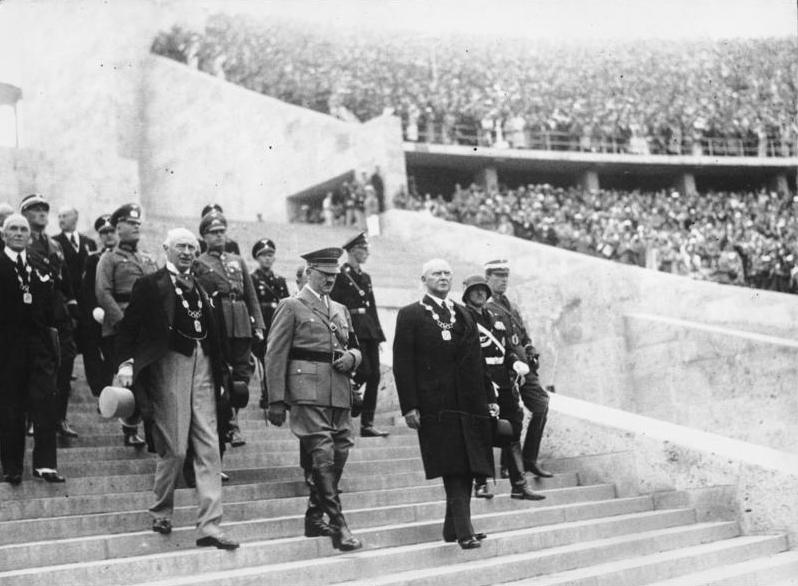
Google translation of the original German caption: “Before the ceremonial opening of the XI Olympic Games. Together with the members of the International and National Olympic Committee, the Führer and Reich Chancellor enters the stadium through the marathon gate. On the left of Adolf Hitler [Henry] Graf Baillet-Latour, on the right His Excellency [Theodor] Lewald.”
German Federal Archives (Accession number Bild 183-G00372) via Wikimedia Commons.
In July 2016, as we were sitting on the fantail of the Swiss sidewheeler Rhone while she chugged across Lake Geneva, my host pointed out the city of Lausanne, where a massive, glass-bedecked curvilinear building was shimmering in the summer sun. “Isn’t that the headquarters of the International Olympic Committee?” I asked. When my friend replied in the affirmative, I said, “I thought I smelled it.”
That rank odor — the stench of greed overpowering the solidarity the Olympics claim to represent — has intensified recently.
Even the casual student of modern Olympic history knows about the August 1936 Berlin Games, at which America’s Jesse Owens, a black man, took four gold medals and trashed Hitler’s Aryan supremacy myth. Fewer may be aware that, in February that year, the Olympic Winter Games were held in the Bavarian town of Garmisch-Partenkirchen. How, we ask today, could two Olympics be held in the Third Reich? How could people not know?
There was some controversy about holding the summer and winter Olympics under Nazi auspices. But in 1936, the German situation was not as comprehensively ghastly as it would become in later years. Yes, the Dachau concentration camp for political prisoners had opened in March 1933, and the Nuremberg Laws banning Jews from German citizenship and prohibiting marriage between Jews and “Aryans” had been enacted in 1935. The horrors of the Kristallnacht pogrom in November 1938 were two years in the future, however, and the satanic Wannsee Conference to plan the “Final Solution” to the “Jewish Question” would come six years later. Clear-minded people ought to have discerned some of the implications of the Nuremberg Laws. But the industrialized mass slaughter of millions, simply because they were children of Abraham, was beyond the imagination of virtually everyone.
So Hitler and his thugs temporarily behaved themselves (sort of) in the run-up to the Garmisch-Partenkirchen and Berlin Olympics. And the International Olympic Committee could salve whatever conscience it had in those days and proceed with the games.
The IOC has no excuses today, two months before the XXIV Olympic Winter Games open in Beijing. Because today, everyone knows.
Comments Off on Those Olympic rings are more than just tarnished
December 15, 2021
Why Real Wasabi Is So Expensive | So Expensive
Business Insider
Published 19 Jan 2019The green paste you’ve been eating with your sushi isn’t really wasabi. If you check the ingredients on the packet, you might see a mixture of sweetener, horseradish and perhaps a small percentage of the real thing. Real wasabi is hard to come across and it can cost $250 per kilo. So what actually is wasabi, and why is it so expensive?
For more from The Wasabi Company, go to: https://www.thewasabicompany.co.uk/
——————————————————
#Wasabi #Expensive #BusinessInsider
Business Insider tells you all you need to know about business, finance, tech, retail, and more.
BI on Instagram: https://read.bi/2Q2D29T
BI on Twitter: https://read.bi/2xCnzGF

Comments Off on Why Real Wasabi Is So Expensive | So Expensive
December 12, 2021
One Year Since Pearl Harbor – WW2 – 172 – December 11, 1942
World War Two
Published 11 Dec 2021The Japanese try and fail to supply their starving soldiers. The Allies fail to break through in Tunisia and New Guinea. The fighting in the USSR is bloody, but the Axis prepare for a new offensive there.
(more…)
Comments Off on One Year Since Pearl Harbor – WW2 – 172 – December 11, 1942
December 10, 2021
History Summarized: Britain and the Empire
Overly Sarcastic Productions
Published 20 Aug 2021How is it that the history of some islands off the northern coast of Europe balloons into a worldwide history? Empire is how! Let’s dig into the history of Britain since Union of the Crowns of England and Scotland in 1603, and follow that narrative through the monumental rise and precipitous fall of the British Empire.
Special thanks to the community members on Discord who assisted me with my script: Corvin the Crow, Johnny, Jdedredhed, Joud, Jéuname, Klieg, RileyTheProcrastinator, The Missing Link, and thesleepingmeerkat
SOURCES & Further Reading: The Great Courses Lecture series Foundations of Western Civilization II: A History of the Modern Western World by Robert Buchols lectures 11, 12, 13, 14, 15, 18, 19, 20, 21, 22, 30, The History Of England volumes 3 Rebellion, 4 Revolution & 5 Dominion by Peter Ackroyd, Scotland: A Concise History by Fitzroy MacLean, The Great Cities in History by John Julius Norwich, A Concise History of Wales by Geraint H. Jenkins, Sea Power: The History and Geopolitics of the World’s Oceans by James Stavridis.
Our content is intended for teenage audiences and up.
PATREON: https://www.Patreon.com/OSP
PODCAST: https://overlysarcasticpodcast.transi…
DISCORD: https://discord.gg/osp
MERCH LINKS: http://rdbl.co/osp
OUR WEBSITE: https://www.OverlySarcasticProductions.com
Find us on Twitter https://www.Twitter.com/OSPYouTube
Find us on Reddit https://www.Reddit.com/r/OSP/

Comments Off on History Summarized: Britain and the Empire
December 8, 2021
Imperial Japan – A Spy Comedy? – WW2 – Spies & Ties 11
World War Two
Published 7 Dec 2021Japanese spy rings were somewhat successful up until December 1941, but after Pearl Harbor, Japanese intelligence remains only a shell of its former self.
(more…)
Comments Off on Imperial Japan – A Spy Comedy? – WW2 – Spies & Ties 11
December 7, 2021
Kokoda Trail: D-by-D Recap 01
World War Two
Published 6 Dec 2021For the past months, we have continuously mentioned the fighting on the Kokoda Track, but it was often a mere footnote next to the colossal battles happening throughout the world. Today, we give you a unique recap of all that’s been going on in this remote theater of war.
(more…)
Comments Off on Kokoda Trail: D-by-D Recap 01
December 5, 2021
Axis Armies Facing Starvation – WW2 – 171 – December 4, 1942
World War Two
Published 4 Dec 2021The Soviets have launched offensives on the entire eastern front and by now hundreds of thousands of men are surrounded at Stalingrad. The Japanese win a battle at sea, but are losing a war of attrition.
(more…)
Comments Off on Axis Armies Facing Starvation – WW2 – 171 – December 4, 1942
December 2, 2021
XM-148: Colt’s Vietnam Grenade Launcher
Forgotten Weapons
Published 11 Dec 2019http://www.patreon.com/ForgottenWeapons
Cool Forgotten Weapons merch! http://shop.bbtv.com/collections/forg…
While the Special Purpose Infantry Weapon (SPIW) program failed to produce any successful rifles, it did become clear that the area-effect aspect of its requirements did have merit. This was spun off as its own program to develop a 40mm under-barrel grenade launcher for the M16 rifle. Of the initial entrants, (Philco/Ford, AAI, and Colt), Colt’s CGL-4 was the most promising. It was moved quickly through development and 10,500 were ordered in January 1966 as the XM-148. Field reports quickly turned sour, though, and in May of 1967 the XM-148 was ordered out of combat use, to be replaced with the M79 grenade launcher. The idea was sound, but the execution needed improvement — which would come in the form of the M203 launcher instead.
Many thanks to Movie Armaments Group in Toronto for the opportunity to showcase this grenade launcher for you! Check them out on Instagram to see many of the guns in their extensive collection:
https://instagram.com/moviearmamentsg…
Contact:
Forgotten Weapons
6281 N. Oracle #36270
Tucson, AZ 85704
Comments Off on XM-148: Colt’s Vietnam Grenade Launcher
November 28, 2021
Bigger Than Uranus? – Mars – WW2 – 170 – November 27 1942
World War Two
Published 27 Nov 2021Last week’s counterattack was just the beginning, for the Soviets launch another giant offensive this week. And things look bad for the Axis powers in the south of the USSR. Meanwhile in France, the French scuttle their navy rather than allow it to fall into German hands.
(more…)
Comments Off on Bigger Than Uranus? – Mars – WW2 – 170 – November 27 1942
November 26, 2021
The modern carrier debate
I recently started reading A Collection of Unmitigated Pedantry, a fascinating historical blog run by Dr. Bret Devereaux. You can expect to see plenty of QotD entries from his blog in future months, as I’ve been delighted to find that he not only has deep knowledge of several historical areas I find interesting, but that he also writes well and clearly. This post from last year is a bit outside his normal bailliwick, being modern and somewhat speculative rather than dealing with the ancient world, classic-era Greece, Republican and Imperial Rome, or the Middle Ages in Europe and the Mediterranean basin:
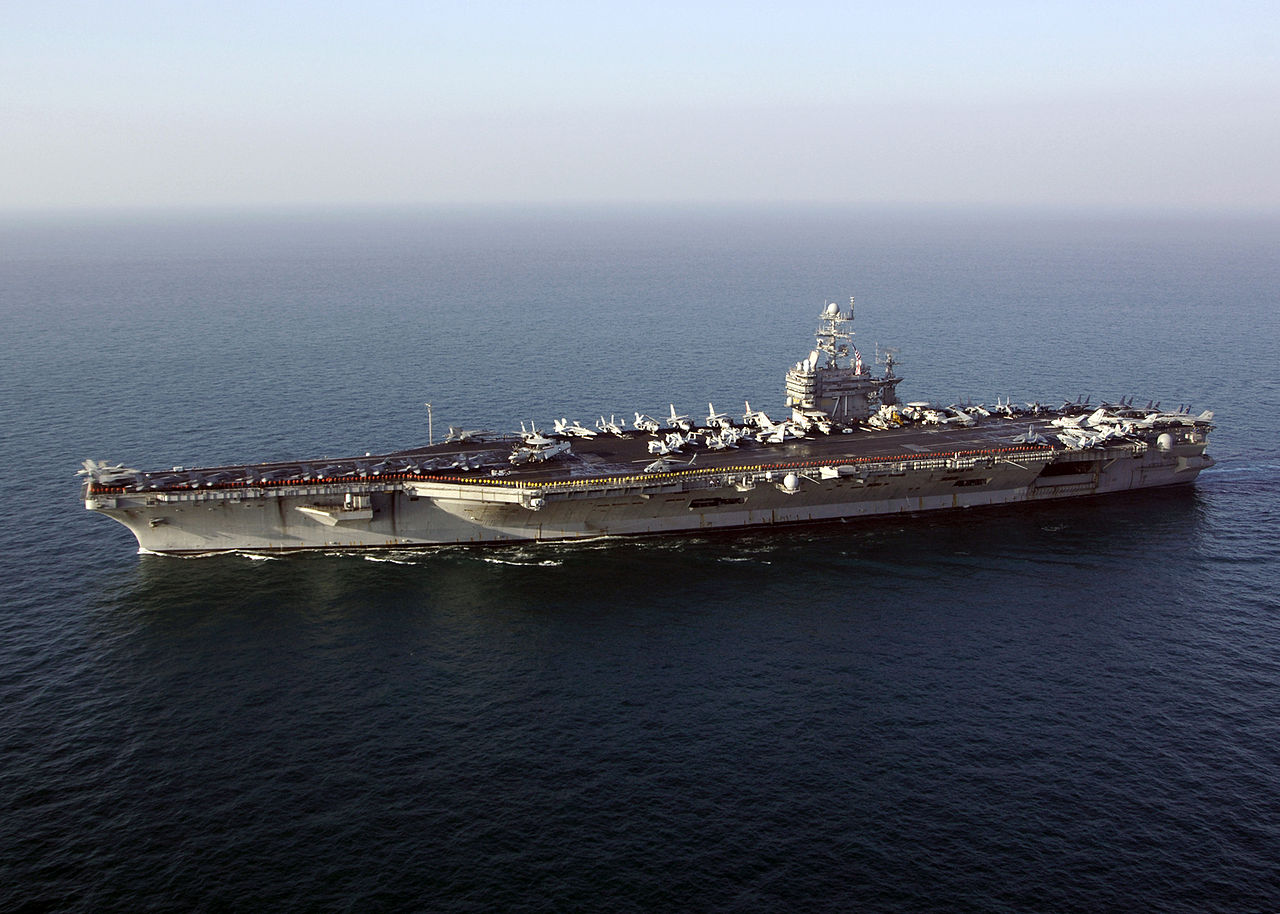
The Nimitz-class aircraft carrier USS Theodore Roosevelt (CVN 71) underway in the Persian Gulf, 3 December 2005.
U.S. Navy photo by Photographer’s Mate 2nd Class Matthew Bash via Wikimedia Commons.
Let’s talk about aircraft carriers for a moment […] There is currently a long-raging debate about the future of the aircraft carrier as a platform, particularly for the US Navy (by far the largest operator of aircraft carriers in the world), to the point that I suspect most national security publications could open companion websites exclusively for the endless whinging on aircraft carriers and their supposed obsolescence or non-obsolescence. And yet, new aircraft carriers continue to be built.
As an aside, this is one of those debates that has been going on so long and so continuously that it becomes misleading for regular people. Most writing on the topic, since the battle lines in the debate are so well-drawn, consists of all-or-nothing arguments made in the strongest terms in part because everyone assumes that everyone else has already read the other side; there’s no point in excessively caveating your War on the Rocks aircraft carrier article, because anyone who reads WotR has read twenty already and so knows all of those caveats already. Except, of course, the new reader does not and is going to read that article and assume it represents the current state of the debate and wonder why, if the evidence is so strong, the debate is not resolved. This isn’t exclusive to aircraft carriers, mind you – the various hoplite debates (date of origin, othismos, uniformity of the phalanx) have reached this point as well; a reader of any number of “heterodox” works on the topic (a position most closely associated with Hans van Wees) could well be excused for assuming they were the last word, when it still seems to me that they represent a significant but probably still minority position in the field (though perhaps quite close to parity now). This is a common phenomenon for longstanding specialist debates and thus something to be wary of when moving into a new field; when in doubt, buy a specialist a drink and ask about the “state of the debate” (not “who is right” but “who argues what”; be aware that it is generally the heterodox position in these debates that is loudest, even as the minority).
Very briefly, the argument about carriers revolves around their cost, vulnerability and utility. Carrier skeptics point out that carriers are massive, expensive platforms that are increasingly vulnerable to anti-ship missiles and that the steadily growing range of those missiles would force carriers to operate further and further from their objectives, potentially forcing them to choose between exposing themselves or being pushed out of the battlespace altogether (this, as an aside, is what is meant by A2/AD – “Anti-Access/Area-Denial” – weapons). The fear advanced is of swarms of hypersonic long-range anti-ship missiles defeating or overwhelming the point-defense capability of a carrier strike group and striking or even sinking the prize asset aircraft carrier – an asset too expensive to lose.
Carrier advocates will then point out all of the missions for which carriers are still necessary: power projection, ground action support, sea control, humanitarian operations and so on. They argue that no platform other than an aircraft carrier appears able to do these missions, that these missions remain essential and that smaller aircraft carriers appear to be substantially less effective at these missions, which limits the value of dispersing assets among a greater number of less expensive platforms. They also dispute the degree to which current or future weapon-systems endanger the carrier platform.
I am not here to resolve the carrier debate, of course. The people writing these articles know a lot more about modern naval strategy and carrier operations than I do.
Instead I bring up the carrier debate to note one facet of it […]: the carrier debate operates under conditions of fearsome technological uncertainty. This is one of those things that – as I mentioned above – can be missed by just reading a little of the debate. Almost none of the weapon systems involved here have seen extensive combat usage in a ship-to-ship or land-to-ship context. Naval thinkers are trying to puzzle out what will happen when carriers with untested stealth technology, defended by untested anti-missile defenses are engaged by untested high-speed anti-ship missiles which are guided by untested satellite systems which are under attack by untested anti-satellite systems in a conflict where even the humans in at least one of these fighting forces are also untested in combat (I should note I mean “untested” here not in the sense that these systems haven’t been through test runs, but in the sense that they haven’t ever been used in anger in this kind of near-peer conflict environment; they have all been shown to work under test conditions). Oh, and the interlinked computer systems that all of these components require will likely be under unprecedented levels of cyber-attack.
No one is actually certain how these technologies will interact under battlefield conditions. No one can be really sure if these technologies will even work as advertised under battlefield conditions; ask the designers of the M16 – works in a lab and works in the field are not always the same thing. You can see this in a lot of the bet-hedging that’s currently happening: the People’s Republic of China has famously bet big on A2/AD and prohibiting (American) carriers from operating near China, but now has also initiated an ambitious aircraft carrier building program, apparently investing in the technology they spent so much time and energy rendering – if one believes the carrier skeptics – “obsolete”. Meanwhile, the United States Navy – the largest operator of aircraft carriers in the world – is pushing development on multiple anti-ship missiles of the very sort that supposedly render the Navy’s own fleet “obsolete”, while also moving forward building the newest model of super-carrier. If either side was confident in the obsolescence (or non-obsolescence) of the aircraft carrier in the face of A2/AD weapons, they’d focus on one or the other; the bet hedging is a product of uncertainty – or perhaps more correctly a product of the calculation that uncertainty and less-than-perfect performance will create a space for both sets of weapon-systems to coexist in the battlespace as neither quite lives up to its best billing.
(I should note that for this brief summary, I am treating everyone’s development and ship procurement systems as rational and strategic. Which, to be clear, they are not – personalities, institutional culture and objectives, politics all play a huge role. But for now this is a useful simplifying assumption – for the most part, the people procuring these weapons do imagine that they are still useful.)
In many ways, the current aircraft carrier debate resembles a fast moving version of the naval developments of the late 1800s and early 1900s. Naval designers of the period were faced with fearsome unknowns – would battleships function alone or in groups? Would they be screened against fast moving torpedo boats or forced to defend themselves? How lethal might a torpedo attack be and how could it be defended against? Would they be exposed to short-range direct heavy gunfire or long-range plunging gunfire (which radically changes how you arm and armor these ships)? With technologies evolving in parallel in the absence of battlefield tests, these remained unknowns. The eventual “correct solution” emerged in 1903 with the suggestion of the all-big-gun battleship, but the first of these (HMS Dreadnought), while begun in 1904 was finished only after the Battle of Tsushima (May 27-8, 1905) had provided apparently startling clarity on the question.
Comments Off on The modern carrier debate
November 21, 2021
The Red Army Kicks Ass – Operation Uranus! – WW2 – 169 – November 20th, 1942
World War Two
Published 20 Nov 2021After months of stubborn defense the time has finally come for the Soviet counterstroke, but is it in time to save Stalingrad? And can the Allies reach Tunis and take all of North Africa before the Axis can reinforce?
(more…)
Comments Off on The Red Army Kicks Ass – Operation Uranus! – WW2 – 169 – November 20th, 1942
November 15, 2021
Fighting Nazis with Radios and Funerals – WAH 046 – November 1942, Pt. 1
World War Two
Published 14 Nov 2021As the Winter of 1942/43 is beginning, the German Nazis are under more and more pressure, both on the frontlines and in the occupation zones.
(more…)
Comments Off on Fighting Nazis with Radios and Funerals – WAH 046 – November 1942, Pt. 1
November 14, 2021
Axis and Allies Both Invade France – WW2 – 168 – November 13, 1942
World War Two
Published 13 Nov 2021Operation Torch goes off this week, the Allied invasion of French Northwest Africa, but this prompts the Germans to invade Vichy France. This is the Allies’ first combined major offensive in the Western Hemisphere. The Germans launch another offensive of their own this week, though — Operation Hubertus in Stalingrad. And in the South Pacific, a major naval battle begins off Guadalcanal.
(more…)
Comments Off on Axis and Allies Both Invade France – WW2 – 168 – November 13, 1942


