
TimeGhost History
Published 8 Jun 2025In 1949, the Soviet Union detonates its first atomic bomb — years ahead of Western expectations. This episode dives into how the USSR mobilized former Nazi scientists, forced Soviet physicists into secret cities, and relied on intelligence from spies like Klaus Fuchs. While Stalin pushes for rapid progress, Beria enforces brutal discipline, and Soviet scientists race to meet an impossible deadline. The nuclear balance of power is about to shift — forever.
(more…)
June 10, 2025
How Moscow Got the Atomic Bomb – W2W 31
Comments Off on How Moscow Got the Atomic Bomb – W2W 31
June 2, 2025
Fighting at Yenangyaung, 17-19 April 1942
Dr. Robert Lyman on the battle at Yenangyaung between 17-19 April 1942 early in the Burma campaign:
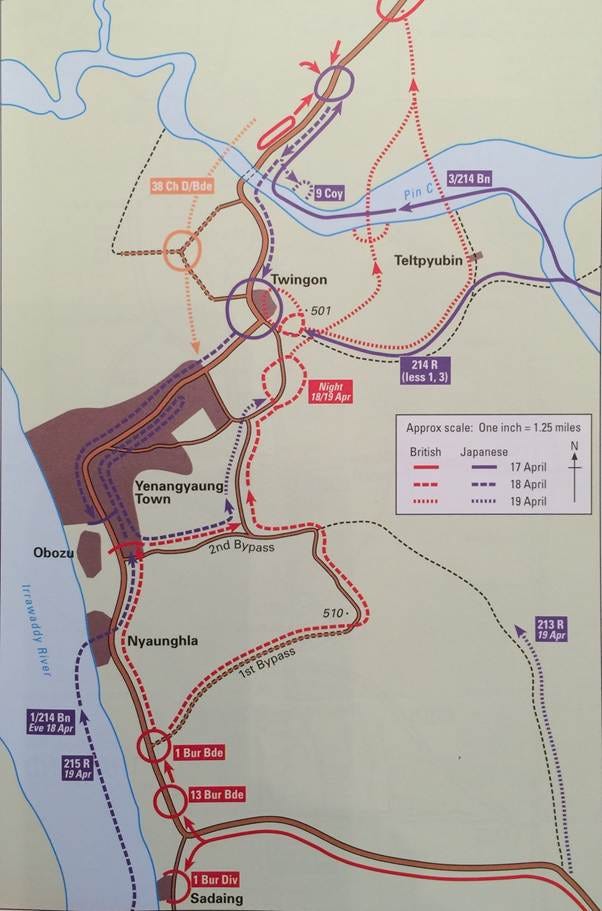
… the Yenangyaung battle is a fascinating one, with its own small degree of controversy, I decided to lay it out in this post. A mystery of the battle is the differing accounts of the Chinese attacks on the 19th April. In the British accounts (including Bill Slim’s in Defeat into Victory) the Chinese are blamed for failing to attack in the morning as they had promised, adding further jeopardy to the fate of the encircled 1st Burma Division. But was this true? The Japanese, Chinese and American accounts differ, so I thought I’d lay out the story to allow you, dear reader, to come to your own conclusion.
The fabulous map of Yenangyaung produced by the late Ian Lyall Grant.
The scrap at Yenangyaung was the final Corps-sized battle before the order to evacuate Burma Corps was given in early May. The Japanese had pushed out of Rangoon in mid-March, driving up the Irrawaddy on the left and against Toungoo on the right. Allied plans for the defence of Burma were inadequate, both Chinese (on the right) and Slim’s Burcorps (on the left) effectively fighting separate battles. Attempts by General Harold Alexander, the Army Commander, to control the battle and constrain the advancing Japanese ultimately came to naught. Alexander, Slim and Lieutenant General Joe Stilwell, nominally commanding the Chinese 5th Army, tried every trick in the tactical rule book to bring a halt to the relentless Japanese advance, and to destroy them in battle. After a month of fighting in which the Chinese were pushed out of Toungoo, the British lost control of Prome and an attempt to consolidate a defensive line across the country failed, the Japanese moved up the Irrawaddy in an attempt to turn the British flank, breaking in at the oilfield town of Yenangyaung on 17 April. At the time Slim’s Burma Corps was attempting to withdraw to the north from Allamyo. The Japanese infiltration into Yenangyaung cut the British in half. The 1st Burma Division was now cut off in Yenangyaung. The battle by the already weakened division (amounting to probably no more than 4,000 troops) into the Yenangyaung pocket over the period 17 and 19 April proved to be the severest trial yet faced by British troops in the short Burma campaign, the pressure applied by the Japanese exacerbated by the intense heat and the lack of water.
It was critical that Slim defeated this Japanese infiltration, rescue the 1st Burma Division from encirclement and retain the integrity of his Corps. If Yenangyaung were lost the Japanese would be free to sweep north to threaten Mandalay. It was crucial therefore that the divisional commander – Major General Bruce Scott – held on for as long as he could. But Slim had no reserve. The only hope of relief lay in assistance from the Chinese far to his right. He concluded that if he could engineer a attack into the pocket by the Chinese, across the Pin Chaung, combined with a breakout attack by 1st Burma Division, they might have a chance of escape. Nothing else looked likely to succeed.
When asked, Stilwell agreed to Alexander’s request for help to be provided to Slim, and gave him Lieutenant General Sun Lijen’s 38th Division – responsible for the defence of Mandalay – for the task. Chiang Kai-shek had given Sun responsibility for defending Mandalay. At midnight on 16 April Sun received an order from General Lo Cho-yin, “to dispatch his 113th Regiment to Kyaukpadaung, there to be commanded by the British General Slim …” Sun’s friend, Dr Ho Yungchi, recorded that by 3 a.m. he had arrived at Lo’s HQ at Pyawbe to discuss the order. Lo explained that the British were in serious trouble “in the oil town of Yenangyaung and had sent repeated requests for help”. By 6.30 a.m. it was agreed that Sun would personally take command of the 113th Regiment, while the two remaining regiments stayed to defend Mandalay. Sun and 1,121 men of 113th Regiment (commanded by Colonel Liu Fang-wu) arrived at Kyaukpadaung on the morning of 17 April.
Slim recalled: “The situation was not encouraging, and I was greatly relieved to hear that 113 Regiment of the Chinese 38th Division was just arriving at Kyaukpadaung. I dashed off in my jeep to meet their commander and give him his orders … this was the first time I had had Chinese troops under me … I got to like all, or almost all, my Chinese very much. They are a likeable people and as soldiers they have in a high degree the fighting man’s basic qualities – courage, endurance, cheerfulness, and an eye for country.”1
At Yenangyaung, Slim’s plan was for Sun’s 38th Division to attack from the north on the morning of 18th April while the 1st Burma Division, within the pocket, fought its way out. As Slim and Sun Lijen talked, discussing the details of the attack planned for the following morning Slim decided that he would place the Stuart tanks of the 7th Armoured Brigade directly under Sun’s command. It was only a move a man confident in the capabilities of his allies could make. Slim commented that “I was impressed by Sun and it was essential to gain his confidence. His division had no artillery or tanks of its own, and I was therefore arranging that all the artillery we had this side of the Pin Chaung and all available tanks should support his attack.” The commander of the British armoured brigade – Brigadier John Anstice – accepted this arrangement and according to Slim “he and Sun got on famously together”. What’s more, the soldiers worked well together too, Slim recording that the “gunners and tank crews, as is the way of British soldiers, soon got on good terms with their new comrades, and, in spite of language difficulties of an extreme kind, co-operation was, I was assured by both sides, not only close but mostly friendly.”2 Accordingly, at 6.15 a.m. on 18 April, Major Mark Rudkin of 2nd Royal Tank Regiment (2RTR) reported as instructed by Anstice to 38th Division HQ:
There was little activity except for the cooking of breakfast and it seemed most unlikely that the attack could start on time. I asked the British liaison officer with the Chinese what was happening and he informed me that as the Chinese realized that they would not be ready to attack at 0630 hours, they had put their watches back one hour, so that officially they were still attacking at 0630 though the time would in reality be 0730. They had, therefore, not lost “face” by being late.
The plan was that a troop of tanks would follow the leading troops of the leading Chinese battalion and give what support it could. Another troop was to follow the leading infantry battalion and assist the leading troop if required. The tanks would be almost entirely road bound owing to the going off the road.
At 0730 the assaulting Chinese moved forward off the ridge on a front of about four hundred yards, the leading troop keeping very close behind on the road. On foot near the tanks was a Chinese interpreter who carried out liaison between the tanks and infantry.
After advancing about half a mile the leading tank was hit by a Japanese 75-mm gun situated on the road just north of the Pin Chaung which was firing straight up 300 yards of road. The tank was disabled but there were no casualties.
The Chinese advance continued and by afternoon had almost reached the line of the ford on the Pin Chaung which was still held by the enemy. The Chinese had had heavy casualties, especially amongst officers, as it was the custom for Chinese officers to lead, whatever their rank. It was finally decided to hold positions about half a mile north of the crossing and continue the attack next day.3
With the first attack a failure, the Japanese retained their grip on both the ford and the village of Twingon. The situation for the surrounded remnants of the 1st Burma Division was desperate; the Japanese close to achieving a complete victory. Slim and Sun then worked through a plan for another attempt to be made the following morning, 19th April. This day also began badly, however. The Chinese attack was scheduled to begin at 7 a.m. British accounts subsequently recorded that a Chinese attack did not materialise at this time. Slim subsequently recorded in Defeat into Victory that the failure to attack must have been a function of the administrative difficulties faced by the Chinese. He wrote that with the Chinese “lack of signalling equipment, of means of evacuating wounded and of replenishing ammunition, and their paucity of trained junior leaders it was not surprising that to sort themselves out, reform, and start a fresh attack took time”.4 Slim was invariably impressed with what he saw of the Chinese soldier in action, but considered their support and command functions to be shockingly poor and a source of constant frustration to themselves, and to all who had occasion to operate with them.
Slim, and most other British published accounts, including the Indian and British Official Histories, record that the attack finally went in at 3 p.m., when Colonel Liu’s 113th Regiment successfully captured the ford and penetrated into Yenangyaung.5 “When the Chinese did attack they went in splendidly” wrote Slim in admiration. “They were thrilled at the tank and artillery support they were getting and showed real dash. They took Twingon, rescuing some two hundred of our prisoners and wounded. Next day, 20th April, the 38th Division attacked again and with tanks penetrated into Yenangyaung itself, repulsing a Japanese counter-attack. The fighting was severe and the Chinese acquitted themselves well, inflicting heavy losses, vouched for by our own officers.”
1. Slim, Defeat into Victory (1956), p. 63.
2. Ibid., p. 65.
3. Bryan Perrett, Tank Tracks to Rangoon: The Story of British Armour in Burma (London: Robert Hale, 1978)
4. Slim, op. cit., p. 70.
5. Bisheshwar Prasad (ed,) The Retreat from Burma 1941 – 42 (Calcutta, Combined Inter-Service Historical Section, 1954), p. 296.
Comments Off on Fighting at Yenangyaung, 17-19 April 1942
May 28, 2025
Masters of the Air – The Bomber War Episode 4 – 8th Air Force 1942-1943
HardThrasher
Published 6 Jan 2024If you’d like to be a cool kid, then become a Patreon or if you’d like to email me send a message to lordhardthrasher@gmail.com
0:00 Intro
4:30 We’re Going to North Africa 1st
8:36 But you’re not doing it properly
16:16 Play it Again Ira
22:30 Mid 1943 – The Crisis Begins
26:53 The Black Summer
28:03 Operation Tidal Wave
34:21 Into The Valley of Death – Schweinfurt
41:34 What Now?
48:37 Survivors Club
(more…)
Comments Off on Masters of the Air – The Bomber War Episode 4 – 8th Air Force 1942-1943
May 25, 2025
Comparing Japan’s supply management system to the Canadian version
Colby Cosh considers the fate of a Japanese government minister who accidentally told the truth about a subject near and dear to Japanese consumers’ hearts (well, stomachs, actually):
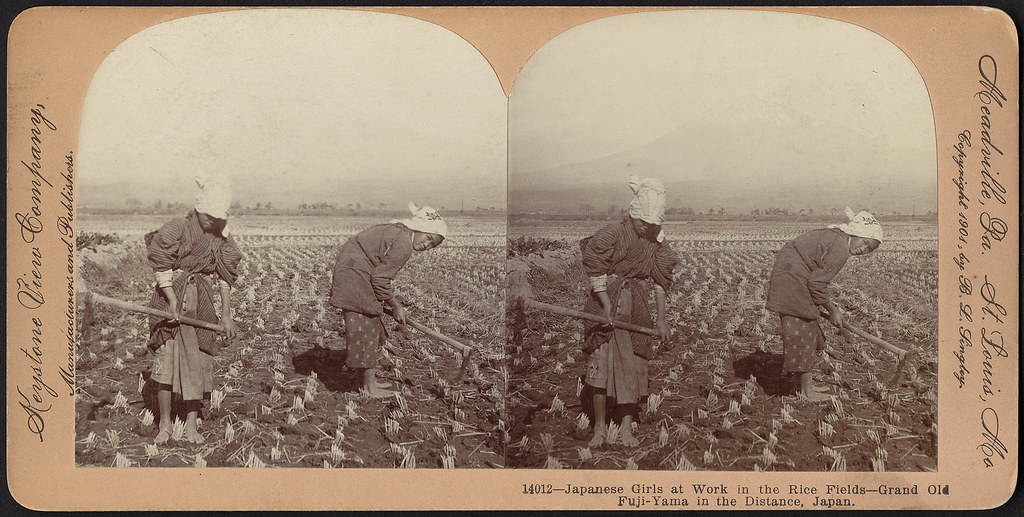
“Japanese Girls at Work in the Rice Fields – Grand Old Fuji-Yama in the Distance, Japan” by Boston Public Library is licensed under CC BY 2.0 
 .
.
I’m sure some of you saw Wednesday’s NP headline for an Associated Press wire story: “Japan’s agriculture minister resigns after saying he ‘never had to buy rice’” AP’s Mari Yamaguchi explained this international-news nugget. A cabinet minister in a shaky minority government made a flippant comment indicating that he was light-years out of touch with ordinary people facing high grocery costs in a developed country.
Taku Eto’s political survival thus became impossible within a matter of hours, and his prime minister hastily swapped a congenial young star into the agriculture portfolio. Japan is a constitutional monarchy with a system of parliamentary government more or less like ours, so there’s nothing incomprehensible about any of this to a Canadian …
… but, of course, one almost couldn’t help flashing back to our recent election campaign, wherein the prime minister had half-boasted to a Radio-Canada reporter that he doesn’t buy his own groceries and has no earthly idea how the stuff in his fridge gets there. It struck me at the time that this was a classic mistake for an electoral neophyte like Mark Carney. Fans of the legendary American columnist Michael Kinsley will surely think of it as a “Kinsley gaffe”, i.e., an obviously true statement that is nevertheless bound to get a politician in trouble.
[…]
Eto was talking about rice because the prices for it in Japan have gone through the roof, the clouds and the stratosphere. And rice plays a role in the Japanese culture and diet for which there is no analogue in omnivorous Canada. For precisely that reason, rice is supply-managed there in much the same way our dairy, eggs and poultry are — i.e., through confiscatory tariffs on foreign products, along with a mafia of politically powerful producer cooperatives who operate under supply quotas.
If you read Canadian news, you can recite the effects of this, whether or not you’re capable of finding Japan on a map of Japan. Their supply-management system is, like ours, a major headache for counterparties in trade negotiations. Their farmers, like Canada’s, are dwindling in number and aging out of the business. They are sometimes paid to destroy crops. Farm costs for machinery and supplies are subject to inflation. And sometimes the system for domestic demand forecasting blows a tire.
It’s a constant high-wire act for Japanese governments, who still have official responsibility for the national rice supply under wartime statute. If store-shelf prices get too high, and consumers start to make trouble, the cabinet must consider loosening tariff barriers and releasing rice from the national strategic reserve. The LDP ministry has done both these things in the face of hallucinatory prices, and so the farmers are now just as ticked off as the buying public.
Comments Off on Comparing Japan’s supply management system to the Canadian version
May 23, 2025
Yasukuni-jinja, Japan’s most controversial historical site
Nigel Biggar on the Yasukuni-jinja in the Imperial Gardens in Toyko, where the Japanese shrine to their war dead also celebrates fourteen convicted WW2 war criminals:
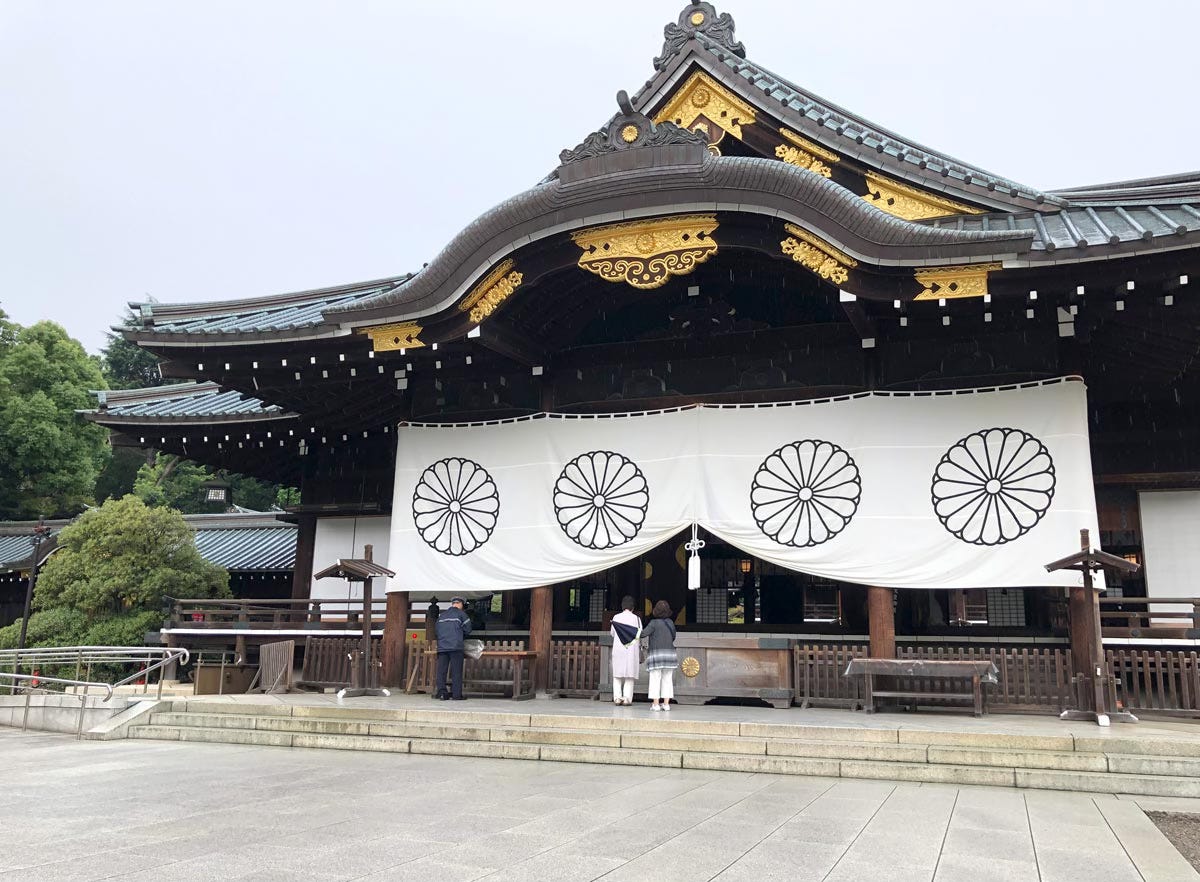
The Yasukuni Shrine in the Imperial Gardens, Tokyo.
Photo by Pierre Hazan
If ever you find yourself in the centre of Tokyo, make your way to the north-west corner of the Imperial Gardens, and turn left. A few minutes will bring you to the Yasukuni-jinja, Japan’s most controversial site. This is the national shrine to the war-dead, whose two and half million resident “glorious souls” include fourteen Class A war criminals.
A hundred yards to the right of the main shrine stands a museum, the Yushukan. Upon entering it, a visitor finds himself immediately face to face with a locomotive.
Now, when an Anglo-Saxon puts together Japan, Second World War, and locomotive, he arrives at one thing only: the “Burma Railway”. This is the railway that was hacked through the Burmese jungle partly by Allied prisoners-of-war, who were treated as slave labour and perished in their thousands. Over 12,000 Westerners died — about one in five — alongside perhaps 90,000 Asians.
So our Anglo-Saxon visitor beholds the locomotive with a mixture of disbelief, rising horror, and curiosity. He approaches the machine, looking for an explanatory text. Finding it, he learns that this locomotive is one of ninety that ran along the Burma Railway. He also learns the name of the military unit responsible for the railway’s construction. But of the Allied prisoners, the slave-labour, and the number of their deaths he learns nothing at all.
The Burma Railway wasn’t Auschwitz, either in genocidal intent or in murderous scale. But it was similar in its cruel contempt for human life. So the experience of confronting this Tokyo locomotive is analogous to stepping into a museum in Berlin and being confronted by one of the trains that shipped Jews to Auschwitz, and then reading an explanation that omits any mention of its cargo or the nature of its destination. If there were such a museum in Berlin, I’d have found it.
When our Anglo-Saxon ventures deeper into the Yushukan, he eventually discovers the exhibition on the 1930s and World War Two in the Far East. And here he learns that Japan’s imperial expansion was in fact a war of liberation, waged on behalf of subjugated Asian peoples, against Western colonial domination. And he learns that, even though Japan lost the war militarily, she won it politically, since the example of her early victories over the French in Vietnam, the Americans at Pearl Harbor, and the British at Singapore helped to inspire anti-colonial movements worldwide and so succeeded in ridding the world of European empires.
He also learns that what is known outside Japan as “the Rape of Nanking” (1937-8) is referred to demurely in the museum as “the Chinese incident”. And that whereas the “Rape of Nanking” is reckoned to have involved the indiscriminate massacre by Japanese troops of about 300,000 Chinese civilians, “the Chinese incident” only involved the severe treatment of Chinese troops who had violated the laws of war by disguising themselves in civilian clothes.
Comments Off on Yasukuni-jinja, Japan’s most controversial historical site
May 17, 2025
Learning racism in Japan
John Carter recounts how his views and opinions on racism changed while living for an extended period in Japan:
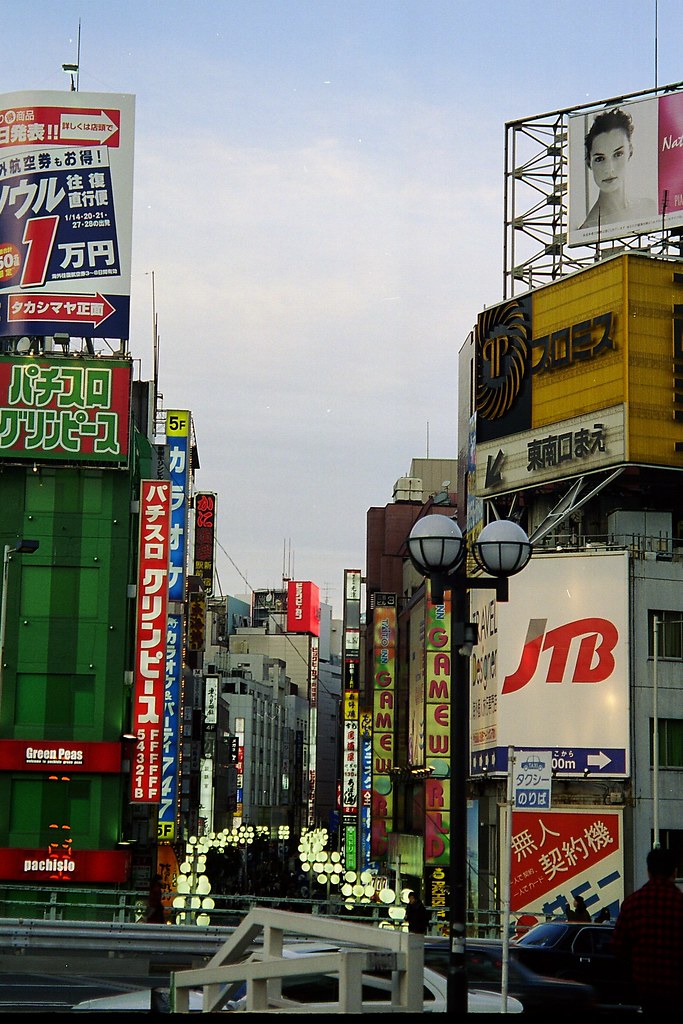
We started the conversation talking about the Shiloh Hendrix affair, but ultimately got onto the subject of the Land of the Rising Sun. As it turns out, Alexandru and I have both spent quite some time living in Japan, an experience which contributed to both of us becoming incorrigible racists. This is a very common occurrence: almost anyone who spends a significant amount of time living in a very different country will start to draw conclusions about the differences between human groups. Your levels of epistemic closure need to be extraordinarily high to avoid this.
When I first moved to Japan I was, in most ways, an unreconstructed liberal. I took the axiomatic precept of the Boomer Truth Regime – that stereotypes are both incorrect and evil, because all people are basically the same – more or less for granted. This was very easy for me to do: I’d grown up in a remote, homogeneously Anglo part of rural Canada, and while I’d had some degree of exposure to different ethne at university, this was during a period in which Canada was making a real effort to filter immigrants for quality, and most of the non-white, second-generation immigrants I interacted with were heavily westernized. I wasn’t unaware of cultural differences, but I generally assumed that it went no deeper than that, and that inside every human being there was a liberal Anglo struggling to break free.
Japan of course is a completely alien culture. Among the many profound differences with the contemporary West is that the Japanese are, famously, intensely and unashamedly racist, or “xenophobic” as it is usually framed. I was initially taken aback by how frank the Japanese could be about this, for instance by asking questions about me that were clearly in rooted in their stereotypical understanding of what young North American white boys were generally like. But there were two things about this experience that quickly made me stop and think. First, these questions were almost never hostile, but rather came from a place of genuine curiosity: they were simply trying to get to know me, which they would do by starting with a default mental picture and then testing to see if and how I conformed or departed from that picture so that they could update their model accordingly. Yet I had been assured my entire life, by every TV show, movie, and teacher, that stereotypes were always hateful! Second, a great many of their stereotypical assumptions about me were uncomfortably accurate. Yet I had been assured my entire life, by every TV show, movie, and teacher, that stereotypes were always wrong!
It didn’t take me long to get over this cognitive dissonance, which I resolved by the simple expedient of concluding that I’d been lied to by my culture, which is something that even then I’d realized happens a lot. This then gave me internal permission to observe the Japanese themselves, to notice the myriad differences in character and behaviour as compared to my own people, and to connect these individual level differences to their emergent societal consequences.
Learning racism in Japan is a humbling experience for a Westerner. I’ve travelled to a lot of different countries, and everywhere else I’ve either felt like my own people were basically on the same civilizational level (Europe), or at a noticeably higher level (South America). Japan is the only place I’ve ever been where I felt like an unlettered, uncouth, savage, stinky barbarian primitive one step removed from the cave – where it was obvious that my own people could learn quite a bit about how to comport themselves in a civilized fashion. Then again, at the same time, this taught me to value that very barbarism: it’s quite possible, as the Greek understood when regarding the Mede, to be overcivilized.
I could go on about this subject for hours, but I’ve got things I need to do today – like go to the gym and get some work done on other projects I’ve been engrossed in – and I wanted to get this out fast. In any case, I did go on about this subject for hours, with Alexandru and Phisto, so if you’d like to hear more about Japan you’ll just have to click through and listen.
Comments Off on Learning racism in Japan
May 4, 2025
The Clean German Myth, Doomed B-17 Pilots, and Japan’s Rapid Victories – Out of the Foxholes Live
World War Two
Published 3 May, 20205Indy and Sparty tackle some more of your interesting questions in another live Out of the Foxholes. Today they look at loss rates of B-17 crews, the myth of the clean Wehrmacht, and ask why the West was apparently so unprepared for Japan’s attack.
(more…)
Comments Off on The Clean German Myth, Doomed B-17 Pilots, and Japan’s Rapid Victories – Out of the Foxholes Live
April 29, 2025
The US Cancels Tariffs and Saves the World – W2W 025
TimeGhost History
Published 28 Apr 2025After seeing the devastating effects of the trade war that ravaged the global economy between the world wars, in 1948 the US is determined to usher in an age of free trade and global cooperation that will last until the spring of 2025.
(more…)
Comments Off on The US Cancels Tariffs and Saves the World – W2W 025
April 27, 2025
Nuking the Reich: What If the War Had Dragged On? – Out of the Foxholes Live
World War Two
Published 26 Apr 2025Indy and Sparty bring you another episode of Out of the Foxholes Live! Today they talk about Thailand’s relationship with Japan, ask why the Americans firebombed Japanese cities even after cutting off the country’s supplies, and they tackle a big one: would the Allies have nuked Germany?
(more…)
Comments Off on Nuking the Reich: What If the War Had Dragged On? – Out of the Foxholes Live
QotD: Fighting against Japan in the Pacific
Japan’s biggest advantage in the Pacific was knowing the terrain. Volcanic atolls being what they are, there are only a few places in the whole South Pacific that can be turned into airfields. Not only that, but there are only a very few approaches to those places, and the Japanese knew them all. If you’re outmanned and outgunned, a strategy of digging in deep and selling your lives as dearly as possible is the only way to go. Bleed the enemy white.
And lord knows the Americans took the bait, more than once. If “bait” is really the right word, because if you’ve got no choice … the early campaigns in the Solomons were so legendarily nasty for that reason: You have no choice but to go right up the pipe to seize an objective, and if you do, the enemy has no choice but to go right up the pipe to get it back.
The genius of the later American strategy — and credit where it’s due, few people have a lower opinion of MacArthur than I, but this was brilliant — was to simply go around. Heavy bomber strips are a must, and in the even fewer places in the Pacific that can take heavy bombers, the Americans had no choice but to go right up the chute … but carrier airpower can do a hell of a lot, particularly when it can move about completely unmolested by the enemy. Thus the Americans turned all those guaranteed meat grinders the Japanese had set up for them into big open-air POW camps, without bothering to go in there and force them to surrender (which, of course, they wouldn’t). Have fun starving in your bunkers, boys; we’ll just leave a covering naval detachment, to make sure you can’t evacuate; see you when the war’s over.
Severian, “Strategy”, Founding Questions, 2021-11-21.
Comments Off on QotD: Fighting against Japan in the Pacific
April 22, 2025
Rise of Japan: 1st Sino-Japanese War 1894-95
Real Time History
Published 18 Apr 2025In 1894, tensions are rising in East Asia. There’s trouble in the small but strategically-located Kingdom of Korea, as rival factions in the royal family fight for power and against popular uprisings. Shaken by a major revolt, Korea’s King Kojong calls on China for help – but Japan intervenes, setting off a war that will devastate Korea and upend the old order in Asia.
(more…)
Comments Off on Rise of Japan: 1st Sino-Japanese War 1894-95
April 20, 2025
Did Britain Bomb The Wrong Targets in WW2? – Out of the Foxholes Live
World War Two
Published 19 Apr 2025Today Indy and Sparty answer questions on the French colonies, Pykrete and iceberg aircraft carriers Japan’s invasion of India, and they talk about Britain’s misguided strategic bombing strategy.
(more…)
Comments Off on Did Britain Bomb The Wrong Targets in WW2? – Out of the Foxholes Live
April 19, 2025
QotD: Allied air and sea operations won WWII
The Allies won the war by using air power to destroy the German and Japanese capacity both to produce military equipment and to transport it to the battlefield. By 1944-45, the Germans and Japanese could not use their economies to arm and supply their armies on the battlefield, leading to their inevitable defeat.
In the European war, American and British airpower: (a) directly destroyed a significant amount of productive capacity, (b) rendered remaining capacity far less efficient, (c) made it impossible for the Germans to defeat western ground forces, and (d) compelled the Germans to waste tremendous resources on air defense and exorbitant, ultimately ineffective vengeance weapons.
In the Pacific, the United States used carrier-based airpower, submarines, and bomber-deployed mines to isolate Japan from the resources of the empire it conquered in 1941-42. American bombers also directly destroyed factories and transportation systems, leading to similar levels of economic dysfunction as in Germany.
Anonymous, “Your Book Review: How the War Was Won“, Astral Codex Ten, 2024-08-09.
Comments Off on QotD: Allied air and sea operations won WWII
April 16, 2025
Food in the Japanese-American Internment Camps of World War 2
Tasting History with Max Miller
Published 3 Dec 2024Tuna noodle casserole made with spaghetti, and rice with canned apricots for dessert
City/Region: Topaz War Relocation Center, Utah
Time Period: 1943In 1942, anyone of Japanese ancestry in the United States was forcibly sent to live in incarceration camps. Food was often in the form of leftover military rations that was augmented by crops grown by the people living in the camps, but there were also canteens that sold food and sundries. These items were great luxuries as the Japanese Americans living in the camps made only about 1/5 of a typical wage and included things like Ovaltine, apple juice, and canned tuna.
This recipe, from a newspaper printed in the Topaz War Relocation Center, makes a tasty, if basic, tuna noodle casserole. I would add more of the paprika, or really some more spices in general, but I really like the lightly crunchy texture of the bread crumbs and the celery.
If you’d like to serve this forth with dessert, as I did, then you simply need some cooked white rice and some canned apricots with syrup.
(more…)
Comments Off on Food in the Japanese-American Internment Camps of World War 2
April 9, 2025
Battle of Saipan 1944: Total War in the Pacific
Real Time History
Published 15 Nov 2024In June 1944, an armada of warships and landing craft is getting ready for D-Day. Thousands of American soldiers are about to attack a prepared enemy with formidable defenses. But this isn’t Normandy, this is the island of Saipan. And the bloody battle there will bring total war to the Pacific.
Chapters:
00:00 Why the US Landed on Saipan
01:46 American Plan for Saipan
03:38 Japanese Defenses on Saipan
05:08 Preparations for D-Day on Saipan
06:39 D-Day on Saipan
08:46 Marine Combat Shotguns on Saipan
14:48 Japanese Counterattack
16:30 D-Day Plus 3 on Saipan
17:01 Battle of the Philippine Sea
20:45 D-Day Plus 7-9 on Saipan
22:33 D-Day Plus 11-15 on Saipan
24:10 Japanese Banzai Charge on Saipan
26:46 Civilian Casualties on Saipan
27:57 End of the Battle of Saipan
28:48 Battles of Tinian and Guam
30:04 Epilogue
(more…)
Comments Off on Battle of Saipan 1944: Total War in the Pacific


