
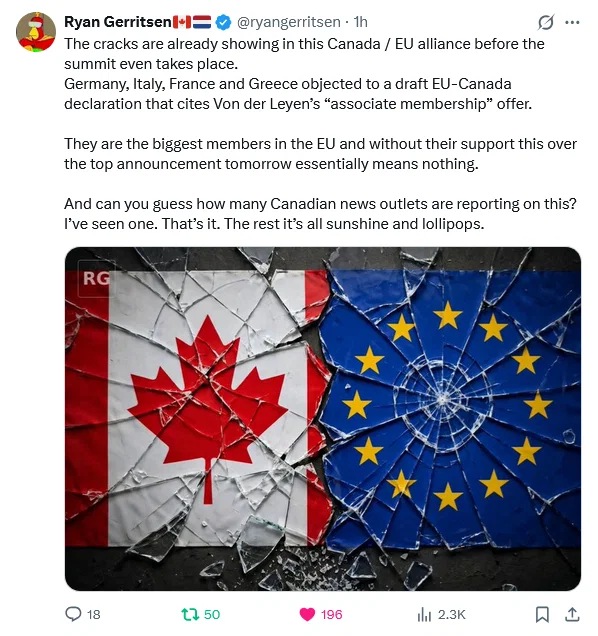
Canada’s propaganda outlets are doing everything they can to hide the fact that Carney’s EU love affair is going badly.
Although Canadian voters weren’t given any advance notice, the clear goal of Prime Minister Mark Carney is to move Canada deep into the orbit of the European Union. While I think this is a terrible idea, it’s very attractive to the urban managerial class in Toronto, Montreal, and Vancouver … they tend to think of the rest of Canada as being knuckle-dragging, low IQ chuds anyway, and already consider themselves to be simpatico with the Eurobureaucratic elites. Fulfilling Carney’s dream would go down well with those folks (who are already disproportionally Liberal voters). On Substack Notes, GJS links to an article on the attempt to Europeanize Canada saying:
Urban sophisticates are intoxicated by the idea of Canada “becoming more European” because they envision themselves lolling away the hours swilling café au laits and Beaujolais in quaint city squares, debating the meaning of life and whether Parmigiano Reggiano is superior to Le Gruyère. Tim Hortons, trucks and SUVs, and brutish blue collar workers will all instantly evaporate into the sky, and there’ll be no more talk of crude and barbaric matters like hockey, natural resource extraction, or Nickelback. Don Cherry and Stephen Harper will be erased from our history and we’ll ride bicycles with baguettes tucked under our arms.
At Haultain Research, Marco Navarro-Génie discusses eight things that make Carney’s EU dreams unrealistic and unlikely to come true:
How does a country become more sovereign by joining a union that makes rules but cannot vote on them? Prime Minister Mark Carney told the European Parliament this week that Canada will.
Ursula von der Leyen offered the title of “first associate member” the day before, and he welcomed it, then said at his press conference that the term was hers. But the term has no substance yet. No treaty article defines an associate member, no text sets out what Canada would take on or give up, and the two sides have agreed only to “define together” what the words mean. The sovereignty he promised rests, for now, on an aspiration with a name. The question is how it could ever work.
Start with what nobody disputes. Canada sells roughly seven of every ten export dollars to one customer, and that customer has spent almost two years proving it will use the fact against us. Albertans have been saying this since Quebec and BC blocked new pipelines to tidewater. Ottawa treated the complaint as a regional grievance, killed Northern Gateway, let Energy East die, and bought Trans Mountain only after its owner gave up. If the federal government has finally discovered that Canada needs more customers, the West welcomes the conversion, however late. Closer ties with Europe are part of any sensible answer; Europe is wealthy, democratic, and already bound to us by a trade agreement. Its future, however, is questionable.
The argument rests on emotional primacy and the claim that a closer embrace makes Canada freer.
Eight things about that claim do not add up.
The first is the use of the word sovereignty. Mark Carney used it six times in Strasbourg. He defined it as a country’s ability to make its own choices without being dictated to. Then he listed what he wants from Europe: common standards for artificial intelligence, pooled computing power, an integrated market for financial services, membership in European research and student programmes, alignment on energy and digital rules. How much of that requires Canada to follow rules made by institutions in which it has no seat and no vote? Members surrender powers and get a vote in return. A non-member who follows the rules gets the obligations without the empowering vote.
At Davos in January, Carney had a phrase for accommodating a hegemon. He called it “the performance of sovereignty while accepting subordination.” Everyone understood which hegemon he meant. The sentence today fits Brussels without changing a word.
The second is the title. Ursula von der Leyen offered Canada the chance to become “the first associate member of the EU.” Carney said that the substance matters; the substance has a name. The Union’s treaty provides, in Article 217, for agreements “establishing an association” with outside countries. Turkey has had one since 1963 and is still in the antechamber; nobody with an association agreement is a member. The adjective in von der Leyen’s sentence is inaccurate. It describes an old arrangement.
The third is where the word associate comes from. Official Canada has spent a decade repudiating colonialism: the 2008 parliamentary apology, the Truth and Reconciliation Commission, Justin Trudeau accepting the word genocide, a new citizenship oath, the Vimy Memorial removed from the passport, Canada Day cancelled in city halls, names changed, and statues pulled down.
Now the same official Canada seeks its independence in the embrace of a project founded by colonial powers, with the development of their colonies written into its birth certificate. The Treaty of Rome of 1957 devoted a whole chapter, Part Four, to “the Association of Overseas Countries and Territories“, meaning the colonies of France, Belgium, Italy and the Netherlands, from the Congo to Saint-Pierre-et-Miquelon, twenty-five kilometres off Newfoundland.
That chapter is where the word “association” enters the Union’s law. It survives as Articles 198 to 204, and its annex still lists Greenland and Saint-Pierre. Canada would be the third North American party to an association with Brussels; the other two hold the word under the colonial chapter.
On Sunday (September 20) the Prime Minister flies to Saint-Pierre, French colonial territory a short boat ride from the Burin Peninsula, to affirm sovereignty beside President Macron, whose country, let me remind you again, has not ratified CETA. Nobody in Ottawa seems to have looked up St.-Pierre’s address.
Ottawa claims to fight second-hand colonialism at home but embraces it in the splendour of colonial metropoleis.


