
Over the weekend, Peter Caddick-Adams had a post in The Critic discussing how the fighting between Russian and Ukrainian forces has been changing in response to new technologies and capabilities:
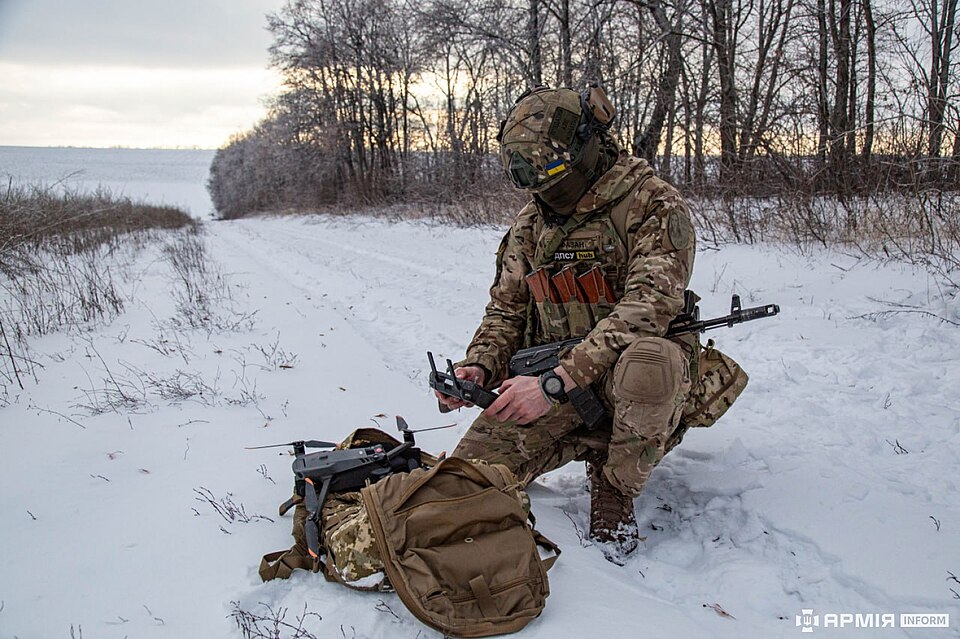
Ukrainian Border Guard operating a DJI Mavic drone, 13 February 2024.
Ministry of Defense of Ukraine photo, CC BY-SA 4.0
At the same moment Zelensky’s Starshield cover was disintegrating, I was being briefed by military colleagues just back from Ukraine. They began with the observation that there is no such thing as a front line any more. The forward edge of the battle areas — the so-called fortress belt, shielding Ukraine from Russian forces in the Donbass — are held very lightly, with none of the density of troops or foxholes found in either world war. Instead, they have been replaced by a dense mesh of unmanned systems, optical devices and other sensors, some concealed on the ground, which can cover forward areas 24/7, day and night, in all weathers. Dozens of kilometres can now be held by a few hundred well-equipped defenders, who can call on precision-guided artillery and/or drones in the event of trouble. Small raiding parties of interlopers from both sides, often armed with tactical quadcopters, occasionally filter through the notional front on foot, having navigated minefields and concrete anti-tank obstacles, but cannot achieve much and do not linger. My friends believe the days of banning anti-personnel mines appear to be over.
To skimp on manpower, both sides have found it expedient to cover terrain by fire, rather than the traditional methodology of humans dug deep into the earth. Painful memories of days wasted on NATO exercises digging trenches flashed through my mind. Furthermore, outside of urban areas, combat zones with an ever-present risk of drone or artillery interception may stretch as deep as 20km, so the concept of front and rear has also disappeared. However, such tactical depth is not always available to small countries, such as the Baltic states. In urban areas, whenever Russia claims possession of a new settlement or objective, its troops are rarely able to move around above ground by day, due to opposing drone activity. New gains announced by Moscow are in fact merely of cellars and subterranean passages. It takes us back to the old adage that to take and hold ground, you need ‘boots on the ground’, not a few nervous moles. My colleagues suggested, “It’s like claiming control of an ocean, from the seabed”.
And those drones? The latest figures from Ukraine are suggesting 85 per cent of Moscow’s human and equipment casualties are allegedly caused by unmanned aerial vehicles (UAVs), or artillery and mortars directed by them. According to retired General David Petraeus, including long-range strikes and air defence, Kyiv is routinely expending between 9,000-10,000 UAVs per day and aims to manufacture 7m in 2006. On that basis, any NATO partner that boasts of being drone-ready for the next war, will need an arsenal of a minimum of 3.5 million cutting-edge UAVs and the manufacturing capability to replace them, to conduct operations for a year.
Often of the First Person View (FPV) type, identifiable by the spools of gossamer-thin wire they carry (which keeps them proof against electronic interference, but limits their range) UAVs come with the advantage of being cheap and easy to assemble. Crucially, these cunning little devices and their longer-range brethren have largely replaced (often American-built) cruise missiles, regarded as exorbitantly expensive by comparison, with long lead times. It is, put simply, the economics of interception, and a logic that is starting to spread to Western navies.
Via UAVs and waterborne drones, Unmanned Surface Vehicles (USVs), Kyiv now controls huge swathes of the Black Sea. Recently a Ukrainian USV successfully intercepted and destroyed a Russian USV in a world-first tactical clash of this type. This activity has pushed the Russians to begin to use their Caspian Sea flotilla to launch long-range missiles, as their Black Sea warships are so degraded. Practical combat experience is also suggesting that all soldiers, in every arm or service, will need to be trained in small drone operation, which is proving to be as basic a required skill in war as operating a rifle. Furthermore, the most important figure to whom troops now report seems not to be the ranking infantry officer, but the network engineer or coder. They are the ones who need to know of the success or otherwise of their various integrated unmanned systems and can make on-the-spot adjustments, or send the necessary reports up the command chain.
Tweaks might include the ability of drones to take prisoners (Russians are now known to be surrendering to machines), and the availability of unmanned ground vehicles (UGVs) to not only bring up all manner of logistics, but return with casualties. All the engineers have a price on their heads, and as a result, their workshops are better protected than traditional headquarters because their signature across the electromagnetic spectrum is huge. This is becoming a perennial problem for the Ukrainians but one they have exploited amongst Russian positions for some time.
Another drone development was unveiled very recently by Kyiv’s 475th Assault Regiment who sent a Challenger 2 tank and a Bradley M2 infantry fighting vehicle against Russians in a forward area. Normally this would result in instant destruction, but addition to being surrounded by protective metal cages (‘turtles’) and armed with welded-on spikes to trigger incoming warheads (‘hedgehogs’), the armoured vehicles were protected by new classes of crewless aerial scouting and escort craft, devised to protect friendly ground assets from air interference. Drone apparently fought drone, while others dropped grenades to suppress Russian positions and clear mines.


