Quotulatiousness

June 29, 2019

QotD: Blogging versus social media

Filed under: Media, Quotations, Technology — Tags: , , , — Nicholas @ 01:00

Even the “blogosphere” of the early 21st century, in which independently run blog sites posted items on news and responded both to Big Media stories and to each other was more like traditional media in some respects than like Usenet or social media. To read content on blogs, readers had to go there. To interact, bloggers had to read each other’s sites and decide to post a response, generally with a link back to the post they were replying to. If you didn’t like a blog you could just ignore it. A story that spread like wildfire through the blogosphere still did so over the better part of a day, not over minutes, and it was typically pretty easy to find the original item and get context, something the culture of blogging encouraged… In addition, a story’s spreading required at least a modicum of actual thought and consideration on the part of bloggers, who were also constrained, to a greater or lesser degree, by considerations of reputation. Some blogs served as trusted nodes on the blogosphere, and many other bloggers would be reluctant to run with a story that the trusted nodes didn’t believe. In engineering parlance, the early blogosphere was a “loosely coupled” system, one where changes in one part were not immediately or directly transmitted to others. Loosely coupled systems tend to be resilient, and not very subject to systemic failures, because what happens in one part of the system affects other parts only weakly and slowly. Tightly coupled systems, on the other hand, where changes affecting one node swiftly affect others, are prone to cascading failures… [On Twitter,] little to no thought is required, and in practice very few people even follow the link (if there is one) to “read the whole thing”.

Glenn “Instapundit” Reynolds, The Social Media Upheaval, 2019. (link goes to Althouse, who posted this quote based on the Kindle edition)

June 26, 2019

Social media giants can be publisher or platform, but not both

Filed under: Business, Law, Liberty, Media, Politics, USA — Tags: , , , , — Nicholas @ 06:00

At Ace of Spades H.Q., Ace explains why Facebook, Google, and the other social media companies have been playing fast and loose with the rules, sometimes using the rules that apply to publishers and sometimes the ones that apply to platforms, depending on their whim:

Only a speaker or publisher of claimed defamatory content can be sued.

Not being a speaker or publisher of a defamatory statement gives you total immunity from suit. You’re just a guy, you had nothing to do with the tort alleged.

Section 230 [of the Community Decency Act] specifically says that “neutral content platforms” shall not be deemed to be the “speaker or publisher” of a claimed defamatory statement made by a third party using their service — hence, the complete immunity from suit. You can’t be sued for something someone else said, obviously.

Now newspapers can be sued for the defamatory remarks of, say, an interview subject. They are publishers of that defamatory statement — they chose to publish it. The interview subject made the statement, but then they chose to publish it themselves, becoming another “speaker” of the defamation.

Now, “neutral content platforms” are never considered “speakers” of third-party defamations (or any third-party crime involving speech, such as offering to sell contraband or conspiring to commit a crime). But a newspaper or media company — or this blog — could be.

The corporate cucks claim that you cannot put restrictions on Google, Facebook, or Twitter as regards their right to censor opinions they disagree with because that constitutes “compelled speech.” You’re compelling them to speak things they do not believe, the cucks’ argument goes.

But… section 230 states that, as a legal matter, they are not considered the “speakers” of any statement made on their “neutral content platforms.”

So which is it? Are they the speakers of these words — in which case, like a newspaper or tv station, they’d have every right to exercise editorial judgment and decide what they wish their company to say — or are they not the speakers of these words, which is their claim whenever someone tries to sue them?

As it stands, they are speakers when it comes to their power to block people from speaking on their platforms — and thus can indulge in the vice of censorship — but not speakers when it comes to people suing them for what other people said on their platforms.

Choose one or the other: Either you are a speaker of other people’s words or you’re not. You can’t forever choose one and then the other when it’s in your interest to have the Clown Nose On or the Clown Nose Off.

May 12, 2019

A handy list for your next band name

Filed under: Humour, Media — Tags: , , — Nicholas @ 03:00

An amusing Twitter thread from a few days ago threw up some entertaining band name suggestions:


I’m pretty sure that Multiaxial System opened for Estrus Peak at the El Mocambo in ’94.

March 8, 2019

Wokescolds, rejoice! Titania McGrath has been unmasked!

Filed under: Britain, Humour, Media, Politics — Tags: , , , , — Nicholas @ 05:00

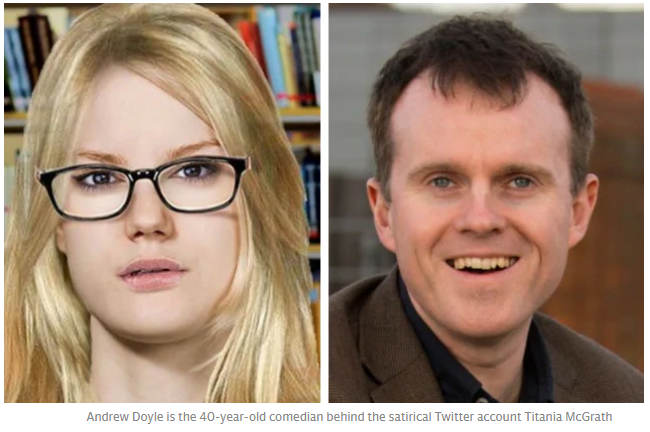
After the woke wolfpack finally dragged down and destroyed the great Twitter troll Godfrey Elfwick (RIP), the satirical void was eventually filled by the ultra-woke poet Titania McGrath. All good things must come to an end, apparently, because we recently discovered that noble Titania is actually — gasp! — just another Twitter troll:

When a former Oxford University postgraduate student set up a satirical Twitter account in April 2018 under the name of Titania McGrath, he had no idea of the social media storm that was to follow.

Aiming to poke fun at the “identitarian left” who use “vicious tactics to push identity politics above all else”, the parody account quickly amassed over 180,000 social media followers.

After months of speculation, the individual behind it can finally be revealed – as a 40-year-old former private school teacher with a doctorate in Early Renaissance Poetry from Wadham College, Oxford.

Dr Andrew Doyle created the account to mock today’s “woke culture” that is obsessed with gender fluidity, identity politics and hates freedom of speech.

Describing Titania McGrath as “a militant vegan who thinks she is a better poet than William Shakespeare”, Mr Doyle told The Telegraph: “Woke is the concept that everything must be inclusive, inoffensive, that you always use the correct language and that you must be hyper aware of other people’s sensitivities.

“This social justice movement is full of people who are arrogant, narcissistic and very certain in themselves. The very idea that they could be wrong doesn’t even cross their mind. That to me is incredibly funny. I thought Titania could embody all of that.

“The majority of people are desperate for this culture to be mocked. The account has become so popular because people are sick of feeling that they can’t say what they want. It used to be the case that if someone spoke out of turn, you would say that’s a bit much, apologise and everyone would move on. Now you post a screenshot on Twitter and try to get someone fired.

“Titania is staying the stuff that most people want to say.”

March 4, 2019

Twitter’s vast latifundia of techno-serfs

Filed under: Business, Media, Technology — Tags: , , , — Nicholas @ 03:00

In Quillette, Alec Cameron Orrell debunks the notion that the average Twitter user derives much benefit from time spent on the site:

Researchers of social media both in the Academy and in Silicon Valley have apprehended for a long time that social media prey on the dopamine rewards system of the brain. Some have used this knowledge to exploit users; others have used it to warn the public of a digital narcotic epidemic. The frisson of delightfully outraged purpose that courses through a user’s nerves as he reads or responds to a post arises from the same brain system that rewards a human being for consuming a healthy meal or organizing his sock drawer. The Hollywood actors who have done mighty work to support the Bolivian cocaine trade in the past can’t put Twitter down now, and that’s no accident.

Digital abolitionists grow more and more strident and numerous these days. Many — including early Facebook investor McNamee — hail from inside Silicon Valley. A raft of articles over the last few years have documented the wave of Silicon Valley techno-elites who, like savvy drug cartel bosses, forbid their own children from using the devices and social media platforms they build, while they encourage their employees to spend frequent periods “unplugged.” They know social media and mobile devices create users, and some have been brave enough to lobby the public for a shift in consciousness.

The slave reaps no substantial or real-world payment for his labor. Chemical slaves to drugs get nothing but misery and poverty in the end. Social media users subsist in an analogous trap, subtle and harder to spot. When it comes to social media, 99.9 percent of users will never see any substantial return on what stacks up to be an enormous longterm investment of time. Users will experience some fleeting stimulant sensations and a smattering of poorly organized — or incorrect—information. “I find out what’s happening on Twitter!” or “I get to promote myself on Twitter!” amounts to self-delusion on par with the vile Antebellum plantation saw that “Slaves get paid in the satisfaction of a hard day’s work and some are even taught how to read!” Such apologetics leverage false but presentable ends to cover horribly exploitive means — means the real ends of which are too embarrassing to admit. The average Twitter user might make the odd connection or get some attention for his business on Twitter, if he keeps at it day after day. In contrast, Jack Dorsey always gets paid handsomely for the user’s time on-site month after month by advertisers. The users work the platform with their attention, and Master Jack goes home with the check.

Unless already famous, the chances of reaping substantial reward from Twitter — such as income or significant growth of attention from others — roughly equal the chances of winning the lottery. And like the lottery, millions of average users chip in and hope, while just a few luck out and get a payout. Those few average users who get a mediocre reward — and even fewer who get famous with a lucky tweet or some such — keep the millions of average users coming back to try their luck every day. The little blue bird runs on the principle of the one-armed bandit and Powerball.

Virtually all users end up losing in the long-term. Most lose hours and hours scrolling through quips and posting burns, sifting through nonsense to find the odd bit of useful information, but mostly for distraction. Like their casino cousins cursed by fate with a gambling addiction, an unlucky minority of Twitter users lose everything on the platform without meaning to. A particularly ill-considered tweet brings down on their heads digital lynching, infamy, disgrace, loss of employment, loss of a spouse, libel lawsuits, and in some countries, criminal indictment for hate speech or threatening behavior. Uncounted thousands of users have operated their mobile devices under the influence of Twitter on the information superhighway, only to wind up with a digital DUI or in an online 25-car pileup.

December 15, 2018

Twitter cannot hold her back – Titania McGrath speaks!

Filed under: Media, Politics — Tags: , , , , — Nicholas @ 03:00

Despite the patriarchal oppression of a Twitter permanent suspension, Titania McGrath will be heard:

My name is Titania McGrath. I am a radical intersectionalist poet committed to feminism, social justice, and armed peaceful protest. In April of this year, I decided to become more industrious on social media. I was inspired by other activists who had made use of their online platforms in order to spread their message and explain to people why they are wrong about everything.

This week the powers-that-be at Twitter hit my account with a “permanent suspension” (a semantic contradiction, but then I suppose bigots aren’t known for their grammatical prowess). This was the latest in a series of suspensions, all of which were imposed because I had been too woke. The final straw appeared to be a tweet in which I informed my followers that I would be attending a pro-Brexit march so that I could punch a few UKIP supporters in the name of tolerance.

Don’t get me wrong. I have always supported censorship. Major social media platforms have a responsibility to ensure that we are expressing the correct sort of free speech. Twitter’s decision to suspend Alex Jones, host of American website InfoWars, set the right kind of precedent. I fully supported this action because Jones is known for disseminating fake news and wild conspiracy theories. But the fact that I was also banned makes me think that Twitter were being secretly controlled by InfoWars from the very start.

Indeed, Twitter’s modus operandi appears to involve routinely silencing those who defend social justice and enabling those who spread hate. In my short time on the platform, I have regularly come across hate speech from the sort of unreconstructed bigots who believe that there are only two genders, or that Islam is not a race. It’s got to the point where if someone doesn’t have “anti-fascist” in their bio, it’s safest to assume that they’re a fascist.

The permanent suspension only lasted for a day, but the experience was traumatic and lasting. I now understand how Nelson Mandela felt. If anything, my ordeal was even more damaging. Mandela may have had to endure 27 years of incarceration, but at least his male privilege protected him from ever having to put up with mansplaining, or being subject to wolf-whistling by grubby proles on a building site.

They may have silenced the great Godfrey Elfwick, but thank goodness Titania McGrath can continue to point out the absurdities and inconsistencies of the wider world.

December 4, 2018

Terry Teachout’s unhappy Twitter experience

Filed under: Media — Tags: , , — Nicholas @ 03:00

While I don’t follow him on Twitter, I’ve long subscribed to the RSS feed from Terry Teachout’s website. On Sunday, he posted about a recent unpleasantness on Twitter that I thought was worth sharing:

… my Twitter account, was hacked on Sunday morning as part of a cross-platform attack on my social-media presence. The objective, it seems, was ransom: I actually received a series of telephone calls from the culprits, who appear to reside in England. Needless to say, I hung up and immediately started changing passwords and building a higher security wall. Alas, several hours went by before the powers-that-be at Twitter took notice of my plight, and numerous obscene postings are still visible on my old Twitter page as of this hour, as well as on the Twitter module in the right-hand column of this blog.

So, as you’d expect, the crack Twitter security team sprang into action, right? Er, no:

I received this message from Twitter Support late last night:

    We’ve investigated the reported account and have determined that it is not in violation of Twitter’s impersonation policy. In order for an account to be in violation…it must portray another person…in a misleading or deceptive manner.

So that’s how Twitter Support responds when my verified account is hacked, obscene and racist messages are posted on it, and a ransom request is made to me by telephone. Is it any wonder that more and more people are getting fed up with Twitter?

October 21, 2018

Politicians’ social media accounts

Filed under: Media, Politics, Technology — Tags: , , , — Nicholas @ 05:00

Stephen Gordon probably has the right of this issue here:

August 21, 2018

Only certain kinds of truth can be allowed in modern Britain

Filed under: Britain, Liberty, Politics, Technology — Tags: , , , , — Nicholas @ 05:00

Brendan O’Neill on the latest outrage on British social media — telling unpleasant or unwelcome truths:

Is it now a crime to tell the truth in Britain? It’s heading that way. At the weekend it was revealed that Merseyside Police are making ‘enquiries’ into a trans-sceptical group that distributed stickers saying ‘Women don’t have penises’. Yes, that’s right: the police, the actual police, are investigating a group for expressing what the vast majority of people consider to be a biological, social, actual fact: that if you have a penis you are not a female. What next: arrest people for saying the sky is blue or that Piers Morgan is a muppet?

The stickers, shaped like penises, were produced by a so-called TERF group. TERF stands for ‘trans-exclusionary radical feminist’ – that is, a feminist who doesn’t think men who have a sex change are real women – but it is really just an updated, PC word for ‘witch’. When trans-sceptical women are denounced as ‘TERFs’ by hordes of irate identitarians online, they are really being branded disobedient bitches, women who really ought to know their place. The ‘TERFs’ distributed their heretical stickers in the Merseyside area, including on the Antony Gormley sculptures that make up his piece ‘Another Place’ on Crosby Beach, and all hell broke loose.

Twitter went into meltdown. This is a hate crime, they said. These people genuinely believe it is a hate crime to say women don’t have penises. Arrest all biology teachers right away! Twitter snitches, who are legion, grassed on the TERFs to the mayor of Liverpool, Joe Anderson, who promised that he would get the police to ‘identify those responsible’ for these outrageous declarations of scientific truth. These sticker heretics are an affront to Liverpool’s history of ‘diversity’ and ‘equality’, he said. A fancy way of saying they are thoughtcriminals. And lo, the Merseyside Police duly got involved: ‘[W]e are aware of this matter and enquiries are being made.’

July 26, 2018

The life and strange death of Godfrey Elfwick

Filed under: Britain, Humour, Media — Tags: , , — Nicholas @ 03:00

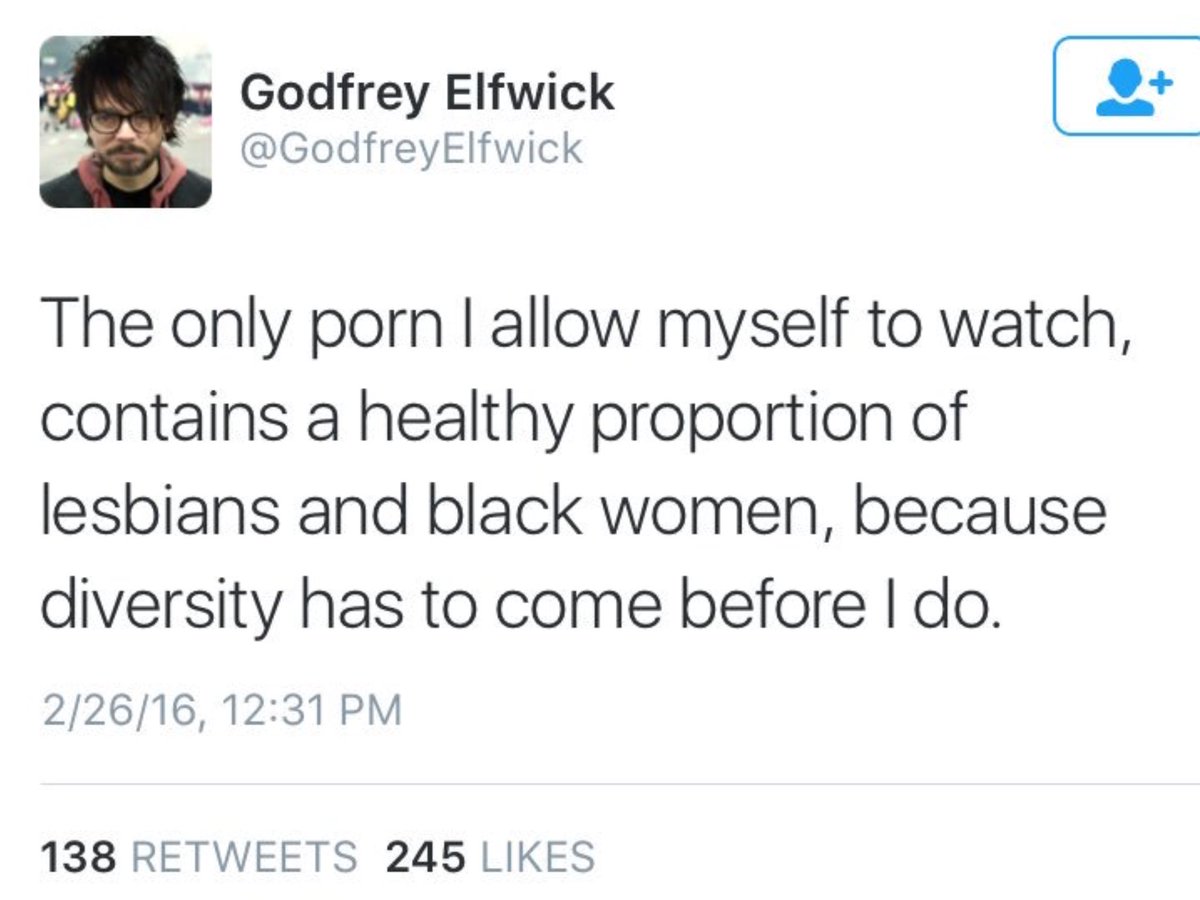
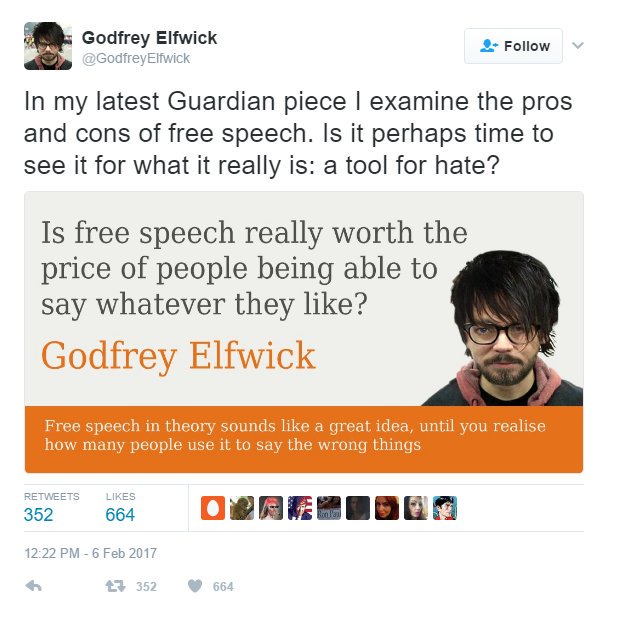
Poor old Godfrey has been taken from us by the Grim Twit-Reaper, felled in his Xirs prime in the midst of Twitter’s most recent mass-banning. At Spiked, Andrew Doyle pays tribute to the late Arch-Ubertroll of social media:

In November 2016, the Guardian published a comment piece in which the anonymous writer described how he was radicalised into the ‘alt-right’. It started when he watched a few ostensibly harmless videos by the American liberal Sam Harris. From there, he graduated to material of an anti-SJW (Social Justice Warrior) and anti-feminist disposition, before eventually becoming a fan of the dreaded Milo Yiannopoulos. As the writer dramatically put it: ‘The indoctrination was complete.’

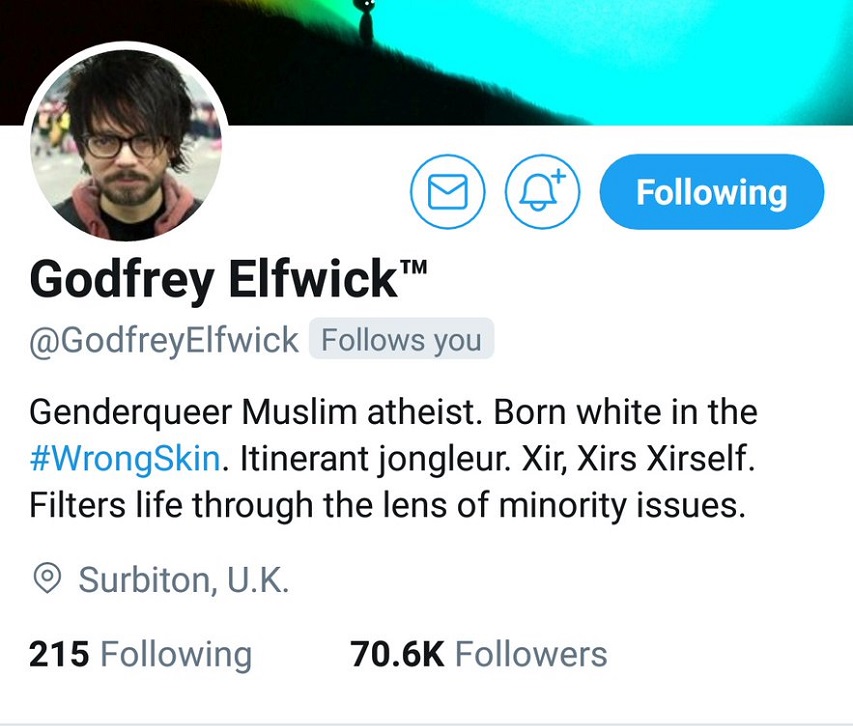
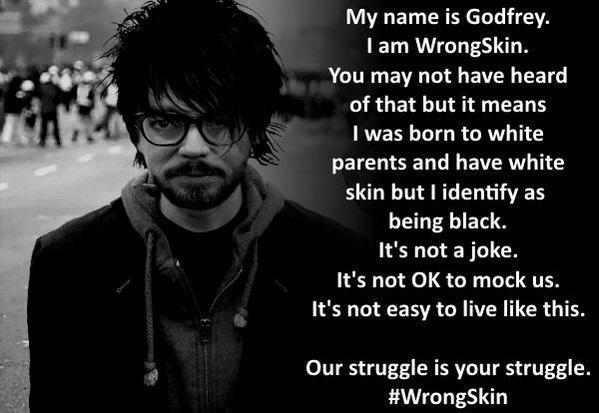
Soon after, a well-known Twitter troll called Godfrey Elfwick claimed to be the author. It made complete sense, even though it wasn’t true. Elfwick was a brilliant caricature of the excesses of the liberal-left. He, or rather xe, identified as a ‘genderqueer Muslim atheist’ who was ‘born white in the #WrongSkin’. His ‘transblack’ status began as a satire of Rachel Dolezal, the US civil-rights activist who was born to white parents but identifies as black. ‘I have light skin’, he tweeted, ‘yet I know in my heart I am black and act accordingly’. Elfwick’s #WrongSkin hashtag soon began to trend worldwide on Twitter, fooling many in the process. Even the Mirror and the BBC published articles which did not rule out the possibility that the campaign might be authentic.

Similarly, Elfwick’s claim to have penned the Guardian comment piece was effective precisely because it was so feasible. The satire was double-edged. On the one hand, Elfwick had accentuated the inherent absurdities of the article in question, exposing the self-parodic nature of the Guardian. On the other, he had successfully duped public figures such as Sam Harris, Maajid Nawaz, and leading Gamergater Ethan Ralph, all of whom had been so quick to take his tweets at face value. The hoax claim was in itself a hoax.

Elfwick’s brand of satire depended on this kind of ambiguity. Those who took his posts seriously were inadvertently enhancing the impact of the joke, especially when they expressed such boiling outrage. It is no coincidence that objections to Elfwick tend to come from po-faced peddlers of identity politics who are unhappy about being ridiculed. The same goes for the ideologues of Twitter, who have an established record of deleting accounts for political reasons and have now permanently banned Elfwick from their platform.

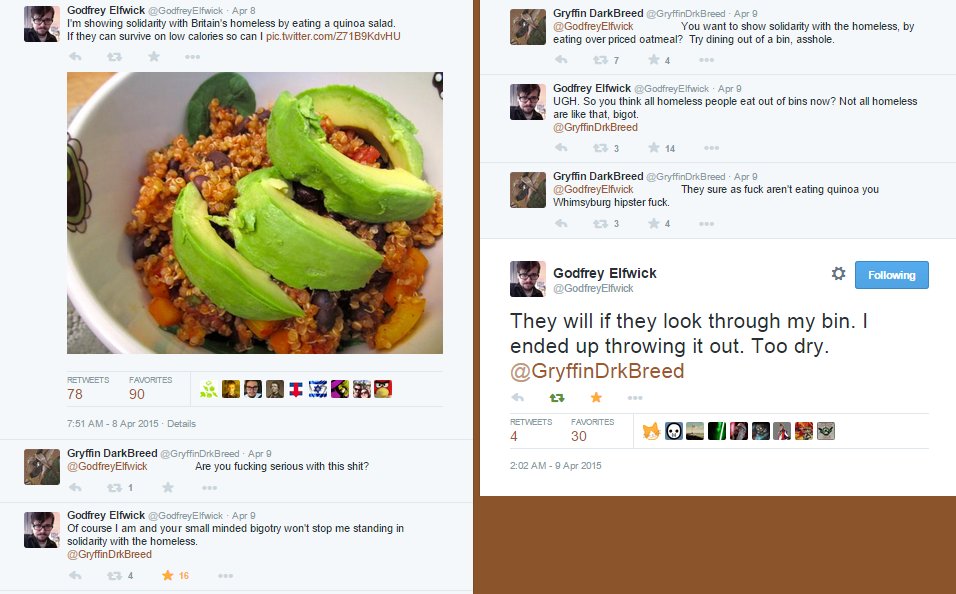
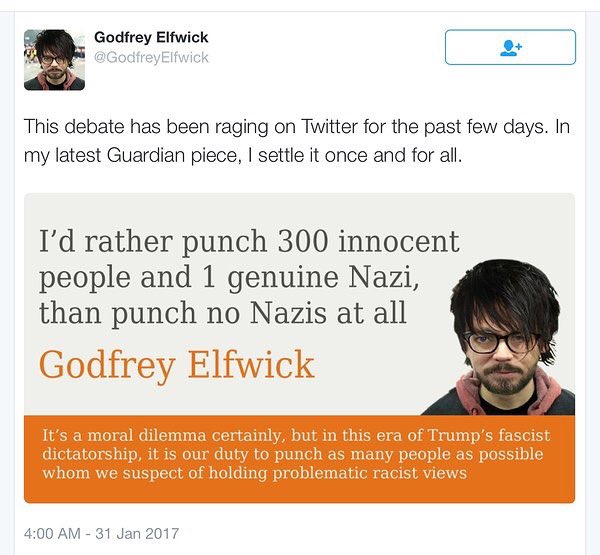
A few gems from the Trolling Hall of Fame:


July 4, 2018

It’s never a good idea to expand the power of the state

Francis Porretto on the problem of giving the state yet another tool for its already overflowing toolbox:

    The party in power is smug and arrogant. The party out of power is insane.” – Megan McArdle, a.k.a. “Jane Galt”

Among the older maxims of politics is to beware handing the State a new power without first reflecting on how your opponents could use it against you. For as sure as the Sun rises in the East, your opponents will return to dominance someday, and whatever powers you awarded the State will be in their hands.

Just now, the focus is on President Trump’s choice of a replacement for retiring Supreme Court Associate Justice Anthony Kennedy. The Democrats are tearing their collective hair out over this, as now that the filibuster is a dead letter for judicial appointees, their minority status in the Senate leaves them no way to block his selection. Yet it was Senate Democrats during the Obama Administration who first attacked the filibuster – when they were in the majority and sought to confirm Obama appointees. Coulda told ‘em then, but they weren’t in a mood to listen.

Today’s critical battles are over freedom of expression and “deplatforming.”

Some folks of sound mind and generally good will are exercised about how Silicon Valley giants such as Facebook and Twitter regulate their immensely popular social-media platforms to disfavor conservatives. The complaints have been many, and a great many of them are both accurate (i.e., the things complained about really happened) and valid (i.e., only persons of conservative or libertarian bent were silenced). However, they come up against a barrier that’s proved impassable to date: the right of private property.

So a lot of those folks have embraced the notion that those platforms could be regulated by the federal government as public accommodations. That’s the conception under which the Civil Rights Acts were deemed to hold legitimate authority over restaurants, hotels, movie theaters, and other nominally private properties. If you present your facility as “open to the public,” the logic runs, then you can be forbidden to discriminate – i.e., to provide your services to some members of the “public” but not others.

(For those who remember the “nationwide Bell System,” the phrase common carrier might rise to mind. The concept is essentially the same, as was the federal government’s assertion of authority over it. However, in that particular case, the rationale was that the Bell System was a monopoly, protected by that same federal government. Telecom deregulation and the breakup of the Bell System put paid to that scheme, thank God.)

Those in the Right who favor this notion are asking for trouble. Someday the balance of power will shift leftward once again. What would the Democrats – an increasingly totalitarian bunch who’ve never seen a law, a regulation, or a tax it didn’t love – do with the precedent that an Internet platform can be regulated as a public accommodation, despite being private property?

H/T to Bill St. Clair for the link.

June 22, 2018

QotD: The “narrative” and social media

Filed under: Media, Politics, Quotations — Tags: , , , — Nicholas @ 01:00

The Times piece brought to its conclusion a dialectic that has increasingly consumed the news media in the age of Twitter. A narrative generated on social media is fed back into the “mainstream” press, and then in turn fed back into Twitter in the form of reporting that appears to confirm the pre-existing narrative. It acquires along the way the force of sanction, rewarding those who participate in the dissemination of the narrative, and punishing those who dissent from it in the form of mob-style attacks and ostracism. This machinery for the spontaneous coordination of orthodoxy exploits vulnerabilities in our evolved psychology. “Confirmation bias” is the tendency to lower our threshold of proof for claims that conform to what we are already primed by habit, familiarity, and the desire to believe. “The availability heuristic” is the tendency to mistake the vividness of an occurrence for its frequency. Use these quirks of the mind to feed the bias held by partisans that the only people that could possibly oppose them are knaves and fools, and you can gaslight even otherwise bright and skeptical people into accepting and repeating blatant falsehoods.

Wesley Yang, “The Shocking Truth About Jordan Peterson”, Tablet, 2018-05-28.

June 12, 2018

G7 minus one

Justin Raimondo on the well-shared image of Angela Merkel and her associates apparently trying to browbeat Donald Trump at the G-7 meeting (this version from Raimondo’s article):

All the Very Serious People are tweeting and retweeting this “iconic” photo of Trump surrounded by the Euro-weenies, with Angela Merkel seeming to lecture the President while the rest of our faithless “allies” look on. It’s “America Alone” – the visual representation of the internationalist worldview: Trump’s policy of “America First” is “isolating” us, and, according to clueless leftists like Michael Moore, Merkel is now the “leader” of the “free world.”

This last is good news indeed, for if Merkel is the new leader of the “free world” then the stationing of 35,000 US troops in Germany – at a cost of billions annually – is no longer required and we can bring them home. This also means Germany, rather than the US, will be sending troops all over the world to fight “terrorism” – a move that is sure to cause consternation in certain regions with a history of German intervention, but hey, somebody has to do it!

The political class is screaming bloody murder over Trump’s performance at the G-7 meeting in Canada, where he reportedly spent most of the time detailing how much the US was paying for the defense of our vaunted “allies,” not to mention the high tariffs imposed on American goods. He then proposed a “free trade zone” in which member countries would drop all tariffs, subsidies, and other barriers to trade: the “allies” didn’t like that much, either. Nor did the alleged advocates of free trade here in the US give him any credit for ostensibly coming around to their point of view. Which reminds me of something Murray Rothbard said about this issue: “If authentic free trade ever looms on the policy horizon, there’ll be one sure way to tell. The government/media/big-business complex will oppose it tooth and nail.”

Of course the Euro-weenies don’t want real free trade: after all, they practically invented protectionism. What they want is a free ride, at Uncle Sam’s expense, and the reason they hate Trump is because they know the freebies are over. However, what really got the Usual Suspects frothing at the mouth was Trump’s insistence that Russia be readmitted to the G-8:

    “I think it would be good for the world, I think it would be good for Russia, I think it would be good for the United States, I think it would be good for all of the countries in the G-7. I think having Russia back in would be a positive thing. We’re looking to have peace in the world. We’re not looking to play games.”

The “experts” went crazy when he said this: our “allies” are being insulted, they wailed, while our “enemies” are being “appeased.” It’s sedition! Russia! Russia! Russia!

Eric Boehm says that the White House’s justification for imposing tariffs on national security grounds may have been undermined through Trump’s tweets hitting back after what he clearly felt was Justin Trudeau’s hissy fit (although Trudeau didn’t exactly break new ground or say anything radically different in his comments):

The Trump administration has spent months trying to construct a rather flimsy argument that steel and aluminum imports from Canada and other close American allies constitute a national security threat. More than a handy way to drum up public support for trade barriers, the “national security” claim is a crucial bit of the legal rationale for letting the president impose tariffs on those goods without congressional approval.

Then, as he was departing this past weekend’s G7 summit, Trump took to Twitter to air some grievences with Canadian Prime Minister Justin Trudeau. In doing so, the president may have significantly kneecapped that legal argument.

The last sentence of Trump’s tweet is the one that really matters.

The White House slapped a 25 percent tariff on imported steel and a 10 percent tariff on imported aluminum by invoking Section 232 of the Trade Expansion Act of 1962, which gives the president legal authority to impose tariffs without congressional approval when it’s for the sake of national security. That line of argument, outlined by Commerce Secretary Wilbur Ross in a February report, says that America needs aluminum and steel to make weapons of war, and that protecting the domestic steel and aluminum industries is the only way to ensure the country will be able to defend itself if attacked.

That is pretty weak, as I (and others) have written before. But as long as Trump makes that claim — no matter how strained the logic might be — the law seems to be on his side. Invoke “national security” and the president can do what he wants with trade.

Except now Trump seems to have admitted that it’s not about national security at all. His tweet plainly states that “our Tariffs [sic] are in response to his of 270% on dairy!”

Chris Selley points out that up until this eruption, Canadian politicians were still carrying on as if nothing was really at stake (especially Conservative leader Andrew Scheer, who re-swore his allegiance to ultra-protectionist supply management at all costs, and damn actual free trade):

So utterly obsessed are Canadian politicians by the small differences between them that federal Conservative leader Andrew Scheer recently demanded Prime Minister Justin Trudeau explain what he meant when he suggested Canada might be “flexible” on the issue of supply management in the dairy industry, in the face of new demands from Washington. It’s preposterous: you can’t fit a processed cheese slice between the three major party’s total devotion to the dairy cartel.

Because, as we all know, what unites Canadians from coast-to-coast is our universally shared determination to pay significantly higher prices for dairy products, to ensure that Quebec farmers are not overly bothered by pesky competition from uppity foreigners who don’t even speak Joual

June 2, 2018

The Robinson Affair (that the British establishment would like to “disappear”)

Filed under: Britain, Law, Media, Religion — Tags: , , , , , — Nicholas @ 03:00

If you haven’t been paying attention to the British media, you might not have heard about Tommy Robinson and his crusade to expose the “Asian grooming gangs” that have been left almost undisturbed by the British police, prosecutors and (until very recently indeed) the media:

The controversy around him continued. In March, Robinson was suspended from Twitter, where he had almost half a million followers. The social-media site (which merrily allows terrorist groups like Lashkar e-Taiba to keep accounts) decided that Robinson should be suspended for tweeting out a statistic about Muslim rape gangs that itself originated from the Muslim-run Quilliam foundation. And it is on this matter that the latest episode in the Robinson drama started — and has now drawn worldwide attention.

Ten years ago, when the EDL was founded, the U.K. was even less willing than it is now to confront the issue of what are euphemistically described as “Asian grooming gangs” (euphemistic because no Chinese or Koreans are involved and what is happening is not grooming but mass rape). At the time, only a couple of such cases had been recognized. Ten years on, every month brings news of another town in which gangs of men (almost always of Pakistani origin) have been found to have raped young, often underage, white girls. The facts of this reality — which, it cannot be denied, sounds like something from the fantasies of the most lurid racist — have now been confirmed multiple times by judges during sentencing and also by the most mainstream investigative journalists in the country.

But the whole subject is so ugly and uncomfortable that very few people care to linger over it. Robinson is an exception. For him — as he said in a 2011 interview with the BBC’s Jeremy Paxman — the “grooming gangs” issue isn’t something that afflicts some far-off towns but people in the working-class communities that he knows. And while there are journalists (notably the Times’ Andrew Norfolk) who have spent considerable time and energy bringing this appalling phenomenon to light, most of British society has turned away in a combination of embarrassment, disgust, and uncertainty about how to even talk about this. Anyone who thinks Britain is much further along with dealing with the taboo of “grooming gangs” should remember that only last year the Labour MP for Rotherham, Sarah Champion, had to leave the shadow cabinet because she accurately identified the phenomenon.

Which brings me to last Friday. That was when Robinson was filming outside Leeds Crown Court, where the latest grooming-gang case was going on. I have to be slightly careful here, because although National Review is based in the U.S., I am not, and there are reporting restrictions on the ongoing case. Anyhow, Robinson was outside the court and appeared (from the full livestream) to be filming the accused and accosting them with questions on their way in. He also appeared to exercise some caution, trying to ensure he was not on court property.

But clearly he did not exercise enough caution, a strange fact given that last year Robinson had been found guilty of “contempt of court” for filming outside another rape-gang trial, one involving four Muslim men at Canterbury Crown Court. On that occasion Robinson was given a three-month prison sentence [PDF], which was suspended for a period of 18 months. Which meant he would be free so long as he did not repeat the offense.

Although Robinson appeared to be careful at Leeds Crown Court last Friday, to dance along the line of exactly what he could or could not livestream outside an ongoing trial with a suspended sentence hanging over his head was extraordinarily unwise. What happened next went around the world: The police turned up in a van and swiftly arrested Robinson for “breach of the peace.” Within hours Robinson had been put before one Judge Geoffrey Marson, who in under five minutes tried, convicted, and sentenced Robinson to 13 months. He was immediately taken to prison.

From that moment it was not just Robinson but the U.K. that entered a minefield of legal problems. In addition to the usual reporting restrictions on the ongoing trial, a reporting ban was put on any mention of Robinson’s arrest, swift trial, and conviction, meaning that for days people in the blogosphere and the international media got free rein to claim that Tommy Robinson had been arrested for no reason, that his arrest was a demonstration of a totalitarian state cracking down on free speech, and even (and this one is remarkably clueless as well as careless) that the recent appointment to the position of home secretary of Sajid Javid — who was born to Muslim parents — is the direct cause of Robinson’s recent arrest.

April 22, 2018

QotD: Chronic Truth Aversion Disorder

Filed under: Australia, Media, Quotations, Technology — Tags: , , , — Nicholas @ 01:00

When little children can’t understand things, they often lash out and throw tantrums.

Workplace and safety considerations prevent adults stamping their feet and hurling themselves onto the playground, so they have to content themselves with spewing invective all over the virtual playground of Twitter.

They take aim at whoever confounded them, claim to be offended and engage in a cathartic process of name-calling and abuse.

This therapeutic process is effect­ive, but flawed.

By enabling tantrum-throwers to re-establish their feelings of moral superiority they can walk away purged, but it doesn’t get to the root of their problem: Chronic Truth Aversion Disorder.

The CTAD epidemic that is raging unchecked through Australia’s social media population is rendering impossible any intellig­ent debate on serious social issues, such as the rampant violence, abuse and neglect of children in remote indigenous communities.

The reactions of people in an advanced stage of the condition to anything that so much as hints at the truth, while utterly irrational, are also so hostile that anyone ­inclined to speak the truth understandably becomes afraid to do so.

Bill Leak, “Bill Leak cartoon: what are you tweeting about?”, The Australian, 2016-08-05.

« Newer PostsOlder Posts »

Powered by WordPress