The Times piece brought to its conclusion a dialectic that has increasingly consumed the news media in the age of Twitter. A narrative generated on social media is fed back into the “mainstream” press, and then in turn fed back into Twitter in the form of reporting that appears to confirm the pre-existing narrative. It acquires along the way the force of sanction, rewarding those who participate in the dissemination of the narrative, and punishing those who dissent from it in the form of mob-style attacks and ostracism. This machinery for the spontaneous coordination of orthodoxy exploits vulnerabilities in our evolved psychology. “Confirmation bias” is the tendency to lower our threshold of proof for claims that conform to what we are already primed by habit, familiarity, and the desire to believe. “The availability heuristic” is the tendency to mistake the vividness of an occurrence for its frequency. Use these quirks of the mind to feed the bias held by partisans that the only people that could possibly oppose them are knaves and fools, and you can gaslight even otherwise bright and skeptical people into accepting and repeating blatant falsehoods.
Wesley Yang, “The Shocking Truth About Jordan Peterson”, Tablet, 2018-05-28.
June 22, 2018
June 12, 2018
G7 minus one
Justin Raimondo on the well-shared image of Angela Merkel and her associates apparently trying to browbeat Donald Trump at the G-7 meeting (this version from Raimondo’s article):
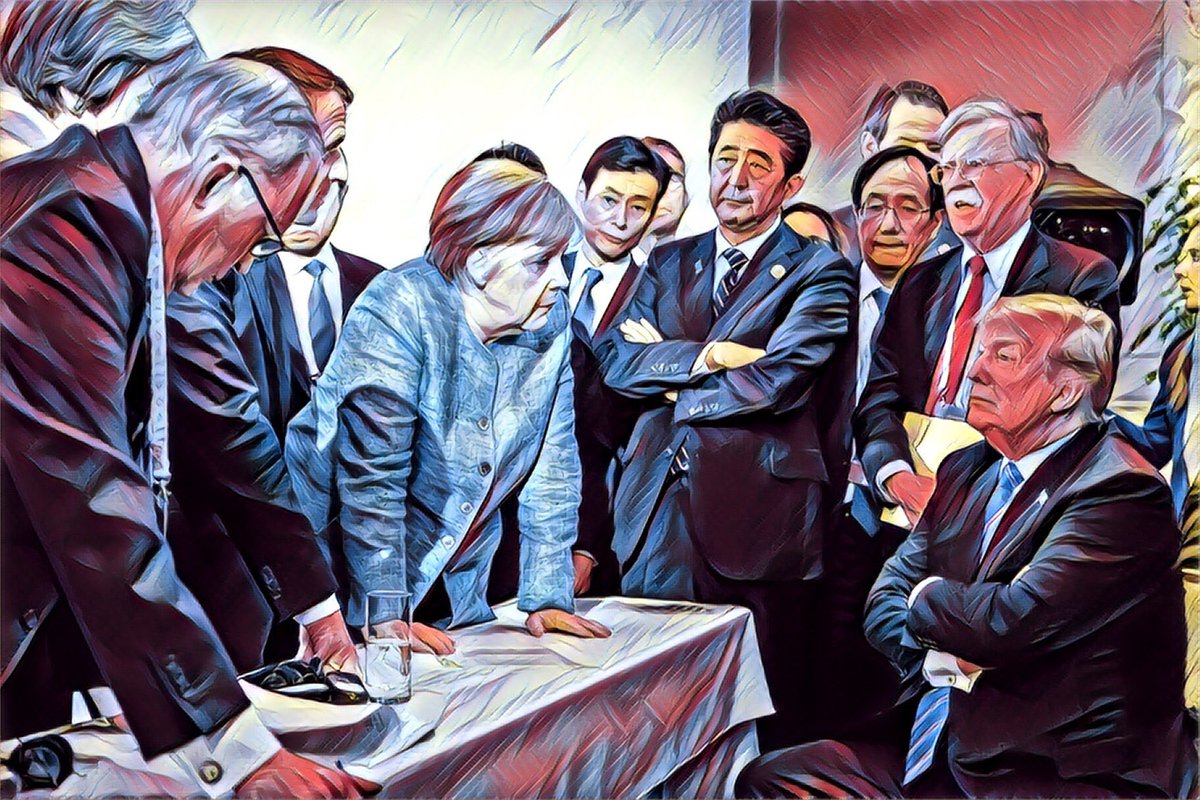
All the Very Serious People are tweeting and retweeting this “iconic” photo of Trump surrounded by the Euro-weenies, with Angela Merkel seeming to lecture the President while the rest of our faithless “allies” look on. It’s “America Alone” – the visual representation of the internationalist worldview: Trump’s policy of “America First” is “isolating” us, and, according to clueless leftists like Michael Moore, Merkel is now the “leader” of the “free world.”
This last is good news indeed, for if Merkel is the new leader of the “free world” then the stationing of 35,000 US troops in Germany – at a cost of billions annually – is no longer required and we can bring them home. This also means Germany, rather than the US, will be sending troops all over the world to fight “terrorism” – a move that is sure to cause consternation in certain regions with a history of German intervention, but hey, somebody has to do it!
The political class is screaming bloody murder over Trump’s performance at the G-7 meeting in Canada, where he reportedly spent most of the time detailing how much the US was paying for the defense of our vaunted “allies,” not to mention the high tariffs imposed on American goods. He then proposed a “free trade zone” in which member countries would drop all tariffs, subsidies, and other barriers to trade: the “allies” didn’t like that much, either. Nor did the alleged advocates of free trade here in the US give him any credit for ostensibly coming around to their point of view. Which reminds me of something Murray Rothbard said about this issue: “If authentic free trade ever looms on the policy horizon, there’ll be one sure way to tell. The government/media/big-business complex will oppose it tooth and nail.”
Of course the Euro-weenies don’t want real free trade: after all, they practically invented protectionism. What they want is a free ride, at Uncle Sam’s expense, and the reason they hate Trump is because they know the freebies are over. However, what really got the Usual Suspects frothing at the mouth was Trump’s insistence that Russia be readmitted to the G-8:
“I think it would be good for the world, I think it would be good for Russia, I think it would be good for the United States, I think it would be good for all of the countries in the G-7. I think having Russia back in would be a positive thing. We’re looking to have peace in the world. We’re not looking to play games.”
The “experts” went crazy when he said this: our “allies” are being insulted, they wailed, while our “enemies” are being “appeased.” It’s sedition! Russia! Russia! Russia!
Eric Boehm says that the White House’s justification for imposing tariffs on national security grounds may have been undermined through Trump’s tweets hitting back after what he clearly felt was Justin Trudeau’s hissy fit (although Trudeau didn’t exactly break new ground or say anything radically different in his comments):
The Trump administration has spent months trying to construct a rather flimsy argument that steel and aluminum imports from Canada and other close American allies constitute a national security threat. More than a handy way to drum up public support for trade barriers, the “national security” claim is a crucial bit of the legal rationale for letting the president impose tariffs on those goods without congressional approval.
Then, as he was departing this past weekend’s G7 summit, Trump took to Twitter to air some grievences with Canadian Prime Minister Justin Trudeau. In doing so, the president may have significantly kneecapped that legal argument.
PM Justin Trudeau of Canada acted so meek and mild during our @G7 meetings only to give a news conference after I left saying that, “US Tariffs were kind of insulting” and he “will not be pushed around.” Very dishonest & weak. Our Tariffs are in response to his of 270% on dairy!
— Donald J. Trump (@realDonaldTrump) June 9, 2018
The last sentence of Trump’s tweet is the one that really matters.
The White House slapped a 25 percent tariff on imported steel and a 10 percent tariff on imported aluminum by invoking Section 232 of the Trade Expansion Act of 1962, which gives the president legal authority to impose tariffs without congressional approval when it’s for the sake of national security. That line of argument, outlined by Commerce Secretary Wilbur Ross in a February report, says that America needs aluminum and steel to make weapons of war, and that protecting the domestic steel and aluminum industries is the only way to ensure the country will be able to defend itself if attacked.
That is pretty weak, as I (and others) have written before. But as long as Trump makes that claim — no matter how strained the logic might be — the law seems to be on his side. Invoke “national security” and the president can do what he wants with trade.
Except now Trump seems to have admitted that it’s not about national security at all. His tweet plainly states that “our Tariffs [sic] are in response to his of 270% on dairy!”
Chris Selley points out that up until this eruption, Canadian politicians were still carrying on as if nothing was really at stake (especially Conservative leader Andrew Scheer, who re-swore his allegiance to ultra-protectionist supply management at all costs, and damn actual free trade):
So utterly obsessed are Canadian politicians by the small differences between them that federal Conservative leader Andrew Scheer recently demanded Prime Minister Justin Trudeau explain what he meant when he suggested Canada might be “flexible” on the issue of supply management in the dairy industry, in the face of new demands from Washington. It’s preposterous: you can’t fit a processed cheese slice between the three major party’s total devotion to the dairy cartel.
Trudeau needs to explain what he meant when he said he was open to "flexibility" on that file when negotiating with the US, and what concessions he offered to them from Canada's dairy industry. https://t.co/GeCA4irhAY (2/2)
— Andrew Scheer (@AndrewScheer) June 8, 2018
Because, as we all know, what unites Canadians from coast-to-coast is our universally shared determination to pay significantly higher prices for dairy products, to ensure that Quebec farmers are not overly bothered by pesky competition from uppity foreigners who don’t even speak Joual…
June 2, 2018
The Robinson Affair (that the British establishment would like to “disappear”)
If you haven’t been paying attention to the British media, you might not have heard about Tommy Robinson and his crusade to expose the “Asian grooming gangs” that have been left almost undisturbed by the British police, prosecutors and (until very recently indeed) the media:
The controversy around him continued. In March, Robinson was suspended from Twitter, where he had almost half a million followers. The social-media site (which merrily allows terrorist groups like Lashkar e-Taiba to keep accounts) decided that Robinson should be suspended for tweeting out a statistic about Muslim rape gangs that itself originated from the Muslim-run Quilliam foundation. And it is on this matter that the latest episode in the Robinson drama started — and has now drawn worldwide attention.
Ten years ago, when the EDL was founded, the U.K. was even less willing than it is now to confront the issue of what are euphemistically described as “Asian grooming gangs” (euphemistic because no Chinese or Koreans are involved and what is happening is not grooming but mass rape). At the time, only a couple of such cases had been recognized. Ten years on, every month brings news of another town in which gangs of men (almost always of Pakistani origin) have been found to have raped young, often underage, white girls. The facts of this reality — which, it cannot be denied, sounds like something from the fantasies of the most lurid racist — have now been confirmed multiple times by judges during sentencing and also by the most mainstream investigative journalists in the country.
But the whole subject is so ugly and uncomfortable that very few people care to linger over it. Robinson is an exception. For him — as he said in a 2011 interview with the BBC’s Jeremy Paxman — the “grooming gangs” issue isn’t something that afflicts some far-off towns but people in the working-class communities that he knows. And while there are journalists (notably the Times’ Andrew Norfolk) who have spent considerable time and energy bringing this appalling phenomenon to light, most of British society has turned away in a combination of embarrassment, disgust, and uncertainty about how to even talk about this. Anyone who thinks Britain is much further along with dealing with the taboo of “grooming gangs” should remember that only last year the Labour MP for Rotherham, Sarah Champion, had to leave the shadow cabinet because she accurately identified the phenomenon.
Which brings me to last Friday. That was when Robinson was filming outside Leeds Crown Court, where the latest grooming-gang case was going on. I have to be slightly careful here, because although National Review is based in the U.S., I am not, and there are reporting restrictions on the ongoing case. Anyhow, Robinson was outside the court and appeared (from the full livestream) to be filming the accused and accosting them with questions on their way in. He also appeared to exercise some caution, trying to ensure he was not on court property.
But clearly he did not exercise enough caution, a strange fact given that last year Robinson had been found guilty of “contempt of court” for filming outside another rape-gang trial, one involving four Muslim men at Canterbury Crown Court. On that occasion Robinson was given a three-month prison sentence [PDF], which was suspended for a period of 18 months. Which meant he would be free so long as he did not repeat the offense.
Although Robinson appeared to be careful at Leeds Crown Court last Friday, to dance along the line of exactly what he could or could not livestream outside an ongoing trial with a suspended sentence hanging over his head was extraordinarily unwise. What happened next went around the world: The police turned up in a van and swiftly arrested Robinson for “breach of the peace.” Within hours Robinson had been put before one Judge Geoffrey Marson, who in under five minutes tried, convicted, and sentenced Robinson to 13 months. He was immediately taken to prison.
From that moment it was not just Robinson but the U.K. that entered a minefield of legal problems. In addition to the usual reporting restrictions on the ongoing trial, a reporting ban was put on any mention of Robinson’s arrest, swift trial, and conviction, meaning that for days people in the blogosphere and the international media got free rein to claim that Tommy Robinson had been arrested for no reason, that his arrest was a demonstration of a totalitarian state cracking down on free speech, and even (and this one is remarkably clueless as well as careless) that the recent appointment to the position of home secretary of Sajid Javid — who was born to Muslim parents — is the direct cause of Robinson’s recent arrest.
April 22, 2018
April 10, 2018
March 22, 2018
February 18, 2018
December 8, 2017
But what about “whataboutism”?
Megan McArdle on the folks who automatically resort to “what about x”:
Last week, as you may have noticed, Republicans passed a tax bill. As you may also have noticed, Democrats were aghast. Passing a bill like that on straight party lines! Using a parliamentary maneuver to push through something that could never have survived a filibuster! How could Republicans be so brazen, so immoral, so fiscally irresponsible?
Those of us who remembered saying many of the same things during the passage of Obamacare had to beg them to stop. I mean, we could have been seriously hurt, laughing that hard.
But when I pointed this out, the good citizens of Twitter informed me over and over that this was mere “whataboutism.”
Whataboutism is defending some indefensible action by pointing to some equally indefensible action that was supported, or at least not condemned, by your opponents. (Whataboutism is usually defined as a version of the tu quoque fallacy, attacking the questioner rather than answering the question. It’s also a red herring.) After lobbing a few “What about you?” grenades, you use the resulting chaos to duck uncomfortable questions.
It is a favorite tactic of our president, whose campaign platform was “What about her emails?” Every time someone brings up the FBI investigation that is creeping closer to the highest echelons of his staff, he is fond of asking, apropos of nothing, why Hillary Clinton’s not in jail.
December 1, 2017
Censorship on the web
At City Journal, Aaron Renn explains why some of the concerns about censorship on the Internet are not so much wrong as misdirected:
The basic idea of net neutrality makes sense. When I get a phone, the phone company can’t decide whom I can call, or how good the call quality should be depending on who is on the other end of the line. Similarly, when I pay for my cable modem, I should be able to use the bandwidth I paid for to surf any website, not get a better or worse connection depending on whether my cable company cut some side deal to make Netflix perform better than Hulu.
The problem for net neutrality advocates is that the ISPs aren’t actually doing any of this; they really are providing an open Internet, as promised. The same is not true of the companies pushing net neutrality, however. As Pai suggests, the real threat to an open Internet doesn’t come from your cable company but from Google/YouTube, Twitter, Facebook, and others. All these firms have aggressively censored.
For example, Google recently kicked would-be Twitter competitor Gab out of its app store, not for anything Gab did but for what it refused to do — censor content. Twitter is famous for censoring, as Pai observes. “I love Twitter, and I use it all the time,” he said. “But let’s not kid ourselves; when it comes to an open Internet, Twitter is part of the problem. The company has a viewpoint and uses that viewpoint to discriminate.” (Twitter’s censors have not gotten around to removing the abuse, some of it racist, being hurled at Pai, including messages like “Die faggot die” and “Hey go fuck yourself you Taliban-looking fuck.”)
Google’s YouTube unit also censors, setting the channel for Prager University to restricted mode, which limits access; Prager U. is suing Google and YouTube. YouTube has also “demonetized” videos from independent content creators, making these videos ineligible for advertising, their main source of revenue. Much of the complaining about censorship has come from political conservatives, but they’re not the only victims. The problem is broad-based.
Yet sometimes Silicon Valley giants have adopted a see-no-evil approach to certain kinds of content. Facebook, for instance, has banned legitimate content but failed to stop Russian bots from going wild during last year’s presidential election, planting voluminous fake news stories. Advertisers recently started fleeing YouTube when reports surfaced that large numbers of child-exploitation videos were showing up on supposedly kid-friendly channels. One account, ToyFreaks, had 8 million subscribers — making it the 68th most-viewed YouTube channel — before the company shut it down. It’s not credible that YouTube didn’t know what was happening on a channel with millions of viewers. Other channels and videos featured content from pedophiles. More problems turned up within the last week. A search for “How do I …” on YouTube returned numerous auto-complete suggestions involving sex with children. Others have found a whole genre of “guess her age” videos, with preview images, printed in giant fonts, saying things like, “She’s only 9!” The videos may or may not have involved minors — I didn’t watch them—but at minimum, they trade on pedophilic language to generate views.
August 26, 2017
Hot takes are easy, if you’re Andy Benoit
 At the Daily Norseman, taking shots at “pro” sports personalities comes as second nature. Ted Glover and Eric Thompson have developed a particular joy in sharing the … gems … from Andy Benoit’s Twitter feed, and have taken it one step further:
August 19, 2017
How bad can a business graphic get? This bad
Found on Colby Cosh’s Twitter feed:
CUT TO DESIGN MEETING
“We need something like a pie chart, but worse.”
“Sure thing, boss.”#PieChartsKillKittens pic.twitter.com/lXJ6SKYxNc
— Thomas LaRock (@SQLRockstar) August 16, 2017
"Bet you can't violate every principle in 'The Visual Display of Quantitative Information' with one chart."
"Hold my beer."— W. Dow Rieder (@Riderius) August 17, 2017
July 23, 2017
Requiem for an SJW heavyweight
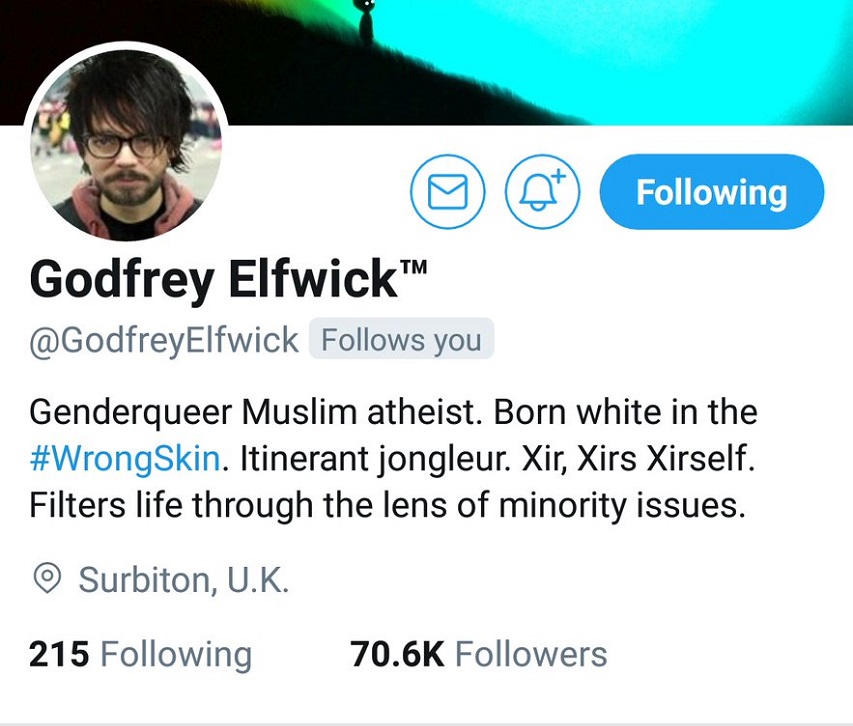
James Delingpole on the Twitter phenomenon Godfrey Elfwick:
Linda Sarsour/Sally Kohn/Graham Linehan/Caroline Criado Perez/Gary Lineker/Diane Abbot/someone from the Guardian/a guy from CNN/ISIS has said something really hateful, stupid, and wrong on Twitter. Again.
Back in the day, this would have been a cause for celebration, not dismay. Why? Because within milliseconds of their fatuous utterance tainting the ether with its embittered, warped, politically correct insanity it would have been endorsed – and simultaneously destroyed – by the mighty Godfrey Elfwick.
Godfrey Elfwick was the funniest and best thing on Twitter.
To have your tweet singled out for praise by Godfrey was the kiss of death. It meant that you were a humorless, self-righteous, deluded, smug, sanctimonious, insufferable Social Justice Warrior. Just like Godfrey purported to be.
Which is why, of course, Twitter had to silence him. Sure, the official reason given for Godfrey’s permanent ban was because he had broken Twitter’s terms of service – apparently having upset a millionaire potato chip salesman called Gary Lineker.