
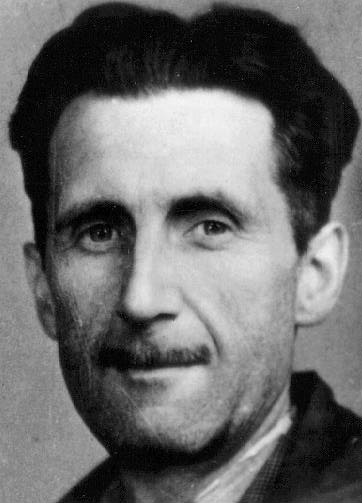
Orwell’s press card portrait, 1943
It is probable that the nature of modern war has made “democratic army” a contradiction in terms. The French army, for instance, based on universal service, is hardly more democratic than the British. It is just as much dominated by the professional officer and the long-service N.C.O., and the French officer is probably rather more “Prussian” in outlook than his British equivalent. The Spanish Government militias during the first six months of war — the first year, in Catalonia — were a genuinely democratic army, but they were also a very primitive type of army, capable only of defensive actions. In that particular case a defensive strategy, coupled with propaganda, would probably have had a better chance of victory than the methods casually adopted. But if you want military efficiency in the ordinary sense, there is no escaping from the professional soldier, and so long as the professional soldier is in control he will see to it that the army is not democratised. And what is true within the armed forces is true of the nation as a whole; every increase in the strength of the military machine means more power for the forces of reaction. It is possible that some of our more Left-wing jingoes are acting with their eyes open. If they are, they must be aware that the News-Chronicle version of “defence of democracy” leads directly away from democracy, even in the narrow nineteenth-century sense of political liberty, independence of the trade unions and freedom of speech and the press.
George Orwell, “Democracy in the British Army”, Left, 1939-09.
December 7, 2019
QotD: A “democratic” army
November 12, 2019
QotD: The crimes of the Righteous
There was no mercy in them, not even those specks of humanity that can occasionally be glimpsed in the most heartless of souls. Priests, judge, scribe, and torturers acted with such rigorous coldness and distance that that was precisely what evoked the most horror. Even more blood-curdling that the suffering they were capable of inflicting was the icy determination of those know they are backed by divine and human laws and who at no moment doubt the righteousness of what they are doing.
Later, with time, I learned that although all men are capable of good and evil, the worst among them are those who, when they commit evil, do so by shielding themselves in the authority of others, in their subordination, or in the excuse of following orders. And even worse are those who believe they are justified by their God. Because in the secret dungeons of Toledo, nearly at the cost of my life, I learned that there is nothing more despicable or more dangerous than the malevolent individual who goes to sleep every night with a clear conscience. That is true evil. Especially when paired with ignorance, superstition, stupidity, or power, all of which often travel together.
And worst of all is the person who acts as exegete of The Word — whether it be from the Talmud, the Bible, the Koran, or any other book already written or yet to come. I am not fond of giving advice — no one can pound opinions into another’s head — but here is a piece that costs you nothing: Never trust a man who reads only one book.
Arturo Pérez-Reverte, Purity of Blood, 1997.
November 10, 2019
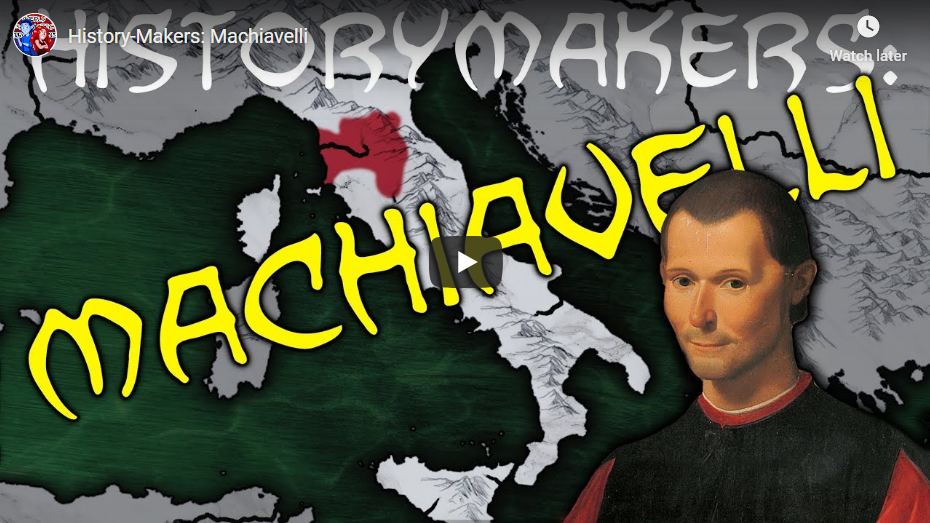
History-Makers: Machiavelli
Overly Sarcastic Productions
Published 8 Nov 2019If I could have a conversation with any person in History, it’s Machiavelli. Easy. And I wouldn’t even have to do anything, I’d just say “So, tell me about Rome” and watch the fireworks. In the meantime, I’ll settle for playing Assassin’s Creed Brotherhood and liberating Roma with my boy Niccolò.
The best Prince is one who donates to TEAM TREES: https://teamtrees.org
PATREON: https://www.Patreon.com/OSP
DISCORD: https://discord.gg/sS5K4R3
MERCH LINKS: https://www.redbubble.com/people/OSPY…
OUR WEBSITE: https://www.OverlySarcasticProductions.com
Find us on Twitter https://www.Twitter.com/OSPYouTube
Find us on Reddit https://www.Reddit.com/r/OSP/
November 6, 2019
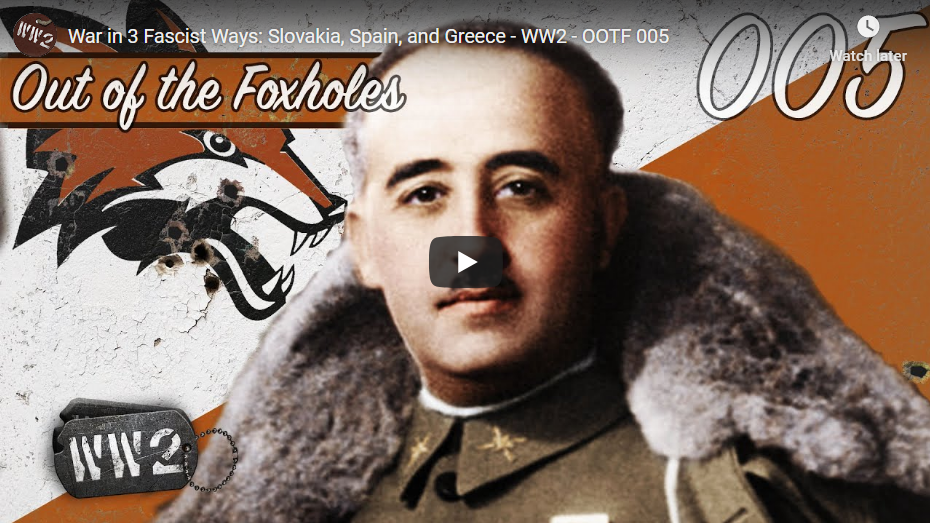
War in 3 Fascist Ways: Slovakia, Spain, and Greece – WW2 – OOTF 005
World War Two
Published 5 Nov 2019What role did Slovakia play during the invasion of Poland? How did Franco view the war in Europe? And did Greece see an invasion coming? We answer all of this in this episode of Out of the Foxholes.
Submit your own question: https://community.timeghost.tv/c/Out-…
Join us on Patreon: https://www.patreon.com/TimeGhostHistory
Or join The TimeGhost Army directly at: https://timeghost.tvFollow WW2 day by day on Instagram @World_war_two_realtime https://www.instagram.com/world_war_t…
Join our Discord Server: https://discord.gg/D6D2aYN.
Between 2 Wars: https://www.youtube.com/playlist?list…
Source list: http://bit.ly/WW2sourcesHosted by: Indy Neidell
Produced and Directed by: Spartacus Olsson and Astrid Deinhard
Executive Producers: Bodo Rittenauer, Astrid Deinhard, Indy Neidell, Spartacus Olsson
Creative Producer: Joram Appel
Post Production Director: Wieke Kapteijns
Research by: Rune Vaever Hartvig
Edited by: Mikołaj Cackowski
Map animations: EastoryColorisations by Norman Stewart and Julius Jääskeläinen https://www.facebook.com/JJcolorization/
Eastory’s channel: https://www.youtube.com/channel/UCEly…
Archive by Screenocean/Reuters https://www.screenocean.com.A TimeGhost chronological documentary produced by OnLion Entertainment GmbH.
October 17, 2019
England in 1550 was a remarkably unpromising location for the later industrial revolution
Anton Howes, in his investigations on the Industrial Revolution looks back in time to see where or even if England deviated from the rest of Europe in ways that made the revolution possible, thinks he’s located the crucial time:
If a peaceful extraterrestrial visited the world in 1550, I often wonder where it would see as being the most likely site of the Industrial Revolution – an acceleration in the pace of innovation, resulting in sustained and continuous economic growth. So many theories about why it happened in Britain seem to have a sense of inevitability about them, but our extraterrestrial visitor would have found very few signs that it would soon occur there. There were many better candidates, on a multitude of metrics.
[…]
But England in 1550 was by global standards quite poor. Historical GDP per capita measures are notoriously difficult to obtain, even for some countries in the twentieth century let alone the sixteenth. The historical GDP per capita of England – by far the most studied region – is still hotly debated among economic historians. Nonetheless, according to the most recent collection of estimates – the Maddison project’s database of 2018 – in 1550 our extraterrestrial visitor would have been much more interested in Belgium. England at that stage lagged behind almost all of the areas for which we have estimates: Holland, Spain, Italy, Sweden, and France. In 1600, it was behind Portugal and India. Here are the figures in 2011 dollars; the colours are by row:
Such estimates should of course be taken with a hefty boulder of salt. (Note, also, that these particular figures, called “CGDPpc”, are something of an innovation by the team compiling the Maddison Project Database – they use multiple benchmarks to improve how we compare countries’ relative incomes in any particular year, which comes at the cost of not being able to compare their growth rates, for which there are separate figures. In other words, you should read the figures by row, not by column.) But it is worth noting that the more recent research on historical GDP per capita, finally filling in some details for regions other than England and Holland, often results in those other countries seeming richer in the sixteenth and seventeenth centuries. The more we know, the more the traces of an early English divergence seem to disappear.
Even without access to such statistics, however, our visitor would have noticed that in the mid-1550s England suffered severe food shortages. Indeed, the threat of famine would be present right up until the beginning of the eighteenth century: there was a major famine in the north of England in 1649, and even a famine in the 1690s that killed between five and fifteen percent of Scotland’s population. Britain would one day become perhaps the first famine-free region, but that did not occur until much later, when innovation had already begun to accelerate. It may even have been its result.
And England in 1550 was not just poor; it was also weak. If our visitor thought, as some historians do, that conquest and exploitation were essential for future growth, then it was Spain that had the major overseas empire, followed by Portugal. England in 1550 had no colonies in the New World, and its attempts to found them all failed until the seventeenth century, by which stage the Dutch and French had also begun to extend their own empires too. It was not until the eighteenth century that Britain began to exceed them.

October 5, 2019
Legends Summarized: El Dorado
Overly Sarcastic Productions
Published 4 Oct 2019El Dorado! A shining golden city packed with promises of wealth, power and everlasting glory. An unspoiled paradise deep in the jungle, the PERFECT destination for treasure-hunters and anthropologists alike. Something that perfect is something EVERYONE wants to be real.
Aaaaand that’s the trick, isn’t it? Wanting something that badly isn’t healthy. Just ask the conquistadors!
(Oh wait, we can’t – because so many of them died on fruitless quests for El Dorado. And also it’s been five hundred years and they’d all be dead anyway)PATREON: https://www.Patreon.com/OSP
MERCH LINKS: https://www.redbubble.com/people/OSPY…
OUR WEBSITE: https://www.OverlySarcasticProductions.com
Find us on Twitter https://www.Twitter.com/OSPYouTube
Find us on Reddit https://www.Reddit.com/r/OSP/

September 29, 2019
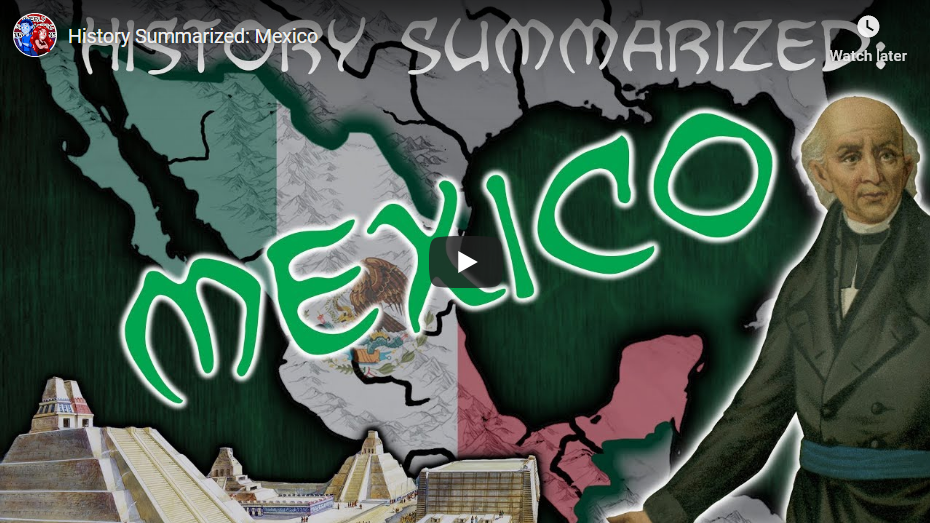
History Summarized: Mexico
Overly Sarcastic Productions
Published 27 Sep 2019Go to https://NordVPN.com/overlysarcastic and use code OVERLYSARCASTIC to get 70% off a 3-year plan and an extra month for free. Protect yourself online today!
This video is quite serendipitous in timing — by complete coincidence, this is going live on September 27, the day of Mexico’s true political independence under the First Mexican Empire. This is the 11 year sequel to the more traditional Mexican Independence celebrations of September 16th, which marks Miguel Hidalgo’s proclamation of the “Cry of Dolores” and the start of the Mexican War of Independence. No joke, I only realized this when I was partway through researching the video. I do so much ancient history I’m not used to events having dates we can track to the day.
ANYWAY enjoy this look at Mexican History, here broken into three main acts, the Aztec Empire, the Colony of New Spain, and the Independent nation of Mexico.
“Santianna” By The Longest Johns: https://thelongestjohns.bandcamp.com/…
PATREON: https://www.Patreon.com/OSP
DISCORD: https://discord.gg/sS5K4R3
September 22, 2019
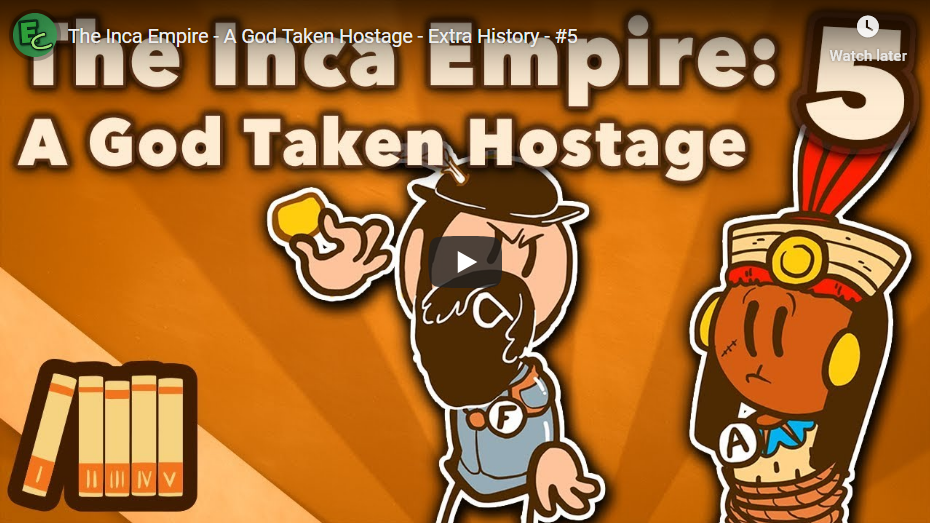
The Inca Empire – A God Taken Hostage – Extra History – #5
Extra Credits
Published on 21 Sep 2019Join us on Patreon! http://bit.ly/EHPatreon
Atahualpa vs. Francisco Pizarro. The Incas had never seen horses before, and it wasn’t long before the Spanish had captured Atahualpa as a hostage for gold and silver. But Atahualpa had a plan. He found a way to use this situation to his own political advantage — and Pizarro eventually destroyed himself through his greed and violent carelessness that appalled the Spanish government, eventually allowing the Incas to thrive again.
Follow us on Instagram: http://bit.ly/ECisonInstagram
September 16, 2019
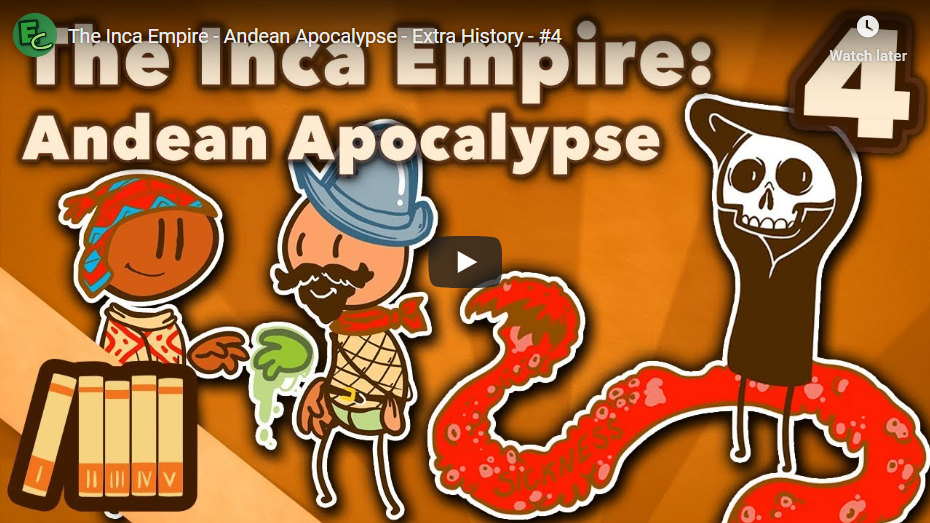
The Inca Empire – Andean Apocalypse – Extra History – #4
Extra Credits
Published on 14 Sep 2019Join us on Patreon! http://bit.ly/EHPatreon
Disease — likely, smallpox or measles — had arrived in the Inca empire, and it was ruthless. Two of the (now dead) Emperor Huayna Capac’s sons, Atahualpa and Huáscar, decided that a civil war over who should be Sapa Inca was perfect to do right now — nevermind the fact that Francisco Pizarro and his conquistadores had just showed up.
August 12, 2019
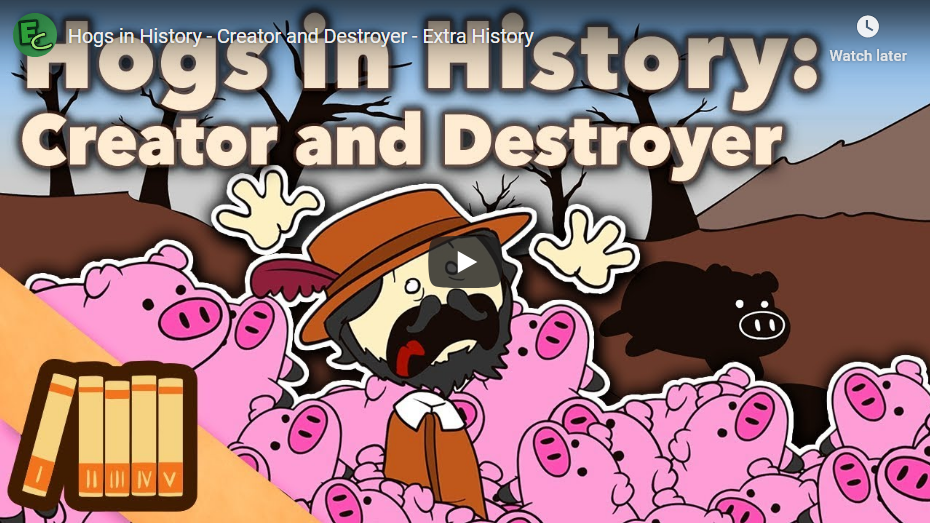
Hogs in History – Creator and Destroyer – Extra History
Extra Credits
Published on 10 Aug 2019Download the World of Tanks game for free https://tanks.ly/2yj0usN and use the invite code
EXTRATANKS1to claim your $15 starter pack.In 1494, among the colonization forces from Spain, eight pigs arrived in Cuba. With multiple uses in culinary and craft trades, as well as their general top-tier hardiness, pigs would naturally propagate themselves throughout the Caribbean, and then to Central, South, and North America — but they were also incredibly destructive.
Visit TierZoo to learn about how OP pigs are: https://www.youtube.com/watch?v=6xbQ2…
Join us on Patreon! http://bit.ly/EHPatreon
July 24, 2019
QotD: The failure of the Republican cause in the Spanish Civil War
Orwell’s press card portrait, 1943
The backbone of the resistance against Franco was the Spanish working class, especially the urban trade union members. In the long run — it is important to remember that it is only in the long run — the working class remains the most reliable enemy of Fascism, simply because the working-class stands to gain most by a decent reconstruction of society. Unlike other classes or categories, it can’t be permanently bribed.
To say this is not to idealize the working class. In the long struggle that has followed the Russian Revolution it is the manual workers who have been defeated, and it is impossible not to feel that it was their own fault. Time after time, in country after country, the organized working-class movements have been crushed by open, illegal violence, and their comrades abroad, linked to them in theoretical solidarity, have simply looked on and done nothing; and underneath this, secret cause of many betrayals, has lain the fact that between white and coloured workers there is not even lip-service to solidarity. Who can believe in the class-conscious international proletariat after the events of the past ten years? To the British working class the massacre of their comrades in Vienna, Berlin, Madrid, or wherever it might be seemed less interesting and less important than yesterday’s football match. Yet this does not alter the fact that the working class will go on struggling against Fascism after the others have caved in. One feature of the Nazi conquest of France was the astonishing defections among the intelligentsia, including some of the left-wing political intelligentsia. The intelligentsia are the people who squeal loudest against Fascism, and yet a respectable proportion of them collapse into defeatism when the pinch comes. They are far-sighted enough to see the odds against them, and moreoever they can be bribed — for it is evident that the Nazis think it worth while to bribe intellectuals. With the working class it is the other way about. Too ignorant to see through the trick that is being played on them, they easily swallow the promises of Fascism, yet sooner or later they always take up the struggle again. They must do so, because in their own bodies they always discover that the promises of Fascism cannot be fulfilled. To win over the working class permanently, the Fascists would have to raise the general standard of living, which they are unable and probably unwilling to do. The struggle of the working class is like the growth of a plant. The plant is blind and stupid, but it knows enough to keep pushing upwards towards the light, and it will do this in the face of endless discouragements. What are the workers struggling for? Simply for the decent life which they are more and more aware is now technically possible. Their consciousness of this aim ebbs and flows. In Spain, for a while, people were acting consciously, moving towards a goal which they wanted to reach and believed they could reach. It accounted for the curiously buoyant feeling that life in Government Spain had during the early months of the war. The common people knew in their bones that the Republic was their friend and Franco was their enemy. They knew that they were in the right, because they were fighting for something which the world owed them and was able to give them.
One has to remember this to see the Spanish war in its true perspective. When one thinks of the cruelty, squalor, and futility of War — and in this particular case of the intrigues, the persecutions, the lies and the misunderstandings — there is always the temptation to say: “One side is as bad as the other. I am neutral”. In practice, however, one cannot be neutral, and there is hardly such a thing as a war in which it makes no difference who wins. Nearly always one stands more or less for progress, the other side more or less for reaction. The hatred which the Spanish Republic excited in millionaires, dukes, cardinals, play-boys, Blimps, and what-not would in itself be enough to show one how the land lay. In essence it was a class war. If it had been won, the cause of the common people everywhere would have been strengthened. It was lost, and the dividend-drawers all over the world rubbed their hands. That was the real issue; all else was froth on its surface.
George Orwell, “Looking back on the Spanish War”, New Road, 1943 (republished in England, Your England and Other Essays, 1953).
July 16, 2019
QotD: Wartime atrocities
Orwell’s press card portrait, 1943
I have little direct evidence about the atrocities in the Spanish civil war. I know that some were committed by the Republicans, and far more (they are still continuing) by the Fascists. But what impressed me then, and has impressed me ever since, is that atrocities are believed in or disbelieved in solely on grounds of political predilection. Everyone believes in the atrocities of the enemy and disbelieves in those of his own side, without ever bothering to examine the evidence. Recently I drew up a table of atrocities during the period between 1918 and the present; there was never a year when atrocities were not occurring somewhere or other, and there was hardly a single case when the Left and the Right believed in the same stories simultaneously. And stranger yet, at any moment the situation can suddenly reverse itself and yesterday’s proved-to-the-hilt atrocity story can become a ridiculous lie, merely because the political landscape has changed.
In the present war we are in the curious situation that our “atrocity campaign” was done largely before the war started, and done mostly by the Left, the people who normally pride themselves on their incredulity. In the same period the Right, the atrocity-mongers of 1914-18, were gazing at Nazi Germany and flatly refusing to see any evil in it. Then as soon as war broke out it was the pro-Nazis of yesterday who were repeating horror stories, while the anti-Nazis suddenly found themselves doubting whether the Gestapo really existed. Nor was this solely the result of the Russo-German Pact. It was partly because before the war the Left had wrongly believed that Britain and Germany would never fight and were therefore able to be anti-German and anti-British simultaneously; partly also because official war-propaganda, with its disgusting hypocrisy and self-righteousness, always tends to make thinking people sympathize with the enemy. Part of the price we paid for the systematic lying of 1914-17 was the exaggerated pro-German reaction which followed. During the years 1918-33 you were hooted at in left-wing circles if you suggested that Germany bore even a fraction of responsibility for the war. In all the denunciations of Versailles I listened to during those years I don’t think I ever once heard the question, “What would have happened if Germany had won?” even mentioned, let alone discussed. So also with atrocities. The truth, it is felt, becomes untruth when your enemy utters it. Recently I noticed that the very people who swallowed any and every horror story about the Japanese in Nanking in 1937 refused to believe exactly the same stories about Hong Kong in 1942. There was even a tendency to feel that the Nanking atrocities had become, as it were, retrospectively untrue because the British Government now drew attention to them.
But unfortunately the truth about atrocities is far worse than that they are lied about and made into propaganda. The truth is that they happen. The fact often adduced as a reason for scepticism — that the same horror stories come up in war after war — merely makes it rather more likely that these stories are true. Evidently they are widespread fantasies, and war provides an opportunity of putting them into practice. Also, although it has ceased to be fashionable to say so, there is little question that what one may roughly call the “whites” commit far more and worse atrocities than the “reds”. There is not the slightest doubt, for instance, about the behaviour of the Japanese in China. Nor is there much doubt about the long tale of Fascist outrages during the last ten years in Europe. The volume of testimony is enormous, and a respectable proportion of it comes from the German press and radio. These things really happened, that is the thing to keep one’s eye on. They happened even though Lord Halifax said they happened. The raping and butchering in Chinese cities, the tortures in the cellars of the Gestapo, the elderly Jewish professors flung into cesspools, the machine-gunning of refugees along the Spanish roads — they all happened, and they did not happen any the less because the Daily Telegraph has suddenly found out about them when it is five years too late.
George Orwell, “Looking back on the Spanish War”, New Road, 1943 (republished in England, Your England and Other Essays, 1953).
July 12, 2019
QotD: Warmongers, propaganda, and the intelligentsia
Orwell’s press card portrait, 1943
Our memories are short nowadays, but look back a bit, dig out the files of New Masses or the Daily Worker, and just have a look at the romantic warmongering muck that our left-wingers were spilling at that time. All the stale old phrases! And the unimaginative callousness of it! The sang-froid with which London faced the bombing of Madrid! Here I am not bothering about the counter-propagandists of the Right […]; they go without saying. But here were the very people who for twenty years had hooted and jeered at the “glory” of war, at atrocity stories, at patriotism, even at physical courage, coming out with stuff that with the alteration of a few names would have fitted into the Daily Mail of 1918. If there was one thing that the British intelligentsia were committed to, it was the debunking version of war, the theory that war is all corpses and latrines and never leads to any good result. Well, the same people who in 1933 sniggered pityingly if you said that in certain circumstances you would fight for your country, in 1937 were denouncing you as a Trotsky-Fascist if you suggested that the stories in New Masses about freshly wounded men clamouring to get back into the fighting might be exaggerated. And the Left intelligentsia made their swing-over from “War is hell” to “War is glorious” not only with no sense of incongruity but almost without any intervening stage. Later the bulk of them were to make other transitions equally violent. There must be a quite large number of people, a sort of central core of the intelligentsia, who approved the “King and Country” declaration in 1935, shouted for a “firm line against Germany” in 1937, supported the People’s Convention in 1940, and are demanding a Second Front now.
As far as the mass of the people go, the extraordinary swings of opinion which occur nowadays, the emotions which can be turned on and off like a tap, are the result of newspaper and radio hypnosis. In the intelligentsia I should say they result rather from money and mere physical safety. At a given moment they may be “pro-war” or “anti-war”, but in either case they have no realistic picture of war in their minds. When they enthused over the Spanish war they knew, of course, that people were being killed and that to be killed is unpleasant, but they did feel that for a soldier in the Spanish Republican army the experience of war was somehow not degrading. Somehow the latrines stank less, discipline was less irksome. You have only to glance at the New Statesman to see that they believed that; exactly similar blah is being written about the Red Army at this moment. We have become too civilized to grasp the obvious. For the truth is very simple. To survive you often have to fight, and to fight you have to dirty yourself. War is evil, and it is often the lesser evil. Those who take the sword perish by the sword, and those who don’t take the sword perish by smelly diseases. The fact that such a platitude is worth writing down shows what the years of rentier capitalism have done to us.
George Orwell, “Looking back on the Spanish War”, New Road, 1943 (republished in England, Your England and Other Essays, 1953).
May 15, 2019
1984 – Dystopias and Apocalypses – Extra Sci Fi
Extra Credits
Published on 14 May 2019What makes 1984 still relevant to modern readers is that it serves as a warning against fascism in all its possible forms. George Orwell’s service fighting in the Spanish Civil War led him to see that the heart of totalitarianism is about xenophobia and nationalism no matter which kind of government it came from.
The idea that Orwell presents us in 1984 is that people subtle enough and brutal enough can take the undirected dissatisfaction and anger of a society and point it at whatever they will, using us to damn ourselves.
May 14, 2019
Hotchkiss Revolving Cannon from San Juan Hill
Forgotten Weapons
Published on 9 Apr 2019This Hotchkiss cannon and its accessories are lot #1116 in the upcoming April 2019 Morphy auction:
https://www.forgottenweapons.com/hotc…
Benjamin Hotchkiss was an American artillery designer who moved to Paris in 1867 in hopes of building a business for his improvements in artillery shells. He experienced the Franco-Prussian War in 1870, and understood the failure of the French Mitrailleuse multi-barrel volley guns. In his opinion, an effective rapid-fire weapon needed to fire explosive projectiles to have a real effect at extended range (unlike the Mitrailleuse which fired simple rifle bullets). So being the inventive sort, he went ahead and designed just such a gun. His revolving cannon was sized for 1-pound (450g) 37mm explosive shells (although he would also produce armor-piercing and canister ammunition). The gun looks like a Gatling gun at first glance, but its mechanical operation is quite different.
The Hotchkiss cannon would become quite popular, with major purchases by the French and American navies as well as many other nations. They would serve into World War One, including some use repurposed as antiaircraft weapons. This particular example was captured by American forces in Cuba during the Spanish-American War, most likely from San Juan Hill. It is a magnificent example of the type, and with a fantastic historical provenance to match.
http://www.patreon.com/ForgottenWeapons
Cool Forgotten Weapons merch! http://shop.bbtv.com/collections/forg…
Contact:
Forgotten Weapons
PO Box 87647
Tucson, AZ 85754


