
Quotulatiousness

January 29, 2013

Economic analysis of Imperial Rome

Filed under: Economics, Europe, History — Tags: , , , , , — Nicholas @ 09:43

A post by Jasmine Pui at History Today discusses a new online tool for economic analysis of the Roman Empire:
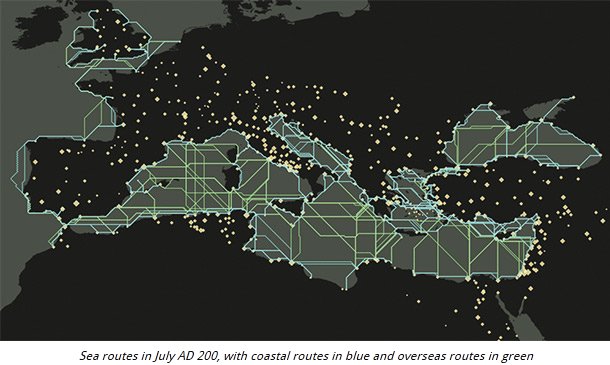
Sea routes in July AD 200

A recently launched online interactive research source, ORBIS, the Stanford Geospatial Network Model of the Roman World, has made it possible to analyse data about the Roman Empire in new ways that reveal the fragility of Roman communication and freight systems. Conventional maps are often unable to capture the environmental constraints that govern the flows of people, goods and information. Museum and ancient sites usually include titbits of information about the wide-ranging origins of artefacts, hinting at the relative cost of goods and labour in the Roman era, but factors such as sailing times and inland routes for freight cannot be precisely revealed through archaeological finds, Roman coins, taxation records or riot reports.

The first resource of its kind, ORBIS offers comprehensive graphic tools to portray the transport and communication infrastructure that underpinned the Roman Empire’s existence. By typing in a starting point, destination, an imagined weight of goods to transport and the time of year, the site shows whether such a movement would have been feasible and at what cost. Studying movement during the course of the empire’s existence suggests it was far more difficult to hold an empire together than to expand one. There are few scenarios where marching and conquering is not easier and less costly than moving goods and slaves between regions. Cost, rather than distance, was the principal determinant of connectivity in the Roman world.

ORBIS is based on a simplified version of the giant network of cities, roads, rivers and sea lanes that framed movement across the Roman Empire. The Stanford team has relied on data such as historical tide and weather information, size and grade of road surfaces and an average walking distance of 30 kilometres per day. Hundreds of cities, ports and routes, vehicle speeds for ships, ox carts and horses, as well as the variable cost of transport have been logged. The data mainly focuses on the period around AD 200, when Septimius Severus expanded control of Africa and Roman power was at one of its peaks.


March 15, 2012

Rome Reborn 2.2: A Tour of Imperial Rome in 320CE

Filed under: Europe, History, Italy — Tags: , , — Nicholas @ 00:07

Rome Reborn 2.2: A Tour of Ancient Rome in 320 CE from Bernard Frischer on Vimeo.

This video presents a fly-through of the latest version of Rome Reborn (2.2). The new version incorporates some new content (including the Pantheon) and for the first time includes animations.

Rome Reborn is an international initiative to create a 3D digital model of the ancient city as it might have appeared in A.D. 320. For more about the project, please see: www.romereborn.virginia.edu.

For more information, contact the project director, Prof. Bernard Frischer at: bernard.d.frischer@gmail.com; cell +1-310-266-0183

May 30, 2010

QotD: The first great back-to-the-land experiment

. . . the plundering, the lack of invention, the barbarians and above all Diocletian’s red tape did for Rome in the end. As the empire disintegrated under this bureaucratic burden, at least in the west, money lending at interest stopped and coins ceased to circulate so freely. In the Dark Ages that followed, because free trade became impossible, cities shrank, markets atrophied, merchants disappeared, literacy declined and — crudely speaking — once Goth, Hun and Vandal plundering had run its course, everybody had to go back to being self-sufficient again. Europe de-urbanised. Even Rome and Constantinople fell to a fraction of their former populations. Trade with Egypt and India largely dried up, especially once the Arabs took control of Alexandria, so that not only did oriental imports such as papyrus, spices and silk cease to appear, but those export-oriented plantations in Campania became the plots of subsistence farmers instead. In that sense, the decline of the Roman Empire turned consumer traders back into subsistence peasants. The Dark Ages were a massive experiment in the back-to-the-land hippy lifestyle (without the trust fund): you ground your own corn, sheared your own sheep, cured your own leather and cut your own wood. Any pathetic surplus you generated was confiscated to support a monk, or maybe you could occasionally sell something to buy a metal tool off a part-time blacksmith. Otherwise, subsistence replaced specialization.

Matt Ridley, The Rational Optimist: How Prosperity Evolves, p. 175

« Newer Posts

Powered by WordPress
