Quotulatiousness

April 29, 2011

NDP surge extremely taxing for . . . NDP candidates?

Filed under: Cancon, Media, Politics — Tags: , , , , , , , — Nicholas @ 11:35

I’ve worked on political campaigns for minor party candidates (provincial and federal Libertarians) who had to keep their campaigning to the weekend and after-work slots because they still had to earn a living during the election. I find it hard to believe that so many candidates for a “major” party are running part-time candidacies:

There’s a standard-bearer in Quebec who went on a Las Vegas vacation for a week because she didn’t want to lose her deposit. She also reportedly spoke French so poorly that a local radio station had to scotch an interview rather than air the exchange. Another candidate went to the Caribbean and one travelled to France. There’s a Toronto candidate who has not campaigned at all, can’t be reached, and, judging by a Toronto Star report, quite possibly is an apparition. There are all kinds of students who, presumably, did not have the pesky constraints of full-time work that weighed down Mr. Larkin.

None of these things are unusual — third-place parties usually have a fair bit of cannon fodder — but it is unusual for anyone to be asking about them. And that’s what’s happening to the NDP. People are asking about them, and about the party and its platform, far more than they were last month, or even early last week.

It’s what naturally happens when an also-ran finds itself suddenly very much in the running. The key question for the NDP is: Can it manage four days of impromptu scrutiny?

That will depend on how the traditionally Liberal media handles this unexpected surge from the left: they know how to find awkward quotes and disreputable connections for candidates on the right, but generally have treated leftists with a faint air of “isn’t that cute?” rather than as serious campaigners. Can they apply the same standards in a mirror image?

It’s possible that they will give Jack Layton a much rougher ride than they have so far:

Jack Layton himself is also now facing a different sort of question about his own policies from reporters travelling with him. He was asked on Thursday about how his platform, which calls for a price on carbon, would affect gasoline prices. One analysis says the NDP plan would add 10¢ a litre at the pumps. Mr. Layton insisted that an ombudsman would be able to keep oil companies from raising prices for consumers, but he disagreed that he was proposing to regulate gasoline prices. Reporters described the exchange, which included questions about the AWOL candidates, as “testy” and “heated,” which has been rare for the NDP leader thus far. And testy exchanges lead to stories about how a leader is “on the defensive” or “responding to critics.” Eventually they can become “embattled.” (In the case of Mr. Ignatieff, a report on Thursday referred to him as “beleaguered.”)

“Tone matters,” explains Prof. Matthews. “People do respond to the media. Not everyone, of course, not the partisans and not the people who aren’t paying any attention, but there are people who take their cues from the coverage.”

Update: Publius points out that the situation could be at least as good as last season’s CBC offerings:

Everyone has been stunned by the NDP surge. The newly minted Sun News has started calling it an “Orange Crush,” which is a gross insult to a fine fizzy beverage. No one has been more surprised than the NDP. For years the party has run non-entity place holders in most ridings, as they did this time around. One of them is a Quebec barmaid who took a vacation mid-campaign, which says everything you need to know about the NDPs organization in Quebec. Now some of those ridings are competitive. We could have MPs in the next Parliament that were “accidentally” elected. There’s a sitcom in there somewhere.

April 26, 2011

CBC headline: “Layton open to constitutional talks with Quebec”

Filed under: Cancon, Government, Politics — Tags: , , , , , — Nicholas @ 13:32

Oh, crikey. Because that’s exactly what we need to do to continue our recovery from the recession — re-open the constitutional debate all over again:

NDP Leader Jack Layton is willing to reopen talks on the Canadian Constitution in an effort to get Quebec to sign the document once there was a “reasonable chance of success.”

Layton was asked about the issue of constitutional talks on Tuesday in Montreal, where he is trying to capitalize on an apparent sharp increase in support for the NDP in recent public opinion polls.

The NDP leader, however, said he does not think the federal government should enter into constitutional negotiations with the provinces until “there is some reasonable chance of success.”

“It’s not a question of appeasing anybody. We have an historic problem. We have a quarter of our population who have never signed the Constitution. That can’t go on forever,” Layton said.

April 24, 2011

Duceppe throws down the gauntlet: “This election is a battle between… Canada and Quebec”

Filed under: Cancon, Media, Politics — Tags: , , , , , , — Nicholas @ 13:20

The rise of the NDP in Quebec is forcing Bloc Québécois leader Gilles Duceppe to take a much stronger line against Jack Layton:

The NDP’s newfound status proved jarring enough for Duceppe to make a strident, emotional appeal to his base Saturday:

“This election is a battle between… Canada and Quebec,” said a message Saturday from the Bloc leader’s Twitter account.

He later erased that note and replaced it with a toned-down appeal for all sovereigntists to back his party. The message is a clear departure from previous campaigns that saw Duceppe work to broaden his appeal beyond sovereigntist voters.

“This election is not a left-right battle, but a battle between federalists and sovereigntists,” said the later message from Duceppe’s account. “Between the parties of the Canadian majority and Quebec.”

There are even anti-NDP attack ads, including a new one from the Liberals featuring a yellow traffic light and the message, “Not so fast, Jack.”

The Liberals have been forced to pay more attention to the NDP than they had planned, especially with the parties in a statistical tie in the latest polls. Liberal Leader Michael Ignatieff was even booed loudly at at hockey game last night, which has only been lightly mentioned in the media. His low personal popularity is starting to be seen as a big reason for the Liberals’ plight in the polls — although it can’t be the only reason.

The NDP’s financial promises are one area the Liberals can safely attack:

The Liberals are pointing out a series of alleged exaggerations in the NDP platform, saying the promises are based on invented revenues like a supposed $3.6 billion that would come in the first year of a climate cap-and-trade system. The Liberals call it, “fantasy money.”

The Liberals also heaped ridicule on the NDP promise to hire 1,200 new doctors and 6,000 nurses for the bargain-basement rate of $25 million.

They said the NDP promise to save $2 billion by slashing subsidies to the oil sands overstates the possible savings by four times, and that the math is similarly wonky on the NDP’s pledge to crack down on foreign tax havens.

“It’s time to take a close look at what Jack Layton’s saying to the Canadian people. The numbers add up and up and up,” Ignatieff said.

“Mr. Layton has got a platform that when you look at it closely has . . . $30 billion of spending, which we think is not going to be good for the economy and he derives it from sources we just don’t think are credible.

“He’s got a cap-and-trade system that’s going to deliver $3.5 billion in the first year. We don’t even have a cap and trade system. It’s science fiction.”

April 21, 2011

News topic for today: the rise in NDP support in Quebec

Filed under: Cancon, Politics — Tags: , , , , , , — Nicholas @ 08:04

It may be just another blip in the polling, or it could really be the NDP benefitting from weaker BQ numbers. Lots of trees will be consumed in this debate, and many electrons will be inconvenienced. The national numbers don’t show the pattern all that well, but the NDP may finally be close to that popularity breakthrough they’ve been hoping for since the brief taste of power they got in the Trudeau years. Instead of asking the Liberal leader how many NDP cabinet seats he’d need to give to Jack Layton, we might be asking Jack how many Liberal cabinet ministers he’d have in his coalition.

Jack Layton’s New Democratic Party has surged past Gilles Duceppe’s faltering Bloc Quebecois and is now in first place in Quebec, according to an Ekos public opinion poll released exclusively to iPolitics.

The poll, conducted earlier this week, found the New Democrats have jumped 10 percentage points since the eve of the leaders debate to 31.1% while the Bloc has dropped like a rock by 7.4 percentage points to 23.7%.

The Liberals are steady at 20.6% while the Conservatives have dropped slightly to 16.9%.

While the margin of error is higher at the city level, in Montreal the NDP is at 32.9% while the Bloc is at 29.7%.

Nationally, the NDP is now in a statistical tie with the Liberals at 24.9% to 25.8%. Both lag well behind the Conservatives who were preferred by 34.5% of respondents.

Update: Jane Taber has more on the regional breakdown:

Atlantic Canada now is shaping up to be a three-way race, with the NDP gaining every day for the past seven days. The Tories are at 36.3 per cent followed by the Liberals with 33.1 per cent and the NDP at 28.3 per cent. (There is a margin of error of plus or minus 9.7 percentage points, 19 times out of 20 in the regional sample.)

In British Columbia, the Liberals have dropped significantly — Mr. Ignatieff has seen his support decrease from 33.5 per cent Monday to 22.7 per cent Wednesday night. The Conservatives have 43.5 per cent support and the NDP are at 29.6 per cent, up from 24.7 per cent the night before. (The margin of error in that province is plus or minus 7.9 percentage points, 19 times out of 20.)

In Quebec, Mr. Layton remains strong although the Bloc is still in first place with 32 per cent support compared to 23.4 per cent for the NDP, 20.8 per cent for the Liberals and 17.5 per cent for the Conservatives. “At 32 per cent it would be the worst ever showing for the BQ in a federal election,” Mr. Nanos said, noting that their previous worst showing was in 1997 where they won 37.9 per cent of the vote.‬

If all of this isn’t just a blip, it’s terrible news for Michael Ignatieff. That grinding noise you hear is the knife-sharpening back at Liberal HQ.

Update, the second: If the initial news was promising for Jack Layton, the poll done for La Presse must have been like a big shot of adrenalin:

A new poll by CROP for La Presse suggests that the enthusiasm for Mr. Layton is such that the NDP has now overtaken the Bloc Québécois in voting intentions for the first time in Canadian history. The online poll suggested that the NDP is now first choice for 36% of Quebecers, compared to 31% for the Bloc, 17% for the Conservatives and a mere 13% for the once mighty Liberal Party.

Having heard the NDP boast about “historic breakthroughs” over the years, I’m loath to get too carried away until these numbers are confimed by other pollsters. In 2008, Mr. Layton was in a statistical tie with Stéphane Dion two weeks before election day but ended up trailing by eight points and 40 MPs.

Yet there are signs this time might be different. In Quebec in particular, the Liberal brand is damaged goods and the Bloc is looking like a tired, one-trick pony. There is nowhere else to go for left-of-centre voters.

Update, the third: Forum Research says that the NDP is already in second place nationally:

“The Tories are ahead everywhere except Quebec, it’s all going to come down to what happens in Quebec,” says Mr. Bozinoff, noting the tradition of Quebec voters to move en masse when they have sharply changed preferences in past elections.

The survey of 2,727 voting-age Canadians was conducted Wednesday evening. It was an interactive voice response survey with a margin of error of plus or minus 2.2 per cent 19 times out of 20. The margin of error for regional and provincial breakdowns is slightly higher, but in such a large survey, with 348 citizens reached in the GTA alone, it is a reliable indicator of election trend lines.

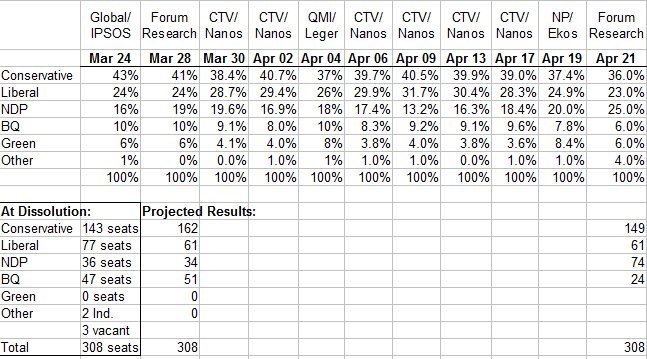
Nationally, the survey gave the Conservative Party support from 36 per cent of decided and leaning voters, 25 per cent for the NDP, 23 per cent for the Liberal party, and six per cent each for the Green Party and the Bloc Québécois. A separate Forum Research analysis, based partly on ridings won and lost in the 2008 election, suggest the survey results would give the Conservatives 149 of the 308 Commons seats if an election were held today, with 71 seats for the NDP, 64 for the Liberals and the Bloc Québécois would have 24 seats.

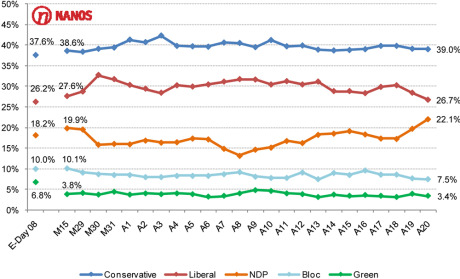
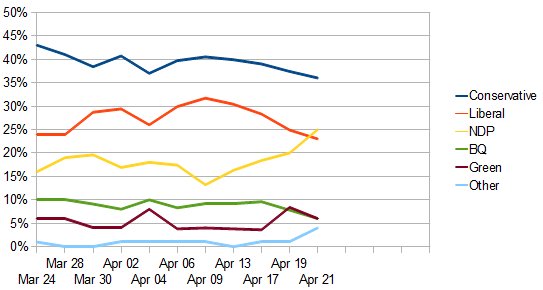
My occasionally updated percentage tracker, now (thanks to commenter request) with a graph to match:


April 2, 2011

QotD: The nature of Harper’s “slap in the face” to Quebec

Filed under: Cancon, Economics, Politics, Quotations — Tags: , , , , — Nicholas @ 12:19

I labour over this history to place in context the astounding, even outré, comments offered by Canada’s First Separatist, Gilles Duceppe, on hearing of the proposed arrangement — which, I hasten to mention, is merely a $4.2-billion loan guarantee from Ottawa, not some massive outright subsidy. Mr. Duceppe, with a logic that can only belong to a man who gets paid to be a separatist by the government he’s trying to extinguish, called the deal “a direct attack on Quebec.”

What really bothers Mr. Duceppe and other separatists is that they want to retain Quebec’s monopoly on southbound power sales to the United States — something the Lower Churchill project, including its 1,100 km of underwater transmission cables, would threaten. “By financing the Newfoundland project, Stephen Harper has given Quebec a slap right in the face,” the BQ leader declared.

It’s one of the continuing risibilities of the Canadian federation that we cosset and pamper and pay for the separatist faction in the House of Commons, and go along with the pretense that they’re parliamentarians like any other. They are not. They displace the natural balance of the federation. They have a vested interested in seeing the parliament they attend not working. And they leap to any perceived or manufactured imperfection in our system as evidence of dark perfidy or contempt for Quebec. They warp the system. Nowhere do these observations meet with greater validation than these ludicrous comments by Duceppe on the proposed assistance to the Lower Churchill.

Rex Murphy, “Newfoundland’s three-gigawatt insult to Gilles Duceppe”, National Post, 2011-04-02

February 6, 2011

“Mad Max” throws away the Quebec vote

Filed under: Cancon, Liberty, Politics — Tags: , , , — Nicholas @ 12:26

At least, that’s the way most in the media are likely to interpret his position on Bill 101:

Some people say I am not a “real Quebecer” and are accusing me of “attacking Quebec” simply because I want to be more popular in the rest of Canada. They seem unable to conceive that it’s possible to have a different position than theirs on the basis of fundamental principles.

My position is this: Yes, it’s important that Quebec remain a predominantly French-language society. And ideally, everyone in Quebec should be able to speak French. But we should not try to reach this goal by restricting people’s rights and freedom of choice.

French will survive if Quebecers cherish it and want to preserve it; it will flourish if Quebec becomes a freer, more dynamic and prosperous society; it will thrive if we make it an attractive language that newcomers want to learn and use. Not by imposing it and by preventing people from making their own decisions in matters that concern their personal lives.

Mad Max for PM!

Update, 9 February: According to an anonymous Conservative, Maxime Bernier is “mostly harmless”.

January 25, 2011

The genomic treasure trove of Quebec

Filed under: Cancon, History, Science — Tags: , , , — Nicholas @ 07:36

Thanks to relatively thorough genealogical records, the people of Quebec are of great and growing interest to genetic researchers:

One of the great things about the mass personal genomic revolution is that it allows people to have direct access to their own information. This is important for the more than 90% of the human population which has sketchy genealogical records. But even with genealogical records there are often omissions and biases in transmission of information. This is one reason that HAP, Dodecad, and Eurogenes BGA are so interesting: they combine what people already know with scientific genealogy. This intersection can often be very inferentially fruitful.

But what about if you had a whole population with rich robust conventional genealogical records? Combined with the power of the new genomics you could really crank up the level of insight. Where to find these records? A reason that Jewish genetics is so useful and interesting is that there is often a relative dearth of records when it comes to the lineages of American Ashkenazi Jews. Many American Jews even today are often sketchy about the region of the “Old Country” from which their forebears arrived. Jews have been interesting from a genetic perspective because of the relative excess of ethnically distinctive Mendelian disorders within their population. There happens to be another group in North America with the same characteristic: the French Canadians. And importantly, in the French Canadian population you do have copious genealogical records. The origins of this group lay in the 17th and 18th century, and the Roman Catholic Church has often been a punctilious institution when it comes to preserving events under its purview such as baptisms and marriages. The genealogical archives are so robust that last fall a research group input centuries of ancestry for ~2,000 French Canadians, and used it to infer patterns of genetic relationships as a function of geography, as well as long term contribution by provenance.

January 22, 2011

QotD: Sikhs, the kirpan, and the courts

Filed under: Cancon, Law, Quotations, Religion, Weapons — Tags: , , , — Nicholas @ 00:02

The [Supreme] court didn’t find for the appellants on the grounds that “the kirpan is not a weapon”. Indeed, all parties to the suit accepted the premise “that the kirpan, considered objectively and without the protective measures imposed by the Superior Court, is an object that fits the definition of a weapon.” The court found for the appellant because the school board’s zero-tolerance policy towards weapons, based largely on fears that the presence of a knife would somehow allow spooky negative vibes to propagate throughout the school, did not constitute a minimal infringement upon the rights of a religion that happens to insist upon the carrying of a weapon. (Anyone who has studied the remarkable history of the Sikhs can only be surprised that they don’t carry about five of them.)

I hate to break it to Nav Bains and to admirers of leading comparative-religion scholar Michael Ignatieff, but reciting “It’s not a weapon” won’t give us a magic wormhole we can all leap through to avoid debates over religious accommodation in public services. As I understand matters, and I am perfectly prepared to receive instruction on this point, the whole point of the kirpan is that it’s an avowedly defensive weapon. The reference books, including those written by Sikhs, tell us that it is worn precisely to signify and reinforce the Sikh’s wholly admirable preparedness to protect his faith, his community, and innocent human life. I suppose I could have added the words “just as a handgun might be”, but that would send altogether too many of my readers scrambling for the Preparation H.

Respectable efforts to establish a modus vivendi on the kirpan in secured public spaces can’t begin with evasion if they hope to be successful (and certainly it sets a terrible precedent for evasion to be designated courage). I’ll add that the problems are not really all that thorny for those of us who have never consented to fanaticism about security theatre or to cretinizing “zero tolerance” of blades in schools

Colby Cosh, “That non-weapon sure is pointy”, Maclean’s, 2011-01-21

November 25, 2010

QotD: “The Traitors and the Spendthrifts”

Filed under: Cancon, Politics, Quotations — Tags: , , , — Nicholas @ 14:17

The Coalition horrors warned of by the Conservatives have come to pass, at the hands of the Conservatives themselves. They have spent like drunken Trudeau-era Grits. They have compromised their principles and told a key part of their base to stuff it. They have put patronage ahead of promise in their Senate appointments. Short of holding another referendum on national unity, they are as bad as what they claim to abhor.

It should then come as no surprise that Stephen the Spendthrift is rumoured to be in bed with Giles the Traitor. The deal at hand is classic pork-barrelling: Federal subsidies for an uneconomical Quebec City NHL arena. The region is the Tories only stronghold in La Belle Province, naturally a little electoral sweetener wouldn’t go amiss. Tis’ the season to be generous, with other people’s money. The Bloc serve no function except as a pressure group for the Quebecois. Their tautological platform has only one plank: What is Good for Quebec is Good for Quebec. It’s a deal made in political heaven, or hell for those who believe that principle should play a role in politics.

The much-abused Tory base remains loyal. The question is to what? To conservative values? Unlikely. Yes, the Tories have a minority government. That does limit what they can do. Lester Pearson also had two back to back minority governments, and he introduced sweeping changes to the country, albeit most of them bad.

Is the failure of the Harper Tories one of opportunity, or courage? And should the Conservatives at long last win their majority, what mandate will they have? They have governed from the center for so long, how can they justify governing from the RIght? Won’t the rationale then become we can’t take risks because we might lose the majority? So when will the Reform come? As time passes it becomes clear that many Conservatives’ loyalty lies with Team Blue, not conservative ideas or values.

Publius, “The Traitors and the Spendthrifts”, Gods of the Copybook Headings 2010-11-25

September 10, 2010

Maxime Bernier for PM!

Filed under: Cancon, Liberty, Politics — Tags: , , , — Nicholas @ 13:12

Now that most of us have given up on any actual free market policies coming out of the PMO, perhaps it’s time to look to someone who still appears to have libertarian tendencies:

It seems the libertarian Conservative MP is offside with the rest of his Quebec caucus colleagues over the issue of funding a multi-million-dollar hockey rink. He was conspicuously absent from a photo-op this week, in which Quebec MPs donned Nordiques jerseys to show their support for the arena and the possibility of bringing an NHL team back to the provincial capital.

“It was instructive that Quebec MP Maxime Bernier, who opposes public handouts for private enterprise, was missing from the photograph and e-mailed me a curt ‘no comment’ when asked about the merits of federal support for the arena,” National Post columnist Don Martin wrote at the time.

Mr. Bernier has since taken to the local airwaves in his Beauce riding to pour cold water on the idea of the Tories showering taxpayer dollars on sports facilities while battling a $56-billion deficfit.

Corporate give-aways of millions of dollars to billionaire sports team owners shouldn’t be merely controversial: they should be anathema. It’s that much worse when the government is deeply in debt.

Update: Maxime Bernier in his own words:

The hard reality is that we have just been through a global economic crisis — which remains very preoccupying and is likely not over — and governments in both Quebec City and Ottawa are heavily indebted. Our government has just posted a huge $56-billion deficit and the priority is to get back to a balanced budget through reductions in our own programs, and avoid by all means getting involved in risky financial ventures.

I was not at all impressed by the Ernst & Young study, which concluded that the project would be “profitable” — but only on the assumption that governments provide full funding for the construction as well as the repairs and renovations that will be necessary over the next 40 years. That’s a deceptive way of putting it. The conclusion should rather be that the project is simply not profitable and will constitute a financial burden for taxpayers for decades to come, even in the best scenario. That’s why not a single private player has been found to invest in it.

Just about any business would be “profitable” if they never had to pay rent for their business premises or buy, build, and maintain their own buildings. That isn’t the way ordinary businesses operate, and professional sports teams shouldn’t be any different. We don’t elect governments to be the primary supporters of sports team owners . . . no matter how many “complimentary” premium seats at the stadium may be offered to individual politicians.

As the great French economic Frédéric Bastiat wrote, “Government is the great fiction through which everybody endeavours to live at the expense of everybody else.” When such large amounts are in play, it is impossible to calculate exactly who has received how much. We would need to go beyond a single file and take into account all public spending items, going as far back as possible.

That’s what Quebec separatists like to do. They keep telling us that Quebec has been on the losing side of the financial equation and that Ottawa has systematically been favouring Ontario for more than a century. Meanwhile, people in the rest of the country believe that Quebec is the spoiled child of the federation. Each region can point towards many examples to nurture its frustrations. It is a pointless debate which can only divide our country.

Oh, swoon!

August 7, 2010

QotD: De Gaulle

Filed under: Cancon, Europe, France, History, Quotations, WW2 — Tags: , , , — Nicholas @ 00:01

De Gaulle was great because he knew how to act the part. Actually doing great things was someone’s else problem. The heavy lifting of the Second World War was done by the Russian foot soldier and the English speaking powers. Objectively, Canada did more to defeat Hitler than France. Being a nation of citizen soldiers, who desperately wanted to get home, we did our bit and went home. This allowed a prima donna like De Gaulle to take the credit for liberating France. In gratitude, the Liberator then travelled to Montreal, some twenty years later, and thanked Canada by trying to destroy it.

Publius, “The Saviour of the Nation”, Gods of the Copybook Headings, 2010-08-04

June 9, 2010

A Canadian Liberal-Democrat party?

Filed under: Cancon, Politics — Tags: , , , , — Nicholas @ 07:43

Andrew Potter pokes fun at the widely rumoured merger discussions that may or may not result in a combination of the Liberals and the New Democrats:

So here’s what I think, for what it matters to anyone: It’s a stupid idea. Not just stupid as in don’t-eat-that-fifth-taco stupid, but deeply, profoundly, moronic. If it were to come to pass, the only, and I mean only, beneficiaries would be the Conservatives. The NDP would lose, the Liberals would lose, and, more than anything, Canadians would lose.

[. . .]

The problem with the Liberals is not that their voter base it is divided, it is that their voter base has left them. And the reason their voter base has left them is because the Liberals have been acting like humungeous bozos for most of this decade. It is really not much more complicated than that. The former Natural Governing Party transformed itself into the Party of Humungeous Bozos, and if there is one thing Canadians have shown over the years is that you can’t get elected if you are a humungeous bozo. You can be an arrogant jerk (Trudeau), a slimeball (Mulroney), a gangster (Chretien) or a paranoid control freak (Harper), but the Canadian body politic is powerfully immune to bozos.

While I wouldn’t say it’s impossible, I’d expect the NDP rank-and-file to object strenuously to anything more than a tactical agreement to avoid running directly against the Liberals. The NDP, although I disagree with much of what they stand for, at least do believe in something. The only thing the Liberals stand for is their belief that they should be running the country.

Update: Steve Janke thinks it could be an ugly, ugly scenario indeed:

And there are plenty of senior Liberals utterly appalled at the idea of a merger, I think because they realize the NDP, though smaller, is more ideologically pure, and that the NDP would pull the merging Liberals leftward (though the NDP purity would itself be diluted, something the NDP membership would be worried about, and would probably struggle hard against). The new party would be much more NDP than Liberal.

These appalled Liberals would fight hard against a merger at a Liberal convention, and it seems to me that the Liberal Party could tear itself apart in a very ugly and public way.

Let’s say the merger amendment fails. What then? We could see a chaotic abandonment of the Liberal Party by disaffected Liberals (remember, I dialled the chaos way up on the scenario-a-tron). As of yesterday, the existence of Liberal-NDP merger talks is public knowledge. Even if it isn’t true, people now believe it to be true. The pro-merger Liberals in the rank-and-file might not accept a failure of those talks or a failure to accept a constitutional amendment to make a merger official. If they see their dream snatched away, we could see large numbers of Liberals tearing up their membership cards and switching parties, especially if they are led by someone like Bob Rae tearing up his membership card first.

May 24, 2010

Why the Canadian political sphere lacks zest

Filed under: Britain, Cancon, Politics — Tags: , , — Nicholas @ 17:33

It’s a fundamental issue that prevents any form of excitement from being discussed, or acted upon:

In Britain, even post-Blair, many of the best and brightest still go into politics. Until the expenses scandal, there was something of a cache to being an MP, something which will probably return in time. The typical Canadian Cabinet is, by comparison, made of poorer quality timbers. The average minister of the crown, here in the Elder Dominion, might make it as a parliamentary secretary back in the Mother Country. Our best and brightest go into business, science and down South. In Canada, those who can’t do, teach, those who can’t teach, teach gym, and those who fail at that run for elected office. There are exceptions. Very few.

The other reason British parties are, relatively, more principled than their Canadian derivatives is national unity. Until about the mid-1990s, no one seriously talked about the break up of the United Kingdom. Even the bleeding ulcer of Ulster was unlikely to be resolved by uniting North and South. This is not the case in Canada. On pretty much every major national issue of the last century and a half — Catholic Schools, prohibition, conscription, foreign policy, Medicare, Afghanistan — English speaking Canada leans one way, and French Canada the other. Raise controversial issues and you might start reminding the Solitudes how much they dislike each other. Thus our national politics has the colour, consistency and firmness of oatmeal. It’s why Mackenzie King, the Great Equivocator, was our longest serving Prime Minister.

April 26, 2010

Maxime Bernier: Harper’s successor?

Filed under: Cancon, Economics, Politics — Tags: , , , , — Nicholas @ 17:32

Okay, so Andrew Coyne doesn’t quite go so far as to say that Bernier is the next leader of the Conservative party, but he certainly makes a case for Bernier speaking for an under-represented viewpoint in that party — actual conservatives, even (whisper it) “libertarians”:

Let’s just pause for a moment to consider what an extraordinary thing Maxime Bernier is attempting. The former minister in the Harper government is widely said to be preparing the ground for a future leadership bid. How has he been going about it? Since January, Bernier has been methodically laying explosives beneath the government and detonating them at regular intervals, in speeches and writings that, while not overtly criticizing Conservative policy, point in precisely the opposite direction to that on which the government happens to be embarked.

[. . .]

I cannot think of a precedent for this performance. Bernier is careful not to attack the party’s current leadership — just everything they’ve been doing. Yet he could hardly be accused of heresy. He represents, to paraphrase Howard Dean, the Conservative wing of the Conservative party — the party’s soul, its core beliefs, varnished as they may be under layers of expediency, yet still there. Indeed, so contorted has the Conservative party become that many people insist he is merely giving voice to what the leader himself believes.

[. . .]

Indeed, as a libertarian conservative from Quebec, he may find he has more supporters in the West. I don’t suggest he will be leader, or should. His record in cabinet was decidedly mixed: a fine industry minister, he was a disaster at Foreign Affairs. Though the speeches are thoughtful, it remains unclear whether there is a man of substance behind them, not least after the Couillard fiasco. Yet his willingness to state brave truths openly, to call the party back to its authentic self, marks him as one to watch.

I’ve often asked folks what substantive difference there is between the current Conservative government and the previous Liberal government. Other than the colour of the party signs, there’s not much actual “conservative” governing going on.

April 23, 2010

QotD: Seeing the justice system through different eyes

Filed under: Cancon, Law, Quotations — Tags: , , , , — Nicholas @ 12:59

By revealing how a city employee seemed to spend virtually all his time following her in a city truck, she has directed much-needed attention to city’s supervisory practices.

That’s in addition to highlighting, by explaining what it is like to be stalked, the nature of — and remedy for — a crime that can be devastating in its psychological effects, even if nothing worse happens.

De Blois, 40, who works at Youth Court, told The Gazette’s Katherine Wilton that at first she thought she could handle the situation herself. But in the months before the stalker, 49-year-old André Martel, was arrested, De Blois said she felt terrorized. She lost 23 pounds and had trouble sleeping.

Even after Martel pleaded guilty to criminal harassment and was conditionally released on bail, he continued to follow De Blois, she says. The lawyer suddenly saw the justice system through different eyes. “I can’t imagine what it must be like for a regular person who is not a lawyer, who doesn’t have contacts with a police officer or a crown prosecutor,” she said.

“Why were taxpayers subsidizing a stalker?”, Montreal Gazette, 2010-04-23

« Newer PostsOlder Posts »

Powered by WordPress