Quotulatiousness

November 20, 2011

In praise of Sir Wilfrid Laurier

Filed under: Cancon, History — Tags: , , , — Nicholas @ 10:22

A conservative senator writes of the greatest Liberal prime minister in Canadian history:

Today, almost 100 years after Laurier’s death, I believe as strongly as my grandfather did that great figures from our history like Sir Wilfrid and Sir John A. should be celebrated and honoured, regardless of party.

Like John A., Laurier had that special touch and talent that makes nation-building possible. He was a visionary leader who built upon the foundations laid by Macdonald and brought Canada into the 20th century with success and a healthy confidence. In a country so divided in the early days — divided by race, religion and geography — the guiding principle and mission of his life was the unity of our nation.

Some have said he was the perfect prime minister — too French sometimes for the English, and too English sometimes for the French. He challenged both main language groups in Canada, while simultaneously opening the door to the settlement of Western Canada by immigrants from Eastern Europe.

Shortly before his death, Laurier addressed a group of youth in Ontario. His words are as inspiring in 2011, 92-years-later, as they were when he first spoke them. Canadians, particularly our youth, would do well recall his advice.

“I shall remind you that already many problems rise before you: Problems of race division, problems of creed differences, problems of economic conflict, problems of national duty and national aspiration,” Laurier said. “Let me tell you that for the solution of these problems you have a safe guide, an unfailing light if you remember that faith is better than doubt and love is better than hate. Let your aim and purpose, in good report or ill, in victory or defeat, be so to live, so to strive, so to serve as to do your part to raise even higher the standard of life and living.”

October 20, 2011

Timer now started for how quickly Quebec forces Harper to override shipbuilding contract awards

Filed under: Cancon, Economics, Military, Politics — Tags: , , , , , , — Nicholas @ 12:08

The National Post editorial board has lots of nice things to say about the federal government’s attempt to take politics out of the huge shipbuilding contract process:

On Wednesday, the Tory government released its Solomonic decision regarding which shipyards will build $33-billion in new military and non-military vessels over the next two decades. The evaluation of bids for the largest government procurement contract since the Second World War was handled by senior bureaucrats, rather than cabinet ministers. Even the announcement of the winning contractors was made by Francois Guimont, the top civil servant from Public Works and Government Services, rather than his minister or the minister of National Defence, as would have been the case with past contracts of this magnitude.

Of course, that’s not to say there will be no political backlash from the decision. Irving Shipbuilding of Halifax will be given $25-billion to build new joint support ships, Canadian Surface Combatants — a sort of destroyer-frigate hybrid — and offshore patrol vessels capable of sailing off all three of Canada’s coasts — east, west and Arctic. Seaspan Marine of Vancouver will build science vessels for the Coast Guard and for the Fisheries department, plus icebreakers worth a total of $8-billion. That means Davie Shipyard in Levis, Que. was left without a major shipbuilding contract (though Davie is still eligible to bid on a further $2-billion contract to provide smaller government boats, such as Fisheries patrol vessels). It must have been tempting for the Tories to intervene in the contract-award process and toss Quebec a bigger bone. Their recent decision to expand the grasp of the official languages commissioner to several airlines, and their willingness to give new seats to Quebec in the House of Commons (despite the fact Quebec was not underrepresented there), just because Ontario, B.C. and Alberta were getting more, shows the Tories have become very concerned about their appeal to Quebec voters.

You can guarantee that many Quebec politicians will benefit for having yet another stick to beat the federal government with — this would be true in all scenarios except the one where the Quebec shipyard got both contracts. It would be an even better deal for the taxpayers (and perhaps even the Royal Canadian Navy) if the contracts hadn’t been restricted to Canadian shipyards: it wouldn’t fly politically, but it would almost certainly have been better bang for the billions of bucks.

October 14, 2011

Harper back-pedals promises to adjust number of seats in the Commons

Filed under: Cancon, Politics — Tags: , , — Nicholas @ 11:53

Quebec once again demonstrates that you don’t have to have many of your MPs in the government benches to “wag the dog” about representation in the House of Commons:

Fears of a Quebec backlash have delayed the Harper government’s plan to give the growing parts of Canada a larger share of seats in the House of Commons.

As a result, the changes the Tories promised in the spring campaign may not be in place in time for the 2015 election, leaving millions of voters once again underrepresented in Parliament.

The bill to change the way seats are allocated, which would give Ontario an expected 18 additional MPs, British Columbia seven and Alberta five, aims to redress the severe shortage of seats in large and growing urban areas.

But the Conservatives are still grappling with the fact that the change would disadvantage Quebec, which it continues to court despite being virtually shut out there in May. The province has 23 per cent of Canada’s population and 24 per cent of the seats in the House, but its share would fall to 22 per cent under the new formula. The NDP, which achieved a breakthrough there in the election, and many Quebec politicians vehemently oppose the plan.

September 29, 2011

Quebec may create its own gun registry

Filed under: Cancon, Government — Tags: , , , — Nicholas @ 08:10

Matt Gurney examines the Quebec government’s declared intention to create a provincial gun registry:

In July, Quebec’s Public Safety Minister Robert Dutil told reporters that his government was considering a “Plan B” in the (highly probable) event that the federal Tories scrapped the long-gun registry — the creation of a provincial registry. Quebec is particularly sensitive to crimes committed by firearm, and has been more wedded than most provinces to the faulty notion that registration provides public-safety benefits. The Supreme Court has already ruled that firearms registration is a federal responsibility due to the public safety nature of gun control, but Quebec could theoretically try to establish a registry for firearms that treats them as simple property, no different than dogs, cats or boats. It would be a political stunt only … but then again, that’s all the registry has been since the beginning: A costly act of political theatre in which politicians impose burdensome red tape on lawful firearms owners and proclaim society somehow safer as a result.

September 11, 2011

The Canada Pension Plan and moral hazard

Filed under: Cancon, Economics, Government — Tags: , , , , — Nicholas @ 11:37

An interesting post at Worthwhile Canadian Initiative looks at the overlooked failure in pension markets. I found this bit of information to be quite interesting, as it addresses a conversation I had with Dark Water Muse a few months ago:

Governments provide pensions in one of two ways. Pay As You Go (PAYG) plans use current contributions to fund current benefits. The Canada and Quebec Pension Plan were, when they were first introduced, PAYG plans. The moral hazard risk a worker faces with these plans is political: a politician will design the plan so as to maximize his or her chances of re-election.

The design of Canada and Quebec Pension Plan has created large benefits for the first generation of recipients (current voters) and a much lower rate of return for future recipients (future voters). Now those gainers were the generation that entered the labour market in the Great Depression and fought in World War II, so one could argue that the windfall gain they experienced was merited on equity grounds. The point here is merely that the design of PAYG pension plans reflects the interests of the designers (for re-election) as well as the interests of the contributors and recipients.

The Canada and Quebec Pension Plans are now transitioning into fully-funded plans. The Canada Pension Plan Investment Board was, as of June 30th 2011, managing $153 billion in assets. Some is managed directly by the board, the rest is managed by “partners” ranging from Istanbul-based Actera Group to New York-based Welsh, Carson, Anderson & Stowe. I suspect that the CPP, roaming the world with billions to invest, is able to negotiate low management fees, and there must be savings associated with economies of scale in investing. But the possibility of moral hazard — someone getting rich by diverting away a tiny percentage of the return on $153 billion, or a politician exerting pressure on the CPP investment board to make electorally-sound investments — remains.

In sum, while private pension markets suffer from moral hazard, it’s not clear that governments can solve the problem.

In my discussion with DWM, I claimed that the CPP was a PAYG system (in extreme examples, like the US social security system, this can be compared to a Ponzi Scheme), while DWM — claimed that the system was fully funded from investments. As the quoted section above shows, we each had part of the answer.

It’s hard to believe that the CPPIB (the organization that handles the investments of the CPP) can remain immune to government meddling — buy this company’s stock, invest in that company’s risky-but-located-in-a-marginal-riding new venture, etc. As long at the CPPIB can remain independent of political pressure, the system might work.

July 21, 2011

Quebec-based botnet taken down

Filed under: Cancon, Law, Technology — Tags: , , , — Nicholas @ 09:19

John Leyden reports on the Laval, Quebec man who has been arrested:

Joseph Mercier, 24, of Laval, Quebec, allegedly hacked school board systems in Canada as well as computer networks in the US, France, Russia and the United Arab Emirates. Mercier — who was in charge of his employer’s information security — reportedly ran his alleged botnet scam at home and at work, the Canadian Broadcasting Corporation reports.

Mercier was released on bail following a brief court appearance on Tuesday. The Royal Canadian Mounted Police are still investigating the scope of his alleged misdeeds. It’s unclear whether any banking fraud resulted from the scam, the precise motive for which remains unclear.

July 8, 2011

Culinary cage match: Middlesbrough’s “Parmo” versus Canadian Poutine

Filed under: Britain, Cancon, Food, Humour, Randomness — Tags: , — Nicholas @ 10:52

I was born in Middlesbrough, but it was news to me that they have their own “signature dish”: the parmo:

As promised, our highly-trained operatives took time off from audacious spaceplane projects to tackle the parmo — a Middlesbrough delicacy whose fame has already spread as far as Sunderland, but is now set to burst onto the international stage.

However, in the interests of science, we decided to pitch the parmo against another dish whose name is uttered in hushed tones: Canadian poutine.

Yes, we hear you ask, qu’est-ce que c’est this poutine of which you parlez? Since you ask, it’s an unholy alliance of chips, gravy and cheese curds, which will now do battle with the parmo’s deep-fried pork fillet for the ultimate post-pub nosh deathmatch crown.

I should probably warn you that poutine is really a Quebec dish, and has only recently become well known outside the province of its birth. It’s also been described as “the culinary equivalent of having unprotected sex with a stripper in the parking lot of a truck stop in eastern Quebec.”

So, what’s the verdict? Well, I’d like to be able to report that the Spanish locals were willing to give these two tempting dishes a go and report back, but no sooner did we emerge from the kitchen bearing platters of goodness, than the bar immediately emptied.

Among the excuses offered for not being able to stick around to try our hearty fare was one bloke who’d forgotten it was his mother’s funeral in 10 minutes, and another chap who after 40 years as a committed atheist, decided it was an opportune moment to go to Mass and be reclasped to the bosom of the Church.

June 24, 2011

“Damn! Another cursed Mordecai!”

Filed under: Books, Cancon, Media — Tags: , , , , , — Nicholas @ 12:02

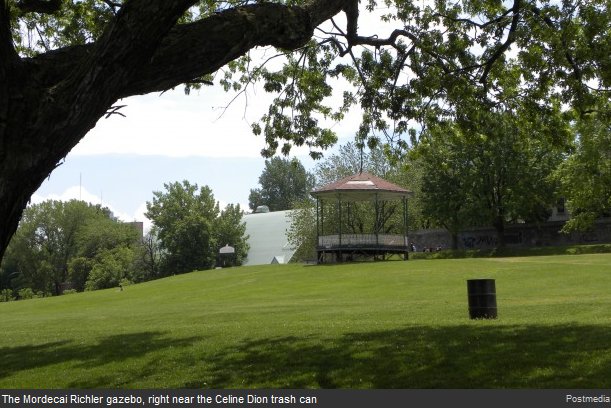
Barbara Kay takes issue with the token that Montreal has chosen to commemorate Mordecai Richler:

Mordecai Richler is Canada’s biggest claim to literary fame. If he had been born and lived in any other province but Quebec there would have been an outpouring of ideas on how to commemorate his life and achievements: perhaps renaming streets in his honour, building schools bearing his name, or erecting a statue featuring the disheveled genius wryly peering over his pince-nez at a smoked meat sandwich on wry…er, rye.

Instead Montreal’s political mandarins have decided he is getting a gazebo — a crummy little open pavilion at the foot of Mount Royal, with no known connection to the author. A place for people to come in out of the rain. Not quite a public toilet, but close.

That’s like naming the change house at an outdoor skating rink after Margaret Atwood, a pellet dispenser at the zoo after Yann Martel, or a maintenance shed after Margaret Laurence. But then, if Mordecai Richler had been born outside Quebec, maybe he wouldn’t have been inspired to the kind of savage indignation that made him such a household word (and often not in a good way) in his native Montreal.

She provides a rather more appropriate memorial gesture:

Here’s an idea: Montreal is riddled with potholes. The French for “pothole” is “nid-de-poule,” literally a chicken’s nest. How about if the word is officially changed to “mort-de-caille(ou)” which means “death of stone” (well, death of pebble, close enough). Henceforth let all Montreal potholes be called Mordecais. In this way, his name will forever be on every Montrealer’s lips, because Montreal potholes are ubiquitous and eternal, and yet not in a good way – “Damn! Another cursed Mordecai!” I think Richler himself would have appreciated the irony, and approved.

June 12, 2011

Montreal model railway loses out to real railway

Filed under: Cancon, Economics, Railways, Randomness — Tags: , , — Nicholas @ 12:36

Canadian National, which owns the building hosting Montreal Model Railway Club — claimed to be “Canada’s largest fully operational model railway” — is terminating the club’s lease because they can get higher rent for the building:

In a warehouse in Montreal’s historic Griffintown neighbourhood, model train enthusiasts have spent 38 years engaging in a labour of love.

Inch by inch, they’ve constructed what is believed to be Canada’s largest fully operational model railway.

More than 300 people have participated over the years, devoting thousands of hours to building life-like models across an eye-popping, detail-laden, 1,493-metre masterpiece.

And it’s about to be detroyed.

The reason for the imminent dismantling is not without irony: the make-believe trains are about to be forced away by a real train company, dealing with real-life issues like rising property costs.

Canadian National owns the 9,000-square-foot warehouse space and wants to lease it out at a higher rent, starting next year. It warned the model-train association five years ago that its time was up.

The club’s website is http://www.canadacentral.org/Reseau_EN.htm.

May 7, 2011

Bring Mad Max back into cabinet?

Filed under: Cancon, Government, Politics — Tags: , , — Nicholas @ 10:13

I admit I’m rather fond of Maxime “Mad Max” Bernier, so of course I’m in favour of bringing him back into cabinet:

Mr. Harper also needs to reach out to the inner conservative that lies dormant in the hearts of most Quebecers.

How to kill these two birds with one stone? Appoint Maxime Bernier as President of the Treasury Board.

The position is open, since incumbent Stockwell Day decided not to run in the May 2 election.

Maxime Bernier hails from Beauce, a fortress of entrepreneurship in the heart of the province. He is an efficient communicator who sticks to the message. He emphasizes fiscal conservatism and individual liberties, a stance that resonates with a core of enthusiastic supporters in the province. He preaches the entrepreneurial values that lie at the very centre of Quebec’s conservative past, but are too seldom celebrated nowadays.

Lorne Gunter: Give the new MP for Las Vegas a break

Filed under: Cancon, Politics — Tags: , , — Nicholas @ 00:40

It’s inevitable that the election of Ruth Ellen Brosseau in absentia would be a cause for amusement, but Lorne Gunter makes a good case that we should cut her a bit of slack:

It is common practice across the country to dig up candidates wherever they can be found and plead with them to let their names stand in ridings where a party has no chance of winning. (Or almost no chance. Ms. Brosseau’s case proves there is never NO chance of winning.)

In a past life, when I used to be a devoted Liberal party worker in Alberta, during the height of the National Energy Program, we used to use this tactic all the time: Get some campus Liberal club member to let him- or herself be nominated in a rural riding where the Tory candidate was going to capture 80% of the vote anyway, just so the party could claim it had run a candidate in all X number of ridings in the country.

On this count, I’m willing to grant Ms. Brosseau a pass, as this is what every small party faces every election: the need to get as many names on to the ballot as possible. It’s tough enough for minor parties to get any press coverage, but it’s much harder if you are only running a corporal’s guard of candidates in the election.

That being said, however, even in the days when we only ran paper candidates (no signs, no brochures, no active campaigning), the candidate was at least in the riding during the election. She should have either cancelled her trip, postponed it, or declined the nomination if she couldn’t do either.

One NDP supporter in Ms. Brosseau’s new riding asked the other day whether he and his fellow voters where victims of some sort of scam. No, sir, not victims — participants.

Who votes for someone who was never seen in the riding during the election, someone who doesn’t live anywhere near the riding, doesn’t articulate any policies and doesn’t even speak French all that well, but who is seeking to represent a constituency in which over 90% of the residents list their at-home language as French?

It’s clear the voters of Berthier-Maskinongé were so eager to vote NDP — as were so many Quebec voters — that they didn’t care who the local candidate was, which is appropriate in this case, because the local candidate didn’t care either. Ms. Brosseau was doing a favour for a friend at NDP headquarters in Ottawa, now she’s going to have to uproot her life for the next four years and go be the MP for a riding where the voters know no more about her than she knows about them.

I wrote about the allegations of fraud in the nomination papers here.

May 6, 2011

Chris Selley on those new “orange posts”

Filed under: Cancon, Government, Politics — Tags: , , , , — Nicholas @ 12:13

The new NDP youth wing gets lots of fun poked at it (some of it here), but Chris Selley has hopes that they may force the House of Commons to revisit the worst aspects of parliamentary behaviour:

Look. It’s easy, and frankly appropriate, to laugh at the gaggle of orange poteaux — “posts,” as Quebecers call cipher candidates — soon heading to Ottawa to take their seats as New Democrat MPs (and to move into their very first apartments!). But whatever their shortcomings, it’s safe to assume they’re full to bursting with idealism and self-esteem. Many of them aren’t long out of high school. Try to bully them and by God, they’ll probably call the police.

There’s 57 new NDP MPs from Quebec — almost 20% of the House of Commons. They have a real opportunity to make a difference in the way Parliament conducts its business. Jack Layton himself has said he intends to officially oppose the government in a more dignified manner. And it’s hard to think of anyone in a better position to hold him to his word than, say, a 21-year-old student with $600,000 or so coming to him over the next four years, representing a riding he’s barely visited (if at all) and constituents who didn’t (and don’t, and may never) really give a damn who he is.

The complaints of ex-MPs detailed in the Samara report go far beyond Question Period. One ex-parliamentarian said he profoundly regretted toeing the party line on an emotional issue — almost certainly same-sex marriage, although it’s not specified — and recalled colleagues weeping as they voted against their consciences. Another tells of being tasked, very early in his career, with delivering a speech on the mountain pine beetle infestation in British Columbia, which he knew absolutely nothing about, on 20 minutes’ notice.

One of the weaknesses of our system is that there are not stronger supports for MPs voting freely rather than following the direction of the party whips. The constituents are not being represented if their MP is not allowed to vote in line with their preferences but instead has to subordinate their concerns to that of the party. SSM and the long gun registry are recent examples where the outcome was dictated by party leaders refusing to allow their MPs to vote freely.

It’s good that MPs recognize, at least in hindsight, that partisanship fries their brains and makes them act like monkeys. But hindsight isn’t good enough. Unless MPs grow some … uh, courage, when it actually matters — refusing orders to act foolishly or speechify on subjects they know nothing about, or to waste hours filling chairs on “house duty” when they could be out doing something useful, or to vote against their own or their constituents’ beliefs — this is never going to change.

May 4, 2011

Alleged forged signatures on NDP nomination papers

Filed under: Bureaucracy, Cancon, Politics — Tags: , , — Nicholas @ 15:29

This is weird. It may just be a function of how little experience the campaign workers had in that riding — I know the NDP were a skeleton crew in Quebec for this election (which makes their huge haul of seats from the province even more amazing), but forging signatures? It just doesn’t add up at all. Why do I say that? Let me tell you a little story . . .

Oddly enough, I had a discussion with a Returning Officer (not the RO for my riding) a few weeks ago about nomination papers and the requirements for signatures. It was rather illuminating.

Every candidate for parliament has to submit nomination papers to the constituency’s Returning Officer within a set number of days after the writ has dropped. Many would-be candidates for smaller or less well-organized parties have to depend on going door-to-door to gather signatures, as they don’t have enough party members in the riding to meet the requirement internally. I’ve done this for Libertarian candidates, and I’m sure most of the NDP candidates in Quebec this time around had to do the same thing. (Signing the nomination paper does not mean you’re a supporter of that candidate, it merely acknowledges that you have been informed that they are hoping to run in the election.)

So, a few bare minutes before the deadline, each of the candidates has to drop off their nomination papers with all of the required signatures. Elections Canada is not a huge organization (by government standards, they’re tiny). They don’t have the resources to do an instant check of the nomination papers. What they do is to verify that each of the signatories on the list is a registered voter in the riding.

Even this low barrier can be a problem, so Elections Canada recommends that candidates provide more than the minimum 100 signatures, as some of them may not be acceptable. Once all the names have been checked, if there are still not at least 100 acceptable signatures, then the Elections Canada folks do another pass through the list, and accept signatures from people whose addresses had registered voters in the previous election (the hurdle gets even lower).

Did you notice that last little bit? If you live at an address which had one or more registered voters living there in the last election, you are deemed to be a registered voter for the purposes of signing nomination papers. Is that not a low enough hurdle to avoid the need to submit forged signatures?

Update: Here’s the Globe & Mail story.

Update the second, 6 May: Elections Canada has declared the nomination papers to be valid. The other candidates still have the opportunity to challenge the result in court, although there may not much hope for them to succeed.

The NDP’s rookie class of 2011

Filed under: Cancon, Politics — Tags: , , — Nicholas @ 07:54

Tamsin McMahon has a story about some of the (many) new NDP Members of Parliament from Quebec, including everyone’s favourite Vegas gambler, Ruth Ellen Brosseau:

At a news conference in Montreal Mr. Mulcair found himself defending the neophyte MP, saying that he would take responsibility for the riding while Ms. Brosseau brushed up on her French and that of all the NDP candidates elected in Quebec, she was the only one not fluent in the language.

Ms. Brosseau wasn’t originally chosen by the party to run in the riding. Elections Canada records show Julie Demers won the party nomination on March 23, but was moved to the riding of Bourassa, where she lost to Liberal Denis Coderre.

It must be odd enough for Ms. Brosseau, winning the seat despite being out of the country for a significant portion of the campaign, but you really have to feel sorry for Julie Demers!

May 3, 2011

Conservatives win majority, NDP break through to official opposition

Filed under: Cancon, Politics — Tags: , , , , , , — Nicholas @ 00:26

A political earthquake in Canada, as the Liberal party vote collapses across the country and the separatist Bloc Quebecois vote collapses even further in Quebec. The result of division on the left is a majority for Stephen Harper’s Conservative party.

As I’m writing this post, the current numbers are:

  • Conservatives — 167 seats
  • New Democratic Party — 103 seats (historic high)
  • Liberals — 34 seats (with leader Michael Ignatieff losing his own seat)
  • Bloc Quebecois — 3 seats (below “official party status”, with leader Gilles Duceppe losing his own seat)
  • Greens — 1 seat (historic high, as party leader Elizabeth May wins the first Green seat in parliament)

As I posted in a Twitter update a few hours back, this is the same situation that allowed Liberal leader Jean Chretien to win three straight majorities: a divided opposition. This time, instead of the Progressive Conservatives fighting the Reform Party on the right, it’s the Liberal Party fighting the NDP on the left.

The test facing Jack Layton is how to manage his hugely inflated caucus in the new parliament (with new Quebec MP’s in the majority) and perhaps finding ways to keep the rump of the Liberal party willing to work with his new official opposition.

It must be a great day to be an NDP supporter, with historic gains for the party and new respect for leader Jack Layton.

« Newer PostsOlder Posts »

Powered by WordPress