Quotulatiousness

April 25, 2018

Ontario’s ongoing guaranteed annual income experiment

Filed under: Cancon, Economics, Government — Tags: , , , , — Nicholas @ 05:00

Finland may have given up on their guaranteed annual income pilot, but Ontario’s similar program is still getting positive reviews from GAI fans like Andrew Coyne at the National Post. Colby Cosh isn’t quite as impressed with the program or the chances of it being expanded beyond its current small scale:

The Ontario plan is giving randomly selected low-income working-age individuals $16,989 a year in free money. That’s the basic story, with the detail that couples are eligible for a combined $24,027. This amount replaces provincial welfare, employment insurance, or early Canada Pension Plan payments, dollar-for-dollar; Canada Child Benefit cheques are strictly separate, however, and if study members go out and earn some income, their payment is reduced by 50 cents for every dollar they make until the supplement hits zero.

This is the “negative income tax” model of guaranteed income, intellectually pioneered by the Austria-Mont Pelerin-Chicago strain of economic thought that is my personal heritage and Coyne’s alike. The conclusion of the PBO paper is that the total cost of such a program for the entire country, applied to this year’s economy, would come to about $76 billion.

[…]

Kevin Milligan, a UBC economist who is skeptical of GAI, often points out that GAI advocates face the challenge of reconciling three conflicting elements of such a program: we want it to have a reasonable overall cost, we want it to be generous enough to bother with, and we want it to impose a low “clawback” rate on earned income so as not to discourage that.

The “Ontario model” sort of resolves the “trilemma” by being soggy on all three fronts. The $17,000 basic amount was chosen specifically to come to 75 per cent of Statistics Canada’s “low-income measure”: it is a guaranteed not-even-low income. (At the same time, I notice that the basic personal exemption on federal income tax forms is just $11,809 this year. Before we hurl ourselves headlong at a new social program of a relatively untested nature, maybe we could explicitly just stop taxing the poor first?)

Three points of GST may seem like a reasonable overall cost, if it could be realized, but an entitlement such as this is bound to be a one-way street: by the time we decide we do not like the effects, it will have become the next thing to a sacrament. (Canada’s guaranteed federal income defines us as a country!) Meanwhile, the 50-per-cent clawback in the Ontario model is fairly dramatic, and, moreover, under the model, couples who begin cohabiting would stand to lose up to $10,000 a year of GAI payments between them.

April 4, 2018

The bias against reporting good news

Filed under: Economics, Media — Tags: , , , — Nicholas @ 03:00

Last month, Matt Ridley looked at the contrast between how readily bad news is shared and how reluctant we seem to be to share good news:

[…] It also feeds our appetite for bad news rather than good. Almost by definition, bad news is sudden while good news is gradual and therefore less newsworthy. Things blow up, melt down, erupt or crash; there are few good-news equivalents. If a country, a policy or a company starts to do well it soon drops out of the news.

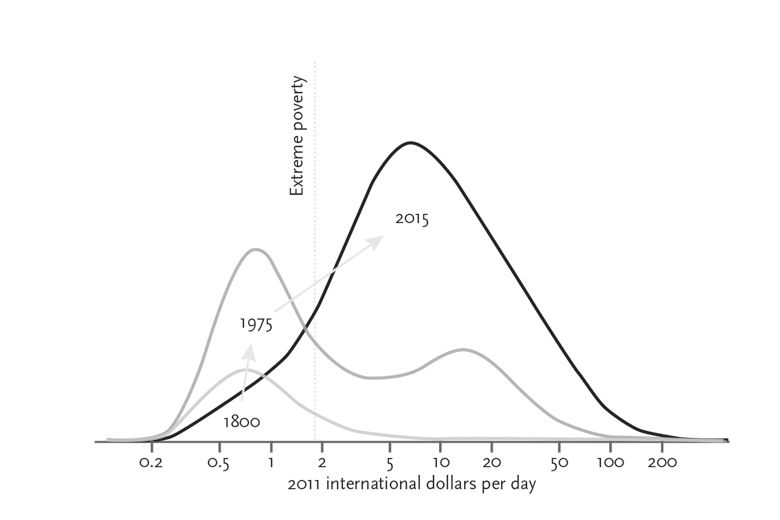
This distorts our view of the world. Two years ago a group of Dutch researchers asked 26,492 people in 24 countries a simple question: over the past 20 years, has the proportion of the world population that lives in extreme poverty

1) Increased by 50 per cent?

2) Increased by 25 per cent?

3) Stayed the same?

4) Decreased by 25 per cent?

5) Decreased by 50 per cent?

Only 1 per cent got the answer right, which was that it had decreased by 50 per cent. The United Nations’ Millennium Development goal of halving global poverty by 2015 was met five years early.

As the late Swedish statistician Hans Rosling pointed out with a similar survey, this suggests people know less about the human world than chimpanzees do, because if you had written those five options on five bananas and thrown them to a chimp, it would have a 20 per cent chance of picking up the right banana. A random guess would do 20 times as well as a human. As the historian of science Daniel Boorstin once put it: “The greatest obstacle to discovery is not ignorance — it is the illusion of knowledge.”

Nobody likes telling you the good news. Poverty and hunger are the business Oxfam is in, but has it shouted the global poverty statistics from the rooftops? Hardly. It has switched its focus to inequality. When The Lancet published a study in 2010 showing global maternal mortality falling, advocates for women’s health tried to pressure it into delaying publication “fearing that good news would detract from the urgency of their cause”, The New York Times reported. The announcement by NASA in 2016 that plant life is covering more and more of the planet as a result of carbon dioxide emissions was handled like radioactivity by most environmental reporters.

What is more, the bias against good news in the media seems to be getting worse. In 2011 the American academic Kalev Leetaru employed a computer to do “sentiment mining” on certain news outlets over 30 years: counting the number of positive versus negative words. He found “a steady, near linear, march towards negativity”. A recent Harvard study found that 87 per cent of the coverage of the fitness for office of both candidates in the 2016 US presidential election was negative. During the first 100 days of Donald Trump’s presidency, 80 per cent of all coverage was negative. He is of course a master of the art of playing upon people’s pessimism.

March 16, 2018

QotD: Achieving socialist nirvana

Filed under: Americas, Economics, Government, Quotations — Tags: , , , , — Nicholas @ 01:00

The evidence is in. Again. Socialism and government statism is the only way to eliminate income inequality.

As reported in Reuters, a 3 university study of conditions in Venezuela has shown that 90% of citizens now live in poverty. But socialism can only achieve so much. The other 10% must suffer in abject affluence so that the 90% can have income equality.

That in Venezuela income equality necessitates poverty is a design feature of the policy and not a fault.

Venezuela has also demonstrated that socialism can not only eliminate income inequality, it can also eliminate obesity. There was no need to deploying a sugar tax, when the income equalization policies achieved the same ends. You see, Venezuelans reported losing an average of 11 kilograms in 2017. This was on top of losing an average of 8 kilograms in 2016.

Viva Venezuela. Viva Chavez. Viva Maduro.

“I Am Spartacus”, “Nirvana – income equality and a truly fair society”, Catallaxy Files, 2018-02-23.

March 15, 2018

DicKtionary – H is for Homicide – Francisco Macias Nguema

Filed under: Africa, History — Tags: , , , , , — Nicholas @ 04:00

TimeGhost
Published on 14 Mar 2018

H is for homicide, the taking of lives
Bloodthirsty people with pistols or knives
Or government leaders than strangled their nations
And Macias Nguema killed whole populations.

Join us on Patreon: https://www.patreon.com/TimeGhostHistory

Written and Hosted by: Indy Neidell
Based on a concept by Astrid Deinhard and Indy Neidell
Produced by: Spartacus Olsson
Executive Producers: Bodo Rittenauer, Astrid Deinhard, Indy Neidell, Spartacus Olsson
Camera by: Ryan Tebo
Edited by: Bastian Beißwenger

A TimeGhost format produced by OnLion Entertainment GmbH

February 19, 2018

Graphing good news

Filed under: Books, Economics, History — Tags: , , , — Nicholas @ 05:00

In the Times Literary Supplement, David Wootton reviews Enlightenment Now: A manifesto for science, reason, humanism and progress by Steven Pinker:

This book consists essentially of seventy-two graphs – and, despite that, it is gripping, provocative and (many will find) infuriating. The graphs all have time on the horizontal axis, and on the vertical axis something important that can be measured against it – life expectancy, for example, or suicide rates, or income. In some graphs the line, or lines (often the graphs compare trends in several countries) fall as they go from left to right; in others they rise. In every single one, the overall picture (with the inevitable blips and bounces) is of life getting better and better. Suicide rates fall, homicides fall, incomes rise, life expectancies rise, literacy rates rise and so on and on through seventy-two variations. Most of these graphs are not new: some simply update graphs which appeared in Pinker’s earlier The Better Angels of Our Nature (2011); others come from recognized purveyors of statistical information. The graphs that weren’t in Better Angels extend the argument of that book, that war and homicide are on the decline across the globe, to assert that life has been getting better and better in all sorts of other respects. The claim isn’t new: a shorter version is to be found in Johan Norberg’s Progress (2017). But the range and scope of the evidence adduced is new. The only major claim not supported by a graph (or indeed much evidence of any kind) is the assertion that all this progress has something to do with the Enlightenment.

Since the argument of the book is almost entirely contained in the graphs, those who want to attack the argument are going to attack the figures on which the graphs are based. Good luck to them: arguments based on statistics, like all interesting arguments, should be tested and tested again. Better Angels caused a vitriolic dispute between Pinker and Nassim Nicholas Taleb as to whether major wars are becoming less frequent. In Taleb’s view the question is a bit like asking whether major earthquakes are getting less frequent or not: they happen so rarely, and so randomly, that you would need records going back over a vast stretch of time to reach any meaningful conclusion; a graph showing falling death rates in wars over the past seventy years won’t do the job. But it certainly will tell you that lots of generalizations about modern war are wrong. Much, indeed most, of Pinker’s argument survived Taleb’s attack, which in any case was directed at only one graph among many.

A more radical line of criticism of Better Angels came from John Gray. How can one find a common standard of measurement for the suffering of a concentration camp victim, of a soldier who died in the trenches, and of someone killed in the firebombing of Dresden? To turn to economics, how can one find a common standard of measurement for books and washing machines, oranges and steak pies? Money, you might think, provides that standard, but what happens if many of the goods being measured – electric lighting, cars, televisions, computers – get cheaper and cheaper as time goes on, so that a rising standard of living is concealed by falling prices? For Gray, to place one’s faith in statistics, which claim to be measuring the unmeasurable, is no different from believing in conversations with angels or in the efficacy of Buddhist prayer wheels. Quantification is our religion.

February 17, 2018

The great enrichening of 1960-2016

Filed under: Economics — Tags: , , , — Nicholas @ 05:00

Marian Tupy explains why all the Malthusian worry about overpopulation in the Third World was wrong:

Many people believe that global population growth leads to greater poverty and more famines, but evidence suggests otherwise. Between 1960 and 2016, the world’s population increased by 145 percent. Over the same time period, real average annual per capita income in the world rose by 183 percent.

Instead of a rise in poverty rates, the world saw the greatest poverty reduction in human history. In 1981, the World Bank estimated, 42.2 percent of humanity lived on less than $1.90 per person per day (adjusted for purchasing power). In 2013, that figure stood at 10.7 percent. That’s a reduction of 75 percent. According to the Bank’s more recent estimates, absolute poverty fell to less than 10 percent in 2015.

Rising incomes helped lower the infant mortality rate from 64.8 per 1,000 live births in 1990 to 30.5 in 2016. That’s a 53 percent reduction. Over the same time period, the mortality rate for children under five years of age declined from 93.4 per 1,000 to 40.8. That’s a reduction of 56 percent. The number of maternal deaths declined from 532,000 in 1990 to 303,000 in 2015 — a 43 percent decrease.

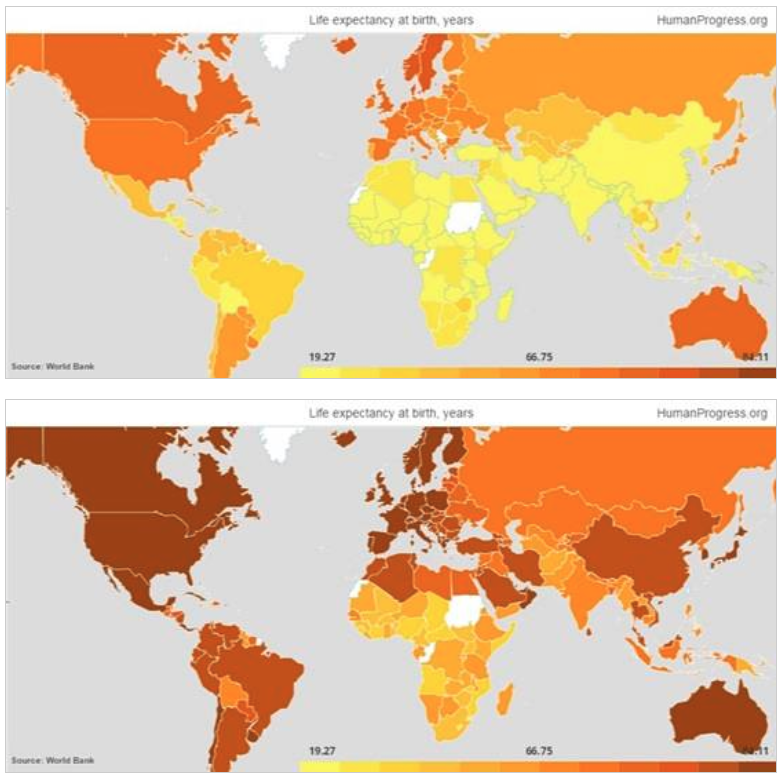
Famine has all but disappeared outside of war zones. In 1961, food supply in 54 out of 183 countries was less than 2,000 calories per person per day. That was true of only two countries in 2013. In 1960, average life expectancy in the world was 52.6 years. In 2015, it was 71.9 years — a 37 percent increase.

In 1960, American workers worked, on average, 1,930 hours per year. In 2017, they worked 1,758 hours per year — a reduction of 9 percent. The data for the world are patchy. That said, a personal calculation based on the available data for 31 rich and middle-income countries suggests a 14 percent decline in hours worked per worker per year.

And because everyone loves pictures, here’s one from an earlier article by the same author showing increases in life expectancy between 1960 (top) and 2015 (bottom):

December 11, 2017

QotD: Occupational licensing

Filed under: Bureaucracy, Government, Law, Liberty, Quotations — Tags: , , , — Nicholas @ 01:00

… occupational licensing laws and Competitor’s Veto laws exclude would-be entrepreneurs from the marketplace — with disproportionately negative consequences for members of minority groups — […] Congress could act today to protect the fundamental human right of economic liberty against unjust state interference.

Licensing laws tend to have particularly harsh consequences on members of minority groups for a couple reasons. First, if a law requires a person to have, say, a college degree to practice the trade of interior design (which is the law in Florida), people who have less money and time to spend in college will find that avenue of opportunity closed to them. Since black and Hispanic Floridians are about 30 percent less likely to have a college degree, they will suffer more from this absurd licensing requirement than others will. Competitor’s Veto laws that forbid a person from practicing a trade unless they get permission from the businesses already operating in that industry are also very likely to create a sort of Old Boys Network, and to exclude entrepreneurs who lack political connections. Second, in a more general sense, any law that restricts economic opportunity for some to benefit others — as licensing laws tend to do — are likely to benefit those who have more political influence and can therefore get the government to regulate in ways favorable to them. Since members of minority groups have less political influence, they tend to be the ones excluded.

Timothy Sandefur, “Testifying to the U.S. Senate Oversight Subcommittee Tuesday about economic liberty and minorities”, Freespace, 2015-09-30.

December 4, 2017

QotD: Why mid-20th century Americans ate what they did – 3

Filed under: Economics, Food, Health, History, Quotations, USA — Tags: , , — Nicholas @ 01:00

People were poorer. Household incomes grew enormously, and as they did, food budgets shrank relative to the rest of our consumption. People in the 1960s also liked steak and chicken breasts better than frankfurters and canned meats. But most of them couldn’t afford to indulge their desires so often.

The same people who chuckle at the things done with cocktail franks and canned tuna will happily eat something like the tripe dishes common in many ethnic cuisines. Yet tripe has absolutely nothing to recommend it as a food product, except that it is practically free; almost anything you cooked with tripe would be just as good, if not better, without the tripe in it. If you understand why folks ate Trippa alla Romana, you should not be confused about the tuna casserole or the creamed chipped beef on toast.

Megan McArdle, “Friday Food Post: The Economics Behind Grandma’s Tuna Casseroles”, Bloomberg View, 2015-10-30.

November 28, 2017

A Tax on the Poor – The Lotto and the Surprisingly Common Sad Aftermath of Winning

Filed under: Randomness — Tags: , , , , — Nicholas @ 02:00

Today I Found Out
Published on 1 Jun 2017

In this video:

It’s been called a voluntary tax on the poor and under-educated, with people spending a whopping $60 billion a year in the United States alone on lottery tickets, most of which are purchased by low income individuals. (All total, about 20% of Americans play the lotto). Despite the high number of lotto tickets purchased annually, when playing the lottery (in all its forms), you’ll win an average of just 53 cents for every $1 you spend, making it one of the lowest return rates of any form of commercial gambling, and thus extremely profitable for the various government bodies who run the lotteries.

Want the text version?: http://www.todayifoundout.com/index.php/2012/12/on-average-people-who-earn-less-than-13000-a-year-in-the-u-s-spend-5-of-their-gross-earnings-on-lottery-tickets/

October 23, 2017

QotD: Cargo cult economics

Filed under: Economics, Quotations, USA — Tags: , , , — Nicholas @ 01:00

Once upon a time, government officials decided it would help them keep their jobs if they could claim they had expanded the middle class. Unfortunately, none of them really understood economics or even the historical factors that led to the emergence of the middle class in the first place. But they did know two things: middle class people tended to own their own homes, and they sent their kids to college.

So in true cargo cult fashion, they decided to increase the middle class by promoting these markers of being middle class. They threw the Federal government strongly behind promoting home ownership and college education. A large part of this effort entailed offering easy debt financing for housing and education. Because the whole point was to add poorer people to the middle class, there was a strong push to strip away traditional underwriting criteria for these loans (e.g., down payments, credit history, actual income to pay debt, etc.)

We know what happened in the housing market. The government promoted home ownership with easy loans, and made these loans a favorite investment by giving them a preferential treatment in the capital requirements for banks. And then the bubble burst, with the government taking the blame for the bubble. Just kidding, the government blamed private lenders for their lax underwriting standards, conveniently forgetting that every President since Reagan had encouraged such laxity (they called it something else, like “giving access to the poor”, but it means the same thing).

Warren Meyer, “Cargo Cult Social Engineering”, Coyote Blog, 2012-11-28.

October 13, 2017

LITERATURE – George Orwell

Filed under: Books, Britain, History, Liberty, Politics — Tags: , , , , — Nicholas @ 04:00

The School of Life
Published on 25 Nov 2016

George Orwell is the most famous English language writer of the 20th century, the author of Animal Farm and 1984. What was he trying to tell us and what is his genius?

October 10, 2017

India’s bold experiment … is an economic failure

Filed under: Economics, Government, India — Tags: , , — Nicholas @ 05:00

Back in December, I linked to an article by Shikha Dalmia, discussing the rhetoric and (likely) reality of India’s currency experiment. Now, Lawrence White rounds up the damage done:

The debate over demonetization was revived this month (September 2017) after the Reserve Bank of India finally announced the count of returned currency. It announced that 99 percent of the discontinued notes, Rs 15.28 trillion out of Rs 15.44 trillion, had been returned. As Vivek Kaul has noted, “The conventional explanation for this is that most people who had black money found other people, who did not have black money, to deposit their savings into the banking system for them.”

The trivial size of unreturned currency, of course, obliterates BDK’s [Bhagwati, Dehejia, and Krishna’s] projection of a government seigniorage windfall.

What about BDK’s other projected source of revenue, the 50% tax on acknowledged black deposits? Whereas in BDK’s scenario, black currency holders would make Rs2 trillion in voluntary-disclosure deposits, which would yield Rs 1 trillion in revenue, the actual collections under the scheme were reported in April at Rs 23 billion, or 2.3% of the BDK-imagined sum. Such paltry revenues mean that demonetization, from the fiscal perspective, was all pain and no gain.

The accumulating evidence on economic growth, meanwhile, has become damning. Between July and September 2016, India’s GDP grew 7.53 percent. Between January and March 2017 it grew 5.72 percent. Former head of the Reserve Bank of India Raghuram Rajan, now returned to the University of Chicago, links the drop to demonetization: “Let us not mince words about it — GDP has suffered. The estimates I have seen range from 1 to 2 percentage points, and that’s a lot of money — over Rs2 lakh crore [i.e. trillion] and maybe approaching Rs2.5 lakh crore.” Kaul adds that GDP does not well capture the size of the informal cash sector, where the losses from demonetization were greatest.

In response to the RBI report and GDP data, and to their credit, BDK have substantially retreated from claims of success to what can be regarded as the claim that there is still a chance to break even.

October 5, 2017

Out of Frame: The Real Life Wilson Fisk

Filed under: Government, History, Liberty, Media, USA — Tags: , , , , — Nicholas @ 12:00

Foundation for Economic Education
Published on 5 Oct 2017

Wilson Fisk is one of the most terrifying villains in the Marvel universe. Good thing he’s just fictional, right? Wrong!

In this episode of Out of Frame, we explore the real-life Wilson Fisk, a central planner from America’s not so distant past.

Learn more about Robert Moses and his greatest nemesis, Jane Jacobs at FEE: https://fee.org/articles/jane-jacobs/

September 28, 2017

A very different kind of “hockey stick” – everything sucked until the industrial revolution

Filed under: Economics, History — Tags: , , — Nicholas @ 03:00

Steve Kates linked to this post at Luke Muehlhauser’s blog, showing another graph with a hockey stick pattern, but it isn’t one of the IPCC’s misleading bits of propaganda:

In How big a deal was the Industrial Revolution?, I looked for measures (or proxy measures) of human well-being / empowerment for which we have “decent” scholarly estimates of the global average going back thousands of years. For reasons elaborated at some length in the full report, I ended up going with:

  1. Physical health, as measured by life expectancy at birth.
  2. Economic well-being, as measured by GDP per capita (PPP) and percent of people living in extreme poverty.
  3. Energy capture, in kilocalories per person per day.
  4. Technological empowerment, as measured by war-making capacity.
  5. Political freedom to live the kind of life one wants to live, as measured by percent of people living in a democracy.
  6. (I also especially wanted measures of subjective well-being and social well-being, and also of political freedom as measured by global rates of slavery, but these data aren’t available; see the report.)

Anyway, the punchline of the report is that when you chart these six measures over the past few millennia (data; zoomable), you get a chart like this (axes removed for space reasons):

Click to embiggen

(And yes, there’s still a sharp jump around 1800-1870 if you chart this on a log scale.)

Basically, if I help myself to the common (but certainly debatable) assumption that “the industrial revolution” is the primary cause of the dramatic trajectory change in human welfare around 1800-1870, then my one-sentence summary of recorded human history is this:

    Everything was awful for a very long time, and then the industrial revolution happened.

August 25, 2017

QotD: The “job” of literature between the wars

Filed under: Books, Economics, History, Politics, Quotations — Tags: , , , , , — Nicholas @ 01:00

Until round about WWI when the wheels came off European culture (and in that strata, American taste always molded itself on European taste, starting before the revolution) “high culture” and “proper taste” which defined “quality literature” involved the author making sure the upper classes knew he was one of them. That is, the story would be full of literary references, to either classical literature (a lot) or to various artists and writers which had become hallmarks of high culture. (Shakespeare or Chaucer, not “quality” or high class in their own times, but rendered more difficult and therefore more rarefied a taste by the change in language.)

Then the wheels came off. There was some insurgence and some of this type of thing before then, mind, but it was after WWI that self-loathing became the hallmark of the upper classes in Europe. Then, because they were still the elite and (in their own eyes) the taste makers, the mark of rarefied good taste became the nostalgie de la boue. Where Shakespeare and his like had written about kings and queens or at least Lords and Ladies, increasingly the “modern” and cutting edge literature bypassed even decent middle class who were despised as bourgeois and concentrated on ne’er do wells, the criminal element, the lowest of the low in morals more than in money. Alternately it concentrated on the corruption and bankrupt morals of the [nouveau riche], the noblemen, those that could be seen as winners in life.

This is what Agatha Christie in her Miss Marple books more than once characterizes as “Unpleasant people in unpleasant circumstances, doing unpleasant things.”

This trend, roughly akin to an adolescent reveling in writing things that upset his parents, as communism became an established thing and the USSR reached out tendrils of propaganda to the west, turned into a mess of set-pieces, the “international realism” of socialists, about as artistically relevant as the national realism of the fascists. It became set pieces to the point that you REALLY need to question your cultural assumptions to get at the truth.

The “literature” of this type has given us the exploited mill workers, for instance, living in horror and squalor. While this is absolutely true when compared to the conditions of our time, those mill workers didn’t get the chance to live in our time, in the conditions of our time. They had the choice of living off the land or going to the city and living in factories. Life on the land has been painted with the soft tints of the romantics and the glorious tints of the early Marxists, but if you actually LOOK at the industrial revolution going on before our eyes in China or India, you realize people are coming to the cities and getting factory jobs because life is BETTER there than in the rural fastnesses they come from. Sure, their lives as industrial workers would horrify American workers, but they’re relatively good for what they have available.

In this sense, the literature of that time did its job which was to sell a socialist future (though most of the authors who were trying to write quality were probably unaware of what they were doing or how the dictates of “quality” came from a self-hating and often outright traitorous elite.) It shaped even the minds of those who are naturally suspicious of socialist tripe.

Sarah A. Hoyt, “The Quality of Writing”, According to Hoyt, 2015-10-11.

« Newer PostsOlder Posts »

Powered by WordPress