
Today I Found Out
Published on 1 Jun 2017In this video:
It’s been called a voluntary tax on the poor and under-educated, with people spending a whopping $60 billion a year in the United States alone on lottery tickets, most of which are purchased by low income individuals. (All total, about 20% of Americans play the lotto). Despite the high number of lotto tickets purchased annually, when playing the lottery (in all its forms), you’ll win an average of just 53 cents for every $1 you spend, making it one of the lowest return rates of any form of commercial gambling, and thus extremely profitable for the various government bodies who run the lotteries.
Want the text version?: http://www.todayifoundout.com/index.php/2012/12/on-average-people-who-earn-less-than-13000-a-year-in-the-u-s-spend-5-of-their-gross-earnings-on-lottery-tickets/
November 28, 2017
A Tax on the Poor – The Lotto and the Surprisingly Common Sad Aftermath of Winning
October 23, 2017
QotD: Cargo cult economics
Once upon a time, government officials decided it would help them keep their jobs if they could claim they had expanded the middle class. Unfortunately, none of them really understood economics or even the historical factors that led to the emergence of the middle class in the first place. But they did know two things: middle class people tended to own their own homes, and they sent their kids to college.
So in true cargo cult fashion, they decided to increase the middle class by promoting these markers of being middle class. They threw the Federal government strongly behind promoting home ownership and college education. A large part of this effort entailed offering easy debt financing for housing and education. Because the whole point was to add poorer people to the middle class, there was a strong push to strip away traditional underwriting criteria for these loans (e.g., down payments, credit history, actual income to pay debt, etc.)
We know what happened in the housing market. The government promoted home ownership with easy loans, and made these loans a favorite investment by giving them a preferential treatment in the capital requirements for banks. And then the bubble burst, with the government taking the blame for the bubble. Just kidding, the government blamed private lenders for their lax underwriting standards, conveniently forgetting that every President since Reagan had encouraged such laxity (they called it something else, like “giving access to the poor”, but it means the same thing).
Warren Meyer, “Cargo Cult Social Engineering”, Coyote Blog, 2012-11-28.
October 13, 2017
October 10, 2017
India’s bold experiment … is an economic failure
Back in December, I linked to an article by Shikha Dalmia, discussing the rhetoric and (likely) reality of India’s currency experiment. Now, Lawrence White rounds up the damage done:
The debate over demonetization was revived this month (September 2017) after the Reserve Bank of India finally announced the count of returned currency. It announced that 99 percent of the discontinued notes, Rs 15.28 trillion out of Rs 15.44 trillion, had been returned. As Vivek Kaul has noted, “The conventional explanation for this is that most people who had black money found other people, who did not have black money, to deposit their savings into the banking system for them.”
The trivial size of unreturned currency, of course, obliterates BDK’s [Bhagwati, Dehejia, and Krishna’s] projection of a government seigniorage windfall.
What about BDK’s other projected source of revenue, the 50% tax on acknowledged black deposits? Whereas in BDK’s scenario, black currency holders would make Rs2 trillion in voluntary-disclosure deposits, which would yield Rs 1 trillion in revenue, the actual collections under the scheme were reported in April at Rs 23 billion, or 2.3% of the BDK-imagined sum. Such paltry revenues mean that demonetization, from the fiscal perspective, was all pain and no gain.
The accumulating evidence on economic growth, meanwhile, has become damning. Between July and September 2016, India’s GDP grew 7.53 percent. Between January and March 2017 it grew 5.72 percent. Former head of the Reserve Bank of India Raghuram Rajan, now returned to the University of Chicago, links the drop to demonetization: “Let us not mince words about it — GDP has suffered. The estimates I have seen range from 1 to 2 percentage points, and that’s a lot of money — over Rs2 lakh crore [i.e. trillion] and maybe approaching Rs2.5 lakh crore.” Kaul adds that GDP does not well capture the size of the informal cash sector, where the losses from demonetization were greatest.
In response to the RBI report and GDP data, and to their credit, BDK have substantially retreated from claims of success to what can be regarded as the claim that there is still a chance to break even.
October 5, 2017
Out of Frame: The Real Life Wilson Fisk
Foundation for Economic Education
Published on 5 Oct 2017Wilson Fisk is one of the most terrifying villains in the Marvel universe. Good thing he’s just fictional, right? Wrong!
In this episode of Out of Frame, we explore the real-life Wilson Fisk, a central planner from America’s not so distant past.
Learn more about Robert Moses and his greatest nemesis, Jane Jacobs at FEE: https://fee.org/articles/jane-jacobs/
September 28, 2017
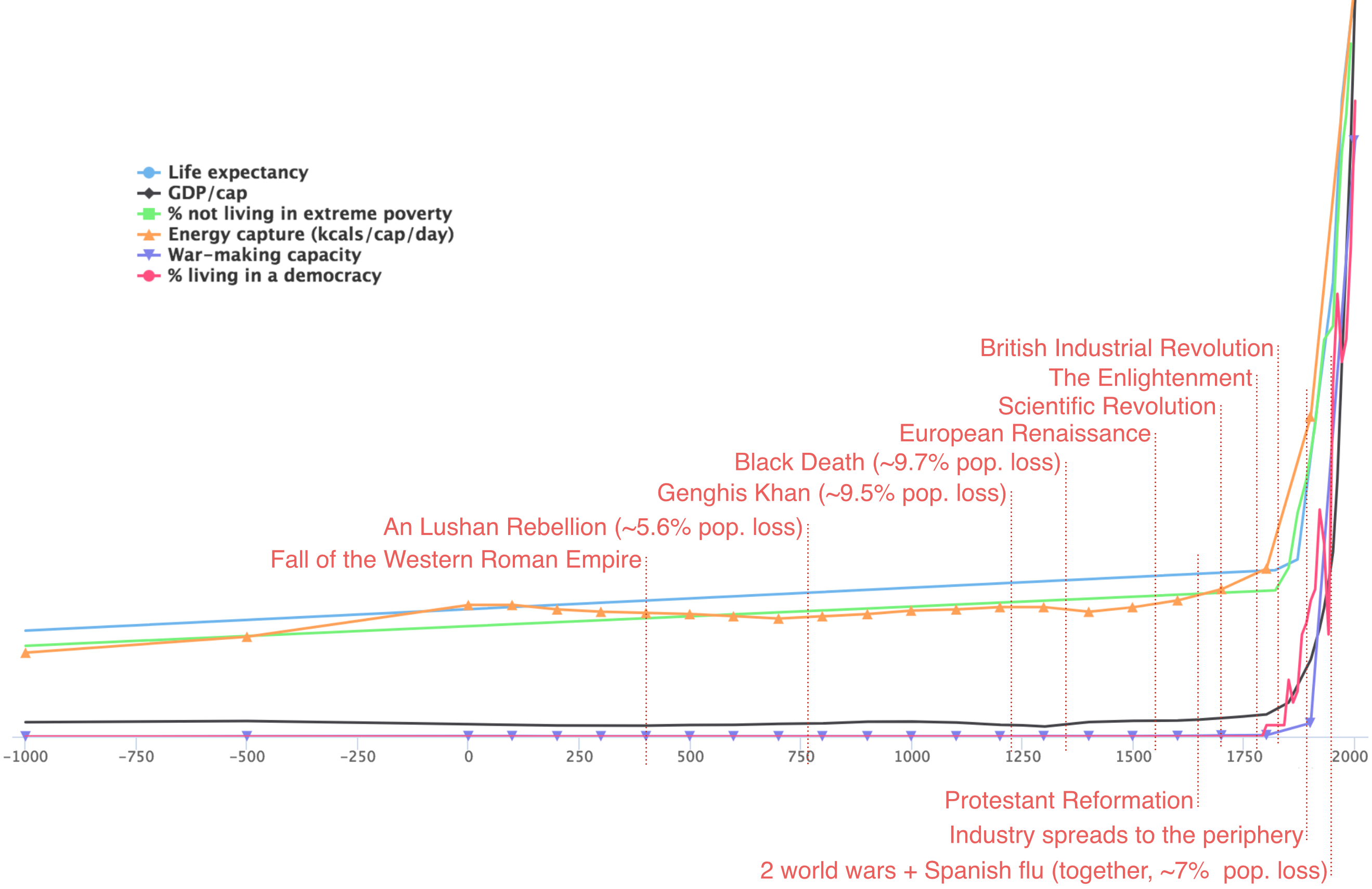
A very different kind of “hockey stick” – everything sucked until the industrial revolution
Steve Kates linked to this post at Luke Muehlhauser’s blog, showing another graph with a hockey stick pattern, but it isn’t one of the IPCC’s misleading bits of propaganda:
In How big a deal was the Industrial Revolution?, I looked for measures (or proxy measures) of human well-being / empowerment for which we have “decent” scholarly estimates of the global average going back thousands of years. For reasons elaborated at some length in the full report, I ended up going with:
- Physical health, as measured by life expectancy at birth.
- Economic well-being, as measured by GDP per capita (PPP) and percent of people living in extreme poverty.
- Energy capture, in kilocalories per person per day.
- Technological empowerment, as measured by war-making capacity.
- Political freedom to live the kind of life one wants to live, as measured by percent of people living in a democracy.
- (I also especially wanted measures of subjective well-being and social well-being, and also of political freedom as measured by global rates of slavery, but these data aren’t available; see the report.)
Anyway, the punchline of the report is that when you chart these six measures over the past few millennia (data; zoomable), you get a chart like this (axes removed for space reasons):
Click to embiggen
(And yes, there’s still a sharp jump around 1800-1870 if you chart this on a log scale.)
Basically, if I help myself to the common (but certainly debatable) assumption that “the industrial revolution” is the primary cause of the dramatic trajectory change in human welfare around 1800-1870, then my one-sentence summary of recorded human history is this:
Everything was awful for a very long time, and then the industrial revolution happened.
August 25, 2017
August 17, 2017
Words & Numbers: The Illusion of School Choice
Published on 16 Aug 2017
In private schools, as in private enterprise in general, poor performance drives funding away by driving paying customers away. Yet in public schools, poor performance is used as an excuse for increased funding. With incentives like these, is it any wonder that public schools are failing our children so badly? Isn’t it time to inject some competition into the system?
Education for all is a worthy wish. So is food for all. But we don’t force poor people to eat state-produced food. Even food stamp recipients get to choose where to shop. Why shouldn’t beneficiaries of public education spending get to choose where to send their kids?
Our hosts James R. Harrigan and Antony Davies want to know…
August 13, 2017
August 8, 2017
Civil asset forfeiture in Las Vegas – kick’em while they’re down
C.J. Ciaramella summarizes the findings of a new report on civil asset forfeiture in Nevada, where the Las Vegas police have been profiting nicely by confiscating even from the poorest members of society:
When Las Vegas police seized property through civil asset forfeiture laws last year, they were mostly likely to strike in poor and minority neighborhoods.Photo by Thomas Wolf, via Wikimedia.
A report [PDF] released last week by the Nevada Policy Research Institute (NPRI), a conservative think tank, found the Las Vegas Metropolitan Police Department raked in $1.9 million in asset forfeiture revenue in 2016. Two-thirds of those seizures occurred in zip codes with higher-than-average rates of poverty and large minority populations.
The 12 Las Vegas zip codes most targeted by asset forfeiture have an average poverty rate of 27 percent, compared to 12 percent in the remaining 36 zip codes. Clark County, Nevada, has an average poverty rate of 16 percent.
The 12 most targeted zip codes also have an average nonwhite population of 42 percent, compared to 36 percent in the other remaining zip codes.
Under civil asset forfeiture laws, police may seize property they suspect of being connected to criminal activity. The owner then bears the burden of challenging the seizure in court and disproving the government’s claims. Law enforcement groups say civil asset forfeiture is a vital tool to disrupt drug trafficking and other organized crime by cutting off the flow of illicit proceeds.
But a bipartisan coalition of civil liberties groups and lawmakers have been calling for the laws to be reformed, saying asset forfeiture’s perverse profit incentives and lack of safeguards leads police to shake down everyday citizens, who often lack the resources to fight the seizure of their property in court.

August 3, 2017
Words & Numbers: Is UBI Better Than Welfare?
Published on 2 Aug 2017
A viewer recently asked us what Words & Numbers thought of Universal Basic Income.
Antony Davies likes the idea of it, provided it’s done well, but doesn’t think it could ever possibly be done well. But what about a theoretical UBI? If we could actually figure out how to implement that well, would that work? And why wouldn’t that work in the real world? This week on Words and Numbers, Antony and James R. Harrigan tackle the issue that’s getting a lot of attention in Silicon Valley.
July 27, 2017
Words & Numbers: Is Income Inequality Real?
Published on 26 Jul 2017
Income inequality has been in the news more and more, and it doesn’t look good. It’s aggravating to see people making more money than you, and we’re told all the time that income inequality is on the rise. But is it? And even if it is, is it actually a bad thing? This week on Words and Numbers, Antony Davies and James R. Harrigan talk about how income inequality plays out in the real world.
Learn more: https://fee.org/articles/is-income-inequality-real/
July 26, 2017
QotD: From local private charity to national government social program
In a small town, the impulse to assist the poor and disorganized was direct, and the people being helped were known to everyone. Big cities with their concentrated slums of poor immigrants led to social service agencies, funded at first by churches and cities, and then by state and federal governments. As the source of the assistance became impersonal, so did the aid — and the direct contact between those assisting and those assisted declined. Instead of the local church matrons with their bourgeois ideas of proper behavior and work, harassed social workers with enormous caseloads processed cases quickly, and the ideology of government assistance changed so that any behavioral expectation of the client population was viewed as an affront to their dignity.
In time, the government assistance ethos spread to every corner of the country and crowded out the local community services. Meanwhile, locally-controlled schools were gradually taken over by higher levels of government and distant union bureaucracies so that the influence of local parents was minimized. This was viewed as “progressive,” since distant elites thought local school boards and parents were too parochial and backward to be entrusted with decisions, and would get in the way of teaching the correct materials.
The incorrect application of emotions of sympathy and support to faceless categories of people like “the poor” and “the undocumented” removes any possibility of understanding the real situations of each of the category’s members. A hazy idealized poor family is envisioned, then a response that would be appropriate if that family lived next door (help them!) leads to voting for politicians that offer new programs to help “people like that.” By misapplying family and community feelings to higher levels of government, voters put into place a bureaucracy that misses most of the social signalling features of local groups and takes tax money to grow itself, crowding out local groups (and the valuable social signals that maintained bourgeois standards.)
Jeb Kinnison, “Real-life ‘Hunger Games'”, According to Hoyt, 2015-09-25.
July 7, 2017
Despite the headlines, the world is getting much better, much faster
The mainstream media has a built-in bias for bad news, which is understandable: bad news draws eyeballs and clicks because as a species we’re much more attuned to detecting risks than anything else — it’s a good pro-survival trait. Our bias (and reinforcement offered by the media’s bias) leads us all to think things are going much worse than they really are, pretty much all the time. Scott Sumner offers a bit of counterpoint:
The news media is good at storytelling. That’s no surprise, as people like to learn through stories, indeed this preference is probably hardwired into our brains. The news media can’t survive without readers and viewers, and so naturally they focus on storytelling. And the most riveting stories involve war, terrorism, natural disasters, and other serious problems. While the individual stories are usually true, the overall effect is to present a very false image of the world. As a result, at least 90% of Americans literally have no idea as to what is actually going on in the world. Here’s Nicholas Kristof:
Nine out of 10 Americans say in polls that global poverty has been staying the same or worsening. So let’s correct the record.
There has been a stunning decline in extreme poverty, defined as less than about $2 per person per day, adjusted for inflation. For most of history, probably more than 90 percent of the world population lived in extreme poverty, plunging to fewer than 10 percent today.
Every day, another 250,000 people graduate from extreme poverty, according to World Bank figures. About 300,000 get electricity for the first time. Some 285,000 get their first access to clean drinking water. When I was a boy, a majority of adults had always been illiterate, but now more than 85 percent can read.
Family planning leads parents to have fewer babies and invest more in each. The number of global war deaths is far below what it was in the 1950s through the 1990s, let alone the murderous 1930s and ’40s.
Aneri and I are reporting from a country whose name, Liberia, evokes Ebola, civil war and warlords like General Butt Naked. That’s partly because we journalists have a bias toward bad news: We cover planes that crash, not planes that take off.
Unfortunately these true lies are hard to push back against. Statistics tells us that the world is getting better at a mind-boggling rate (Seriously, can your brain even imagine the improvement in human welfare associated with 250,000 people a day rising above extreme poverty? I can’t.) But that’s not the world people tend to see. As a result, they elect politicians who pander to their ignorance of the world.
June 27, 2017
QotD: The mistakes of the wealthy versus the mistakes of the poor
What have been the effects of progressive, centralized control of education, healthcare, and social services? It is true that the backwards practices of a few local school boards have been reformed, but the loss of a rich layer of church and private charity social services has impoverished local social capital. While today’s mass communication and the Internet removed one of the impulses to community (“I’m bored. Let’s go into town and hang out!”), a lot of the loss is due to the crowding out by a monopoly government, which had deep pockets and would use them to continue failed policies, as Microsoft in the 80s used the profits from its near-monopoly OS business to keep creating mediocre applications software until the innovators in applications were destroyed.
Very wealthy people have always been freer than others from the stifling social controls and judgments of bourgeois community standards. The elite of Paris and London in the 1800s often kept mistresses and dabbled in drug use without having their lives destroyed. The lower classes did not have the wealth to recover from errors, and those who did not hew to bourgeois social norms were isolated and damaged.
As the upper middle classes in the US grew as wealthy as the elite had been in the previous century after WWII, the sexual revolution and War on Poverty bestowed more social freedom on everyone — the middle and upper classes got birth control, sexual freedom, and women in the workplace, while the poor got programs to “uplift” them from poverty (a term which exposes the condescension involved). Social workers in vast numbers were hired to distribute assistance, free of any obligation — except for unmarried mothers, who were told their assistance would be cut if they married a working man.
Over the course of several generations, the well-off used their freedoms and came out relatively unscathed — families were still largely intact, children were still trained in the arts of civilization and followed the path of university and marriage into professional careers. But the artificial assistance to the poor, with its lack of community obligations and support and its immediate withdrawal in the event of marriage and better work, removed the social incentives that keep healthy communities healthy. Intact families grew less common. Crime and social pathologies became the norm in poor inner-city communities. As conditions worsened, the motivated and organized left for more civilized neighborhoods with better schools. The segregation of cities and even whole regions by income increased. Whole generations of children were poorly raised, poorly schooled, and left to drift without purpose or guidance from now-absent fathers, who were in prison or adrift themselves.
Jeb Kinnison, “Real-life ‘Hunger Games'”, According to Hoyt, 2015-09-25.


