
Knowledge of the effects of government interference with market prices makes us comprehend the economic causes of a momentous historical event, the decline of ancient civilization.
[…]
The Roman Empire in the second century, the age of the Antonines, the “good” emperors, had reached a high stage of the social division of labour and of interregional commerce. Several metropolitan centres, a considerable number of middle-sized towns, and many small towns were the seats of a refined civilisation […]. There was an extensive trade between the various regions of the vast empire. Not only in the processing industries, but also in agriculture there was a tendency toward further specialization. The various parts of the empire were no longer economically self-sufficient. They were interdependent.
What brought about the decline of the empire and the decay of its civilization was the disintegration of this economic interconnectedness, not the barbarian invasions. The alien aggressors merely took advantage of an opportunity which the internal weakness of the empire offered to them. From a military point of view the tribes which invaded the empire in the fourth and fifth centuries were not more formidable than the armies which the legions had easily defeated in earlier times. But the empire had changed. Its economic and social structure was already medieval […]
[I]n the political troubles of the third and fourth centuries the emperors resorted to currency debasement. With the system of maximum prices the practice of debasement completely paralysed both the production and the marketing of the vital foodstuffs and disintegrated society’s economic organisation. The more eagerness the authorities displayed in enforcing the maximum prices, the more desperate became the conditions of the urban masses dependent on the purchase of food. Commerce in grain and other necessities vanished altogether. To avoid starving, people deserted the cities, settled on the countryside, and tried to grow grain, oil, wine, and other necessities for themselves.
Ludwig von Mises, Human Action, 1949.
November 4, 2019
QotD: Ludwig von Mises explains the fall of the western Roman empire
October 21, 2019
QotD: Poverty versus relative poverty
However, viewers took to Twitter to insist that Andy and Kim Leamon and their two children from Southampton who have £170 a week to spend on food, clothes and socialising after paying their mortgage and bills are certainly not struggling.
It’s not, by local standards, exactly great riches, to be sure. But that is £2,210 of disposable income per person per year. That’s on the fringes of the top 30% of all global incomes. 70% or so are poorer.
Note again, this is their disposable income, after housing, bills and taxes, the global income number is before all of that. Or, as we might also put it, this is unimaginable riches by global or historical standards.
Tim Worstall, “Well, yes, there’s a point here”, Tim Worstall, 2017-10-20.
September 3, 2019
QotD: Fencing out the London poor
Orwell’s press card portrait, 1943
I see that the railings are returning — only wooden ones, it is true, but still railings — in one London square after another. So the lawful denizens of the squares can make use of their treasured keys again, and the children of the poor can be kept out.When the railings round the parks and squares were removed, the object was partly to accumulate scrap-iron, but the removal was also felt to be a democratic gesture. Many more green spaces were now open to the public, and you could stay in the parks till all hours instead of being hounded out at closing times by grim-faced keepers. It was also discovered that these railings were not only unnecessary but hideously ugly. The parks were improved out of recognition by being laid open, acquiring a friendly, almost rural look that they had never had before. And had the railings vanished permanently, another improvement would probably have followed. The dreary shrubberies of laurel and privet — plants not suited to England and always dusty, at any rate in London — would probably have been grubbed up and replaced by flower beds. Like the railings, they were merely put there to keep the populace out. However, the higher-ups managed to avert this reform, like so many others, and everywhere the wooden palisades are going up, regardless of the wastage of labour and timber.
George Orwell, “As I Please” Tribune, 1944-08-04.
July 6, 2019
Putting global worker pay into perspective
Tim Worstall explains why the headline-friendly numbers in a recent ILO report are nothing to be surprised at:
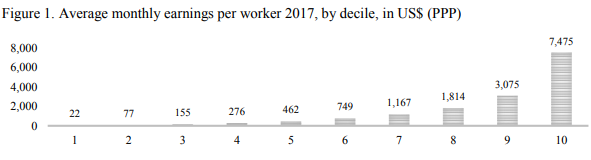
“Nearly half of all global pay is scooped up by only 10% of workers, according to the International Labour Organization, while the lowest-paid 50% receive only 6.4%.
“The lowest-paid 20% – about 650 million workers – get less than 1% of total pay, a figure that has barely moved in 13 years, ILO analysis found. It used labour income figures from 189 countries between 2004 and 2017, the latest available data.
“A worker in the top 10% receives $7,445 a month (£5,866), while a worker in the bottom 10% gets only $22. The average pay of the bottom half of the world’s workers is $198 a month.”
[…]
The explanation? To be in the top 10% of the global pay distribution you need to be making around and about minimum wage in one of the rich countries. Via another calculation route, perhaps median income in those rich countries. No, that £5,800 is the average of all the top 10%.
Note that this is in USD. About £2,000 a month puts you in the second decile, that’s about UK median income of 24,000 a year.
And as it happens about 20% of the people around the world are in one of the already rich countries. So, above median in a rich country and we’re there. Our definition of rich here not quite extending as far as all of the OECD countries even. Western Europe – plus offshoots like Oz and NZ, North America, Japan, S. Korea and, well, there’s not much else. Sure, it’s not exactly 10% of the people there but it’s not hugely off either.
So, what is it that these places have in common? They’ve been largely free market, largely capitalist, economies for more than a few decades. The most recent arrival, S. Korea, only just managing that few decades. It is also true that nowhere that hasn’t been such is in that listing. It’s even true that nowhere that is such hasn’t made it – not that we’d go to the wall for that last insistence although it’s difficult to think of places that breach that condition.
June 28, 2019
The “V-word” in political discussions
Kristian Niemietz explains why “Venezuela” isn’t a sensible or satisfactory answer to claims in favour of socialism:
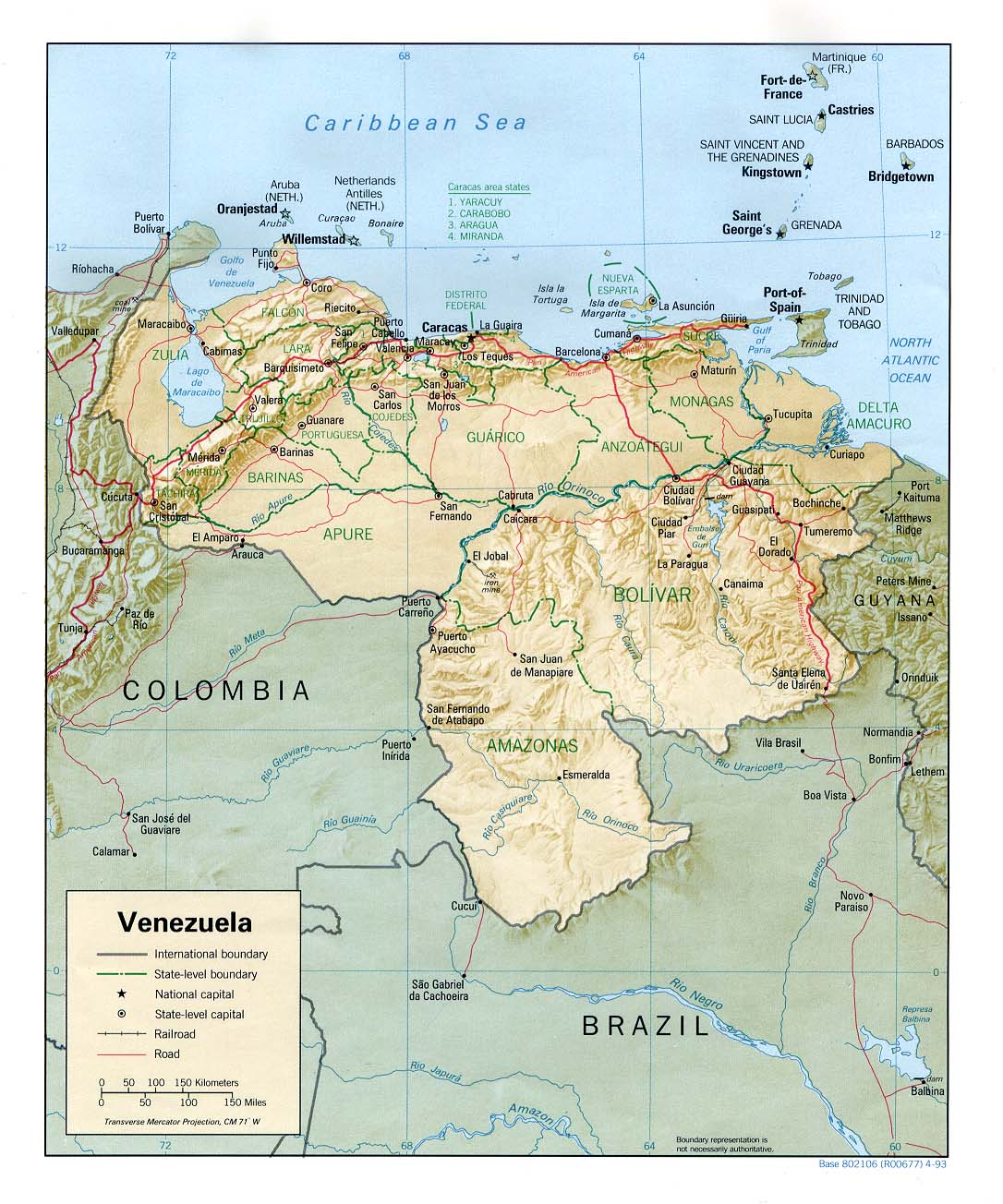
Shaded relief map of Venezuela, 1993 (via Wikimedia)
The main point to note is that Venezuela is an actual country, not a shorthand for “everything I don’t like about the Left”. It is a country that is in trouble for specific, identifiable reasons, not for being, somehow, generically, “too left-wing”. This sounds obvious when you put it like that, but deviations from this point are the main cause of V-word inflation.
So when somebody on the Left proposes to, for example, raise income tax, wealth taxes, or corporation tax, people on the pro-market side should not respond by shouting “Venezuela!”. Because that’s not what happened in Venezuela. Venezuela is not a high-tax economy, or at least, their tax burden is not what ruined them.
In the same way, if somebody on the Left proposes to hike the minimum wage, to abolish university tuition fees, or to ban zero-hour contracts, shouting “Venezuela!” is not the answer either. Those are bad ideas, sure. But those are not the ideas that destroyed Venezuela.
In short, we shouldn’t bring up Venezuela in a discussion of run-of-the-mill left-wing policies, which bear little relationship to anything that Chávez and/or Maduro did.
Furthermore, when somebody points out a genuine social problem in Britain, “Yeah but Venezuela!” is not much of a reply. Socialists are sometimes good at identifying problems, even if they are terrible at developing solutions. It is true that we have some of the highest housing costs in the world. It is true that our productivity performance, and as a result, wage growth, are poor, and have been poor for far too long. It is true that our welfare system is riddled with flaws, and often fails to support people who have fallen on hard times.
“It’s much worse in Venezuela, which is the system you lot want!” is not good enough. “It’s much better in capitalist countries X and Y – which is the system we should learn from” is more like it. So in such cases, it’s best to leave Venezuela out of it. Let “Venezuela” be a country, not a rhetorical all-purpose put-down.
That said – don’t declare that moratorium just yet. When prominent British socialists call for mass nationalisations, when they call for price controls and capital controls, when they deride the rule of law as a mere “bourgeois” construct that only serves “the elites” – then yes, it is absolutely fair to point out that this is exactly what happened in Venezuela. Here, we’re not talking about some allegorical “Venezuela”, but about the actual country, and about specific things that happened there. These are the very policies, and this is the very mindset, which turned what was once South America’s richest country into a basket case. This argument may not “resonate with people” – but it’s true.
Further to that: when socialists claim that “their” version of socialism will be completely different from any of its previous incarnations, that it will be genuinely democratic, empowering, grassroots-based and non-hierarchical – then it is fair to point that this is exactly what the Chavistas also used to say.
Some Western socialists are currently trying to convince themselves that Chávez and Maduro just never really aspired to a different kind of socialism, that authoritarian populism is all they ever wanted. This is fundamentally untrue, and Western socialists used to know this very well. The project of Venezuelan socialism started with the aspiration that this time would be different, that this time, “socialism” would not mean an all-powerful state controlling everything. It started with the aspiration that there could be completely different forms of collective ownership, which had nothing to do with the top-down nationalised industries of the past.
The appeal of Millennial Socialism rests on the delusion that the democratic, bottom-up socialism Millennial Socialists aspire to is a fundamentally novel aspiration, and that nobody in history has ever tried to build anything like this before.
But it is not a new aspiration. This was precisely what Chávez’s and Maduro’s “21st Century Socialism” was also about, which is why it used to be so popular in the West. A moratorium on the V-word would just play into the hands of those who now want to pretend that none of this ever happened, and that “Millennial Socialism” is novel, untried and untested.
June 19, 2019
QotD: Working class “materialism”
When one thinks of all the people who support or have supported Fascism, one stands amazed at their diversity. What a crew! Think of a programme which at any rate for a while could bring Hitler, Petain, Montagu Norman, Pavelitch, William Randolph Hearst, Streicher, Buchman, Ezra Pound, Juan March, Cocteau, Thyssen, Father Coughlin, the Mufti of Jerusalem, Arnold Lunn, Antonescu, Spengler, Beverley Nichols, Lady Houston, and Marinetti all into the same boat! But the clue is really very simple. They are all people with something to lose, or people who long for a hierarchical society and dread the prospect of a world of free and equal human beings.
Orwell’s press card portrait, 1943
Behind all the ballyhoo that is talked about “godless” Russia and the “materialism” of the working class lies the simple intention of those with money or privileges to cling to them. Ditto, though it contains a partial truth, with all the talk about the worthlessness of social reconstruction not accompanied by a “change of heart”. The pious ones, from the Pope to the yogis of California, are great on the “change of heart”, much more reassuring from their point of view than a change in the economic system. Petain attributes the fall of France to the common people’s “love of pleasure”. One sees this in its right perspective if one stops to wonder how much pleasure the ordinary French peasant’s or working-man’s life would contain compared with Petain’s own.
The damned impertinence of these politicians, priests, literary men, and what-not who lecture the working-class socialist for his “materialism”! All that the working man demands is what these others would consider the indispensable minimum without which human life cannot be lived at all. Enough to eat, freedom from the haunting terror of unemployment, the knowledge that your children will get a fair chance, a bath once a day, clean linen reasonably often, a roof that doesn’t leak, and short enough working hours to leave you with a little energy when the day is done. Not one of those who preach against “materialism” would consider life livable without these things. And how easily that minimum could be attained if we chose to set our minds to it for only twenty years! To raise the standard of living of the whole world to that of Britain would not be a greater undertaking than the war we have just fought. I don’t claim, and I don’t know who does, that that wouldn’t solve anything in itself. It is merely that privation and brute labour have to be abolished before the real problems of humanity can be tackled.
The major problem of our time is the decay of the belief in personal immortality, and it cannot be dealt with while the average human being is either drudging like an ox or shivering in fear of the secret police. How right the working classes are in their “materialism”! How right they are to realize that the belly comes before the soul, not in the scale of values but in point of time! Understand that, and the long horror that we are enduring becomes at least intelligible. All the considerations are likely to make one falter — the siren voices of a Petain or of a Gandhi, the inescapable fact that in order to fight one has to degrade oneself, the equivocal moral position of Britain, with its democratic phrases and its coolie empire, the sinister development of Soviet Russia, the squalid farce of left-wing politics — all this fades away and one sees only the struggle of the gradually awakening common people against the lords of property and their hired liars and bumsuckers.
The question is very simple. Shall people […] be allowed to live the decent, fully human life which is now technically achievable, or shan’t they? Shall the common man be pushed back into the mud, or shall he not? I myself believe, perhaps on insufficient grounds, that the common man will win his fight sooner or later, but I want it to be sooner and not later — some time within the next hundred years, say, and not some time within the next ten thousand years. That was the real issue of the Spanish war, and of the last war, and perhaps of other wars yet to come.
George Orwell, “Looking back on the Spanish War”, New Road, 1943 (republished in England, Your England and Other Essays, 1953).
June 18, 2019
QotD: The birth of Jesus and the open concept house
Peasant homes in first century Bethlehem were designed with what we would today call an “open concept.” They typically had one large room with the nicer living space in an open loft or on the roof, while the main floor area was where the family’s animals would be brought for safekeeping at night. The guestroom that was unavailable to Jesus, Mary, and Joseph was that loft or roof space, and the big room where they stayed instead served as the kitchen, living room, dining room, and farmyard all at once. The defining feature of Jesus’ birthplace was not isolation, as we often tend to think, but an utter lack of privacy: Mary delivered in a crowded farmhouse with few, if any, interior walls.
And that was perfectly normal, if not exactly desirable, for our modern fixation on the open floor plan is a historical anomaly. It flies in the face of literally millennia of consensus that more rooms is better, and it is a dreadful mistake. The last 70 years of open concept construction and remodeling has left us with dysfunctional houses, homes that are less conducive to hospitality, less energy efficient, and more given to mess.
Bonnie Kristian, “Open concept homes are for peasants”, The Week, 2019-05-12.
April 26, 2019
The ill-founded notion that rural peasants had a better life than the city-dwelling poor
Historical illiteracy — encouraged by totally unrealistic historical fiction and highly selective memories — places the lifestyle of farm workers, herders, and other rural people before the industrial era in almost a Disneyfied state of Arcadian paradise. This misunderstanding of reality fed many of the complaints about the terrible living conditions of the poor in industrial towns and cities up to almost living memory — which, to be fair, were terrible, by the standards of the upper and middle classes of the day. Marian L. Tupy provides a bit of evidence for the horrible poverty and miserable living conditions of the majority of Europeans living outside the major towns and cities:
In my last two pieces for CapX, I sketched out the miserable existence of our ancestors in the pre-industrial era. My focus was on life in the city, a task made easier by the fact that urban folk, thanks to higher literacy rates, have left us more detailed accounts of their lives.
This week I want to look at rural life, for that is where most people lived. At least theoretically, country folk could have enjoyed a better standard of living due to their “access to abundant commons – land, water, forests, livestock and robust systems of sharing and reciprocity,” which the anthropologist Jason Hickel praised in a recent article in The Guardian. In fact, the life of a peasant was, in some important aspects, worse than that of a city dweller.
[…]
An account of rural life in 16th century Lombardy found that “the peasants live on wheat … and it seems to us that we can disregard their other expenses because it is the shortage of wheat that induces the labourers to raise their claims; their expenses for clothing and other needs are practically non-existent”. In 15th century England, 80 per cent of private expenditure went on food. Of that amount, 20 per cent was spent on bread alone.
By comparison, by 2013 only 10 per cent of private expenditure in the United States was spent on food, a figure which is itself inflated by the amount Americans spend in restaurants. For health reasons, many Americans today eschew eating bread altogether.
What about food derived from water, forests and livestock? “In pre-industrial England,” Cipolla notes, “people were convinced that vegetables ‘ingender ylle humours and be oftetymes the cause of putrid fevers,’ melancholy and flatulence. As a consequence of these ideas there was little demand for fruit and vegetables and the population lived in a prescorbutic state”. For cultural reasons, most people also avoided fresh cow’s milk, which is an excellent source of protein. Instead, the well-off preferred to pay wet nurses to suckle milk directly from their breasts.
The diet on the continent was somewhat more varied, though peasants’ standard of living was, if anything, lower than that in England. According to a 17th century account of rural living in France: “As for the poore paisant, he fareth very hardly and feedeth most upon bread and fruits, but yet he may comfort himselfe with this, and though his fare be nothing so good as the ploughmans and poore artificers in England, yet it is much better than that of the villano [peasant] in Italy.”
The pursuit of sufficient calories to survive preoccupied the crushing majority of our ancestors, including, of course, women and children. In addition to employment as domestic servants, women produced marketable commodities, such as bread, pasta, woollen garments and socks. Miniatures going back to the 14th century show women employed in agriculture as well. As late as the 18th century, an Austrian physician wrote, “In many villages [of the Austrian Empire] the dung has to be carried on human backs up high mountains and the soil has to be scraped in a crouching position; this is the reason why most of the young people [men and women] are deformed and misshapen.”
April 13, 2019
QotD: School vouchers
I am still a supporter of school vouchers. I don’t think they’ve lived up to the hopes that I (and a bunch of other folks) had for them. But that said, the best opponents can say is that they don’t do all that much better than the public schools on academic measures. Parents like them, kids like them, and they cost less. I just don’t see a good argument against them.
I think it’s telling that of the folks I know who oppose vouchers, not one of them has voluntarily kept their kids in a failing urban school. When they move, they choose a house in a good school district. I don’t see how you can morally do that and then tell some other, poorer parent that they need to lean into the strike zone and take one for the team.
That said, maybe there’s an argument for restricting them to kids in failing schools, or below a certain income. I don’t see any need for the government to subsidize Exeter. But for the kids who are trapped, I think they should get the same chance middle class kids do, even if it’s not the panacea we once hoped.
Megan McArdle, “Ask Me Anything”, Reddit, 2017-04-10.
April 5, 2019
April 3, 2019
Greater Poland Uprising – Book Picks – Veteran Care I BEYOND THE GREAT WAR
The Great War
Published on 2 Apr 2019It’s time for another episode of Beyond The Great War where we answer questions from the community. This time we take a look at the Greater Poland Uprising and the situation of Poland in early 1919, Jesse recommends a few of his favourite history books and we also talk about how veterans were treated after the 1918 armistice.
» SUPPORT THE CHANNEL
Patreon: https://www.patreon.com/thegreatwar
Merchandise: https://shop.spreadshirt.de/thegreatwar/» SOURCES
Boysen, Jens. “Polish-German Border Conflict”, in 1914-1918 online. International Encyclopedia of the First World War. https://encyclopedia.1914-1918-online…Davies, Norman. White Eagle, Red Star. The Polish-Soviet War 1919-1920 and the ‘Miracle on the Vistula’ (London: Pimlico, 2003 [1972]).
Gattrell, Peter. Russia’s First World War (Pearson, 2005).
Gerwarth, Robert. The Vanquished. Why the First World War Failed to End, 1917-1923 (Penguin, 2017).
Horne, John. “The Living,” in Jay Winter, ed. The Cambridge History of the First World War, vol. 3: Civil Society (Cambridge: Cambridge University Press, 2014): 592-617.
Leonhard, Jörn. Der überforderte Frieden. Versailles und die Welt 1918-1923 (CH Beck, 2018).
Pawlowsky, Verena/Wendelin, Harald. “Government Care of War Widows and Disabled Veterans after World War I,” in: Contemporary Austrian Studies, XIX: From Empire to Republic: Post-World War I Austria, eds. Bischof, Günter/Plasser, Fritz/Berger, Peter (2010): 171-191
Prost, Antoine. “Les anciens combattants”, in Stéphane Audoin-Rouzeau and Jean-Jacques Becker, eds. Encyclopédie de la Grande guerre 1914-1918 (Paris: Bayard, 2013): 1025-1036.
Snyder, Timothy. The Reconstruction of Nations. Poland, Ukraine, Lithuania, Belarus, 1569-1999 (Yale University Press, 2003).
March 12, 2019
A choice between a (small) UBI and not taxing the poor at all
Tim Worstall responds to an article advocating abolishing Britain’s tax-free personal allowance and replacing it with a form of universal basic income (UBI):
Sure, we need to have government, even if not quite as much as we do have. Thus we need tax revenues to pay for it. But that tax should be, where it is derived from income, paid by the better off among us. As Adam Smith pointed out, people should be paying more than in proportion to their income. I would actually argue that income tax should only kick in at median income but agree that would require a smaller state than we’ve got now. Actually, that’s why I would propose it.
Still, that does mean that this suggestion fails at that first hurdle:
The tax-free personal allowance, which rises to £12,500 in April, should be scrapped and replaced with a flat payment of £48 a week for every adult, according to radical proposals welcomed by shadow chancellor John McDonnell. The proposal, from the New Economics Foundation thinktank, is for a £48.08 “weekly national allowance,” amounting to £2,500.16 a year from the state, paid to every adult over the age of 18 earning less than £125,000 a year. The cash would not replace benefits and would not depend on employment.
It’s a universal basic income. Excellent stuff therefore. But the error is to think that this should replace that personal allowance. Assume that they’re including NI in that no allowance thing – if they’re doing it for income tax then they probably will for NI. What that means is that anyone earning more than £50 a week is facing a 40% marginal tax rate (yes, 40%, employers’ NI is incident upon the workers’ wages).
Do we think that’s a just way to pay for diversity advisers? That someone on £50 a week gives up 40% of any income over that? No, we don’t, we think that’s an entirely unjust taxation system. Actually, it’s a really stercore* taxation system.
* Someone’s been at his Latin texts again … I had to look this word up myself. It’s the ablative singular form of stercus, which means “manure, dung; to sully, soil, decay”, according to Wiktionary.
March 10, 2019
Irish Potato Famine – The American Wake – Extra History – #4
Extra Credits
Published on 9 Mar 2019Not all of the 214,000 Irish immigrants in 1847 made it safely to their new homes — and of those who did, many faced classism and xenophobia and even bullying from the “Ulster Irish” or “Scots-Irish” folks who had previously established themselves. In New York City specifically, the Five Points neighborhood became an infamous center of conflict — while local Irish-American John Joseph Hughes became instrumental in restoring Irish Catholicism.
Join us on Patreon! http://bit.ly/EHPatreon
February 28, 2019
The federal Liberals did get one important thing right … no, not marijuana legalization
Justin Trudeau’s Liberals haven’t had a lot of successes in their term in office, but there is one achievement they can legitimately take some credit for:
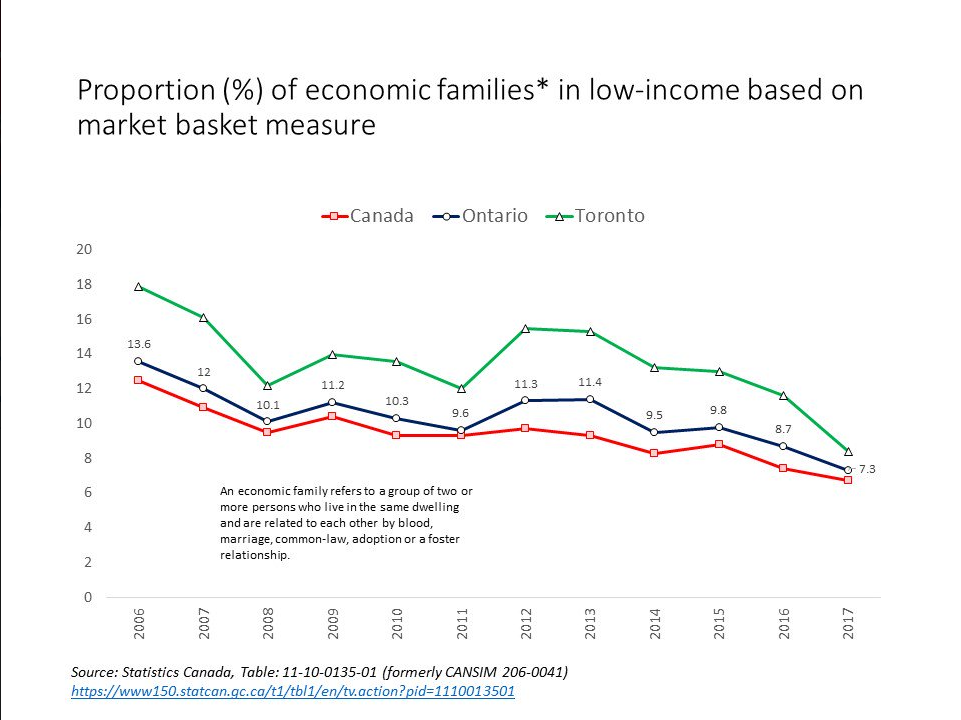
Pssst. Can I let you in on a little secret? Keep it under your hat, but — the poverty rate has fallen again. In fact, it’s at a new all-time low. Statistics Canada reports that the percentage of Canadians falling below the official poverty line in 2017 fell to 9.5 per cent, down from 15.6 per cent in 2006. That still leaves much room for improvement. But this is remarkable progress.
Of course, the official measure of poverty, known as the Market Basket Measure, has only been around for a few years. But an earlier, unofficial measure, known as the Low Income Cut Off, goes back much further. It, too, is at an all-time low, after a steady, two decades-long decline. Indeed, at 7.8 per cent, it’s barely half what it was in 1996.
Andrew Coyne continues:
The sources of this amazing success story are not hard to find — and no, it is not quite as simple a matter as replacing the Conservatives with the Liberals. The trendlines on both low and median incomes, I repeat, go back to the mid-1990s: when the economy, after the long recession, began to grow again.
It turns out — who knew — that poverty tends to fall, and incomes to rise, in periods of economic growth, such as we have enjoyed, almost without interruption, since then. Even the 2009 recession, a relatively mild one in Canada, barely made a dent in either trend.
Still, the Liberals deserve some credit for the continuing decline in poverty since they were elected. If the overall rate has dropped appreciably, it has fallen even more among children — especially welcome, given the lasting effects poverty can have on life chances. At nine per cent, it is down a third from just two years ago.
That’s almost certainly due, at least in part, to the Liberals’ first and most significant policy reform: the rationalization of several existing child benefits and credits into a single income-tested Canada Child Benefit, with increased amounts going to low-income families. It turns out — who knew — that if you give people more money, they are less likely to be in poverty.
February 18, 2019
Mis-measuring inequality
Tim Worstall explains why any protest in a western country about “inequality” is probably bogus from the get-go:
Their opening line, their justification:
We live in an age of astonishing inequality.
No, we don’t. We live in an age of astonishing and increasing equality. Thus any set of policies, any series of analysis, that flows from this misunderstanding of reality is going to be wrong.
And that’s all we really need to know about it all.
The problem is that their measurements – the ones they’re paying attention to – of inequality just aren’t the useful ones, the ones we’re interested in. They’re usually pre-tax, pre-benefits. They’re always pre-government supplied services. And they never, ever, look at the thing we’re actually interested in, inequality of living standards.
To give an example, the Trades Union Congress did a calculation a few years back looking at top 10% households in the UK and bottom 10%. They took the average of each decile – so, the average of the top 10% households, the average of the bottom. Then they looked at the ratio between them.
The top 10% gain some 12 times the market income of the bottom 10%. Now take account of taxes and benefits. Then add in the effects of the NHS, free education for all children and so on. Government services. We end up with a ratio of 4 to 1. Life as it’s actually lived gives the top 10% four times the final income – income being defined by consumption of course – of the bottom 10%.
That’s not a high level of inequality.


