
First let’s start with the fact that homelessness as it exists in America isn’t poverty. In fact part of the problem with it is that it ISN’T poverty. Look, regardless of what you’ve seen on the movies or TV, most homeless are not families fallen on hard times. Yes, there are some of those now, but most of those while technically “homeless” aren’t living in your local park. They’ve just taken over mom and dad’s basement, moved onto a friend’s living room or whatever. Terrible – I’ve been JUST short of that at least three times in my married life – and humiliating, but NOT “stand in the park and wheedle on yourself.”
90% of the homeless in America and the hard core ones are people with mental health issues, people with drug abuse issues and people who have found they can live without having to do anything for it, and can be “free” and outside society. I’ve overheard conversations in the park, and I suppose that most of the people who “dropped out” in the sixties are dead, but a lot of them are alive and going from soup kitchen to free clinic, with a bit of begging in between.
Yes, there are entire families in this system, including homeless children – but for them to stay in it, the parents need to have some sort of serious issue. Otherwise, even if they can’t find work, there is assistance available to get them at least into public housing, which, nightmarish though it is, is not living in the park.
I’m not going to pretend this doesn’t happen to normal families too – see where I came very close to that level and more than once too – but normal families usually tend to bounce back. They go through a few months of mess and horror, and then they claw back to some semblance of normalcy. (This might change as our economy dives and programs of necessity get cut. The ones for the DESERVING poor will be cut first, of course, since they rarely riot.)
The problem with this is that when people get appalled at the conditions the homeless live in and start offering “homeless services” there is an entire network, not just of homeless but of social workers who direct the homeless to the cities with better services.
I swear to you and I’m not even joking that right now there are plenty more homeless on Colorado Springs streets than in Denver, despite the Springs being much smaller.
The Springs also has its soup kitchens and other services downtown and within easy walking distance of each other.
This means downtown businesses are closing, except for bars and restaurants which can control access. And that the library is of course a place to camp in the cool/warm during the day.
It means more than that. We moved within easy driving distance of downtown, because when we lived downtown when we first came to Colorado Springs, I used to take walks every day. When we moved to our little mountain village, without these, I gained ten pounds a year. I used to love walking downtown, dropping by the deli and the three bookstores (only one left, and it’s MOSTLY a restaurant now) checking out the other little shops which ranged from yarn to weird import crafts.
Now those are gone. Worse – the last two times I walked downtown alone (i.e. without commanding the muscle, aka older son to go with me) someone FOLLOWED me and I had to employ stuff from my childhood to lose them. Once it was a large and addled looking male, and yes, he was following me. And once it was TWO large and addled looking males. For the icing on the cake – not related to this, but from a blog entry – I clicked on the sex offenders registry. Yes, I know, a lot of people there are there because someone accused them and was never proven. Our local one at least has notes on whether it’s accusation, trial or conviction and also whether the crime was against children or adults.
The downtown zipcode is FULL of registered sex offenders who’ve done hard time and who have committed their crimes against adults. The faces are very familiar from my walks, and yep, one was the guy who tried to follow me.
Sarah Hoyt, “Of Books, Compassion And Cruelty A Blast From The Past From June 2013”, According to Hoyt, 2020-03-10.
June 12, 2020
QotD: Homelessness in America
June 2, 2020
QotD: Economic inequality
Steven Pinker, “Twenty Questions with Steven Pinker”, Times Literary Supplement, 2018-02-18.
May 22, 2020
When raising tax rates reduces total tax revenue
In the Continental Telegraph, Tim Worstall explains that the US tax system is already drawing too much in tax and any hope of increasing the total revenue will hinge on reducing the tax rate:

“washdc040208-02” by carencey is licensed under CC BY-NC-SA 2.0


It is often stated that the rate [the Laffer Curve peak rate] discovered here is 75 to 80%. This is not so – that could be the rate if only we entirely and wholly changed the taxation system in a mass of highly undesirable ways. If we remain with roughly what we’ve got in structure and intent then the peak of the Laffer Curve is 54%. That is not income tax, that is taxes upon income. That means we add together all Federal and State taxes upon income, including “employer paid” portions of Social Security, Medicaid, special amounts for this and that and so on and on. Anyone even vaguely familiar with the US taxation system will note that top earners are, already in many states, paying this or more.
There is something else though. The Laffer Curve is not about taxes upon high earners. It is about taxes upon income. It’s true that there will be slight differences in what the peak rate on lower incomes should be, or what the peak of the curve is there. The income effect will be higher than the substitution at lower incomes than it is at higher. We don’t know how much so let’s just stick with what we’ve got – 54%.
At which point:
The U.S. has a plethora of federal and state tax and benefit programs, each with its own work incentives and disincentives. This paper uses the Fiscal Analyzer (TFA) to assess how these policies, in unison, impact work incentives. TFA is a life-cycle, consumption-smoothing program that incorporates household borrowing constraints and all major federal and state fiscal policies. We use TFA in conjunction with the 2016 Federal Reserve Survey of Consumer Finances to calculate Americans’ remaining lifetime marginal net tax rates. Our findings are striking. One in four low-wage workers face marginal net tax rates above 70 percent, effectively locking them into poverty.
This includes the withdrawal of welfare benefits as income rises – as it should – and so is compatible with the Universal Credit idea that the peak tax and withdrawal rate should be 60%. Or is it 66%?
As we can see that rate is hugely above the Laffer Curve peak. It should, therefore, be lower.
It’s possible to extend the taper. Withdraw benefits at slower rates as income rises. This is, however, hugely, vastlylily, expensive. So it’s not going to happen to any significant degree and if it does then it will be financed by reducing the overall amount of benefit being paid. Which would mean taking money off the truly low income in order to soften the blow to the marginally low income – not the way we want to be doing things.
The only other way to do this is to reduce the taxation of the income of those low income folks. This has been done, a bit, by the Trump tax reforms and the much larger personal deduction. A further bite could be taken by FICA taxation only applying to the income above the personal deduction, not from dollar $1 of income as now. In fact that would be the simplest manner of at least beginning to get to grips with this problem. FICA only starts at $12,000 a year or so. Or even, if all are to be sensible, starting income tax and FICA only at the poverty line, currently $14,000 or so a year for a single adult.
May 4, 2020
Government “problem solving” is an oxymoron
Antony Davies and James R. Harrigan explain why you should back away quickly when you hear a variant of “We’re from the government and we’re here to help”:
A central theme of our recent book, Cooperation & Coercion, is that all governments are hamstrung when they attempt to fix problems. Policymakers suffer from the knowledge problem: they don’t know enough to foresee every eventuality that will follow from what they do. Politicians see a problem, speak in sweeping statements, then declare what will happen, assuming their edicts will settle matters. But that is always just the beginning. More often than not, all manner of unintended consequences emerge, often making things worse than they were before their policies went into effect.
Consider the United States’ three high-profile wars against common nouns over the past half-century. Lyndon Johnson declared a War on Poverty in the 1960s, Richard Nixon a War on Drugs in the 1970s, and George W. Bush declared a War on Terror in the early 2000s.
How are those wars working out? Because a back-of-the-envelope calculation indicates that we have spent somewhere in the neighborhood of $23 trillion in our attempt to eradicate poverty, drugs, and terror. Not only have we not won any of these wars, it is unclear that any of them can be won. These three so-called wars have managed to saddle future generations of taxpayers with unprecedented debt. And, as is the case with all coercive endeavors, policymakers ask us to imagine how bad things would have been had we not spent the trillions we did spend. And then they ask for even more money. So now we have unwinnable wars along with institutionalized boondoggles to support them.
We see the same sort of thing happening now in the face of the COVID-19 threat that has induced the largest panic attack in world history. In the name of safety, policymakers have shut down myriad productive endeavors. And there will be a raft of unintended consequences to follow. We are already seeing them manifest, and they portend potential disaster as supply chains fail.
The first cracks in US supply chains appeared in the meat industry. Smithfield Foods, reacting to a number of workers contracting the virus, shut down its Sioux Fall plant. Kenneth M. Sullivan, President and CEO, explained in a press release that, “the closure of this facility, combined with a growing list of other protein plants that have shuttered across our industry, is pushing our country perilously close to the edge in terms of our meat supply.” But it’s not just the meat plant that’s implicated. It’s everyone from the cattle farmer to the person who cooks dinner, and there are a number of people who have a place in that process who might first escape attention. The people who make packing materials needed to ship food, the maintenance workers who service machines up and down the supply chain, the truck drivers who move product from one place to another, the grocers who sell the product, the daycare workers who care for the grocers’ children so the grocers can work, and many, many more are all at risk.
[…]
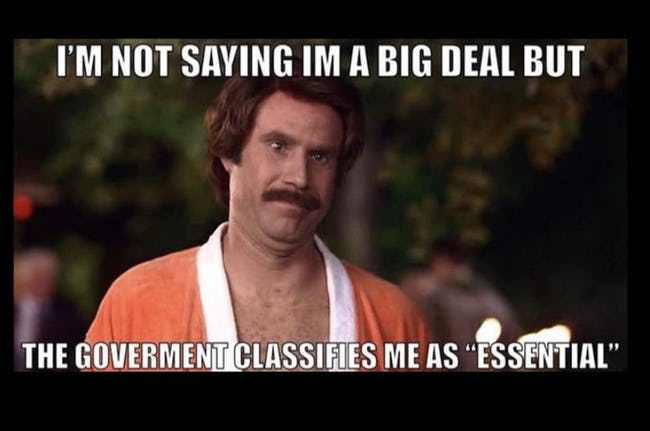
In declaring some jobs “necessary” and others not, in focusing on one supply chain versus another, policymakers show how little they know about the nation’s economy. In their view, they can simply declare things they want to happen, and then those things will happen. But that is not how economies work. An economy is the sum total of everyone’s activities, and when the government declares that something must happen, all kinds of other things happen too.
Consider how all the “non-essential workers” have been sent home for the past two months. Who gets to declare which workers are non-essential to the economy, and by what standard? Most assumed that politicians had the correct answers to these questions. But, as we are discovering, there is no such thing as “non-essential” workers. All workers are essential. How do we know? Because their jobs existed. Profit-driven businesses do not create non-essential jobs. Those people’s jobs were essential to their employers. Further, those people’s jobs were incredibly essential to the people themselves. They need their wages to pay the rent, buy their food, make their car payments, and for everything else that makes their lives livable.
But policymakers simply declared them non-essential, as if there would be no fallout from that decision.
March 29, 2020
QotD: Cargo cults, ancient and modern
To say that Pacific island societies were “relatively undeveloped” is a euphemism; they were primitive backward people who, when first encountered by European explorers, lived in a Neolithic stage of development far behind that of Mesopotamia in 1,500 B.C. That natives of Melanesia were at least 3,000 years behind Western civilization is simply a fact, but facts are now racism. Nevertheless, the point about cargo cult thinking is that these primitive islanders were unable to comprehend the advanced social and economic systems that produced, e.g., steam-powered ships, airplanes and the manufactured goods that the white man’s mechanical contrivances delivered. Utterly ignorant of how and why “cargo” had been produced and transported to their remote islands, the natives were understandably mystified when the arrival of “cargo” was interrupted. So they resorted to imitative rituals by which they believed the return of “cargo” might magically be reinstated.
The 21st-century American might laugh at these primitive superstitions, except that similarly ignorant “monkey see, monkey do” behaviors can be observed in our own society every day. My favorite example is the teenage boy who observes that girls are interested in athletes. The star basketball player in high school is popular with the girls, and so lower-status teenage boys — including the ones with zero athletic aptitude — will often emulate the athletic boys in terms of their attitudes, manners and clothing. This is why you see so many dorky suburban white boys wearing Nikes, NFL jerseys, etc., slouching around and speaking in a rap-influenced slang: “Wazzup, bruh?” These behavioral styles are an attempted imitation of popular black athletes. The clumsy adolescent white boy lacks the essential substance of the black athlete’s appeal, yet superstitiously believes (in cargo-cult manner) that he can obtain popularity by performing a superficial imitation.
Robert Stacy McCain, “The Cargo Cult Mentality”, The Other McCain, 2019-12-20.
March 27, 2020
March 26, 2020
David Warren on the situation in Parkdale
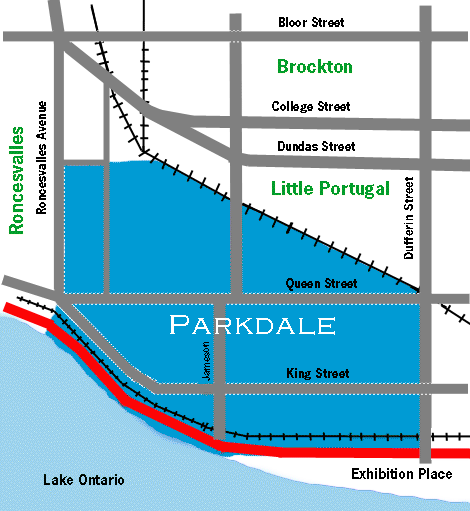
David Warren provides a glimpse of what life is like in the Toronto neighbourhood of Parkdale during the Wuhan Coronavirus epidemic:
Is gentle reader bored with pathogens yet? At some point in the proximate future, death will lose its sting. While there are plausible economic reasons for people to return to work, there is also a dark secret. The most restless society since the invention of restlessness cannot cope with “downtime.” This is what gives me my monopoly on Idleness. Without the “events” which help to distinguish one day from another, we will need to start a war.
The Parkdale neighbourhood of Toronto.
Map by Alaney2k via Wikimedia Commons.Had we books, and to have developed the habit of using them, we might read history instead; and even a bit of poetry on the side. But now, at loose ends, we are inspired to do something. Also, please note, the doctrine of original sin. I’m a big fan.
My political dogma has surely been established by now. I am against “doing” anything. Fight for a world in which nothing exciting happens, other than the pursuit of beauty, goodness, and truth. Fight relentlessly — by example.
Here in Parkdale, Toronto’s go-to centre for the criminally insane, there is always entertainment. From my balconata I can spy several half-way houses, and for variety, a Tibetan temple. The streets get quieter every day, especially the throb of the superhighways. It has been softening, as the economy bleeds away; and there are clear days with no contrails in the sky.
The “Green Nude Eel” is being accomplished. Superficially, this might seem like a good thing.
But because Parkdale has been unable to start a war with our bourgeois neighbour — Liberty Village, where the childless young professionals live in sterilized apartment blocks — we have had to look for excitement elsewhere. By calling 9-1-1 frequently, the Vallishortensians (demonym for “Parkdale”) are able to keep the sirens blaring, and little knots of emergency vehicles collecting, to no definable purpose here and there. Due to my Scottish genetic endowment, I follow these skits as I would a taxi-meter: How much have we cost the taxpayers today?
March 20, 2020
QotD: Absolute and relative poverty
That the poor of our nation live better than 90 percent of anyone only 100 years ago, better than anyone at all from more than 200 years ago, shows just how fabulous an economic system it is.
Sure, it’s not perfect, it could do with some revisions here and there, but this system — the rule of law, markets, and capitalism — delivers in the one thing that truly matters: raising the living standards of the people, most especially poor people. Even more, no other economic system has managed this at all.
Tim Worstall, “Appalachia’s woes show the success of American capitalism”, Washington Examiner, 2018-01-09.
March 18, 2020
QotD: The “magic” of capitalism
In 1776, America set off to unleash human potential by combining market economics, the rule of law and equality of opportunity. This foundation was an act of genius that in only 241 years converted our original villages and prairies into $96 trillion of wealth.
Other places which did much the same thing — that mixture of capitalism, the rule of law and free markets — achieved much the same end. We generally refer to those places as the developed world, while those that didn’t are still the Third World. There is nowhere at all that has become rich, absent some vast natural resource, without adopting this system.
We can show this, too, with the numbers from Angus Madison. The average GDP per capita over history, all countries, all empires, was some $600 a year or so — That’s in today’s dollars, meaning history was, by our standards, abject destitution for everyone. This is also why we use $1.90 a day (at modern American prices) as our measure of global absolute poverty. Because that’s just what the past was and we celebrate when people, a country, a nation, rise above that historical existence.
Tim Worstall, “Appalachia’s woes show the success of American capitalism”, Washington Examiner, 2018-01-09.
March 15, 2020
Those damned unintended consequences
Sarah Hoyt on the differences between intention and the real world:
Unintended consequences are the bane of social engineers. They are why the “Scientific” and centralized method of governance never worked and will never work. (Sorry, guys, it just won’t.)
Part of it is because humans are contrary. Part of is because humans are chaotic. And part of it is because like weather systems, societies are so complex it’s almost impossible to figure out what a push in any given place will cause to happen in another place.
This is why price controls are the craziest of idiocies. They don’t work in the way they’re intended, but oh, they work in practically all the ways they’re not. So, take price controls on rent. All they really do is create a market in which housing is scarce, landlords don’t maintain their property AND the only people who can afford to live in cities that have rent control are the very wealthy.
BUT Sarah, you say, aren’t rent controls supposed to make them affordable. Yeah. All that and the good intentions will allow you to go skating in hell on the fourth of July weekend.
Let’s be real, okay? I saw rent control up close and personal in Portugal. Rents were controlled and landlords were penalized for “not keeping the property up”.
In Portugal at the time, and here too, most of the time from what I’ve seen, the administration of property might be some management company, but that’s not who OWNS the damn thing. The owners are usually people who bought the property so it would support them in old age/lean times.
To begin with, you’re removing these people’s ability to make money off their legitimately owned property. And no, they’re not the plutocrats bernie bros imagine. These are often people just making it by.
Second, people are going to get the money some other way, because the alternative is dying. And people don’t want to die or be destitute. So they’re going to find the money. I have no idea what it is in NYC, etc, but in Portugal? it was “key buying.” Sure, you can rent the house for the controlled price, but you have to make a huge payment upfront to “buy the key.” From what I remember this was on the order of a small house down payment. And if you couldn’t do that, you were stuck getting married and living with your parents. And if you say “greedy landlords” — well, see the other thing you could do was leave the lease in your will. So the landlord didn’t know if they’d ever get control of their property back, and they needed to live off this for x years (estimated length of life.) So, that was an unintended consequence. The kind that keeps surfacing in rent-controlled cities in the US.
The same applies to attempts to “help” the homeless. Part of this, as part of all attempts to “fix” poverty is that the people doing it, usually the result of generations of middle class parents and strives assume the homeless and the poor are people like them.
To an extent, they’re correct. The homeless and the poor are PEOPLE. But culture makes a difference, and culture is often based on class and place of upbringing. And the majority of humanity, judging by the world, might be made to strive but are not natural strivers. Without incentive, most of humanity sits back, relaxes and takes what it’s given.
February 27, 2020
QotD: Clichés of bad travel writing
Kerry Howley, “But the People Are So Friendly“, Hit and Run, 2005-08-18.
February 7, 2020
QotD: The negative economic and human value of foreign aid
During the past four decades, Western governments have lavished on Africa nearly a half-trillion dollars in aid. But to no good effect. Everyone agrees that Africans remain desperately poor.
Academic studies confirm aid’s ineffectiveness. In his celebrated 2001 book, The Elusive Quest for Growth, former World Bank economist William Easterly carefully reviews aid’s history and concludes that it is one of abject failure.
Indeed, many studies find that aid harms economies. For example, University of Regina economist Tomi Ovaska, writing in the Cato Journal, finds that “a 1 percent increase in aid as a percent of GDP (gross domestic product) decreased annual real GDP per capita growth by 3.65 percent.”
The reasons for this dismal record should be plain to anyone with a rudimentary understanding of economics. Failure of economies to develop is not because of lack of resources. Instead, it’s because of overbearing and corrupt governments, as well as to the dysfunctional social and cultural institutions that keep such governments in power and that are themselves fostered by such governments.
As long as a country is cursed by a malignant government and dysfunctional institutions, no amount of foreign aid will help it.
Don Boudreaux, “Faulty Band-Aid”, Pittsburgh Tribune-Review, 2005-06-18.
January 21, 2020
Amity Shlaes’ Great Society: A New History
In City Journal, Edward Short reviews the latest American economic history book by Amity Shlaes:
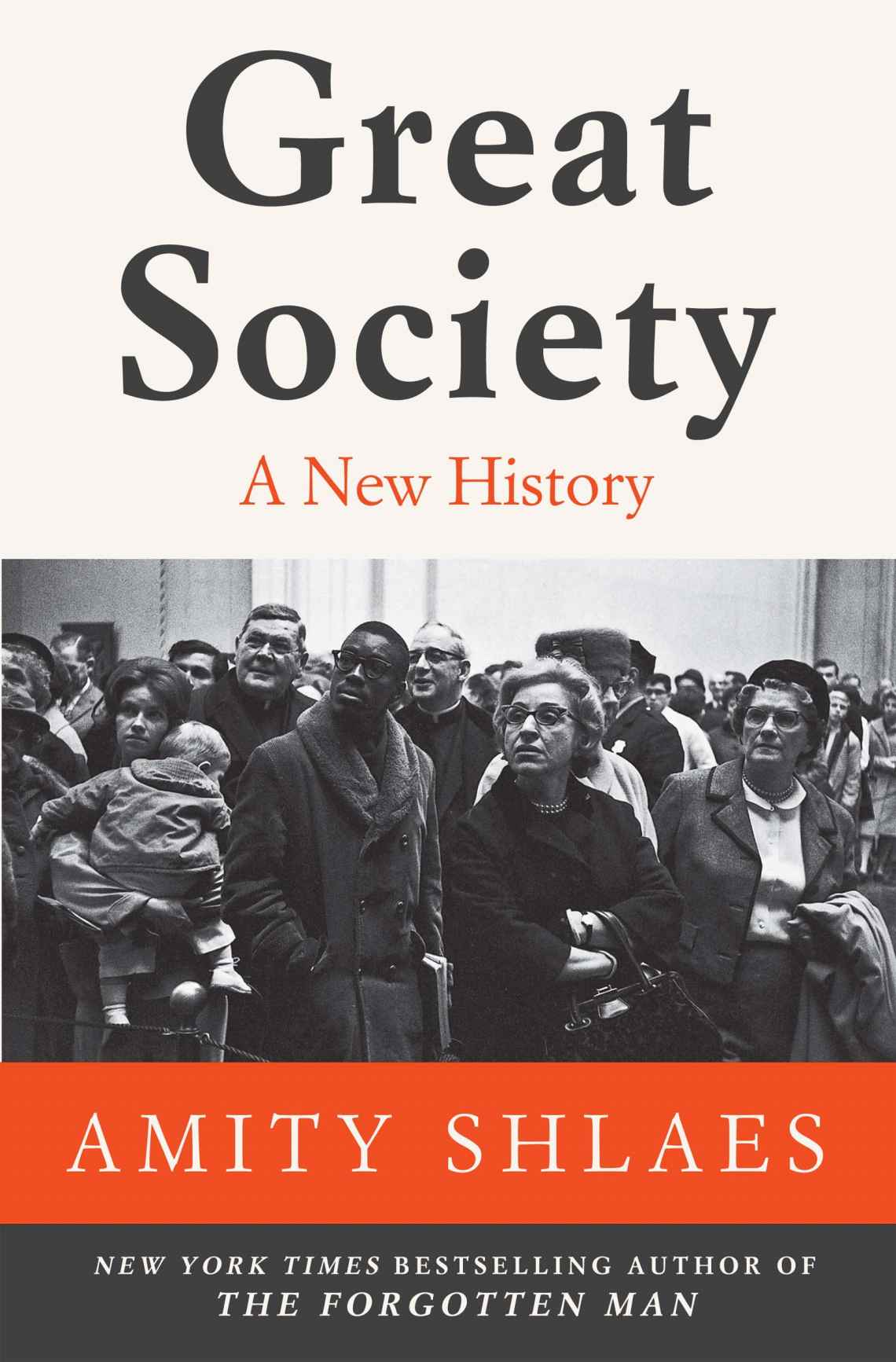
In Great Society: A New History, Amity Shlaes revisits the welfare programs of the Kennedy, Johnson, and Nixon administrations to show not only how misguided they were but also what a warning they present to those who wish to resurrect and extend such programs. “The contest between capitalism and socialism is on again,” the author writes in her introduction. Despite the Trump administration’s thriving economy, or perhaps because of it, Democratic Party progressives are calling for new welfare programs even more radical than those advocated in the 1960s by the socialist architect of Lyndon Johnson’s War on Poverty, Michael Harrington. In the new schemes for wealth redistribution, student debt relief, socialized medicine, and universal guaranteed income that make up the Democrats’ political platform in 2020, Shlaes rightly sees a recycling of Great Society hobby horses — and she worries that a good portion of the electorate may be taken in by them. “Once again many Americans rate socialism as the generous philosophy,” she observes, and she has written her admirable, sobering study to make sure that readers realize that the “results of our socialism were not generous.”
Reviewing how ungenerous makes for salutary reading. After all, socialism of any stripe, whether in Russia, South America, Europe, or America, has always been an inherently deceitful enterprise. Shales captures the essence of this imposture when she describes one of its manifestations as “Prettifying a political grab by dressing it up as an economic rescue.” In totting up these receipts for deceit, Shlaes has done a genuine public service. […]
On display here are all of Shlaes’s strengths as an author: her clear and unpretentious prose, sound critical judgment, readiness to enter into the thinking of her subjects with sympathy (even when she regards it as mistaken), and, perhaps most impressively, understanding how history can help us fathom what might otherwise be obscure in our own more immediate history.
Accordingly, she describes the influence that Roosevelt’s New Deal had on Johnson, who saw it as a model for maintaining and consolidating his Democratic majorities, as well as focusing his Cabinet’s talents. “The men around Johnson,” Shlaes points out, including Robert McNamara, McGeorge Bundy, Richard Goodwin, and Sargent Shriver, “felt the weight of his faith on them, and strove hard. Vietnam would be sorted out. There would be a Great Society. Poverty would be cured. Blacks of the South would win full citizenship. The Great Society would succeed.” Yet the president’s men could not help asking “by what measures” it would succeed.
Moynihan’s answer to this question is one that still mesmerizes social-engineering elites. The Great Society would be achieved by social science. “Progress begins on social problems when it becomes possible to measure them,” Moynihan declared. Improved quantitative analysis would give the centralized power of planners a new credibility.
Whether Johnson himself ever truly believed in such claims is questionable. When aides asked the exuberant Texan what he thought of the risks of going forward with his wildly ambitious program, his reply epitomized the hubris at the heart of his Great Society: “Well, what the hell’s the presidency for?”
January 2, 2020
The 2010s … the best decade (so far) in human history
Matt Ridley explains why, despite all the doom and gloom in the daily headlines, the last ten years have been the best by almost any measure:
Let nobody tell you that the second decade of the 21st century has been a bad time. We are living through the greatest improvement in human living standards in history. Extreme poverty has fallen below 10 per cent of the world’s population for the first time. It was 60 per cent when I was born. Global inequality has been plunging as Africa and Asia experience faster economic growth than Europe and North America; child mortality has fallen to record low levels; famine virtually went extinct; malaria, polio and heart disease are all in decline.
Little of this made the news, because good news is no news. But I’ve been watching it all closely. Ever since I wrote The Rational Optimist in 2010, I’ve been faced with “what about …” questions: what about the great recession, the euro crisis, Syria, Ukraine, Donald Trump? How can I possibly say that things are getting better, given all that? The answer is: because bad things happen while the world still gets better. Yet get better it does, and it has done so over the course of this decade at a rate that has astonished even starry-eyed me.
Perhaps one of the least fashionable predictions I made nine years ago was that “the ecological footprint of human activity is probably shrinking” and “we are getting more sustainable, not less, in the way we use the planet”. That is to say: our population and economy would grow, but we’d learn how to reduce what we take from the planet. And so it has proved. An MIT scientist, Andrew McAfee, recently documented this in a book called More from Less, showing how some nations are beginning to use less stuff: less metal, less water, less land. Not just in proportion to productivity: less stuff overall.
This does not quite fit with what the Extinction Rebellion lot are telling us. But the next time you hear Sir David Attenborough say: “Anyone who thinks that you can have infinite growth on a planet with finite resources is either a madman or an economist”, ask him this: “But what if economic growth means using less stuff, not more?” For example, a normal drink can today contains 13 grams of aluminium, much of it recycled. In 1959, it contained 85 grams. Substituting the former for the latter is a contribution to economic growth, but it reduces the resources consumed per drink.
As for Britain, our consumption of “stuff” probably peaked around the turn of the century — an achievement that has gone almost entirely unnoticed. But the evidence is there. In 2011 Chris Goodall, an investor in electric vehicles, published research showing that the UK was now using not just relatively less “stuff” every year, but absolutely less. Events have since vindicated his thesis. The quantity of all resources consumed per person in Britain (domestic extraction of biomass, metals, minerals and fossil fuels, plus imports minus exports) fell by a third between 2000 and 2017, from 12.5 tonnes to 8.5 tonnes. That’s a faster decline than the increase in the number of people, so it means fewer resources consumed overall.

H/T to Damian Penny for the link.
November 27, 2019
The “Gentrification” debate
In Quillette, Coleman Hughes explains the furor over gentrification in many big American cities:
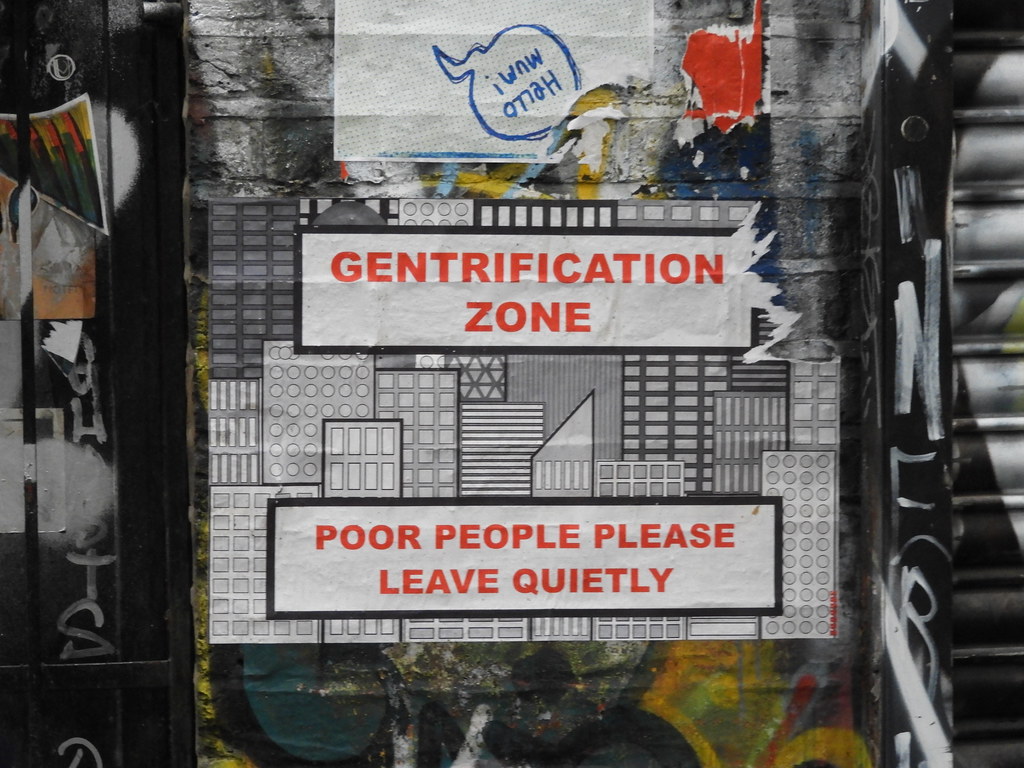
“Shoreditch Graffiti” by Kit-Kat is licensed under CC BY-NC-SA 2.0
The word “gentrification” was coined in 1964 to describe the influx of wealthy newcomers into low-income inner-city neighborhoods, resulting in rising property values, changes in neighborhood culture, and displacement of original residents. Though gentrification predates the modern era, it has only become the target of criticism in recent decades, as cities like Washington, D.C., Atlanta, and Boston have witnessed rapid transformations. Opponents of gentrification have ranged from residents directly affected by it to wealthy college students directly responsible for it, as well as prominent Democrats such as Bernie Sanders, Cory Booker, and Alexandria Ocasio-Cortez.
Critics of gentrification give two main reasons for their opposition: (1) wealthy newcomers drive up monthly rents, thereby displacing original residents; and (2) rapid change to neighborhood culture represents an injustice to original residents. Both critiques are magnified by the presumed skin color of the gentrifiers and the gentrified, who tend to be white and black or Hispanic, respectively.
Though such critiques may seem reasonable at first glance, neither of them survive scrutiny. Not only is gentrification harmless, it’s actually beneficial. Indeed, for reasons I will lay out, it’s exactly the kind of thing that progressives should support.
Let’s begin with the charge that gentrification displaces original residents. Two economists used data from the 2000 U.S. Census and the 2010-2014 American Community Survey to track individual outcomes for all residents of “gentrifiable” — or low-income inner-city — neighborhoods in America’s one hundred largest metropolitan areas. The largest study of its kind, it divided residents of gentrifiable neighborhoods into two categories based on educational attainment. Their findings refute the displacement narrative conclusively.
[…]
On the whole, progressives ought to love gentrification. It makes black inner-city homeowners wealthier. Among less-educated homeowners — who are majority non-white and comprise over a quarter of the total population in gentrifiable neighborhoods — those who remained in gentrified neighborhoods saw a $15,000 increase in the value of their homes due to gentrification. Among more-educated homeowners — who are also majority non-white — those who remained saw a $20,000 increase in property value.
What’s more, gentrification breaks up concentrated poverty and reduces residential segregation. Progressives have frequently observed that poor blacks are more likely to live in concentrated poverty than poor whites. As a result, they lose out on the advantages that come with living in a mixed-income neighborhood. Gentrification helps solve this problem. Moreover, progressives often observe that residential segregation remains pervasive half a century after the 1968 Fair Housing Act. Gentrification helps solve that problem too.


