Quotulatiousness

April 6, 2019

“The Prime Minister has repaid my loyalty with betrayal”

Filed under: Britain, Europe, Government, Politics — Tags: , , , — Nicholas @ 05:00

Despite the full applicability of the headline to Canadian politics, this isn’t about the Dauphin’s betrayal of cabinet ministers or the Canadian people, it’s actually Matt Ridley talking about Prime Minister Theresa May:

The Prime Minister has ignored the views of the majority of her Cabinet and ruled out No Deal. The reason, we are told, is that No Deal might lead to the re-imposition of direct rule over Northern Ireland, and might lead to a second Scottish independence referendum.

That either of these considerations should outweigh the independence of the United Kingdom from an increasingly decrepit but increasingly autocratic empire is bizarre. If No Deal causes a second referendum in Scotland – we were told that the vote itself would cause that too, remember, but it did not – then we will win that too.

But more bizarre is that these worries have existed all along. If the Prime Minister thinks the risk of direct rule in Northern Ireland (which is happening in practice anyway) trumps all other considerations, and rules out No Deal, then why did she not say so more than two years ago or at any time since? Instead, she said 108 times that we would leave the EU on 29th March, whatever happens; 50 times that she would not extend that date; and 32 times that No Deal is better than a bad deal. Not once did she say it was impossible.

[…]

Mrs May should have ruled out No Deal at the start of the negotiations, if that is what she thought, or she should have meant “No Deal is better than a bad deal” when she said it. As it is, the combination of threatening No Deal until the moment when it might actually matter in the negotiations, then dropping the threat on the feeblest of latest excuses, is about as foolish as one can imagine. And now rushing off to hand the initiative to an apologist for totalitarians, anti-Semites and terrorists instead. Thanks.

The Prime Minister and her allies are now chanting that it is all the fault of the European Research Group for rejecting her deal and are saying they have no alternative than the dismal choices of supporting her deal or no Brexit, as if amnesiac about the third option: their recent promises to leave with No Deal if necessary. Yet the truth is that ever since the debacle at Chequers in July, when everybody from half the Cabinet to the Democratic Unionists to the media to the people themselves told her quite clearly that she would never get the Chequers plan through Parliament, she has been the one at fault.

April 5, 2019

The Brexit trainwreck is “revealing to the British public the extent of its political class’s incompetence”

Theodore Dalrymple in City Journal on the scale of political tomfoolery going on in the Brexit clusterfutz:

The imbroglio over Brexit has at least had the merit of revealing to the British public the extent of its political class’s incompetence. If it is accepted that people get the leadership that they deserve, however, thoughts unflattering to self-esteem ought to occur to the British population.

Theresa May did not emerge from a social vacuum. She is typical of the class that has gradually attained power in Britain, from the lowest levels of the administration to the highest: unoriginal, vacillating, humorless, prey to the latest bad ideas, intellectually mediocre, believing in nothing very much, mistaking obstinacy for strength, timid but nevertheless avid for power. Thousands of minor Mays populate our institutions, as thousands of minor Blairs did before them.

Avidity for power is not the same as leadership, and Brexit required leadership. There was none to be had, however, from the political class. From the very first, it overwhelmingly opposed Brexit — for some, the eventual prospect of a tax-free, expense-jewelled job in Brussels was deeply alluring — but found itself in a dilemma, since it could not openly deny the majority’s expressed wish. Many Members of Parliament sat for constituencies in which a solid majority had voted for Brexit. They feared that they would not win their next election.

The opposition Labour Party was as divided as the Conservatives. Irrespective of what its MPs actually believed about Brexit—its leader was, until recently, ardent for leaving the European Union, which he believed to be a capitalists’ club, changing his mind for reasons that he has so far not condescended to disclose — its main concern was to force an election that it believed it could win, a victory that would soon make Brexit seem like a minor episode on the road to ruin. The majority of the Labour MPs wanted first to bring about the downfall of a Conservative government and second to prevent Britain leaving the European Union without an agreement — what might be called the leaving-the-Union-without-leaving option. But they wanted the first more than they wanted the second, so under no circumstances could they accede to anything that Prime Minister May negotiated. Because of her tiny majority in Parliament, the hard-line Brexit members on her own side who want Britain to leave without a deal, and the refusal of her coalition partner, the Democratic Unionist Party, to back her, May needs the support of a considerable proportion of Labour MPs — which, so far, she has not received.

But the House of Commons as a whole, including the Conservatives, deprived May of leverage with which to renegotiate, because it voted that it would not accept leaving the Union without a deal. This deprived the European Union of any reason to renegotiate anything: it was a preemptive surrender to the demands of the E.U. that makes Neville Chamberlain look like a hard-bitten poker champion.

April 1, 2019

Sean Gabb on the Brexit crisis

Filed under: Britain, Europe, Government, Politics — Tags: , , , , — Nicholas @ 03:00

In his latest email newsletter, Sean Gabb discusses the Brexit situation:

The consensus in the media appears to be that Parliament is out of control, and is attempting to stop our exit from the European Union – even if this means tearing up every settled constitutional norm. I disagree. No doubt, the House of Commons is filled with some very trashy people, and I have little doubt most of them would like to stay in the European Union. Even so, they are acting collectively with strict constitutional propriety. For the first time in my life, they are earning their inflated salaries and expenses and bribe allowances.

Three years ago, we vote to leave the European Union. The margin was respectable, though not substantial. The Government was therefore given one reasonably difficult job. This was to detach us from the institutions of the European Union, while respecting the wish of a large majority for continued good relations with the European Union. This was difficult, but hardly in the same class as trying to win a war against the greatest military power in the world, or dismantle an Empire, or even reform the structures and financing of local government. The most obvious compromise was to rejoin EFTA and remain in the Single Market, while negotiating a longer term set of arrangements. Most people, I think, would have accepted such a compromise. I would, and I may have written about it at the time.

Instead of doing this, however, Theresa May loaded us with endless vague promises, while negotiating in secret with the European Commission. At the end of two years and six months, she presented us with a draft Withdrawal Agreement that was universally unacceptable. I will not rehearse why it was unacceptable. Everyone has read it for himself, or read a fair summary and critique. When this was presented to the House of Commons, it was overwhelmingly rejected. Why the Labour Party and the various open Remainers voted against it is less important than that they did vote against it. This is why we have a Parliament. It is there to stop the Executive from acting against the public good. It is there to make the voice of the people heard.

Our present set of crises blew up when it emerged that Theresa May had allowed no one to think about any alternative to her Agreement. Her only solution to losing the first vote was to arrange for another, and then for another. Each time, her Agreement was rejected – and rejected, I repeat, for good reasons. But, thanks to her wickedness or stupidity, there were only three options available to Parliament. One was to swallow her Agreement. Another was to leave without any deal. The other was to give up on leaving – to cancel the Referendum result.

[…]

It may be that the plan was to unveil a fraudulent leaving agreement, and to whip this through Parliament, leaving the rest of us to grumble about it for the next generation, though unable to do anything about it. If so, the plan has failed. The problem is not that our ruling class does not want to be bound by the will of the people – this is hardly a novel discovery. The problem is the crude inflexibility of our rulers. The EFTA compromise I and most other people would have accepted three years ago would have allowed any number of quiet understandings in London that let things as they matter to our rulers go on much as before. Instead, they wanted complete victory on their terms, and they planned for no other outcome. No competent strategist or negotiation behaves like this. The Tory ultras did not behave like this in 1832 or 1911. Labour did not behave like this after 1983. On the whole, we are lucky that we have asked these people only to arrange a departure in good order from a customs
union. They might instead have messed up something really important.

These crises have been a useful learning experience. Theresa May and the interests she has been chosen to front are both wicked and stupid. Speaking for myself, I think our Members of Parliament – wretched creatures if these may be in themselves – for doing their job and lifting the stone to show the pale and stinking bugs in full light of day. Sooner or later, we shall leave the European Union. This will be a messier and more acrimonious departure than it needed to be. But I suspect that the debate between Leavers and Remainers is turning to a shared demand for our will to be obeyed by the Executive. This is a much wider matter than our membership of the European Union. Leaving is now a symbol of who has the final say in this country. The longer our decadent rulers try to hold firm, the more radical the demands will grow for a reconstruction of the system.

I have no idea what will happen in the next few weeks. But I am glad we have the Parliament that we have.

Alex Noble feels the situation is going pretty much exactly how the EU wanted it to go from the start:

For a few months now I have written about how the EU’s plan is increasingly transparent, and it is becoming possible to anticipate their every move.

I believe we are now so close to the outcome they wargamed a year ago, that the final week is now almost completely predictable.

For what it’s worth, here we go.

[…]

So this coming week, the EU will water down or remove the backstop they never cared about, and the British people will be betrayed into vassalage by their Vichy Parliament.

That’s right – another “breakthrough” is imminent, although I suspect the EU will once again trot out the gap-toothed Belgian bumpkin Verhofstadt to pretend to find the whole affair insulting, so we remember to be properly grateful to his paymasters.

All other options now are just scare tactics – No Brexit, No Deal, long extensions, a general election, a loss of drinking water, or pet food, or medicine – these are all just the Bad Cop act designed to get us to gratefully turn to the Good Cop.

Namely the EU’s Withdrawal Agreement, which as I’ve pointed out is like the Withdrawal Technique in that despite the promises made, it usually involves no actual withdrawal.

We have been herded for nearly a year like scared children towards the EU’s treaty, which imprisons us forever in the EU – it is what they wanted all along, and they have used our government, our MPs (with a few dozen honourable souls still resisting as I write), our media, and the craven statists embedded in our institutions to convince us that the EU’s Withdrawal Agreement represents freedom.

In this coming week, all but a few dozen stalwarts will crumble, and then the only question is whether enough Labour europhiles will cross the House to pass this grotesque betrayal and inflict it on the British people.

At that stage, I wonder whether our cries of fury and anguish will fade into silence, or swell into carnage?


March 27, 2019

“This was the week it became necessary to destroy the village of good government in order to save it”

Filed under: Cancon, Government, Media, Politics — Tags: , , , — Nicholas @ 03:00

It may be hard to believe, but in his latest at Maclean’s, Paul Wells appears to be getting a little bit cynical about recent shenanigans in Ottawa:

We have learned so much. Within minutes Monday afternoon, two good reporters had stories (here and here) about the Chief Justice of Manitoba, who was a candidate to be Chief Justice of the Supreme Court of Canada and who, later, wasn’t. Both reporters unfurled similar yarns about a lone Prime Minister standing athwart the tide of conservatism by blocking — shudder — a Harper appointee from sitting on the top court. Jody Wilson-Raybould plays the role of villain in the piece.

Both reporters decorously neglect to mention that Trudeau’s choice for Chief Justice, Richard Wagner, was a Harper appointee.

There are many things we can say about this story, working outward in concentric rings from the thing itself. First, Glenn Joyal’s views, as expressed in speeches that were said to alarm the prime minister, are almost comically orthodox. I first became aware of the notion that Charter litigation systematically airlifts important matters from the parliamentary arena and into the realm of jurisprudence in a Chantal Hébert column in the late 1990s. If I had paid more attention to literally any of my Canadian public administration profs a decade earlier I would have caught the argument then, because it is canvassed in every Canadian political science class. This is not wild-eyed Hayekism.

Second, perhaps the many thousands of Canadians who have applied for federal government appointments under what they thought was a confidential process, introduced by this prime minister, will want to contemplate a class-action suit against him. Because it is now radiantly clear to each of them that their CV is being held hostage by a claque of embattled sorcerers’ apprentices who will cheerfully wheel it over the transom to any waiting scribe if anything about them — their opinions, a fallen political star’s unfortunate decision to argue for their advancement — becomes politically inconvenient. This is the very stuff of the police state.

It was immediately fashionable to wonder on social media how everyone would react if Stephen Harper had done such a thing. It’s germane to note that Stephen Harper never did. Because he had more class. Welcome to the Tet offensive of Charter rights: This was the week it became necessary to destroy the village of good government in order to save it.

Third, Justice Joyal’s wife was in poor health. Apparently we are to believe that 9,000 jobs depended on your knowing that.

If the Trudeau government is not the source of the leak, I assume we will see spectacular efforts deployed in the next 36 hours to find the leaker. Mark Norman-scale efforts. But I’m pretty sure that we needn’t hold our breath, because the government is the source of the leak; that the amiable chap who currently sits in the office once occupied by the Attorney General of Canada will not bestir himself to question Monday’s sickening attack on due process; and that the leak will actually be roundly applauded by the ambient cloud of Liberal and Liberal-adjacent opinion, which became self-aware this weekend and decided Jody Wilson-Raybould and Jane Philpott are a virus endangering the party’s re-election chances and must therefore be stopped.

March 17, 2019

Brexit delayed is Brexit denied

Filed under: Britain, Europe, Politics — Tags: , , , , — Nicholas @ 03:00

At Spiked, Mick Hume looks at the likely outcome of yet another Brexit betrayal by parliamentary remainers:

The vote to delay / bugger Brexit is a betrayal of the major parties’ promises, but not of their principles. This, after all, is what the overwhelming Remainer majority of MPs wanted all along. Behind all the divisions and parties-within-parties revealed by this week’s parliamentary shenanigans, there remains a clear anti-Brexit majority among MPs, aided and abetted by conniving Speaker John Bercow, and bugger whether their constituents backed it or not.

The final resolution remains uncertain. All options are still technically on the table; the UK remains legally committed to leaving on 29 March unless and until the law is changed. However, things look grim for a meaningful exit; some Tory Brexiteers and the DUP are making vague noises about using Article 62 of the Vienna Convention (oh yes, that old chestnut!) as an excuse for backing May’s deal next week, while Labour’s arch-Remainer buzzards are circling.

But however its planned betrayal of Brexit pans out, the political class cannot delay its own day of reckoning forever. The naked contempt politicians have displayed for voters and popular democracy will not go unrewarded. The Leave revolt has let the democratic genie out of the bottle, and it will not easily be shoved back in.

If Remainers get their long extension, for a start, it should mean that the UK has to hold Euro elections in May. See Brendan O’Neill’s podcast interview with Nigel Farage for a hint at the fun the latter’s newly registered Brexit Party could have with those.

The chaos surrounding this week’s vote to delay and betray Brexit is a microcosm of the dire state of official UK politics. It confirms that both major zombie parties are deeply divided, and that May’s government does not have authority within its own cabinet room, never mind in the country at large. The old political order is falling apart under the pressures of trying to contain the democratic revolt for Brexit.

Amid all this rancour and uncertainty, one thing remains clear: how right Leave voters were to vote to take back control from the demos-loathing EU elites and their allies in the UK’s ‘Bugger Brexit’ alliance.

March 16, 2019

So “Brexit means Brexit” actually means “no Brexit, no matter how many people voted for it”

Filed under: Britain, Europe, Politics — Tags: , , , , — Nicholas @ 03:00

Mark Steyn on the British Parliament’s decision to overturn the referendum result:

As I write, I happen to be next door to the Canadian House of Commons – which is far from my favorite place. But, at its lowest and most contemptible, Ottawa’s House has never screwed over the Commoners the way that of its imperial mother just has in London.

Last night, sixteen days before Britain supposedly leaves the European Union in accord with the people’s vote of three years ago, their elected representatives voted by 312 to 308 to rule out a “no-deal” Brexit – ie, a straightforward walkaway – ever.

So the EU now has no incentive ever to reach a deal with Britain. The appalling “deal” Theresa May “negotiated” was for a wretched and humiliating vassal status with Brussels. Because for the Eurocrats, what matters is to teach the lesson the ingrate voters that you can check “Out” any time you like but you can never leave. Mrs May’s deal was meant to be a message to antsy Continentals that the citizenry’s impertinence must never happen again.

When that flopped, Brussels moved to the next stage – not that Brexit must never happen again, but that Brexit must never happen, period. And, to their shame, the people’s representatives at Westminster have colluded in their subversion of the people’s will.

So last night the elites rose up and overthrew the masses. Of course, they have also destroyed their own reputation, and that of England as the Mother of Parliaments. But in a sense that also makes the larger point – that the world is too complex to be left to self-government by the people’s representatives, so best to leave it to Brussels.Sorry, you grunting morons don’t realize how difficult it all is, so you can vote for it all you want, but it can’t be done.

March 5, 2019

If Brexit doesn’t happen, will there be a meaningful reaction?

Filed under: Britain, Europe, Government, Politics — Tags: , , , , — Nicholas @ 05:00

The British government under Prime Minister Theresa May believes — or appears to believe — that with sufficient delay, muddle, and obfuscation, the voters will mutter and grumble but in the end do nothing. David Betz and MLR Smith believe differently:

What do you get when you have a Conservative party that doesn’t conserve, a Labour party that doesn’t represent the interests of the working class, and a Liberal Democrat Party that is neither liberal nor democratic?

The answer is, a pretty accurate description of the current British political landscape. Here are different kinds of political ice cream for sale, but when licked they all turn out to have roughly the same unpalatable taste: a bland, socially progressive, anti-traditionalist, globalist, corporatist flavour. And, you the people, don’t ask for anything else! We know how to make ice cream. You don’t.

Of course, it is Brexit and the reactions of the political classes to it, that most clearly reveals the startling democratic deficit in the United Kingdom. Brexit is, though, not the cause of political strife. It is merely the symptom that has brought these latent anti-democratic inclinations to the surface. Arguably, they have always been there in one form or another since ancient times.

In November 2016, Nigel Farage told the BBC’s Andrew Marr: ‘Believe you me, if the people in the country think they’re going to be cheated, they’re going to be betrayed, then we will see political anger the likes of which none of us in our lifetimes have ever witnessed in this country’. It was an obvious point and true. Yet the striking thing about such a warning has been the degree to which national politicians and media have tried to ignore it.

How, we might wonder, has it all come to this and, just as vitally, what are the possible long-term consequences?

The government is gambling that reaction will be fierce, but localized and short-lived, and that the establishment can ride out the storm with little or no real problem. They may be seriously underestimating the anger and resentment of a voting public who are being explicitly denied the outcome they chose. But will there be serious outbreaks of violence?

Cumulatively, over the past three decades, then, the empirically demonstrable lesson is that violence and threats work. Crudely, there is simply no arguing with the fact that violence is the deus ex machina for changing the way people think and act. Physical force is a method of political communication, and when it is sustained it invariably succeeds in changing minds and changing policies.

Under the threat of violence, it is often easier for governments to knuckle under for the sake of maintaining a semblance of peace, to wax piously about societal cohesion and resilience, and to climb onwards as though the status quo ante were not crumbling beneath them. The progressive factions of academia, culture, and media cheer them for it. So, if the populace don’t really react in the face of such threats and actual violence, and merely light candles and hug teddy bears, then the bet of the political classes is sustained. They have gambled correctly.

But do enough people feel that violence is their only resort when the government refuses to do what the voters want? Might things go beyond mere loud, angry protests and transition towards rioting? Worse?

Thus, we come to the ultimate gamble of the political class, one that appears strongly to be operative in the minds of many in Parliament, namely, that Britons do not rebel and, therefore, faced with a fait accompli they will lump it even if they do not like it. Unlike the French, Italians, or Germans each of which nation is prone in its own way to violent mass spasms of political passion, the British are a phlegmatic people given to the sensible path. So the cliché goes.

It is true to an extent that revolution is a continental phenomenon that does not travel well across the English Channel — British governments have been better at responding to incipient uprisings, sometimes deflecting them, betimes co-opting their leaders, but mostly muddling through by accommodating their demands within the parameters of the status quo. This is a system that has succeeded precisely because parliamentary democracy, for over 300 years now, is able to internalise the will of the people, even when faced with threats of violent revolt, be it in the demands of Chartists, Irish nationalists or suffragettes.

Should we be so sanguine to believe that the British political system, for so long a beacon of stability, is immune from the turbulence that has afflicted other societies? As Remainers are so keen to remind us, we are not an island whose fortunes and follies are separate from those of our near-neighbours. If people, goods, and ideas flow freely across the borders of Europe why should not the concept of the Yellow Jackets too? White Van Man voted strongly for Brexit, after all. Why should there be an Alternative for Germany movement but not an alternative for Britain, even though the people were asked to choose one and did?

March 3, 2019

We need more data on the SNC-Lavalin affair

Filed under: Cancon, Government, Media, Politics — Tags: , , , — Nicholas @ 03:00

Andrew Coyne insists the whole story must come out before we call in the RCMP:

Where do we go from here? It is important not to get ahead of ourselves. Opposition calls for the prime minister to resign over the SNC-Lavalin affair, or for the RCMP to investigate, are premature at this point. However compelling Wednesday’s testimony before the Commons justice committee by the former minister of justice and attorney general, Jody Wilson-Raybould, may have been, all of the facts are not in.

It is still open to the government to provide those missing facts, and still possible to hope they may prove exculpatory. That they have done their level best so far to provide none, alas, strongly suggests the contrary. Even in response to Wilson-Raybould’s detailed, documented account of the many and sustained ways in which he and officials in his government attempted to interfere with a criminal prosecution, to the point not only of threatening her job but, it would seem, of carrying out the threat, the best that Justin Trudeau could offer was that he “disagreed” with it.

The prime minister prevented Wilson-Raybould from speaking for as long as he dared, and is still insisting she may not discuss potentially significant conversations with him and his cabinet after she was shuffled out of Justice. The prime minister’s former principal secretary, Gerry Butts, has agreed to testify before the committee, but no current employee of the prime minister’s office has yet been called, nor have any of the others Wilson-Raybould identified as having pressured her to go easy on SNC-Lavalin, save the clerk of the privy council, Michael Wernick.

Demands for a public inquiry, then, or at least for all of the relevant witnesses to be called before the committee, are closer to the mark. Whatever the prime minister and his people may or may not be guilty of, they cannot be allowed to get away with this blatant stonewalling. So, too, the Conservative and NDP leaders were justified in calling for Parliament to continue to sit next week, rather than take the next two weeks off. Indeed, they would be within their rights to hold up all parliamentary business, including the budget, until they get satisfaction. It is that important.

February 22, 2019

The odd dual role of the Minister of Justice and Attorney General of Canada

Filed under: Cancon, Government, Law — Tags: , , , — Nicholas @ 03:00

Colby Cosh provides an interesting tidbit of Canadian constitutional detail in the SNC-Lavalin affair:

As a minister she can be expected, and will have expected, to sometimes be given advice and orders from the PM. It would not be an unusual feature of her job to have one of the PM’s close advisers visit her with delegated instructions. Maybe sometimes those instructions would be delivered somewhat abruptly. It happens.

But. The minister of justice also bears an associated title: she is also the attorney general of Canada. You may have gotten the idea that this is just a matter of tradition, a romantic holdover from olden times. It is in fact a matter of explicit statute, the Department of Justice Act, as well as an important constitutional concept. The minister of justice is a politician who writes legislation and oversees the operation of law and courts. The attorney general, although always and necessarily the same human as the minister of justice, is a distinct person charged with the royal authority to commence, manage and cancel criminal prosecutions. When someone sues the Crown it is normally the attorney general who answers, and when the Crown sues it is done through her.

What does this mean? It means that if you are the prime minister’s trusted old chum who does his dirty work, it is all right for you to visit a mere minister of justice, operating in that capacity, and to tell her what the boss wants done for crude partisan reasons. But it is quite strictly forbidden to do that to an attorney general.

In matters of hiring or statute-writing, you can go ahead, kick down her door, and tell her “Orillia needs more red-headed Hungarian judges!” or “There really oughta be a law against candy.” When it comes to prosecutions — when madame has her attorney general hat on — it is very different. You, as a sunny-ways enforcer, are not even supposed to provide unsolicited advice or hints from the prime minister. The PM may be the minister of justice’s boss, but he is not in the chain of command between the attorney general and the sovereign at all.

An attorney general is supposed to make prosecution decisions with the good of the country in mind, and she can ask ministers for their opinions about what would be good, just as she could consult any other schmuck. But for a PM or his dogsbody to venture such an opinion spontaneously, whatever the motive, is not cool. If someone tried to give an attorney general such advice, and she told that person to shove off back to Cape Breton in a leaky dory, and she woke up one morning not long after and turned on the radio and heard that she was no longer attorney general, that would certainly be a mighty big deal.

January 25, 2019

Putting the federal cabinet on a radical diet

Filed under: Bureaucracy, Cancon, Government — Tags: , , , — Nicholas @ 03:00

Earlier this week, Ted Campbell suggested that one (of many) problems Justin Trudeau faces is the sheer size of his cabinet: there are limits to the number of people who can be successfully managed to achieve an organization’s goals by a single person. This is the reason most armies limit the size of their smallest tactical units to at most ten soldiers … much more than that, and the average leader is unable to maintain direct control without delegating sub-groups to subordinates. Running a federal government is a much more complicated task than running an infantry section. He begins by praising what he feels was the best cabinet in federal history:

A friend and regular interlocutor, reacting to a comment I made about a week ago, suggesting that the Trudeau cabinet is still too large, challenged me to look at the “ideal” cabinet. Now, it is certainly no secret that I think the “best” government Canada ever had, in modern times, say during the past century, was a Liberal one, led by Louis St Laurent. It was firmly grounded in liberal political philosophy that was shared, and broadly accepted, by most Canadians; the St Laurent cabinet was determined to govern for the people, for each person, not just to govern the people; it was economically bold but, at the same time, fiscally prudent; it believed, firmly, in a principled foreign policy and a strong enough military to give it the muscle it would need, from time to time; it advanced increasingly progressive social policies, step-by-step, but always in moderation; it was about as competent and as honest as almost any government was ever going to be … bearing in mind that governments are composed of men and women much like us.

This was the St Laurent cabinet:

There is some doubt about the date of this picture; one Government of Canada source says 1948 and another says 1953; the few familiar faces around the table, Douglas Abbott, Brooke Claxton, Brigadier Milton Gregg VC, C.D. Howe and Lester B. Pearson all served throughout that entire period. What is not in doubt is that the cabinet was much smaller than what we see today: fewer than 20 members. Today’s cabinet has over 35 members.

The problems of large cabinets are grounded in two realities: more and more complex issues, especially social issues, and more choices. Louis St. Laurent had between 245 and 265 MPs in the whole House of Commons and he governed with between 118 and 191 Liberal MPs on the government side. Justin Trudeau has a bigger problem: any modern majority government has 170+ members and Canadians are much better informed (or at least aware) of what government might do for (and to) them. He, like every prime minister before him, responds to the challenge by giving every group a voice. The outcome is a larger and larger cabinet. It’s not Justin Trudeau’s fault, it wasn’t Pierre Trudeau’s fault, either.

The correct answer, in my opinion, is a two tier cabinet: senior and junior ministers or an “inner” and “full” cabinet.

January 22, 2019

QotD: From Athenian democracy to the Magna Carta

Filed under: Britain, Europe, History, Politics, Quotations — Tags: , , , , — Nicholas @ 01:00

It is always tempting to look for our roots in ancient Athens … tempting, but wrong. The ancient Athenian “democracy” in the agora was, to be charitable, just mob rule, and the mob was incited, most often bought and paid for, by a series of loud mouthed bullies and celebrities ~ so, I can hear some of you saying, not much different from Canada and the USA in the 21st century, right? Now and again, Thucydides, for example, the loud mouth bully also had some brains and good ideas, but, more often than not they were just unqualified pretty boys and clowns.

The Romans gave us something a wee, tiny bit better: rule by law. But the Romans are, rightfully, often best remembered as engineers and they “engineered”, rigged, their political system to ensure that while there were, indeed, laws, to protect and serve the interests of the common people, the plebeians, the system ensured that no law could stand if it ever threatened the privileges of the patricians ~ Rome’s equivalent of our Laurentian elites.

The first time we find something that I think we can properly claim as a “root” of our, modern, liberal democracy is in Anglo Saxon England where, somewhat haphazardly to be sure, a council, called the Witan, advised and constrained and sometimes even elected the monarch for about 400 years, until the Norman conquest. The Witan (members of the Witenaġemot ~ the “meeting of wise men”) were the first privy council, the prototype of modern, Australian, British and Canadian cabinet government.

Next, in Norman times, came Magna Carta, echoes of which can still be heard in our great common law. Magna Carta itself was not as important as two men who, in their turn, gave it life. King John had no difficulty in persuading the Pope to disallow Magna Carta but the British barons actually went into open revolt and, first, William Marshal, acting as Earl Marshal of England and regent for the boy King Henry III, traded Magna Carta for an independent exchequer, and then Simon de Montfort, acting for the barons against the grown King Henry III, forced Magna Carta and parliamentary supremacy on to England.

Ted Campbell, “Our Conservative Roots”, Ted Campbell’s Point of View, 2017-03-05.

January 2, 2019

In non-breaking, non-news … politicians lie

Filed under: Britain, Government, Media, Politics — Tags: , , , , — Nicholas @ 05:00

Hector Dummond explains why what might seem like a shocking revelation from a former Thatcher MP isn’t even getting a raised eyebrow from the British media:

In a highly revealing article former MP Matthew Parris admits that the Conservative Party would often lie so that it could do what it wanted. And when it didn’t lie it fudged and avoided issues in order to prevent the ‘people’ having any say in the country’s governance:

    our challenge was to find ways of ducking the issue. Once I became an MP, I did so by voting for the principle and against the practice. This subversion of democracy (in Theresa May’s phrase) caused me embarrassment, but not a second’s guilt. Sod democracy: hanging was wrong …

    Among ourselves we talked cheerfully about subterfuge. The Britain of 1979 and 1983 most emphatically did not vote for a massive confrontation with the coal miners. We made sure the electorate was never asked.

These candid admissions have been completely ignored by the media. One reason they’ve been ignored is, of course, that most people have come to work this out for themselves, so Parris isn’t telling us anything we don’t already know. But surely hearing it from the horse’s mouth has great value? Why hasn’t the media splashed on this? Why haven’t Parris’s old enemies in the Labour party made hay with it?

The main reason is that most of the media, and virtually all the Labour party, is on his side over this. Even newspapers like the Guardian. You might think the Guardian would be the natural enemy of a former Tory MP, especially one who worked with Thatcher, and certainly on some issues they will regard Parris as an enemy, but the fact is that the Guardian wants government to be free of restraint by the people, because its vision of the state involves a leftist government getting into power, imposing its own ideology onto society and removing the power for the people to have a democratic say from most areas of life. So it can hardly criticise Parris for having done what it longs to do. It doesn’t want to bring about anything that might lessen the freedom government currently has to ignore the voter.

December 23, 2018

Parliamentary renovations

Filed under: Cancon, Government — Tags: , , — Nicholas @ 05:00

Andrew Coyne on the as-yet unclear path forward for the required renovations to the Parliament buildings in Ottawa:

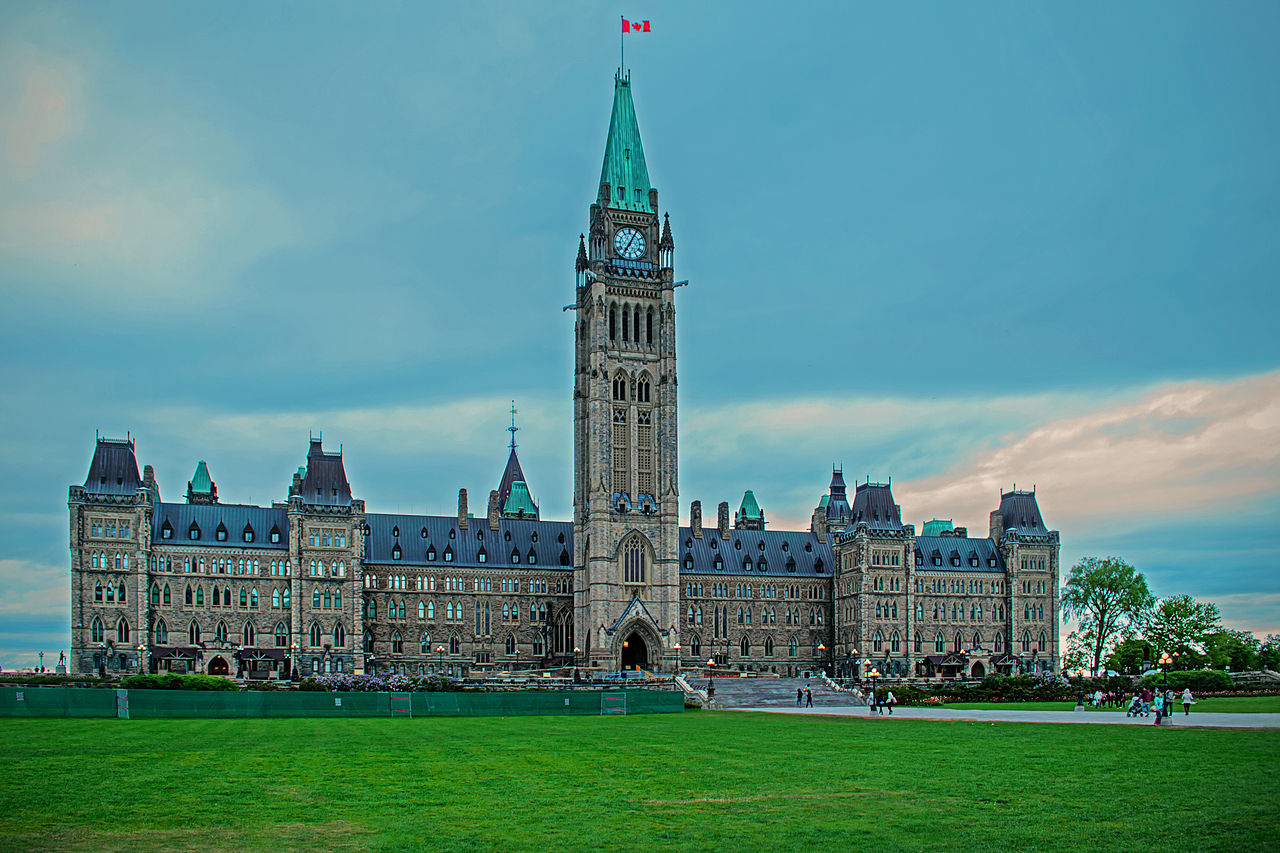
Centre Block on Parliament Hill in Ottawa.
Photo by S Nameirakpam via Wikimedia Commons.

… nobody seems to know much of anything about the project: not only how long it will take (Public Services and Procurement has already begun backing away from the original 10-year estimate for completion), but how much it will cost (just to move the Commons and Senate into their temporary digs in the West Block and Government Conference Centre, respectively, is estimated to cost over $1 billion; there are no cost estimates as yet for the renovation itself), or even what exactly it entails.

The building itself, constructed in 1916-27 after a fire destroyed the original, is part of the mystery: no one knows quite how it was built, or what went into it. Officials explain they will have to get in and gut the place before they can assess what needs to be done to restore it, let alone update it with such mod cons as air conditioning or Wi-Fi. But part of it is, as usual, a problem of governance. Responsibility for the project seems to have been assumed to be a matter between bureaucrats at Public Services and the House of Commons, who took it upon themselves to make decisions on project design, cost etc with little to no input from those affected: MPs, Senators, or staff, let alone the public who will have to pay for it all.

Not only has there been no consultation, there is no body formally tasked with conducting it: when the Commons Procedure and House Affairs Committee temporarily assigned itself the role last week, it was very much stepping into a void. Like the renovation itself, the oversight process gives every appearance of being improvised on the fly.

It’s all a little too symbolic: the renovation of the “people’s house,” the home of our democracy, is proceeding with no budget, no timetable, no plan and only the most rudimentary democratic oversight. The one consolation is that it is likely to get far worse.

Assuming MPs now get their hooks into it, and pouring through the breech after them every interest group and activist organization in the country, the whole thing is likely to devolve into the same chaotic tangle of cross-purposes that is the fate of every other attempt at large-scale collective enterprise in this country — Trans Mountain meets the Meech Lake Accord. There are children not yet born, I’d wager, who will be voting in their first election before this is completed, at a cost of God knows how many billions.

December 13, 2018

QotD: The Cabinet

Filed under: Britain, Government, Humour, Politics, Quotations — Tags: — Nicholas @ 01:00

[T]here is a clear similarity between the Prime Minister’s cabinet and the wardrobe/closet from the Narnia Chronicles: neither has any back to it and people who spend an excessive amount of time in either find themselves in a fantasy land.

Eric Kirkland, 2005-03-24.

November 30, 2018

England: South Sea Bubble – Lies – Extra History

Filed under: Americas, Britain, Business, Economics, Government, History — Tags: , , , , — Nicholas @ 02:00

Extra Credits
Published on 9 May 2015

Support us on Patreon! http://bit.ly/EHPatreon
____________

No historian is perfect, so it’s important we acknowledge our mistakes where we find them (with the help of our viewers, no less)! After we clear up some discrepancies that emerged during the South Sea Bubble series, we turn to answering some common questions that came up during this series on economic history. In a period where financial masterminds like John Blunt engaged in trickery meant to confuse other people and hide his real activities, it’s no wonder that many viewers had questions about what insider trading is and how Blunt could endlessly inflate stock prices for his unprofitable company. This is a history show, but we do our best to explain! As a bonus, James also reads Robert Knight’s letter to Parliament on the eve of his illegal flight and tells some cool stories about Robert “It was Me” Walpole.

« Newer PostsOlder Posts »

Powered by WordPress