Quotulatiousness

November 29, 2018

England: South Sea Bubble – It Was Walpole – Extra History – #5

Extra Credits
Published on 25 Apr 2015

Support us on Patreon! http://bit.ly/EHPatreon
____________

Robert Walpole’s attempts to use the South Sea Company scandal to enhance his own ambitions are threatened by the appearance of Robert Knight, a former South Sea employee whose records of corporate bribery implicate Walpole and his friends in Parliament. But faced with threats of retribution if he ever shares these records, Knight flees the country rather than face a public inquiry. Although he gets caught and sent to prison in Antwerp, Walpole deftly engineers his release and escape. With Knight finally gone, Walpole teams up with John Blunt to pin the blame for the South Sea stock bubble on his political opponents, conveniently clearing the way for himself to become essentially the first Prime Minister of England. He also makes sure that all of his own supporters get off easy (if not scot free) for their involvement, and even Blunt walks away from the South Sea Bubble with more money than he started with.

November 28, 2018

England: South Sea Bubble – The Bubble Pops – Extra History – #4

Filed under: Americas, Britain, Business, Economics, Government, History — Tags: , , , , — Nicholas @ 02:00

Extra Credits
Published on 11 Apr 2015

Support us on Patreon! http://bit.ly/EHPatreon
____________

With the South Sea Company’s value dangerously inflated, Blunt drives one more scheme to raise stock prices – and it finally backfires on him. Early investors (including the famous politician Robert Walpole) seize the opportunity to sell their stock while the value is high, and the general public finally realizes that the South Sea Company has no actual worth. Everyone who didn’t sell their stock in the first round finds themselves suddenly bankrupt as the stock value plummets. Even King George, on vacation when disaster strikes, loses a large amount of the royal fortune. Robert Walpole, however, sees this as an opportunity to make himself a hero of the public. Hiding his own involvement in the South Sea Swindle, he cancels all debts owed for the company’s stock to help put its public investors back on their feet. Despite this, the public demands an inquiry and Walpole must walk a thin line between his facade as defender of the people and the reality of his, his party, and the King’s blatant corruption.

November 27, 2018

England: South Sea Bubble – Buying Out Britain – Extra History – #3

Filed under: Americas, Britain, Business, Economics, Government, History — Tags: , , , — Nicholas @ 02:00

Extra Credits
Published on 28 Mar 2015

Support us on Patreon! http://bit.ly/EHPatreon
____________

The time has come for Blunt to enact the final act of his scheme: taking on the 31 million pound British debt. When Parliament initially balks at transferring responsibility for that much money to Blunt’s insolvent South Sea Company, he bribes them with special deals on his own stock. Despite a legal clause that should have locked the stock price until the company began paying off the debt, Blunt keeps introducing new plans to inflate the stock price and pocket the money for himself. He does everything from selling stocks on layaway to loaning people money so they could buy more stocks from him, creating an artificial demand for South Sea Company stock that drives the company’s worth up to 300 million pounds: a staggering ten times the initial value of the already stunning debt it had assumed. His success, founded entirely on speculation with no actual revenue from trade, not only starves out other businesses across Britain but exceeds the total amount of money in the country’s entire economy. This bubble can not last.

November 5, 2018

Who Was Guy Fawkes? – Anglophenia Ep 18

Filed under: Britain, History, Religion — Tags: , , , , , , — Nicholas @ 02:00

Anglophenia
Published on 5 Nov 2014

Remember, remember the 5th of November: Guy Fawkes is one of Britain’s most infamous figures. Who’s the man behind the mask made famous by V For Vendetta and the protest group Anonymous? Siobhan Thompson explains.

September 27, 2018

“Oops” indeed!

Filed under: Asia, Cancon, Politics, Religion — Tags: , , , , — Nicholas @ 06:00

Colby Cosh has a bit of good-natured fun-poking at the great and the good of the Canadian Establishment as an honorary Canadian turns out to be presiding over something that might be described as genocide:

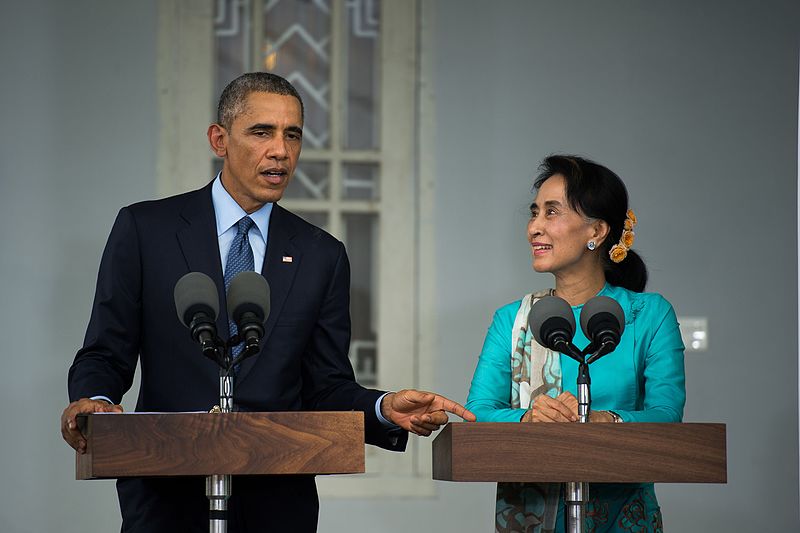
President Barack Obama and Aung San Suu Kyi in 2014
Photo via Wikimedia Commons

Sometimes I am convinced that Canada is a name that will endure through the ages and travel with mankind throughout the galaxy. Sometimes I am convinced that we should be considered exclusively as a subject for absurdist fairy tales, a real-life Ruritania or Grand Fenwick. I guess it goes about 50-50. But I am afraid the emerging controversy over Aung San Suu Kyi’s honorary Canadian citizenship puts us firmly in kooky Zembla territory.

The present State Counsellor of Burma was the fourth person ever to receive this distinction. Now we are talking about withdrawing her honorary citizenship because, as first minister of Burma, she has been heavily implicated in massacres and ethnic cleansing of the Muslim Rohingya people of the country’s Rakhine state.

One in four: not such a great batting average, is it? Our political class devised the highest and most permanent form of honour that could be envisioned for a foreign do-gooder, and literally the fourth person on the entire surface of the planet who was deemed to have met the criteria went and became CEO of a genocide. What does this suggest about the collective judgment of Canada’s elite? You don’t suppose anyone is going to lose a job over this, do you?

[…]

Our prime minister is now spitballing the idea of having Aung San Suu Kyi’s honorary citizenship withdrawn, and one supposes that if this might help save innocent lives, it ought to be considered, even at the price of turning this concocted showpiece institution of “honorary citizenship” into garbage. One of the essential meanings of citizenship is that it cannot be withdrawn, even with due process, even when a citizen has perpetrated unspeakable crimes. “Honorary citizenship” does not confer the legal rights of the real thing, but surely it is at least supposed to resemble the real thing — to represent a commitment of analogous significance and irreversibility as that which we enter into with immigrants taking the oath and joining the club over at the courthouse.

Since honorary citizenship is not conferred by Parliament, it is not clear that it could be revoked by Parliament. Probably an Order-in-Council would do (because, again, no enforceable rights are at stake). If this is done in the case of Aung San Suu Kyi, it seems obvious that we should just put the institution in abeyance for a century or so. Let later generations see if they can manage not to screw up this honorary citizenship thing so thoroughly.

September 26, 2018

The last British carriers before the Queen Elizabeth class

Filed under: Britain, History, Military — Tags: , , , , , , — Nicholas @ 06:00

This is a long, long thread from @EngageStrategy, so I’m putting it below the fold for those who aren’t interested and don’t want to scroll down for hours…

It covers the near-death experience of British carriers in the 1960s (the cancellation of the last fleet carriers), the odd evolution of the “through deck command cruisers” (Invincible, Illustrious, and Ark Royal), the development of the Harrier, and the very near-run thing that was the carriers’ share of combat duty during the Falklands War.

(more…)

September 18, 2018

A case to keep Theresa May in power … at least until March, 2019

Filed under: Britain, Europe, Politics — Tags: , , , , , , — Nicholas @ 03:00

Sean Gabb offers about the only possible justification for the British Tories to keep Theresa May on as Prime Minister:

Let us imagine that there is a vote of no-confidence in Mrs May as Leader of the Conservative Party. Let us imagine what is not certain — that someone more committed to leaving then becomes the Prime Minister. We can suppose that Anna Soubry and Damian Green will resign the Conservative whip — they and perhaps several dozen others of their kind. They are held from doing this at the moment because the ghostly electoral mandate Mrs May has gives them no excuse for splitting. A new Prime Minister without any mandate would give them their excuse. This would leave the Government with no majority. But there is worse.

Between a third and half the Parliamentary Labour Party would like an excuse to peel away and form a new party. So far, they have not found this excuse. A Conservative split would be their excuse. I can imagine a “centrist” block of 150 Members in the House of Commons. Add the Scottish Nationalists and the Liberal Democrats — that would be enough to form a new coalition government. Whether this new government then called a second referendum or found some less honest method, there would be no departure of any kind from the European Union. And, thanks to the Fixed Term Parliaments Act, they would keep their seats until 2022. After that, they could look forward to a shower of corporate sinecures.

Bearing this in mind, I call on the Conservative leavers not to allow a vote of no-confidence in Mrs May. Instead, let them focus on making it impossible for the Government we have to offer new concessions to the European negotiators. I call on the relevant Jewish organisations to keep up their pressure on the Labour leadership — but not to try for any killing blow. They can have Mr Corbyn’s head on a plate after next March. In short, I pray for no change in any direction in British politics until after we have left the European Union. Then, we can have blood on the moon — the more, the better. Until then, let the May Government continue shuffling towards departure on whatever terms they can get or want to get.

September 11, 2018

How the Media and Literati Class Determines the Politics of a Nation

Filed under: Britain, Government, Humour — Tags: , , — Nicholas @ 02:00

rubatirabbit
Published on 15 Oct 2016

From Yes Prime Minister S02E05 Power To The People

The prime minister intends to introduce a professor’s scheme for enacting bottom-up government. The civil service and reformists reacts to this scheme.

August 26, 2018

Australia’s most recent (as of Saturday) spill

Filed under: Australia, Politics — Tags: , , — Nicholas @ 05:00

Mark Steyn on the rather different and abrupt Australian method of defenestrating the sitting Prime Minister:

If you saw me on stage for our live show from the Manning Conference in Ottawa last year, you’ll know I was doing a lot of Canadian sesquicentennial gags that day: “It’s a hundred and fifty years since the Tory leadership race began…” and so forth. That was a very slight exaggeration, but it is a fact that the post-Harper Conservative Party decided to have a multi-year campaign to succeed him. In Australia, by contrast, a leadership race in the (supposedly) right-of-center Liberal Party lasts 150 seconds, if you’re lucky. They’re called “spills”, which is not a reference to the blood on the floor but is an Aussie coinage of at least three quarters of a century’s vintage for a suddenly called election: Like many of the Lucky Country’s contributions to the language, it’s very good, conveying the sense not of an ordered poll but of something more spasmodic, capricious and convulsive.

Don’t ask me why the two senior dominions of the Westminster system wound up with diametrically opposed systems of selecting their leaders.

New Australian Prime Minister Scott Morrison (photo from January 2014).
Via Wikimedia Commons.

Their chums in the UK Tories have much calmer contests in which all the alternative candidates self-destruct leaving Theresa May to inherit by default. The former Foreign Secretary, William Hague, has just said he doesn’t think increasing the party membership (I believe there are still seven nonagenarian paying subscribers) is the answer because a lot of beastly UKIP types might sign up and there goes the neighborhood. Given the results of these various contests, you might as well shuffle the winners and systems randomly between the three countries and see if you could do any worse.

At any rate, on Friday the latest Canberra spillage broke out and kiboshed the PM, Malcolm Turnbull. Unlike the American three-month “peaceful transfer of power”, under which the Deep State has all the time in the world to set up its plans to subvert the incoming leader, in the Australian system the new bloke has twenty minutes to freshen up in the men’s room before he’s sworn in […]

Malcolm Turnbull is Australia’s most famous republican, so he’ll appreciate Oliver Cromwell’s famous words to the Rump Parliament in 1653:

    You have sat too long for any good you have been doing lately. Depart, I say; and let us have done with you. In the name of God, go!

It’s remarkable how long it took Turnbull’s Rump to say as much to him. I wrote yesterday that, just as Tony Abbott had been toppled by Malcolm Turnbull, so Turnbull has now been toppled by Scott Morrison. And immediately a gazillion antipodean members of The Mark Steyn Club wrote to explain that no, no, Turnbull was toppled by Peter Dutton, the conservative who moved against him, but, before he could ascend the drive-thru throne, Dutton was himself toppled by Morrison, who was a so-called compromise candidate put up by frantic Turnbullites as they were being fitted for their lamppost ropes. So, if you’ll forgive the analogy, if Turnbull is Mrs Thatcher, Scott Morrison is the John Major put up to ward off Peter Dutton’s Michael Heseltine. My old pal Julie Bishop, meanwhile, after years of serving as loyal deputy to Malcolm Turnbull, Tony Abbott, Malcolm Turnbull (first time round), Brendan Nelson, Andrew Peacock, Malcolm Fraser, Sir William McMahon, Harold Holt, Sir Robert Menzies, etc, etc, finally ran for the leadership herself, and came a poor third: She had become the Black Widow of the Liberal Party – she mates, she kills – but this time it all went awry and she shot the venom into her own leg. It’s hard to remember that in some polls of 2015, when she agreed to support Turnbull’s overthrow of Abbott, she was more popular than either man. A mere three years on from what was supposed to be a swift cleansing knife in the back, the entire party is gangrenous and pustulating.

August 17, 2018

Thomas Clarkson: The First Abolitionist

Filed under: Africa, Britain, History, Liberty — Tags: , — Nicholas @ 02:00

Foundation for Economic Education
Published on 26 Jul 2018

The brutal and cruel transatlantic slave trade lasted for more than 300 hundred years. In 1785, Thomas Clarkson, a man you’ve probably never heard of, firmly held to his belief that no man can rightly claim ownership over another. That year he vowed to end the transatlantic slave trade. This is his story.

August 1, 2018

British Labour Party continues to sideline pro-Brexit MPs

Filed under: Britain, Europe, Politics — Tags: , , , , , , — Nicholas @ 05:00

Fraser Myers on the most recent pro-Brexit Labour MP deselected by local party activists:

Labour Party activists have passed votes of no confidence in two of Labour’s Brexit-backing MPs, and called for their deselection. Frank Field and Kate Hoey were censured by their local parties for voting with the government against an amendment that would have kept the UK in a customs union with the EU after Brexit. If passed, it would have killed off any prospect of Britain having an independent trade policy after Brexit, and would have kept us under the jurisdiction of the European Court of Justice. Recognising this as a betrayal of the Leave vote, Labour Brexiteers had no other choice but to vote with the government to defeat the amendment. Now, for defending the democratic choice of 17.4million voters, Field and Hoey stand accused of ‘betraying’ the Labour movement and ‘siding with the reactionary Tory establishment’.

This sends a disastrous message to voters and pits Labour against the Leave vote, the largest democratic mandate in British history. Labour’s better-than-expected result at the 2017 General Election depended on retaining Brexit-voting seats. Two thirds of Labour MPs represent Leave-backing constituencies, with some of the largest Leave votes in Labour-held seats. Labour needs to win 64 seats at the next election to form a majority government, 42 of which are dotted around blue-collar, Leave-voting England. To attack the few Labour MPs who are on the side of the Leave majority is an astonishing act of self-harm for a party that claims to represent ordinary people.

While some Blairite MPs have long feared the prospect of deselection campaigns launched by the Corbyn-backing Momentum, the no-confidence motion against Kate Hoey was initiated by members of the Blairite pressure group, Progress. And rather than stand up for Hoey, a defender of Corbyn’s leadership, Momentum sided with its erstwhile rivals against the Brexiteer MP. As Owen Jones revealingly writes in the Guardian: ‘Self-professed Blairites, soft lefties and Corbynites were united in this vote.’ While the Blairite and Corbynite wings of the party claim to agree on very little, they appear to be united in their contempt for the electorate and for democracy.

These activists seem to forget that Labour has a long history of Euroscepticism. Labour’s much-celebrated postwar prime minister, Clement Attlee, and the architect of the NHS, Nye Bevan, were against Britain joining the EU’s predecessor, the European Economic Community (EEC). When the left-winger Michael Foot led Labour into the 1983 General Election, the party’s manifesto pledged to withdraw Britain from the EEC. Tony Benn – Corbyn’s hero – opposed the anti-democratic tendencies of the EU all his life. Would Benn, Foot and Bevan face a similar fate to Hoey and Field in Labour today?

July 20, 2018

“Trudeau becomes the first prime minister I’ve ever covered who has demoted himself”

Filed under: Cancon, Politics — Tags: , , — Nicholas @ 05:00

In Maclean’s, Paul Wells analyzes Prime Minister Justin Trudeau’s recent federal cabinet shuffle:

So much has changed, culminating — for now — with the burial of Ontario provincial Liberalism at the hands of Doug Ford. Alberta and Quebec could next fall to Jason Kenney and François Legault. Certainly that’s the way to bet it. Even normally sunshiny New Brunswick, Newfoundland and PEI are refusing to file carbon reduction plans in line with what Catherine McKenna expects.

So the cabinet Trudeau shuffled on Wednesday isn’t a pre-election cabinet, in the sense of one that’s sweet and shiny to attract distracted voters, so much as it’s a survive-until-the-election cabinet. If this cabinet were a movie, it’d be Walter Hill’s 1979 classic The Warriors. A bunch of street fighters, just trying to make it from the Bronx to Brooklyn in one piece. Doug Ford calling to them from an abandoned car, clinking empty bottles together. Or to use another, perhaps less obscure, movie analogy, it’s farewell to Hope and Hard Work, hello to Horse’s Head/ In Your Bed.

The stars of this partially-refurbished cabinet are two bad cops, in one case quite literally: Bill Blair and Dominic LeBlanc. Blair’s job on the border-crossing file isn’t only to get up Doug Ford’s nose, though that’s a handy bonus. It’s to do more or less what he did as the Liberals’ back-bench pilot of cannabis legalization: to steward a controversial file as humourlessly as humanly possible, to convey with every flinty word and steely grimace that the government is not even remotely interested in messing around.

It’s interesting that Ahmed Hussen, a personable and diligent minister who was also obviously appointed so he could incarnate Liberal branding of openness and diversity, keeps every part of the immigration file except those elements that scare some voters: the people walking across the border. Those parts have been assigned to Sgt. Rock over here.

LeBlanc, an irrepressible rogue whose dad was Pierre Trudeau’s fisheries minister and who has known Justin Trudeau all his life, is not by nature a political bone-crusher, although that’s certainly within his vocabulary. He doesn’t even like when people like me emphasize that part of his personality. He will prefer to get along. But he has the job Trudeau had because Trudeau noticed that, even though his intergovernmental minister was Justin Trudeau, the intergovernmental mood out there was getting noticeably chippy. So Trudeau stripped Trudeau of that portfolio and handed it to someone who could concentrate on it. It’s traditional to view a smaller ministerial portfolio as evidence of a demotion. Trudeau becomes the first prime minister I’ve ever covered who has demoted himself.

May 18, 2018

Missing the entire point of the capitalist system

Filed under: Britain, Business, Economics — Tags: , , , — Nicholas @ 03:00

At the Continental Telegraph, Tim Worstall tried to explain why the UK Commons committee looking into the Carillion collapse appear to misunderstand the current economic system in a big way:

Frank Field and his mates on the Commons work and pensions committee really do have some ‘splainin’ to do here. For they’ve entirely missed the structure of our current society and the reasons why that structure both exists and works. They go on about the greed at Carillion, the corporate vanity, the bad management. Then they complain that it’s gone bust. Finally, that we need a management system to prevent corporate greed and vanity from bankrupting companies.

No you fools, that Carillion went bust is the very point and purpose of the system. This is how we leach corporate vanity and greed out of the system, those who practise it leave the system.

[…]

What’s being missed is that this is good. Not the greed, obviously, for that’s something ever present in human nature. But what happens to those who act it out, bankruptcy.

[…]

And haven’t they come up with a likely candidate for making things worse? That a committee of bureaucrats should be making commercial decisions for companies instead of the directors and management. Really, that’ll work wonders, won’t it?

[…]

People who screw up, for whatever reason, disappear from the economic stage. Which is what we want of course, those who screw up to leave said economic stage. We have actually tried bureaucracy as a method of managing this and as the persistence of the National Coal Board, the very existence of British Leyland, show, that’s a system which doesn’t work. Either of those organisations would have disappeared at least a decade before they did without bureaucratic interference. Indeed, that’s how the bureaucracy’s actions were justified, to “save” them. That is, markets are more ruthless at weeding out failures than bureaucracies are.

What have we here? A complaint that markets weeded out a failure and to stop this we must have bureaucracy?

Carillion going bust is the very point of our having a market based economic system. Sure, they screwed up – bye bye Carillion. See, it works!

So why the hell are Frank Field and friends complaining? We already have a system which ensures that failures go kablooie – bankruptcy in our market economy.

May 9, 2018

Freedom of the Press … except where prohibited by (British) law

Filed under: Britain, Law, Liberty — Tags: , , , , — Nicholas @ 03:00

Wednesday is a critical day in the history of Britain, in the sense that a long-established freedom is at risk of being curtailed:

Press freedom is hanging by a thread in Britain. Tomorrow, the House of Commons will vote on the Data Protection Bill, and Labour MPs have added amendments to it that would effectively end 300 years of press freedom in this country.

That this profound affront to liberty had almost passed under the radar, until spiked and others began making noise about it over the weekend, shouldn’t surprise us. This vote is the culmination of a slow and covert war on the press that has been waged for the best part of a decade.

This story begins with the Leveson Inquiry, an effective showtrial of the press that sparked dozens of spurious trials of journalists and barely any convictions. Since then, press-regulation campaigners have had to find new and underhand ways to push their agenda on an industry and a public who clearly see right through it.

In the wake of Leveson, a new regulator, Impress, was established and given official recognition. It was an historic moment, in the worst possible sense: this was Britain’s first state-backed regulator since the days of Crown licensing. But it was also a stunningly bad bit of PR for the press-regulation lobby, in that Impress was staffed by tabloid-loathing hackademics and funded by tabloid-loathing millionaire Max Mosley.

No national newspaper signed up to it. And so the Hacked Off brigade has been pushing over the past few years for Section 40, a law that would force publications to sign up to a state-approved regulator, which at the moment means signing up to Impress. Those publications, like spiked, who would refuse on principle, would be required to pay the legal costs of any case brought against them, even if they win.

As such, Section 40 would be a gift to the powerful and the begrudged. It would enable anyone to launch lawsuits aimed at shutting down publications they dislike. This is an opportunity that people who have been exposed by the press would take in a heartbeat. It would undermine not only press freedom, but also natural justice.

And it isn’t just the press who are concerned about this. In 2016, the government opened a public consultation into press freedom, asking members of the public if it should implement Section 40 and commence the second part of the Leveson Inquiry. Out of a huge 174,730 responses, 79 per cent said No to Section 40 and 66 per cent said No to Leveson 2.

Update, 10 May: The vote was too damned close, but it was defeated by a nine-vote margin. Guido has the list of MPs voting in favour of muzzling the press here.

April 3, 2018

Governments are like diapers – they need to be changed regularly and for the same reason

Paraphrasing an old joke in the headline, but as Andrew Coyne points out, it’s close enough to observed federal reality to qualify:

Is it inevitable that every government becomes what it once despised — a matter of the realities of power overtaking the dreams of opposition? Or do their broken promises, ethical lapses and abuses of power remain, in the end, choices, for which they can be held to account? Do governments turn to seed, or were they that way before they took office? Or is the problem not of any particular party at any particular time, but of a larger culture of cynicism and deceit, in which all parties share?

I do not know the answers to these questions. I only see the same pattern repeated in every government over the last several decades. The Mulroney government came to power promising to clean up the sodden mess left by the Trudeau Liberals (“you had an option, sir — you could have said no!”), only to indulge in its own orgy of patronage appointments and dubious ethics.

The Chretien Liberals were elected to clean up the mess left by the Mulroney Conservatives. Instead they ramped up a massive kickback scheme overseen by a parallel government of party officials and Liberal-friendly advertising executives — to say nothing of their shameless pork-barreling, habitual disdain for Parliament or the prime minister’s personal portfolio of shame.

The Harper government ran and won on a promise to break this pattern, even including the passage of a Federal Accountability Act among their “five priorities.” In power, they invented whole new ways to evade accountability and step on Parliament, while going back on nearly every principle they had ever held or promise they had ever made. Unsurprisingly, compromises on principle ended up begetting compromises on ethics, if only because, in the blur, people forgot which was which.

And now the Trudeau Liberals, again, dynastic succession being the surest sign of the democratic health of a polity. But then, Trudeau fils went to unusual lengths to stress how different he was, not only from his father but from pretty much every leader who went before.

« Newer PostsOlder Posts »

Powered by WordPress