Quotulatiousness

September 27, 2019

England’s constitution before the shiny new Supreme Court was created

Filed under: Britain, History, Law, USA — Tags: , , , , , — Nicholas @ 05:00

Peter Hitchins provides a thumbnail sketch of the state of play before the Supreme Court was added to British constitutional arrangements:

Why did we never even have such a body until ten years ago? As we shall see, it would have been, and still is, a contradiction in terms. But in interesting times such as these, elephants fly, fishes walk, figs grow on thorns, and oxymorons inherit the earth.

The most powerful law court in the land was, by a curious paradox, not in the land at all, but based in tiny Luxembourg, across the Narrow Seas which have kept invaders from our door but are useless against bureaucratic takeovers by the European Union. There sits the European Court of Justice, which as long ago as 1990 established that it could tell British courts to overrule British Acts of Parliament when they conflict with E.U. law. It can carry on doing this until we eventually do leave the E.U., if we ever do.

These various messes came about because we are so old, and rely so much on convention and manners, that it is all too easy for unconventional and ill-mannered busybodies to come storming in with new ideas. England’s constitution was not planned and built, like America’s. Instead, it grew during a thousand years of freedom from invasion. Both are beautiful in their way. America’s fundamental law has the cold, orderly beauty of a classical temple. England’s has the warmer, more chaotic loveliness of an ancient forest. It seems to be wholly natural but, when examined closely, it shows many signs of careful cultivation and pruning. Our powers are not as separated as America’s, but slightly tangled. Still, it has worked well enough for us over time.

Any thinking person must admire both the American and the English constitutions as serious efforts in a world of chaos, despotism, and stupidity to apply human intelligence to the task of giving people ordered, peaceful, and free lives. They have a common origin in the miraculous Magna Carta, which Americans often revere more than modern Englishmen do. We in England have grown complacent about our liberty, and have become inclined to forget our great founding documents.

But the two constitutions are not the same, and in my view they are not compatible. For my whole life, until a few years ago, the very idea that England should have a Supreme Court was an absurdity. The Highest Court in England is the Crown in Parliament which, as I was once taught, had the power to do everything except turn a man into a woman. In these more gender-fluid times, that expression is not much used. But it contains the truth. Parliament can make any law and overturn any law, made by itself or by the courts.

That is why England (often to my regret) lacks a First Amendment and cannot have one unless we undergo a revolution. No law in England could possibly open with the words “Parliament shall make no law.” Our 1689 Bill of Rights, the model for the U.S. Bill of Rights a century later, tells the king what he cannot do and the courts what they cannot do. It grants me (as a Protestant) the right to have weapons for my defense. But while it draws its sword against arbitrary power, it puts a protective arm round Parliament.

September 19, 2019

QotD: Parliament and democracy

Filed under: Britain, Government, History, Politics, Quotations — Tags: , , , , — Nicholas @ 01:00

In legal theory, the members of the Commons are representatives and they have the role that was enunciated in the famous letter to the electors of Bristol by Edmund Burke. “I owe you my discretion; I don’t merely owe you my vote.” That was nearly 250 years ago when there was no democracy and politics was run by a handful of families like the Marquess of Rockingham to whom he was the paid lackey (and by the way the electors of Bristol threw him out). There is a very vague relationship between Parliament and democracy. We have had Parliament for 800 years. We’ve had democracy for less than a century. And the great issue was: how do you reconcile the previous tradition of representative in a non-democratic Parliament with the position of delegate in a democratic Parliament. And the way it was dealt with — this is what all the fuss, all the things that we are talking about: Erskine May, A V Dicey, they all appear at a particular moment of time. They appear in the middle of the 1880s because it’s the 1884 reform act that introduces something like democracy.

But you see we’ve never worked out the relationship between the fact that we’ve got two sovereigns. There is the legal sovereign which is the Crown in Parliament and there is the real, political sovereign which is the sovereign people behind them. But what we did, and this is why Bercow’s behaviour is so disastrous; it’s why Theresa May’s behaviour has been so catastrophic: what we developed thanks to Erskine May and the Parliamentary Handbook and endorsed by Dicey, we developed a whole series of devices. They were conventions that turned MPs from more or less representatives into more or less delegates. And what are these things? They’re party affiliation. They are manifestos. They’re standing on a ticket and they’re being whipped when they’re in the house. That is the thing that binds them to the popular vote. No MP; Dominic Grieve was not elected in a personal capacity. He was elected because he stood as a Tory on a Tory manifesto which promised Brexit. That man did not dissent at the time. His claims to dignity, his claims to acting honourably, are totally false.

There are other rules in Erskine May about the procedures of Commons business which gives the government the basic control of the parliamentary timetable. Otherwise what happens is the house just dissolves into a talking shop. Becuase MPs have refused to vote for any deal: they’re strong in the negative but they’re hopelessly weak in the positive. They can’t agree on anything. We developed a series of conventions in the 1880s that turn MPs into something like the representatives of the people and what has systematically happened in this Parliament: we have broken those conventions.

Theresa May’s loss of the election and her absurd notion that you can keep people with completely contradictory opinions on a main platform of government policy in the same party broke down the whipping system. Bercow broke down the government’s control of legislation. And you’re left with this chaotic mess.

David Starkey talking to Brendan O’Neill on the Brendan O’Neill Show, 2019-09-15. (Transcription from The Great Realignment)

September 13, 2019

NDP leader Jagmeet Singh gets his tax plans vetted by the Parliamentary Budget Office

Filed under: Cancon, Economics, Politics — Tags: , , , , , — Nicholas @ 03:00

A recent innovation for political campaigns is that they can ask the Parliamentary Budget Office to provide an estimate for the impact of any taxation proposals, and NDP leader Jagmeet Singh was the first out of the gate to have his “super-wealth tax” evaluated. The PBO estimates that the levy would net out some $6 billion in the first full year of implementation. Sounds like a lot of money! Colby Cosh explains why it’s not quite what it might seem:

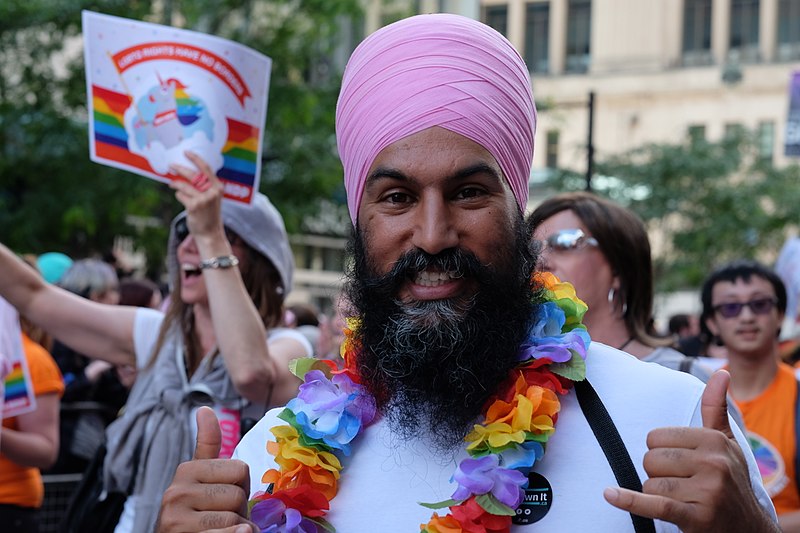
Federal NDP leader Jagmeet Singh taking part in a Pride Parade in June 2017 (during the leadership campaign).
Photo via Wikimedia.

Alas, the bean-counters always swoop in to spoil things. Singh’s wealth-tax scheme is instructive not only because he availed himself of PBO costing, but because it usefully reveals the limits of what the PBO or any other economic modeller can do. Look, in other words, at the fine print.

The PBO’s job was to estimate what you can extract from “an annual net wealth tax on Canadian resident economic families equal to one per cent of net wealth above $20 million.” In the PBO model this is a simple multiplication, but the roughly $6 billion take is arrived at only by reducing the revenue by 35 per cent to correct for “behavioural response” — that is, lawful (and unlawful) tricks employed to avoid the new tax by the rich targets. The net revenue is what’s left after you deduct another two per cent to cover administrative costs.

And, as the PBO immediately insists, “the estimate has high uncertainty” on both counts. This means they’re educated guesses. Jennifer Robson, a social policy prof at Carleton University’s Arthur Kroeger College, pointed out on Twitter that right now we don’t tax economic families per se and we don’t report assets and debts routinely to Revenue Canada. Ideas for pure wealth taxation (which is rare in practice) are predicated on the creation of, essentially, a new tax system — one which would have to detect and perpetually update how much, for example, the furniture in your house costs. The 35 per cent loss from behavioural response is at the high end of historic estimates from real-world examples. Even within our current tax system, Robson observes, we only get two extra dollars for every one we spend on expanding collections and compliance against the existing tax base.

As a practical matter, a wealth tax would mostly be, or would act most efficiently as, a tax on bank balances and investment accounts. Of course, there is always real estate. The super-rich seem to have a lot of that, and it is relatively easy to tax, and the resentment of Torontonians and Vancouverites who don’t own some is, for better or worse, a major reason the NDP is trying to weaponize envy.

But this reminds us that property taxes and taxes on property transfers perform a similar function, although they are not used primarily for income redistribution as such here — and in Canada ours are relatively high. The OECD does a little league table of tax structures, and compared with other industrialized countries Canada’s take from property taxes is about double the average. In a 36-country list we are near the bottom (33rd) in our dependence on taxing goods and services, and about average (12th) in dependence on corporate taxation, but fifth highest in dependence on personal taxation — and third in dependence on property taxes.

September 8, 2019

Boris may have a viable escape hatch after all

Filed under: Britain, Government, Law, Politics — Tags: , , , , — Nicholas @ 05:00

It could not only untangle the current mess in Parliament but have the almost equally attractive feature of sending his opponents into paroxysms of rage:

The consensus is that the Government is trapped in an iron vice that will now be tightened till it cracks. The truth, however, is that this vice is less of iron than of hot air.

The Civil Contingencies Act 2004 is a constitutional outrage. It allows a government to declare an emergency, and then to rule by decree. It should never have been made. But it was made; and it can now be used as an instrument of liberation.

The Act defines “emergency” as just about anything the authorities may dislike. One possible definition is “an event or situation which threatens serious damage to human welfare in a place in the United Kingdom.” (s.1(1)) This sounds a promising excuse. It seems to cover what the Opposition claims would be the effect of a No-Deal Brexit.

Triggering the Act requires no more than “a senior Minister of the Crown” – that is, Boris Johnson – to announce an Emergency. This done, he can make, alter or suspend almost any law he likes. (s.22) He can do this for a period of thirty days. (s.26) All he has to do is preface his decree with a statement that he “is satisfied that the regulations contain only provision which is appropriate for the purpose of preventing, controlling or mitigating an aspect or effect of the emergency in respect of which the regulations are made.” (s.20(5)(b)(ii))

He cannot change the Act itself, or the Human Rights Act. He cannot set up concentration camps for his opponents, or put them before a firing squad. But the Fixed Term Parliament Act is fair game. He could suspend that. Then he could dissolve Parliament in the traditional way.

He must, “as soon as is reasonably practicable,” lay his decrees before Parliament. (s.27(1)(a)) No doubt, the Parliament we have would punish him with an Act of Attainder. But this Parliament would no sooner reassemble after the prorogation than it would be dissolved. The Speaker would barely have time to open his mouth. Assuming the general election went as hoped, the next Parliament would not be inclined to dispute the circumstances of its birth.

All the opposition parties would go screaming mad. But, as said, we are not talking about concentration camps and firing squads. The only use of the Emergency would be to give a voice to the people. Who could legitimately deny that? As for sharp practice in general, the opposition parties have spent this year turning the Constitution upside down. Who could complain if the Government now joined in the fun?

September 7, 2019

Mark Steyn – “So the Remainer leaves, putting a question mark over whether the Leaver can remain”

Filed under: Britain, Government, Politics — Tags: , , , , , — Nicholas @ 03:00

Despite the lovely scenery outside his cabin window … I guess that should be “porthole” … Mark Steyn still finds time to comment on the circus at Westminster:

Greetings from the Mark Steyn Cruise, currently sailing the beautiful Inside Passage of Alaska. Across the continent and an ocean, Westminster continues to be roiled by Brexiteers and Remoaners locked, like the latter seasons of Dynasty, locked in ever more demented plot twists. Today Her Majesty’s Government suffered its first resignation since Boris Johnson took over as Prime Minister. The Minister for Universities and Science quit, and is leaving Parliament. His name is Jo Johnson. Any relation? Why, yes. He’s Boris’ brother. In the normal course of events, no normal person knows who the Minister for Universities is, or indeed that such a post exists, or, if aware of this grand office, what the chap who holds it does all day long: He ain’t a heavy, he’s his brother — that’s all. But the junior Johnson, a Remainer, has walked out on the senior Johnson, a Leaver, so it’s the biggest thing since Cain fired his Secretary of State for Sheep-Herding. Boris was his brother’s keeper, but he couldn’t keep him. So the Remainer leaves, putting a question mark over whether the Leaver can remain.

~All sides are throwing around media accusations of “constitutional outrage”, ever since Boris got the Queen to prorogue Parliament and was instantly ungraded from PM to Caudillo of the new dictatorship. I am more sympathetic to the charges against his opponents: Jeremy Corbyn, Leader of Her Majesty’s Loyal Opposition, has been claiming for months to want a general election. Indeed, there is no reason not to have one. On Tuesday the Prime Minister formally lost his majority, when some Tory nobody I’d never heard of crossed the floor and became a Liberal. So Boris and his team cannot govern. Indeed, even their minority is shrinking by the hour, as he removes the whip, expels and deselects those who vote against him on Brexit.

And yet Corbyn voted down Boris’ motion for a general election — because the Opposition Leader is determined to force the Government to enact not its own but the Opposition’s policy, by making Boris go to Brussels, grovel, and beg for another extension of Britain’s zombie membership in the European Union. To put it in American terms, the legislative branch wants to maintain the executive branch in power purely as its dead-eyed sock puppet. That is certainly a constitutional abomination, and, cautious as she is in such matters, I have no doubt the Queen regards it as such.

~Why is Corbyn doing this? Isn’t an Opposition Leader supposed to bring down the Prime Minister so he can force an election and replace the bloke? Yes, but Corbyn would lose that election, and Boris would likely win. The guff about the will of Parliament and the people’s representatives obscures the reality — that this situation exists because of the ever wider chasm between the people and their representatives, between a citizenry that voted to leave the European Union and the fanatically Remainer Liberal Democrats, openly Remainer Celtic nationalists, covertly Remainer Labour Opposition, and semi-Remainer Tory backbench all determined to subvert the will of the people. You can dress that up in all kinds of parliamentary flimflam, but, when politicians who’ve been bleating about a “people’s vote” for over a year refuse to let the people vote, you know these tribunes of the masses have gone rogue and left the masses far behind.

September 5, 2019

The “Stop the Coup” movement and the chances for a British general election

Filed under: Britain, Government, Politics — Tags: , , , — Nicholas @ 05:00

Brendan O’Neill on the recent political upheavals in the Mother of Parliaments as Boris Johnson lost his parliamentary majority and the “Stop the Coup” activists celebrate by backing away from the election they claimed they wanted all along:

The ridiculousness of the “Stop the Coup” movement is now starkly exposed. For the past week a few thousand members of the obsessively anti-Brexit urban elites have taken to the streets to accuse Boris Johnson of behaving like a dictator by suspending parliament for a few more days than is normal. “It’s a coup d’état!”, they hysterically cry. And yet now our supposed dictator, the author of this foul, anti-democratic coup, is offering people a General Election, and how have the “Stop the Coup” saps responded? By saying they don’t want one.

What a momentous self-own. They have literally traipsed through the streets saying “Britain is a dictatorship” and “Boris has stolen our democracy”. Now, Boris hasn’t only disproven this claptrap (dictators don’t usually suggest holding an election). He has also helped to expose the fact that if anyone is agitated and even disgusted by the idea of democracy right now, it isn’t the imaginary jackbooted generals of Downing Street – it’s the pseudo-democratic Remainer elite.

All of them are running scared from the idea of a General Election. Labour has made clear that it will not be backing the call for an election, at least not until No Deal Brexit has been legally taken off the table. “We are not going to dance to Boris Johnson’s tune”, said Labour’s shadow Brexit secretary Keir Starmer this morning when asked if the party would back Boris’s General Election proposal in parliament later today. An election on Boris’s terms would be a “trap” for Labour, he said.

Jo Swinson, leader of the Lib Dems, is against an election too. And her justification is very revealing indeed. In the Commons she said “It is vital that this House acts with responsibility and does not tip our country into an election at a point when there is any risk that we will crash out of the European Union during that election campaign or immediately after.” With added emphasis she declared: “We must act responsibly.”

… but not democratically. After all, elected MPs know far better what’s good for the country than the majority of Britons who voted in favour of Brexit.

August 10, 2019

Enter Yugoslavia Part 2 | BETWEEN 2 WARS I 1929 Part 3 of 3

Filed under: Europe, History — Tags: , , , , , , , — Nicholas @ 06:00

TimeGhost History
Published on 9 Aug 2019

As 1929 approaches, the Kingdom of Serbs, Croats and Slovenes spirals closer and closer to collapse. When the parliament descends into murderous chaos, it is up to King Alexander to decide what to do…

Join us on Patreon: https://www.patreon.com/TimeGhostHistory

Hosted by: Indy Neidell
Written by: Francis van Berkel and Spartacus Olsson
Directed by: Spartacus Olsson and Astrid Deinhard
Executive Producers: Bodo Rittenauer, Astrid Deinhard, Indy Neidell, Spartacus Olsson
Creative Producer: Joram Appel
Post-Production Director: Wieke Kapteijns
Research by: Francis van Berkel
Edited by: Daniel Weiss
Sound design: Make Kaminski

Archive by: Reuters/Screenocean http://www.screenocean.com

A TimeGhost chronological documentary produced by OnLion Entertainment GmbH.

From the comments:

TimeGhost History
1 hour ago
We don’t delete or ban any opinions which disagree with other opinions. We delete comments that contain historical fallacies and political propaganda by antidemocratic organisations, irrespective of political leaning. This means that we do not tolerate any lies or propaganda that forward the agenda of, for instance, Nazis, Fascists, Stalinists, Leninists, other ultra-Marxists or Anarchists. That is within our responsibility according to the laws in our territory which forbids the dissemination of false flag information, propaganda, and symbols connected to organizations that have been found to be unconstitutional and an immediate danger to a democratic, free society by the German courts, in accordance with §86 and §86a of the German Penal Code. The law specifically mentions NDSDAP in §86 and the KPD in §86a (NSDAP is the Nazi Party and KPD the Communist party). Moreover we do not tolerate hate speech, racism, xenophobia, and the denial of proven crimes against humanity. This is in perfect agreement with the opinion forwarded by The US Supreme Court on society’s responsibility to fight against that kind of speech and it is in agreement with numerous EU and EU member state laws against same said speech.

August 1, 2019

“Since I recently called [Johnson] ‘a bag of living offal,’ my view is unlikely to be positive”

Filed under: Britain, Politics — Tags: , , , , , — Nicholas @ 05:00

Sean Gabb provides a brief evaluation of new British PM Boris Johnson:

Boris Johnson, Secretary of State for Foreign and Commonwealth Affairs at an informal meeting of the Foreign Affairs Council on 15 February 2018.
Photo by Velislav Nikolov via Wikimedia Commons.

I have been asked to comment on Boris Johnson’s appointment as Leader of the Conservative Party and therefore as Prime Minister. Since I recently called him “a bag of living offal,” my view is unlikely to be positive. However, I will try to be fair. More to the point, I will try to relate this latest turn of events to my general analysis of British politics.

Last month, I wrote that membership of the European Union was a peripheral issue for our ruling class. The main agenda for this class is to carry through a neo-Puritan remodelling of our institutions, and indeed our minds. The details of a customs and regulatory union are less important than control of education, the media and the criminal law. This being said, membership is useful so far as it blurs the lines of accountability. It is also an article of belief among some elements of the Ruling Class. For this reason, the verdict of the 2016 Referendum was unwelcome. It meant a diversion of effort from the main purpose. It upset various important people. The obvious solution was to give us a minimal departure that would satisfy us, but would keep in place those elements of the European Project that really are important to the Ruling Class.

Here, I come to a digression on the nature of how we are governed. There is no cabal of evil persons directing all events and appointments from behind the scenes. This is generally not how ruling classes operate. A more realistic model can be taken from Ian Kershaw’s analysis of the National Socialist revolution in Germany. This proceeded with limited central direction. Before 1939, the leaders were concerned mostly with foreign policy, after that with fighting a big war. Instead, the revolution was decentralised. Reliable men were put in key positions and told to “work towards the Fuhrer” – that is, to act in any situation as they might imagine Hitler himself would act. The result was often administrative chaos. The benefit was that the leadership could concentrate on what it saw as the essentials, and more local knowledge could be used in the overall revolution than would otherwise have been possible.

This is largely how things work in England. Our own transformation is not driven by detailed orders from the Shadowy-Ones-on-High, but by creating a bias within every useful institution to those who are broadly in favour of the transformation. The benefit is a constrained diversity of approaches that can be presented as a genuine diversity of opinion. The disadvantage is that executive power lies in this country where it has since 1701 – that is, in the hands of the Ministers of the Crown, who are accountable to the House of Commons. If the Prime Minister turns out to be a fool, and the other ministers are too cowardly to stab him in the back, there is no easy way to remove him.

On balance, Theresa May was more stupid than malevolent. Her job was to produce the minimal departure I have mentioned. The question of who wrote her Withdrawal Agreement is less important than the fact that few who mattered wanted or dared to accept it. She should never have thought it would be accepted. Having discovered it was unacceptable, she should have tried something else. Instead, she tried four times to ram it through the House of Commons. She also reached out to a Labour leader who is feared or just hated by important strands within the Ruling Class. At first, the damage was confined to the possibility of a Labour Government. It then widened, with the emergence of the Brexit Party, to the threat of a general delegitimisation of the system as it has emerged since 1997, or perhaps 1979.

“People in Ottawa don’t invoke PMO frequently or lightly. It is done to intimidate and obtain compliance”

Filed under: Bureaucracy, Cancon, China, Government, Politics — Tags: , , , , — Nicholas @ 03:00

What we’re not allowed to know can’t hurt us … the federal government apparently figures that no charges can be contemplated if there’s no investigation allowed:

Parliament Hill in Ottawa.
Photo by S Nameirakpam via Wikimedia Commons.

Before colleagues voted to quash a review of whether the Liberal government acted improperly after a bureaucrat asked former ambassadors to temper public comments about China, Liberal MP Rob Oliphant told Parliament’s Foreign Affairs committee that he’s “distressed”.

Apparently, he was not distressed about a Foreign Affairs assistant deputy minister being asked to “check-in” on two former Canadian diplomats to China before making future pronouncements on Canada’s shambolic relations with the communist regime.

Oliphant’s also not distressed about the troubling optics that either diplomat – David Mulroney and Guy Saint-Jacques – felt The Globe and Mail should be aware of their reservations about said interactions, which the paper reported last week.

“I am very distressed, at the tone, at the idea and at the allegations that are being cast about by members of the opposition,” Oliphant, Parliamentary Secretary to the Minister of Foreign Affairs and non-voting member, claimed at the committee’s emergency meeting Tuesday.

Oliphant’s claim comes after either diplomat says the department’s ADM Paul Thoppil told them his call was at the behest of the PMO. Both Prime Minister Justin Trudeau and Foreign Affairs Minister Chrystia Freeland have denied they directed such outreach.

Mulroney, who had earlier warned about travel to China following the detention two Canadians there in December of last year, told the Globe that Thoppil cited the “election environment” and asked him to contact the department before making future statements.

“It wasn’t, in my view, so much an offer to consult and share ideas as to ‘get with the program’. People in Ottawa don’t invoke PMO frequently or lightly. It is done to intimidate and obtain compliance,” Mulroney is quoted as saying.

Saint-Jacques told the Globe that his conversation with Thoppil differed somewhat, “But I can understand that one could come to that conclusion when they say we should speak with one voice.”

June 28, 2019

What does £1 trillion buy you?

Not much, apparently:

Tory MPs have been told by CCHQ to share this graphic boasting about their new commitment to make the UK carbon-neutral by 2050. No other major country has committed to the pledge although Theresa May is planning a desperate attempt at the G20 to talk other leaders into it. The fact that developed countries going ‘net zero’ simply means they’ll outsource all their emissions to the developing world instead seems to be completely lost on her…

The pledge will cost the UK at least £1 trillion, much of which will be borne by individuals and businesses rather than the exchequer, we don’t know the true cost as May hasn’t even done a proper Treasury analysis. Eco-fanatics love to talk about the burden this generation is placing on children and grandchildren. For a fleeting PR stunt Tory MPs are being told to boast about piling on mountains of economic harm for future generations by a leader who won’t be in office to deal with the consequences…

This is exactly the sort of virtue signalling that Justin Trudeau indulges in … I imagine he’s quite miffed that Theresa May got there first.

June 19, 2019

BOHICA! Section 13 threatens to come back to life

Filed under: Cancon, Law, Liberty — Tags: , , , , — Nicholas @ 03:00

Mark Steyn recently testified before the parliamentary Justice and Human Rights Committee recently. They carefully avoided having the video cameras turned on during his testimony and that of two other civil libertarian speakers. The committee clearly ignored everything that was said:

Lindsay Shepherd, Mark Steyn, and John Robson prepare to give testimony to the Parliamentary Justice and Human Rights Committee, June 2019.
Photo via Andrew Lawton.

“No monarch, no parliament, no government, and certainly no bureaucratic agency operating the pseudo-law of section 13 can claim jurisdiction over my right to think freely, to read freely, to speak freely and to argue freely.”

Those were the closing words of Mark Steyn’s testimony before parliamentarians on the Canadian House of Commons’ so-called justice and human rights committee just two weeks ago.

His call fell on deaf ears.

Yesterday, the justice committee tabled its report on “online hate” in Canada’s parliament.

The report laid out nine recommendations, one of which being that government should provide a “civil remedy for those who assert that their human rights have been violated under the Canadian Human Rights Act, irrespective of whether that violation happens online, in person, or in traditional print format. This remedy could take the form of reinstating the former section 13 of the Canadian Human Rights Act, or implementing a provision analogous to the previous section 13 within the Canadian Human Rights Act, which accounts for the prevalence of hatred on social media.”

Once you strip away the mumbo jumbo bureaucrat-speak in there, it means the Canadian Liberals wish not only to revive section 13 from the dead, but to give it untold powers to force social media companies to purge online speech from whomever the government deems the hatemongers du jour.

This is apparent in another recommendation, that lawmakers “establish requirements for online platforms and Internet service providers with regards to how they monitor and address incidents of hate speech, and the need to remove all posts that would constitute online hatred in a timely manner.”

Of course there’s no provided definition for what “hate speech” is in the context of this desired law. Just a promise to figure it out later.

Before section 13’s repeal under the previous Conservative government, there was a quasi-judicial body to decide if online posts were sufficiently “likely to expose a person or persons to hatred or contempt.” Those found guilty of violating this provision were slapped with a fine or gag order, while having none of the protections afforded to criminal defendants throughout the process.

This regime seems like child’s play compared to what’s proposed in this report – elimination of online speech by social media giants under the threat of government penalty. Not sure which I like better, actually: the opaque, unappealable hammer or the sham tribunal that at least pretends to give you a shot at beating the rap.

June 16, 2019

History of England – Ashes – Extra History – #4

Filed under: Britain, France, History, Military — Tags: , , , , — Nicholas @ 06:00

Extra Credits
Published on 15 Jun 2019

Bertrand du Guesclin was the hero the French needed. Focused on fortifying defenses and cities, Guesclin rebutted the advances of the Black Prince — who ended up contracting an illness that undid his iconic image of triumph and chivalry. Edward became beset by drama in the royal court, and England started to lose power…

Thanks again to David Crowther for writing AND narrating this series! https://thehistoryofengland.co.uk/pod…

Join us on Patreon! http://bit.ly/EHPatreon

June 5, 2019

Sensible proposals from the copyright review report

Filed under: Business, Cancon, Law, Liberty, Media, Technology — Tags: , , — Nicholas @ 06:00

Michael Geist summarizes the — seemingly quite sensible — recommendations from the copyright review process:

Assignments of copyrights photostat copies by mollyali (CC BY-NC 2.0) https://flic.kr/p/5JbsPE

In December 2017, the government launched its copyright review with a Parliamentary motion to send the review to the Standing Committee on Industry, Science and Technology. After months of study and hundreds of witnesses and briefs, the committee released the authoritative review with 36 recommendations [PDF] that include expanding fair dealing, a rejection of a site blocking system, and a rejection of proposals to exclude education from fair dealing where a licence is otherwise available. The report represents a near-total repudiation of the one-sided Canadian Heritage report that was tasked with studying remuneration models to assist the actual copyright review. While virtually all stakeholders will find aspects they agree or disagree with, that is the hallmark of a more balanced approach to copyright reform.

This post highlights some of the most notable recommendations in the report that are likely to serve as the starting point for any future copyright reform efforts. There is a lot here but the key takeaways on the committee recommendations:

  • expansion of fair dealing by making the current list of fair dealing purposes illustrative rather than exhaustive (the “such as” approach)
  • rejection of new limits on educational fair dealing with further study in three years
  • retention of existing Internet safe harbour rules
  • rejection of the FairPlay site blocking proposal with insistence that any blocking include court oversight
  • expansion of the anti-circumvention rules by permitting circumvention of digital locks for purposes that are lawful (ie. permit circumvention to exercise fair dealing rights)
  • extend the term of copyright only if ratifying the USCMA and include a registration requirement for the additional 20 years
  • implement a new informational analysis exception
  • further study of statutory damages for all copyright collectives along with greater transparency
  • adoption of an open licence rather than the abolition of crown copyright

My submission to the Industry committee can be found here. The submission and my appearance is cited multiple times in the report and I’m grateful that the committee took the submissions from all witnesses seriously.

April 17, 2019

Theresa May has been brilliantly successful in achieving her (true) aims

Filed under: Britain, Europe, Government, Politics — Tags: , , , , — Nicholas @ 03:00

Theodore Dalrymple admits having misjudged Mrs. May as a failure, when in fact her plans have been coming brilliantly to fruition:

Like almost everyone else, I regarded [Theresa May] as a pygmy in courage and a giant in incompetence, but it is time for a re-assessment, especially with regard to her efforts to Britain’s exit from the European Union. After the Union granted a further delay to Britain’s departure, the President of the European Council, Donald Tusk, said that it was his secret dream to prevent Britain from leaving. It is pleasing to know that Mr Tusk’s secret dreams so entirely coincide with those of the British political class, including (I surmise) those of Mrs May. At last we have a basis for full and final agreement.

Like the great majority of the British political class, Mrs May was always in favour of remaining in the Union. This class was so confident of its ability to persuade the population that it was right that it agreed with practically no demur to a referendum which would pronounce the winner as the side which obtained 50 per cent plus one of the votes cast. Thus the matter of British membership, it thought, would be settled once and for all.

The problem for the political class was now to find a method of overriding the result of the referendum without doing so in too blatant a fashion. And here, in Mrs May, it found a perfect leader.

Needless to say, Mrs May, having been selected as Prime Minister, could not just put forward her conviction that Britain should remain in the Union and say outright that she had no intention of carrying out the will of the majority. At that stage, such a disavowal of the result would have been politically impossible and might even have caused unrest. Instead, she went through a brilliantly elaborate charade of negotiating withdrawal, in such a way that the result would not be accepted by Parliament. Her agreement would be withdrawal without withdrawal, the worst of all possible outcomes, all complication and difficulty, and no benefit.

She knew perfectly well that the European Union, having drafted this agreement unacceptable to Parliament, would not renegotiate it. Why should it, since it knew that Parliament had no intention of demanding a real and total withdrawal, since it did not want to withdraw at all? She also knew that Parliament would never agree to a withdrawal without an agreement with the Union, as Parliament has repeatedly made clear.

April 7, 2019

Justin’s SNC-Lavalin swamp … how deep does it go?

For a penny-ante scandal where there’s no hint of sexual impropriety or unmarked bundles of bills being passed along in brown paper bags, Justin’s SNC-Lavalin scandal looks more and more interesting the more we look at it:

A game-changing bombshell lies buried in the supplementary evidence provided to the House of Commons Judiciary Committee by former Attorney General Jody Wilson-Raybould.

It has gone virtually unreported since she submitted the material almost a week ago. As far as we can find, only one journalist — Andrew Coyne, columnist for the National Post — has even mentioned it and even then he badly missed what it meant, burying it in paragraph 10 of a 14 paragraph story.

The gist of the greatest political scandal in modern Canadian history is well-known by now. It’s bigger than Adscam, the revelation 15 years ago that prominent members of the Liberal Party of Canada and the party itself funneled tens of millions of dollars in kickbacks into their own pockets from federal spending in Quebec sponsoring ads promoting Canadian unity. That was just venal politicians and a crooked political party helping themselves to public money.

The Trudeau-SNC-Lavalin scandal is so much more, involving the corruption of the supposedly non-partisan civil service, and even the judiciary, for the political benefit of a disgraced political party, and a cover-up endorsed, encouraged and actively engaged in by the sitting Members of Parliament of that political party.

[…]

Which brings us to the ticking-timebomb-evidence the committee and the public didn’t get to hear.

In between the appearances by Butts and Warnick, Wilson-Raybould testified to getting a report from her chief of staff who had had a meeting with Butts and Trudeau’s chief of staff Katie Telford. They aggressively pushed the attorney general to get an “outside” opinion from someone like the retired Chief Justice of the Supreme Court, Beverley McLachlin, on dropping the criminal charges against SNC-Lavalin in favour of a non-criminal plea deal.

Wilson-Raybould took contemporary notes of what her staff member told her.

    “My COS (chief of staff…ed) asked what if the opinion comes saying “She can review it, but she shouldn’t” or simply “She can’t review it” end of story? Mr. Butts stated “It wouldn’t say that.”

BOOM!!!!!!

Read what Butts said again. And again. And again.

“IT WOULDN’T SAY THAT”

H/T to Halls of Macademia and Small Dead Animals for the link.

« Newer PostsOlder Posts »

Powered by WordPress