Quotulatiousness

September 24, 2020

I thought we were supposed to speak well of the (politically) dead

Filed under: Books, Britain, Government, Media, Politics — Tags: , , — Nicholas @ 03:00

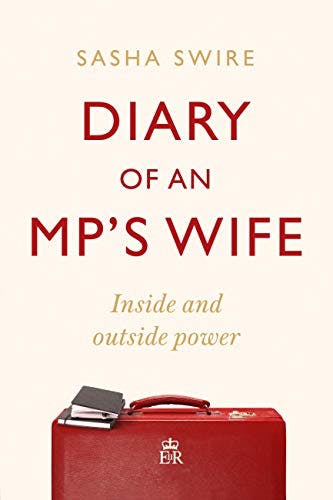
In The Critic, Nigel Jones examines the soon-to-be-published “political tittle-tattle” of the wife of an MP and junior cabinet minister during David “Dave” Cameron’s premiership:

For anyone who has been holidaying under a rock for the past fortnight and may have missed the furore, I should explain that Lady Swire, daughter of Mrs Thatcher’s former Defence Secretary Sir John Nott, is the wife of ex-Tory MP Sir Hugo Swire, an Old Etonian chum of David Cameron, who somehow failed to be promoted beyond the ranks of junior ministers during his pal’s Premiership, but remained a close confidante and boon holiday companion to the PM. Lady Swire herself is half-Slovenian, and though brought up in the bosom of the Tory establishment, may not be entirely attuned to the evasions, hypocrisy and double standards that make up British political life, which makes her book all the more enjoyable.

Throughout Dave’s inglorious time in office, Lady Swire kept a secret diary detailing intimacies of conversation, banter and badinage, and revealing insights that give – shall we say – a not wholly flattering picture of the ruling Tory clique at play during their most unguarded moments. The bad behaviour, petty jealousies and embarrassing remarks of Dave, George, Boris and Michael and their wives are set down in all their toe-curling cringeworthiness.

The diaries are to be published next week but have been serialised in The Times and reviewed and widely commented on in the rest of the media. The two main targets – the duopoly of Cameron and Osborne – have already expressed their displeasure at the revelations. But all the tut-tutting disapproval of Lady Swire’s profitable indiscretions misses the main point: there is nothing that the British public relishes and enjoys more than an exposé of their leaders with their dignity gone and their metaphorical trousers down.

Moreover, gossip and tittle tattle as set down in diaries often tells us more about the true nature of politics and the motivations and personalities of politicians than a thousand self-serving pompous political memoirs or dull works of dry political analysis. What we really want is gossip – the gamier the better – and all the inconvenient truths our rulers rather we didn’t know.

Very often what we learn from particular epochs of history are the telling anecdotes and juicy titbits revealed by diarists rather than the respectability that the statesmen themselves wish to present and be remembered for. Our picture of the Restoration of the monarchy in 1660, for example, and the very merry court of Charles II, along with the apocalyptic disasters of fire and plague that followed comes largely from the indiscreet journals of Samuel Pepys, Daniel Defoe, and John Evelyn.

September 20, 2020

QotD: The anti-slavery movement

Filed under: Books, Britain, Government, History, Liberty, Quotations — Tags: , , , — Nicholas @ 01:00

“William Wilberforce,” writes Eric Metaxas in his book Amazing Grace, “was the happy victim of his own success. He was like someone who against all odds finds the cure for a horrible disease that’s ravaging the world, and the cure is so overwhelmingly successful that it vanquishes the disease completely. No one suffers from it again — and within a generation or two no one remembers it ever existed.”

What did Wilberforce “cure”? Two centuries ago, on March 25th 1807, one very persistent British backbencher secured the passage by Parliament of an Act for the Abolition of the Slave Trade throughout His Majesty’s realms and territories. It’s not that no one remembers the disease ever existed, but that we recall it as a kind of freak pandemic — a SARS or bird flu that flares up and whirrs round the world and is then eradicated. The American education system teaches it as such — as a kind of wicked perversion the Atlantic settlers had conjured out of their own ambition.

In reality, it was more like the common cold — a fact of life. The institution predates the word’s etymology, from the Slavs brought from eastern Europe to the glittering metropolis of Rome. It predates by some millennia the earliest laws, such as the Code of Hammurabi in Mesopotamia. The first legally recognized slave in the American colonies was owned by a black man who had himself arrived as an indentured servant. The first slave owners on the North American continent were hunter-gatherers. As Metaxas puts it, “Slavery was as accepted as birth and marriage and death, was so woven into the tapestry of human history that you could barely see its threads, much less pull them out. Everywhere on the globe, for 5,000 years, the idea of human civilization without slavery was unimaginable.”

Mark Steyn, The [Un]documented Mark Steyn, 2014.

September 18, 2020

From innovation to absolutism — English inventors and the Divine Right of Kings

In the latest Age of Invention newsletter, Anton Howes looks at how innovations during the late Tudor and Stuart eras sometimes bolstered the monarchy in its financial battles with Parliament (which, in turn, eventually led to actual battles during the English Civil War):

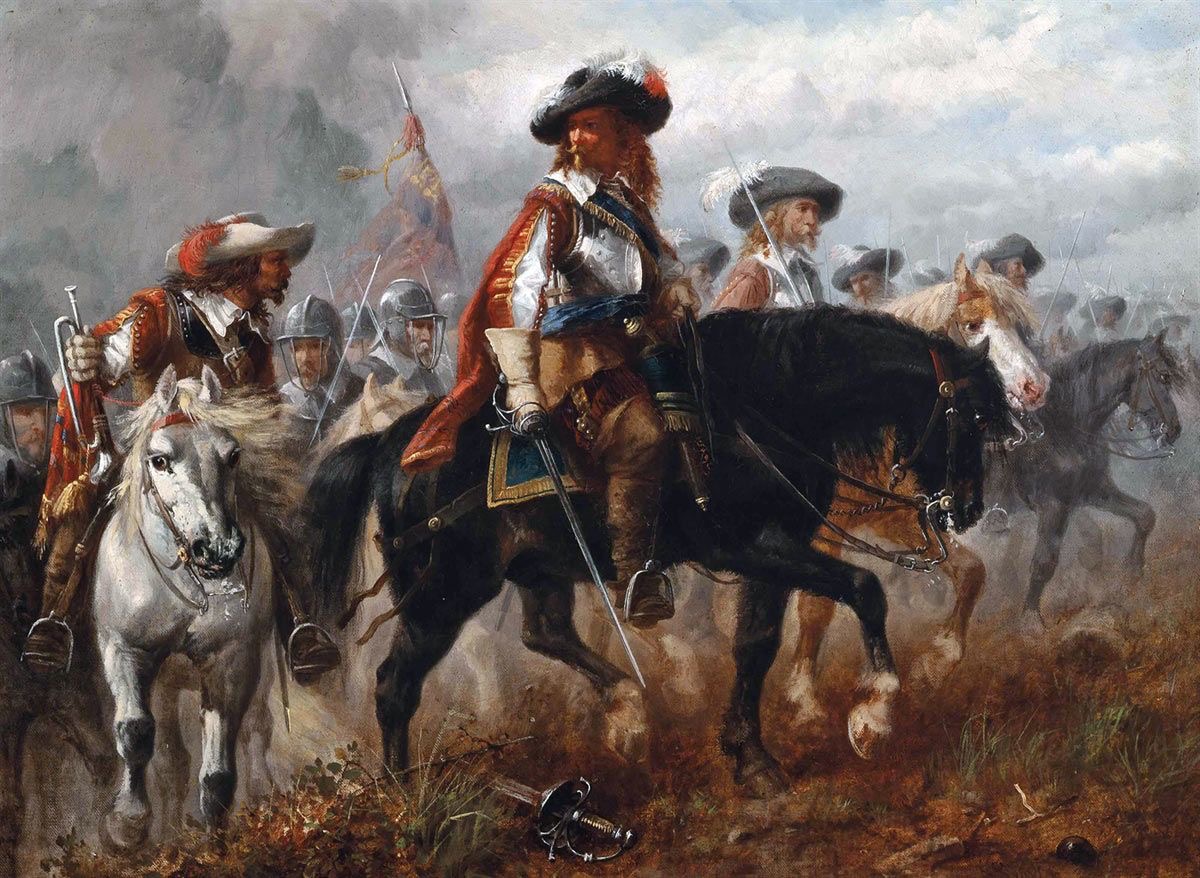
King Charles I and Prince Rupert before the Battle of Naseby 14th June 1645 during the English Civil War.
19th century artist unknown, from Wikimedia Commons.

The various schemes that innovators proposed — from finding a northeast passage to China, to starting a brass industry, to colonising Virginia, or boosting the fish industry by importing Dutch salt-making methods — all promised to benefit the public. They were to support the “common weal”, or commonwealth. And to a certain extent, many projects did. The historian Joan Thirsk did much pioneering work in the 1970s to trace the impact of various technological or commercial projects, revealing that even something as mundane as growing woad, for its blue dye, could have a dramatic impact on local economies. With woad, the income of an ordinary farm labouring household might be almost doubled, for four months in the year, by employing women and children. In the late 1580s, the 5,000 or so acres converted to woad-growing in the south of England likely employed about 20,000 people. That may seem small today, but at a time when the population of a typical market town was a paltry 800 people, even a few hundred acres of woad being cultivated here or there might draw in workers from across the whole region. In the mid-sixteenth century, even the entire population of London had only been about 50-70,000. As Thirsk discovered, innovative projectors also sometimes fulfilled their other public-spirited promises, for example by creating domestic substitutes for costly imported goods, or securing the supplies of strategic resources.

But the ideal of benefiting the commonwealth could also, all too frequently, be elided with serving the interests of the Crown. Projectors might promise the monarch a direct share of an invention’s profits, or that a stimulated industry would result in higher income from tariffs or excise taxes. Increasingly, they proposed schemes that were almost entirely focused on maximising state revenue, with little evidence of new technology. They identified “abuses” in certain industries — at this remove, it’s difficult to tell if these justifications were real — and asked for monopolies over them in order to “regulate” them, then making money by selling licences. Last week I mentioned patents over alehouses, and on playing cards. They also offered to increase the income from the Crown’s property, for example by finding so-called “concealed lands” — lands that had been seized during the Reformation, but which through local resistance or corruption had ostensibly not been paying their proper rents. The projectors would take their share of the money they identified as “missing”. And they proposed enforcing laws, especially if the punishments involved levying fines or confiscating property. The projectors offered to find the lawbreakers and prosecute them, after which they’d take their share of the financial punishments.

Projectors thus came to present themselves as state revenue-raisers and enforcers, circumventing all of the traditional constraints on the monarch’s money and power. They provided an alternative to Parliaments, as well as to city corporations and guilds, in raising money and propagating their rule. Taking it a step further, projectors offered the tantalising possibility that kings like James I and Charles I might rule through proclamation and patents alone, without having to answer to anybody. They thus experimented with absolutism for much of 1610-40, only occasionally being forced to call Parliament for as briefly as possible when the pressing financial demands of war intervened.

In the process, with the growing multitude of projects — a few bringing technological advancement, but many merely lining the pockets of courtier and king — the designation “projector” became mud. It was as if, today, the Queen were to use her prerogative to grant a few of her courtiers monopolies on collecting all traffic fines, or litter penalties, to be rewarded solely on commission. Or if she were to award an unscrupulous private company the right to award all alcohol-selling licences (perhaps on the basis that underage drinking was becoming common). The country would soon be awash with hidden speed cameras and incognito litter wardens, and the price of alcohol would go through the roof. The people responsible would not be popular. A recent book by economic historian Koji Yamamoto meticulously charts the changing public perceptions of projects, describing the ways in which innovators then struggled, for decades, to regain the public’s trust.

September 5, 2020

Beginning the transition from personal rule to the modern bureaucratic state

Anton Howes discusses some of the issues late Medieval rulers had which in some ways began the ascendency of our modern nation state with omnipresent bureaucratic oversight of everyone and everything:

… the bureaucratic state of today, with its officials involving themselves with every aspect of modern life, is a relatively recent invention. In a world without bureaucracy, when state capacity was relatively lacking, it’s difficult to see what other options monarchs would have had. Suppose yourself transported to the throne of England in 1500, and crowned monarch. Once you bored of the novelty and luxuries of being head of state, you might become concerned about the lot of the common man and woman. Yet even if you wanted to create a healthcare system, or make education free and universal to all children, or even create a police force (London didn’t get one until 1829, and the rest of the country not til much later), there is absolutely no way you could succeed.

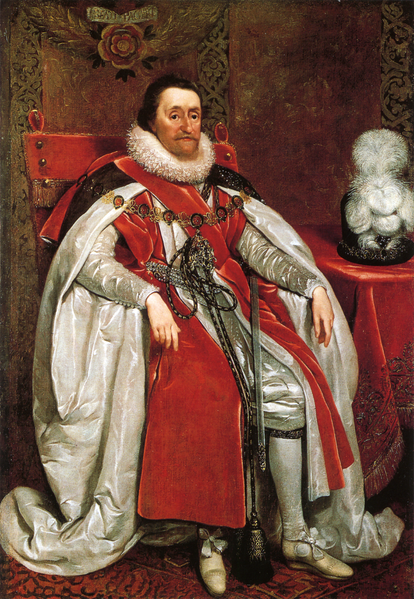
King James I (of England) and VI (of Scotland)
Portrait by Daniel Myrtens, 1621 from the National Portrait Gallery via Wikimedia Commons.

For a start, you would struggle to maintain your hold on power. Fund schools you say? Somebody will have to pay. The nobles? Well, try to tax them — in many European states they were exempt from taxation — and you might quickly lose both your throne and your head. And supposing you do manage to tax them, after miraculously stamping out an insurrection without their support, how would you even begin to go about collecting it? There was simply no central government agency capable of raising it. Working out how much people should pay, chasing up non-payers, and even the physical act of collection, not to mention protecting that treasure once collected, all takes substantial manpower. Not to mention the fact that the collecting agents will likely siphon most of it off to line their own pockets.

[…]

It was not until 1689, when there was a coup, that an incoming ruler allowed the English parliament to sit whenever it pleased. Before that, it was convened only at the whim of the ruler, and dispersed even at the slightest provocation. In 1621, for example, when James I was planning to marry his heir to a Spanish princess, Parliament sent him a petition asserting their right to debate the matter. Upon hearing of it, he called for the official record of parliamentary proceedings, personally ripped out the page with the offending vote, and promptly dissolved the Parliament. The downside, of course, was that James could not then acquire any parliamentary subsidies.

Ruling was thus an intensely personal affair, of making deals and finding ways to circumvent deals you had inherited. Increasing your capabilities as a ruler – state capacity – was thus no easy task, as the typical ruler was stuck in an essentially medieval equilibrium. Imposing a policy costs money, but raising money involves imposing policy. Breaking out of this chicken-and-egg problem took centuries of canny leadership. The rulers who achieved it most would today seem hopelessly corrupt.

To gain extra cash without interference from Parliament, successive monarchs first asserted and then abused their ancient prerogative rights to grant monopolies over trades and industries. They eventually granted them to whomever was willing to pay, establishing monopolies over industries like gambling cards or alehouses under the guise of regulating unsavoury activities. They also sold off knighthoods and titles, and in 1670 Charles II even made a secret deal with the French that he would convert to Catholicism and attack the Protestant Dutch, all in exchange for cash. Anything to not have to call a potentially pesky Parliament. At times, the most effective rulers even resembled mob bosses. Take Elizabeth I’s anger when a cloth-laden merchant fleet bound for an Antwerp fair in 1559 was allowed to depart. Her order to stop them had not arrived in time, thus preventing her from extracting “loans” from the merchants while she still had their goods within her power.

September 4, 2020

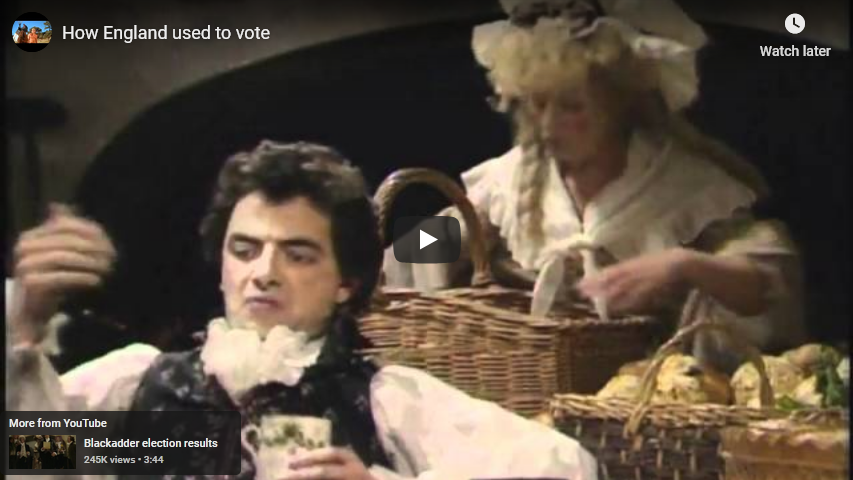
How England used to vote

Filed under: Britain, History, Humour — Tags: , — Nicholas @ 02:00

Learnhistory3
Published 1 May 2011

Rowan Atkinson as Edmund BlackAdder in a sketch on the voting situation before 1832. Rotten boroughs and pocket boroughs etc

Script excerpt from BlackAdder Scripts:

At Mrs. Miggins’ home

E: Well, Mrs. Miggins, at last we can return to sanity. The hustings are
over, the bunting is down, the mad hysteria is at an end. After the
chaos of a general election, we can return to normal.

M: Oh, has there been a general election, then, Mr. BlackAdder?

E: Indeed there has, Mrs. Miggins.

M: Oh, well, I never heard about it.

E: Well of course you didn’t; you’re not eligible to vote.

M: Well, why not?

E: Because virtually no-one is: women, peasants, (looks at Baldrick)
chimpanzees (Baldrick looks behind himself, trying to see the animal),
lunatics, Lords…

B: That’s not true — Lord Nelson’s got a vote!

E: He’s got a boat, Baldrick. Marvelous thing, democracy. Look at
Manchester: population, 60,000; electoral roll, 3.

M: Well, I may have the brain the size of a sultana…

E: Correct…

M: …but it hardly seems fair to me.

E: Of course it’s not fair — and a damn good thing too. Give the like of
Baldrick the vote and we’ll be back to cavorting druids, death by
stoning, and dung for dinner.

B: Oh, I’m having dung for dinner tonight.

M: So, who are they electing when they have these elections?

E: Ah, the same old shower: fat tory landowners who get made MPs when
they reach a certain weight; raving revolutionaries who think that just
because they do a day’s work that somehow gives them the right to get
paid… Basically, it’s a right old mess. Toffs at the top, plebs at the
bottom, and me in the middle making a fat pile of cash out of both of them.

M: Oh, you’d better watch out, Mr. BlackAdder; things are bound to change.

E: Not while Pitt the Elder’s Prime Minister they aren’t. He’s about as
effective as a catflap in an elephant house. As long as his feet are warm
and he gets a nice cup of milky tea in the sun before his morning nap,
he doesn’t bother anyone until his potty needs emptying.

August 23, 2020

Trudeau’s hopes for re-election hinge on promising “an organic chicken in every pot and a solar panel on every shed”

The Line wonders who the hell the Liberals think they are:

It may have been easy to miss amid the news coming out of Ottawa, but as the government lost its finance minister, appointed Chrystia Freeland to yet another job, prorogued parliament, halted testimony into its latest scandal, prepared for the announcement of a new Conservative Party of Canada leader and braced for a likely second wave of COVID-19, the prime minister promised to announce a transformative agenda. One that promises sweeping social change, and a wholesale re-invention of our economy in line with the greenest ambitions. We here at The Line have but one question.

Who the hell do these people think they are?

It is obvious to anyone who has been reading the news and possesses even residual brain function why the prime minister would like to be talking about a plan for transformative change. Talking about all the amazing things he could do for Canadians with borrowed money beats talking about his government’s bumbling of the WE file and the departure of now-former finance minister Bill Morneau.

Promising an organic chicken in every pot and a solar panel on every shed is obviously more appealing to Trudeau than repeating the last month. But it is astonishing to us — as jaded as we have undeniably become — that the government is talking about this instead of the necessary steps needed to shore up this country ahead of a likely second wave of COVID-19.

This government has a mandate to respond to the emergency, by mere unlucky virtue of being in power at the moment the virus hit. It is the duty of every Canadian government to safeguard the wellbeing of the population, full stop. But the emergency, contrary to what you may believe if you’ve been reading Liberal Party HQ memos, is not over. We have an urgent need to secure more medical equipment, to harden our long-term care facilities, to prevent any further lockdowns from derailing a fragile economic recovery, to ensure the resiliency of critical supply chains, and to shore up our health-care system. This is what every Canadian official should be focused on right now.

[…]

But can anyone maintain faith that the Liberals will stick to their knitting when we hear buzzwords like “transformative” social change? Sweeping climate-change reforms? Engineering a new green economy? They are all fine notions — let’s put them to the people and vote on them. Until calling that election is feasible (mid-pandemic, it is not) this government simply does not have the mandate to undertake such far-reaching efforts.

It’s easy to forget now, but only nine months ago this government was reduced to a minority of seats in parliament. The Liberals lost the popular vote, and saw one million of their own prior voters abandon them. They are only in government because the Conservatives, to the surprise of no one, found several novel and exciting new ways to fail.

June 21, 2020

Jagmeet Singh’s social media moment in the sun

Filed under: Cancon, Media, Politics — Tags: , , , , — Nicholas @ 03:00

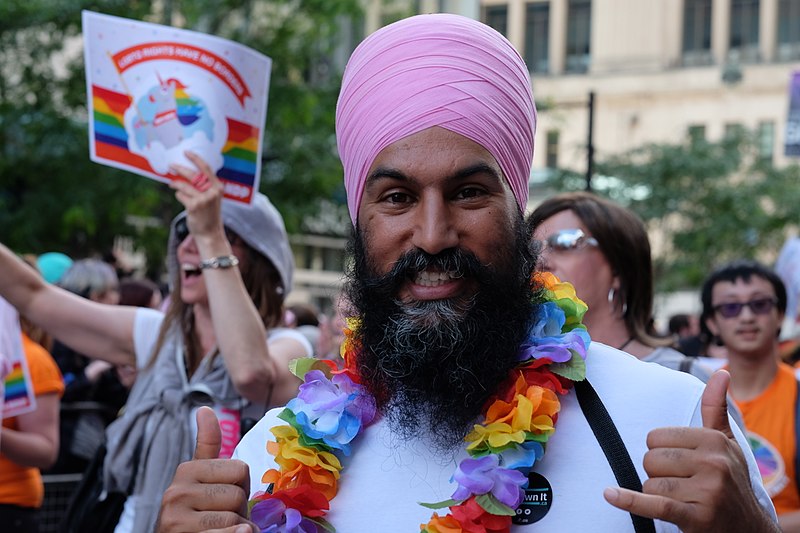
Most Canadians seem to have forgotten about federal NDP leader Jagmeet Singh, so this parliamentary kerfuffle — perfectly timed for maximum social media attention — is a great boost to his political visibility.

Federal NDP leader Jagmeet Singh taking part in a Pride Parade in June 2017 (during the leadership campaign).
Photo via Wikimedia.

In this woebegotten year of 2020, blessed is the politician who can stumble into a scandal perfectly tailored to the tyranny of Twitter.

As protests, riots, and rage make their mark across the world in the wake of the murder of George Floyd, NDP leader Jagmeet Singh got himself ejected from the House of Commons for calling Bloc MP Alain Therrien a “racist.”

It was an act of civil disobedience, well suited to the passions of the moment, that generated overwhelming support for Singh.

“Only in a racist country does a brown man get ejected from parliament for insisting that the denial of systemic racism is racist,” was a fairly typical, and popular, example on Twitter.

I’m not interested in disputing the point, but rather deconstructing it. So let’s start, for a moment, with the prim prohibitions on unparliamentary language.

In keeping with the long-standing “tradition of respect for the integrity of all Members,” elected officials are barred from using personal attacks, obscenities and insults while in the House of Commons.

And, yes, I’m mentioning this point mostly for the joy of listing off some of the language that has been deemed “unparliamentary” in the past, including, my favourite; “Honourable only by courtesy” (ruled against in 1880), “Coming into the world by accident,” (1886) and “The political sewer pipe from Carleton County” (1917).

Whatever else we can say about the state of our political culture, the quality of our insults has declined alarmingly.

There are a few examples in the parliamentary record of the term “racist” being used in the House. In several instances, the record can’t identify who said it. Or the subject of the insult failed to call a point of order on the matter.

June 15, 2020

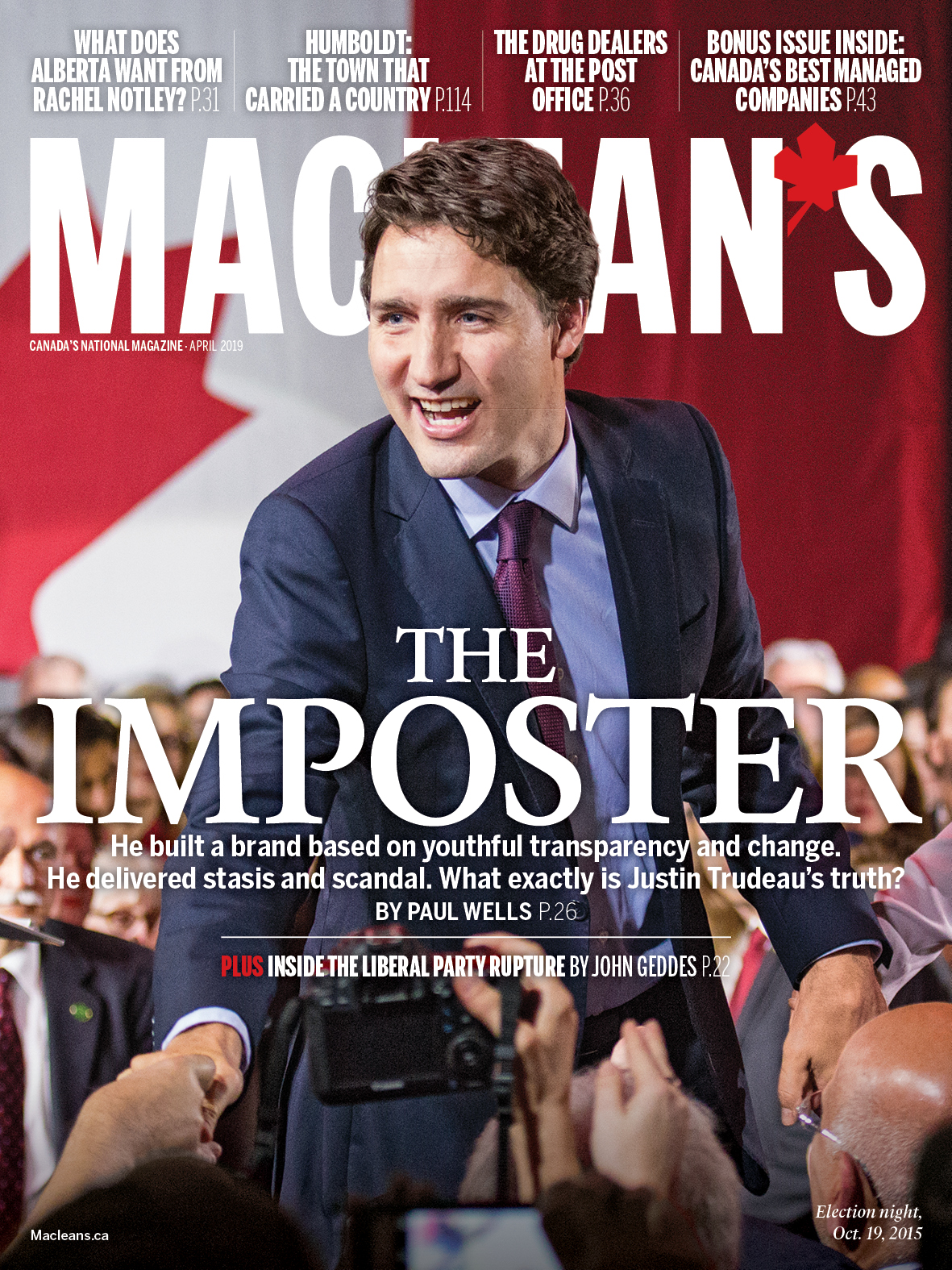
Canada’s ongoing experiment with Justin Trudeau’s “basic dictatorship”

Filed under: Cancon, Government, Health, History, Liberty, Politics — Tags: , , , — Nicholas @ 03:00

Ted Campbell outlines the development of the concept of “rights” from Saxon England through Magna Carta and how a bad king finally triggered a rebellion that forced him to grant the Great Charter which still acts as a foundation for British (and Canadian) law. Justin Trudeau may be the modern day version of the bad king:

A few hundred years later, one of liberalism‘s and democracy’s greatest voices told us that we have three absolutely fundamental, natural rights: to life, to liberty and to property. These rights were not and still are not unlimited. There were and are ways to lawfully and properly deprive a person of his property and his liberty and, in some countries, even his life. A few centuries after John Locke another philosopher wanted to do away with the right to property: “From each according to his ability, to each according to his need,” Karl Marx wrote, and many, far too many, believed. The only real problem with Marx’s notion is that it requires that humans are perfect … and most of us know how rare that is. Here in Canada, especially since the early years of the 20th century, we have had far too much Marx and far too little Locke.

Now, in 2020, we even have a new version of King John: a vain and foolish prime minister who seems to believe that he has been sent to rule over us. Justin Trudeau is profoundly ignorant about both liberalism and democracy. He is, actually, more of a puppet than a ruler but it is less easy than it should be to determine just who is pulling on which strings. He does not appear to have the mental capacity to pull more than a couple of ideas together at any one time.

Because we have been panicked by the coronavirus pandemic we have decided accepted that more government is the best least bad answer. To give us more and more government, Justin Trudeau’s handlers suspended parliament until September … they wanted to have that “basic dictatorship” thing.

Democracy is in peril in Canada … it’s not because Justin Trudeau is an evil dictator, it’s because we, as a people, are too complacent. We have come to believe that democracy is, somehow, automatic, that it is natural. It’s not. It needed to be carefully built, brick-by-brick, over many centuries. We needed to fight for democracy: we needed to win it and then defend it, too. It doesn’t renew itself, it is not the natural order of things, and, In Canada, in 2020, it is in peril. Parliament needs to be recalled, soon, before September. Parliament needs to tend to its ancient rights, duties and powers. The Trudeau regime needs to be called to account and then replaced by a new, better, government.

May 23, 2020

Failed Assassinations — History Hijinks

Overly Sarcastic Productions
Published 22 May 2020

If videogames have taught me anything, it’s that an assassin can solve a lot of problems. But sometimes plans fall apart, and sometimes it’s for the absolute DUMBEST reasons.

SOURCES & Further Reading: A History of Venice by Norwich, Rebellion by Ackroyd, The Poison King by Mayor.

This video was edited by Sophia Ricciardi AKA “Indigo”. https://www.sophiakricci.com/
Our content is intended for teenage audiences and up.

PATREON: https://www.Patreon.com/OSP

DISCORD: https://discord.gg/h3AqJPe

MERCH LINKS: https://www.redbubble.com/people/OSPY…

OUR WEBSITE: https://www.OverlySarcasticProductions.com
Find us on Twitter https://www.Twitter.com/OSPYouTube
Find us on Reddit https://www.Reddit.com/r/OSP/

February 27, 2020

Winston Churchill Biography: In the Darkest Hour

Filed under: Africa, Britain, History, Military, WW2 — Tags: , , , , , — Nicholas @ 02:00

Biographics
Published 13 Feb 2018

We imagine Winston Churchill with his signature cane, drinking scotch whiskey, and puffing on a Cuban cigar. His mouth is downturned, and his voice is gruff and his words pointed. This is the image Hollywood portrays but it is a mere caricature of the flesh and blood version. Who was Winston Churchill? In Britain’s “darkest hour,” Churchill led his country from the brink of Nazi conquest by forging an alliance with the U.S. and Russia. He had many critics, and made mistakes on a grand scale. Yet, above it all, possessed an unwavering belief in his own power. To his beloved country he offered his “blood, toil, tears and sweat.”

Visit our companion website for more: http://biographics.org

Credits:
Host – Simon Whistler
Author – Crystal Sullivan
Producer – Samuel Avila
Executive Producer – Shell Harris

Business inquiries to biographics.email@gmail.com

Biographies by the book, get Winston Churchill’s biography from Amazon: http://amzn.to/2EAfh7b

February 26, 2020

The Home Office – “Abandon hope all ye who enter here”

Filed under: Britain, Bureaucracy, Government — Tags: , — Nicholas @ 05:00

From Stephen Pollard, one gets the sense that no rational politician would ever want to be Home Secretary in a British government:

Official portrait of the Right Honourable Priti Patel, MP.
Photo by Richard Townshend.

Here’s a trick question: which Home Secretary has been subject to hostile briefings from within the department that they are too Right-wing, too populist, too lazy, too stupid and a bully?

It’s a trick because the answer is: almost all of them. You can pretty much take your choice from any of those who have arrived at the Home Office with a definable agenda, and one that differs from the received Home Office wisdom.

The briefings currently being meted out against Priti Patel are certainly severe. She has been accused of creating an “atmosphere of fear” by officials, an allegation strongly denied by ministers. But in the sweep of recent political history, they are entirely normal. The Home Office has always played dirty when a minister attempts to overturn its shibboleths. The moment its mandarins sniff trouble, stories start appearing in the press about how the new minister is out of his or her depth, unthinking, posturing and — always the same — a variation on stupid.

[…]

The list of the Home Office’s responsibilities is ludicrously large, including: illegal drug use; alcohol strategy, policy and licensing conditions; terrorism; crime; public safety; border control; immigration; applications to enter and stay in the UK; issuing passports and visas; policing; fire prevention; fire rescue. In addition it is responsible for more than 30 agencies and public bodies.

John Reid infamously described its immigration department as “not fit for purpose”, and that quote has often been — understandably — misapplied to the Home Office as a whole.

The likes of Michael Howard and David Blunkett, who became Home Secretary in 2001, were political heavyweights with enough nous to get a grip of the hostile department. In preparing my biography of Blunkett, I spent months in and out of the Home Office when he was running the department, observing and speaking to officials — some who were supportive of their boss but others who clearly regarded him as an irritant.

One adviser to Blunkett recalls that the feeling was mutual. Blunkett wanted to replace the senior civil servants from top to bottom, and he and his aides were shocked at just how chaotic and inefficient the department was. “Nothing had prepared us for it,” recalled one adviser. “It was worse than any of us had imagined possible. God alone knows what Jack [Straw] did for four years. I am simply unable to comprehend how he could have left it as it was. At least Howard had the alibi that he was attempting a wholesale culture shift. In the Home Office, doing nothing means going backwards. It was a mess. A giant mess.”

February 21, 2020

Justin Trudeau, Prime Empathizer of Canada

Filed under: Cancon, Government, Law, Politics, Railways — Tags: , , , , , , — Nicholas @ 03:00

The Prime Minstrel channels his inner Bill Clinton, although he just manages to avoid saying that he “feels our pain”:

A strange thing happened Tuesday morning. That strange thing was … an important and interesting exchange on the floor of the House of Commons. It happened during routine proceedings, and not in the Punch-and-Judy exchange of question period. The leaders of the various parties in the House stood and outlined positions on the rail blockades being conducted around the country in support of Wet’suwet’en opponents of B.C.’s Coastal GasLink pipeline.

First came the prime minister. “People are troubled by what they have been witnessing this past week,” he said. Our empathizer-in-chief, the emotional mascot of Confederation, was about to go to work. “Young, old, Indigenous and newcomers are asking themselves what is happening in the country … On all sides, people are upset and frustrated.”

The next three words out of his mouth were: “I get it.” Huh. Is that the sort of thing you say when you’ve actually gotten it? If a friend called you up in a shattered emotional state because he had just lost his job, as people are starting to lose jobs to the Wet’suwet’en solidarity protests, would you say “I get it”?

Beyond this tin-eared reassurance, Trudeau did not have much specific to say, and what there was seemed to contradict itself. “Our government’s priority is to resolve this situation peacefully, but also to protect the rule of law in our country,” he promised. “That is a principle we will always stand up for.” One would have thought the role of a prime minister was to apply the law rather than to “stand up for” it. He gave his usual spiel about the myriad of ways in which the federal government has failed First Nations, again speaking as though someone else were in charge. Certainly very little of it is his own fault: the government he leads has “invested more than any other … to right historic wrongs.”

Trudeau worried aloud that Canada might become “a country where people think they can tamper with rail lines and endanger lives,” but he seemingly renounced the use of force (it’s not “helpful”) against protesters who openly discuss sabotage. What the prime minister means when he talks of the “rule” of something called “law” has been left imperfectly clear.

Chris Selley suggests the government’s fecklessness will continue to prevent any solutions being implemented:

The stupefying weightlessness of Justin Trudeau’s government has never been more evident than in recent days, as it tries to arrange an end to the Mohawk blockade of CN’s main line near Belleville, Ont. At times it seems as if it might just float away, like an improperly tethered bouncy castle in a thunderstorm.

This week has been particularly windy.

[…]

The situation is ludicrous: Because Ontario’s independent provincial police won’t enforce a court injunction, the federal public safety minister seems to be in discussions with B.C.’s solicitor general about whether B.C.’s independent provincial police might back off enforcing a different injunction.

And the worst part of this absurdist theatre festival is how difficult it is to imagine a better alternative. Conservatives continue to call on Trudeau to somehow fix the problem, but the way Canada is set up, it’s really not a federal issue. The RCMP might have some jurisdiction over the railway as federally regulated infrastructure, said University of Toronto law professor Kent Roach, but that hasn’t happened in past cases. It wouldn’t even be up to Trudeau to send in troops: under the Emergencies Act, Roach said, a provincial solicitor-general has to request it.

These are structural issues that any PM will face. Indeed, the biggest difference between the Liberals’ approach to this blockade and the Conservatives’ approach to the 2013 Idle No More protests, which included a 13-day blockade of a CN line in southwestern Ontario, has been one of rhetoric and engagement. The Conservatives talked tougher, but Aboriginal Affairs rebuffed CN’s request to intervene. (Those protesters eventually obeyed a court injunction and left.) The Liberals needlessly tie themselves in knots and insult our intelligence — they know no other way — but they clearly believe it’s their job to broker some kind of resolution.

It’s tough to say which approach is likelier to work. At this point odds seem to favour “neither.” If you have a better, workable idea to get the trains moving, for God’s sake get on the horn to Ottawa.

February 19, 2020

Enoch Powell

Theodore Dalrymple reviews a recent book by Paul Corthorn on Powell’s career and the concerns that animated him:

Enoch Powell in a 1987 portrait by Allan Warren.
Wikimedia Commons.

It does not pretend to be a biography, or even an intellectual biography. Rather, it chronicles, scrupulously but somewhat drily, Powell’s varying attitudes toward the main subjects of his political concerns: international relations, economics, immigration, Britain’s relations with Europe, and the status of Northern Ireland in the United Kingdom. Powell’s wider intellectual interests and religious views are scarcely touched upon, though it is mentioned that he went from being a believer to being (under the influence of Nietzsche) an atheist, to then returning to Christian belief. There is no description of his character in this book, not even by implication, and with this book as a guide, one would not recognise him if one met him. It is not possible to tell whether the author admires or detests his subject. This neutrality creates confidence in the accuracy of his scholarship, but also makes his book less than a pleasurable or exciting read. Perhaps it is the sign of a frivolous mind, but I prefer even histories of ideas to be spiced with a little biography (or, more truthfully, gossip).

The author does, however, offer a unifying interpretation of Powell’s various political concerns, namely that they were all responses to Britain’s precipitous national decline, the steepest part of which occurred in his lifetime, but which is continuing apace to the extent that Britain might even cease to be a nation at all. Powell was born in a great power and died in an enfeebled country with no industrial or military might, with precious little patriotism, and with no sense either of grandeur or collective purpose.

That this decline – relative rather than absolute, except in such fields as the maintenance of law and order — was inevitable given the conjunctures of the age, was evident to Powell (though not at first). This relative decline was already implicit in Disraeli’s dictum that “the Continent [of Europe] will not suffer England to be the workshop of the world.”

Powell’s concerns, then, were how to manage Britain’s decline and how to find it a new place in the world. He had not always been perceptive about the scale of its decline. He clung, for example, to the illusion that the Empire might still count for something even after the Second World War. Thereafter, however, he became a devotee of a kind of Realpolitik, to the extent of wanting a rapprochement or even alliance with the Soviet Union to balance the power of the United States, whose aims he had long distrusted. He discounted ideology, including communism, as a force in international politics, which is odd in a man who was by far the most intellectual and intellectually accomplished of all British politicians of the 20th century, being both a classical scholar and a brilliant linguist. He seemed to think that Soviet ambition was merely that of any large power in the great game. Those countries that fell into its grip knew otherwise.

On economics, Powell was an early devotee of the superiority of the market over state planning at a time when the intellectual tide was running the other way. There was one important subject, however, on which he was a confirmed statist, namely that of health care. He was for a time Minister of Health in the British government, during which he fiercely defended the NHS. He believed that the government had an ethical duty to provide health care for its citizenry, and it never seemed to occur to him that the centralised NHS was not the only possible way of doing so. He was often highly suspicious of international comparison, but it is difficult to see how judgment of the merits of a system could be made without it. It was clear, moreover, that in this, as in other fields, Britain was at best very mediocre. Perhaps Powell was blind to the NHS’s mediocre performance because of the benevolence of its stated intentions (an occupational hazard among intellectuals, even — or perhaps especially — among brilliant ones). At any rate, he never satisfactorily explained why health care should be different from other spheres of service provision in the superiority of private over public organization.

January 26, 2020

Trudeau’s illogical gun ban will do nothing to reduce violent crime

Filed under: Cancon, Government, Law, Liberty, Weapons — Tags: , , , , — Nicholas @ 05:00

It will, on the other hand, infringe the rights of law-abiding Canadians and encourage otherwise law-abiding people to disobey the law. It won’t take a single lethal weapon out of the hands of criminals — because they’re already violating the laws that are in force today and won’t be deterred by yet another token rule they won’t obey. At the Post Millennial, D.J. Sumanik explains why the proposed ban is wrong:

Restricted and prohibited weapons seized by Toronto police in a 2012 operation. None of the people from whom these weapons were taken was legally allowed to possess them.
Screen capture from a CTV News report.

I chose the AR-15 for that video because it is the singular most demonized firearm on the planet. The rifle is used to scare uninformed citizens daily. Yet the same rifle has never been used for murder by a legal gun owner in Canada.

In fact, it’s only been used for murder one time in our country over the last 50 years by a gang. A far cry from the narrative that “assault weapons” are lurking in every corner of Canadian society waiting to murder our children.

Justin Trudeau is claiming this firearm and others like it are so deadly, so dangerous, and so extreme that they must be confiscated from every licensed Canadian gun owner across the country. But with only one murder in 50 years, and the gun almost certainly still being the murderer’s hand regardless if there was a ban, the numbers simply don’t add up. In fact they barely register. Semi-auto rifles are extremely rare for use in Canadian gun homicide […] handguns are the firearm of choice for most shootings. Semi-autos only make up a small percentage of rifles and shotguns in our country. So how does this add up to a federal ban costing $600 million in taxpayer money?

Short answer: It doesn’t.

Canada has roughly 2.2 million licensed gun owners who are monitored DAILY by RCMP for red flags. Most people don’t know that. It’s called continuous eligibility screening. If you step out of the line with the law, the cops show up and take your guns.

Some further thoughts.

If only 5 percent of Canadian gun owners were out there shooting up the streets, we’d have 110,000 deaths on our hands annually. According to StatsCan, 2018 left Canada with 249 tragic gun murders. The vast majority were by gangs fighting over drugs in urban centers. Even if you were to incorrectly assume every one of those shootings was a legal gun owner and not a gang member (yeah right) it means 99.9998868% of us pose no threat to society. Can you think of another demographic with that kind of track record? I certainly can’t.

Now, the lives lost in those incidents are valuable. 249 Canadian families are feeling daily pain. Something needs to change. Gang warfare can’t go unchecked. But to punish millions of innocent Canadians who hold such an excellent track record will not help. There’s a very simple truth in all of this: Taking my firearms away in the Yukon will not prevent gang homicide in Toronto.

Furthermore, we as Canadians don’t discriminate against entire groups of people based on the actions of a few bad eggs. For instance, we don’t blame all Muslims in Canada for the actions of 9/11. How is it acceptable for Justin Trudeau to punish gun owners across Canada for gang violence?

January 25, 2020

Petition against the Trudeau government’s proposed “military-style assault rifle” ban goes over 100,000 signatures

Filed under: Cancon, Law, Liberty, Politics, Weapons — Tags: , , , — Nicholas @ 05:00

There may be little point in protesting, as the Trudeau government has a track record of ignoring what Canadians want to do what it intends regardless, but you can still sign the petition here (if you do sign, remember to click the confirmation link in the email you’ll receive after signing the petition). In the Post Millennial, Sam McGriskin reports that the petition has enough confirmed signatures to be the second-largest in Canadian history:

E-petitions can be open for 30, 60, 90 or 120 days for signature based on what the petitioner prefers. The petitions get a government response within 45 days of their opening. Public Safety Minister Bill Blair is overseeing the “buyback program” which Blair estimates could cost anywhere from $400 to $600 million.

Blair’s office did not respond to request for comment from The Post Millennial. His office was asked what the minister’s response is to over 100,000 Canadians calling on the government to drop what many experts see as a completely ineffectual action to curb gun violence. Blair was also asked about fellow Liberal MP Marcus Powlowsk’s letter addressed to him that opposed the gun ban (Powlowsk has since retracted the letter) and Winnipeg Police constable calling the ban “nonsense”.

“When we seize handguns, the handguns are always almost 100% in the possession of people who have no legal right to possess them. They’re almost always stolen or illegally obtained,” said Const. Rob Carver. “I simply don’t see how as a 27-year-old veteran, how adding another layer of law will make any difference, anywhere in this country.”

In Powlowski’s letter to Blair he wrote, “Over the course of the past three months, I have heard a wide variety of views on this proposed ban. I believe it is my role to ensure that these views are brought to your attention for consideration.”

“Given that there is currently no legal definition for a ‘military-style assault rifle’ in Canada, some community members I have spoken with are skeptical that a ban based on this term would make sense as a coherent firearm policy,” the letter continued.

In a CBC interview in the summer of 2018, Blair said that most of the gun crime is committed by illegal handguns smuggled in from the U.S. and he was skeptical of a gun ban being effective in combating gun crime. His position changed drastically once he was appointed by Prime Minister Justin Trudeau as the public safety minister.

Variants of the AK-47

The Liberal voters in downtown Toronto and other major cities want the government to “do something” about gun crimes, but nothing the government can do is going to make much of a difference for people who are already violating multiple laws, so all they can do is make things worse for those who are already obeying the laws as they stand. In the real world, this makes no sense, but in the fantasy world of electoral politics, the government needs to be seen to be “doing something” … and this, stupid as it may be, counts as “something”.

« Newer PostsOlder Posts »

Powered by WordPress