Tasting History with Max Miller
Published 2 Nov 2021Thank you to my Patreon Patrons – https://www.patreon.com/tastinghistory
Merch ► crowdmade.com/collections/tastinghistory
Instagram ► https://www.instagram.com/tastinghist…
Twitter ► https://twitter.com/TastingHistory1
Tiktok ► TastingHistory
Reddit ► r/TastingHistory
Discord ► https://discord.gg/d7nbEpySend mail to:
Tasting History
PO Box 766
Burbank, CA 91503LINKS TO INGREDIENTS & EQUIPMENT**
Sony Alpha 7C Camera: https://amzn.to/2MQbNTK
Sigma 24-70mm f/2.8 Lens: https://amzn.to/35tjyoW
Medium Oatmeal: https://amzn.to/2ZAcpTE
Cake Flour: https://amzn.to/3brKkkl
Black Treacle: https://amzn.to/2XZdW5x
Golden Syrup: https://amzn.to/3jPzhWRLINKS TO SOURCES**
Pot-Luck by May Byron: https://amzn.to/3ExpRHs
Parkin by Anne Fencott: https://www.fencott.com/FencottBooks/…**Some of the links and other products that appear on this video are from companies which Tasting History will earn an affiliate commission or referral bonus. Each purchase made from these links will help to support this channel with no additional cost to you. The content in this video is accurate as of the posting date. Some of the offers mentioned may no longer be available.
Subtitles: Jose Mendoza
PHOTO CREDITS
Lewes Guy Fawkes Night: Peter Trimming
Andy Beecroft / Filey Brigg at low tide#tastinghistory #GuyFawkes #Bonfirenight
November 3, 2021
1915 Yorkshire Parkin for Bonfire Night
October 5, 2021
Chris Alexander – “The truth is that ‘normal’ in the People’s Republic of China, at least since 1959, has never included the rule of law”
Writing in The Line, Chris Alexander (former Minister of Citizenship and Immigration) explains why attempts to “return to normal” in Canada’s relationship with mainland China are foredoomed to failure:
Yuen Pau Woo was joined in these arguments by senators Peter Boehm and Peter Harder, both seasoned diplomats, who also urged Canada to suspend its judgement with regard to China’s persecution of the Uighurs. This includes the use of concentration camps and forced labour, as well as the repression of language, culture and religion. These are all blatant acts committed with the “intent to destroy, in whole or in part, a national, ethnical, racial or religious group”, as the 1951 Genocide Convention defines this “odious scourge”.
Throughout this unfortunate saga, Beijing has had a Greek chorus of supporters across Canada — mostly from people with well-remunerated corporate or political backgrounds — for the preposterous notion of a “prisoner exchange” that would get relations with China back to “normal”.
In the end, the Senate’s genocide motion failed by a vote of 29 in favour to 33 opposed, with 13 abstentions. China’s Foreign Ministry praised Woo, Boehm and Harder as “people of vision” who had seen through the “despicable schemes of a few anti-China forces”. The “clumsy trick of attacking China for selfish political gains” and “the hype of ‘genocide’ in Xinjiang is unpopular and doomed to fail”, the Foreign Ministry spokesperson crowed.
Had Woo, a former president and CEO of the Asia Pacific Foundation of Canada, and the “two Peters”, both former deputy ministers of foreign affairs, voted in favour, the Senate’s genocide motion would have passed. Instead all three chose, on an issue directly threatening the identity and lives of millions, to take the position of the Communist Party of China over one unanimously endorsed by Canada’s elected House of Commons — all in the empty hope of getting back to “normal” with Beijing.
The truth is that “normal” in the People’s Republic of China, at least since 1959, has never included the rule of law. From China’s ferocious and brutal invasion of Tibet that same year, through the murderous Great Leap Forward ending in 1962, to the decade-long Cultural Revolution up to Mao’s death in 1976 (and beyond), China has been a legal void. Serious judicial reforms never featured in Deng Xiaoping’s economic relaunch. On the contrary, basic rights were decimated, as Tibetan, Mongolian, Uighur and other refugees attest.
According to Freedom House, the current General Secretary of the Chinese Communist Party Xi Jinping’s relentless push for all-encompassing surveillance and censorship has made China the worst environment in the world for internet freedom for the seventh year running. Compliance with such global gag orders is enforced by the CCP’s Orwellian digital panopticon, the notorious United Front Work Department, which seeks to browbeat, buy, corrupt, blackmail, extort or otherwise leverage people and firms with connections to China in support of Xi’s agenda.
Thanks to United Front subterfuge, some prominent Canadians still take China’s side, even as Beijing’s favourability score in Canadian public opinion plummeted to 14 per cent, mirroring a worldwide nosedive for China’s image driven by the two Michaels’ ordeal and Beijing’s “wolf warrior” belligerence.
August 20, 2021
“They were there to debate Afghanistan, a far-away country of which it turns out that we know even less than we thought”
The British government recalls Parliament to debate the situation in Afghanistan (not that there’s much to be done at this late stage, but formalities are at least being observed in a perfunctory manner):
The House of Commons was full, for the first time since last March. Members of Parliament had been brought back from their holidays, from West Country campsites and from Greek resorts, in a repatriation operation that puts the Foreign Office to shame.
They were there to debate Afghanistan, a far-away country of which it turns out that we know even less than we thought. It was only last month that Boris Johnson was assuring MPs that “there is no military path to victory for the Taliban”, although we now know that path was straight along the road to Kabul, as fast as their trucks could carry them.
Now Johnson was back to explain that things had turned out to be a bit more complicated than he thought. Or perhaps a bit simpler: we’ve gone, they’re back. Parliament was getting eight hours to discuss this, although it was too late to do very much about it. It wasn’t so much shutting the stable door after the horse had bolted as holding a long discussion about the history of equine care as the stallion in question disappeared over the horizon.
Still, the atmosphere was jolly. Many of these MPs haven’t seen each other in over a year. There was a first-day-of-term feel to things. With Parliament’s Covid restrictions lapsed, the Conservatives were wedged in together in the small, windowless chamber, barely a facemask in sight. The government’s instructions are still to wear masks in crowded places, but the Conservatives view Covid as some sort of socialist conspiracy that will go away if they ignore it. Or maybe they just feel that rules are for the little people.
Labour MPs had at least nodded to social distancing, sitting about 18 inches apart from each other. This is, admittedly, easier when there aren’t very many of you. The opposition benches were a sea of masks. Only the Democratic Unionists, who like the Tories see illness as a sign of moral failure, were a lone island of uncovered faces.
Johnson’s statement was, as ever, a masterpiece of bare adequacy. It eloquently just about dealt with the matter in question, magisterially pretty much covering the bases. The speechwriters, one sensed, must have been working on the words late into the previous afternoon. They had gone through as many as one draft as they tried to come up with something that, if it didn’t deal with every complex nuance of the Afghan tragedy, at least asked the question that Johnson lives by: “Will this do?”
The situation in Afghanistan was a “concern”, the prime minister explained, with what might, in another context, have been a brilliantly comic understatement. Over the past 20 years, the British had worked for a better future for the people of Afghanistan. “Some of this progress,” the prime minister said, “is fragile”, which is certainly one way of putting it.
What had gone wrong with our intelligence services, several people asked, that they had so comprehensively failed to see this coming? Be fair, replied Johnson, even the Taliban had been surprised by the speed of their own advance.
On the US Naval Institute Blog, CDRSalamander notes the only speech in the House of Commons during that debate that grabbed and held the attention of the entire body:
Let’s back away from the problem at hand a bit … and then back up further. I mentioned it earlier, but let’s bring it up again; national humiliation. There are different aspects of this growing humiliation that are already manifesting itself, the first of which is how others look at us.
Let’s start with our closest friend and take a moment to listen to a speech earlier today in the British House of Commons by Tom Tugendhat, MP.
The mission in Afghanistan wasn’t a British mission, it was a Nato mission. … And so it is with great sadness that I now criticise one of them. … To see their commander-in-chief call into question the courage of men I fought with — to claim that they ran. It is shameful. … this is a harsh lesson for all of us and if we are not careful it could be a very, very difficult lesson for our allies. … to make sure we are not dependent on a single ally, on the decision of a single leader, but that we can work together with Japan and Australia, with France and Germany, with partners large and small, and make sure we hold the line together.
That is our closest friend outlining a loss of confidence. That is just one datapoint from a friend, but it is safe to say that it is probably somewhere in the center of opinion.
What are those nations who are not our friends thinking? I don’t think I need to spend all that much time on discussing how emboldened they are. It is self-evident to anyone who reads USNIBlog.
On the ground, troops of 2nd Battalion, The Parachute Regiment are actively involved in escorting British and Afghani civilians from safe houses to Kabul airport for evacuation:
At least one NATO country hasn’t forgotten the civilians who have been left behind during the precipitate withdrawal by US troops.
June 20, 2021
L’Affaire Annamie Paul – “… it’s like every Liberal across the land forgot about politics”
The weekly wrap-up from The Line wonders why Canadian media outlets pay so much attention to the Green Party (far in excess of their political influence normally), but recent Green Party fratricidal bun-fighting merits attention just because of the injured bystander, the Prime Minister of the current year:
The background of all of this is complicated, and we’re not going to bother recapping it. If you care enough about Canadian politics to follow the Greens, you know it all already. What’s interesting to us — and funny as all hell — is how angry the PM’s die-hard fanbase was, how shocked and sincerely surprised they were, when Paul turned her guns on the PM instead of her own rebelling party executives and grassroots:
“To the prime minister, Justin Trudeau,” Paul said at a press conference, “I say to you today, you are no ally. And you are no feminist. Your deeds and your words over these past weeks prove that definitively. A real ally and feminist doesn’t end their commitment to those principles whenever they come up against their personal ambition.”
And, gosh. Liberals everywhere were just stunned.
It was cute. As we said, it’s like every Liberal across the land forgot about politics. And that’s ridiculous. Canadian Liberals are the most ruthlessly effective vote winners precisely because they are relentlessly amoral and craven. We don’t even mean this as an insult! Your typical Canadian Liberal constitutes the purest sample of raw partisanship known to human science — which is why they’re so good at winning.
And that’s why they should have instantly understood what Paul was doing when she attacked the PM. She was picking a fight she could win because she’s losing the one she’s actually facing. Paul is a black woman. She’s Jewish. She’s obviously lost control of her own party. The only chance in hell she has of surviving is to lay every possible identity group card down on the table, declare herself the champion of those oppressed groups, and then dare her own party to purge her. She’s adopting the mantle of the WOC woke champion. It’s a lot easier for Paul to fight that battle against the PM than it is for her to fight it against her own party.
As much as Liberals hate to admit it — and they really, really, really hate to admit it — the PM is vulnerable to accusations of hypocrisy on the feminism and racial equality files. Obviously.
Paul is desperate. She’s in a fight for her political life, and she seems to be losing. So she’s picked a fight with a powerful white man to play up her own “voice of the oppressed” credentials. It’s cynical and desperate. Frankly, the Liberals ought to be honoured. What’s that they say about imitation and flattery?
June 9, 2021
June 3, 2021
QotD: Simon de Montfort
While he was in the Tower, Henry III wrote a letter to the nation saying that he was a Good Thing. This so confused the Londoners that they armed themselves with staves, jerkins, etc., and massacred the Jews in the City. Later, when he was in the Pope’s Bosom, Henry further confused the People by presenting all the Bonifaces of the Church to Italians. And the whole reign was rapidly becoming less and less memorable when one of the Barons called Simon de Montfort saved the situation by announcing that he had a memorable Idea.
Simon de Montfort’s Good Idea
Simon de Montfort’s Idea was to make the Parliament more Representative by inviting one or two vergers, or vergesses, to come from every parish, thus causing the only Good Parliament in History. Simon de Montfort, though only a Frenchman, was thus a Good Thing, and is very notable as being the only good Baron in history. The other Barons were, of course, all wicked Barons. They had, however, many important duties under the Banorial system. These were:
- To be armed to the teeth.
- To extract from the Villein(*) Saccage and Soccage, tollage and tallage, pillage and ullage, and, in extreme cases, all other banorial amenities such as umbrage and porrage. (These may be collectively defined as the banorial rites of carnage and wreckage).
- To hasten the King’s death, deposition, insanity, etc., and make quite sure that there were always at least three false claimants to the throne.
- To resent the Attitude of the Church. (The Barons were secretly jealous of the Church, which they accused of encroaching on their rites — see p. 30, Age of Piety.)
- To keep up the Middle Ages.
(*) Villein: medieval term for agricultural labourer, usually suffering from scurvy, Black Death, etc.
W.C. Sellar & R.J. Yeatman, 1066 And All That, 1930.
May 9, 2021
“The PMO and senior defence officials knew [about the sexual assault allegations]. For three years. … No one cared.”
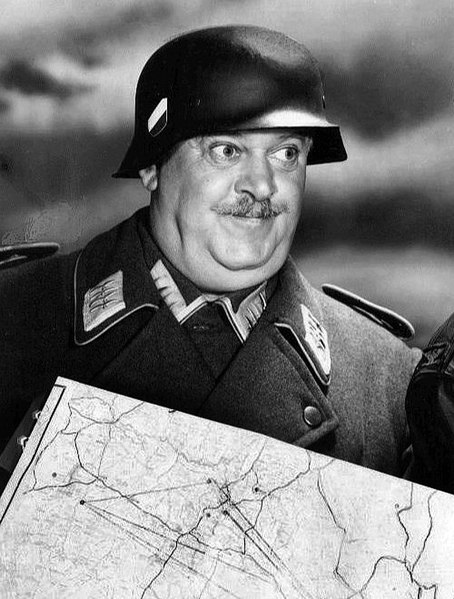
The federal government collectively and individually (in the person of Justin Trudeau’s chief of staff) continues to do their vastly unconvincing Sergeant Schultz imitation, “I see nothing! I hear nothing! I know nothing!”

John Banner as Sergeant Schultz in Hogan’s Heroes, 1965.
CBS Television promotional photo via Wikimedia Commons.
We at The Line ended a long week staring agog and aghast at Katie Telford, the prime minister’s chief of staff, who was interviewed by members of the Standing Committee on National Defence over her knowledge (such as it was) of the sexual misconduct allegations made against now-retired Army general Jonathan Vance.
Vance, until recently the chief of the defence staff, the highest position in the Canadian Armed Forces, was accused of sexual misconduct by a female subordinate in 2018, but nothing came of it because, well, hey, Telford explained. Life is complicated. Right?
We don’t really have the emotional wherewithal to summarize the entire proceeding at length. Suffice it to say that nothing new was learned. Telford’s defence continues to be the same as the ones offered by other Liberal officials — they knew there was an allegation of some kind, but not what the allegation was. And they were clearly content to leave it that way for three years. The problem for Telford, of course, is that Global News already obtained documents showing internal emails among senior staff openly discussing “sexual harassment” allegations against Vance. We accept that Telford and other high mucky-mucks didn’t know the details of the allegations, but if they didn’t know that they were related to sexual misconduct, their ignorance was a product of a deliberate, sustained multi-year effort.
Our official opposition wasn’t exactly draping itself in glory either, alas, which might explain why they remain a distant second in the polls. The Tory MPs on the committee clearly had their battle plan, and they were sticking to it: they wanted to know why Telford hadn’t told the PM that there had been allegations of some kind against Gen. Vance, or who had made that decision, if not her. We know that they wanted to know this because they asked her this 50 or so fucking times. And each time she just declined to answer, offering up some word salad instead. Yet the Tory MPs just kept going in again and again, like infantry marching into machine-gun nests in one of the dumber battles of the First World War. We assume their strategy was to create memorable soundbite moments of Telford refusing to answer, or maybe trip her up into a gotcha. But the Tories spent so much time repeating the one question Telford had already made manifestly clear she was not gonna answer that they didn’t ask a way better question: what the hell are women in the armed forces supposed to react to the fact that their government knew that there were sexual misconduct allegations against Gen. Vance, and that they just sat around and waited for him to retire three years later?
Look, we weren’t born yesterday. If we were, we wouldn’t be as exhausted as we are. (Though probably roughly equally as frightened of sudden loud noises.) We know that there is a political desire for the CPC to link Trudeau himself to the scandal. But there was a bigger, more profound scandal laying right before their eyes — everyone in the PMO and the senior levels of National Defence knew there were unanswered questions about Gen. Vance and they were all A-fucking-OK with that. For years. The right questions to ask weren’t what Trudeau knew, and when, or who chose to tell (or not tell) him this, that or the other thing. The only relevant question is how these people could dare look any female member of the military, or any of their loved ones, in the eyes.
The PMO and senior defence officials knew. For three years. They didn’t know everything, but they knew enough to know they should know more. No one cared. So Gen. Vance stayed in command, and oversaw the military’s efforts to, uh, root out sexual misconduct and end impunity among high-ranked abusers.
That’s what the CPC should have been asking about, and that’s what Canadians should be angry about. But they didn’t, and we aren’t. And that’s why nothing’s gonna change.
March 25, 2021
Boris wanted to be a new Churchill, but instead is shaping up as a cut-rate Cromwell
Bella Wallersteiner on the vast difference between Boris Johnson’s hopes for his premiership and the actual role he’s been playing:
A year has passed since the British public accepted lockdown as the best way to combat the spread of the novel coronavirus, yet we are still living under the strictures of the Coronavirus Act.
In the name of virus protection, we have experienced a level of authoritarianism not seen in this country since the time of Oliver Cromwell – restrictions on freedom of movement, forced closure of businesses, and prohibitions on weddings and funerals have challenged many of our most cherished beliefs about the limits of government power, while the ban on large gatherings means we cannot even legally protest them.
Today, as we mark the anniversary of the first lockdown, we would do well to reflect on just how compliant we have become to what were intended to be “emergency” powers.
Cheery platitudes have ranged from “we’re all in this together” and “we’ll send this virus packing” to the hopelessly inaccurate “it will all be over by Christmas”. But history tells us that governments tend to hold on to additional powers far longer than is necessary.
The Defence of the Realm Act of 1914, for example, granted the government wide-ranging powers in the name of public safety, including heavy censorship of the press and the introduction of rationing. Pub licensing laws remained in place for decades, only relaxed in November 2005.
The Second World War brought The Emergency Powers (Defence) Act 1939 which ceded immense regulatory powers to the government, including provisions “for the apprehension, trial and punishment of persons offending against the Regulations and for the detentions of persons whose detention appears to be expedient to the Secretary of State in the interest of public safety or the defence of the realm”. The Act was finally repealed on 25th March 1959, but the last of the Defence Regulations (which included the maintenance of public order) was not lifted until 31st December 1964.
March 11, 2021
Boris as a latter-day Prince Rupert of the Rhine?
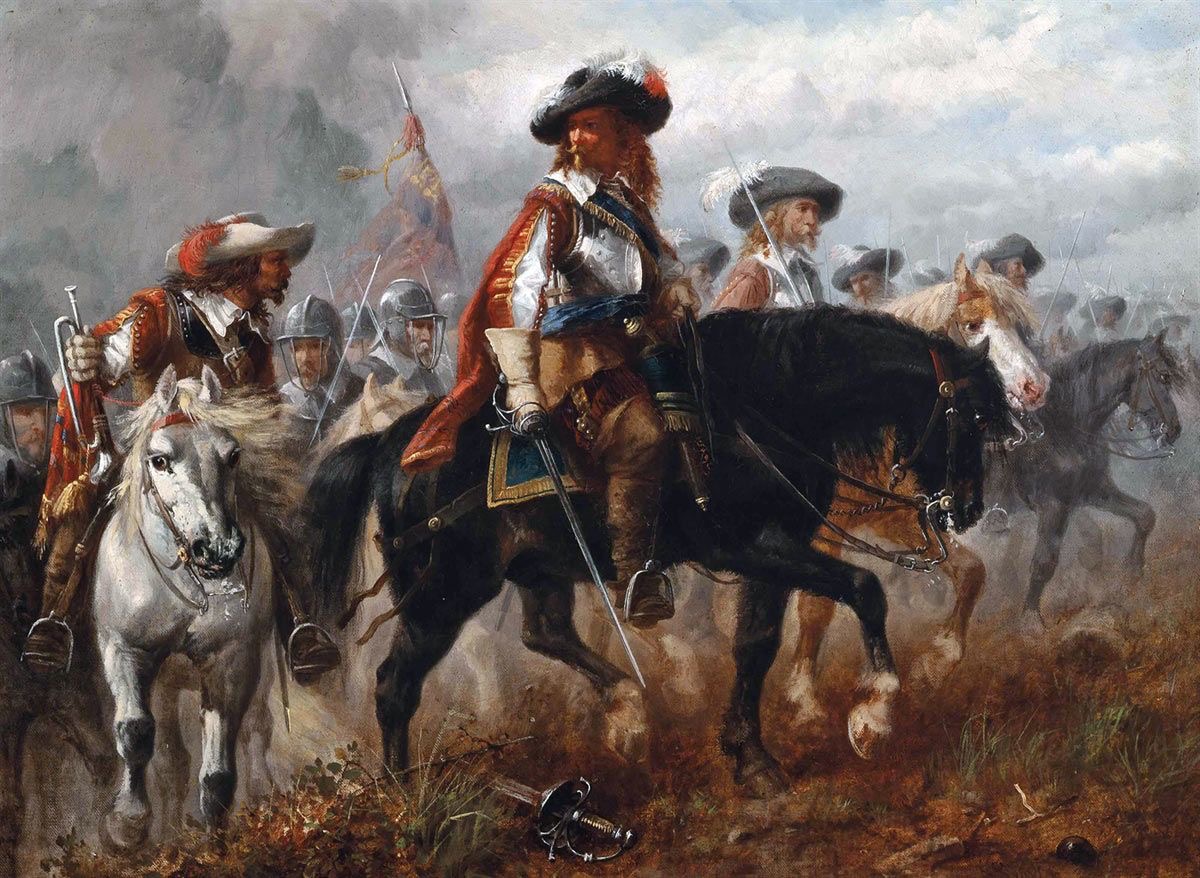
In The Critic, Graham Stewart portrays the British Prime Minister and Sir Keir Starmer, leader of Her Majesty’s loyal opposition in the House of Commons as English Civil War combatants:

King Charles I and Prince Rupert before the Battle of Naseby 14th June 1645 during the English Civil War.
19th century artist unknown, from Wikimedia Commons.
Prime Minister’s Questions distils into a single gladiatorial contest what thousands of enthusiasts in a charitable organisation called the Sealed Knot perform across the country most summers – namely the re-enactment of battles of the English Civil War.
Unsmiling, relentless, serious to the point of bringing despair to his foot-soldiers as much as his opponents, Sir Keir Starmer is a Roundhead general for our times. Nobody believes better than he that virtue and providence are his shield. This faith sustains him whilst the fickle and ungodly court of popular opinion fails to rally to his command. He believes that holding firm, doggedly probing the enemy with the long pike and short-sword will eventually prevail, no matter how long the march to victory may prove.
Facing him, the generous girth of the nation’s leading Cavalier occupies his command-post. His long, uncut hair resembling a thatch on a half-timbered cottage, Boris Johnson lands at the despatch box as if he has just fallen from his place of concealment in an oak tree, bleary and under-prepared, but confident in assertion. It might be said of him, as Sir Edward Bulwer Lytton once said of the parliamentary style of a previous Tory prime minister, Lord Derby, that Johnson is “irregularly great, frank, haughty, bold – the Rupert of debate.”
Today was one of those occasions when the prime minister did indeed resemble the dashing Prince Rupert of the Rhine. Unfortunately, it was the moment during the decisive civil war battle of Naseby when the great Cavalier commander charged his horsemen through the parliamentary lines with such momentum that they kept going and ended up spending the rest of the day plundering a distant baggage train rather than returning to determine the result of the battle.
February 12, 2021
Calls for the federal government’s Broadcasting bill (Bill C-10) to be withdrawn
Michael Geist updates the situation with the federal government’s attempt to massively rework the Canadian broadcast and internet regulation framework without proper scrutiny or transparency:
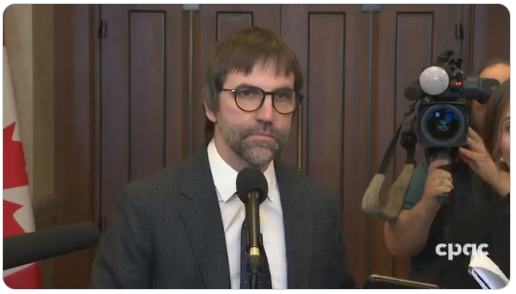
I have not been shy about expressing my concerns with the Bill C-10, the Broadcasting Act reform bill. From a 20 part series examining the legislation to two podcasts to a debate with Janet Yale, I have actively engaged on policy concerns involving regulation that extends far beyond the “web giants”, the loss of Canadian sovereignty over broadcast ownership, the threat to Canadian intellectual property, and the uncertainty of leaving many questions to the CRTC to answer. Yet beyond the substance of the bill, in recent days an even more troubling issue has emerged as Canadian Heritage Minister Steven Guilbeault, his Parliamentary Secretary Julie Dabrusin, and the Liberal government abandon longstanding commitments to full consultation, transparency, and parliamentary process.
Last week, I appeared before the Standing Committee on Canadian Heritage as part of what it is calling a “pre-study” on Bill C-10. In this case, “pre-study” is euphemism for avoiding the conventional parliamentary process. Bill C-10 has not yet passed second reading in the House of Commons and has not been referred to committee for study. There have been extensive debates in the House and last week Conservative MP Michael Kram called for the bill to be withdrawn, noting that politicians could do Canadians a lot of good by “rewriting it from scratch.” That move drew criticism from Guilbeault during an interview at the CMPA Prime Time event, as he called for pressure on the Conservatives to support referring the bill to committee. There are instances of pre-study, but doing so concurrently with second reading makes no sense since a pre-study allows for a wide range of amendments, whereas after second reading the permitted amendments are more limited.
In an earlier era (or with a different government), the prospect of conducting a study of the bill while simultaneously engaging in second reading would garner loud objections. In fact, at the Heritage Committee hearing last week, opposition MPs wondered why they were already being asked for amendments to the bill when they had yet to hear from witnesses, much less conduct an actual study of the bill. Indeed, for a government that once prized itself on robust consultation, it seemingly now wants to avoid any genuine consultation on Bill C-10, content to have potential amendments presented through lobbyists, rather than on the public record in open hearings.
The secrecy does not end there. At the same hearing (I was a witness and waited patiently for these issues to play out), Conservative MPs raised questions about promised data on how the government had arrived at claims that the bill will generate over $800 million in new money. Leaving aside the fact that Guilbeault has often inflated that figure to over $1 billion, there has no public disclosure about the source of this claim. Cartt.ca reports that officials told the committee that the calculations could be “confusing” without a verbal explanation. Days later, Dabrusin told the committee that in fact the data had been provided to the committee late last year but perhaps not distributed to committee members.
When I was questioned by Conservative MP Kevin Waugh during my appearance before the committee, he again raised concerns about the claim. Dabrusin interjected with a point of order to make it clear that the data had been provided to the committee, albeit not distributed to MPs. What made the exchange so striking was that Dabrusin – a parliamentary secretary – seemingly did not give any thought to the fact that the data has not been made publicly available. Promoting long overdue disclosures to a handful of MPs while the public is kept in the dark is hardly the stuff worthy of praise or a point of order.
February 7, 2021
Former Liberal MP dishes on Justin Trudeau in her new book
When I moved out of Whitby, the local Member of Parliament was Liberal Celina Caesar-Chavannes. She was, we thought, a high-profile person who’d probably be quickly moved into a junior cabinet position, as Justin Trudeau sets a very high value on being seen to be supportive of women and minorities. As she quickly discovered, however, with Trudeau it’s very much the “being seen” part that matters to him and almost nothing in the way of actually being supportive:
[After a kerfuffle with opposition MP Maxime Bernier] she said she didn’t hear from most of her Liberal colleagues or the prime minister until a #hereforCelina hashtag campaign started weeks later, in response to a column that accused her of “seeing racism everywhere.” When she later confronted Trudeau about the lack of support, she said he told her, “As a strong Black woman, I didn’t think you needed help.” She said Conservative MP Michelle Rempel Garner was more supportive to her during that period than Trudeau.
The incident is one of many allegations of racism, tokenizing, and microaggressions Caesar-Chavannes wrote about in her new memoir Can You Hear Me Now?, which came out February 2.
[…]
Caesar-Chavannes told VICE World News her experiences of being tokenized, excluded, and undervalued led her to resign from the Liberal caucus and not run again in the 2019 election. Her decision culminated in an explosive conversation with Trudeau in February 2019, during which she alleges he complained to her about being confronted about his privilege. She said he was angry that she wanted to resign on the same day then Minister of Veterans Affairs Jody Wilson-Raybould quit her cabinet role, in the midst of the SNC-Lavalin scandal, the biggest crisis the governing Liberals had faced since Trudeau’s election in 2015.
“I was met with an earful that I needed to appreciate him, that everybody talked to him about his privilege, that he’s so tired of everybody talking to him about this stuff, and that I cannot make this announcement right now,” she said. She alleges he told her “he couldn’t have two powerful women of colour leave at the same time.”
After listening to his “rant” for a while, Caesar-Chavannes said she cussed out the prime minister.
“I had to ask him, ‘Motherfucker, who the fuck do you think you’re talking to?'” she said. “I was so angry.”
She said she didn’t make out what Trudeau said after that, but it “sounded like he was crying.” She ended up delaying her resignation announcement until March 2019.
Caesar-Chavannes said the Liberal party’s treatment of Wilson-Raybould — an Indigenous woman and whistleblower — made her feel like many of her colleagues were “fake as fuck” and cemented her desire to sit as an independent.
January 22, 2021
QotD: The enclosure movement, in historical fact and in Marxist imagining
Consider, for example, that the tenfold increase [in the population of London] was in the period before the expropriative parliamentary enclosures of Marxist legend, when state fiat was used to deny smaller farmers their ancient, customary rights to use the land near their villages. While the very first of these enclosure acts appeared as early as 1604, parliamentary enclosure only really got going from the mid-eighteenth century. Instead, for the period in question, enclosure happened in a piecemeal way, with the open fields gradually dissolving as farmers exchanged or sold their tiny strips of land, over time amalgamating them into larger, privately controlled plots. With ownership concentrated in fewer and fewer hands, it became relatively easy to gain the unanimity needed to suspend common rights. The process played out in myriad ways all over the country, sometimes with amicable agreement and voluntary exchange, sometimes with ruthless monopolising of the land, with the already-large owners systematically buying out their neighbours. In some cases it involved the consolidation of existing arable land, in others it meant the conversion of forest, heath, marsh, or fen — the traditional “wastes”, to which the poorer villagers might have had various customary rights to gather firewood for fuel, or to graze their cattle, or to hunt for small game — into land that could be used for farming or pasture.
How this process played out all depended on extremely specific, local conditions. But on the whole it was slow — piecemeal enclosure had been happening to varying degrees since at least the fourteenth century. It’s hard to see how such a sporadic and piecemeal process could have led to such consistently and increasingly massive numbers flocking specifically to London. Indeed, the fact that they singled out London as their target suggests that this narrative might have it back-to-front. Some economic historians argue that it was the prospect of higher wages in the ever-growing metropolis that induced farmers to leave the countryside in the first place, selling up or abandoning their plots to those they left behind. Rather than enclosure pushing peasants off the land and into the city, London’s specific pull may instead have thus created the vacuum that allowed the remaining farmers to bring about enclosure. Otherwise, why didn’t the peasants simply flock to any old urban centre? The second-tier cities like Norwich or Bristol or Exeter or Coventry or York would all have been far less dangerous.
Anton Howes, “London the Great”, Age of Invention, 2020-10-20.
November 26, 2020
Deport All Anarchists! – The Palmer Raids | BETWEEN 2 WARS: ZEITGEIST! | E.05 – Harvest 1919
TimeGhost History
Published 25 Nov 2020The First World War has been over for a year, and the modern era plows ahead. But so does fear and paranoia. In America, the Red Scare goes into overdrive.
Join us on Patreon: https://www.patreon.com/TimeGhostHistory
Hosted by: Indy Neidell
Written by: Indy Neidell and Francis van Berkel
Director: Astrid Deinhard
Producers: Astrid Deinhard and Spartacus Olsson
Executive Producers: Astrid Deinhard, Indy Neidell, Spartacus Olsson, Bodo Rittenauer
Creative Producer: Maria Kyhle
Post-Production Director: Wieke Kapteijns
Research by: Indy Neidell and Francis van Berkel
Image Research by: Daniel Weiss and Spartacus Olsson
Edited by: Daniel Weiss
Sound design: Marek KamińskiColorizations:
Daniel Weiss – https://www.facebook.com/TheYankeeCol…Sources:
Some images from the Library of CongressSome Soundtracks from Epidemic Sound, ODJB, Edward Elgar, Richard Strauss and Pietro Mascagni:
– “One More for the Road” – Golden Age Radio
– “Dawn Of Civilization” – Jo Wandrini
– “Deviation In Time” – Johannes Bornlof
– “Easy Target” – Rannar Sillard
– “Dark Beginning” – Johan Hynynen
– “Steps in Time” – Golden Age Radio
– “Tiger Rag” – ODJB
– “Cello Concerto” – Edward Elgar
– “Pomp and Circumstance” – Edward Elgar
– “Die Frau ohne Schatten: Act III” – Richard Strauss
– “Cavalleria Rusticana” – Pietro Mascagni
– “What Now” – Golden Age RadioArchive by Screenocean/Reuters https://www.screenocean.com.
A TimeGhost chronological documentary produced by OnLion Entertainment GmbH.
October 25, 2020
Canada’s broken [REDACTED] to [REDACTED] [REDACTED]
In The Line, a look at the failings of the federal government’s promises to fix the badly broken Access to Information system:
Sometimes, Line readers, though we always strive to be fair, we cannot deny that certain politicians are just fun to skewer. Because some of them are just terrible, terrible people, and while we polite Canadians don’t normally report too much on the personal lives of our elected leaders, well, what can we say? When you can, within responsible journalistic bounds, give a dirtbag a hard time for falling down on the job, hey. Life is good!
Patty Hajdu, the federal minister of health, is actually … perfectly pleasant. This isn’t unheard of in our politicians, but it’s rare enough to mention here, all to make very clear that we take no particular pleasure in reporting on her pathetic performance this week. But report it we must. And pathetic it surely was.
Under sharp questioning by Tory MP Michelle Rempel Garner, Hajdu very carefully and deliberately aimed a soon-to-be-banned .44 Magnum revolver at her foot, waited a dramatic second for effect, and then figuratively blew her poor extremity to smithereens. Rempel Garner had been asking about the abysmally broken state of the federal access-to-information systems, and Hajdu, with all-too-Liberal scorn, stood up and declared:
Mr. Speaker, I have spoken to hundreds, if not thousands, of Canadians since the pandemic was first announced, when COVID-19 arrived on our shores. In fact, not once has a Canadian asked me to put more resources into freedom of information officers. What they have asked me for is to ensure that all the resources of Canada are devoted to one thing, and that is the health, safety and economic prosperity of our country. We are going to continue to make sure that Canada has the most robust response possible.
There are two gigantic problems with Hajdu’s answer there.
The first is that Canada’s access-to-information regime is notoriously dysfunctional, and her government has long admitted that. Indeed, fixing this disgrace was a major plank in the party’s 2015 platform.
In the years since, the government has effectively accomplished the square root of zero.
October 6, 2020
Has Boris had his fifteen minutes yet?
James Delingpole is very much of the opinion that Boris Johnson’s time is almost up and is starting to consider who would replace him as British PM:

Prime Minister Boris Johnson at his first Cabinet meeting in Downing Street, 25 July 2019.
Official photograph via Wikimedia Commons.
It’s no longer a question of “if” but when the ailing, flailing UK Prime Minister crashes and burns. The only remaining questions now are “How much more damage is the buffoon going to inflict before he retires, gracefully or otherwise?” and “Who is going to pick up the pieces when he is gone?”
With the second question, my money is on Chancellor Rishi Sunak. Sure he’s a young-ish (40), fairly untested, partly unknown quantity and, perhaps worse, he’s a graduate of Goldman Sachs. On the other hand, with no General Election likely till 2024, it’s a simple fact that whoever replaces Johnson as prime minister will almost certainly be a member of his current cabinet. Sunak scores highly because he’s arguably the senior minister least tainted by Johnson’s spectacular mishandling of Chinese coronavirus.
Unlike Johnson, his preening Health Secretary Matt Hancock, and Chancellor of the Duchy of Lancaster Michael Gove, Sunak is not one of the so-called “Doves” advocating for ever more stringent measures — lockdowns, masks, curfews, quarantines, a mooted cancellation of Christmas.
Rather, he is the leader of the Hawk faction arguing that it is long since time to prioritise the economy.
True, opinion polls currently favour the Doves — aka the Bedwetters. The British public has so far proved remarkably amenable to having its freedoms snatched away in order to keep it “safe” from coronavirus. Polls continue to suggest that the vast majority of British people want more authoritarian measures, not fewer, in order to deal with the crisis. And Dominic Cummings — the sinister, opinion-poll-driven schemer who, as Johnson’s chief advisor has been controlling the Prime Minister much in the manner of Wormtongue controlling King Théoden in Lord of the Rings — has been more than happy to oblige.
But it would be a massive error to assume that this state of affairs will last.