Quotulatiousness

June 9, 2022

A brutal microcosm of the English Civil War

Filed under: Books, Britain, History, Military — Tags: , , , , , — Nicholas @ 03:00

At The Critic, Jonathan Healey reviews The Siege of Loyalty House by Jessie Childs:

Late in the summer of 1641, with Charles I deep in dispute with his Parliament, alarming reports reached Westminster of Catholics amassing arms at Basing House in Hampshire. At this point in time, few expected civil war, but plenty feared an imminent Catholic plot. Recent reform to the Church had introduced lavish ceremonies which looked, to many eyes, like the trappings of Rome, and Charles himself was married to a Catholic.

More to the point, England’s Catholics had done it before. Every year, people marked the anniversary of the Gunpowder Treason, which was already stuck in the national consciousness as the quintessential Popish rebellion: an armed coup plotted by dissident aristocrats gathering weapons on their great rural estates and planning subterfuge at the highest levels.

Yet civil war came, and when it did it would be nothing like the “Popish Plots” of Protestant imagining. It would be fought over constitutional as much as religious divides. And, rather than a rebellion, it would be an armed struggle between two competing fiscal-military organisations — effectively between two competing states.

The English countryside became militarised. Now, it was not just a landscape. It was territory. The great houses were no longer places for covert plotting; now they were centres of command and control. And few were more important than Basing House.

Hampshire today is a pleasant place: gentle and verdant with rolling chalk hills, shaded woodlands, and quiet valleys. But in the 1640s it became contested and dangerous: a dark, malevolent land of violence and death. People looked upon one another with suspicion, and riders were ambushed and killed as they travelled at night. Parish churches were stormed, towns starved and bombarded. Armies of musketeers, pikemen, and cavalry traversed the folding lanes of the county looking to bring bloodshed and plunder.

[…]

A crucial theme is encapsulated in the book’s denouement. The deputy sent to pacify Hampshire for the New Model was Oliver Cromwell. He had been in the thick of the fighting from the start, and before then was an earnest — if obscure and scruffily-attired — Member of Parliament. But Cromwell really rose to prominence in 1644 and 1645, on the back of his military abilities. He represented a new approach to the war: the pursuit of total victory even at the cost of sharp bloodshed.

It was Cromwell’s direct — even brutal — efficiency that brought the siege of Basing House to its end. The walls fell and many of the garrison were killed. Slaughtered, too, were a number of Catholic priests in a moment of violence that was representative of the way the war was heading. Cold-blooded murder of female camp followers had been perpetrated by royalists in Cornwall and by parliamentarians after Naseby. King Charles had allowed a bloody storm of Leicester which had cost many civilian lives, and Cromwell would go on to oversee the horrors of Drogheda and Wexford in Ireland. The chivalry of Waller and Hopton would come to seem a long way in the past.

May 15, 2022

QotD: Parliament

Filed under: Britain, Government, Politics, Quotations — Tags: , , — Nicholas @ 01:00

What is the use of Parliament if it is not the place where true statements can be brought before the people? What is the use of sending Members to the House of Commons who say just the popular things of the moment, and merely endeavour to give satisfaction to the Government Whips by cheering loudly every Ministerial platitude, and by walking through the Lobbies oblivious of the criticisms they hear? People talk about our Parliamentary institutions and Parliamentary democracy; but if these are to survive, it will not be because the Constituencies return tame, docile, subservient Members, and try to stamp out every form of independent judgment.

Winston S. Churchill, speech around the time of the Munich crisis, 1938.

May 9, 2022

Canada has no abortion law on the books: this is extremely convenient for the federal Liberals

Filed under: Cancon, Government, Health, Law, Media, Politics, USA — Tags: , , , — Nicholas @ 05:00

In the free-to-cheapskate-freeloading readers portion of The Line‘s weekly dispatch, the editors explain why we should expect exactly zero change to Canadian law on the abortion issue regardless of what happens in the United States in the wake of a leaked US Supreme Court draft decision that has agitated and carbonated the debate there all over again:

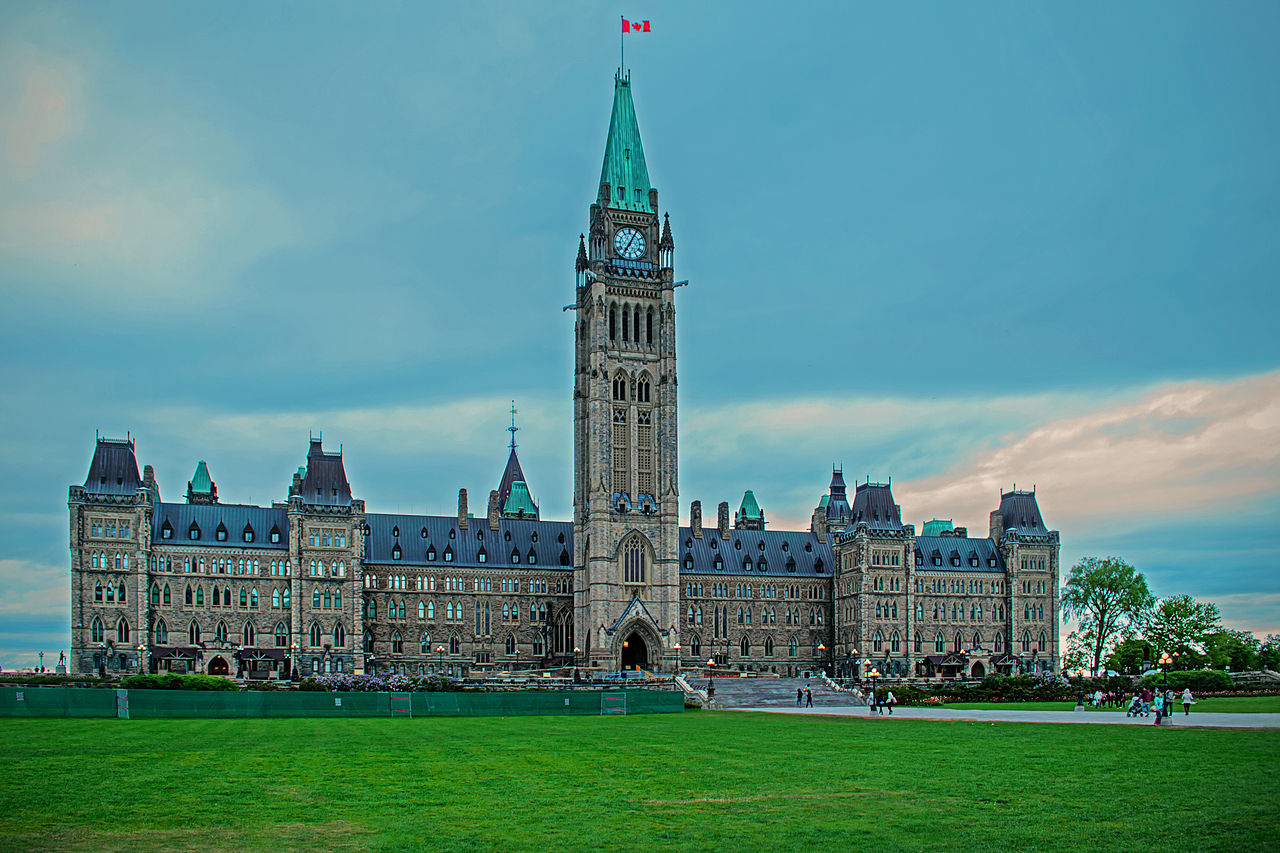
Parliament Hill in Ottawa.
Photo by S Nameirakpam via Wikimedia Commons.

… given the extent to which Canadian media and politics has become thoroughly Americanized in the past few years, it was inevitable that the draft ruling immediately took over the front pages of our national papers and became the dominant topic of debate in the House of Commons. And while we are loath to contribute to what we see as a very unhelpful trend, there are some Canada-relevant aspects of this that at least one of your editors thinks are worth discussing.

The first is the obvious glee with which the Liberal party greeted the leak. Of course they all acted appalled, with a parade of cabinet ministers taking to Twitter to talk about the “concerning” news out of the U.S. and to make it clear that they would never allow anything like this to happen in Canada.

But for all their bluster, the Liberals long ago perfected a curious little two-step here. On the one hand, they never tire of asserting that the debate over abortion is “settled”, and that the pro-choice position is and will always be the law of the land. Yet on the other hand, Liberals are constantly acting as if we’re just one private member’s bill away from Canada becoming the Republic of Gilead. But as Chris Selley pointed out in a recent column, if abortion rights are so fragile and tenuous, why haven’t the Liberals done anything about it? Perhaps the imminent overthrow of Roe v. Wade in the U.S. might provide the government with the perfect occasion to finally put abortion rights on Canada on a proper legislative footing. Or, at the very least, define and defend the status quo.

That will never happen, for two reasons.

The first reason the Liberals won’t move to do something has to do with a philosophical equivocation at the heart of Canada’s pro-choice movement. In some guises, the pro-choice position is framed as a harm reduction policy, not completely dissimilar to needle exchange programs or safe injection sites for drug users. That is, while we may legitimately debate and disagree over the moral worth of the activity itself, there is no question that it is something that is going to happen regardless. Given that, the best thing for the state to do is make sure that the circumstances under which it takes place are as safe and accessible as possible, while withholding moral judgment.

But there’s another position, which holds that abortion is akin to a victimless crime: the fetus simply deserves no moral standing, so getting an abortion is no more morally controversial than getting your appendix removed.

The advantage to the status quo is that it allows the government, as well as pro-choice supporters, to remain formally agnostic on this question. There is no law, so the law needs to take no position. But any attempt to put a legal framework around abortion would probably require that the fetus be given some status at some point in development. And that opens a huge can of worms, not least for someone like Justin Trudeau who, at times, has claimed to be personally opposed to abortion but a pro-choice practicing Catholic. Why would he be against abortion personally, unless he believed that it was, at some level, wrong?

This brings us to our second point. In his column, Selley called on Trudeau to “grow up” and defend the status quo on its principles. But why would he do that? The Liberals benefit enormously from the status quo, including the lack of clarity around it. Abortion is legal (in the sense that there is nothing in the criminal code forbidding it), and reasonably accessible, depending on which part of the country you live in. But it’s also tenuous, which means the Liberals get to spend a good part of every election campaign wedging the ever-loving crap out of the Conservatives, whose benches are chock full of people who are anti-abortion, or at least, anti-the-status-quo on abortion.

Given how successful this strategy has been, there is no reason for the Liberals to change it, since for them the tenuous status of abortion is a feature of the current regime, not a bug.

April 26, 2022

QotD: “Boris Lloyd George”

Filed under: Britain, History, Politics, Quotations — Tags: , , , , — Nicholas @ 01:00

Since Lloyd George’s admirers are usually found at the liberal end of the spectrum, I imagine many of them will be displeased by the comparison. It’s true that Lloyd George — born in 1863, brought up speaking Welsh, steeped in the Baptist faith of his native land — came from a relatively humble background, never went to Eton, was a brilliantly fluent speaker and had an extraordinary appetite for hard work. And in his early days he exhibited an admirable commitment to all kinds of unfashionable causes — that is, until he sold out.

But more than any other twentieth-century PM, the last Liberal premier embodied the ambition, promiscuity and shameless indifference to rules and conventions that have driven Boris Johnson’s critics mad. Boris might be a mountebank, but Lloyd George was the mountebank’s mountebank.

Had he been prime minister during the Covid pandemic, would he have held parties at Number 10? The answer is obvious. He wouldn’t just have invited you to a party, he’d have sold you a peerage and made a move on your wife while you were still hanging up your coat.

Lloyd George was brilliantly funny. He was patriotic. He had the common touch. He was also, to quote Max Hastings on his modern-day successor, a “cavorting charlatan”, a “bully”, a “rogue” and a “scoundrel”, who “would not recognise truth, whether about his private or political life, if confronted by it in an identity parade”. And like Boris, he never hid it; quite the reverse. “My supreme idea is to get on,” he wrote to his future wife, Maggie Owen, during their courtship. “I am prepared to thrust even love itself under the wheels of my Juggernaut if it obstructs the way.” He meant every word.

According to one of his own aides, Lloyd George was “mental on matters of sex. In his view, a man and a woman could not possibly be friends without sexual intercourse.” That sounds familiar. Like Boris, he could never be entirely sure how many children he had. Within months of his marriage to the stolid and long-suffering Maggie, he had already strayed, impregnating a Liberal activist known only as Mrs J.

Not content with also impregnating his wife’s cousin Kitty, he also had affairs with “Mrs Tim” who was married to his friend Timothy Davies, as well as Julia Henry, another Liberal MP’s wife. He also carried on for decades with his secretary, Frances Stevenson, whom he forced to have at least two abortions. And there were many more — so many that nobody has ever produced a definitive count.

At the time, people joked that Lloyd George had a child in every town in Britain. The story goes that one day his son Dick went into a pub and fell into conversation with a stranger who looked just like him. The stranger eventually confessed that Lloyd George was indeed his father, and was secretly paying him £400 a year. To cap it all, some biographers suggest that Lloyd George also slept with Dick’s troubled wife, Roberta — and this when he was well into his sixties! By these standards, even Boris seems a paragon of fidelity.

Dominic Sandbrook, “How to bring down a Prime Minister”, UnHerd, 2022-01-14.

April 13, 2022

A new look at the Commonwealth and the Protectorate of Oliver Cromwell

Filed under: Books, Britain, History — Tags: , , , , , — Nicholas @ 03:00

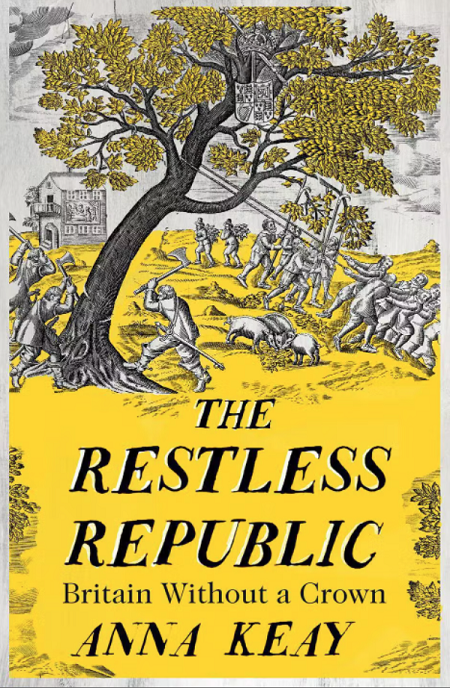
In The Critic, Miranda Malins reviews a new history of the period between the execution of Charles I and the Stuart restoration of Charles II, The Restless Republic: Britain Without a Crown by Anna Keay:

This evasion is not for the historian Anna Keay. Faced with these collective shortcomings (“This book was born of ignorance,” she explains in opening), she explores this most dynamic of decades, looking it squarely in the face. With her, we roam around the period, the broad chronological narrative softened through a selection of nine interwoven biographies ranging from the irrepressible newspaperman Marchamont Nedham, to the indomitable royalist Countess of Derby, from the brilliant scientist William Petty to the dreaming Digger Gerrard Winstanley.

This structure achieves a broad perspective and rare realism, giving the reader the sense of dipping and diving through the restless waves of the republic and taking them to all corners of the new Britain forged in the fire of three Civil Wars. As expected, we travel from the trial and execution of Charles I to the Restoration of his son, but Keay’s achievement is to make the shape-shifting years of the kingless Commonwealth and Protectorate that lie between more thrilling than either royal bookend, demonstrating how far from inevitable the return of the Stuarts was. There is no “high road to Restoration” here, but rather a snaking maze of paths striking off in new directions and looping back: an uncharted landscape for Keay’s characters to navigate where every choice counted.

The result is a panoramic and pulsating drama every bit as restless as the republic it captures so well. Indeed the “Restless” adjective of the title perfectly conjures the progressive spirit of Britain without a crown: unstable and dangerous, yes, but as a result, experimental and unafraid. As Keay puts it: “The 1650s was a time of extraordinarily ambitious political, social, economic and intellectual innovation, and it was not a foregone conclusion that the British republic would fail.”

This portrait will be, for many, a revelation. Far from the dour, militaristic regimes of popular imagination, life under the Commonwealth and Oliver Cromwell’s Protectorate emerges as innovative and exciting: the effect of the hitherto unimaginable act of abolishing the monarchy and House of Lords after years of transformative conflict being to unleash an energetic spirit of ambitious experimentation and industry.

We feel this bold energy in the meetings of the Oxford Experimental Philosophy Club (which would become the Royal Society in 1660) and its young member William Petty managing to survey the whole of Ireland in record time despite having no cartographical experience; in failed cloth trader Gerrard Winstanley’s determination to dig the new Jerusalem that had come to him on an autumn ramble; in Marchamont Nedham escaping Newgate prison and picking his way through several dangerous changes of side, pen in hand, always managing to land cat-like on his feet through sheer commercial nous and audacity.

March 28, 2022

The only question in my mind is why the NDP thought they’d benefit from propping up Trudeau the Lesser

Filed under: Cancon, Government, Politics — Tags: , , , , — Nicholas @ 03:00

The editors at The Line, having taken last week off to look after kids on March break, sent out a brief round-up post on the deal Jagmeet Singh made with the Devil Justin Trudeau to keep the Liberals comfortably in power for (potentially) the full term:

The key question here that we can’t really think up an answer for is what this deal changes. In big picture terms, the NDP is going to keep the Liberals alive for a while, and the Liberals will serve up some goodies the NDP base will like. That’s what the parties have agreed to, distilled to the most basic essence.

And this is new how? This has changed what?

The NDP doesn’t want an election right now. The Liberals don’t want an election right now. The Liberals are led by a guy who has already moved the party toward the left and seemed quite happy to do it. The Liberals were getting along just fine with NDP support until they rolled the electoral dice and tried to secure a majority in summer of 2021; they fell short, and now they’ll continue getting along just fine with NDP support.

Well, gee. Stop the presses.

Yes, yes, there’s more specific commitments. The parties have put on paper what they’ll work jointly to achieve. But look at those commitments. Anything surprising? Is this not precisely what any random collection of reasonably bright high schoolers in a mandatory civics class could have guessed when their teacher told them to write a five-paragraph essay on things the NDP and Liberals agree on?

We aren’t particularly swayed by arguments, largely from angry Conservatives, that this deal suddenly leaves the Liberals immune from accountability. Again, the NDP was already playing ball to avoid an election. A week ago, the Liberals were going to be held precisely as accountable as Singh found convenient, and that’s just as true now as it was then. It’s not that the angry Conservatives are wrong about the Liberals being immune from accountability. It’s just that they essentially already were, NDP protestations aside. The NDP will tighten the screws enough to make Trudeau uncomfortable but not enough to trigger an election. They won’t be an opposition, but they’ll play one on TikTok. This sucks, but it is what it is, folks.

Nor do we expect the deal to last the full four years. Hey, it could happen. Both parties could find reasons to keep it going. But remember: this is a gentlemen’s agreement between gentlemen that don’t like each other. Gentlemen who are both pursuing different personal and political agendas. This deal will last right up until the moment one of them sees more advantage in stabbing the other guy than in continuing to play nice-nice.

We admit we really aren’t sure what the Liberals are thinking here. Trudeau had a largely free hand already. This is, to us, baffling.

And as for the NDP, well, gosh, all we can say is good luck, fellers. An old grizzled political observer your Line editors once knew liked to joke that being the junior partner in these kinds of arrangements is like being the mistress of a rich, married man. If you don’t know that you will be dumped while your former lover runs back to his family — the base voters, the caucus, the donors — well, sorry, sweetheart, but that’s on you. We saw a version of this play out in Ontario just a few years ago: the provincial NDP propped up the minority Liberals in exchange for a pledge to cut auto-insurance premiums. The Liberals failed to deliver, ran another election, won another majority and shrugged off the NDP’s complaints. The auto-insurance promise? Meh. That was just a stretch goal.

February 26, 2022

“The [House of] Commons of 1621 would get completely out of control — all thanks to beer”

Filed under: Britain, Government, History — Tags: , , , , , — Nicholas @ 03:00

In the latest Age of Invention newsletter from Anton Howes, we’re still back in the reign of King James I of England (also at the same time King James VI of Scotland), and the king has a financial woe that has forced him once again to try getting Parliament to vote him the funds he needs to wage war:

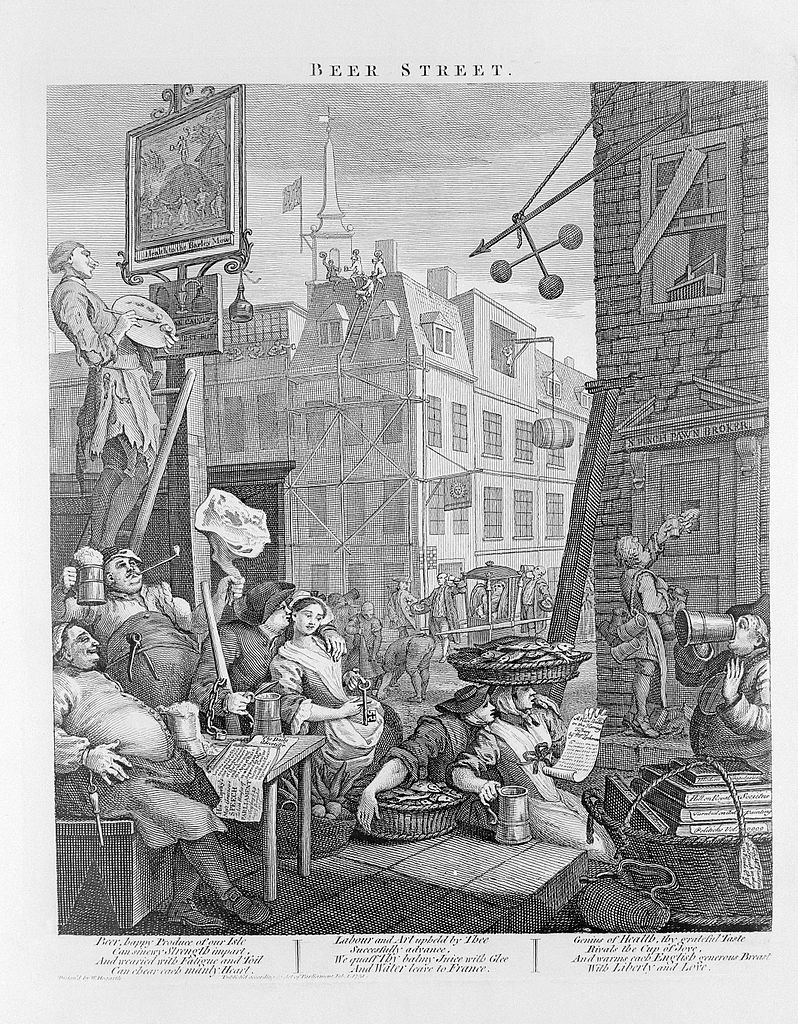
Beer Street, from Beer Street and Gin Lane by William Hogarth. The picture is a counterpoint to the more powerful Gin Lane — Hogarth intended Beer Street to be viewed first to make Gin Lane more shocking — but it is also a celebration of Englishness and depicts of the benefits of being nourished by the native beer.
Wikimedia Commons.

1620 was a dramatic year for England. As I mentioned last time, the rashness of the king’s son-in-law threatened to pull the country into a major European conflict. Religion, honour, and family — James I’s grandchildren were set to lose their inheritance, the Palatinate of the Rhine — dictated that the king should break his decades-long habit of peace. But war was hugely expensive, and the king already heavily in debt. He was forced to summon Parliament so that it could vote him the taxes he would need to wage war.

Parliament was already a major source of annoyance to James I. After 1610, he had done everything in his power to rule without its aid, at one point even comparing its lower house, the Commons, to a “House of Hell”. Yet the MPs of 1610 would come to seem almost angelic compared to those who assembled in Westminster in 1621. The Commons of 1621 would get completely out of control — all thanks to beer.

Beer (and ale, made without hops) was the most important source of calories after bread, and the first choice for hydration — cheaper than wine and safer than water, with coffee, tea, and spirits only becoming popular much later. It financially supported inns, the crucial infrastructure for travellers. Alehouses also provided a major focal point for socialising. If you controlled beer, you controlled society — second only, perhaps, to religion.

If beer was too strong, it could lead to drunkenness and unrest. If inns went unpoliced, they could become havens for criminals, heretics, sinners, and rebels. If brewers used too much malt, made from grains like barley, they could drive up the price of bread and cause famine. If beer-brewers demanded too many hops — used as both a preservative and a source of bitterness compared to sweeter ale — they could also put pressure on otherwise scarce land for food. Regulating the drinks industry correctly was thus a major priority for those in charge.

The making and selling of ale had originally been dominated by brewsters — that is, by female brewers. (Compare with the more persistent word spinster, to mean a woman who spins thread. Spinning remained women’s work long after the brewsters had been driven out of their industry. Only later, because of the independence that earning one’s own money brought, did spinster gain the more general meaning of a woman who was unmarried.) Meanwhile, hopped beer had been the preserve of immigrants. As one popular ditty put it, “Hops, Reformation, baize, and beer, Came into England all in one year”, though it had actually happened more gradually over the course of the late fifteenth and early sixteenth centuries.

Yet with population growth, and the dramatic expansion of London in particular, the drinks market became larger and more concentrated, while hop-less ale gave ground to the rise of beer. Male, English ale-brewers seized an opportunity to suppress their competition. London’s Ale Brewers’ Guild, for example, abandoned the use of hucksters — predominantly female ale-sellers — and then in 1556 absorbed the Beer-Brewers’ Guild, which had largely consisted of immigrants. The newly-amalgamated Worshipful Company of Brewers then barred immigrants from becoming members, while the English ale-brewers switched to producing beer. In 1574, they even successfully lobbied for the city to bar foreigners from being members of any guilds at all, including even second-generation immigrants born in England. The bigger the business, the more ruthless it became.

February 23, 2022

If the protest is over, why does the government believe it still needs the Emergencies Act powers?

Depressingly, the House of Commons approved Justin Trudeau’s use of the Emergencies Act, and various officials at federal and municipal level have continued rhetorical scorched-earth statements to the media and directly on social media about the protest. If the stated need for those emergency powers has abated, why are the feds still pushing to hang on to them?

In the Toronto Sun, former Liberal Party president Stephen LeDrew is scathing in his criticisms of Trudeau:

Just walk or drive through cities and villages and the countryside, and see the Canadian flags — paired with signs expressing vehement disapproval of our federal government. Loyal Canadians are fed up with their federal government.

And one person is responsible for this — Prime Minister Justin Trudeau.

He has drastically altered Canadian institutions and norms so considerably that usually calm people are raising their voices in protest.

The core of the protestors in Ottawa and other Canadian centres were angry not only about government heavy-handedness in its pandemic policies, but also the changes being brought about by Trudeau.

He has cheapened public discourse and public life.

He talks so high-minded, yet has a lifelong history of deplorable acts.

He has arbitrarily ruined the lives of many other people who have been supposedly guilty of far less egregious acts than have been proven by photographs against him — perhaps to deflect his own guilt?

Does “do as I say, not as I do” strike home? How about “one standard for the masses, and another for the elites like me?”

His intolerance, and high-handed and ill-founded rectitude has led many to regard the government with disdain, and doubt its ability to get things right.

And now his decision to not only invoke the Emergencies Act (which most minds — those not cowardly beholden to Trudeau — agree was not necessary to get the job done in Ottawa), but to keep it in force for an undetermined period (to “hunt down” some Canadians to charge them with mischief?), has shown precisely how inappropriate Trudeau really is for this high office.

David Warren is, in his own words, modestly optimistic despite the current political situation here in the Trudeaupian Maple Dictatorship:

Our provincial and Dominion governments went formally off the rails of settled law in response to the Batflu epidemic, two years ago. They arrogated to themselves powers never previously claimed by our politicians, except in wartime — to regulate the smallest details of everyday life. It began with “two weeks to disable the Constitution and Human Rights”, both here, and under Trump across the border. The “vaccine passports” were merely the latest crass obscenity of this political and bureaucratic class.

I am modestly optimistic about the course of events, however. True, I must expect direct persecution by the Party of the Dictatorship, which is out to settle scores. But the Freedom Convoy sent to the national capital has shown, for the first time in many years, that a substantial number of Canadians will resist.

That a majority cannot cope with freedom, and are likely to squall when exposed to it, I take for granted. Humans have always been “conservative”, in this worst possible sense. But the splendid Canadian reaction to tyranny went beyond what I had hoped for. In particular, many articulate voices have been raised to speak truth — in the dark fever-swamp of lies in which our culture, and by extension our economy, is choking. This will make a huge difference. The sun is distantly shining; and the spring can once again be imagined. Sunlight is the best disinfectant, to filth accumulating in public life.

In 1993, the then-governing “Progressive Conservatives” were reduced from a majority, to two seats in Parliament, and then to extinction at the “federal” level. Men of good will shall be working towards a similar result, at the next general election, in which the Liberals and NDP should be annihilated.

While my dislike of Trudeau runs extremely high, I didn’t have much of an opinion about Chrystia Freeland, the deputy PM, until very recently. Apparently, I’m way behind the curve on disliking “the Nurse Ratched of the New World Order”:

Sorkin’s Visa piece is suddenly relevant again, after fellow former finance reporter Chrystia Freeland — someone I’ve known since we were both expat journalists in Russia in the nineties — announced last week that her native Canada would be making Sorkin’s vision a reality. Freeland arouses strong feelings among old Russia hands. Before the Yeltsin era collapsed, she had consistent, remarkable access to gangster-oligarchs like Boris Berezovsky, who appeared in her Financial Times articles described as aw-shucks humans just doing their best to make sure “big capital” maintained its “necessary role” in Russia’s political life. “Berezovsky was one of several financiers who came together in a last-ditch attempt to keep the Communists out of the Kremlin” was typical Freeland fare in, say, 1998.

Then the Yeltsin era collapsed in corrupt ignominy and Freeland immediately wrote a book called Sale of the Century that identified Yeltsin’s embrace of her former top sources as the “original sin” of Russian capitalism, a “Faustian bargain” that crippled Russia’s chance at true progress. […]

Years later, she is somehow Canada’s Finance Minister, and what another friend from our Russia days laughingly describes as “the Nurse Ratched of the New World Order”. At the end of last week, Minister Freeland explained that in expanding its Financial Transactions and Reports Analysis Centre of Canada (FINTRAC) program, her government was “directing Canadian financial institutions to review their relationships with anyone involved in the illegal blockades.”

The Emergencies Act contains language beyond the inventive powers of the best sci-fi writers. It defines a “designated person” — a person eligible for cutoff of financial services — as someone “directly or indirectly” participating in a “public assembly that may reasonably be expected to lead to a breach of the peace.” Directly or indirectly?

She went on to describe the invocation of Canada’s Emergencies Act in the dripping-fake tones of someone trying to put a smile on an insurance claim rejection, with even phrases packed with bad news steered upward in the form of cheery hypotheticals. As in, The names of both individuals and entities as well as crypto wallets? Have been shared? By the RCMP with financial institutions? And accounts have been frozen? As she confirmed this monstrous news about freezing bank accounts, Freeland burst into nervous laughter, looking like Tony Perkins sharing a cheery memory with “mother”:
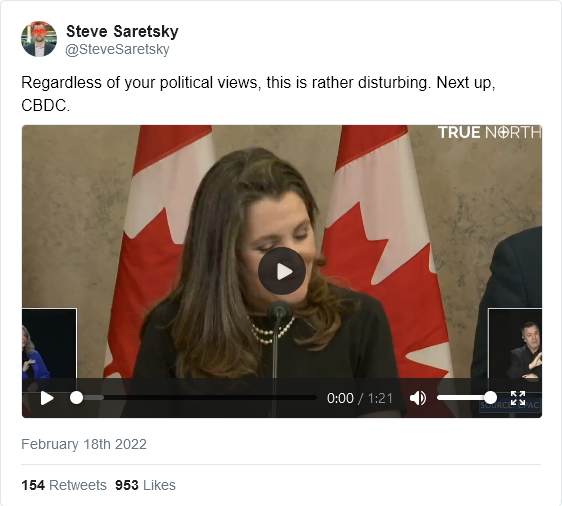
One of the oddest moments during the weeks-long protest in Ottawa was when “counter-protesters” showed up, but as one observer noted, they seemed to be at the wrong protest:

At first glance, it looked like one of the strangest, most incongruous moments of the great trucker uprising of 2022. There were the truckers and their working-class allies, in Ottawa, loudly agitating against Justin Trudeau’s vaccine mandates, when a bunch of hyper-woke, definitely not working-class counter-protesters rocked up to rail against this horn-honking throng. And what did they chant, these painfully PC counter-protesters? “Trans rights are human rights”, that’s what. As clear as anything, these supposed leftists, seemingly horrified by the sight of working-class men and women fighting for their rights, engaged in arguably the most striking non-sequitur of the 2020s so far – they brought transgenderism into an issue that has nothing whatsoever to do with transgenderism.

The truckers have said nothing about trans people. We have no idea what these pissed-off working-class drivers think about genderfluidity and all the rest. My hunch is that they think it’s nonsense. But we don’t know. This vast gathering of truckers and their supporters, which has so rattled the Trudeau administration and inspired copycat revolts around the world, is completely unrelated to sex changes and pronouns and the right of born men to beat women in sports and all the other things that fall under the banner of “trans rights” these days. So, understandably, many people were perplexed by the counter-protesters’ chant. “I don’t think they are at the right protest”, said one observer. Memes emerged, saying: “Truckers: Freedom for all! Counter-protest: Trans rights are human rights. Truckers: What??” What indeed.

[…]

In other words, that strange “trans rights” counter-protest captured a larger truth about the truckers’ uprising. Which is that wokeness has enabled the Canadian state’s exceptionally intolerant and violent assault on this working-class uprising. Many of us have marvelled at the allegedly radical left’s studious ignoring of the Canadian working-class revolt against the bourgeois state. But as more and more time passes, it has become clear that the left has not in fact ignored this globally important protest – rather, it has played a key role in legitimising state tyranny against the protesters, in providing the political justification for the Ottawa police’s violent wielding of truncheons and their crushing of working people. The woke are not mere bystanders, not mere wide-eyed shoulder-shruggers to this working-class uprising. On the contrary, they have been the moral facilitators of the state’s classist violence against the truckers and their allies.

February 19, 2022

Freedom Convoy organizers arrested, Ottawa police “operations” pre-empt Parliamentary session to debate the invocation of the Emergencies Act. Just another day in Trudeaupia

Parliament was scheduled to debate the Prime Minstrel’s use of the Emergencies Act, but the session was cancelled because the Ottawa police were conducting an “operation” on Parliament Hill. The police also warned journalists to avoid the area for their own safety. Nothing disturbing or authoritarian about attempting to ensure that there won’t be any independent reports on the “operation”, right? This isn’t the kind of “free and democratic society” most of us imagined it was just a few days ago.

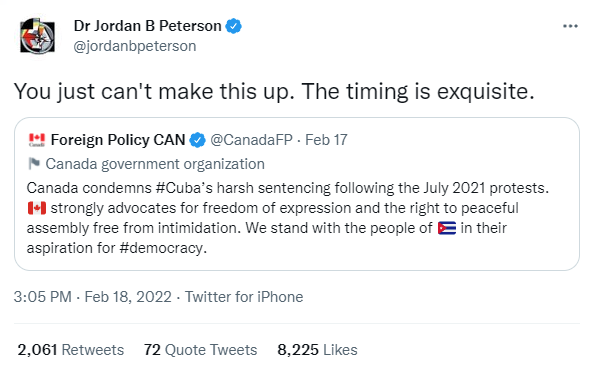
Jordan Peterson points out the amazing tone-deafness of the federal government on yet another topic:

ReasonTV looked at the “Revolt of the Canadian Truckers” and compared it to other populist protest movements of recent years:

PPC leader Maxime Bernier sent out this email to supporters:

There is violence in the streets of Ottawa.

The police, armed with riot gear, are brutalizing and arresting peaceful demonstrators from the truckers’ convoy.

Meanwhile, Parliament is not sitting today because of this police operation. All parties agreed to stay away while the regime cracks down on dissidents.

Just like in a banana republic.

They should have been debating Trudeau’s decision to invoke the Emergencies Act.

The Emergencies Act replaced the War Measures Act in 1988. The only other times in Canadian history that it was invoked were during the First and Second World Wars, and during the October Crisis in 1970.

There is no emergency in Canada. No war, no insurrection, no terrorist attack, no sanitary or environmental catastrophe that justifies invoking this law.

It’s outright illegal, undemocratic, and unconstitutional for this government to give itself exceptional powers to deal with peaceful demonstrators.

It’s a power grab on Trudeau’s part to crush dissidence, that’s all it is.

Trudeau and his Finance minister Chrystia Freeland have given themselves the power to freeze the bank accounts not only of the organizers of the Freedom Convoy, but of anyone who is suspected of helping and funding them.

And we’re supposed to believe that a government that has violated our Constitution and our rights and freedoms for two year will not abuse these new powers?

Nicholas, it’s a dark day for Canada.

But it’s not over. We will continue to fight this authoritarian government, and bring back freedom, respect and justice to this country.

Don’t despair. Stay strong and free.
-Max

The good folks at Spiked explain why the truckers must win:

GiveSendGo sent an email in response to queries about whether the truckers had received the money that had been donated:

Where’s the money?

The questions keep on coming, so we want to answer!

The number one question people are asking right now is, “Have the truckers received the funds?” Our answer is this: “Yes, the truckers have received some of the funds paid out to the ‘Adopt a Trucker’ campaign.”

As this plays out with the Canadian government, there have been steps taken to prevent the funds from being “frozen”. Currently, the bulk of the funds are in an undisclosed U.S. bank.

Right now, the teams involved are actively discussing the legal options for getting the funds where they need to go. (Thank you to those who’ve sent in suggestions, you’ve definitely had some creative ones!)

What we need from you:

We ask that you do not request a refund at this time as these funds will be needed for the truckers and their legal teams. Additionally, please be patient and pray for wisdom for all involved. We will keep you updated as we move forward.

Thank you for all your prayers and support over these past few weeks!

“But as for you, be strong and courageous, for your work will be rewarded.” ‭‭2 Chronicles‬ ‭15:7

‭‭Shine Brightly!

February 15, 2022

King James I and his court favourites

Filed under: Britain, Government, History — Tags: , , , , , — Nicholas @ 03:00

In the latest Age of Invention newsletter, Anton Howes continues the tale of King James I of England (also King James VI of Scotland at the same time, the crowns still being legally separate) and his use of favourites to help him avoid going back to Parliament to ask for money:

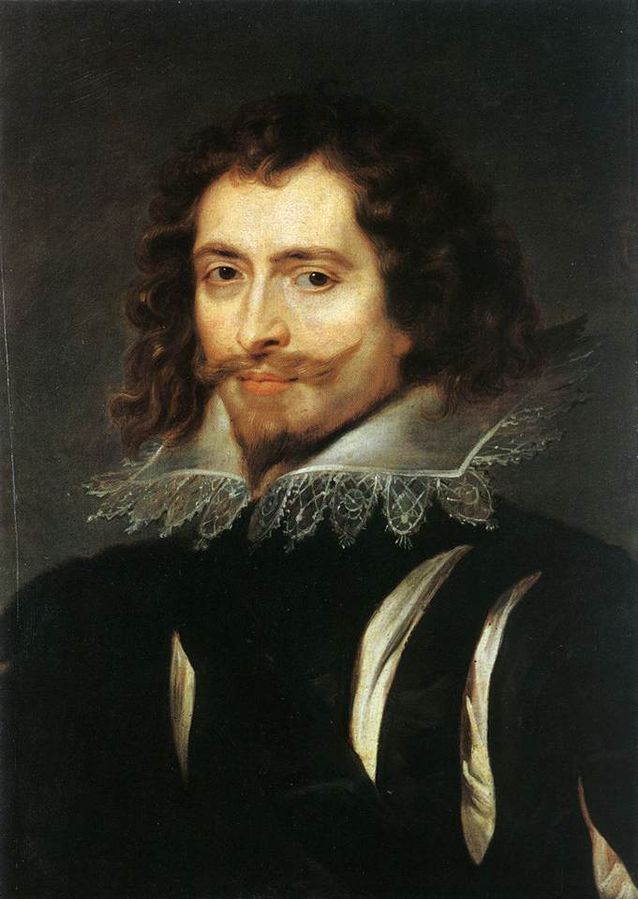
Portrait of George Villiers, First Duke of Buckingham, 1625.
Oil painting by Peter Paul Rubens (1577-1640) via Wikimedia Commons.

At the same time, James found a way to filter many of the petitions before they even reached him. This was something he already did in his original kingdom, Scotland, occasionally sending a noble “favourite” — like his kinsmen the duke of Lennox and the marquess of Hamilton — to dispense patronage and manage its parliament. Yet he increasingly, and even scandalously, relied on favourites in England too.

Using a favourite could make some sense from a political standpoint. Favourites often owed everything they had in terms of wealth, protection, titles and standing to the king personally. As creatures of the king, their loyalty was assured. They served an important practical function by dispensing patronage and absorbing pesky petitions, and could insulate the king himself from blame. Should the king make a mistake, his favourite was the obvious man to take the fall.

But for James, the use of favourites went beyond mere practicality, if they were ever practical at all. His interest could also be romantic.

Although James was married with kids, his favourite by 1607 was one Robert Kerr, the younger son of a minor Scottish laird. A mere groom of the bedchamber, about twenty years James’s junior, he had fallen from his horse in a jousting accident and broken his leg. The king helped nurse him back to health, and was soon besotted. Kerr — often anglicised to Carr — was very rapidly given money, titles, and lands. Within a year he had been knighted, after four years made a viscount, and in 1613 an earl.

But what had been so rapidly gained, could be just as rapidly lost. In 1614, a rival faction at court made sure that another, even younger and more attractive man would catch the king’s eye. This was George Villiers, the 22-year-old younger son of an obscure knight. With his “effeminate and curious” hands and face, as well as a remarkable physique — a clergyman, later a bishop, marvelled at his “well compacted” limbs — Villiers’s rise made Kerr’s seem slow. Every year brought him a new title: in 1615 Villiers was made a knight, 1616 a viscount, 1617 an earl, and 1618 a marquess — a very rare title in England, last given to an influential co-regent of Edward VI, and before that to Anne Boleyn so that she could marry king Henry VIII.

Eventually, incredibly, in 1623 James made Villiers a duke. This was a title that was typically reserved for members of the royal family, or else given by very powerful regents to themselves — Villiers was the first in neither of those categories to be made a duke in 140 years. And he hadn’t even been born into the nobility! The apparent lesson: working on your triceps can really, really pay off.

Yet Villiers had more than just an angelic face and muscles. He seems to have had a real talent for politics, very quickly asserting independence from the faction that had put him before the king. And he would somehow remain the favourite even after James died and was succeeded by his heterosexual son, Charles I. In the dangerous waters of courtly faction — Robert Kerr had meanwhile been found guilty of murder and was imprisoned in the Tower — Villiers knew how to keep himself afloat, and even to chart a course of his own.

And he was extraordinarily corrupt.

January 23, 2022

The Abandoned Hill With Two Members Of Parliament

Filed under: Britain, Government, History, Politics — Tags: , , , , , — Nicholas @ 02:00

Tom Scott
Published 6 Jul 2020

Old Sarum, in Wiltshire, is a now-desolate hillfort run by English Heritage. But it was once one of the most important sites in southern England: so important that it had two members of Parliament. Then, it became a “rotten borough”: and a warning about power.

Thanks to English Heritage: more information and how to visit: https://www.english-heritage.org.uk/v…

Research and script assistance from Jess Jewell
Drone camera by Jamie Bellinger
Edited by Michelle Martin: https://twitter.com/mrsmmartin
Audio mix by Graham Haerther: https://haerther.net

Filmed safely, following all local and national guidance: https://www.tomscott.com/safe/

SOURCES:
Corfield, P. (2000). Power and the professions in Britain 1700-1850. London: Routledge.

Dodsworth, W. (1814). An historical description of the cathedral church of Salisbury: including an account of the monuments, chiefly extracted from Gough’s “Sepulchral Monuments,” and other authentic documents: also, biographical memoirs of the Bishops of Salisbury, from the earliest period by W. Dodsworth, verger of the Cathedral

English Heritage’s own research page: https://www.english-heritage.org.uk/v…

http://www.historyhome.co.uk/c-eight/…

I’m at https://tomscott.com
on Twitter at https://twitter.com/tomscott
and on Instagram as tomscottgo

January 22, 2022

James I and his experiment with “personal rule”

Filed under: Britain, Government, History — Tags: , , , , — Nicholas @ 05:00

In the latest Age of Invention newsletter, Anton Howes explains why King James I grew frustrated in his dealings with Parliament and decided to avoid calling that body into session and ruling the kingdom directly:

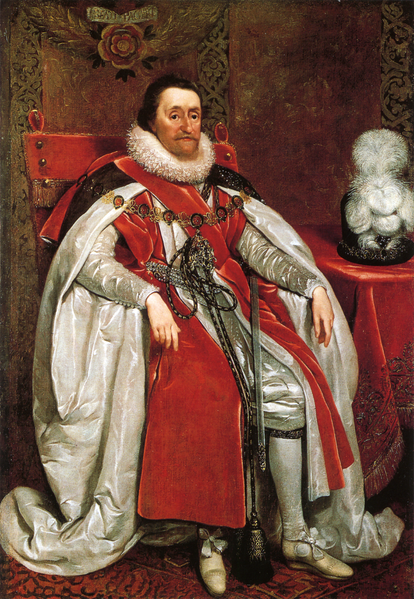
King James I (of England) and VI (of Scotland)
Portrait by Daniel Myrtens, 1621 from the National Portrait Gallery via Wikimedia Commons.

By the end of 1610, James’s disillusionment with the House of Commons was complete — it was, he said, after six years of fruitlessly wrangling for parliamentary taxes, like a “House of Hell”.

So, despite failing to reach a permanent financial settlement, James decided to try to rule without it. His debts were huge, and his deficit substantial. But after the failure of 1610 he would do everything he could to never have to summon a Parliament again. Although he couldn’t actually afford it, he decided to try ruling as an absolutist monarch anyway — to embark on “personal rule”.

This extraordinary decision, to be an absolutist ruler without adequate financial support, would have dramatic consequences for England’s foreign policy, and perhaps on the whole balance of Europe too. James had already tried to reduce the costs of war when he came to the throne in 1603, by immediately concluding a peace with the vast Spanish Empire. Yet peace now became a necessity — if he couldn’t even plug the deficit during peacetime, he could not possibly pay for a war. Recognising this, Spain intervened freely in the affairs of the Protestant German states, confident that England would not be able to come to their aid.

To make matters worse, James’s financial woes made him especially susceptible to foreign influence. A poor king could be bought. Some of the smaller but wealthier European dynasties began to offer James large sums for his children’s hands in marriage. In 1611, the duke of Savoy offered a vast dowry of £210,000 for his daughter to marry James’s eldest son and heir, Prince Henry. The notoriously wealthy grand duke of Tuscany even put in a bid for £300,000. France then offered £240,000 — not as high, but it had the greater status as a kingdom. Any of these amounts would have plugged the deficit for a few years, even if they were nowhere near to eliminating James’s debt. Yet Henry died in 1612 at the age of eighteen, before any match was agreed, and James’s new heir Charles was much younger and sickly. There was now no rush, so the bidding war ceased. Indeed, by 1616 Charles had given England’s rivals yet another way to influence its king. The Spanish Hapsburgs dangled the prospect of a gigantic dowry of £600,000, but dragged their feet in negotiations, keeping James focused for as long as they could on trying to keep them sweet.

In the meantime, with Henry’s death denying him an immediate windfall, James in 1613 turned [to] Ireland. The Irish Parliament had not been summoned for over a quarter of a century, but it could be a way to reduce the costs of the occupation of Ireland and even raise some funds. The Parliament was initially a disaster. James had flagrantly gerrymandered a Protestant majority by chartering dozens of new towns, particularly in the English plantations in Ulster. Each new town was a borough constituency able to choose its own MPs, and James could even select their initial members — especially in cases where the towns were actually only tiny villages. In protest, the Catholic MPs refused to even recognise the new borough MPs, so each side elected their own Speaker. The Catholic Speaker was only forced out of the chair when the Protestant Speaker was hoisted onto his lap. Nonetheless, although James was legally entitled to create as many new boroughs as he liked, he soon compromised and in 1615 the Irish Parliament ended up voting him some cash.

But the delays forced James’s hand, and in 1614 he briefly suspended his foray into personal rule by summoning the English Parliament again. He needn’t have bothered. Having embarked on personal rule, James had doubled down on legally dubious ways of raising cash, like imposing new customs duties without parliamentary approval — measures that had already been deeply unpopular with MPs in 1610. This time, the Parliament lasted just two months and two days before James dissolved it in a rage — the House of Hell had proved even more impudent than before. One of the veteran opposition leaders, Sir Edwin Sandys, went so far as to explicitly compare James’s impositions on trade to tyranny, before reminding the Commons that tyrants often met a bloody end. When the Parliament was dissolved, the king had MPs’ notes on impositions burned, and a few of the ringleaders were even briefly imprisoned. But with the dissolution of Parliament, which had not voted him any cash, he was still none the richer.

January 8, 2022

The Board of Green Cloth — the original “we investigated ourselves and found us innocent” organization

Filed under: Britain, Bureaucracy, Government, History — Tags: , , , , , — Nicholas @ 03:00

In the latest Age of Invention newsletter, Anton Howes explains how England managed to avoid the first attempt by King James I to impose absolute monarchy — that is, putting the Stuart notions of the “divine right of kings” in place of royal powers limited by the Parliamentary control of the royal income:

King James I (of England) and VI (of Scotland)
Portrait by Daniel Myrtens, 1621 from the National Portrait Gallery via Wikimedia Commons.

The year 1610 might by the most under-rated year in British history. It was the year in which England almost became a more permanent absolutist monarchy. Had things gone only a little differently, King James I might have obtained a substantial annual income — enough to pay off his debts within just a few years, to run a substantial surplus, and perhaps even to never have to summon a Parliament ever again. Over the course of a few decades, so long as they didn’t require too many extraordinary taxes to pay for one-off wars, the Stuart kings could have ruled without challenge, issuing proclamations that would have gradually taken on the force of laws.

[…]

As we saw in the last instalment of this series, James I’s finances were desperate. His predecessor had left him substantial war debts, and he was running a large deficit, so the chances of repaying them anytime soon were slim. So in 1604 he had summoned a Parliament with the aim of making a financial deal. Parliaments were typically called in order for the monarch to raise one-off, extraordinary taxes, usually in times of rebellion or war. Rather confusingly from today’s perspective, these taxes were known as “subsidies”, because they were a subsidy to the Crown. Yet James and his ministers wanted Parliament to instead establish peacetime taxes that would be both ongoing and ordinary — what came to be known as “support”. The deal was that he would give up some of his least popular feudal prerogative rights in return.

The House of Commons did not go for the deal in 1604, as we saw. They may have hated feudal obligations like purveyance or wardship — the requisitioning of goods for the court, and the Crown’s control of noble heirs whose fathers had died before they came of age — but they also saw some major risks in trying to make a deal with the king.

When it came to the matter of purveyance, for example, many members of Parliament wanted to stamp out the abuses rather than see the institution abolished. They thought it perfectly legal for the Crown to compulsorily purchase goods, and even to requisition the carts to carry them. What they complained of was that many purveyors were failing to give compensation immediately, and that corrupt purveyors were sometimes taking more than was required, pocketing the difference for themselves. Many MPs also argued that there was no legal basis for purveyors to determine their own prices for the provisions that they seized — a privilege that the Crown adamantly insisted upon.

James’s predecessor Queen Elizabeth I had granted a concession over patent disputes — “patents” at that time were a rather different and much wider legal notion than our more product-oriented modern patents: the monarch granted patents to assign lands and titles, appoint officials, create cities or guilds, or to allow monopoly privileges over an economic resource among other purposes. The concession was that patent disputes would be litigated in common-law courts rather than by royally appointed judges.

Yet by extending the jurisdiction of the common-law courts to monopolies, Elizabeth opened the floodgates of complaints against all prerogative courts — especially against the court of royal household officials responsible for commissioning the purveyors, known as the Board of Green Cloth.

To Hyde and his followers, this court was especially corrupt. Whereas the trying of monopoly patents had at least been done in the more general prerogative courts, anyone hauled before the Green Cloth for denying the purveyors was effectively being tried, judged, fined, and even imprisoned, by the very organisation that was accusing them. Even if purveyors really were acting illegally by naming their own prices, as opponents maintained, there would be no justice so long as the purveyors effectively judged themselves. For Hyde and his allies then, they wished to do to purveyance what they had done to monopolies — to subject them to the common law.

December 23, 2021

Cheshire and Durham in the English Parliament

Filed under: Britain, Government, History — Tags: , , , , , — Nicholas @ 05:00

In his end-of-the-year Age of Invention newsletter, Anton Howes looks at two of the historic counties of England that lacked Parliamentary representation until surprisingly late dates:

Cheshire and Durham (post-medieval boundaries: English county boundaries have varied wildly over the centuries).
Base map by Hogweard at Wikimedia Commons.

England, compared to other parts of Europe, is often said to have been remarkably centralised early on. France, for example, in the late eighteenth century had some thirteen or so regional parliaments, while Britain just had the one. Scotland’s separate parliament was famously dissolved in 1707, with the official union of Scotland with England. Wales gained representation at the English parliament at Westminster from 1536. So far so expected.

But less well-known is that the county of Cheshire — some of it now disappeared under Greater Manchester — used to have an entirely separate parliament of its own, and was not represented at Westminster until 1543. Arguably, it has about as much historical claim to a national assembly today as Wales. Rule of Cheshire was even, very briefly, included among the various titles of the monarch. Richard II, as well as being king of England, was in 1397-99 also styled “Prince of Chester”. He drew his personal bodyguard from among the men of Cheshire too. So whatever happened to Cheshire nationalism?

On a related note: the mantra “no taxation without representation” looms large in the history of American independence. But parts of England itself had gone unrepresented for decades too. County Durham, traditionally ruled by its prince-bishop, was not represented by any MPs in the House of Commons at all until 1654. And as it only gained representation under the revolutionary Protectorate, this was undone upon the restoration of the monarchy in 1660. The county would not be represented again until 1675.

Why? One might argue that the bishop of Durham, who sat in the House of Lords, could be considered its parliamentary representative. But he was not elected, and most importantly had little say over the matter of parliamentary taxation, which was controlled by the Commons. Before 1603 this was not much of an issue, as county Durham was exempt from various taxes because it was near the hostile Scottish border. But the accession of James VI of Scotland to become king of England meant that the hostile border suddenly disappeared. County Durham thus became subject to parliamentary taxation without having any say over those taxes at all — a situation that they then had to bear for over sixty years! Where were the Durham revolutionaries?

December 18, 2021

King James and the search for ready cash

Filed under: Britain, Economics, Government, History — Tags: , , , — Nicholas @ 03:00

In the latest Age of Invention newsletter, Anton Howes outlines how and why England’s new Stuart king found himself in desperate financial straits very early in his reign:

King James I (of England) and VI (of Scotland)
Portrait by Daniel Myrtens, 1621 from the National Portrait Gallery via Wikimedia Commons.

… after a generous honeymoon period of about a year, he and his government soon discovered that they were leaking cash. Despite eliminating the costly wars in Spain and in Ireland, James still had to pay off the debts that his predecessor Elizabeth I had incurred in fighting them. And he had a more extensive, and expensive, royal family to support. He traded the one-off expenses of war for the ongoing expenses of a profligate court.

This may sound like a good deal. James effectively stopped the English Crown splashing out money on really big but infrequent expenses, while increasing its ongoing expenditure — like refraining from buying a new car every few years, while spending a lot more each month eating out at restaurants.

But the Crown’s sources of revenue were ill-suited to this change. The funding for wars had been voted to Elizabeth by Parliament, usually as and when the need arose. Such expenditures were matters of national interest, and she otherwise just relied on other sources of income — ongoing taxes like customs duties, or simply the rent from her lands. When the one-off “subsidies” granted to her by Parliament had not quite been sufficient to cover the costs of the wars, Elizabeth had made up the difference by keeping her own ongoing expenses as low as possible, and took out loans to fill any gaps. It also helped that in the years before crises, Elizabeth had tried to run a surplus, building up a war-chest of cash to dip into.

So switching to the new pattern of expenditure was not straightforward. To increase the Crown’s ongoing expenses, it would have to find more sources of ongoing income, especially as it was already in deficit and had loans to pay off. It was politically impossible for James to ask Parliament for extra one-off subsidies to help him bridge the gap, as some of Elizabeth’s subsidies from 1601 had yet to even be collected. He did actually test the waters about what would happen if he did ask, just in case, but when the matter was raised by some would-be sycophants, it was met with outrage. As one member of Parliament angrily put it, “we have no sheep that yields two fleeces in the year.”

The country was already feeling over-taxed, there were no looming crises to justify such extra taxation, and even if there were, such one-off measures would be unsustainable. James needed to find revenue streams to match his spending leak — and ideally, to even exceed it. His ministers fretted about getting the Crown back into surplus again, to build up another war-chest. Who knew when the next war or rebellion might arise.

So when James called his first Parliament in 1604, it was not really to ask for one-off subsidies as Elizabeth had so often done. Instead, he and his ministers focused on outlining a series of financial deals.

« Newer PostsOlder Posts »

Powered by WordPress