
BBC Comedy Greats
Published 26 Jul 2021Bernard (Derek Fowlds) walks Jim Hacker (Paul Eddington) through the red-tape of signing his Christmas cards, but Jim Hacker is more concerned with worrying plans from Brussels to rename the British sausage.
(more…)
December 22, 2022
The Emulsified High-Fat Offal Tube | Yes, Minister: 1984 Christmas Special | BBC Comedy Greats
Comments Off on The Emulsified High-Fat Offal Tube | Yes, Minister: 1984 Christmas Special | BBC Comedy Greats
December 5, 2022
Edmund Burke
At Samizdata, Niall Kilmartin republishes part of a much older post out as background on Edmund Burke (who I haven’t yet read):
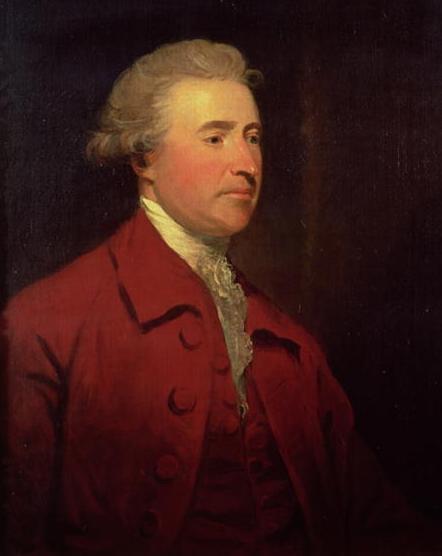
Portrait of Edmund Burke (1729-1797), circa 1770-1780 after a painting of 1774 by James Northcote.
Original in the Royal Albert Museum & Art Gallery via Wikimedia Commons.
When I first started reading Edmund Burke, it was for the political wisdom his writings contained. Only many years later did I start to benefit from noticing that the Burke we know – the man proved a prophet by events and with an impressive legacy – differed from the Burke that the man himself knew: the man who was a lifelong target of slander; the one who, on each major issue of his life, gained only rare and partial victories after years or decades of seeing events tragically unfold as he had vainly foretold. Looking back, we see the man revered by both parties as the model of a statesman and thinker in the following century, the hero of Sir Winston Churchill in the century after. But Burke lived his life looking forwards:
- On America, an initial victory (repeal of the Stamp Act) was followed by over 15 years in the political wilderness and then by the second-best of US independence. (Burke was the very first member of parliament to say that Britain must recognise US independence, but his preferred solution when the crisis first arose in the mid-1760s was to preserve – by rarely using – a prerogative power of the British parliament that could one day be useful for such things as opposing slavery.)
- He vastly improved the lot of the inhabitants of India, but in Britain the first result of trying was massive electoral defeat, and his chosen means after that – the impeachment of Warren Hastings – took him 14 years of exhausting effort and ended in acquittal. Indians were much better off, but back in England the acquittal felt like failure.
- Three decades of seeking to improve the lot of Irish Catholics, latterly with successes, ended in the sudden disaster of Earl Fitzwilliam’s recall and the approach of the 1798 rebellion which he foresaw would fail (and had to hope would fail).
- The French revolutionaries’ conquest of England never looked so likely as at the time of his death in 1797. It was the equivalent of dying in September 1940 or November 1941.
It’s not surprising that late in his life he commented that the ill success of his efforts might seem to justify changing his opinions. But he added that, “Until I gain other lights than those I have“, he would have to go on being true to his understanding.
Burke was several times defeated politically – sometimes as a direct result of being honest – and later (usually much later) resurged simply because his opponents, through refusing to believe his warnings, walked into water over their heads and drowned, doing a lot of irreversible damage in the process. Even when this happened, he was not quickly respected. By the time it became really hard to avoid noticing that the French revolution was as unpleasant as Burke had predicted, all the enlightened people knew he was a longstanding prejudiced enemy of it, so “he loses credit for his foresight because he acted on it”, as Harvey Mansfield put it. (Similarly, whenever ugly effects of modern politics become impossible to ignore, people like us get no credit from those to whom their occurrence is unexpected because we were against them “anyway”.)
Lastly, I offer this Burke quote to guide you when people treat their success in stealing something from you (an election, for example) as evidence of their right to do so:
“The conduct of a losing party never appears right: at least, it never can possess the only infallible criterion of wisdom to vulgar judgments – success.”
Comments Off on Edmund Burke
November 29, 2022
Prime Minister Justin Trudeau, expert projectionist
Donna Laframboise on part of Prime Minister Justin Trudeau’s performance last Friday at the Public Order Emergency Commission’s hearings in Ottawa:
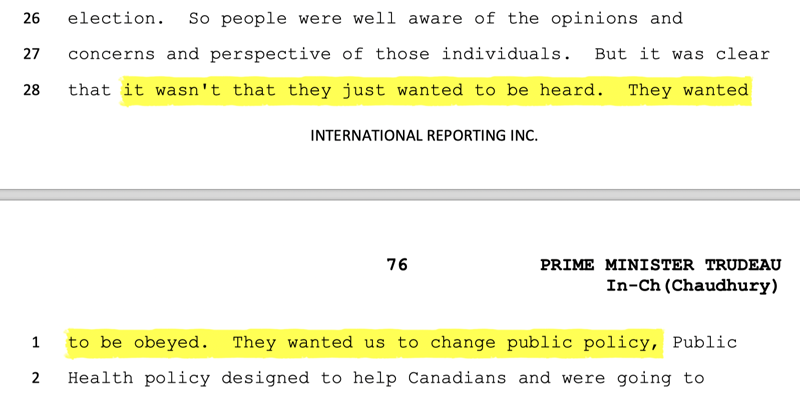
There’s a concept in psychology known as projection – accusing others of your own shortcomings. Last week Canada’s Prime Minister, Justin Trudeau, told an Emergencies Act hearing that Freedom Convoy protesters didn’t just want to talk. They wanted, he said, to be obeyed.
That was a strange word for him to use. About people he’d never spoken to. Yet it sums up his own posture rather nicely: Don’t bother trying to change my mind. I’m in charge, you must obey. Conversation over. Case closed.
According to Mr. Trudeau, the Freedom Convoy didn’t deserve a face-to-face meeting with his government because it wanted to change public policy. How terrible that free people, in a free country might want some influence over the increasingly draconian COVID rules they were required to follow. How unreasonable for them to come to Ottawa in an attempt to communicate the depths of their desperation.
A Prime Minister who received less than 33% of the votes cast during the federal election a mere four months earlier chose to thumb his nose at these protesters. Get lost, peasants. You will not be changing public policy.
[…]
We need to recognize what has happened here. The same federal officials who meet with corporate lobbyists by the thousands refused to have a single meeting with the truckers.
This, ladies and gentleman, is the state of Canada’s democracy.
November 25, 2022
“… no Canadian should trust any government enough to settle for a ‘trust me’ on matters this serious”
Matt Gurney at TVO Today on the likely outcome of the Public Order Emergency Commission’s deliberations after testimony ends on Friday with whatever Prime Minister Justin Trudeau is planning to say:

A screenshot from a YouTube video showing the protest in front of Parliament in Ottawa on 30 January, 2022.
Photo via Wikimedia Commons.
We can’t simply outsource decision-making to federal agencies, particularly intelligence services! The federal cabinet has the right to disagree with CSIS’s conclusions, especially as it may consider a broader range of information. That’s why we elect leaders. That’s democracy.
But a democracy is supposed to empower the people. We are citizens, not subjects. And there is something very worrisome in Vigneault’s comments. He noted that he had information that informed his decisions — information that cannot be publicly disclosed. This apparently includes legal opinions that the federal government has not disclosed (citing attorney-client privilege) and also, reportedly, classified information.
Attorney-client privilege is important. So is secrecy on matters of national security. Both of these things are essential for a society to function. But, in this case, they are corrosive to democracy and public faith in the federal government.
The Trudeau government’s case for invoking the Emergencies Act isn’t a slam dunk. It’s not bulletproof. I’ve been swayed by some of its arguments and some of the testimony and documents that have been produced. But it hasn’t sealed the deal. And if its final argument hinges on legal advice and classified information, that’s … awful. That’s just a terrible situation. That would amount, in effect, to Trudeau saying, “We can’t tell you why we did this incredibly rare and controversial thing, but trust us.”
No.
That’s it. Just no.
I don’t trust this government. That’s partially, I grant, a criticism of this particular government, which I am not a fan of. It is often high-handed, arrogant, and incompetent, and I do not trust it won’t try to duck criticism by hiding dirty laundry behind privilege and secrecy. Its conduct over the past seven years in office simply has not earned it any benefit of the doubt.
But there’s a deeper truth here: no Canadian should trust any government enough to settle for a “trust me” on matters this serious. That’s not how a democracy is supposed to work. Bluntly, if that’s how your democracy is working, it isn’t working or a democracy.
Comments Off on “… no Canadian should trust any government enough to settle for a ‘trust me’ on matters this serious”
November 24, 2022
Viewing the Public Order Emergency Commission spectacle from abroad
Chris Bray on how the Public Order Emergency Commission inquiry in Ottawa has utterly failed to show up on the radar of the US legacy media:
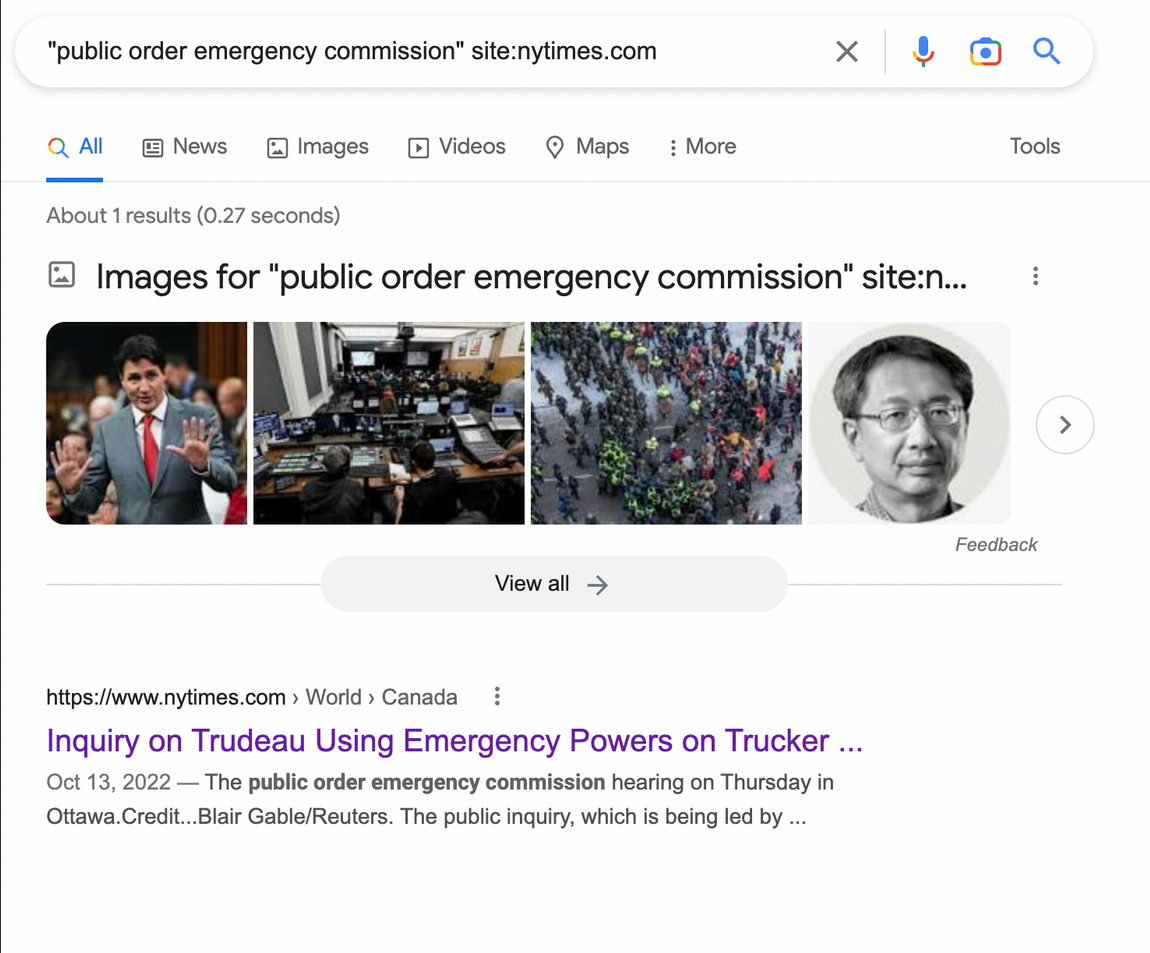
I conducted a dignified survey of a number of politically savvy people this evening, by which I mean I staggered around a bar and slurred questions at friends, and I was surprised to discover that no one has noticed the POEC. At all. Similarly, the US news media appears to have taken a nearly complete pass on covering the thing. The New York Times offered a single story, more than a month ago, describing the fact that it would be happening, and then lapsed into silence. I left some blank space at the bottom of this image so you can see all the nothing down there:
But the spectacle has been extraordinary, and it opens the curtains on the world of high-status malevolence, elite mediocrity, and news media cravenness. For background, remember that the Canadian government led by Prime Minister Derek Zoolander responded to the peaceful truckers’ “Freedom Convoy” in Ottawa and anti-Covid-measure blockades at several border crossing areas this February — the infamous bouncy castle protests — by invoking Canada’s Emergencies Act, for the first time since that law was created in 1988. That declaration of a national emergency allowed the government to exercise extraordinary power, most infamously in the form of an order to Canadian banks to completely freeze the bank accounts of protest participants. Zoolander lost his state of emergency as the Canadian Senate signaled its growing alarm at the decision, after a shameful vote in the House of Commons to affirm the declaration. The state of emergency was declared on February 14, and revoked on February 23.
Now comes the second act. The invocation of the Emergencies Act triggers a legal duty to review that decision after the fact. Here’s the directive calling the Public Order Emergency Commission into being.
So the commission is meeting, with testimony from government officials, and — this is the important part — with cross-examination from lawyers representing the targets of the declaration of emergency. In effect, the truckers are in the room; their representatives can ask questions of the government officials who did things like ordering banks to take their money because they disagreed with the government.
If you read the mainstream Canadian press, which pisses me off every time I try to do it, this means that the moronic lawyers for a bunch of idiotic terrorists are being pointlessly mean to senior government officials. Conspiracy theories! Debunked claims! I mean, truck drivers versus respectable figures, amirite? All the usual deployment of marking language is in effect, telling readers what to think about what’s happening while carefully limiting their description of what’s actually happening.
[…]
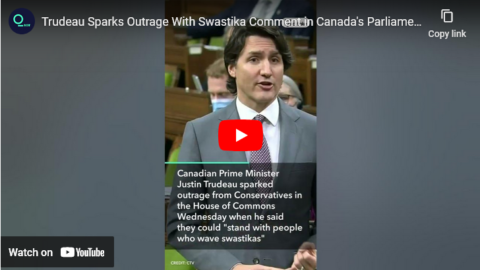
And finally, most remarkably, if you followed the Emergencies Act debate in the House of Commons back in February, you’ll recall that Prime Minister Zoolander and his ministers responded to every criticism and question regarding their handling of the convoy by saying that Canadians won’t stand with people who carry Confederate flags, and with “those who fly swastikas”.
That’s how they framed the entire event, full stop: the truckers, the swastika people. The anti-vaccine-mandate Nazis!
The news media picked up that framing and ran with it, non-stop, pounding the message that the truckers were flying Nazi symbols and Confederate flags:
Now: Miller said, before the commission, that he knows the identity of the people who carried those Nazi and Confederate flags in Ottawa — and that they’re employees of a public relations firm that was working on behalf of officials in the Canadian government.

Comments Off on Viewing the Public Order Emergency Commission spectacle from abroad
November 5, 2022
Repost: Remember, Remember the Fifth of November
Today is the anniversary of the Gunpowder Plot:
Everyone knows what the Gunpowder Plotters looked like. Thanks to one of the best-known etchings of the seventeenth century we see them “plotting”, broad brims of their hats over their noses, cloaks on their shoulders, mustachios and beards bristling — the archetypical band of desperados. Almost as well known are the broad outlines of the discovery of the “plot”: the mysterious warning sent to Lord Monteagle on October 26th, 1605, the investigation of the cellars under the Palace of Westminster on November 4th, the discovery of the gunpowder and Guy Fawkes, the flight of the other conspirators, the shoot-out at Holbeach in Staffordshire on November 8th in which four (Robert Catesby, Thomas Percy and the brothers Christopher and John Wright) were killed, and then the trial and execution of Fawkes and seven others in January 1606.
However, there was a more obscure sequel. Also implicated were the 9th Earl of Northumberland, three other peers (Viscount Montague and Lords Stourton and Mordaunt) and three members of the Society of Jesus. Two of the Jesuits, Fr Oswald Tesimond and Fr John Gerard, were able to escape abroad, but the third, the superior of the order in England, Fr Henry Garnet, was arrested just before the main trial. Garnet was tried separately on March 28th, 1606 and executed in May. The peers were tried in the court of Star Chamber: three were merely fined, but Northumberland was imprisoned in the Tower at pleasure and not released until 1621.
[. . .]
Thanks to the fact that nothing actually happened, it is not surprising that the plot has been the subject of running dispute since November 5th, 1605. James I’s privy council appears to have been genuinely unable to make any sense of it. The Attorney-General, Sir Edward Coke, observed at the trial that succeeding generations would wonder whether it was fact or fiction. There were claims from the start that the plot was a put-up job — if not a complete fabrication, then at least exaggerated for his own devious ends by Robert Cecil, Earl of Salisbury, James’s secretary of state. The government’s presentation of the case against the plotters had its awkward aspects, caused in part by the desire to shield Monteagle, now a national hero, from the exposure of his earlier association with them. The two official accounts published in 1606 were patently spins. One, The Discourse of the Manner, was intended to give James a more commanding role in the uncovering of the plot than he deserved. The other, A True and Perfect Relation, was intended to lay the blame on Garnet.
But Catesby had form. He and several of the plotters as well as Lord Monteagle had been implicated in the Earl of Essex’s rebellion in 1601. Subsequently he and the others (including Monteagle) had approached Philip III of Spain to support a rebellion to prevent James I’s accession. This raises the central question of what the plot was about. Was it the product of Catholic discontent with James I or was it the last episode in what the late Hugh Trevor-Roper and Professor John Bossy have termed “Elizabethan extremism”?
Comments Off on Repost: Remember, Remember the Fifth of November
October 27, 2022
Rishi Sunak becoming PM apparently – wait for it – proves that systemic racism is still a thing in Britain
You’d think the first non-white British PM would help dispel the constant claims that British society is still deeply racist, but as Theodore Dalrymple shows, that underestimates the political need to use “racism” as a rhetorical stick to beat the electorate with:
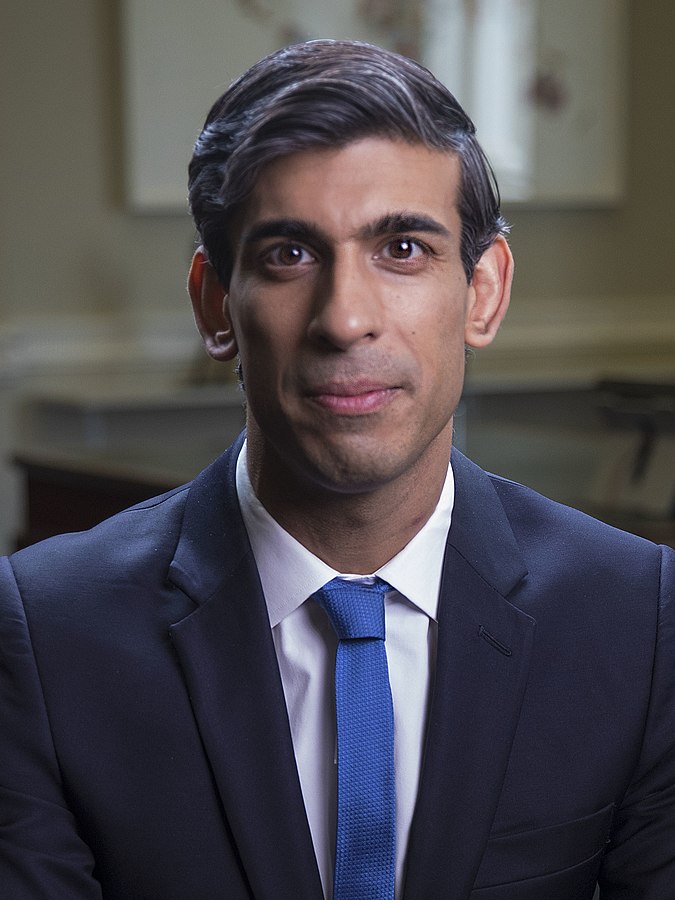
Rishi Sunak shortly after becoming Chancellor of the Exchequer in 2020.
The new British Prime Minister, Rishi Sunak, is the son of Punjabi immigrants from East Africa. You might have thought that this would satisfy, or at least please, the anti-racism lobby, by demonstrating that British society is an open one, not completely sclerosed by racist prejudice: but you would be wrong.
An opposition member of parliament called Nadia Whittome, herself of Indian origin, tweeted that Sunak’s appointment to the highest political position was not a victory for Asian representation.
This follows the assertion not long ago by Rupa Huq, another Member of Parliament of Indian subcontinental origin, that Kwasi Kwarteng, former Prime Minister Liz Truss’s short-lived Chancellor of the Exchequer, was only “superficially black” because he spoke what in England is called the King’s English. She said that, listening to him on the radio, one would not even know that he was black. Instead, he spoke like the highly educated person he was, which in Huq’s opinion was incompatible with being black. Whites are not the only racists.
The remarks by these two female politicians, all the more significant because they were spontaneous rather than deeply considered, reveal something about the nature of modern identity politics: that the function of minorities (whether racial, sexual, or other) is to act as vote-fodder for political entrepreneurs of a certain stripe. It’s therefore the duty of minorities to remain the victims of prejudice against them and not to rise in the social scale by their own efforts: To do so is to betray the cause and above all their supposed leaders.
The reason that Whittome considers that Sunak’s appointment isn’t a victory for Asian representation is that, although of Asian origin, his parents (his father was a doctor) had him expensively educated and Sunak is now a multimillionaire, unlike most people of Asian origin — to say nothing of most whites.
There are, of course, other ways in which he isn’t representative of the Asian, or any other, population, the most important of which is that he’s of far above-average intelligence. (I must here point out also that while a certain level of intelligence is a necessary condition for a successful political career, it’s far from being a sufficient one.)
Representative government doesn’t mean that the representatives in the legislature or government must reflect the population demographically, such that — for example — 5 percent of them must have IQ’s of less than 70, though increasingly it may appear that they do. Nor are a person’s political or social views straightforwardly a reflection of his or her own economic position: If they were, Engels (who was a factory owner and rode to hounds) would never have been Marx’s collaborator, and Marx himself would not have written Capital, for he was no more proletarian than is King Charles.
Comments Off on Rishi Sunak becoming PM apparently – wait for it – proves that systemic racism is still a thing in Britain
October 25, 2022
Rishi Sunak becomes Britain’s latest Prime Minister
I don’t know how the oddsmakers rate the new PM’s chances, but there’s bound to be money made and lost on how long he sticks around. In The Line, Andrew MacDougall wishes Rishi Sunak good luck in his new post:
Rishi Sunak shortly after becoming Chancellor of the Exchequer in 2020.
Wikimedia Commons.
It says something about the current dysfunction in British politics that the elevation of a third prime minister in a matter of just two months — without a single vote cast, by anyone — is seen as a relief. So all hail the new PM Rishi Sunak, a.k.a. the man who lost to Liz Truss eight weeks ago, as he takes the wheel of this drunken nation.
Sunak won the leadership of the Conservative Party — and through it, the premiership of the country — in the short and sharp race triggered by the spectacular end of the Trussterfuck all of (checks notes) four days ago. With the declared support of nearly 200 of his Parliamentary colleagues, Sunak was able to see off challenges from former prime minister Boris Johnson and current House Leader Penny Mordaunt. Both Mordaunt and Johnson declined to seek a vote by the party membership, prioritizing “party unity” instead.
It will now be up to the 42-year old Sunak, an MP for only seven years, to deliver that party unity. And good luck, as they say, with that. Because the Tories are now riven into warring factions which appear to have no more in common with each other than Jagmeet Singh does with success.
Yeah, it’s that bad.
A good first step for Sunak would be to not repeat the errors of the Truss … era? When you’re in a hole, stop digging, etc. Thankfully, Sunak already has credibility here, having spent the summer telling everyone that Truss’s economic policies would be disastrous. The former chancellor of the Exchequer is, thank Christ, well acquainted with economic reality and is expected to continue the new course set out by Jeremy Hunt, the current chancellor, who has spent his time erasing all of the dick-and-ball doodles Truss scribbled onto the economy. This will surely please the international bond markets, who are the actual rulers of the United Kingdom. It will also please mortgage holders, whose payments are now expected to go up less than during Trussonomics.
But it won’t please everyone.
Robert Hutton in The Critic, for one, welcomes the new robot PM:
The morning had been hugely enjoyable, hours of watching Tory MPs rushing to endorse Rishi Sunak while there was still time. Boris Johnson had suddenly disappeared from view, claiming that he could have won, easily, but had decided not to try. Penny Mordaunt tried her best, and claims to have come within touching distance of the 100-nomination threshold, but, just before Sir Graham Brady was going to announce the result, she issued a statement saying that she hadn’t made it. It was, of course, significantly more gracious than Johnson’s. For all the claims that his time on holiday has made him a more thoughtful and humble figure, his Sunday evening statement suggests he is as much of a petulant man-child as he ever was.
And so to the desk-banging. In fairness, the appointment of Rishi Sunak as leader and prime minister-in-waiting was, for a lot of Tory MPs, an unexpected and huge relief. People who six long weeks ago thought they’d never see the inside of a ministerial car again now glimpse a future bright with possibility, at least as far as they personally are concerned.
[…]
The oddity to the day was that we hadn’t heard from our incoming prime minister. In fact, he didn’t seem to have spoken a word in public since the start of September. Finally he popped up, and we worked out why they’d been keeping him away from the cameras.
It was a brief statement, throughout which he stared at a point just off camera, giving the impression to the viewer that he was looking over your left shoulder, hoping to catch the eye of someone more interesting who was standing behind you.
He opened by paying tribute to Liz Truss “who has led with dignity and grace through a time of great change”. Or, as the rest of us call it, “September”. His delivery was awkward, as though he had read about public speaking in a book, with frequent random pauses. “I am,” he said. “Humbled. And honoured. To have the support of my parliamentary colleagues. And to be elected as leader. Of the Conservative. And Unionist Party!”
Sebastian Millbank, on the other hand, sees Sunak as heralding the end of British sovereignty:
Sunak will be praised, despite being arguably the most privileged man in British politics, as being a triumph for diversity and social mobility, Britain’s first ethnic minority Prime Minister. But he’s also our first Californian Prime Minister — a man who believes heart and soul in the Silicon Valley “Californian ideology“, and boasts of his time in Stanford as a formative experience that gave him a “bigger, more dynamic approach to change”.
In choosing Rishi Sunak in a panicked attempt to retain power and calm the markets, Tory MPs have signed away what is left of British sovereignty over our own affairs. You will hear claims that “this is how the British system works”, that in a parliamentary democracy he need only win the confidence of parliament, and does not need to go to the country.
This is sheer and utter nonsense. The Conservative majority was elected, in its current form, on the basis of the 2019 manifesto, with its promises to strengthen the public sector, heal regional inequality, and reclaim sovereignty over our borders, law and finances. If Sunak and his party no longer intend to honour those commitments, they must win a fresh mandate in a general election.
Comments Off on Rishi Sunak becomes Britain’s latest Prime Minister
October 23, 2022
“It’s starting to be noteworthy how often people in government record their important conversations”
From the kindness of his heart, Paul Wells decided to make this column available to cheapskate non-paying subscribers like me because he feels it needs to be seen by a wider audience. The topic is the ongoing inquiry into the Trudeau government’s invocation of the Emergencies Act and it’s certainly promising to stay entertaining for a while (unlike the vast majority of such inquiries):
A screenshot from a YouTube video showing the protest in front of Parliament in Ottawa on 30 January, 2022.
Photo via Wikimedia Commons.
The goal of it all is to permit Rouleau to decide whether the Emergencies Act was used properly when it was invoked, for the first time in its 34-year existence, by the Trudeau government to end the mess in Ottawa’s Centretown. But it’s also a deep dive into conflicting ideas of police doctrine, the best look we’ve had at the stressed and dysfunctional city administration in Ottawa. And while we haven’t yet heard much about the Trudeau government’s processes, that’s coming. The prime minister and seven of his senior cabinet ministers, with their deputies, will testify soon.
Nobody can keep up with it. For Ottawa reporters it’s as though we’ve dragged ourselves for a decade through a desert of talking points and euphemisms into an oasis of unbelievable information bounty. The temptation is to gorge. I took Wednesday off, only to learn that Diane Deans, the city councillor who was heading the Ottawa Police Service Board when the mess began, secretly recorded the call in which she informed Mayor Jim Watson that she’d gone ahead and negotiated the hiring of an interim police chief Watson had never heard of. […]
Aaron Sorkin couldn’t have written it better. Deans tells Watson she’s found a new police chief for him in the middle of the worst public-security crises of their lives. He tells her it’s a terrible plan. She asks whether he’ll vote to remove her from her post and he won’t say, which of course is the same as saying. They talk about what to do next, in a way that leaves room for each to have an understanding of what they agreed that’s incompatible with the other’s. It’s gold. The consensus on Thursday among Parliament Hill people I talked to who’d heard the tape was that conversations like this happen all the time in workplaces across the capital, as of course they happen around the world. It’s just that usually in governments, as in most large organizations, any sign of their existence is buried under lakes of Novocaine.
It’s starting to be noteworthy how often people in government record their important conversations. Almost as though people were increasingly worried they might be lied about. When Jody Wilson-Raybould did such a thing three years ago, it was possible for her ex-colleagues to clutch their pearls and protest that such a thing just isn’t done. But after months of claims and assertions about what RCMP commissioner Brenda Lucki told the RCMP detachment in Nova Scotia, nine days after the worst mass murder in Canadian history, it’s handy to have a recording, isn’t it.
By this emerging standard, Patricia Ferguson is old-fashioned. As far as we know she didn’t record her meetings. But she did break open a notebook methodically, like clockwork, to write detailed longhand notes after her conversations. Those notes are hard to reconcile with the portrait Deans painted in her testimony a day earlier, of Peter Sloly as a lone good man, standing up for proper policing in the face of heckling and even racism from the city’s old guard.
In Ferguson’s version, it sounds like Ottawa’s cops were all reasonably good but they were cracking and colliding under immense pressure.
Ferguson described an Ottawa Police Service already worn down by the beginning of this year. There had been retirements, resignations, a high-level suspension and a suicide before and during the COVID lockdowns, followed by Black Lives Matter protests with the attendant internal soul-searching and external scrutiny every North American police corps faced.
And then the convoy hit. And then it stayed. This last was more of a surprise than it should have been.
The late stories out of Wednesday’s testimony were from Pat Morris, an Ontario Provincial Police superintendent in charge of intelligence-gathering. He dumped a bunch of old OPP “Project Hendon” reports, a term of art for the force’s intelligence-gathering operations, onto the commission server. Those reports were sent regularly to the Ottawa police as the various truck convoys approached the capital. Ferguson testified that she didn’t become aware of them until just before the trucks arrived. Which is too bad. What the OPP had found was a very large group of protesters from all over. They did not pose an organized threat of violence, though the Hendon reports acknowledged that confrontation can always escalate and that “lone wolf” extremists could well be tempted to join the crowd. But all the trucks represented a huge problem anyway, because they had rapidly growing funding — and no plans to go home at any point.
Comments Off on “It’s starting to be noteworthy how often people in government record their important conversations”
October 21, 2022
The brief career of Liz Truss as British Prime Minister
As I was typing the heading for yesterday’s post on former British Chancellor Kwasi Kwarteng, it occurred to me that I might need the same phrasing for the Prime Minister … but I expected her to stumble on a few more weeks or months rather than following Kwarteng out the door this quickly:
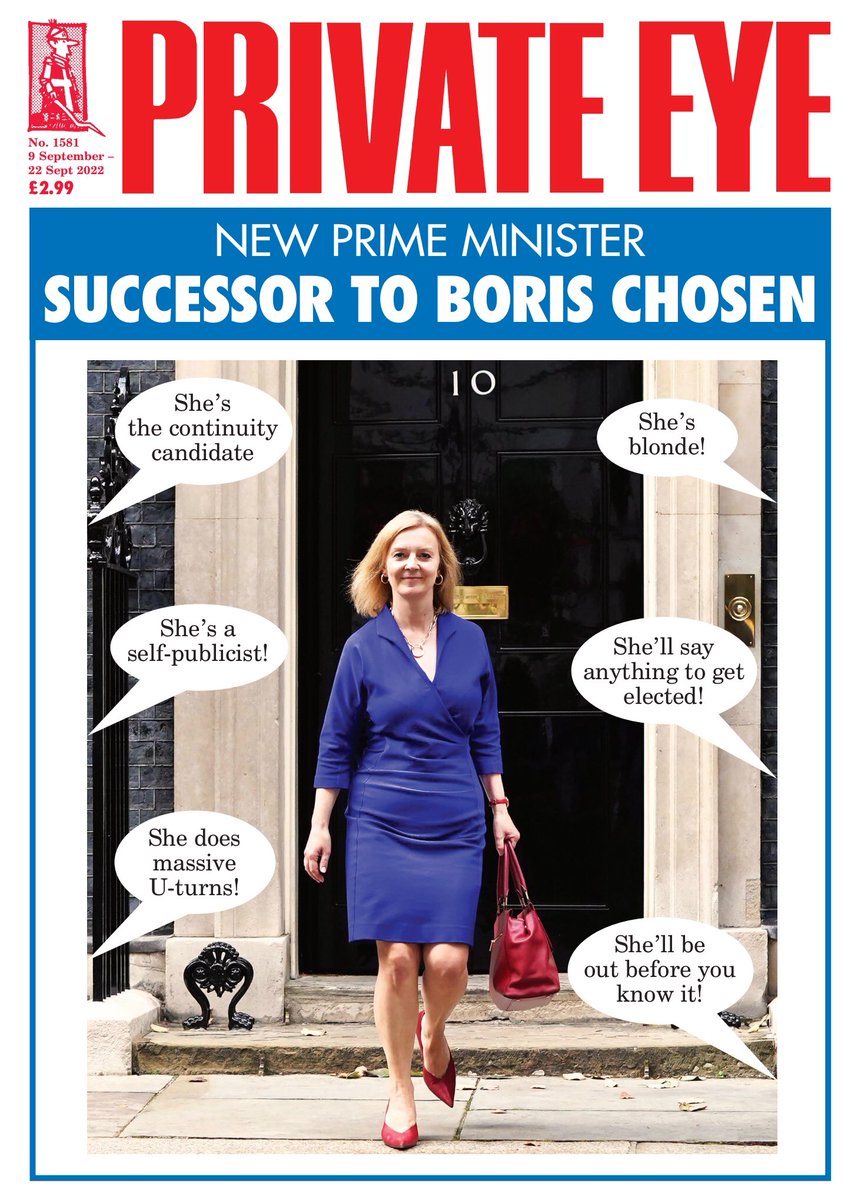
Edmund Burke – one of the great theorists of the state – argued that for a government to rule successfully, it must have consent. Liz Truss lacked that consent; she moved like Thomas Hobbes’ Leviathan, ruling with an iron fist towards her economic vision without the consent, explicit or implicit, to rule in that manner and pursue that agenda.
Her economic programme was wholly unsuitable for the climate and deeply damaging. The result was that her reign, like Hobbes’ state of nature where nobody had the political legitimacy to rule, was nasty, brutish and short. It has left the mantle impossibly difficult for her successor.
Liz Truss has become the first prime minister since Neville Chamberlain to never face a general election whilst in office, and her successor will be under immediate pressure to call one. The economic situation is far more dire than it was before her disastrous mini-budget, and trust is shattered. This is before expected interest rate increases could tip millions into unaffordable mortgages, and the expiry of the energy support scheme (except for targeted support). Whoever takes over will face crises on multiple fronts that may prove impossible to arrest.
There’s rarely been a political downfall that didn’t merit at least a nod to the famous bunker scene:
If you haven’t seen Downfall, you’ve almost certainly seen its most famous scene. As shells fall on Berlin and the Red Army advances, Hitler sits in his bunker and listens as his generals lay out exactly how bad the situation is. One by one, his options are whittled away until eventually it sinks in that all that awaits is total defeat, humiliation, and annihilation.
On an entirely unrelated note, as Liz Truss returns to her bunker underneath the big table in the Cabinet Office Briefing Room, difficult conversations are happening in Downing Street. It’s 11am on a Thursday morning …
Penny Mordaunt attempts a cheerful smile. She does not succeed. “Prime Minister – the Labour party has made a breakthrough across a wide front. In the South they are taking Bedfordshire and Norfolk. In the North, the Red Wall is broken. In the East and West, losses are limited because fish don’t vote. But indications are that even the haddock are pretty gloomy about your prospects.”
Truss waves this away. “Don’t worry. Kwasi’s resignation will bring it under control.”
The Cabinet exchanges uneasy glances. Mordaunt steps forward from the crowd. “Prime minister … Kwasi …”
Jacob Rees-Mogg finishes the thought. “Kwasi is briefing against you in the Times. He says you have weeks remaining in office.”
An awkward silence develops, extends. In this room, time now has no meaning. Glaciers run like rivers. The sun and moon flicker across the sky. Empires rise and fall, newly sapient species emerge, flourish, and die off. Eventually the universe undergoes total heat death, frozen into stasis until a spark suddenly appears; a second big bang. Energy. Light. The reinvention of particle physics, and eventually an earth, evolution, Britain, and
“Prime Minister?”
“Yes. I see.”
A second pause, blessedly shorter. Mordaunt and Rees-Mogg glance nervously at each other. Eventually, Truss settles on a response: “Would everyone who has briefed against me in the last week please leave the room.”
In Spiked, Brendan O’Neill makes the argument that Britain is now a political wasteland:
So Liz Truss is out. After just 44 days her premiership is no more. “I’m a fighter, not a quitter”, she said in parliament yesterday, and now she’s quit. Her premiership deserves to live in ignominy. Not necessarily because her blunders were so spectacular – though many of them were – but because of what this strangled-at-birth stint in Downing Street tells us about British politics more broadly. Which is that it’s a wasteland. An ideological void. A dustbowl of ideas. The lack of even the faintest glimmer of leadership material anywhere in the Westminster circus is horrifying to me. Trussism is but a symptom of a wider malady afflicting our political class.
[…]
Let’s go beyond Truss and Hunt and ask what this all tells us about the Conservative Party. This is the oldest political party in Europe, arguably the world. It’s the party that gave us Peel, Churchill, Thatcher, properly historic figures. Which birthed so much of the legal and political order we live under. Which The Economist aptly called “the world’s most successful party”. And which once reached, through Conservative Associations, the Church and other formal and informal networks, into communities across the land.
Now it’s a hollow machine, bereft of strategy, in dire want of ideas, out of touch with the public, disorientated, and infamous for having a PM who couldn’t last a naff, paltry 50 days in Downing St. The factional Tories cheering Truss’s demise are fools. Your entire party is indicted by this shitshow. And by the fact that your big replacement for lame Liz – Hunt – is a man so disconnected from British people, British history and British politics that he prefers EU oversight to national sovereignty, technocracy to belief, and “competence” to passion. Congrats!
To see the true state of the Tory Party, look no further than a comment piece penned by one of its former leaders, William Hague, this week. “Ideology is dead: it’s competence we need now”, the headline said. In short, you’ve had your fun with Brexit and Boris and the mad populist experiment – now it’s time for the adults to come back into the room and take control. Not only is this undemocratic (14million people voted for Boris to be PM, no one voted for Hunt to be de facto PM). Not only is it anti-political. Not only is it bureaucratic, stiff and unabashedly concerned more with making the trains run on time than with inspiring the people with proposals for a genuinely better life. It is also an admission that they have no ideas left. That the once great Conservative Party is completely out of steam. That Westminster itself is knackered. “Competence” is the last refuge of the visionless. They’re finished. Kaput. Clueless. Not just Liz, all of them. The need for a political overhaul has never been so pressing and so great.
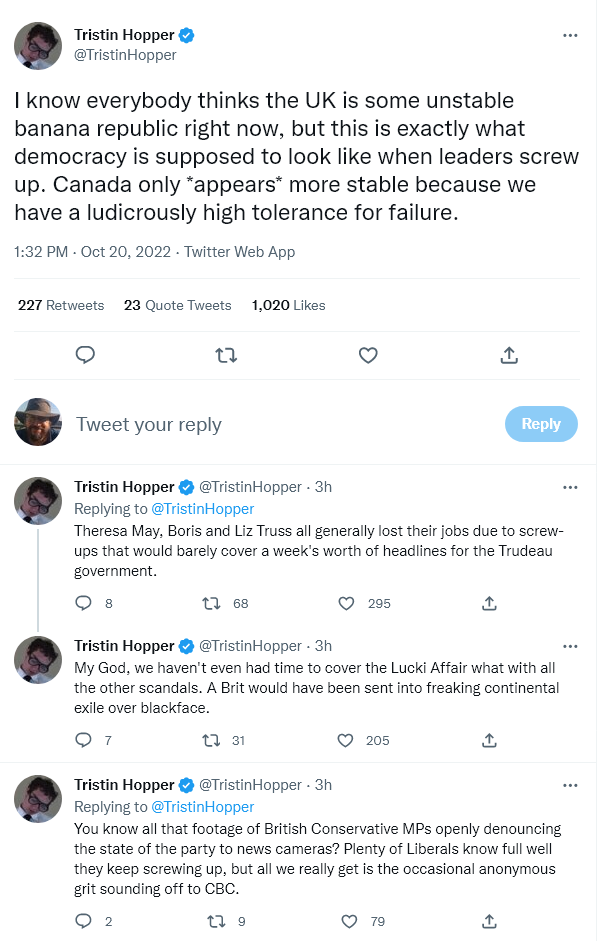
Despite the “bad optics”, as Tristin Hopper points out here, this is what’s supposed to happen when the PM gets it totally wrong, and Canadians have no grounds to criticize Britain here:
Comments Off on The brief career of Liz Truss as British Prime Minister
October 20, 2022
The brief career of Kwasi Kwarteng as Chancellor of the Exchequer
Dominic Sandbrook had the misfortune of having fever dreams in which he found himself pursued by Kwasi Kwarteng. I sympathize, having recently had similar fever dreams, though lacking Mr. Kwarteng’s participation. His very brief time as Chancellor was as unpleasant for all concerned as it could have been:
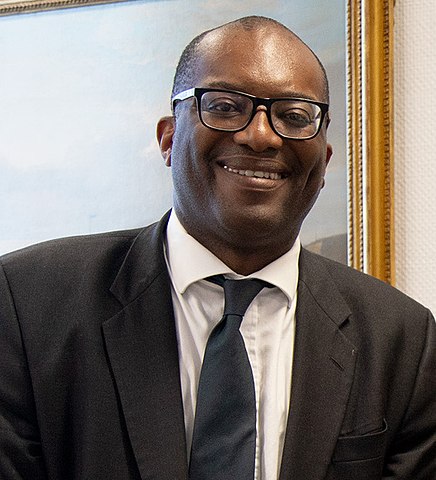
Detail of a photo of Kwasi Kwarteng at a meeting with the US Ambassador, 25 August 2022.
Photo by the Office of U.S. Ambassador to the United Kingdom via Wikimedia Commons.
Nightmares about public failure are very common. There can be few readers who haven’t dreamed about turning up to an exam entirely unprepared, or about walking onstage having neglected to learn the lines. Anecdotal evidence suggests that the more you care about such things, the more likely they are to haunt you, which is why they’re so common among academic high-achievers. So perhaps Kwarteng himself, whose academic credentials are second to none, has had such dreams. And if he did, here’s the twist. His nightmares came true.
What happened to Kwarteng on Friday — and again yesterday, when Jeremy Hunt ripped up his mini-budget, poured petrol on the debris and set the whole thing alight — was more than your standard political sacking. It was a humiliation on the grandest possible scale, as the Chancellor was forced to fly back early from Washington, with some 6,000 people gleefully tracking his flight, before Liz Truss delivered the inevitable bullet. He had been in command at the Treasury for just 38 days, saved only from a post-war record by Iain Macleod’s heart attack in July 1970.
It’s hard to think of many British political figures with such a catastrophic trajectory. Kwarteng had been Boris Johnson’s Business Secretary since January 2021, but it’s a safe bet most ordinary punters had never heard of him. Then, suddenly, he was Chancellor, with a breathtakingly radical plan to defy the markets and turbo-charge a new era of growth. Then, equally suddenly, he became the most unpopular Chancellor in the history of the Ipsos-Mori poll, with even less public support than Denis Healey after the International Monetary Fund bailout in 1976 or Norman Lamont after Black Wednesday in 1992. And then he was gone, and it was all over. What a career!
You might assume from all this that Kwarteng is a fool. But he really isn’t a fool. Giving school talks, I’ve twice come across people who taught him, and both told me he was the cleverest boy they’d ever known. Were they wrong? Obviously not, for when you look at his biography, it’s a proud parent’s dream. At prep school he won a national history prize; at Eton he was a King’s Scholar and won the Newcastle Scholarship for philosophy, a competition examined by Stephen Sykes, Bishop of Ely and former Regius Professor of Divinity at Cambridge.
Kwarteng himself went to Cambridge, where he got a double first, twice won the Browne Medal for Latin and Greek poetry and even won University Challenge. He was a Kennedy Scholar at Harvard. He did a PhD on William III’s attempt to reform the coinage in the 1690s. And he’s written history books — two of which I reviewed at the time. “Well-researched and crisply written, Kwarteng’s book is a lot better than most MPs’ efforts,” I wrote of Ghosts of Empire, which examined the legacy of Britain’s rule overseas. “A politician with a sense of nuance: whatever next?”
For much of his gilded life, then, Kwarteng knew only success. And when he looked forward, he could reasonably expect more in the future. When he daydreamed, he surely imagined himself as a titanic reforming Chancellor to rank alongside William Gladstone or Sir Geoffrey Howe — and perhaps even as Prime Minister. And now? He’s the answer to a quiz question, the 38-day Chancellor whose tax bombshell exploded in his own face. To put that another way, if he were an England football manager, he’d be the love child of Steve McClaren and Sam Allardyce.
Omnium consensu capax imperii nisi imperasset. “All would have agreed that he was capable of being emperor, if only he had never been it.” So wrote Tacitus of the short-lived Roman emperor Galba — who, in fairness, lasted almost seven times longer in his top job than Kwarteng did at the Treasury. It’s a line that often recurs in British political commentary. I’ve seen it applied to Prime Ministers as diverse as Lord Rosebery, Arthur Balfour, Sir Anthony Eden, Harold Wilson, Gordon Brown and Boris Johnson. Perhaps that tells you something about the job — an office in which, one way or another, failure is almost guaranteed.
Comments Off on The brief career of Kwasi Kwarteng as Chancellor of the Exchequer
October 8, 2022
Faint glimmers of hope for Canadians’ “right to repair”?
Michael Geist on the state of play in modifying Canada’s digital lock rules to allow consumers a tiny bit more flexibility in how they can get their electronic devices repaired:
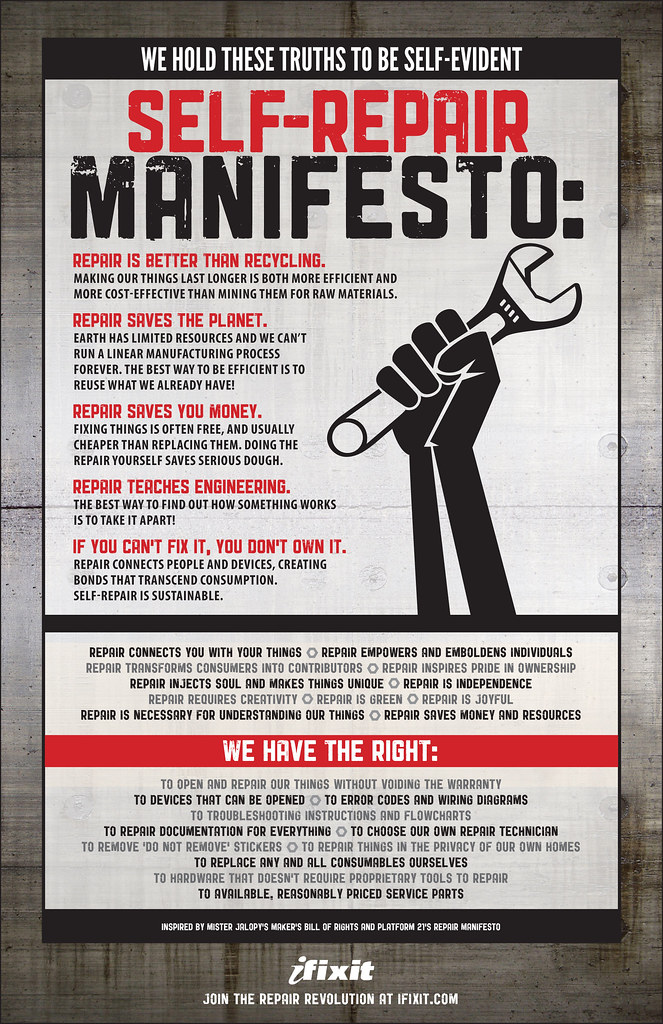
“The Self-Repair Manifesto from ifixit.com ‘If you can’t fix it, you don’t own it’. Hear, hear!” by dullhunk is licensed under CC BY 2.0 
 .
.
Canadian anti-circumvention laws (also known as digital lock rules) are among the strictest in the world, creating unnecessary barriers to innovation and consumer rights. The rules are required under the World Intellectual Property Organization’s Internet Treaties, but those treaties leave considerable flexibility in how they should be implemented. This is reflected in the countless examples around the world of countries adopting flexible anti-circumvention rules that seek to maintain the copyright balance. Canada was pressured into following the restrictive U.S. approach in 2012, establishing a framework is not only more restrictive than required under the WIPO treaties, but even more restrictive than the U.S. system.
One of the biggest differences between Canada and the U.S. is that the U.S. conducts a review every three years to determine whether new exceptions to a general prohibition on circumventing a digital locks are needed. This has led to the adoption of several exceptions to TPMs for innovative activities such as automotive security research, repairs and maintenance, archiving and preserving video games, and for remixing from DVDs and Blu-Ray sources. Canada has no such system as the government instead provided assurances that it could address new exceptions through a regulation-making power. In the decade since the law has been in effect, successive Canadian governments have never done so. This is particularly problematic where the rules restrict basic property rights by limiting the ability to repair products or ensure full interoperability between systems.
The best policy would be to clarify that the anti-circumvention rules do not apply to non-infringing uses. This would enable the anti-circumvention rules to work alongside the user rights in the Copyright Act (also known as limitations and exceptions) without restricting their lawful exercise. This approach was endorsed by the 2019 Canadian copyright review, which unanimously concluded:
it agrees that the circumvention of TPMs should be allowed for non-infringing purposes, especially given the fact that the Nintendo case provided such a broad interpretation of TPMs. In other words, while anti-circumvention rules should support the use of TPMs to enable the remuneration of rights-holders and prevent copyright infringement, they should generally not prevent someone from committing an act otherwise authorized under the Act.
The government has not acted on this recommendation, but two private members bills are working their way through the House of Commons that provide some hope of change. First, Bill S-244 on the right of repair. Introduced by Liberal MP Wilson Miao in February, the bill this week passed second reading unanimously and has been referred to the Industry committee for further study. The lack of a right of repair exception in Canadian digital lock rules has hindered both consumers and Canadian innovation significantly, leaving consumers unable to repair their electronic devices and farmers often locked out of their farm equipment. After farmers protested against similar copyright restrictions, the U.S. established specific exceptions permitting digital locks to be circumvented to allow repair of software-enabled devices.
Given the impact on consumers, the agricultural sector, and the environment, a provision that explicitly permits circumvention for purposes of the right of repair in Canada is long overdue. Indeed, such an approach is consistent with the 2019 copyright review recommendation:
Recommendation 19
That the Government of Canada examine measures to modernize copyright policy with digital technologies affecting Canadians and Canadian institutions, including the relevance of technological protection measures within copyright law, notably to facilitate the maintenance, repair or adaptation of a lawfully-acquired device for non-infringing purposes.
Comments Off on Faint glimmers of hope for Canadians’ “right to repair”?
September 30, 2022
Witness about to testify on Bill C-11? Time to break out good old Parliamentary bullying and intimidation tactics!
It’s had to believe, but the Liberal government continues to defy expectations in their continued mission to prevent public participation in political processes, as Michael Geist documents here:
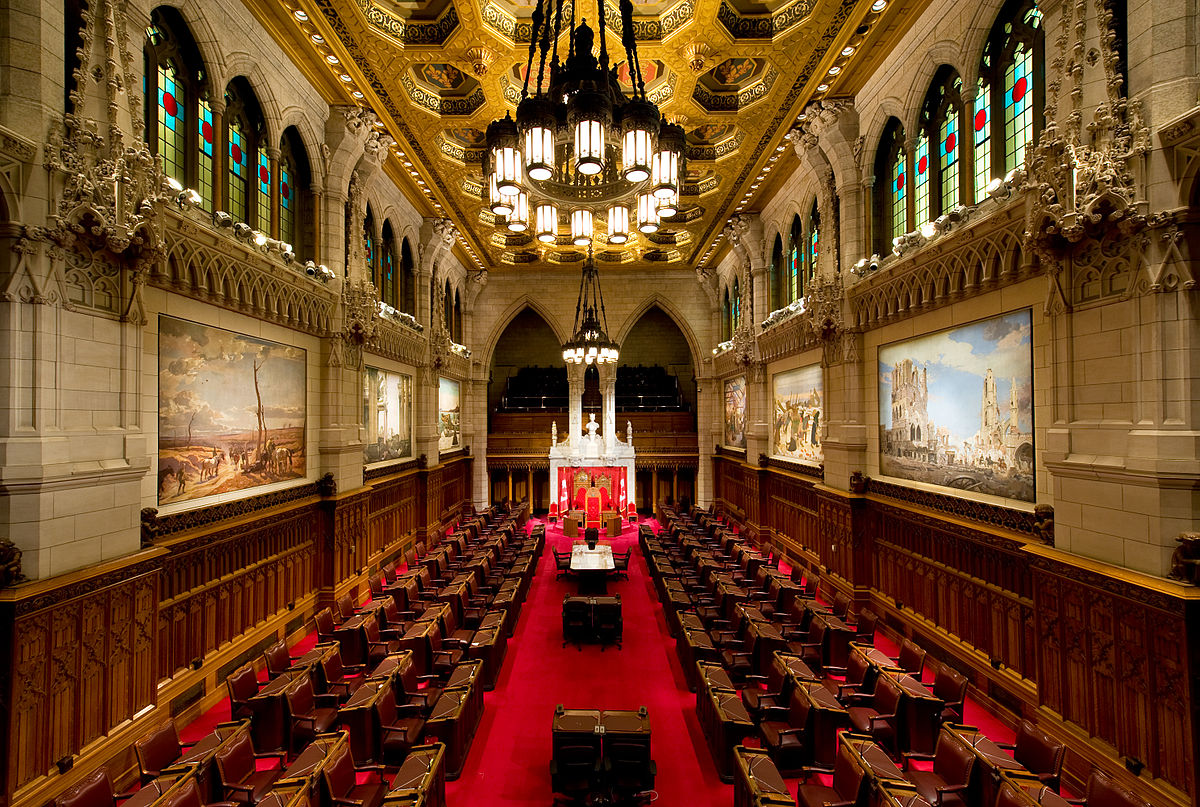
“In the east wing of the Centre Block is the Senate chamber, in which are the thrones for the Canadian monarch and consort, or for the federal viceroy and his or her consort, and from which either the sovereign or the governor general gives the Speech from the Throne and grants Royal Assent to bills passed by parliament.”
Photo and description by Saffron Blaze via Wikimedia Commons.
The Senate Bill C-11 hearings have provided a model for the much-needed, engaged, non-partisan inquiry that was largely missing from the House committee’s theatrics in which the government cut off debate on over 150 amendments. But this week those hearings attracted attention for another reason: serious charges of witness intimidation and bullying by government MPs, most notably Canadian Heritage Parliamentary Secretary Chris Bittle (yes, the same Bittle who last month suggested I was a racist and a bully for raising concerns about Minister Pablo Rodriguez silence over Canadian Heritage funding of an anti-semite as part of its anti-hate program).
The Globe and Mail reported late on Tuesday night that Bittle – together with his colleague, Liberal MP Lisa Hepfner – had sent a letter to the Lobbying Commissioner to seek an investigation into the funding of Digital First Canada, a group representing digital first creators. The letter may have been shopped around to other MPs as Liberal MP Anthony Housefather has told the Globe he did not sign it. DFC’s Executive Director, Scott Benzie, had appeared before the Heritage committee months ago and Bittle used his time to focus on the organization’s funding. Leaving aside the fact that government MPs reserve these kinds of questions only for critics of Bill C-11 (there were no similar questions this week from Ms. Hepfner to the Director of Digital Content Next, whose organization supports Bill C-18 and counts Fox News among its members), the timing of Globe story was incredibly troubling. The Lobbyist Commissioner letter was apparently filed nearly two months ago and Benzie had been assured that he was compliant with the law. Yet the story was presumably leaked to coincide with Benzie’s appearance before the Senate committee last night.
The letter and leak smacked of witness intimidation and bullying with the government seeking to undermine critics of the legislation hours before a Senate appearance. Indeed, the entire tactic felt like the policy equivalent of a SLAPP suit, which are used to intimidate and silence critics through litigation. By the end of the day, the tactic had clearly backfired on Bittle and the government. Conservative MP John Nater filed a point of privilege in the House of Commons, arguing that Bittle had attempted to intimidate a Senate witness.
I rise on a question of privilege, for which I gave notice earlier this same day, regarding the conduct of the member for St. Catharines, who attempted to intimidate Scott Benzie, a witness appearing before a committee of the Senate studying Bill C-11, an act to amend the Broadcasting Act and to make related and consequential amendments to other acts, as reported yesterday by the Globe and Mail.
While I appreciate that this attempt to intimidate relates to proceedings of a Senate committee currently studying Bill C-11, the culprit in this case is a member of the House, and that same witness appeared before the House of Commons Standing Committee on Canadian Heritage during its deliberations on Bill C-11, an appearance where Mr. Benzie, no doubt, first established himself as an undesirable witness for the government on the merits of Bill C-11.
The government response was surprisingly muted with MP Mark Gerretsen simply asking for a couple of days to formulate a response, perhaps recognizing that defending Bittle would mean defending the indefensible.
Comments Off on Witness about to testify on Bill C-11? Time to break out good old Parliamentary bullying and intimidation tactics!
August 24, 2022
QotD: Cromwell dismisses the “Rump Parliament”
It is high time for me to put an end to your sitting in this place, which you have dishonored by your contempt of all virtue, and defiled by your practice of every vice.
Ye are a factious crew, and enemies to all good government.
Ye are a pack of mercenary wretches, and would like Esau sell your country for a mess of pottage, and like Judas betray your God for a few pieces of money.
Is there a single virtue now remaining amongst you? Is there one vice you do not possess?
Ye have no more religion than my horse. Gold is your God. Which of you have not bartered your conscience for bribes? Is there a man amongst you that has the least care for the good of the Commonwealth?
Ye sordid prostitutes have you not defiled this sacred place, and turned the Lord’s temple into a den of thieves, by your immoral principles and wicked practices?
Ye are grown intolerably odious to the whole nation. You were deputed here by the people to get grievances redressed, are yourselves become the greatest grievance.
Your country therefore calls upon me to cleanse this Augean stable, by putting a final period to your iniquitous proceedings in this House; and which by God’s help, and the strength he has given me, I am now come to do.
I command ye therefore, upon the peril of your lives, to depart immediately out of this place.
Go, get you out! Make haste! Ye venal slaves be gone! So! Take away that shining bauble there, and lock up the doors.
In the name of God, go!
Oliver Cromwell, speaking to the so-called “Rump” Parliament, 1653-04-20.
Comments Off on QotD: Cromwell dismisses the “Rump Parliament”
August 8, 2022
Boring British politicians
Katherine Bayford compares the last set of cabinet ministers appointed by lame duck PM Boris Johnson with some of the Parliamentarians of the 20th century … and it’s difficult not to feel nostalgic for a past Golden Age at Westminster:
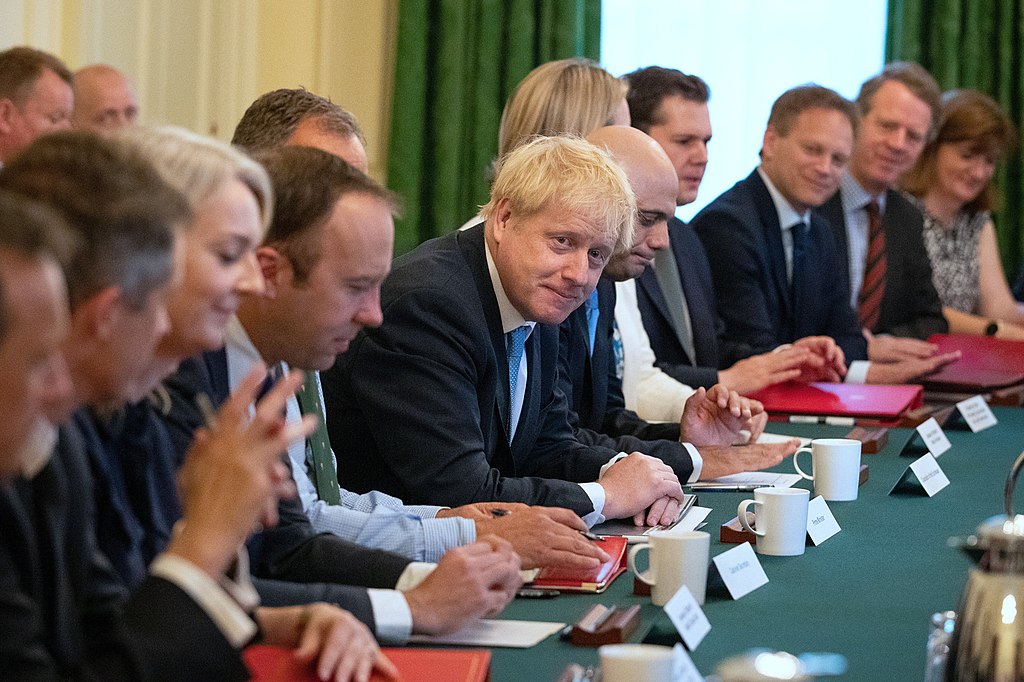
Prime Minister Boris Johnson at his first Cabinet meeting in Downing Street, 25 July 2019.
Official photograph via Wikimedia Commons.
One of Boris Johnson’s final, whimpering acts of power in his premiership was to appoint a new cabinet. Fatally wounded by a team of ministers made up of those with little charm, intelligence or experience, who was actually left for Boris to replace them with?
A veritable who’s-that of the worst unknowns that can be found down the side of parliamentary benches was swiftly conscripted in. I tell a lie — Johnny Mercer MP achieved mild public recognition for defending elderly soldiers accused of war crimes and getting very angry at certain risqué insinuations made in the comments section of the Plymouth Herald.
[…]
There is nothing unusual about this class of minister, however. They are representative figures: dim, without verbal sparkle, frequently light on narrow policy insights and wider understandings of social and economic history. The median British politician has been like this for decades now. Tony Blair would bemoan the shoddy material he had to work with at every reshuffle, and David Cameron likewise found himself struggling for a front bench neither too hateful nor too stupid. The difference in political acumen and sophistication from the most forgotten of ministerial interviews from fifty years ago reveal a steep decline in both the eloquence and elegance of our politicians.
Perhaps the 20th century spoiled the voting public. Pick any decade and you will discover frontline politicians with vast hinterlands. Harold Macmillan recited Aeschylus — in the original Greek — whilst lying shot in the trenches. Enoch Powell rose from private to brigadier during the Second World War, after becoming the youngest professor in the empire. When Winston Churchill was attempting to stay solvent in the face of decades worth of excess, he maintained financial buoyancy by being the highest-paid journalist in the world. Publishers adored him. He could be trusted to write a million-word definitive biography of his relative, the first Duke of Marlborough. Roy Jenkins would in turn distinguish himself as a biographer of Churchill — as well as Gladstone, and the Chancellors of the Exchequer at large. Second-hand embarrassment is the only proper response when comparing such authorial endeavours to Boris Johnson’s biography of Churchill.
It’s not a matter of our politicians not being able to write anymore. Compared to the recent past they can barely speak. Political debates have succumbed to an entropic, deadening mediocrity. Recent discourse between a patronising, bland Sunak and a po-faced, blank Truss was not a nadir: it was standard fare.
Look upon this 1970 debate between Jenkins and Powell. Both men hold articulate and intelligent positions, arguing intricately and considerately, with a commitment to truth rather than point-scoring. They agree where relevant and have an ability to articulate clearly and fluently. Half a century on, political debate of such quality seems unrealisable. When watching vintage ministerial debates, the viewer is struck by the level of knowledge and attention that the speakers assumed their audience would possess, whether on the finer points of tackling inflation or whether IRA bombers deserved to the death penalty.
The slightest glance at cabinets fifty years ago demonstrates a far higher set of standards and abilities than those found today. Harold Wilson — always keen to consolidate as much power as possible — nevertheless packed his cabinet with the best and brightest, even if he kept them in positions in which they wouldn’t be able to outshine him. Wilson himself was a subtle and clever debater, not above using cheap PR tricks (such as his much-perfected pipe smoking) but always as a tool to realise his political vision.
Mediocrity requires mediocrity in order to survive. When judged against excellence — or even simple competence — the insufficiencies of today’s politician become intolerable. It is this which leads the public to distrust politicians more than their policy choices.
Comments Off on Boring British politicians


