Quotulatiousness

October 9, 2009

Army beats Navy and Airforce

Filed under: Britain, Military — Tags: , , , — Nicholas @ 12:11

Following up on yesterday’s post about the British Ministry of Defence directive to find savings to support the ongoing (primarily army) efforts in Afghanistan, Strategy Page calls the winner:

British Army Sinks The Navy And Grounds The Air Force

After several months of debate, the British Royal Navy and Royal Air Force have been ordered to cut back on spending, so that money and resources may be used to support army operations in Afghanistan. Among other things, the army has been pointing out that only ten percent of spending on new equipment goes to the army (based on actual and planned spending between 2003-18). This, despite the fact that it’s the army that is doing most of the fighting during this period. Although the army recently pulled out of Iraq (where it had been since 2003), it is still in Afghanistan, and more troops are headed there. The Royal Navy and Royal Air Force have not been fully involved in a major operation since the Falklands in 1982, although they have been involved in several more limited efforts. The point is that they face nothing like what the army is dealing with in Afghanistan.

The British armed forces have 191,000 troops on active service. Of those, 38,000 are in the Royal Navy, 109,000 in the Army, 41,000 in the Royal Air Force, and the rest in joint staffs and operations. The annual defense budget is about $58 billion.

Those aircraft carriers are looking less and less likely to be ever in service . . .

October 8, 2009

British military establishment facing cuts under next government?

Filed under: Britain, Bureaucracy, Military — Tags: , , — Nicholas @ 07:36

It would be too glib of me to suggest that the Ministry’s preferred way to respond to the Conservative opposition’s call “to cut MoD costs by 25%” would be to abandon the Royal Navy (or ground the Royal Air Force), but it’s hard to imagine them voluntarily cutting their own numbers:

Shadow defence secretary Liam Fox is expected to tell the party’s conference: “Some things will have to change and believe me, they will.”

The BBC’s Laura Kuenssberg said Mr Fox had asked for savings in bureaucracy – the MoD has 85,000 civil servants.

The Tories have pledged to cut overall Whitehall budgets by a third.

In his speech to party members in Manchester, Dr Fox will accuse Labour of having creating “a black hole” in defence budgets, which are affecting the war in Afghanistan and threatening to create an “on-going defence crisis for years to come”.

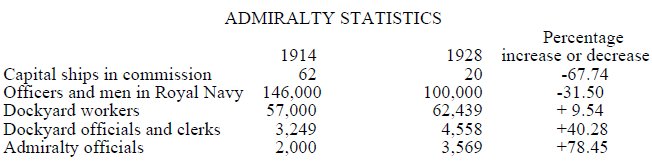
Of course, there’s nothing new about the administrative “tail” of the armed forces growing . . . C. Northcote Parkinson documented the phenomenon (PDF) back in 1955:

The accompanying table is derived from Admiralty statistics for 1914 and 1928. The criticism voiced at the time centered on the comparison between the sharp fall in numbers of those available for fighting and the sharp rise in those available only for administration, the creation, it was said, of “a magnificent Navy on land.” But that
comparison is not to the present purpose. What we have to note is that the 2,000 Admiralty officials of 1914 had become the 3,569 of 1928; and that this growth was unrelated to any possible increase in their work. The Navy during that period had diminished, in point of fact, by a third in men and two-thirds in ships. Nor, from 1922 onwards, was its strength even expected to increase, for its total of ships (unlike its total of officials) was limited by the Washington Naval Agreement of that year. Yet in these circumstances we had a 78.45 percent increase in Admiralty officials over a period of fourteen years; an average increase of 5.6 percent a year on the earlier total. In fact, as we shall see, the rate of increase was not as regular as that. All we have to consider, at this stage, is the percentage rise over a given period.

Parkinson_Admiralty_Statistics

September 25, 2009

Operation Nanook

Filed under: Cancon, Military — Tags: , , — Nicholas @ 10:21

You wouldn’t say they go out of their way to glorify the military in this video . . .

September 22, 2009

More on the ABM decision

Filed under: Europe, Military, USA — Tags: , , — Nicholas @ 11:50

Following up from last week’s post on cancelling ABM systems for Poland and the Czech Republic, Jon sent the following comment:

I was wondering about this sort of thing when the announcements were first made, but thought that “No, Obama is indeed evil enough to do this just for kicks.” Is is possible, thought, that the Polish and Czech installations are being cancelled as they are being replaced with something else?

Have you read anything to that effect anywhere?

I assumed colossal ignorance and ineptitude, rather than deliberate provocation, but maybe I’m just too naive. I had read something about the SM-3 BMD at Taylor Empire Airways (yes, this time I’m sure it was Chris Taylor). He indicates that it does have a better track record than competing systems and it can be deployed much faster, but that there are also some caveats.

September 11, 2009

Visiting HMCS Toronto

Filed under: Cancon, Military — Tags: , , — Nicholas @ 12:04

The Economist reports on a visit to HMCS Toronto during Operation Nanook:

Thursday

A BLAST of the bosun’s whistle at 7am starts the day on the HMCS Toronto. Footsteps echo through the metal hull as the day watch makes their way to breakfast. We journalists lag behind. It is not easy to climb out of the bunks (or racks, in navy slang) stacked three high in areas kept permanently dark because someone is always sleeping. It was even harder to get into our racks the night before, as there were no ladders and no obvious way to get up to the middle or top racks.

Yesterday we were warned that we might have to climb a rope ladder to board the frigate from the Zodiacs. This threat was withdrawn and a set of steep metal steps with handrails was provided. Perhaps they took pity on the sedentary hacks that normally spend their days staring at computer screens. More likely, it was because the Canadian prime minister, the defence minister, and the top military brass are joining us.

While having the leaders assembled in one place appears risky — one well-aimed torpedo from an enemy submarine could cripple the Canadian government and wipe out its military command — we are assured that there is no conventional military threat in the Canadian arctic.

A true cynic might say something like “it’s a good thing the Liberals don’t have any submarines . . .”

September 9, 2009

Operation Nanook

Filed under: Cancon, Military — Tags: , , — Nicholas @ 13:13

I was surprised that they chose this particular name for the exercise, as I’d have assumed it would provoke mild symptoms of offensensitivity. Apparently not:

Ostensibly, we’re here to witness Canada asserting its control of the Arctic, which is attracting increased military and commercial interest due to the melting polar ice cap. But a political motive lurks behind the PR: Stephen Harper, the Conservative prime minister of a minority government, may well be facing an election in the autumn. He has made the Arctic one of his signature issues, and will drop by for grips and grins.

We are told to be at Apex Beach, a five-minute drive from central Iqaluit, at 5:30am to witness the first part of the exercise. Around 140 soldiers and their guides, known as Canadian Rangers, will land from the frigate HMCS Toronto and icebreaker CCGS Pierre Radisson. Midway through the two-month arctic summer, the waters of Frobisher Bay are glass-smooth and ice-free.

Although the sun has already been up for an hour, the weather is cool, more like a crisp autumn day than a midsummer morning. The military has thoughtfully provided a tent stocked with coffee and muffins for the journalists. Those who forgot their hats and gloves shelter there as the first of the Zodiac boats zip across the calm waters to the beach. Aside from the Sea King helicopter circling overhead, there is little drama in the landing. The soldiers, clad in green camouflage, calmly disembark and march off in groups of four to assemble at the top of a rocky hill.

The Canadian Rangers may be the least well-known of Canada’s military:

Rangers reflect the communities they are drawn from, says Mr Buzzell. In the western Arctic, where he is from, they are a mix of white, Indian, Métis and Inuit. In Nunavut, where Inuit make up 85% of the territory’s population, they are mainly Inuit. In any exercise on land, the regular forces would be lost without the Rangers’ survival skills, as would the numerous expeditions from all over the world that set out each year for the North Pole.

The Inuit are usually too polite to make a point of this. But a video I picked up in Iqaluit called “Quallunat: Why white people are funny” provides a rare glimpse of how Inuit view hapless southerners. The scene in which an Inuit on a snowmobile rescues two so-called explorers, equipped with the latest gear but little sense, makes for funny, if uncomfortable viewing.

August 6, 2009

More threats to Royal Navy’s carrier plans

Filed under: Britain, Military — Tags: , , , , — Nicholas @ 12:03

An interesting report in The Register discussing the possibility of abandoning the planned STOVL variant of the F-35 and switching to the more traditional catapult-launch and tailhook-landing variant being developed for the US Navy:

The UK Ministry of Defence (MoD) is set to make a major change to the design of the new aircraft carriers for the Royal Navy, according to a newspaper report. It’s suggested that the ships will now be equipped with catapults and arrester wires, allowing them to operate normal carrier aircraft rather than the complex, expensive jump-jets which had been planned.

According to the Daily Telegraph today “the MoD has indicated that it will drop the jump-jet… The Daily Telegraph has learnt from senior defence officials that an announcement is due this autumn.”

There would definitely be advantages to going with a more traditional aircraft: less mechanical complexity, greater weapons-carrying capability, and (probably most important in the MoD) lower per-aircraft costs. It’s not a slam-dunk decision, however:

Catapults and arrester gear aren’t a significant expense in themselves, but current catapults are powered by steam from the ship’s engines. The planned new Royal Navy ships will be propelled by gas turbines, however, and so have no steam (US and French carriers use nuclear propulsion, which can easily furnish steam from their associated turbines).

Adding powerful auxiliary steam boilers for catapults or upgrading the ships to nuclear propulsion would significantly increase their cost. There is an alternative option, the use of electrically-powered catapults, but these don’t yet exist. They are being developed in the States for the next US carrier, but as a new technology there is naturally some risk that they won’t pan out, or may be subject to delays and cost increases.

Of course, there’s always the risk that the MoD, under pressure from the government of the day would cancel the ships altogether, as a cost-saving measure (see this post from last year for further grim speculation on that topic).

July 29, 2009

Another lost WW2 combat aircraft discovered

Filed under: History, Military — Tags: , , , — Nicholas @ 20:28

This time it’s a US Navy carrier plane:

On May 28, 1945, the SB2C-4 Helldiver was on a practice bombing run from a nearby aircraft carrier. The crew members survived the emergency landing.

At the time, the Navy opted not to recover the plane.

Yesterday, Raia said she couldn’t comment on how long it will take Navy officials to decide whether to salvage the plane. Typically, the Naval Aviation Museum in Pensacola, Fla., plays a major role in the evaluation process.

One of the pilots is believed to be 90 years old and living in Michigan, but the Navy hasn’t provided his name.

“Wouldn’t that be something to fly him out here and have him standing on the shoreline when they lift the plane out?” Manville said.

That’d be cool . . . as long as they don’t make him pay for the recovery of the plane.

July 26, 2009

I’ll take his word for it

Filed under: Britain, Cancon, History, Technology — Tags: , , , — Nicholas @ 00:14

. . . but it looks like a random collection of bits to me:

Fairey_Swordfish_wreck

It may not look like much to the untrained eye, but to those of us who are Warbird afficionados, it is incredibly complete. There have been rebuilds to fly from wrecks recently dragged out of the Russian wilderness which were found in worse condition that this.

July 24, 2009

Photo tour of the USS Hornet

Filed under: History, Military — Tags: , , , , — Nicholas @ 10:06

I’ve been onboard several retired battleships, but so far I’ve not managed to get onto an aircraft carrier. This will have to do for the time being:

The USS Hornet was on hand 40 years ago to pick up the Apollo 11 astronauts after their Columbia Command Module splashed down in the Pacific Ocean on July 24, 1969.

Today, the aircraft carrier is preserved as a museum in Alameda, California. Its main deck is littered with historic warplanes and space artifacts including an Apollo command module and Mobile Quarantine Facility from subsequent missions, pictured below. The first footsteps the Apollo 11 crew took on Earth after walking on the moon are traced on the deck.

USS Hornet CIC

USS Hornet CIC

Above: The USS Hornet’s Crisis Information Center is pictured. While engaged in active warfare, crewmembers would stand behind transparent, hanging boards and write information backwards to keep from getting in the way of the officers who needed to read it.

I think it was actually the “Combat” Information Center, but I could be mistaken. Lots of cool images, but I’d like to see more . . .

July 10, 2009

Sunken 1812 vessel may be HMS Wolfe

Filed under: Cancon, History — Tags: , , , , — Nicholas @ 13:13

An interesting article in the Ottawa Citizen about a recently discovered wreck near Kingston, which may be the remains of HMS Wolfe:

A team of divers is set to plunge into Lake Ontario near Kingston, Ont., next week in a bid to confirm the discovery of a legendary Canadian-built ship from the War of 1812, the HMS Wolfe.

In collaboration with marine archeologists from Parks Canada, the divers plan to take detailed measurements, drawings and photographs of a sunken wooden sailing vessel that appears to match the size and last known location of the famous 32-metre sloop: the flagship of British naval commander James Yeo and star of a dramatic 1813 battle west of Toronto that helped thwart the U.S. invasion of Canada.

The suspected discovery comes just three years before the 200th anniversary of the war, adding urgency to the efforts to identify a possible new showcase relic for bi-national commemoration activities.

(Cross-posted to the old blog: http://bolditalic.com/quotulatiousness_archive/005570.html.)

« Newer Posts

Powered by WordPress