Quotulatiousness

February 13, 2017

Lessons from repeat bestseller Nineteen Eighty-Four

Filed under: Books, Liberty, Politics, USA — Tags: , , , — Nicholas @ 04:00

Brendan O’Neill hopes that some of the folks just encountering George Orwell’s novel for the first time are able to draw the correct lessons from the text:

It’s great to see that leftists and millennials and others are snapping up George Orwell’s Nineteen Eighty-Four in a bid to make some sense of Trump’s presidency. Because when they get deep into this dystopian tale — into the Newspeaking, sex-fearing, history-rewriting meat of it — they might realize that it describes their authoritarianism better than Trump’s. I can picture their faces now: “Guys… is this novel about us?”

The book shot to the top of Amazon’s bestseller list after Kellyanne Conway used the phrase “alternative facts” to describe the Trump administration’s belief that the crowds at his inauguration were larger than the media had let on. People pointed out that “alternative facts” sounds creepily like something the Party in Orwell’s story would say. Trump seems to believe he can fashion facts from thin air, to boost his own political standing.

“Alternative facts is a George Orwell phrase,” said Washington Post reporter Karen Tumulty. MSNBC correspondent Joy Reid tweeted the following lines from the novel: “The Party told you to reject the evidence of your eyes and ears. It was their final, most essential command.” Within hours Nineteen Eighty-Four was a bestseller again, people buying it as a map to the liberty-challenging Trump era.

But the novel is a better guide to what preceded Trump, to the nannying, nudging, speech-policing, sex-panicking, P.C. culture that Trumpism is in some ways a reaction against.

Consider the Junior Anti-Sex League, the prudish youths in Orwell’s story who think the “sex impulse” is dangerous and devote themselves to spying on interactions between the sexes. “Eroticism was the enemy,” they believed. “Desire was thoughtcrime.” If this prissiness finds its echo in anyone today, it isn’t in the creepily oversexed, pussy-grabbing Trump — it’s in the stiff buzz-killers of the campus feminist movement.

January 16, 2017

Why do millennials earn some 20% less than boomers did at the same stage of life?

Filed under: Economics — Tags: , , , , — Nicholas @ 03:00

Tim Worstall explains why we shouldn’t be up in arms about the reported shortfall in millennial earnings compared to their parents’ generation at the same stage:

Part of the explanation here is that the millennials are better educated. We could take that to be some dig at what the snowflakes are learning in college these days but that’s not quite what I mean. Rather, they’re measuring the incomes of millennials in their late 20s. The four year college completion or graduation rate has gone up by some 50% since the boomers were similarly measured. Thus, among the boomers at that age there would be more people with a decade of work experience under their belt and fewer people in just the first few years of a professional career.

And here’s one of the things we know about blue collar and professional wages. Yes, the lifetime income as a professional is likely higher (that college wage premium and all that) but blue collar wages actually start out better and then don’t rise so much. Thus if we measure a society at the late 20s age and a society which has moved to a more professional wage structure we might well find just this result. The professionals making less at that age, but not over lifetimes, than the blue collar ones.

[…]

We’ve also got a wealth effect being demonstrated here. The millennials have lower net wealth than the boomers. Part of that is just happenstance of course. We’ve just had the mother of all recessions and housing wealth was the hardest hit part of it. And thus, given that housing equity is the major component of household wealth until the pension is fully topped up late in life, that wealth is obviously going to take a hit in the aftermath. There is another effect too, student debt. This is net wealth we’re talking about so if more of the generation is going to college more of the generation will have that negative wealth in the form of student debt. And don’t forget, it’s entirely possible to have negative net wealth here. For we don’t count the degree as having a wealth value but we do count the loans to pay for it as negative wealth.

October 12, 2016

This generation gap thingy is bigger than I thought

Filed under: Business, Food — Tags: , , , — Nicholas @ 04:00

I’m far from a McDonalds fan … I darken their doors less than yearly, although I’ve had a long-running “joke” that I need to have a Big Mac at least once a year, if only to remind me why I don’t eat at McDonalds more often. But is the iconic Big Mac a victim of its own success? Has it stopped being relevant in the fast food world? Colby Cosh investigates:

The Wall Street Journal reports that a big McDonald’s franchise owner did some market research recently and stumbled upon a surprising fact: only one in five Americans of “millennial” age has ever tried a Big Mac. Those of you who follow me on Twitter know what my reaction was to this news: a paroxysm of skeptical eye-rolling.

The Big Mac might easily be described as the single most successful consumer product of the 20th century. Of all the various kinds of sandwiches that the human imagination has conceived since the lifetime of the 4th Earl of Sandwich (peace be upon him), the Big Mac might be the specific sandwich that has been prepared and eaten the most. It has a recipe that children everywhere can recite by heart. How is it possible that an entire generation has collectively skipped it, never thinking it might have some merit?

Well, whether or not I would have imagined it, the reactions I got when I asked around convinced me quickly that it is probably true. (Big surprise: a businessman’s expensively gathered information about his customer base turns out to be more accurate than some jackass’s wild guess.) Dozens of young people immediately told me that they have never tried a Big Mac. Plenty of these sandwich-spurners were careful to specify, all with evident shame, that they do visit McDonald’s often; at least one had worked there. A few correspondents had specific reasons for avoiding the Big Mac, but for the most part, the prevailing attitude toward the item seemed to be apathy, rather than hostility.

[…]

As it happens, I was raised in the boonies, and we would visit McDonald’s just a few times a year. I have to acknowledge that my fondness for Big Macs is a matter of generational and circumstantial happenstance. They are, even though I’ve certainly had a thousand of the things, still attainably glamorous — a dream of childhood now indulged at will.

Fortunately, my inherited cheapness protects me from a nightmare of special-sauce overdose. I can never order a Big Mac without an inner Presbyterian voice — Socrates’ daimon, with my grandfather’s accent — grumbling that this damned thing should really cost about $2. What the Wall Street Journal has me wondering is how long the Big Mac can remain on the menu at all, if it has really been bypassed by progress and fashion in the manner of marmalade or pickled eggs. If I knew my next Big Mac was my last — though any one might be! — I might pay more like $50.

Colby and I are of a similar generational group, but I’d probably top out at $25 for my “very last” Big Mac.

August 15, 2016

New sitcom works very hard to offend its audience, Millennials

Filed under: Humour, Media — Tags: , , — Nicholas @ 02:00

Lisa de Moraes explains why the cast and crew of the new CBS comedy are being attacked on social media for their insensitivity to the plight of Millennials:

War broke out today between millennial media and the cast and creators of CBS’ new comedy series The Great Indoors, in which Joel McHale stars as an adventure reporter who becomes boss to a group of millennials in the digital department of their magazine. […]

It started when EP Mike Gibbons, who noted that 40 is the new 80, mentioned that CBS focus-grouped the pilot, and the millennial in the group said he did not like it because of the jokes about millennials being coddled, too sensitive and thin-skinned. The woman running the focus group, Gibbons said, clarified: “So, you were offended by millennials being portrayed as too sensitive.”

A Millennial Media Member interrupted Gibbons. “I’m a millennial myself. How are we so coddled, and what about our overly politically correct workplace bothers you?” she asked, like she meant it to sting.

Stephen Fry, who co-stars as the charismatic founder of The Great Outdoors magazine, who is a world traveler, explorer and adventurer, jumped in to note there is “an element of coddling” and “an element in which you have it tougher than the generation before.”

[…]

Another media member, non-millennial, asked Gibbons if he was “worried” that the show would be dismissed as “middle-aged white guy complaining about his lot in life and having to deal with millennials.”

Joked Gibbons, “Our show is going to make America great again”.

“So you are the Trump show?” Non-Millennial Media Member snapped back. “I’m just seeking clarification.”

“Irony comes through in print, right?” Gibbons quipped.

H/T to Small Dead Animals for the link.

July 8, 2016

Pat Condell – We Saved Our Democracy

Filed under: Britain, Europe — Tags: , , — Nicholas @ 02:00

Published on 7 Jul 2016

We have everything to be proud of.

April 23, 2016

Politics, your social bubble, and you

Filed under: Politics, USA — Tags: , , , — Nicholas @ 02:00

Last week, Megan McArdle looked at the Hindenburg-crashing-into-the-Titanic-during-a-volcanic-eruption how so many people’s assessment of the US general election is so at variance with reality:

Call it “the big sort” or “demographic clusters” or whatever you like, it all comes down to the same thing: Even as Americans talk more and more about diversity, they are increasingly dividing themselves into like-minded bubbles where other people, with other experiences and viewpoints, almost never penetrate. This is the message of books by Charles Murray and Robert Frank, and indeed of our own social media feeds.

All of those articles on “how to talk to your family about politics this Thanksgiving” might as well be called “how to discuss politics on the one day a year when you find yourself in a group that has not been hand-curated to remove dissenting viewpoints.”

I don’t exclude myself from this. I live in one of the most rarefied bubbles on the planet, a community of policy-focused knowledge workers in which I practically qualify as a proletarian because I have spent years in jobs that did not involve writing about what other people have done or ought to do.

Even the socialists here in Washington are often notable for their lack of personal familiarity with their side in the class war. Outside of family circles, I almost never meet anyone who does not have a college degree and a 401(k), unless I’m buying something from them, or giving a talk at a university to people who are on their way to having a college degree and a 401(k).

Social media, of course, makes this problem worse. Even if we are not deliberately blocking people who disagree with us, Facebook curates our feeds so that we get more of the stuff we “like.” What do we “like”? People and posts that agree with us. Given that Facebook seems to be the top news source for millennials, and an increasingly important one even for folks who grew up skimming dead trees for information, that matters quite a lot.

April 6, 2016

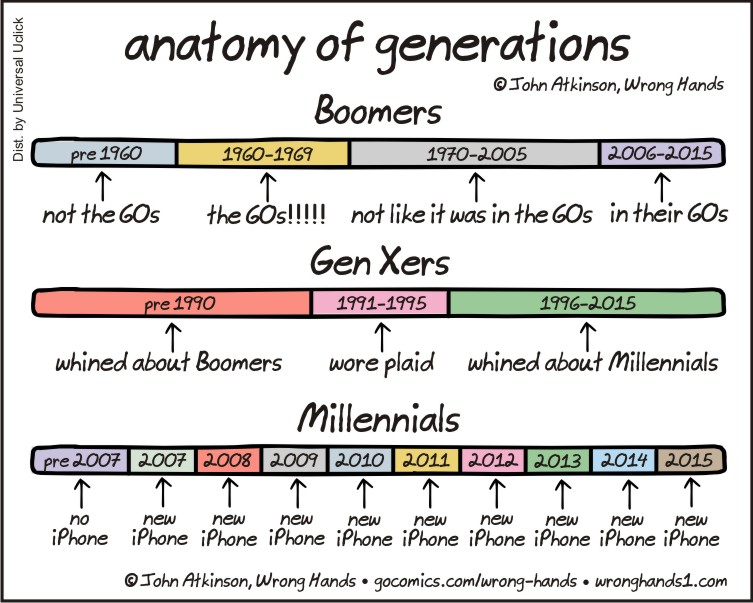
The differences between the Boomers, Gen-Xers and Millennials

Filed under: Humour — Tags: , , — Nicholas @ 02:00

Differences between the generations

Seen at http://ratak-monodosico.tumblr.com/post/142242804250

January 25, 2016

Virtue signalling

Filed under: Media, Politics — Tags: , , , , — Nicholas @ 02:00

At Acculturated, Mark Judge outlines one of the more irritating ways that the “great and the good” show how much better they are than us uncultured, boorish masses:

British author James Bartholomew has secured his place in history. Recently, he invented the perfect phrase for our times: “virtue signaling.”

Virtue signaling is the popular modern habit of indicating that one has virtue merely by expressing disgust or favor for certain political ideas, cultural happenings, or even the weather. When a liberal goes on a tirade about how dumb and dangerous Senator and Republican presidential candidate Ted Cruz is — a tirade devoid of specific examples of Cruz’s mendacity — that person is actually signaling to others that he or she is virtuous. It has very little to do with Cruz’s actually personality or record.

Celebrities who publicly express panic about the environment without knowing much about science are virtue signaling. So are those who seize on current events to publicize their supposedly virtuous feelings, as Facebook founder Mark Zuckerberg did recently when he wrote on Facebook: “If you’re a Muslim in this community, as the leader of Facebook I want you to know that you are always welcome here and that we will fight to protect your rights and create a peaceful and safe environment for you.” Well, that’s a relief—Facebook won’t be banning Muslims.

[…]

The New Left of the 1960s was more about rage than reason, and they passed their anger down to their Millennial offspring. Often the entire front page of left-leaning websites like Slate and Salon are nothing but virtue signaling, the headlines all variations of: Celebrity/Politician/Activist A Just Destroyed the Homophobic/Sexist/Racist Idiocy of Politician B. Usually the articles are jeremiads without much reporting. If research is going to buzzkill your virtue signaling, well then, to hell with research.

But then, virtue signaling is not about journalism. It’s a way to vent your anger.

December 18, 2015

“The gift economy of the digital world is a mirage”

Filed under: Economics, Media — Tags: , , , , — Nicholas @ 02:00

Grant McCracken responds to Clay Shirky’s “gift economy” notions:

In point of fact, the internet as a gift economy is an illusion. This domain is not funding itself. It is smuggling in the resources that sustain it, and to the extent that Shirky’s account helps conceal this market economy, he’s a smuggler too. This world cannot sustain itself without subventions. And to this extent it’s a lie.

Shirky insists that generalized reciprocity is the preferred modality. But is it?

    [In the world of fan fic, there] is a “two worlds” view of creative acts. The world of money, where [established author, J.K.] Rowling lives, is the one where creators are paid for their work. Fan fiction authors by definition do not inhabit this world, and more important, they rarely aspire to inhabit it. Instead, they often choose to work in the world of affection, where the goal is to be recognized by others for doing something creative within a particular fictional universe. (p. 92)

Good and all, but, again, not quite of this world. A very bad situation, one that punishes creators and our culture, is held up as somehow exemplary. But of course reputation economies spring up, but we don’t have to choose. We can have both market and reputation economies. But it’s wrong surely, to make the latter a substitute for the former.

Shirky appears to be persuaded that it’s “ok” for creators to create without material reward. But I think it’s probably true that they are making the best of a bad situation. Recently, I was doing an interview with a young respondent. We were talking about her blog, a wonderful combination of imagination and mischief. I asked her if she was paid for this work and she said she was not. “Do you think you should be paid?” I asked.

She looked at me for a second to make sure I was serious about the question, thought for a moment and then, in a low voice and in a measured somewhat insistent way, said, “Yes, I think I should be paid.” There was something about her tone of voice that said, “Payment is what is supposed to happen when you do work as good as mine.”

[…]

Finally, I do not mean to be unpleasant or to indulge ad hominem attack, but I think there is something troubling about a man supported by academic salary, book sales, and speaking engagements telling Millennials how very fine it is that they occupy a gift economy which pays them, usually, nothing at all. I don’t say that Shirky has championed this inequity. But I don’t think it’s wrong to ask him to acknowledge it and to grapple with its implications.

The gift economy of the digital world is a mirage. It looks like a world of plenty. It is said to be a world of generosity. But on finer examination we discover results that are uneven and stunted. Worse, we discover a world where the good work goes without reward. The more gifted producers are denied the resources that would make them still better producers and our culture richer still.

What would people, mostly Millennials, do with small amounts of capital? What enterprises, what innovations would arise? How much culture would be created? I leave for another post the question of how we could install a market economy (or a tipping system) online. And I have to say I find it a little strange we don’t have one already. Surely the next (or the present) Jack Dorsey could invent this system. Surely some brands could treat this as a chance to endear themselves to content creators. Surely, there is an opportunity for Google. If it wants to save itself from the “big business” status now approaching like a freight train, the choice is clear. Create a system that allows us to reward the extraordinary efforts of people now producing some of the best artifacts in contemporary culture.

December 9, 2015

Bernie and the Snake People

Filed under: Media, Politics, USA — Tags: , , — Nicholas @ 04:00

Katherine Ernst on the odd match of Bernie Sanders and his Millennial Snake People supporters:

A friend, who like me straddles the demarcation line between Millennial and Gen-Xer, was being bombarded at her Millennial-filled office with endless pro-Bernie Sanders “memes.” Things had reached a comic nadir (or zenith, depending on your perspective) with the non-ironic electronic dissemination of a doctored image of Sanders — framed by a heavenly rainbow — with a kitten under each arm: “I FIGHT FOR THE 99 ‘PURR-CENT,’” the bold white letters proclaimed. Quipped my friend: “I eat lunch by myself most days now.”

I commiserated. The same stuff was spamming my social media feeds; Bernie-fever sometimes seemed more intense, more omnipresent than the Obama-gasms of seven years ago. “Feel the Bern” jokes abounded, as did links to left-wing philippics on how Bernie was going to right all capitalist and racist wrongs. Most common were pics of the candidate in heroic, Soviet-worker-like pose — made by his campaign for the express purpose of “grassroots” reposting — next to quotations such as, “I have opposed Keystone from day one.”

My friend and I were not imagining things: the millennial love affair with Sanders is real. A recent NBC News-Survey Monkey poll found that “Millennials … are more than twice as likely to vote for Sanders than Clinton, leading her 54 percent to 26 percent.” The Guardian notes that “On Facebook 1.8 million people like Sanders’s page, 0.6 million more than the Democratic frontrunner Hillary Clinton, and 1.6 million more than Republican Jeb Bush.” The New Yorker concurs: “Today’s Millennials, who will make up thirty-six percent of eligible voters in 2016, have no such candidate to call their own, except for Sanders. If they were to vote at their capacity, they’d be the country’s largest voting bloc.”

None of this is lost on Sanders. Indeed, his whole campaign is about getting college kids frothed up on “revolution.” As he told Bill Maher: “[W]e’re being very aggressive in reaching out to young people … what we want to do is tap, Bill, the idealism of the kids. And what the kids are saying, for example, is that this country should lead the world in transforming our energy system and dealing with climate change.” Indeed, in successive debates — including one held 24 hours after the Isis attacks in Paris — Sanders identified climate change as our “greatest national security threat.”

November 17, 2015

Jonah Goldberg – “You Stupid Schmucks, Look at You Now”

Filed under: Politics, USA — Tags: , , , , — Nicholas @ 05:00

Jonah Goldberg’s weekly “news”letter last week covered the entertaining spectacle of legions of progressive thinkers turning on their own allies:

… this “crisis” is 100 percent liberalism’s fault. Sure, sure, you can divvy up the slices of blame in different ways, but those guys tailgating in the parking lot drinking beers and eating bratwurst? Those are the conservatives and libertarians enjoying a day off, because they don’t have to wait in line for even a morsel of blame.

I almost feel sorry for those decent, sincere career liberals standing there in the quad as the little Maoists scream in their faces and strip off the suede elbow patches on their tweedy jackets like a lieutenant being busted down to a private. As the kids fit lifelong members of the ACLU with their duncecaps, the poor souls can hear the conservatives hooting and laughing off beyond the fence, throwing nerf footballs and telling jokes at the liberals’ expense.

[…]

Outside of the actual headquarters of the Democratic party itself, no major institution in America today is more thoroughly run and controlled by the Left than academia.

For several years now, whenever I’ve visited a college campus, I’ve tried to make the following point. It basically goes like this:

    You kids think it is somehow rebellious to be liberal. So let me see if I get this right. The administrators at this school are liberal. The professors are liberal. Your high-school teachers were probably liberal. Your textbooks are, for the most part, liberal. Hollywood is liberal. The music industry is liberal. The fashion industry is liberal. Publishing is liberal. The mainstream media are liberal. Silicon Valley is liberal. Believe it or not, most corporations and the overwhelming majority of charitable foundations are liberal.

    And yet, you think you’re sticking it to the man by agreeing with them?

Moreover, it’s been like this for generations. It was true when most of these administrators and faculty were born — they have grown up inside a universe where this fact was simply taken for granted. With the Left given total control of these oases of tolerance and citadels of progressivism, what do we get?

We get pampered and coddled students screaming that these institutions are hotbeds of racism, homophobia, sexism, and the rest of the 31 Flavors of Oppression.

I’m sorry, but over here by the hibachi in the parking lot, that’s just frick’n hilarious.

And it is fitting. It is just. It’s almost frick’n Biblical in its justness. You see, there is precious little bigotry and prejudice on college campuses. But the bulk of what does exist is aimed almost entirely at the guys and gals chilling at the tailgate party. Pro-life Christians, Israel-supporting Jews, libertarian professors, conservative scholars, climate-change skeptics, traditionalists of every stripe including classical liberals, and, of course, people who can take a joke: These make up the bulk of the victims of campus bigotry and prejudice. I can’t tell you how many professors I’ve met who have to keep their conservatism secret, at least until tenure, if not forever. I’ve never met or heard of a faculty member who had to keep her Marxism on the down-low.

November 7, 2015

The demand for trigger warnings may make teaching “difficult” subjects practically impossible

Filed under: Politics, USA — Tags: , , , — Nicholas @ 04:00

In Salon, Rani Neutill explains what happened in the class she taught where she provided exactly the sort of trigger warnings in advance of all potentially disturbing material:

About a year ago I was asked to teach a class about the evolution of the representation of sex throughout American Cinema. I started with the silent film (The Cheat) and ended with Spike Jonze’s disembodied sex in Her. Along the way, I showed a number of sexually graphic films that caused a great deal of controversy.

At the time I was teaching the course, I was also figuring out a life outside of academia. I had been a wandering postdoc for a long time and was tired. A friend of mine had recently been violently sexually assaulted. I was a witness. The trauma she suffered, from the assault and the long, drawn-out trial of her assailants, led me to volunteer at my local rape crisis center. Working directly with folks who have experienced trauma, I entered the course believing in trigger warnings and gave them throughout the class, even though it seemed as though the title of the course was a trigger warning in and of itself. Regardless, I gave them for almost every film I showed. I even gave them for films that really shouldn’t have needed them (i.e., Psycho).

Midway through the semester, because of my work in sexual assault prevention, I was asked to fill in for the Director of the Office of Sexual Assault Prevention Services at the university. The Director had to take a short leave so I was there to fill in temporarily. In accepting the position, I took on a dual role. First, I was an activist against sexual violence, supporting survivors on campus, but I was also an educator who believed that learning is about shaking up one’s world and worldview. I didn’t realize that occupying both roles at once would be impossible; failure was inevitable.

[…]

I began class by talking briefly about learning through discomfort. The students were silent. I turned to them for questions about moments of feeling uncomfortable and how we could read these as productive. The student who came to my office raised her hand and asked, “Are we gonna talk about SSBAS.”

“Yes,” I said, “but I want us to talk about any of the films that made people uncomfortable. Let’s discuss the discomfort.” Her face fell. She started crying and ran out of the room. Her friend followed her. Right after she left I showed the scene with Omar. Later that day, she came to my office again, sobbing.

For the rest of the semester, I gave trigger warnings before every scene I screened. Every. Single. One. This wasn’t enough. A student came to me and asked that I start sending emails before class outlining exactly which disturbing scenes I would be showing so that I wouldn’t “out” survivors if they had to walk out of class when hearing what I was about to show. This took all the free form and off the cuff ability to teach. It stifled the teaching process. There would never be a moment for me to educate them by confronting them with the unknown, by helping them become aware of their own biases by making them feel uncomfortable.

September 30, 2015

Helicopter parents have raised a generation of needy, emotionally fragile young adults

Filed under: Education, Health, Quotations, USA — Tags: , , , , — Nicholas @ 02:00

In Psychology Today, Peter Gray looks at how universities are unequipped to handle the anxieties and emotional neediness of today’s students:

A year ago I received an invitation from the head of Counseling Services to join other faculty and administrators, at the university I’m associated with, for discussions about how to deal with the decline in resilience among students. At the first meeting, we learned that emergency calls to Counseling had more than doubled over the past five years. Students are increasingly seeking help for, and apparently having emotional crises over, problems of everyday life. Recent examples mentioned included a student who felt traumatized because her roommate had called her a “bitch” and two students who had sought counseling because they had seen a mouse in their off-campus apartment. The latter two also called the police, who kindly arrived and set a mousetrap for them.

Faculty at the meetings noted that students’ emotional fragility has become a serious problem when in comes to grading. Some said they had grown afraid to give low grades for poor performance, because of the subsequent emotional crises they would have to deal with in their offices. Many students, they said, now view a C, or sometimes even a B, as failure, and they interpret such “failure” as the end of the world. Faculty also noted an increased tendency for students to blame them (the faculty) for low grades—they weren’t explicit enough in telling the students just what the test would cover or just what would distinguish a good paper from a bad one. They described an increased tendency to see a poor grade as reason to complain rather than as reason to study more, or more effectively. Much of the discussions had to do with the amount of handholding faculty should do versus the degree to which the response should be something like, “Buck up, this is college.” Does the first response simply play into and perpetuate students’ neediness and unwillingness to take responsibility? Does the second response create the possibility of serious emotional breakdown, or, who knows, maybe even suicide?

Two weeks ago, the head of Counseling (who has now moved up to another position in the University) sent us all a follow-up email, announcing a new set of meetings. His email included this sobering paragraph: “I have done a considerable amount of reading and research in recent months on the topic of resilience in college students. Our students are no different from what is being reported across the country on the state of late adolescence/early adulthood. There has been an increase in diagnosable mental health problems, but there has also been a decrease in the ability of many young people to manage the everyday bumps in the road of life. Whether we want it or not, these students are bringing their struggles to their teachers and others on campus who deal with students on a day-to-day basis. The lack of resilience is interfering with the academic mission of the University and is thwarting the emotional and personal development of students.”

[…]

In my next essay in this series I’ll examine the research evidence suggesting that so-called “helicopter parenting” really is at the core of the problem. But I don’t blame parents, or certainly not just parents. Parents are in some ways victims of larger forces in the society — victims of the continuous exhortations from “experts” about the dangers of letting kids be, victims of the increased power of the school system and the schooling mentality that says kids develop best when carefully guided and supervised by adults, and victims of increased legal and social sanctions for allowing kids into public spaces without adult accompaniment. We have become, unfortunately, a “helicopter society.”

If we want to prepare our kids for college — or for anything else in life! — we have to counter all these social forces. We have to give our children the freedom, which children have always enjoyed in the past, to get away from adults so they can practice being adults, that is, practice taking responsibility for themselves.

September 17, 2015

The rise of the Millennials Snake People

Filed under: Humour, Technology — Tags: , — Nicholas @ 04:00

Earlier this year, Eric Bailey released a Chrome extension that replaces the word “Millennials” with “Snake People”. I was reminded of this in an article I read the other day where the author had struck out the phrase “Baby Boomers” and replaced it with “Locust Generation“:

The Internet has been saturated for years with videos and photos of cats. This summer, it is also filled with snake people.

For the thousands of Internet users who have downloaded a browser extension called “Millennials to Snake People,” any online use of the word “millennial,” a common term for people born in the 1980s and 1990s, is automatically changed to “snake person.” An extension is a small software program that modifies an Internet browser such as Google ’s Chrome or Mozilla’s Firefox. Related terms are also altered: “Great recession” becomes “time of shedding and cold rocks,” and “Occupy Wall Street” turns into “Great Ape-Snake War.”

Web designer Eric Bailey, 33 years old, said he created the extension to amuse himself. “I saw one crazy-titled headline too many,” he said. “A lot of these articles speak of [millennials] in terms of this weird, dehumanized, alien phenomenon.”

The joke caught on quickly. Mr. Bailey launched the extension for Chrome in April, and others later adapted it for download in Firefox and Apple’s Safari. The Chrome extension has nearly 12,000 users, while a competing extension that turns “millennial” into “pesky whipper-snapper” has about 2,000.

August 14, 2015

Protecting college students from the slightest potential offense

In The Atlantic, Greg Lukianoff and Jonathan Haidt look at how universities are turning themselves inside-out in an attempt to protect their students from ever being confronted with words, thoughts, or images that might possibly offend them:

Something strange is happening at America’s colleges and universities. A movement is arising, undirected and driven largely by students, to scrub campuses clean of words, ideas, and subjects that might cause discomfort or give offense. Last December, Jeannie Suk wrote in an online article for The New Yorker about law students asking her fellow professors at Harvard not to teach rape law — or, in one case, even use the word violate (as in “that violates the law”) lest it cause students distress. In February, Laura Kipnis, a professor at Northwestern University, wrote an essay in The Chronicle of Higher Education describing a new campus politics of sexual paranoia — and was then subjected to a long investigation after students who were offended by the article and by a tweet she’d sent filed Title IX complaints against her. In June, a professor protecting himself with a pseudonym wrote an essay for Vox describing how gingerly he now has to teach. “I’m a Liberal Professor, and My Liberal Students Terrify Me,” the headline said. A number of popular comedians, including Chris Rock, have stopped performing on college campuses (see Caitlin Flanagan’s article in this month’s issue). Jerry Seinfeld and Bill Maher have publicly condemned the oversensitivity of college students, saying too many of them can’t take a joke.

Two terms have risen quickly from obscurity into common campus parlance. Microaggressions are small actions or word choices that seem on their face to have no malicious intent but that are thought of as a kind of violence nonetheless. For example, by some campus guidelines, it is a microaggression to ask an Asian American or Latino American “Where were you born?,” because this implies that he or she is not a real American. Trigger warnings are alerts that professors are expected to issue if something in a course might cause a strong emotional response. For example, some students have called for warnings that Chinua Achebe’s Things Fall Apart describes racial violence and that F. Scott Fitzgerald’s The Great Gatsby portrays misogyny and physical abuse, so that students who have been previously victimized by racism or domestic violence can choose to avoid these works, which they believe might “trigger” a recurrence of past trauma.

Some recent campus actions border on the surreal. In April, at Brandeis University, the Asian American student association sought to raise awareness of microaggressions against Asians through an installation on the steps of an academic hall. The installation gave examples of microaggressions such as “Aren’t you supposed to be good at math?” and “I’m colorblind! I don’t see race.” But a backlash arose among other Asian American students, who felt that the display itself was a microaggression. The association removed the installation, and its president wrote an e-mail to the entire student body apologizing to anyone who was “triggered or hurt by the content of the microaggressions.”

« Newer PostsOlder Posts »

Powered by WordPress