
I can’t really recommend Eamon Duffy’s The Stripping of the Altars or Johan Huizinga’s The Autumn of the Middle Ages as casual reading — you don’t have to be a specialist in the field to appreciate them (I’m not), but it surely helps. Nonetheless they’re worth a browse (provided you can find them), for a glimpse inside the head of a once vital, but now senescent, culture.
As I’ve written here before, the 15th century makes much more sense if you consider it a “mulligan” century, a do-over — an attempt to stuff the Early Modern cat back into the High Medieval bag in the wake of the Black Death. One cannot, of course, say that thus-and-such should’ve happened in history — history is the study of what actually did happen — but it’s clear that the Black Death was a giant hiccup in the otherwise “natural” progression from Middle Ages to Early Modern. It was all there in embryo in 1340; had the Black Death not hit the pause button for half a century, the great ructions of the early 1500s would’ve hit in the early 1400s. And they no doubt would’ve been a lot less severe, too — without the Black Death, the “Martin Luther” of 1417 might’ve been one of the great reforming Popes.
Read Huizinga or Duffy, and you get the overwhelming impression of bright children playing dress up. Everything’s cranked way past eleven. Like kids, they know that grownups do these things, and because they’re bright kids they have some idea why grownups do it … but not really, and the nuances utterly escape them. Huizinga tells the story of some churchman who ostentatiously drinks every drink he’s given in five swallows, one for each of Jesus’s wounds … obnoxious enough, but then he goes that characteristically Late Medieval extra mile — because both blood and water flowed from Christ’s side, he takes the second swallow in two gulps.
Knights vow to not open one of their eyes until they’ve met the Turk in battle. Another churchman rails against the kitschy little figurines found in burghers’ homes, a carving of the Virgin Mary with a door in her stomach. You open it up, and there’s the Trinity. Bad enough, but again the Late Medieval twist: He’s not upset at the figure as such (even though it’s the next best thing to idolatry); he’s pissed because you see the entire Trinity there, and not just Jesus, as is theologically proper. Speaking of Mary, academics debate, in all apparent seriousness, whether or not she was an “active participant” in Our Lord’s conception. And so on: Creeping to the Cross, endless novenas and rosaries and vigils, the whole spastically ostentatious public piety of the devotio moderna. The Imitation of Christ is great, everyone should read it, but imagine people doing all that in public, and not in the cloister as Kempis intended.
The old, exhausted, Alzheimery (it’s a word) dregs of a once vital and vibrant spirituality. Sound familiar?
Severian, “Alt Discussion Thread: Sacraments and Superstitions”, Founding Questions, 2022-01-18.
April 25, 2022
QotD: The 15th century as a “mulligan”
April 19, 2022
QotD: “Bog iron” in ancient and medieval society
One distinction here is between bog iron and iron in ore deposits. Bog iron is formed when ground-water picks up iron from iron-ore deposits, where that iron is then oxidized under acidic conditions to form chunks of iron minerals (goethite, magnetite, hematite, etc.), typically in smallish chunks. Bog iron is much easier to smelt because it contains fewer impurities than iron ore in rock deposits, but the quantity of iron available from bog iron is relatively low (although actually renewable, unlike mines; a bog can be harvested for iron again after a few decades as the processes which produce the bog iron continue). Because of its low output, bog iron tends to be an important part of the iron supply only when production is relatively low, such as during the Pre-Roman Iron Age in Europe, or the early medieval period.
But what I want to stress here at the outset is that while the local variety of iron may vary based on conditions, iron ores are sufficiently common that prior to the industrial revolution, it wasn’t generally necessary to trade or transport them over long distances because most areas have deposits. There are some exceptions (Japan is notoriously mineral poor – my limited geological understanding is that this is common in volcanic land formations – and while it does have some iron deposits, they are few and relatively small), but for the most part, getting iron ore was not hard. As we’ll see, timber availability was actually often a more pressing limitation on iron exploitation than the ore itself […]
Bret Devereaux, “Iron, How Did They Make It? Part I, Mining”, A Collection of Unmitigated Pedantry, 2020-09-18.
April 17, 2022
Queen Victoria’s Easter Cake
Tasting History with Max Miller
Published 23 Mar 2021Help Support the Channel with Patreon: https://www.patreon.com/tastinghistory
Tasting History Merchandise: crowdmade.com/collections/tastinghistoryFollow Tasting History here:
Instagram: https://www.instagram.com/tastinghist…
Twitter: https://twitter.com/TastingHistory1
Tiktok: TastingHistory
Reddit: r/TastingHistory
Discord: https://discord.gg/d7nbEpyLINKS TO INGREDIENTS & EQUIPMENT**
Sony Alpha 7C Camera: https://amzn.to/2MQbNTK
Sigma 24-70mm f/2.8 Lens: https://amzn.to/35tjyoW
Self Rising Flour: https://amzn.to/3cKxIoy
Almond Flour: https://amzn.to/3cGN9Ox
Mixed Peel: https://amzn.to/3lp6MP2
Currants: https://amzn.to/3bWEXe4
Castor Sugar: https://amzn.to/3vJMjJR
8 Inch Cake Pan: https://amzn.to/3f3fL7JLINKS TO SOURCES**
Pot Luck: British Home Cookery Book by May Byron: https://amzn.to/3r1qQIp
The Chronicle of Battle Abbey: https://amzn.to/3ePfrco
Cake: A Slice of History by Alysa Levene: https://amzn.to/2Q7JOAs**Some of the links and other products that appear on this video are from companies which Tasting History will earn an affiliate commission or referral bonus. Each purchase made from these links will help to support this channel with no additional cost to you. The content in this video is accurate as of the posting date. Some of the offers mentioned may no longer be available.
Subtitles: Jose Mendoza
#tastinghistory #easter #simnelcake

April 2, 2022
QotD: The pre-modern farming household
At the same time that households were large (by modern standards), the farms they tilled were, by modern standards, very small. The normal size of a Roman household small farm is generally estimated between 5 and 8 iugera (a Roman measurement of land, roughly 3 to 5 acres); in pre-Han Northern China (where wheat and millet, not rice, were the staple crops), the figure was “one hundred mu (4.764 acres)” – essentially the same. In Languedoc, a study of Saint-Thibery in 1460 showed 118 households (out of 189) on farms of less than 20 setérée (12 acres or so; the setérée appears to be an inexact unit of measurement); 96 of them were on less than 10 setérée (about 6 acres). So while there is a lot of variation, by and large it seems like the largest cluster of household farms tend to be around 3 to 8 acres or so; 5 acre farms are a good “average” small farm.
This coincidence of normal farm size and family size is not an accident, but essentially represents multi-generational family units occupying the smallest possible farms which could support them. The pressures that produce this result are not hard to grasp: families with multiple children and a farm large enough to split between them might do so, while families without enough land to split are likely to cluster around the farm they have. Pre-modern societies typically have only limited opportunities for wage labor (which are often lower status and worse in conditions than peasant farming!), so if the extended family unit can cluster on a single farm too small to split up, it will (with exception for the occasional adventurous type who sets off for high-risk occupations like soldier or bandit).
Now to be clear that doesn’t mean the farm sizes are uniform, because they aren’t. There is tremendous variation and obviously the difference between a 10 acre small farm and a 5 acre small farm is half of the farm. Moreover, in most of the communities you will have significant gaps between the poor peasants (whose farms are often very small, even by these measures), the average peasant farmer, and “rich peasants” who might have a somewhat (but often not massively so) larger farm and access to more farming capital (particularly draft animals). […] Nevertheless, what I want to stress is that these fairly small – 3-8 acres of so – farms with an extended family unit on it make up the vast majority of farming households and most of the rural population, even if they do not control most of the land (for instance in that Languedoc village, more than half of the land was held by households with more than 20 setérée a piece, so a handful of those “rich peasants” with larger accumulations effectively dominated the village’s landholding […]).
This is our workforce and we’re going to spend this entire essay talking about them. Why? Because these folks – these farmers – make up the majority of the population of basically all agrarian societies in the pre-modern period. And when I say “the majority” I mean the vast majority, on the order of 80-90% in many cases.
Bret Devereaux, “Collections: Bread, How Did They Make It? Part I: Farmers!”, A collection of Unmitigated Pedantry, 2020-07-24.
March 29, 2022
Giving up vegetables for Lent
Felipe Fernández-Armesto on updating the traditional Christian observance of Lent for our virtue-signalling, social media age:
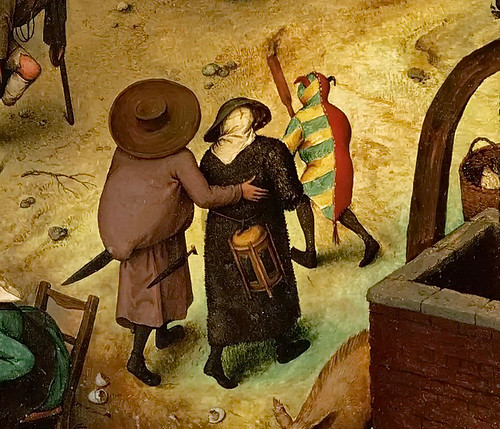
“Bruegel the Elder, Fight between Carnival and Lent, detail 6” by f_snarfel is licensed under CC BY-NC 2.0


For Lent, I am abstaining from vegetables. It may seem counter-intuitive, because “Carnival” or “Carni Vale” — which the English in their glum way call “Shrove Tuesday” and the French, more cheerfully, call “Mardi Gras” — means “Goodbye to Meat”.
The worldly, historic purpose of Lent is to eke out deficient livestock, doomed, unless slaughtered, to die, emaciated and inedible, on sparse or frozen pastures. Nowadays, however, vegetables seem a sacrifice both reasonable and pious.
If I wanted to be lampooned in Private Eye, I’d say that vegetables are the new meat: marketed as dietetically superior, and flattering to a moral form of snobbery.
Like meat in the old days, they are the preferred food of people who want to look down on the rest of us. Flesh and fish are now humbling meals, consumed in self-abasement. “Veganuary” and “Dry January” — wicked, secularist attempts to subvert the sanctity of Lent — repel me from conventional kinds of penance.
I want to defy the absurd propaganda of meat-haters, who try to shame the ill-informed into vegetarianism with mendacious allegations about the environmental cost of carnivorism. Scientifically, they’re on a par with Pythagoras’s denunciation of “passion proteins” and the meat-phobic campaigns of the nineteenth-century evangelists who hawked joyless, overpriced breakfast cereals.
I also want to expose the folly of people who, in flight from the butcher’s shop, grab textured soy concentrate from supermarket shelves: theirs is the idiocy of the ersatz. If you want something like meat, have meat. If you don’t want meat, have something unlike it. My sacrifice would be greater, of course, if I disliked rare steaks and juicy roasts. But I like vegetables, too. So that’s all right.
March 23, 2022
QotD: Fansplaining that feudalism is bad
Portrayal is not promulgation, people.
That said, I’ve spent thirty years learning that no writer, be they ever so clear and plain, can control how readers read, or misread, their texts. Reading is a dance, not a march. If some readers step on one’s feet, well, it’s still better than sitting by the wall … Usually.
Lois McMaster Bujold, “Lois McMaster Bujold on Fanzines, Cover Art, and the Best Vorkosigan Planet”, Tor.com, 2017-11-02.
March 7, 2022
QotD: Historical fiction and fantasy works usually leave out the vast majority of the people who did all the work
But the actual human landscape of the pre-modern period was defined – in agrarian societies, at least – by vast numbers of farms and farmers. Their work proceeded on this cyclical basis, from plowing to sowing to weeding to harvesting and threshing to storage and then back again. Religious observances and social festivals were in turn organized around that calendar (it is not an accident how many Holy Days and big festivals seem to cluster around the harvest season in late Autumn/early Winter, or in Spring). The uneven labor demands of this cycle (intense in plowing and reaping, but easier in between) in turn also provided for the background hum of much early urban life, where the “cities” were for the most part just large towns surrounded by farmland (where often the folks living in the cities might work farmland just outside of the gates). People looked forward to festivals and events organized along the agricultural calendar, to the opportunities a good harvest might provide them to do things like get married or expand their farms. The human drama that defines our lives was no less real for the men and women who toiled in the fields or the farmhouses.
And of course all of this activity was necessary to support literally any other kind of activity.
Bret Devereaux, “Collections: Bread, How Did They Make It? Part III: Actually Farming”, A Collection of Unmitigated Pedantry, 2020-08-06.
February 7, 2022
History Summarized: Vikings
Overly Sarcastic Productions
Published 14 Jul 2017Huge thanks to our friend Shad at Shadiversity! Check out his channel for historical weaponry and much more: https://www.youtube.com/user/shadmbrooks
Grab your swords and hop in your longboats, because it’s time to learn a thing or two about the Vikings!
This video was produced with assistance from the Boston University Undergraduate Research Opportunities Program.
Thanks to patron Karl Erik L Hoftaniska for suggesting this topic!
PATREON: www.patreon.com/user?u=4664797
MERCH LINKS:
Shirts – https://overlysarcasticproducts.threa…
All the other stuff – http://www.cafepress.com/OverlySarcas…Find us on Twitter @OSPYouTube!
From the comments:
Finn Chitwood
4 years ago
In the words of a brilliant Icelandic magazine: “Viking was a seasonal, temporary occupation, not an ethnicity.”

January 3, 2022
How did the Greeks and Romans count Years?
toldinstone
Published 31 Dec 2021The AD/CE system we use to date the year was introduced — more or less by accident — during the Middle Ages. Before its invention, the classical world used a wide range of dating systems.
Please consider supporting this channel on Patreon:
https://www.patreon.com/toldinstoneIf you liked this video, you might also enjoy my book Naked Statues, Fat Gladiators, and War Elephants: Frequently Asked Questions about the Ancient Greeks and Romans:
https://www.amazon.com/Naked-Statues-…
If you’re so inclined, you can follow me elsewhere on the web:
https://www.reddit.com/r/AskHistorian…
https://www.instagram.com/toldinstone/
https://www.goodreads.com/author/show…Chapters:
0:00 Introduction
0:51 Ancient Greek Calendars
1:42 Counting by Olympiads
2:22 The Seleucid Era
2:56 Consular Dating
3:26 Ab Urbe Condita
4:28 Indictions
4:56 Christian Chronology
5:40 Anno Domini
7:00 Conclusion
December 29, 2021
A history of and my first go at MEDIEVAL TENNIS
Lindybeige
Published 28 Sep 2021Thanks to Audible for sponsoring this video. New Audible members get a 30-day free trial. Visit http://audible.com/lindybeige or text “lindybeige” to 500 500 to try Audible today.
Tennis is a very old sport, going back at least to the 1200s. Here I try my hand at it for the very first (but not last) time, and talk about the history of it a bit.
Many thanks to Jesmond Dene Real Tennis Club (https://www.jdrtc.co.uk) where this was shot.
Editing this took a LONG time. We had three cameras recording at the same time, and synching the footage up took an age. The sound consisted mainly of echoing footsteps and ball bounces, and the fact that the main microphone kept glitching did not help (you will notice some of the patches to the sound using other mics, but most I made fairly smooth).
Court map by Atethnekos at English Wikipedia, CC BY-SA 3.0, https://commons.wikimedia.org/w/index…
Anne Boleyn picture by English school – https://thetudortravelguide.com/2019/…, Public Domain, https://commons.wikimedia.org/w/index…
Support me on Patreon: https://www.patreon.com/Lindybeige
Buy the music – the music played at the end of my videos is now available here: https://lindybeige.bandcamp.com/track…
Buy tat (merch):
https://outloudmerch.com/collections/…Lindybeige: a channel of archaeology, ancient and medieval warfare, rants, swing dance, travelogues, evolution, and whatever else occurs to me to make.
▼ Follow me…
Twitter: https://twitter.com/Lindybeige I may have some drivel to contribute to the Twittersphere, plus you get notice of uploads.
My website:
http://www.LloydianAspects.co.uk

December 23, 2021
Cheshire and Durham in the English Parliament
In his end-of-the-year Age of Invention newsletter, Anton Howes looks at two of the historic counties of England that lacked Parliamentary representation until surprisingly late dates:
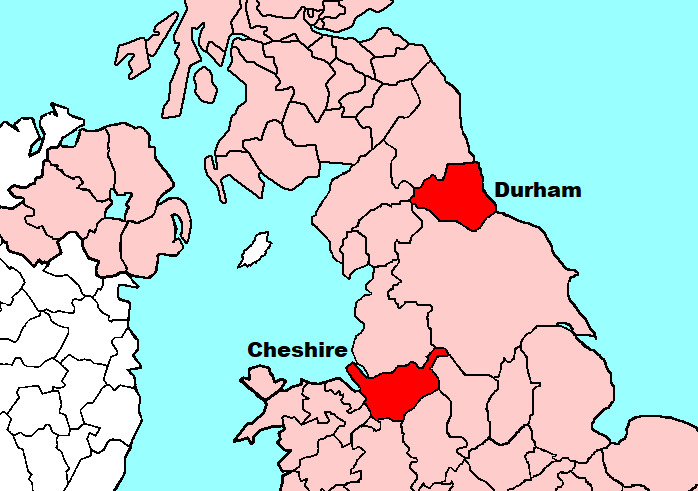
Cheshire and Durham (post-medieval boundaries: English county boundaries have varied wildly over the centuries).
Base map by Hogweard at Wikimedia Commons.
England, compared to other parts of Europe, is often said to have been remarkably centralised early on. France, for example, in the late eighteenth century had some thirteen or so regional parliaments, while Britain just had the one. Scotland’s separate parliament was famously dissolved in 1707, with the official union of Scotland with England. Wales gained representation at the English parliament at Westminster from 1536. So far so expected.
But less well-known is that the county of Cheshire — some of it now disappeared under Greater Manchester — used to have an entirely separate parliament of its own, and was not represented at Westminster until 1543. Arguably, it has about as much historical claim to a national assembly today as Wales. Rule of Cheshire was even, very briefly, included among the various titles of the monarch. Richard II, as well as being king of England, was in 1397-99 also styled “Prince of Chester”. He drew his personal bodyguard from among the men of Cheshire too. So whatever happened to Cheshire nationalism?
On a related note: the mantra “no taxation without representation” looms large in the history of American independence. But parts of England itself had gone unrepresented for decades too. County Durham, traditionally ruled by its prince-bishop, was not represented by any MPs in the House of Commons at all until 1654. And as it only gained representation under the revolutionary Protectorate, this was undone upon the restoration of the monarchy in 1660. The county would not be represented again until 1675.
Why? One might argue that the bishop of Durham, who sat in the House of Lords, could be considered its parliamentary representative. But he was not elected, and most importantly had little say over the matter of parliamentary taxation, which was controlled by the Commons. Before 1603 this was not much of an issue, as county Durham was exempt from various taxes because it was near the hostile Scottish border. But the accession of James VI of Scotland to become king of England meant that the hostile border suddenly disappeared. County Durham thus became subject to parliamentary taxation without having any say over those taxes at all — a situation that they then had to bear for over sixty years! Where were the Durham revolutionaries?
November 27, 2021
Making a Medieval TART DE BRY (Brie Tart) | Brie: The King of Cheese
Tasting History with Max Miller
Published 28 Apr 2020This Tart de Bry, or Brie Tart, comes from The Forme of Cury and was served at the table of King Richard II (1367 – 1400). Its flavor is nearly as rich as the history of the cheese that goes into it, and in this episode I will explore both.
Help Support the Channel with Patreon: https://www.patreon.com/tastinghistory
Follow Tasting History with Max Miller:
Instagram: https://www.instagram.com/tastinghist…
Twitter: https://twitter.com/TastingHistory1Episodes mentioned in this video:
Medieval Cheesecake (for tart dough) – https://youtu.be/GCCJ2Qpr1nM
Medieval Cheese (for straining cheese) – https://youtu.be/vlQZ3NPnoLk
Rapé Fig Spread: https://youtu.be/_o7Oq-OjKu8LINK TO INGREDIENTS & TOOLS**
SAFFRON THREADS – https://amzn.to/2yTwoPS
PIE SHIELD – https://amzn.to/2YeTnjh
TART TIN – https://amzn.to/2yPbUrCLINK TO SOURCE:
The Forme of Cury: https://amzn.to/31frAAy**Amazon offers a small commission on products sold through their affiliate links, so each purchase made from this link, whether this product or another, will help to support this channel with no additional cost to you.
TART DE BRY
RECIPE (1390 – The Forme of Cury)
Take a crust ynch depe in a trape. Take yolkes of ayren rawe and chese ruayn and medle it and the yolkes together. And do thereto powdor gynger, sugar, safron and salt. Do it in a trape, bake it, and serve it forth.MODERN RECIPE (Based on Lorna J Sass’s adaptation from To The King’s Taste – https://amzn.to/3bNg2XE)
INGREDIENTS
– 1 pound of Brie cheese, the younger the better
– 6 egg yolks
– ⅛ tsp saffron (about 10 threads ground up)
– ¾ tsp light brown sugar or more if you want a sweeter tart.
– ⅜ teaspoon powdered ginger
– A pinch of salt
– A sprinkle of nutmeg or cinnamon (optional)METHOD
1. Preheat the oven to 425°F / 220°C.
2. Roll out your tart dough to about an ⅛ inch thick and line your tin. Add pie weights and set in the oven to blind bake for 10 minutes. Remove the crust and remove the pie weights. If the bottom of the crust is not fully cooked, return it to the oven without the weights for 5 minutes. Once out of the oven, press down the bottom of the crust if it has risen. Allow crust to cool completely and reduce the oven temperature to 350°F / 175°C.
3. Remove the rind from the brie saving some to the side. Then cut the brie into small pieces and place in a blender with the egg yolks. Blend together. Then add the saffron, brown sugar, ginger, and salt and blend to combine.
4. Place a bit of the rind on the bottom of the tart and add the cheese mixture and smooth the top. If you are using cinnamon or nutmeg, sprinkle a bit on top now.
5. Bake at 350°F / 175°C for 30 to 40 minutes or until the top is set and begins to brown. Serve warm or at room temperature.SOURCES
The Forme of Cury – By Samuel Pegge – https://amzn.to/3cXBycA
To The King’s Taste – Lorna J. Sass – https://amzn.to/3bNg2XE
The Course of History: 10 Meals that Changed the World – https://amzn.to/2yWuIoL
Brie Cheese History – https://www.thespruceeats.com/history…PHOTOS
Abbaye Notre-Dame-de-Jouarre – Fredlesles CC BY-SA (https://creativecommons.org/licenses/…)
By J. Chéreau – Musée de la Révolution française, CC BY-SA 4.0, https://commons.wikimedia.org/w/index…
A carriage underside has broken sending the occupants flying Wellcome / CC BY (https://creativecommons.org/licenses/…)
Blue Stilton – Coyau / Wikimedia Commons / CC BY-SA 3.0
Limberger Cheese – Original photo by John Sullivan
Gruyere – © Rolf Krahl / CC BY (https://creativecommons.org/licenses/…)
Stracchino – Cvezzoli / CC BY-SA (https://creativecommons.org/licenses/…)
Brie cheese with fresh thyme on black background – Marco Verch / CC BY-SA 2.0 (https://flickr.com/photos/160866001@N…)#brie #cheese #medieval #medievalfood #tastinghistory #medievalrecipes

November 25, 2021
History of Venice: Rise to Glory
Epic History TV
Published 14 Dec 2018Listen to or download the music HERE: smarturl.it/epichistoryvenice
Music by https://www.musicdesigngroup.comThanks to Elias Tsiantas for the 3D Venetian galley footage
Thanks to Miłek Jakubiec for the Battle of Marignano imageSupport the channel & get exclusive previews at Patreon:
https://www.patreon.com/epichistorytvWant to learn more? We recommend A History of Venice by the late John Julius Norwich, a great popular historian on all things Mediterranean (as an Amazon Associate I earn from qualifying purchases): http://geni.us/7q71zx
#EpicHistoryTV #HistoryofVenice
October 31, 2021
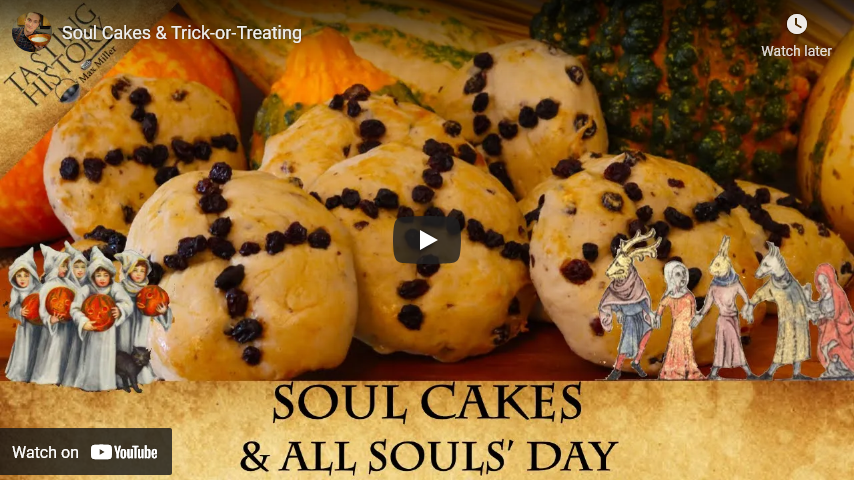
Soul Cakes & Trick-or-Treating
Tasting History with Max Miller
Published 30 Oct 2020Help Support the Channel with Patreon: https://www.patreon.com/tastinghistory
Follow Tasting History here:
Instagram: https://www.instagram.com/tastinghist…
Twitter: https://twitter.com/TastingHistory1
Reddit: r/TastingHistoryLINKS TO INGREDIENTS & EQUIPMENT**
Canon EOS M50 Camera: https://amzn.to/3amjvwu
Canon EF 50mm Lens: https://amzn.to/3iCrkB8
Currants: https://amzn.to/2T3qItA
Nutmeg: https://amzn.to/2IGDlcb
Clove: https://amzn.to/3dyNWRP
Mace: https://amzn.to/31j625h
Saffron: https://amzn.to/3560pbP
KitchenAid Stand Mixer: https://amzn.to/37hsboALINKS TO SOURCES**
The Customs and Traditions of Wales by Trefor Owen: https://amzn.to/37gi6bt
The Book of Hallowe’en by Ruth Eda Kelley: https://amzn.to/3dDb41i
Trick or Treat: A History of Halloween by Lisa Morton: https://amzn.to/348t0xQ**Amazon offers a small commission on products sold through their affiliate links, so each purchase made from this link, whether this product or another, will help to support this channel with no additional cost to you.
Editor: WarwicSN – https://www.youtube.com/WarwicSN
SOUL CAKES
ORIGINAL 16TH CENTURY RECIPE (From Elinor Fettiplace’s Receipt Book)
To make Cakes
Take flower & sugar & nutmeg & cloves & mace & sweet butter & sack & a little ale barm, beat your spice & put in your butter & your sack, cold, then work it well all together & make it in little cakes & so bake them, if you will you may put in some saffron into them or fruit.MODERN RECIPE
INGREDIENTS
– ½ Cup Lukewarm Ale (Below 100°F/38°C)
– 1 Teaspoon Yeast
– 3 Cups (360g) Flour
– ½ Cup (100g) Sugar
– 4 Tablespoons Butter Softened
– ½ Teaspoon Salt (if you’re using unsalted butter)
– ¼ Teaspoon Nutmeg
– ¼ Teaspoon Clove
– ¼ Teaspoon Mace
– ⅓ Cup Sack or Sherry
– 1/4 Teaspoon Saffron Threads (optional)
– 3/4 Cup Dried Fruit, plus more for decoration. (Optional)
– 1 Egg for Egg Wash (Optional)METHOD
1. Create an “ale barm” by mixing the yeast with the lukewarm ale and letting sit for 10 minutes. If you are using saffron, mix that into the sherry and let steep.
2. In a large bowl, mix the flour, sugar, salt, nutmeg, clove, and mace together. Add the yeasted ale and work it in. Then work in the softened butter and the sack with saffron along with any fruit you are using. Mix until everything the dough comes together, then knead for 5 – 12 minutes. The longer you knead, the more bread-like the cakes will be, but the more they will rise.
3. Allow dough to rise for 1 hour (it will likely not double in size), then punch the dough down and form into small cakes. Cover and allow the cakes to rise for another 20 minutes while you preheat the oven to 400°F/200°C.
4. When the cakes have puffed up, add the optional egg wash and/or additional fruit, or form a cross on the top of each cake using the back of a knife (do not cut the cross in). Then back fro 20 minutes. When baked, allow to cool before serving.#tastinghistory #halloween #soulcakes
October 22, 2021
QotD: Post-traumatic stress disorder (PTSD) in the ancient (or medieval) world
That is often not the impression that you would get from a quick google search (though it does seem to be the general consensus of the range of ancient military historians I know) and that goes back to arguments ex silentio. A quick google search will turn up any number of articles written by folks who are generally not professional historians declaring that PTSD was an observed phenomenon in the deep past, citing the same small handful of debatable examples. But one thing you learn very rapidly as a historian is that if you go into a large evidence-base looking for something, you will find it.
That’s not a species of research positivity – it’s a warning about confirmation bias, especially if you do not establish a standard of proof before your investigation. It is all too easy to define down your definition of “proof” until the general noise of the source-base looks like proof. In this case, we have to ask – before we go looking – what would evidence of PTSD in ancient societies (I’m going to start there because it is where I am best informed) look like?
Well, ancient societies engaged in a lot of warfare. Among the citizenry – the sort of fellows who write to us and are written about in our sources – combat experience was almost ubiquitous. That only really changes as we get into the Roman Empire, as violence levels both decline generally and are pushed to the frontier via a professional army. The percentage of veterans in the citizen population (again, citizen here is an important caveat, but then those fellows basically are our primary source base) probably equaled that of the WWI generation in Britain or France, except all the time (there’s a point in the Second Punic War where the Roman censors went through the entire rolls, checking to see how many had managed to avoid military service and found only a few thousand in a citizen body of c. 150,000 adult males). So what ought we expect from our sources? We should expect to see signs of PTSD everywhere. It should be absolutely pervasive in a source-base produced almost entirely by, for and about combat veterans, in societies where military mortality exceeded modern rates by a robust margin.
And it simply isn’t there. There is one very frequently cited account in Herodotus (Hdt. 6.117) of a man named Epizelos experiencing what is generally understood as “conversion disorder” (which used to be badly labeled “hysterical blindness”) in combat. Without being wounded he went blind at a sudden terror in battle and never recovered his sight. Herodotus terms it a θῶμα – a “wonder” or “marvel”, a word that explicitly implies the strange uncommonness of the tale. Herodotus is concerned enough about how exceptional this sounds that he is quick not to vouch for its veracity – he brackets the story (beginning and end) noting that it was what he was told (by someone else) that Epizelos used to say happened to him. In short, this was uncommon enough that Herodotus distances himself from it, so as not to be thought as a teller of tall-tales (though Herodotus is, in fact, a teller of tall tales).
This one example – cited endlessly and breathlessly in internet articles – is remarkable not because it is typical, but because it is apparently very unusual (also, it is my understanding – with the necessary caveat that I am not an expert – that while conversion disorder is a consequence of emotional trauma, it is not clear that it is associated with PTSD more generally). Meanwhile, in the war literature of the Romans, in their poetry (including that by folks like Horace, who fought in quite terrible battles), in the military literature of the Greeks, in the reflections of Xenophon (both on his campaigns and his commands), in the body of Greek lyric poetry … all of it – nothing. It is simply not there – not as a concern that such a condition might befall someone, nor a report that it had done so. Nothing. The lacuna baffled me for years.
My impression is that the medieval literature looks much the same: a few scattered passages that, if you squint hard enough, might be PTSD set against a vast backdrop of nothing in a society where literature was dominated by the war-fighting class. More examples than in the classical corpus (but then the medieval corpus is much larger; oddly, the examples I’ve seen all seem to concern crusading particularly), but nothing close to what we would expect given a literary tradition absolutely dominated by military aristocrats and their (often clerical) families. I call this my impression, because the medieval corpus is both much larger and I have read much less of it; but if there is a hidden reservoir of accounts showing clear symptoms of PTSD, I have not found it yet. I was always struck that – despite the fact that monastic life was often a destination for medieval military aristocrats troubled by their life of violence – none of the monastic rules I have read (admittedly, not all of them), which often have guidelines for abbots to deal with difficult monks, have had anything about how to deal with the symptoms of PTSD.
Now that’s not to say there isn’t grief at loss, mind you! The lamentations of defeat, the sorrow of losing a loved one (even in victory), the misery of war – that you find in the ancient texts in abundance. It occupies literary topoi, it is depicted in artwork, it gets entire tragedies to stretch out in, it is addressed by great big political speeches, it sits at the cornerstone of the Iliad‘s narrative (one reason, no doubt, that the Iliad remains a useful text for soldiers working through their experiences). But the persistent symptoms of PTSD, no. I haven’t been able to find one “flashback” or combat-memory related dissociative episode in ancient literature. You might argue that they simply weren’t recorded, but that strikes me as unlikely in societies where other forms of war-damage were so fiercely valorized and which would have often seen – as with Epizalos – such symptoms as divine omens. There should be dozens and dozens of them. These are societies with active medical literature, after all!
I think the evidence strongly suggests that ancient combatants did not experience PTSD as we do now. The problem is that the evidence of silence leads us with few tools with which to answer why. One answer might be that it existed and they do not tell us – because it was considered shameful or cowardly, perhaps. Except that they do tell us about other cowardly or shameful things. And the loss and damage of war – death, captivity, refugees, wounds, the lot of it – are prominent motifs in Greek, Roman and European Medieval literature. War is not uniformly white-washed in these texts – not every medieval writer is Bertran. We can’t rule out some lacuna in the tradition, but given just how many wails and moans of grief and loss there are in the corpus it seems profoundly unlikely. I think we have to assume that it isn’t in the sources because they did not experience it or at least did not recognize the experience of it.
Bret Devereaux, “Fireside Friday”, A Collection of Unmitigated Pedantry, 2020-04-24.


