Quotulatiousness

May 2, 2021

“Stairway To Heaven” – Medieval Style

Filed under: Media — Tags: , , , — Nicholas @ 02:00

Early Style
Published 29 Aug 2020

Original theme from Led Zeppelin (1971) in medieval – renaissance instruments

#StairwayToHeaven #MedievalStyle #Bardcore

From the comments:

Christopher Merlot
2 months ago
Led Zeppelin did a really good cover of this.

April 30, 2021

QotD: The battle of Bannockburn

Filed under: Britain, History, Humour, Quotations — Tags: , , , , — Nicholas @ 01:00

The Scots were now under the leadership of the Bruce (not to be confused with the Wallace), who, doubtful whether he had slain the Red Comyn or not, armed himself with an enormous spider and marched against the English, determined if possible to win back the Great Scone by beating the English three times running.

The fact that the English were defeated has so confused Historians that many false theories are prevalent about the Bannockburn Campaign. What actually happened is quite clear from the sketch map shown above. The causes of the English defeat were all unfair and were:

  1. The Pits. Every time the Wallace saw some English Knights charging at him he quickly dug one of these unnatural hazards into which the English Knights, who had been taught to ride straight, galloped with flying colours.
  2. Superior numbers of the English (four to one). Accustomed to fight against heavy odds the English were uneasy, and when the Scots were unexpectedly reinforced by a large body of butlers with camp stools the English soldiers mistook them for a fresh army of Englishmen and retreated in disgust.
  3. Foul riding by Scottish Knights. This was typified even before the battle during an exhibition combat between the Brace and the English Champion, Baron Henry le Bohunk, when Brace, mounted on a Shetland pony, galloped underneath the Baron and, coming up unexpectedly on the blind side, struck him a foul blow behind and maced him up for life.

W.C. Sellar & R.J. Yeatman, 1066 And All That, 1930.

April 3, 2021

Metallica – “Nothing Else Matters” – Medieval Style – Bardcore

Filed under: Media — Tags: , , — Nicholas @ 02:00

Algal the Bard
Published 19 Jun 2020

Song composed by James Hetfield & Lars Ulrich
Spotify: https://open.spotify.com/artist/6AU6D…
iTunes: https://music.apple.com/us/artist/alg…
Google Play: https://play.google.com/store/music/a…
Twitter: http://twitter.com/Alvariu
Instagram: https://www.instagram.com/alvariu360
Instruments: Lute-guitar, Irish bouzouki, Low whistle (D), Drums.

March 29, 2021

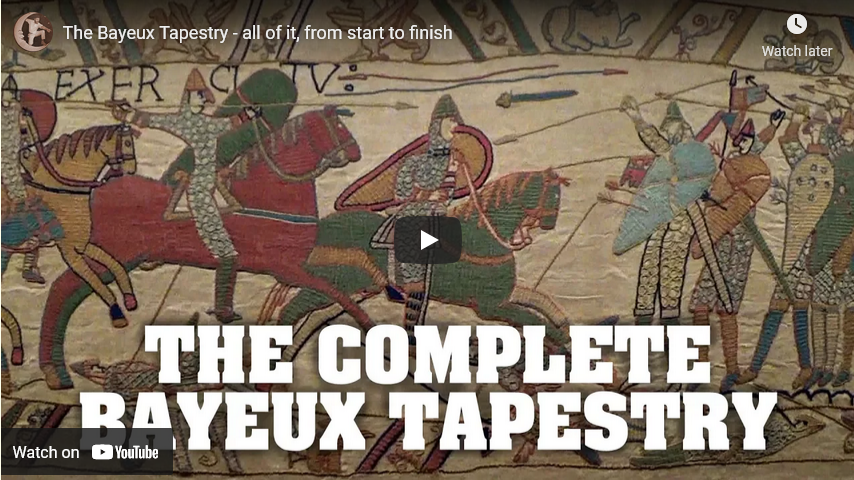
The Bayeux Tapestry – all of it, from start to finish

Filed under: Britain, France, History, Humour — Tags: , , , , , , — Nicholas @ 02:00

Lindybeige
Published 18 Oct 2017

A complete guide to the story as depicted on the famous Bayeux Tapestry. There is a lot more to it than just the Battle of Hastings.

Support me on Patreon: https://www.patreon.com/Lindybeige

Other than The Adventures of Stoke Mandeville, this is the longest editing job I have ever done. It took eleven very long days of work to put this together from the opportunist footage I snatched when changing trains near the museum where it is on display. The shoot was not without its problems, one of which was the fact that because the tapestry is behind glass, and the museum has many illuminated displays, the reflections in the glass were a bane, and I didn’t manage to get rid of them all. Another was that my stills camera refused to work after taking a small number of pictures. It had always worked fine before, and has always worked fine since. It wasn’t the battery and it wasn’t the SD card. It was a mystery.

For the curious, the edit involved seventeen tracks on the timeline, and has twenty-two animated scenes. Unfortunately, the main animation software I was using could not handle full HD images, and so there is a slight loss of picture quality during most of the animated scenes. You will notice that the close-ups have a better picture quality than the wide shots. This is because they were taken with the camera pushed up against the glass, which improved focussing, and got rid of almost all of the haze and reflections caused by the glass.

It is important to understand that this ‘tapestry’ is a piece of propaganda, and does not tell an accurate version of events. The story I tell here is the one depicted, not what actually happened.

I have enough material for more videos on the tapestry, but am in no great hurry to spend many more days editing this difficult footage. Trying to match the writing and speaking of narration to panning camerawork that had no notion when shot of what might need to be said about some passing scene, was a nightmare, and many editing compromises had to be made, with some scenes skipped past quickly, and others drawn out.

Clarification on the nudity: I said that the figure under the mysterious Cleric and woman was the the only figure displaying genitals on the tapestry. This was misleading. Several animals clearly are pictured with genitals, and on the tapestry in Bayeux today it looks as though a couple of other human figures have genitals. Some of these may have been added later, and these are not being ‘displayed’ as the displaying figure is clearly doing, but look more incidental.

I describe the tall figure emerging from the building with a lance and pennant, being brought his horse, as “William”. It occurred to me after making the video that all the sources I consulted describe this figure as William, but the text does not name him as William, so possibly he is just a Norman knight, representing any and all of the knights setting out for the battle, and that this figure is meant to be “William” could be a modern tradition that has become accepted fact just by repetition.

Buy the music – the music played at the end of my videos is now available here: https://lindybeige.bandcamp.com/track…

Lindybeige: a channel of archaeology, ancient and medieval warfare, rants, swing dance, travelogues, evolution, and whatever else occurs to me to make.

▼ Follow me…

Twitter: https://twitter.com/Lindybeige I may have some drivel to contribute to the Twittersphere, plus you get notice of uploads.

website: www.LloydianAspects.co.uk

March 8, 2021

The Rise of Artillery in European Siege Warfare

Filed under: Europe, History, Military, Weapons — Tags: , , , — Nicholas @ 04:00

SandRhoman History
Published 7 Mar 2021

Get 25% off an annual membership of CuriosityStream using code sandrhoman: https://curiositystream.com/sandrhoman​

At the end of the Middle Ages, a new weapon system changed the face of 15th century European siege warfare: artillery made its appearance. It had an impressive impact best shown by one peculiar fact. Imagine a walled fortress in the 14th century. It could easily deter attackers for several months. But in the early 15th up to the early 16th century, after artillery had fully developed, the same walls fell within days. As a result, engineers had to construct much more elaborate defensive structures. By the early to mid 16th century a fortress could again withstand a siege with heavy artillery for several months. This is how modern historiography explains the rise of artillery.

Patreon: https://www.patreon.com/sandrhomanhis…​

Bibliography:
Ayton, A., / Price, J. L., (Hrsg.), The Medieval Military Revolution. State, Society and Military Change in Medieval and Early Modern Europe, 199J.
Black, A Military Revolution? Military Change and European Society 1550–1800, 1991.
Devries, K., Medieval Military Technology, 1994.
Ortenburg, G., Waffe und Waffengebrauch im Zeitalter der Landsknechte (Heerwesen der Neuzeit, Abt. 1, Bd. 1) Koblenz 1984.
Rogers, C. J., “Military Revolutions of the Hundred Years War”, in: Rogers et al. The Military Revolution Debate. Reading on the Military Transformation of Early Modern Europe, 1995, p. 13-35.
Schmidtchen, V., Kriegswesen im Spätmittelalter, 1990.

March 6, 2021

“Jolene” (Bardcore | Medieval Style)

Filed under: Media — Tags: , , — Nicholas @ 02:00

Hildegard von Blingin’
Published 9 Jul 2020

Jolene, By Dolly Parton (Bardcore/Medieval Style)

Good morrow! I have descended from my cloister once more with another offering for the ravenous rabble.

Silliness aside, I want to thank you all again for helping to make such a wholesome part of the internet. I live for your hilarious comments and witty imaginings, and only wish I had more time to devote to this. I’m back to work, so I can’t aspire to weekly videos, but I do endeavour to continue making these.

The art is a composite/partial paint over of three different sources, including: MS Bodley 264, and Lausanne, Bibliothèque Cantonale et Universitaire U 964 – Biblia Porta fol. 178r, and one other that I’ve had no luck tracking down.

Lyrics:
Jolene, Jolene, Jolene, Jolene
I beg of thee, pray take not my lord
Jolene, Jolene, Jolene, Jolene
I fear, from thee, ‘twould take naught but a word
Thy beauty is beyond compare
With flaming locks of auburn hair
With ivory skin and eyes of emerald green
Thy smile is like a breath of Spring
Thy voice is soft like Summer rain
And I cannot compete with thee
Jolene
He talketh of thee in his sleep
And alas, I cannot keep
From weeping when I hear thy name
Jolene
Although it is so plain to see
How little he doth mean to thee
My love for him is boundless as the sea
Jolene, Jolene, Jolene, Jolene
I beg of thee, oh please take not my lord
Jolene, Jolene, Jolene, Jolene
I fear, from you, ‘twould take naught but a word
Thou couldst have thy choice of men
But I could never love again
He is the only one for me
Jolene
I would risk both life and limb
To spend my only days with him
My happiness is at thy whim,
Jolene
Jolene, Jolene, Jolene, Jolene
I beg of thee, pray take not my lord
Jolene, Jolene, Jolene, Jolene
I fear, from thee, ‘twould take naught but a word

March 2, 2021

The Evolution of Shock Cavalry – From Antiquity to the Middle Ages

Invicta
Published 1 Mar 2021

Learn about the evolution of shock cavalry from antiquity before the use of saddles and stirrups! Check out The Great Courses Plus to learn about shock cavalry in the campaigns of Alexander the Great: http://ow.ly/osex30rvhjf​

In this history documentary we explore the topic of ancient cavalry. The basic idea is that these units often get depicted in media as performing glorious massed charges headlong into the enemy ranks as seen in such scenes as the Charge of the Rohirrim from the Battle of Pelenor Fields. In reality this would have been a very dangerous situation for cavalrymen even under the best circumstances. But to make matters worse, riders from antiquity fought without the use of either saddles or stirrups. So how on earth did they manage to dominate the battlefield with these handicaps. Let’s find out.

We begin by covering the history of cavalry with the first domestication of the horse and its introduction to warfare first as member of the baggage train and soon after as a part of chariot crews rather than as actual mounted forces. This was in large part due to the lack of riding experience and technology on behalf of the rider. Soon after the Bronze Age Collapse however cavalry began to rise to prominence across the armies of the Mediterranean. We speak about the various forms of equine practices which ranged from riding bareback into combat as with the Numidian Cavalry to the use of simple bridles and cloth seats as with Greek Cavalry and Persian Cavalry.

We then cover the techniques used by these cavalrymen to mount, ride, and fight. As a part of this discussion, we rely heavily on Xenophon’s Manual on Horsemanship which provides excellent first hand details from the period. We also show how these techniques were successfully used by shock cavalry of antiquity such as the Macedonian Companion Cavalry, the Saka Steppe Lancers, and the Persian Cataphracts to great effect even without the use of saddles and stirrups.

Finally we do pose the question of why they didn’t use the saddle and stirrup given its seemingly obvious advantages. To answer this question we look at the history of its development from late antiquity to the early Middle Ages.

Bibliography and Suggested Reading
On Horsemanship, by Xenophon
Adrian Goldsworthy, The Complete Roman Army
Adrian Goldsworthy, Roman Warfare
J.C. Coulston, Cavalry Equipment of the Roman Army in the First Century A.D.
George T. Dennis, Maurice’s Strategikon, p. 38.
Julius Caesar, Commentarii de Bello Civili
Russel H. Beaty, Saddles

#History​
#Documentary​
#ShockCavalry

From the comments:

Invicta
13 hours ago
I was inspired by comments on our latest Units of History episode covering the Companion Cavalry which asked about how shock tactics worked in an age before the stirrup and saddle. I went down the rabbit hole finding answers and present to you my findings in this video! One awesome source we used was the Manual on Horsemanship by Xenophon which you can read for yourself here: http://www.gutenberg.org/files/1176/1176-h/1176-h.htm

February 22, 2021

The “Infantry Revolution” of the Late Middle Ages

Filed under: Europe, History, Military, Weapons — Tags: , , , , — Nicholas @ 04:00

SandRhoman History
Published 21 Feb 2021

CuriosityStream link: https://curiositystream.com/sandrhoman

The “Infantry Revolution” of the late Middle Ages is kind of a hot topic among armchair historians and academics alike. This is how the argument goes: In the late Middle Ages, infantry grew in importance to the detriment of heavy cavalry; by then battles were increasingly won with pikes, longbows and arquebuses instead of mounted knights with lances, the argument continues, and as a result of that, the socio-political make-up and development of European polities changed lastingly. So, this Infantry Revolution supposedly had an incredible impact on European state building processes AND, the argument finally concludes, it laid the foundation to Europe’s conquest and colonization of many parts of the world. However, in public spaces such as YouTube this whole debate is more discussed in regards to tactics and fighting techniques than economics and politics. Consequently, much of the public discussion is about how and if the importance of knights changed after the High Middle Ages. Likewise, topics such as the efficacy of the English longbow or the impact of pikes in the late Middle Ages are frequently the subject of discussions. All of that is controversial to say the least but it gets worse: these changes must be viewed in the broader military changes such as the rise of gunpowder artillery between 1420 and 1530 — called an artillery revolution — the decline of sieges between the 1420s and the 1530s which, among many things, led to the resurgence of heavy cavalry in the later late Middle Ages. Lastly, all of these revolutions belong to a notion called “military revolution”. This video is not intended to argue one side or the other of the “infantry revolution” but to provide a broad overview over both the debate and the military changes during the 14th and 15th centuries. It explains how contemporary historiography quarrels over the infantry revolution.

Patreon: https://www.patreon.com/sandrhomanhis…​

Twitter: https://twitter.com/SandrhomanBibliog…​

Bibliography:
Bane, M., English Longbow Testing against various armor circa 1400, 2006.
Ayton, A., / Price, J. L., (Hrsg.), The Medieval Military Revolution. State, Society and Military Change in Medieval and Early Modern Europe, 199J.
Black, A Military Revolution? Military Change and European Society 1550–1800, 1991.
Devries, K., Medieval Military Technology, 1994.
Dierk, W., s.v. “Heeresreform”, in: Enzyklopädie der Neuzeit
Ortenburg, G., “Waffe und Waffengebrauch im Zeitalter der Landsknechte” (Heerwesen der Neuzeit, Abt. 1, Bd. 1) Koblenz 1984.
Magier, Mariusz; Nowak, Adrian; et al., “Numerical Analysis of English Bows used in Battle of Crécy”. Problemy Techniki Uzbrojenia. 142 (2), 2017, 69–85.
Meumann, M., s.v. “Military Revolution”, in: Enzyklopädie der Neuzeit.
Parker G., “The ‘Military Revolution’, 1560–1660 – a Myth?”, in: Journal of Modern History 48.2, 1976, 196–214
Parker, G., Die militärische Revolution. Die Kriegskunst und der Aufstieg des Westens 1500–1800, 1990 (Engl. 1988)
Roberts, M.: “The military revolution, 1560–1660”. In: Clifford J. Rogers: The military revolution debate. Readings on the military transformation of early modern Europe. Westview Press, Boulder, Colo. 1995, S. 13–35.
Rogers, C.J. / Tallet F. (editors), European Warfare, 1350–1750, 2010.
Rogers, C.J., The Efficacy of the English Longbow, 1998.
Schmidtchen, Volker, Kriegswesen im späten Mittelalter. Technik, Taktik, Theorie, Weinheim 1990.
Soar, H., Gibbs, J., Jury, C., Stretton, M., Secrets of the English War Bow. Westholme, 2010, pp. 127–151.

February 8, 2021

Why Everybody Disagrees on the Efficacy of the English Longbow – A Video Essay

Filed under: Britain, France, History, Military, Weapons — Tags: , , , , , , , — Nicholas @ 04:00

SandRhoman History
Published 7 Feb 2021

Everybody quarrels over the efficacy of the English longbow. Many historians, reenactors and history enthusiasts alike hold the view that arrows piercing armor is a myth. Some base this view on testing as was done for example by Tod from Tod’s workshop. Together with his team, he provided an invaluable data point for this debate. Others, such as traditionalist historians are often open to the possibility of arrows piercing armor, even though they are aware of actual testing of the longbow. In general, the efficacy of a weapon is much more complicated than its mere armor penetration value. So, in this video we’d like to shed light on the whole debate and explain why it is so hard to find common ground on this issue. This is why everybody disagrees on the efficacy of the English longbow.

Patreon: https://www.patreon.com/sandrhomanhis…​

Twitter: https://twitter.com/Sandrhoman

Tod’s Video: ARROWS vs ARMOUR – Medieval Myth Busting https://youtu.be/DBxdTkddHaE​

Tod’s playlist: MEDIEVAL MYTH BUSTING https://youtube.com/playlist?list=PLI…​

Bibliography:
Rogers, C.J., The Efficacy of the English Longbow, 1998.
Devries, K., Medieval Military Technology, 1994.
Bane, M., “English Longbow Testing against various armor circa 1400”, 2006.
Soar, H., Gibbs, J., Jury, C., Stretton, M., Secrets of the English War Bow. Westholme, 2010, pp. 127–151.
Magier, Mariusz; Nowak, Adrian; et al., “Numerical Analysis of English Bows used in Battle of Crécy”. Problemy Techniki Uzbrojenia. 142 (2), 2017, 69–85.

January 22, 2021

QotD: The enclosure movement, in historical fact and in Marxist imagining

Filed under: Britain, Economics, History, Quotations — Tags: , , , , , — Nicholas @ 01:00

Consider, for example, that the tenfold increase [in the population of London] was in the period before the expropriative parliamentary enclosures of Marxist legend, when state fiat was used to deny smaller farmers their ancient, customary rights to use the land near their villages. While the very first of these enclosure acts appeared as early as 1604, parliamentary enclosure only really got going from the mid-eighteenth century. Instead, for the period in question, enclosure happened in a piecemeal way, with the open fields gradually dissolving as farmers exchanged or sold their tiny strips of land, over time amalgamating them into larger, privately controlled plots. With ownership concentrated in fewer and fewer hands, it became relatively easy to gain the unanimity needed to suspend common rights. The process played out in myriad ways all over the country, sometimes with amicable agreement and voluntary exchange, sometimes with ruthless monopolising of the land, with the already-large owners systematically buying out their neighbours. In some cases it involved the consolidation of existing arable land, in others it meant the conversion of forest, heath, marsh, or fen — the traditional “wastes”, to which the poorer villagers might have had various customary rights to gather firewood for fuel, or to graze their cattle, or to hunt for small game — into land that could be used for farming or pasture.

How this process played out all depended on extremely specific, local conditions. But on the whole it was slow — piecemeal enclosure had been happening to varying degrees since at least the fourteenth century. It’s hard to see how such a sporadic and piecemeal process could have led to such consistently and increasingly massive numbers flocking specifically to London. Indeed, the fact that they singled out London as their target suggests that this narrative might have it back-to-front. Some economic historians argue that it was the prospect of higher wages in the ever-growing metropolis that induced farmers to leave the countryside in the first place, selling up or abandoning their plots to those they left behind. Rather than enclosure pushing peasants off the land and into the city, London’s specific pull may instead have thus created the vacuum that allowed the remaining farmers to bring about enclosure. Otherwise, why didn’t the peasants simply flock to any old urban centre? The second-tier cities like Norwich or Bristol or Exeter or Coventry or York would all have been far less dangerous.

Anton Howes, “London the Great”, Age of Invention, 2020-10-20.

December 10, 2020

Making a Morning Star (Flail) for my Nephew

Filed under: Tools, Weapons, Woodworking — Tags: , , , , — Nicholas @ 06:00

Rex Krueger
Published 9 Dec 2020

Forged in Wood comes back hot with this Morning Star build!

More video and exclusive content: http://www.patreon.com/rexkrueger

Get the FREE measured drawing of the London Pattern Handle: https://www.rexkrueger.com/store
(more…)

November 15, 2020

London’s wool and cloth trade fuelled massive growth in the city’s population after 1550

In the latest Age of Invention newsletter, Anton Howes traces the rise and fall of the late Medieval wool trade and its rebirth largely thanks to an influx of Dutch and Flemish clothmakers fleeing the wars in the Low Countries after 1550:

The Coat of Arms of The Worshipful Company of Woolmen — On a red background, a silver woolpack, with the addition of a crest on a wreath of red and silver bearing two gold flaxed distaffs crossed like a saltire and the wheel of a gold spinning wheel.
The Worshipful Company of Woolmen is one of the Livery Companies in the City of London. It is known to have existed in 1180, making it one of the older Livery Companies of the City. It was officially incorporated in 1522. The Company’s original members were concerned with the winding and selling of wool; presently, a connection is retained by the Company’s support of the wool industry. However, the Company is now primarily a charitable institution.
The Company ranks forty-third in the order of precedence of the Livery Companies. Its motto is Lana Spes Nostra, Latin for Wool Is Our Hope.
Wikipedia.

… it was one thing to be able to reach these new southern markets, and another thing to have something to sell in them. For the shift in the markets for wool cloth exports also required major changes in the kinds of cloth produced. In this regard, London may well have been a direct beneficiary of the 1560s-80s troubles in the Low Countries that had caused Antwerp’s fall, because thousands of skilled Flemish and Dutch clothmakers fled to England. In particular, these refugees brought with them techniques for making much lighter cloths than those generally produced by the English — the so-called “new draperies”, which could find a ready market in the much warmer Mediterranean climes than the traditional, heavy woollen broadcloths.

The introduction of the new draperies was no mere change in style, however. They were almost a completely different kind of product, involving different processes and raw materials. The traditional broadcloths were “woollens”. That is, they were made from especially fine, short, and curly wool fibres — the type that English sheep were especially famous for growing — which were then heavily greased in butter or oil in preparation for carding, whereby the fibres were straightened out and any knots removed (because of all the oil, in the Low Countries the cloths were known as the wet, or greased draperies). The oily, carded wool was then spun into yarn, and typically woven into a broad cloth about four metres wide and over thirty metres long. But it was still far from ready. The cloth had to be put in a large vat of warm water, along with some urine and a particular kind of clay, and was then trodden by foot for a few days, or else repeatedly compacted by water-powered machinery. This process, known as fulling, scoured the cloth of all the grease and shrunk it, compacting the fibres so that they began to interlock and enmesh. Any sign of the cloth being woven thus disappeared, leaving a strong, heavy, and felt-like material that was, as one textile historian puts it, “virtually indestructible”. To finish, it was then stretched with hooks on a frame, to remove any wrinkles and even it out, and then pricked with teasels — napped — to raise any loose fibres, which were then shorn off to leave it with a soft, smooth, sometimes almost silky texture. Woollens may have been made of wool, but they were no woolly jumpers. They were the sort of cloth you might use today to make a thick, heavy and luxuriant jacket, which would last for generations.

Yet this was not the sort of cloth that would sell in the much warmer south. The new draperies, introduced to England by the Flemish and Dutch clothworkers in the mid-sixteenth century, used much lower-quality, coarser, and longer wool. Later generally classed as “worsteds”, after the village of Worstead in Norfolk, they were known in the Low Countries as the dry, or light draperies. They needed no oil, and the long fibres could be combed rather than carded. Nor did they need any fulling, tentering, napping, or shearing. Once woven, the cloth was already strong enough that it could immediately be used. The end product was coarser, and much more prone to wear and tear, but it was also much lighter — just a quarter the weight of a high-quality woollen. And the fact that the weave was still visible provided an avenue for design, with beautiful diamond, lozenge, and other kinds of patterns. The new draperies, which included worsteds and various kinds of slightly heavier worsted-woollen hybrids, as well as mixes with other kinds of fibre like silk, linen, Syrian cotton, or goat hair, thus came in a dazzling number of varieties and names: from tammies or stammets, to rasses, bays, says, stuffs, grograms, hounscots, serges, mockadoes, camlets, buffins, shalloons, sagathies, frisadoes, and bombazines. To escape the charge that the new draperies were too flimsy and would not last, some varieties were even marketed as durances, or perpetuanas.

Curiously, however, while the shift from woollens to worsted saved on the costs of oiling, fulling, and finishing, it was significantly more labour-intensive when it came to spinning — even resulting in a sort of technological reversion. Given the lack of fulling, the strength of the thread mattered a lot more for the cloth’s durability, and the yarn had to be much finer if the cloth was to be light. The spinning thus had to be done with much greater care, which made it slower. Spinners typically gave up using spinning wheels, instead reverting to the old method of using a rock and distaff — a technique that has been used since time immemorial. Albeit slower, the rock and distaff gave them more control over the consistency and strength of the ever-thinner yarn. For the old, woollen drapery, processing a pack of wool into cloth in a week would employ an estimated 35 spinners. For the new, lighter worsted drapery it would take 250. As spinning was almost exclusively done by women, the new draperies provided a massive new source of income for households, as well as allowing many spinsters or widows to support themselves on their own. Indeed, an estimated 75% of all women over the age of 14 might have been employed in spinning to produce the amounts of cloth that England exported and consumed. Some historians even speculate that by allowing women to support themselves without marrying, it may have lowered the national fertility rate.

This spinning, of course, was not done in London. It was largely concentrated in Norfolk, Devon, and the West Riding of Yorkshire. But the new draperies provided employment of another, indirect kind. As a product that was saleable in warmer climes it could be exchanged for direct imports of all sorts of different luxuries, from Moroccan sugar, to Greek currants, American tobacco (imported via Spain), and Asian silks and spices (initially largely imported via the eastern Mediterranean). The English merchants who worked these luxury import trades were overwhelmingly based in London, and had often funded the voyages of exploration and embassies to establish the trades in the first place, putting them in a position to obtain monopoly privileges from the Crown so that they could restrict domestic competition and protect their profits. Unsurprisingly, as they imported everything to London, it also made sense for them to export the new draperies from London too.

Thus, despite losing the concentrating influence of nearby Antwerp, London came to be the principal beneficiary of England’s new and growing import trades, allowing it to grow still further. The city began to carve out a role for itself as Europe’s entrepôt, replacing Antwerp, and competing with Amsterdam, as the place in which all the world’s rarities could be bought (and from which they could increasingly be re-exported). Indeed, English merchants were apparently happy to sell wool cloth at below cost-price in markets like Spain or Turkey — anything to buy the luxury wares that they could monopolise back home.

November 7, 2020

History Summarized: Wales

Overly Sarcastic Productions
Published 6 Nove 2020

Wale, Wale, Wale(s), what have we here? I’ll tell you! A look at the oft-forgotten history of Britain’s secret third country Wales, where the population is about 50% bards just by sheer cultural osmosis.

SOURCES & Further Reading: A Concise History of Wales by Jenkins, A History of Wales by Davies

This video was edited by Sophia Ricciardi AKA “Indigo”. https://www.sophiakricci.com/

Our content is intended for teenage audiences and up.

PATREON: https://www.Patreon.com/OSP

PODCAST: https://overlysarcasticpodcast.transi…

DISCORD: https://discord.gg/osp

MERCH LINKS: http://rdbl.co/osp

OUR WEBSITE: https://www.OverlySarcasticProductions.com
Find us on Twitter https://www.Twitter.com/OSPYouTube
Find us on Reddit https://www.Reddit.com/r/OSP/

October 22, 2020

When England “Londonized”

Filed under: Britain, Economics, Europe, Health, History — Tags: , , , , — Nicholas @ 05:00

In the latest Age of Invention newsletter, Anton Howes looks at changes in urbanization in England from the Middle Ages onward and the astonishing growth of London in particular:

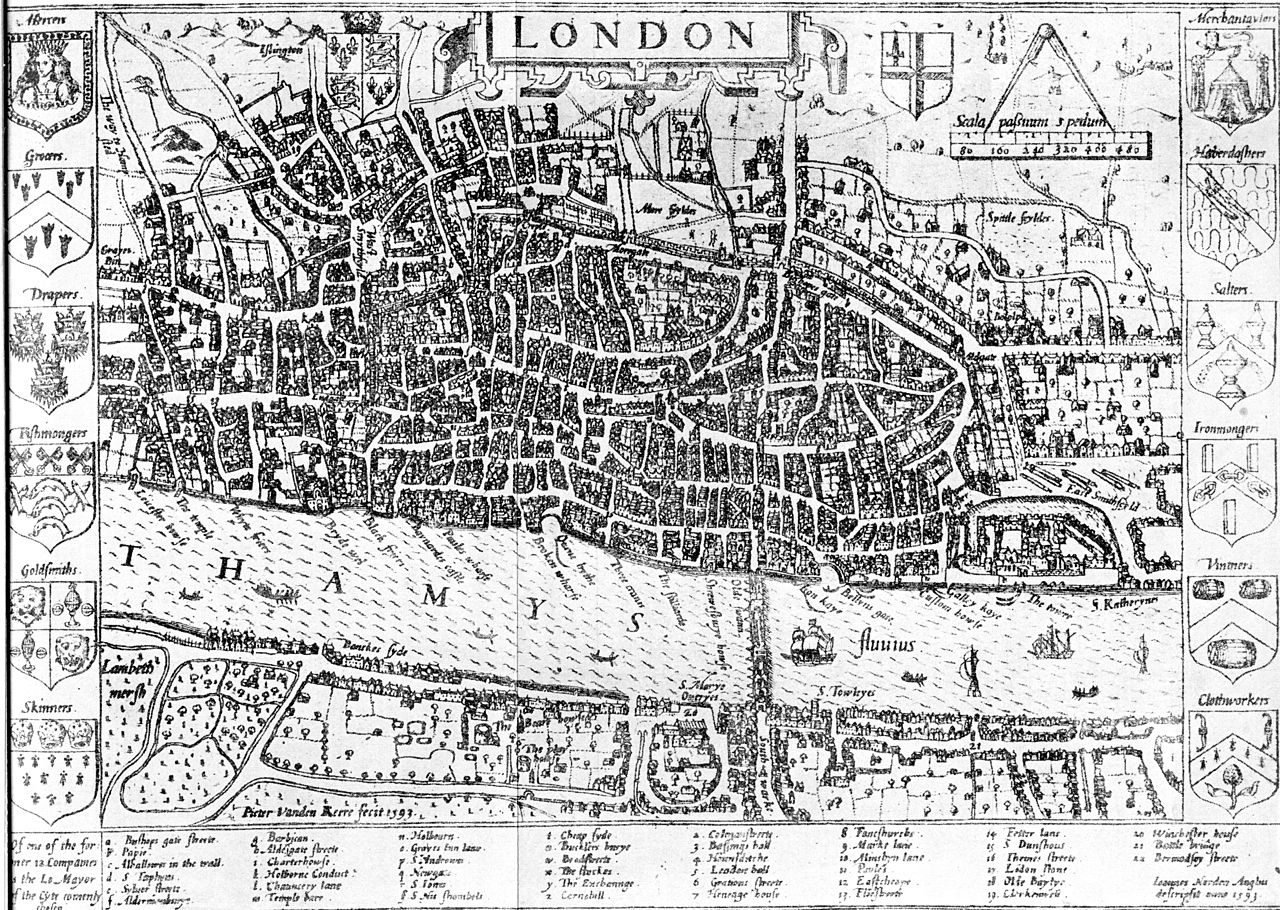
John Norden’s map of London in 1593. There is only one bridge across the Thames, but parts of Southwark on the south bank of the river have been developed.
Wikimedia Commons.

We must thus imagine pre-modern England as a land of tens of thousands of teeny tiny villages, each having no more than a couple of hundred people, which were in turn served by hundreds of slightly larger market towns of no more than a few hundred inhabitants, and with only a handful of regional centres of more than a few thousand people. By the 1550s, the country’s population had still not recovered to its pre-Black Death peak, and still only about 4% of the population lived in cities. London alone accounted for about half of that, with approximately 50-70,000 people (about five times the size of its closest rival, Norwich). So after a couple of centuries of recovery, London was only a little past its medieval peak.

But over the following century and a half, things began to change. At first glance, England’s continued population growth was unremarkable. By 1700, its overall population had finally reached and even surpassed the medieval 5 million barrier, despite the ravages of civil war. This was, perhaps, to be expected, with a little additional agricultural productivity allowing it to surpass the previous record. But the composition of that population had changed radically, largely thanks to the extraordinary growth of London. England’s overall population had not only recovered, but now 16% of them lived in cities of over 5,000 inhabitants — over two thirds of whom lived in London alone. Rather than simply urbanise, England londonised. By 1700, the city was nineteen times the size of second-place Norwich — even though Norwich’s population had more or less tripled.

London had, by 1700, thus risen from obscurity to become one of the largest cities in Europe. At an estimated 575,000 people, it was rivalled in Europe only by Paris and Constantinople, both of which had been massive for centuries. And although by modern standards it was still rather small, it could at least now be comfortably called a city — more or less on par with the populations of modern-day Glasgow or Baltimore or Milwaukee.

During that crucial century and a half then, London almost single-handedly began to urbanise the country. Its eighteenth-century growth was to consolidate its international position, such that by 1800 the city was approaching a million inhabitants, and from the 1820s through to the 1910s was the largest city in the world. In the mid-nineteenth century England also finally overtook Holland in terms of urbanisation rates, as various other cities also came into their own. But this was all just the continuation of the trend. London’s growth from 1550 to 1700 is the phenomenon that I think needs explaining — an achievement made all the more impressive considering how many of its inhabitants were dropping dead.

Throughout that period, urban death rates were so high that it required waves upon waves of newcomers from the countryside to simply keep the population level, let alone increase it. London was ridden with disease, crime, and filth. Not to mention the occasional mass death event. The city lost over 30,000 souls — almost of a fifth of its population — in the plague of 1603 (which was apparently exacerbated by many thousands of people failing to social distance for the coronation of James I), followed by the loss of a fifth again — 41,000 deaths — in the plague of 1625, and another 100,000 deaths — by now almost a quarter of the city’s population — in 1665. And yet, between 1550 and 1700 its population still managed to increase roughly tenfold.

I’ve been hard-pressed to find an earlier, similarly rapid rise to the half-a-million mark that was not just a recovery to a pre-disaster population or simply the result of an empire’s seat of government being moved. Chang’an, Constantinople, Ctesiphon, Agra, Edo, for example — all owed their initial, massive populations to an administrative change (often accompanied by a degree of forcible relocation), and all then grew fairly gradually up to or beyond half a million. As for a very long-term capital like Rome, it seems to have taken about three or four centuries to achieve the increases that London managed in just one and a half (though bear in mind just how rough and ready our estimates of ancient city populations are — our growth guesstimate for Rome is almost entirely based on the fact that the water supply system roughly doubled every century before its supposed peak). The rapidity of London’s rise from obscurity may thus have been unprecedented in human history — and was certainly up there with the fastest growers — though we’ll likely never know for sure.

But how? I can think of a multitude of factors that may have helped it along, but I find that each of them — even when considered altogether — aren’t quite satisfactory.

September 5, 2020

History Summarized: The Viking Age

Overly Sarcastic Productions
Published 4 Sep 2020

The Vikings are enjoying a new wave of enthusiasm in popular culture, but these seafaring Norsemen are still quite clearly a misunderstood force in medieval European history. So let’s take a wide look at the European world during The Viking Age!

Check out Yellow’s livestreams over at https://Twitch.tv/LudoHistory

SOURCES & Further Reading: The Vikings by Walaker Nordeide and Edwards, Vikings: A Very Short Introduction by Richards, Age of the Vikings and The Conversion of Scandinavia by Winroth, The Vikings By Harl via The Great Courses, The Viking World by Graham-Campbell, The Viking Way by Price.

This video was edited by Sophia Ricciardi AKA “Indigo”. https://www.sophiakricci.com/

Our content is intended for teenage audiences and up.

DISCORD: https://discord.gg/kguuvvq

PATREON: https://www.Patreon.com/OSP

MERCH LINKS: https://www.redbubble.com/people/OSPY…

OUR WEBSITE: https://www.OverlySarcasticProductions.com
Find us on Twitter https://www.Twitter.com/OSPYouTube
Find us on Reddit https://www.Reddit.com/r/OSP/

From the comments:

Ludohistory
23 hours ago (edited)
Thanks so much for having me on and letting me help out! It was a lot of fun (even if I talked a little too fast sometimes)! To clarify a piece that I know I did cover too briefly — missionary trips to Scandinavia occurred in Denmark around 823, on the orders of Louis the Pious, and in Sweden in 829, when Ansgar, a Frankish monk, traveled to the town of Birka, where he found a very small Christian community, probably mostly enslaved or formerly enslaved people, and converted a couple of Norse people, including the town prefect. (The graveyard for that town, incidentally, is where the 10th century “female warrior” that made waves a few years ago was buried).

There’s a lot we didn’t get a chance to talk about about the diaspora and its ending, so if there’s anything you all are curious on or find unclear, let me know here or on twitter 🙂

Finally, if you liked this, all the VODs for my personal streams (where I try to ramble about history in games) can be found by clicking on my name, and tomorrow I’ll be streaming CKIII on twitch (link in the description)!

« Newer PostsOlder Posts »

Powered by WordPress