
For those who’ve seen Band of Brothers, there’s a very telling conversation between Carville and Winters, as the sergeant complains about his platoon commander, Lt. Dyke:
“It’s not that he makes bad decisions; it’s that he doesn’t make any decisions at all.”
Any time you see that situation in a manager, any manager, it is a flashing neon sign of incompetence.
One of the reasons why Marxists make such poor managers is that if they are presented with a situation which cannot be addressed by Party doctrine, they are largely indecisive. Even worse, if that doctrine runs counter to good management, they will use that as the underpinning for their indecisiveness. We saw this a lot under Obama, who was pathetically underqualified as a manager, having had no executive experience in his entire life before becoming POTUS. More often than not, when faced with a decision, he simply froze and allowed events to dictate the outcome, even if that outcome was inimical to the interests of the country he was supposed to be governing. (And to prove my point above, his Marxist doctrine held that the United States was a malignant force in world affairs, so allowing harm to befall the country was — to his mind — actually the proper thing to do as it “corrected” or atoned for America’s past sins.)
Kim du Toit, “Failure”, Splendid Isolation, 2020-06-04.
September 17, 2025
September 13, 2025
QotD: The Peter Principle in football, the military, and life in general
Is that true in other jobs where you need a combo of a certain physique, a certain IQ, and a certain attitude? The military, say, or the police? Would the average platoon sergeant be a better lieutenant than the average lieutenant? (I’m seriously asking, even though I know that the average corporal’s opinion of the average butterbar lieutenant and vice versa makes the town-gown split in college look like a friendly rivalry). What about the best NCO — would he make a good general? How about the best patrolman vs. the best detective?
And of course this is complicated by the outliers. SWAT guys generally don’t become police chiefs, Special Forces guys don’t become generals (that McChrystal bastard being an unfortunate exception), and so on, but those are extreme outliers, like quarterbacks — physical freaks with fast-firing heads; they don’t want desk jobs, I imagine.
The reason I’m rambling on about this (other than “I’m jet lagged and I have the flu”) is that our whole society seems to have fucked up its competence sorting mechanism, and that flaw seems to be structural. You don’t want a coach who never played, or a general who never fought, but at the same time there’s fuck-all relationship between “being good at playing / fighting” and “being good at coaching / strategizing” that I can see. The same applies in all bureaucracies, of course, we call it the “Peter Principle” — the guy who was good at answering phones in the call center might or might not be any good at supervising the call center, but there’s only one way to find out …
… or is there? Football is interesting in that there’s only one metric for success, and it’s easy for everyone to see. There’s absolutely zero question that So-and-So was a good player, in the same way that there’s zero question So-and-So was a good coach. You can always find nerds and lawyers to niggle around the edges — oh, So-and-So is overrated, and here’s my charts and graphs to prove it — but we all know what that’s worth. Figuring out a better way to sort talent in a binary system like football would go a long way to help us figure out how to fix our society’s fucked-up competence sorting mechanism.
Severian, “Friday Etc.”, Founding Questions, 2022-02-04.
September 7, 2025
The BEF and the German Sichelschnitt of May, 1940
Dr. Robert Lyman rebuts the common-since-the-1950s adulation of the Wehrmacht‘s attacks of May-June, 1940 through the Low Countries that drove the British Expeditionary Force off the continent and destroyed the flower of the French army prior to the surrender of France in June:
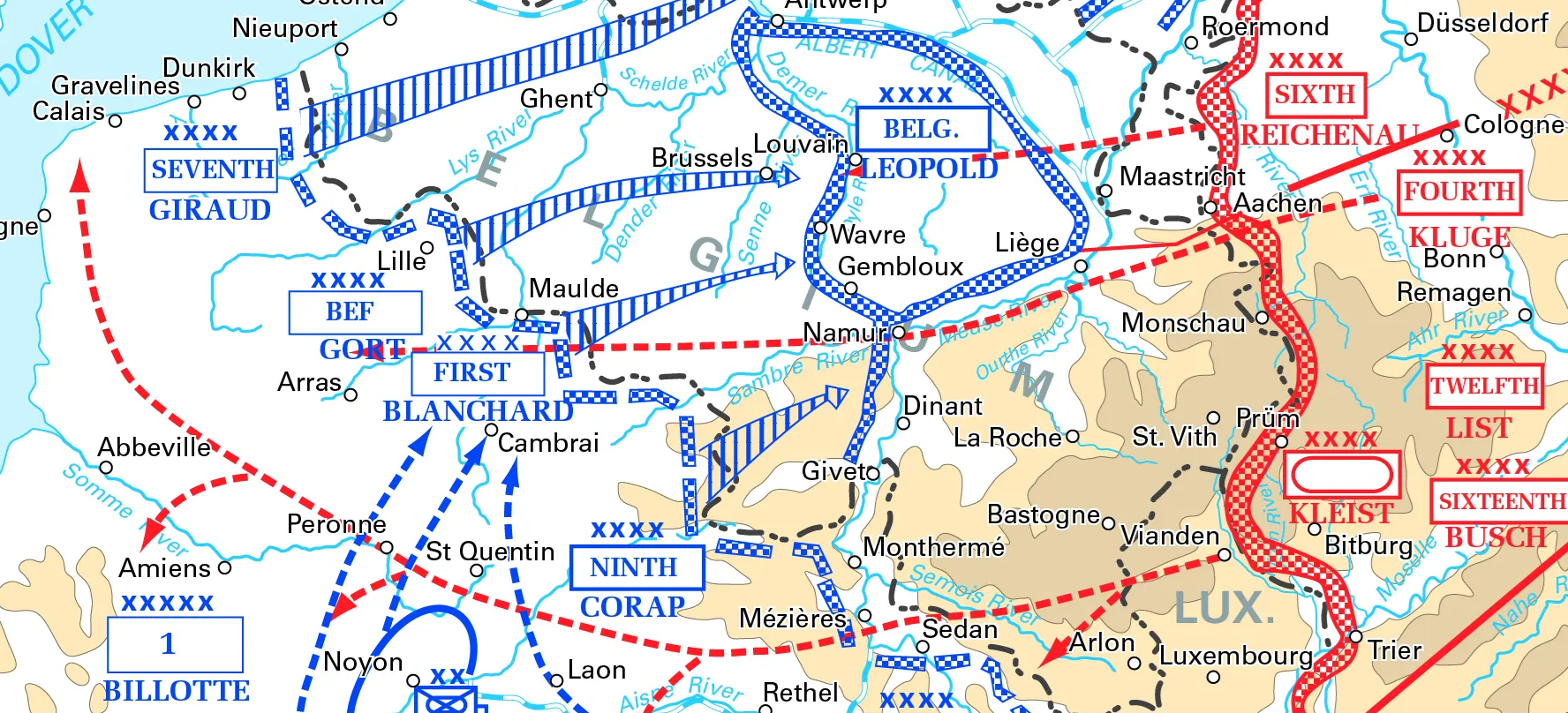
Detail from the West Point Military Atlas map of the “Campaign in the West, Disposition and Opposing Forces, 1940”
Full map.
The world has largely remembered Sichelschnitt as a brilliant German operation of war, but it was one that was fundamentally enabled by Allied ineptitude. Indeed, Blitzkrieg wasn’t particularly new, innovative or even a warfighting doctrine. It is best described, in the context of France 1940, as an event. It was simply the way that the Wehrmacht exerted its tactical and operational superiority over its more pedestrian enemies in 1940. In fact, it was the 1940 extension of what the German Army had first demonstrated in Flanders in March 1918, this time with tanks and Stukas. It was the Panzerwaffe (“tank force”) – combined with a tactical air force – which in 1940 would create the breakthrough that Ludendorff had been unable to achieve in 1918. Where it was applied, by Army Group A, it concentrated fast-moving armoured vanguards co-ordinated with tactical air power, such as 400 Ju 87 Stuka dive-bombers, to so overwhelm the enemy in both time and space that they were unable to respond quickly enough to the changing and challenging battlefield. In 1940 the panzer came into its own, the sound of clattering tracks on French cobblestones a new feature in the sound of battle and a key element in how France remembers its defeat in 1940.
It wasn’t the type of tank in the German inventory which mattered, but the way in which these tanks were employed. Only about 10 per cent of the army comprised tanks, the remainder relying on horse and wagons and the raw, painful feet of the marching infantry. Of the 2,539 tanks the Wehrmacht deployed in 1940, only 916, or 36 per cent were battleworthy, the remainder being clattering tin cans with machine guns (the obsolete Panzer Mark Is and Mark IIs). The only modern tanks were 683 Panzer Mark IIIs and Czech T38 tanks armed with a 37mm gun, and 278 of the larger Mark IVs with a short 75mm gun. But it was enough. The German operational strategy was to use this mass of armour not to fight a large confrontational tank battle, but to achieve breakthrough and breakout, bursting through the enemy’s linear defences. It was surprise and shock action that so discomforted the Allies, who had lazily and, given what we know of British failure to understand 1918, ignorantly assumed that the war would progress against a 1914 rather than a 1918 pattern. The armoured vanguard would surge through the outer skin of the enemy defences, concentrating heavy effort in one place, before driving hard into the heart of enemy territory. With an enemy intent on fighting a linear battle, the rear areas, behind this outer crust, would be weakly defended and full of rear-echelon, administrative and supply troops managing the lines of communication up to the front, not expecting to have to fight. It was by driving hard and fast behind the enemy front line, breaking the cycle of Allied battlefield decision-making, that Blitzkrieg was to achieve its psychological effect.
In contrast the Allies remained concerned about retaining the integrity of their defensive lines. The diaries of Major General Henry Pownall, for instance, are replete with concerns as the days spun past about the widening frontages on one defensive line or another. British concern was misplaced. It was to spread the ever-decreasing butter of the British infantry across ever-widening stretches of French and Belgian bread, without realising that the Germans were concerned not with rolling up a front line, but with driving hard to the rear. By so doing they would take risks with their flanks, but the discombobulatory effect on the enemy was considered to far outweigh any worry about the risk of counter- attack from an increasingly battered and disorganised enemy. Of course this operational concept was risky, but the risks taken were carefully calculated given what the German General Staff knew about British and French tactical doctrine, or the lack of it.
These German tactics were psychologically disconcerting for those not trained to expect them. As was demonstrated on the Meuse, artillery would batter a position in co-ordination with armoured columns bypassing fixed defences and attacking those it needed to clear from the flanks and the rear. The infantry accompanying the advancing armour – Panzergrenadiers (mechanised infantry) – arrived in tandem with the Stukas, which could drop their bombs from a screaming dive. Each Stuka seemed to those at the receiving end to be diving directly at them, personally. For untrained troops it was a terrifying experience. The panzers would sweep on while the truck-borne infantry would turn up to deal with survivors of this storm of fire and movement. By this time, of course, the disorientated French and British would now consider themselves cut off, behind their front line, with no prospect of being relieved. Surrender or a disorganised escape to the rear would seem to be a more sensible option than the forlorn hope of continued resistance when the surrounding fields were dotted with the grey-green uniforms and coal-scuttle helmets of their enemy. The psychological effect of Blitzkrieg was considerable. This wasn’t how their fathers had told them war was fought. How did the Germans manage to discomfort them on the battlefield so comprehensively? Were they inadequate soldiers, unable to meet the standards of campaigning set by the previous generation? Or was it that their tactics were simply not able to cope with the shock of a comprehensive assault by German infantry, armour and air power all descending on them at once? This was the battlefield that the British had entirely dominated, by virtue of their tactical innovations, in 1918. It was now Germany’s turn, a direct result of the failure of the British Army to develop its doctrine and approaches to warfighting at the end of the Great War. Brave men in 1940 did their duty, but against a battle-winning concept of their enemy, they were out-thought rather than out-fought. And critically, when an army thinks it is beaten, it is indeed beaten.
September 6, 2025
QotD: Leadership training for Persian nobles
Anyway, young Cyrus […] and his classmates spend practically every waking moment being little Tai-Pans. They study in classrooms, receive military training,1 and shadow the magistrates in their official duties; but all of these official lessons are just the backdrop against which the real lessons are taking place. The boys have missions to accomplish, missions which they cannot possibly accomplish individually. So they have to learn to put together a team, to apportion responsibilities, and to judge merit in the aftermath. Anytime one of the boys commits an infraction,2 the adults ensure that he is judged by the others. All of this is carefully monitored, and boys who show partiality or favoritism, or who simply judge poorly, are savagely punished.3
The most common sort of mission is a hunt, the boys are constantly going on hunts, because: “it seems to them that hunting is the truest of the exercises that pertain to war”. This is obvious at the level of basic physical skills: while hunting they run, they ride, they follow tracks, they shoot, and they stab. But the military lessons imparted by hunting are not just physical, they’re also mental. They learn to “deceive wild boars with nets and trenches, and … deer with traps and snares”. To battle a lion, a bear, or a leopard on an equal footing would be suicide, and so by necessity the boys learn to surprise them, or exhaust them, or to terrify them with psychological warfare, doing everything in their power to find an unfair advantage or to create one from circumstances.4 As Cyrus’s father tells him years later: “We educated you to deceive and take advantage not among human beings but with wild animals, so that you not harm your friends in these matters either; yet, if ever a war should arise, so that you might not be unpracticed in them.”
There’s another reason that the boys constantly hunt wild animals, which is that it habituates them to hunger, sleep-deprivation, and extremes of heat and cold. When they depart on a hunt the boys are deliberately given too little food, and what they have is simple and bland (though that’s hardly an issue for those who “regularly use hunger as others use sauce”). Some of this is ascesis in the original Ancient Greek meaning of the word (ἄσκησις – “training”); by getting used to being tired and hungry and cold under controlled circumstances, they will be better at shrugging off these disadvantages when the stakes are higher.
But the real core of it lies in the phrase: “He did not think it was fitting for anyone to rule who was not better than his subjects.” Later, when they’ve reached manhood, the boys will oftentimes be called upon to share physical hardship with those they have been set over, and in that moment it is vital to this social order that they not be soft. “We must of necessity share with our slaves heat and cold, food and drink, and labor and sleep. In this sharing, however, we need first to try to appear better than they in regard to such.” Better in the sense of physically tougher, but also better in the sense of having achieved the absolute mastery of the will over any and all desires.5
Constant exposure to deprivation and hardship isn’t just supposed to improve their endurance, it’s also supposed to make them better at sneering at comforts.6 This is a society which believes that men are more easily destroyed by luxury than by hardship, and that it’s especially important that the leaders be seen to scorn luxury, for “whenever people see that he is moderate for whom it is especially possible to be insolent, then the weaker are more unwilling to do anything insolent in the open.”7 What I love about Xenophon is that unlike many Greek authors, who would deliver that line completely straight, he instead subverts (or at least balances) it with the observation that any kind of suffering is easier to bear when you’re in charge, and even easier when you’re bearing it in order to be seen to be bearing it.
John Psmith, “REVIEW: The Education of Cyrus, by Xenophon”, Mr. and Mrs. Psmith’s Bookshelf, 2024-01-08.
1. If you’ve ever been a little boy, or the parent of a little boy, you know how true this is:
“Now the mode of battle that has been shown to us is one that I see all human beings understand by nature, just as also the various other animals each know a certain mode of battle that they learn not from another but from nature. For example, the ox strikes with his horn, the horse with his hoof, the dog with his mouth, the boar with his tusk … Even when I was a boy, I used to seize a sword wherever I saw one, even though I did not learn how one must take hold of it from anywhere else, as I say, than from nature. I used to do this not because I was taught but even though I was opposed, just as there were also other things I was compelled to do by nature, though I was opposed by both my mother and father. And, yes, by Zeus, I used to strike with the sword everything I was able to without getting caught, for it was not only natural, like walking and running, but it also seemed to me to be pleasant in addition to being natural.”
2. Not just explicit violations of the rules though: “they also judge cases of ingratitude, an accusation for which human beings hate each other very much but very rarely adjudicate; and they punish severely whomever they judge not to have repaid a favor he was able to repay”.
3. “In one case, I was beaten because I did not judge correctly. The case was like this: A big boy with a little tunic took off the big tunic of a little boy, and he dressed him in his own tunic, while he himself put on that of the other. Now I, in judging it for them, recognized that it was better for both that each have the fitting tunic. Upon this the teacher beat me, saying that whenever I should be appointed judge of the fitting, I must do as I did; but when one must judge to whom the tunic belongs, then one must examine, he said, what is just possession.”
4. Players of old-school tabletop role-playing games might be reminded of the distinction between “combat as sport” and “combat as war” or the parable of Tucker’s Kobolds.
5. Years later one of Cyrus’s classmates gives a long speech about how falling in love is optional — a real man can make himself love any woman he chooses, and conversely can restrain himself from loving any woman, no matter how desirable. All poetic references to being made a prisoner by love, or forced by love to do certain things, are excuses made by weaklings who wish to give into their desires. This is a message right in line with the most inhuman aspects of Greek philosophy, and to his credit Xenophon immediately subverts it by having the guy who delivers it immediately fall madly in love with his beautiful female captive.
6. One of the highest compliments ever paid to Cyrus is when an older mentor remarks of his posse that:
“I saw them bearing labors and risks with enthusiasm, but now I see them bearing good things moderately. It seems to me, Cyrus, to be more difficult to find a man who bears good things nobly than one who bears evil things nobly, for the former infuse insolence in the many, but the latter infuse moderation in all.”
7. Compare this to the American ruling class, which is also weirdly Spartan in its own way. The wealthiest Americans on average work a crazy number of hours, lead highly regimented lives, and avoid drugs. The difference is that whereas the Persian aristocracy does this as an example for the lower classes, the American aristocracy actively encourages the lower classes to consume themselves in cheap luxury and sensual dissipation.
August 19, 2025
QotD: The fall of France: mass and defeat in detail
As mentioned, for Clausewitz, the defeat of Prussia in the war of the Fourth Coalition was the template, but the more contemporary archetype is the Fall of France in WW2. French command and control was oriented towards a lengthy war of attrition and proved unable to react quickly enough to the German breakthrough at Sedan. Counterattacks were therefore only undertaken on the local level and without coordination. Despite German vulnerability, they were able to defeat the piecemeal commitment of superior forces and ultimately collapse Allied defenses.
The initial German breakthrough was made possible by local air superiority, enabled by the same principle. This was achieved despite an overall superiority by the Allies in aircraft (even when counting only modern planes) because the Allies kept many planes in reserve, anticipating a long war. By the time they realized the significance of the German concentration, the Germans had been able to move forward anti-aircraft guns and it was too late to destroy the bridgeheads over the Meuse (despite the desperate kamikaze-like efforts of a stricken bomber).
The case of France in 1940 gives a clear example of why a defeat in detail has been so feared. French strategy was premised on winning a lengthy war — the initial battle was assumed to be no more conclusive than the Battle of Frontiers had been in 1914 [Wiki]. The exact error of the French is unlikely to be replicated, but the nature of the mistake remains a universal peril. Dismissing the likelihood of an early decision and preparing for a “later” that never comes is the reciprocal mistake of assuming an early decision is inevitable (which can be identified with the “Cult of the Offensive” that preceded WWI).
Kiran Pfitzner, “In Defense of Taiwan: Attrition or Annihilation”, Dead Carl and You, 2025-05-14.
August 6, 2025
The Korean War Week 59 – Who’s Really Running the Korean War? – August 5, 1951
The Korean War by Indy Neidell
Published 5 Aug 2025The Kaesong peace talks keep dragging on, and where any demarcation line should be drawn continues to the biggest obstacle to progress. The war continues, though, and plans for new offensives and blockades are being hashed out. But who exactly are the forces fighting this war? This week we take a closer look at the Communist forces and the American chain of command.
Chapters
00:00 Hook
00:37 Intro
00:50 Recap
01:11 The 38th Parallel Issue
02:51 War Without Victory
04:58 US Chain of Command
09:21 Plans and Alternatives
10:58 UN Air Power
13:19 The Communist Forces
18:28 Summary
18:49 Conclusion
19:45 CTA
(more…)
August 4, 2025
Day Ten – German Victory in the Battle of France – Ten Days in Sedan
World War Two
Published 3 Aug 2025May 19, 1940. Ten days into Fall Gelb, Guderian’s panzers thunder toward the Channel, poised to slam a steel ring around nearly half a million Allied troops. In Paris, Paul Reynaud ousts Daladier and Gamelin, calling back Marshal Pétain and General Weygand as France’s last throw of the dice. The pocket is almost shut, yet the story is far from over. Is there time for one more twist? Keep watching as we follow the fight to its end and discuss the aftermath of this campaign.
(more…)
August 2, 2025
Canada’s PM “… has a job which, like that of most politicians, requires low intelligence and moral vacuousness”
At Essays in Idleness, David Warren explains why Canadian political leadership is so desperately uninspiring … except to our enemies and ill-wishers:
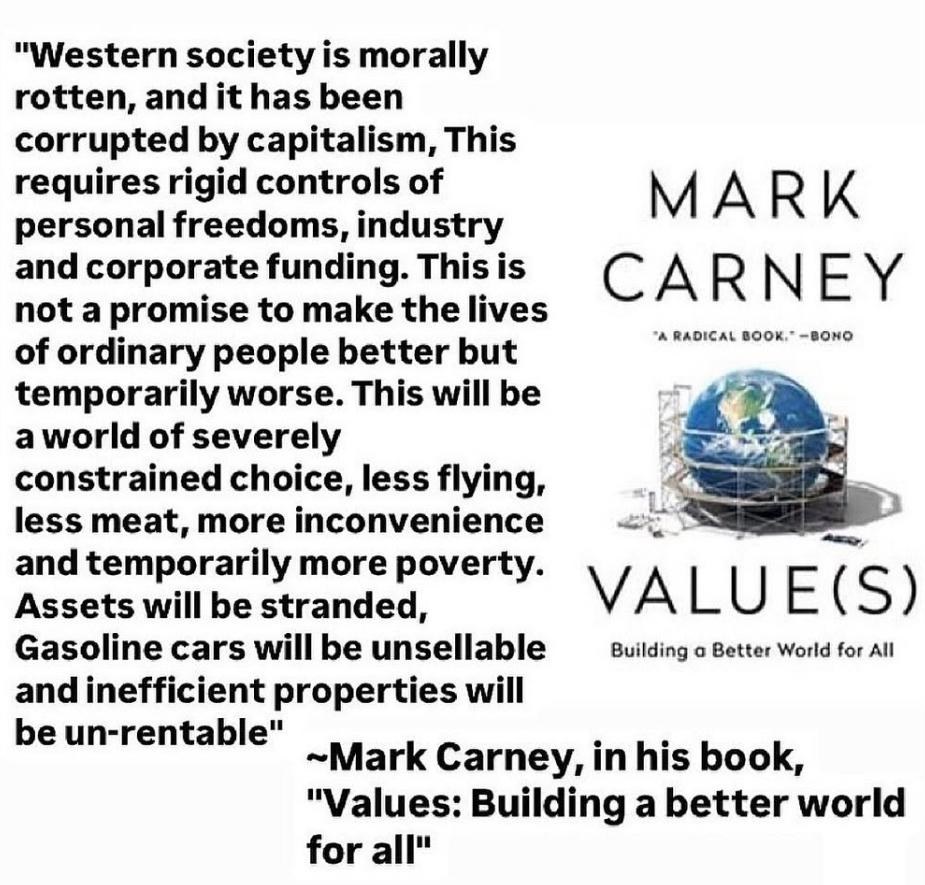
The Canadian prime minister — currently Mr Mark Carney — has a job which, like that of most politicians, requires low intelligence and moral vacuousness. At his cleverest he may exhibit a species of rat cunning. His views on Israel and the Middle East are quite uninteresting, for no rat cunning is required. He simply observes that an anti-Semitic policy is necessary, now that Muslim immigration exceeds the Jewish vote.
Not one good thing has come out of the Liberal Party since Louis St-Laurent was defeated in 1957. He, at least, achieved mediocrity. But what can we do? Canada’s population is one with the Liberals.
What happened on October 7th, 2023 — the slaughter of huge numbers of mostly unarmed Jews when Palestinians got outside the Gaza perimeter — can happen again and again. It will happen as long as Palestinians are, from childhood, taught or brainwashed to kill Jews throughout their education and social systems. I also protest against the disproportionate Israeli response. I think the Israelis have been much too restrained.
My model for “Palestine” would be Germany, or Japan. These formerly vicious nations became harmlessly bourgeois after they unconditionally surrendered to the United States and allies. It is ludicrous to think we should have offered them a peace deal, instead.
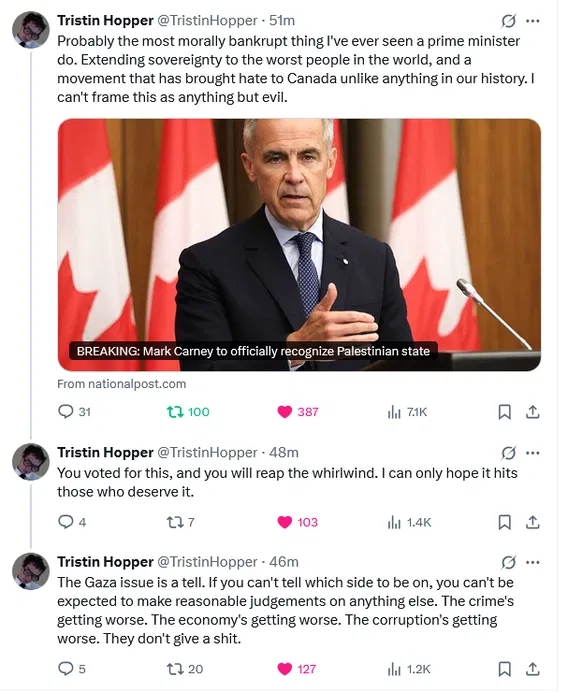
Damian Penny points out the sad truth that we get more obstinate even in support of a terrible idea when someone tries to bully us out of it:
… I find myself torn between being frustrated with my own government and simultaneously outraged by another government trying to bully us out of a policy decision with which I disagree.
I don’t expect most other Canadians to feel so conflicted, however. Trump may not realize it (nor care one bit even if he does understand it) but he just made it more likely that Canadian voters will rally around the flag.
This flag, specifically.
Nothing, and I mean nothing, has the motivational power of your opponent pushing back against you. That social media has given us a new and effective way to yell at and insult each other across partisan lines is part of the reason partisanship has become so much more entrenched in recent years.
And that includes me. During the last election campaign it was when I argued with Liberals on Facebook that I found myself feeling less like a Conservative voter and more like a Conservative militant, and my sparring partners likely felt the same way, only in the opposite direction.
Now, replace political partisanship with nationalism, and the effect becomes that much stronger.
Of course, hardcore supporters of either side won’t be moved. (That Carney is placing any conditions at all on Palestinian statehood, and saying a two-state solution remains the ultimate goal, makes him a filthy Zionist genocidaire as far as that crowd is concerned.) But sometimes it’s easy to forget that most people simply don’t pay as much attention to, and aren’t nearly as emotionally invested in, this conflict as much as we very online types are.

The Bloody Battle of Cannae | Animated(ish) Episode
The Rest Is History
Published 5 Jun 2025This is the final episode of our series on Hannibal, which is the second season on Carthage, the whole series is here: Rome Vs Cathage
Part 1 of our series on Hannibal is here: Hannibal: The Rise of Rome’s Greatest Nemesis
How did the Battle of Cannae — one of the most important battles of all time for Ancient Rome, with a whole Empire at stake, and a reputation that had reverberated across the centuries — in 216 BC, unfold? What brilliant tactics did Hannibal adopt in order to overcome the Roman killing machine, with its vast numbers and relentless soldiers? Why did so many men die in such horrific circumstances? And, what would be the outcome of that bloody, totemic day, for the future of both Carthage and Rome?
Join Tom and Dominic for the climax of their epic journey through the rise of Hannibal, and his world-shaking war against Rome, in one of the deadliest rivalries of all time.
00:00 Context to the battle
08:30 Prelude to the battle and their plans of attack
37:28 The battle
(more…)
July 27, 2025
Day Nine – Hitler’s Halt Order and Tragedy at La Ferté – Ten Days in Sedan
World War Two
Published 26 Jul 2025May 18, 1940. Our coverage of the German blitzkrieg in France continues. Today, we take a break from the panzers for a spot of old-fashioned siege warfare. At Ouvrage La Ferté, a small garrison of French troops makes a doomed last stand against overwhelming German firepower. We follow their final hours, the decisions that sealed their fate, and what their sacrifice meant for the collapsing French front.
(more…)
July 26, 2025
The unaffordable luxury of a second-best army
At History Does You, Secretary of Defense Rock considers the downfall of Prussia’s vaunted army at the hands of Napoleon in a blink-of-the-eye campaign in 1806:
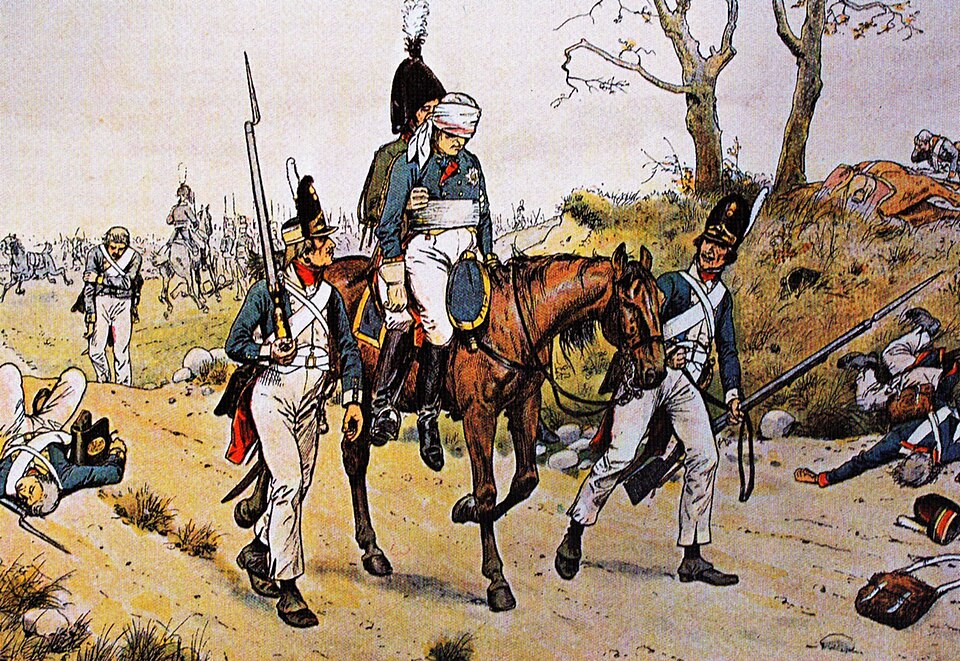
“Prussian wounded and stragglers leaving battle [after the battles of Jena and Auerstadt]. The mortally wounded Duke of Brunswick is the prominent figure in the painting.”
Painting by Richard Knötel (1857–1914) via Wikimedia Commons.
A vain, immoderate faith in these institutions made it possible to overlook the fact that their vitality was gone. The machine could still be heard clattering along, so no one asked if it was still doing its job.1
– Carl von Clausewitz on Prussia in 1806In the autumn of 1806, the Kingdom of Prussia, “The Iron Kingdom”, suffered one of the most rapid and humiliating military defeats in modern European history.2 The twin battles of Jena and Auerstedt shattered not only its army but the myth of invincibility that had surrounded the legacy of Frederick the Great. For the young Carl von Clausewitz, then a junior officer in the collapsing Prussian forces, this moment marked a personal and national catastrophe that would shape his life’s work. Clausewitz would come to see the defeat not simply as a failure of generalship or tactics, but as the exposure of a more profound institutional and societal crisis; one in which a state had grown complacent, a military rendered obsolete, and a society stripped of civic vitality falling apart during “the most decisive conflict in which they would ever have to fight”.3 In that collapse and Clausewitz’s later reflections, one finds an unsettling parallel to present-day America, a powerful nation outwardly strong, yet increasingly vulnerable to the same internal rot.
Prussia’s disaster in 1806 was the formative experience for the author of On War. How the armies of Frederick the Great and the state that he painstakingly built collapsed like a house of cards was a question that bothered Clausewitz for many years.4 It was a comprehensive disintegration of a system that had, since the mid-eighteenth century, claimed a position of prominence in European military affairs based on its discipline, linear tactics, and centralized command. Yet by the turn of the nineteenth century, these very strengths had calcified into weaknesses. Clausewitz foresaw disaster. Even as a young lieutenant, he was already warning of the Prussian army’s growing detachment from reality. In his early writings, he criticized military exercises as highly scripted performances, lacking genuine tactical challenge, unpredictability, and creativity.5 The number of steps marched in a minute of the cadence, what awards should be placed on a uniform, how a rifle should be cleaned for parade, all of this he feared, was cultivating a “lassitude of tradition and detail”.6 Clausewitz understood that rehearsing war under artificial constraints produced not readiness but ritual. Even though he later wrote, “no general can accustom an army to war”, he worried, presciently, that when confronted by a real enemy operating under real conditions, the army would collapse, and in 1806, it did.7
Whatever reservations he may have held, Clausewitz fulfilled his duty. He led a battalion of grenadiers at the battle of Auerstedt and managed to withdraw with most of his men intact in the chaotic aftermath of defeat. His escape was short-lived; however, he was captured on October 28, 1806, and subsequently marched into captivity in France, where he would spend the next year as a prisoner.8 Napoleon’s campaigns revealed that war had been transformed: faster, larger, and fundamentally political. Clausewitz wrote, “War was returned to the people, who to some extent had been separated from it by the professional standing armies; war cast off its shackles and crossed the bounds of what had once seemed possible”.9 The levée en masse and the corps system shattered the static paradigms of eighteenth-century warfare. Yet the Prussian high command, clinging to the geometries of the past, failed to respond with imagination or speed with any kind of seriousness.
Clausewitz’s later concept of friction — the unpredictable resistance that disrupts even the best plans — emerged directly from this experience.10 The Prussian army collapsed not for lack of courage, but because its institutional mindset could not withstand the volatility of an age that demanded adaptability, political intelligence, and creative command.
1. Carl von Clausewitz, Historical and Political Writings, ed. and trans. Peter Paret and Daniel Moran (Princeton, NJ: Princeton University Press, 1992), 32.
2. Christopher Clark, Iron Kingdom: The Rise and Downfall of Prussia, 1600–1947 (Cambridge: Belknap Press, 2006).
3. Clausewitz, Historical and Political Writings, 81.
4. Frederick the Great ruled from 1740-1786 and is usually credited as turning Prussia from a regional power to a continental power.
5. Peter Paret, Clausewitz and the State (Oxford: Oxford University Press, 1976), 92-93.
6. Clausewitz, Historical and Political Writings, 36.
7. Carl von Clausewitz, On War, trans. Michael Howard and Peter Paret (Princeton: Princeton University Press, 1984), 122.
8. Partet, 126.
9. Clausewitz, Historical and Political Writings, 287.
10. Clausewitz discusses this concept in Chapter 7 in On War, 119-121.
July 20, 2025
Day Eight – Can Charles de Gaulle Save France? – Ten Days in Sedan
World War Two
Published 19 Jul 2025Ten Days in Sedan continues as our WW2 Blitzkrieg documentary follows the first serious counterblow against the German spearhead. Colonel Charles de Gaulle leads the 4th Armoured Division in an attack against the German flank. De Gaulle’s units are understrength and his assault is improvised but he catches Heinz Guderian by complete surprise. Is this just a fleeting gesture of defiance, or a new kind of French resistance?
(more…)
July 18, 2025
The Napoleonic-era Royal Navy
David Friedman on some of the aspects of Britain’s Royal Navy in the late eighteenth and early nineteenth century which may be incomprehensible to modern readers who encounter it in works of historical fiction (like the books of C.S. Forester or Patrick O’Brian):
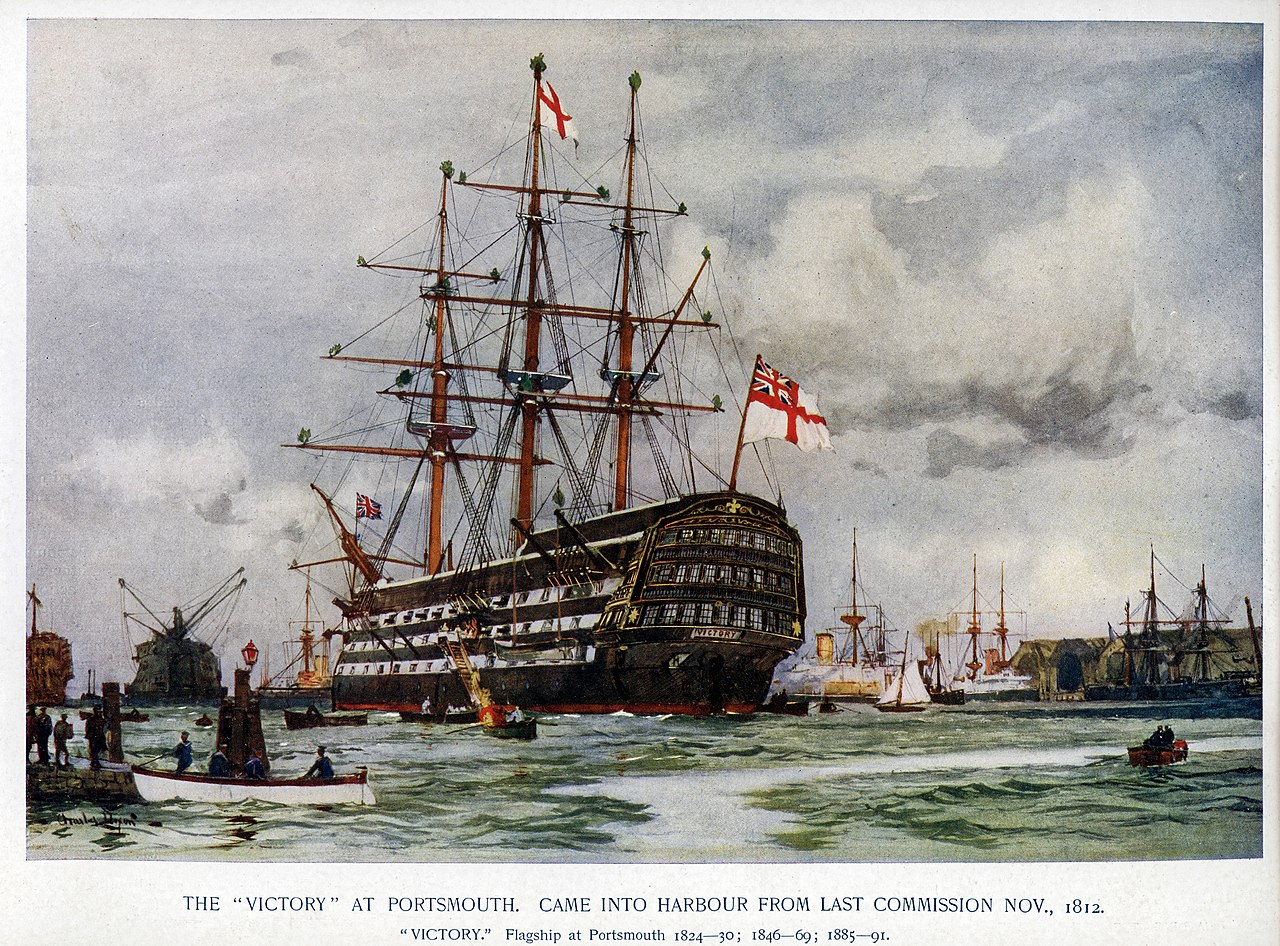
“HMS Victory in Portsmouth Harbour”
Painting by Charles Edward Dixon (1872-1934) via Wikimedia Commons.
I have read and enjoyed several series of novels set in the British navy during the Napoleonic wars, most recently one by Naomi Novik that departs a little further from history than its predecessors by providing the British and their enemies with dragons. The internal structure and the associated rules and customs of the navy seem very strange to a modern eye, yet it was a strikingly successful institution.
One feature likely to catch an economist’s eye was prize money. If a naval vessel captured a legitimate prize, an enemy warship or merchantman, and brought it back to port, the vessel and its contents were sold and the money distributed among those responsible. One large chunk went to the captain, another was distributed among his officers, a third among the crew, a fourth to the admiral under whose orders he was operating.
Another feature of the system was the role of patronage, political influence both within the navy and outside it in the career of an officer, especially a young officer. The critical step of promotion from lieutenant to captain depended in part on performance, in particular on the opinion of the captain under whom a lieutenant was serving. But it depended also on things that seem, to us, irrelevant.
One of Patrick O’Brien’s novels contains a conversation between Maturin, one of his protagonists, and a friend, a young officer of aristocratic birth. The officer has been having an affair with the separated wife of a high naval official and wants to know whether he should live openly with her. Maturin’s response is that, moral issues aside, it might be imprudent for him to offend a powerful official and so risk his future career. His friend replies that he has considered that matter but his family controls a significant number of seats in both houses of parliament and he thinks their influence will be sufficient to balance that of the man he will be offending.
Neither party sees anything strange in either the assumption that giving personal offense to someone within the bureaucracy will make it harder for a competent officer to be promoted or that having a politically influential family will make it easier; that is just part of how the system works. It was a system that produced extraordinarily successful results, a navy that, from the late 18th century to the early 20th won almost every ship to ship or fleet to fleet battle it fought at anything close to even odds.1
A third feature was the seniority system. Once a lieutenant was promoted to captain, his future rank depended only on how long he survived. His name was on the list of captains, the list was ordered by strict seniority, and the next captain to be promoted to admiral would be the one at the top of the list. When two or more captains were working together it was the senior who commanded. That provided an unambiguous rule for allocating command, since every captain knew where he was on the list and knew, or could readily find out, where any other captain was. But it was a rule that had nothing to do with the relative competence of two officers of the same nominal rank.
Promotion beyond captain was entirely determined by seniority; what the officer got to do with his rank was not. An insufficiently competent captain who made it to admiral would end up as an admiral of the yellow, an admiral without a fleet, effectively retired on half pay. A sufficiently competent captain could be assigned particularly important duties, including the command of a group of ships with the temporary position of commodore — provided none of the other captains in the squadron was senior to him. A sufficiently incompetent captain could end up without a ship, on half pay with no chance of prize money. In peacetime, when there was no shortage of competent captains, a minor failing might do it.
[…]
Consider the case of the pre-modern British navy. Prize money was a property solution. The admiralty wanted captains to have an incentive to capture enemy merchant ships, defeat and capture enemy warships, even at risk to their lives. Most of the relevant decisions were made by the captain, so he got the largest part of the reward, but other people, including the admiral whose orders determined what opportunities the captain had to earn prize money, got some of it. A pattern that shows up in the novels, and presumably in the real history, is an admiral who puts an unusually competent and aggressive captain in places where he is likely to encounter enemy warships not because he likes the captain but because he hopes to profit from successful encounters.
Allen argues that prize money was an imperfect property solution because capturing a warship was much riskier, more likely to get the captain killed, than capturing a merchant ship, but prize money was awarded for both. One puzzle he does not consider is why the navy did not solve the problem of misaligned incentives by lowering the prize money awarded for merchant ships or raising it for warships, which should have been easy enough to do.
Allen offers the imperfect alignment of incentives, such as the temptation for a captain in a fleet action to hang back and let other ships and their captains take the risk, as a reason why the property solution had to be supplemented with elements of the other two systems. The admiralty had detailed information on what a captain did through a system of three different logs, one by the captain, one by his first lieutenant, one by the sailing master, the ship’s senior warrant officer. A captain whose career showed him to be incompetent or too inclined to go after merchant ships and avoid warships might end up spending the rest of his career on shore with no ship, hence no opportunity for prize money. A captain who declined a clear opportunity for combat with a ship of the same class was subject to trial by court martial; one admiral ended up convicted and executed for failing to pursue the enemy fleet after an engagement.
1. With the possible exception of the War of 1812.
July 16, 2025
Matt Gurney’s “Hollywood Thesis”
I almost skipped reading this one, as Matt and Jen usually keep their own columns behind the paywall, but this one is free to non-paying cheapskates like me:
… I actually think there is one way that Hollywood — and probably mass entertainment writ large — has kind of warped our society. It’s not that it has promoted degeneracy or loose morals or shameless enjoyment of vice. It’s more insidious. And probably more dangerous.
I think Hollywood has tricked us into thinking that, in an emergency, our governments will prove to be a lot more competent than they will be. And usually are.
This is something I’ve been thinking about for a while. I’ve mentioned it to my Line colleagues before, and I call it my Hollywood Thesis. As I see it, the broader public has fairly accurate expectations about the level of service they can expect from their government. Sometimes it’s good, sometimes it’s bad, but it’s mostly realistic. We basically know what we’re getting into when we, for example, drag the trash bin to the curb, or turn on a tap in the morning, or go to an emergency room because you need to get stitched up after a minor mishap.
But I’ve observed over the years an interesting exception. When the public is confronted with any kind of new or unexpected threat, people, for some reason, believe their government will have some secret ability or unexpected expertise in dealing with it. Maybe it’s a quirky scientist working in the bowels of some ministry or department. Maybe it’s an elite team of experts. Or some hidden base loaded with commandos and advanced weaponry.
Wrong. And I’ve been thinking about this. Why do we assume the same government that is, for instance, struggling to fill potholes in my city, or hire enough nurses in my province, or fix a federal payroll system, is going to be more competent when presented with something totally out of the blue? This flies in the face of all of our lived experiences with government. It’s a generous assumption of state capacity that is, to put it charitably, unearned.
So why? What explains this?
It’s Hollywood. It has to be.
Lots of smart, competent people have government jobs. One of the great joys of my career has been the opportunity to speak with many. There are shining lights of unusual competency in every department, and at every order of government, really — my colleague Jen Gerson recently told our podcast listeners about how one of these hidden gems helped her cut through a confusing and dysfunctional process so she could get a permit. And I will never get tired of saying good things about the men and women of the Canadian Armed Forces — true miracle workers we do not support enough.
But there aren’t hidden capabilities. There aren’t secret teams. The same people trying to prevent Canada Post from going on strike will be the same people handling the next pandemic — or who would be responsible for opening a dialogue if aliens decided to land their mothership in the middle of a Saskatchewan farm.
It’s within the range of possibilities that, presented with a unique challenge, government leaders could rise to meet it … as long as it’s a completely unexpected situation with no pre-existing rules or regulations or bureaucratic processes in place. I admit it’s not the way the smart money would bet, but it’s technically a possibility.
July 14, 2025
Day Seven – Ghost Division! – Ten Days in Sedan
World War Two
Published 13 Jul 2025May 16 1940: Our WW2 Blitzkrieg documentary, Ten Days in Sedan, continues as Winston Churchill arrives in Paris. The Prime Minister still has hope but he’s shocked to see the French burning documents and preparing to evacuate. Meanwhile French and German tanks slug it out in Stonne, Guderian reaches Montcornet, and Rommel leads his Ghost Division far behind French lines.
Chapters
00:00 Intro
00:58 Recap
01:38 Stonne
03:05 Panzers Drive West
07:02 New French Plan
12:23 Rundstedt’s Halt Order
16:06 Ghost Division
21:53 Churchill in Paris
(more…)


