Quotulatiousness

March 15, 2021

Target is careful to only cite economic reasons for abandoning their downtown Minneapolis headquarters

Filed under: Business, Economics, USA — Tags: , , , — Nicholas @ 03:00

Jon Miltimore explains why the Target corporate headquarters in Minneapolis will be given up — for reasons that go beyond the claimed success of the telecommuting encouraged by the 2020 pandemic lockdowns:

A building burning in Minneapolis following the death of George Floyd.
Photo by Hungryogrephotos via Wikipedia.

Target Corporation, the eighth largest retailer in the United States, announced in an email to employees on Thursday that it will be leaving the City Center, its primary downtown Minneapolis location.

Company officials cited improved remote work opportunities and less need for space as the drivers for the decision.

“In just one year we’ve proven that we can drive incredible results, together, from our kitchens and basements and living rooms,” said Melissa Kremer, executive vice president and leader of Target’s human resources operations.

Target, the largest employer in Minneapolis with some 8,500 corporate workers, says the 3,500 employees who work at the City Center will still have a “home base,” but it will be at another Minneapolis location or in the nearby suburb of Brooklyn Park.

A Story of Capital Flight?

On one hand, there is little reason to doubt Target’s explanation for abandoning its headquarters. Many anticipated that the pandemic would lead to a normalization of remote work.

“The future of work will be distributed,” Erica Brescia, the chief operating officer of Github, told the BBC last fall. “We’re going to see a big shift from office by default to remote by default.”

Part of that shift, it’s reasonable to assume, would be corporations moving away from high-end corporate real estate. Yet it also shouldn’t be forgotten (or ignored) that Target’s decision comes less than a year after Minneapolis suffered some of the worst riots in US history, prompted by the May 25 death of George Floyd.

The riots — which broke out after a video went viral showing police pinning Floyd, a 46-year-old black man, to the ground for nearly nine minutes before he died — caused an estimated $2 billion in damage.

Though Target made no mention of the riots in its announcement, last summer I noted that an abundance of evidence suggested that the economic damage of the riots would persist long after the wreckage had cleared.

March 8, 2021

Despite the rhetoric, judging by their actions the Democrats really hate the “gig economy”

Filed under: Business, Government, Politics, USA — Tags: , , , , — Nicholas @ 03:00

Along with all the giveaways to favoured groups in the US government’s huge “relief” bill, there was a late change that will take the gig economy into a back alley and rough it up to the tune of about $1 billion in new taxes:

UBER 4U by afagen is licensed under CC BY-NC-SA 2.0

When the economy is struggling to recover from a pandemic and crushing government lockdowns, that’s probably the worst time to impose $1 billion in new annual taxes on the working class. But that’s exactly what a new provision quietly slipped into the Democrats’ sweeping $1.9 trillion COVID legislation would do.

“A last-minute insert by Democrats looking to offset the cost of their coronavirus aid package would send tax collectors into the gig economy, eventually costing Uber and DoorDash drivers, Airbnb hosts and others about $1 billion annually,” Roll Call reports.

Under current tax law, earnings data for gig economy workers only needs to be reported to the IRS once it reaches $20,000. This means that small earners pursuing gig work to supplement their income aren’t hit by crushing federal taxes. However, the Democrats’ provision would nearly eliminate this benchmark, and instead require all income above $600 to be reported to the IRS.

“The stiffer tax burden would be imposed while 10 million Americans are unemployed and more and more have turned to freelance and gig economy work to make ends meet,” Roll Call notes.

Indeed it would, and this would be disastrous for both workers and the economy.

This tax hike “adds a significant burden to gig economy and small business workers at the worst possible time,” according to TechNet spokesman Steve Kidera. One tax expert warned Roll Call that many struggling gig economy workers won’t be able to pay the higher taxes, and that IRS penalties “can destroy a person’s life.”

February 19, 2021

QotD: The disillusionment of working in a bookshop

Filed under: Books, Britain, Business, Quotations — Tags: , , , — Nicholas @ 01:00

For the better part of 2006, while studying for a master’s degree, I worked part-time in a branch of Waterstone’s, in *REDACTED*, the county capital of *REDACTED*.

I got the interview by stating openly in my covering letter that I was 24, still living with my mum, and asking her for train-fare had become a bit undignified. This seemed encouraging. But then the panel (2 pax.) asked what I was reading currently, and I said Sam Harris’s The End of Faith, and there was awkward silence. This set the tone for almost every “literary” chat thereafter.

Call me an idiot, but I was genuinely stunned to find we weren’t allowed to read on the job. Instead, booksellers had to devote any time not spent actually dealing with customers (which on a rainy weekend, in the wrong bit of the shop, could be a lot) with often-fruitless searches for books which had been lost, mis-shelved, or maybe stolen, or because they had to be returned to publishers (another surprise), and at the publisher’s expense.

I also quickly realised that the layout of the shop was not an accident (even in the jury-rigged “commercial” buildings of many an English town centre), and that the unadvertised steering of a customer around a bookshop was near-identical to how the algorithms work in the online equivalents (or vice versa, probably). If you like Poetry, you’re more likely to also like Philosophy, (right here on the next set of shelves), or Music (by the window), or History books (just across the room there), than if you came in looking for the latest Jeffrey Archer novel (downstairs, on the pile-’em-high islands).

Most of the time, I was just moving “stock” about, taking maddening credit card orders over the phone, or walking people literally to alphabetised mass-market fiction. All of which required no interest in, let alone knowledge of, literature. To a middle-class nerd such as myself, discovering that working in a bookshop [cue poetic images of James Frain, or similar] was fundamentally no different from working in a Sports Direct or Tesco was about the most depressing thing imaginable. That, and waiting for the Sunday trains in winter.

A.S.H. Smyth, “Seven kinds of people you find in bookshops”, The Critic, 2020-11-14.

February 5, 2021

QotD: Misunderstanding the threat/promise of robotics and AI

So, start with the very basics. Human desires and needs are unlimited – that’s an assumption but a reasonable one. There’re some number of people on the planet. This provides us with a lot of human labour but not an unlimited amount. Thus labour is a scarce or economic resource – and we’ve not enough of it to sate all human desires and wants.

OK, so, now we use machines to do some jobs that were previously done by humans. Imagine that this new technology actually required more human labour – that it created new jobs in greater volume than those it destroys. Say, the tractor and combine harvester industry needs more people in it than we used to use to cut the crops by hand. We’ve just made ourselves poorer. We used to have some amount of grain through the labour of some number of people. We’ve now got that grain but by using the labour of more people. We’ve used more of our scarce resource and we’re now poorer by the loss of what they used to make when not hand cutting grain but now no longer are by making tractors.

What makes us richer is if the tractor industry has record production statistics while using less labour than the hammer and sickle. That means that some human labour is now free to go off and try to sate a human desire or want for something other than grain. Ballet dancing for example. We’re now richer – tractors and combine harvesters have made us richer – by whatever value we put on more ballet dancing.

The entire point of any form of automation is to destroy jobs so as to free up that labour to do something else. The new technology doesn’t create jobs, it allows other jobs to be done.

The only point at which this fails is if human needs and desires aren’t unlimited. Which means that we might be able to provide everything that everyone wants without us all working. Which doesn’t really sound like much of a problem really.

Tim Worstall, “As Usual, World Economic Forum Gets Robots And AI Wrong Over Jobs”, Continental Telegraph, 2018-09-18.

January 28, 2021

The economic impact of a US national minimum wage of $15 per hour

Filed under: Business, Economics, Government, USA — Tags: , , , — Nicholas @ 03:00

I missed this post by Warren Meyer last week, but it’s still very topical:

I have talked a lot about the negative effects of higher minimum wages on low-skill workers. Two good example background posts are here and here. I covered how a broad range of labor regulation hurts unskilled workers in a cover story for Regulation magazine a few years back. Unfortunately, in a country where the average American buys about $1000 in lottery tickets each year, the willingness to believe we can get something for nothing is strong.

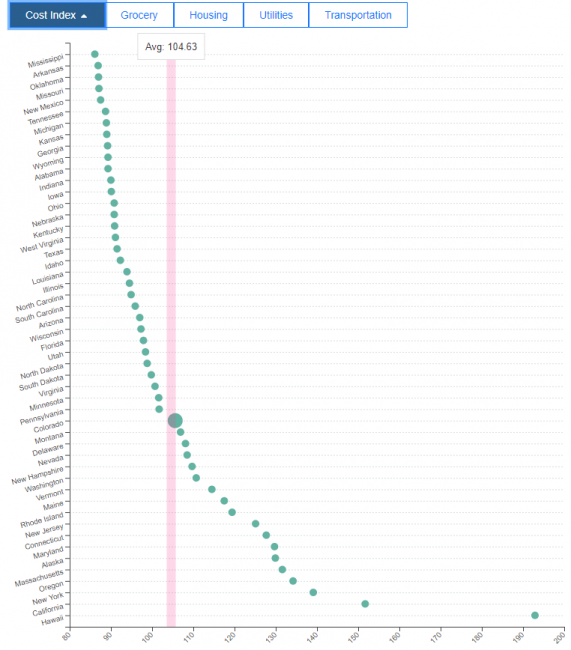
But I want to talk specifically about a Federal minimum wage increase, where one other problem emerges. The best way to state this is — how can one possibly set the same minimum wage for San Francisco at the same rate as one does for rural Mississippi? Here is one source for comparative state cost of living. Doing this by county would make the curve even wider.

Cost of living in Hawaii is more than 2x that of Mississippi. CA and NY are not far behind. A minimum wage that might comfortably be accommodated in San Francisco (and note even there the rise to $15 was ending service jobs in that city long before COVID), would be an economic disaster for rural Alabama. I don’t tend to think primarily along racial lines as seems to be the case on the Left today, but basically this is a policy driven by rich white tech guys in San Francisco that is going to devastate the employment prospects of rural blacks.

Whatever one’s misgivings about minimum wages, it is certainly true that allowing states to take the lead on setting minimum wages (counties would make even more sense) makes a lot more sense that trying to take action at the national level. Even with state action there are disparities.

November 14, 2020

People are working from home? Gotta tax that!

Filed under: Business, Government — Tags: , , — Nicholas @ 03:00

I am … unimpressed … with this sudden urge to impose new taxes on people who are currently working from home (I was working from home before it was cool, so I clearly have an interest in this issue). In the Vancouver Sun, Colby Cosh discusses the “wisdom” of this latest proposed tax grab:

One of the joys of working from home – being your own tech support.

This is the first time I have heard this “obvious” idea in any setting, but maybe that’s me. Telecommuting has experienced rapid growth in the decades I’ve been doing it, but before the pandemic it remained more or less at barely detectable levels. [Deutsche Bank economist Luke] Templeman believes that, “Our economic system is not set up to cope with people who can disconnect themselves from face-to-face society. Those who can WFH receive direct and indirect financial benefits and they should be taxed in order to smooth the transition process for those who have been suddenly displaced.”

As Templeman describes it, you would have to have been a crazy idiot not to work from home all along if it were possible. “WFH offers direct financial savings on expenses such as travel, lunch, clothes and cleaning. … Then there are the intangible benefits of working from home, such as greater job security, convenience and flexibility. There is also the benefit of additional safety.”

This would be my own assessment, except for the gibberish parts (job security?), but you will notice that this is the opposite of [Bank of England chief economist Andy] Haldane’s October argument. Haldane thinks there are negative externalities and even net costs to the individual in working from home. Templeman thinks WFH is an inarguable optimum … and is hot as a $2 pistol to disincentivize it.

Does this make sense? Not economically. Templeman is making more of a moral argument that the great shift to WFH is permanent, for which there is some survey evidence, and that it is proper to tax the resulting windfall to ease the adjustment for affected sectors (businesses designed to cater to office workers, basically). This might persuade you, if like Templeman you mistake an “economic system” for the arrangements produced by that system; but if it does, wait till you see how he proposes to do it:

    The tax will only apply outside the times when the government advises people to work from home (of course, the self-employed and those on low incomes can be excluded). The tax itself will be paid by the employer if it does not provide a worker with a permanent desk. If it does, and the staff member chooses to work from home, the employee will pay the tax out of their salary for each day they work from home. This can be audited by co-ordinating with company travel and technology systems.

There is more gibberish here, and at least one idea of Godzilla-scale terribleness — an incentive for employers to “provide” a desk for the purpose of shifting the WFH tax onto the employee. Undeterred, Templeman proposes for modelling purposes that the tax could be a flat five per cent of salary (which is also ridiculous if there’s a single eligibility threshold).

September 8, 2020

QotD: Creative hand-work

Filed under: Britain, History, Quotations, Woodworking — Tags: , , , , — Nicholas @ 01:00

We have often discussed here that aspect of modern industrial life which has tended to divorce the work of many men from anything that is intelligently creative, because so much is done by machinery. Compensation comes in the increase of leisure which this allows, a leisure that does at least give a man an opportunity of finding his own interests or hobbies. But at the same time have come the counter-attractions of cinema and radio, offering an easy way of entertainment without effort to a man who is tired after his day’s work. So that, in spite of the increase of opportunity, he has every inducement to allow himself to drift. The older man usually knows how to strike the balance. Things were not so easy when he was a boy, he had to learn to amuse himself, and he grew up with all sorts of hobbies and enthusiasms, and learned to be a handy sort of fellow. If he is, say, a keen woodworker, or a keen gardener, there are times when nothing will tempt him away from the job in hand.

But for the younger generation it is different. They were born into the state of affairs where entertainment, like everything else, was made easy. And some of our Youth Leaders are now finding it difficult to get boys really doing things — boys in their teens with no particular hobbies, no particular interests, who simply want to be enter­tained, and that at a time when a boy should be so full of interests that no day is long enough to cram them all in. “I do not complain of growing old,” says John Buchan, “but I like to keep my faith that at one stage in our mortal existence nothing is impossible.” We feel that that should be so in youth, and yet here is the problem in our midst. “It gives you absolutely nothing to work on,” said one of their Leaders to me recently, a man who numbers photography, book-binding, carpentry and music among his own hobbies, and does them all extremely well. “They’ve no conception of taking the initiative themselves or doing a spot of work for the pleasure of it.”

What are we going to do about it? The gospel of “work for the pleasure of it” isn’t an easy gospel to preach to the young. You have got somehow to kindle the spark of enthusiasm in their minds first, that enthusiasm which can make everything seem well worth doing, even the hard bits, for the sake of the end in view. And it is the enthusiasm of the Youth Leaders from which the boys have got to catch their own tiny spark which, once alight, may well kindle into a flame. And it will be worth it. For they can learn more from intelligently working at a hobby than from almost anything else. It develops patience, ingenuity, alertness, self-mastery, helps them to discover their own hidden powers, teaches them the satisfaction of a good job done, widens their knowledge in a thoroughly practical way.

But we have no business to leave it all to the Youth Leaders. There is no easy time ahead for the boys of this generation and it is every man’s job to lend a hand where he can. The best place is in the home. If you are a keen woodworker, then try to interest your boy as well. Don’t just hustle him out of the way because you are in the middle of a job and don’t want to be interrupted, or are afraid he will meddle with your tools. Teach him how to use them; help him with some little constructive job of his own, if it is only to make a “safe” — as a small boy of my acquain­tance did recently — to keep his secrets in! Small boys are usually keen enough. It is the older ones who grow apathetic. And who knows if the blame can be put entirely on the pictures? Mayn’t it be that we have hustled them out of our way rather too often? Dared them to touch our tools when they were simply longing to try them? The impulse to do and to make things is there right enough. But these are days when it needs to be fostered.

Charles H. Hayward, “Work and Pleasure”, The Woodworker, 1942.

August 27, 2020

QotD: Racism and the minimum wage

Filed under: Australia, Business, Cancon, Economics, Quotations, USA — Tags: , , , , , , — Nicholas @ 01:00

Minimum-wage laws can even affect the level of racial discrimination. In an earlier era, when racial discrimination was both legally and socially accepted, minimum-wage laws were often used openly to price minorities out of the job market.

In 1925, a minimum-wage law was passed in the Canadian province of British Columbia, with the intent and effect of pricing Japanese immigrants out of jobs in the lumbering industry.

A Harvard professor of that era referred approvingly to Australia’s minimum wage law as a means to “protect the white Australian’s standard of living from the invidious competition of the colored races, particularly of the Chinese” who were willing to work for less.

In South Africa during the era of apartheid, white labor unions urged that a minimum-wage law be applied to all races, to keep black workers from taking jobs away from white unionized workers by working for less than the union pay scale.

Some supporters of the first federal minimum-wage law in the United States — the Davis-Bacon Act of 1931 — used exactly the same rationale, citing the fact that Southern construction companies, using non-union black workers, were able to come north and underbid construction companies using unionized white labor.

These supporters of minimum-wage laws understood long ago something that today’s supporters of such laws seem not to have bothered to think through. People whose wages are raised by law do not necessarily benefit, because they are often less likely to be hired at the imposed minimum-wage rate.

Thomas Sowell, “Why racists love the minimum wage laws”, New York Post, 2013-09-17.

August 19, 2020

He calls it “unintended consequences”. I disagree … these consequences are very much intended

Brad Polumbo is being far too generous to Californian politicians by saying the impending collapse of the state’s entire gig economy was not the intended result of passing “worker protection” laws that penalized success:

UBER 4U by afagen is licensed under CC BY-NC-SA 2.0

This Friday, Uber and Lyft are set to entirely shut down ride-sharing operations in California. The businesses’ exit from the Golden State will leave hundreds of thousands of drivers unemployed and millions of Californians chasing an expensive cab. Sadly, this was preventable.

Here’s how we got to this point.

In September of 2019, the California state legislature passed AB 5, a now-infamous bill harshly restricting independent contracting and freelancing across many industries. By requiring ride-sharing apps such as Uber and Lyft to reclassify their drivers as full employees, the law mandated that the companies provide healthcare and benefits to all the drivers in their system and pay additional taxes.

Legislators didn’t realize the drastic implications their legislation would have; they were simply hoping to improve working conditions in the gig economy. The unintended consequences may end up destroying it instead.

Here’s why.

AB 5 went into effect in January, and now, a judge has ordered Uber and Lyft to comply with the regulation and make the drastic transformation by August 20. Since compliance is simply unaffordable, the companies are going to have to shut down operations in California.

Their entire business model was based upon independent contracting, so providing full employee benefits is prohibitively expensive. Neither Uber nor Lyft actually make a profit, and converting their workforce to full-time employees would cost approximately $3,625 per driver in California. As reported by Quartz, “that’s enough to boost Uber’s annual operating loss by more than $500 million and Lyft’s by $290 million.”

Essentially, California legislators put these companies in an impossible position. It makes perfect sense that they’d leave the state in response. It’s clear that despite the good intentions behind the ride-sharing regulation, this outcome will leave all Californians worse off.

July 29, 2020

The Equity, Inclusivity, and Diversity Industrial Complex

In The Dominion, Ben Woodfinden comments on a Ross Douthat column on the “antiracist” demands of our modern protestariat (the hordes of un- or under-employed university-educated young liberals and socialists):

University College, University of Toronto, 31 July, 2008.
Photo by “SurlyDuff” via Wikimedia Commons.

… the most interesting aspect of this lockdown-induced outpouring of collective rage hasn’t been the protests, or the cancellations, but the woke job creation that is going on. The ideology behind things like “white fragility” is increasingly being transformed into what can be described as an equity-inclusivity-diversity (EID) industrial complex that might end up being the most significant long term structural change that emerges out of the protests.

One of the most common responses in elite institutions as they promise to address systemic racism has been the creation of new jobs and positions that will supposedly help to do so. For instance, the Washington Post created a set of new positions that will be focusing on racial issues. This included hiring a “Managing Editor for Diversity and Inclusion.” At Princeton, the administration announced, like many other elite universities, new courses (which means new teaching opportunities) focused on racial injustice, as well as new projects and funding for research to explore and address racial issues. Stanford has created a new Centre for Racial Justice at its law school.

This direct job creation is just the tip of the iceberg. The real EID industrial complex is in the creation of a vast number of new jobs dedicated to the promotion and advancement of the basic tenets of this ascendant ideology through the expansion of human resource departments to deal with these issues, the creation of new EID bureaucrats and administrators in universities, corporations, government departments, the rise of EID consulting and mandatory courses and workshops for employees, new jobs and potential litigation for lawyers, as well as courses and modules in law schools to teach aspiring lawyers about these things.

In the bestselling Ibram X. Kendi book How To Be An Antiracist, one of Kendi’s central solutions is to pass an anti-racist amendment to the U.S. Constitution and permanently establish and fund a Department of Anti-racism. This department:

    would be comprised of formally trained experts on racism and no political appointees. The DOA would be responsible for preclearing all local, state and federal public policies to ensure they won’t yield racial inequity, monitor those policies, investigate private racist policies when racial inequity surfaces, and monitor public officials for expressions of racist ideas. The DOA would be empowered with disciplinary tools to wield over and against policymakers and public officials who do not voluntarily change their racist policy and ideas.

The radical tendencies of the bourgeois bolsheviks in the streets might make them seem like true revolutionaries, but what this movement seems to actually want to create, with remarkable success, is new employment opportunities for true believers in the new anti-racist creeds. Racism won’t so much be solved by tearing society down, but by massively expanding new professional and managerial jobs that can guarantee full employment for the credentialed class of true believers.

O’Boyle’s thesis is that the revolutions that swept across European cities in 1848 were because a large surplus of resentful and overeducated men felt society was denying to them what they were rightfully owed. O’Boyle looks at Germany, where university education was cheap, and was “emphasized as an avenue to wealth and power.” This ending up producing an excess of ambitious, but resentful and frustrated men who felt society was not allotting them the status and comfort they deserved. The same was true in France. But in Britain, the opportunities produced by industrialization that had yet to fully materialize on the continent kept this excess surplus of overeducated men much smaller, and helped insulate Britain from revolution.

What if the EID industrial complex actually helps to reduce the scarcity of opportunities in elite fields and institutions that will put a lid on the unrest that overproduction breeds? The EID industry is worth billions of dollars, and in a way it might be the solution liberalism offers to both the radical progressivism of this ideology, and to the challenge posed by elite overproduction.

July 24, 2020

Orchestras encouraged to ditch blind auditions for reasons of diversity

Filed under: Business, Media, Politics, USA — Tags: , , , — Nicholas @ 03:00

Tal Bachman responds to a recent New York Times article by Tony Tommasini demanding that musical organizations ignore the relative quality of a potential musician’s play in order to ensure more visible minority players get hired:

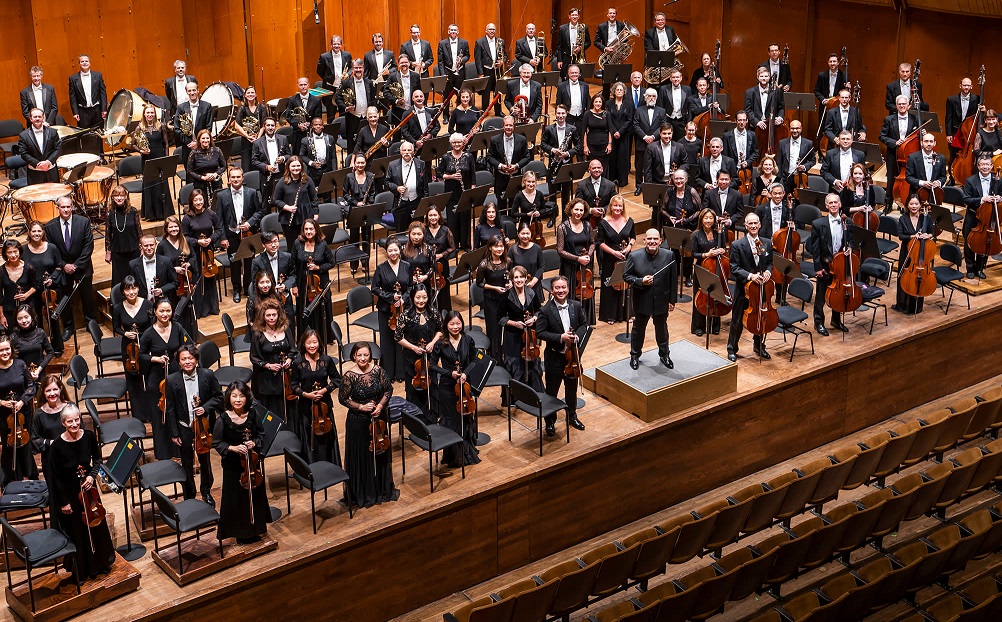
The New York Philharmonic Orchestra, detail from a group portrait in 2018.
Photo from the New York Philharmonic Orchestra website.

Tommasini begins his piece, entitled “To Make Orchestras More Diverse, End Blind Auditions”, by decrying the racism and sexism which, he claims, kept the orchestras of yesteryear predominantly white and male. He then pays tribute to the simple practice that helped erase that racism and sexism from orchestra hiring procedures: the blind audition. Starting in the late 1960s, orchestras began ditching traditional face-to-face auditions in favour of auditions that took place behind screens. With orchestra administrators no longer able to see the race or sex of the orchestra applicant, conscious and unconscious bias in hiring choices became impossible. Musical skill became the sole criterion for winning one of those prized professional playing positions.

This meritocratic turn, Tommasini argues, proved especially beneficial to female players. Whereas in 1970, women made up only 6% of orchestras, they now make up somewhere between a third and half of an average orchestra.

I add that audiences also benefited from meritocratic hiring processes as orchestras played increasingly brilliant renditions of the classics. Those improved performances also showed greater reverence for the original composers themselves. In short, the blind audition was a big win for all lovers of musical excellence – players, living composers, and fans alike.

So why on earth would anyone now call for their abolition?

Tommasini answers this way:

    Blind auditions changed the face of American orchestras. But not enough. American orchestras remain among the nation’s least racially diverse institutions, especially in regard to black and Latino artists … Ensembles must be able to take proactive steps to address the appalling racial imbalance that remains in their ranks. Blind auditions are no longer tenable.

In other words, the low number of black and Latino classical musicians means orchestras need to re-institute the old-time racial discrimination Tommasini began his article by decrying. Orchestras need to know which applicants are white and Asian precisely so they can refuse to hire them on that basis, no matter how skilled they are. Blind auditions make racial discrimination impossible, so they must be scrapped. American orchestras, writes Tommasini, should stop “passively waiting for representation to emerge from behind the audition screen”. Instead, they must realize that “removing the screen is a crucial step”.

To summarize: For Tommasini, it’s not just that justice requires injustice. It’s that justice is injustice (injustice in the form of racial discrimination). And if that reminds you of the official slogan of Orwell’s Ministry of Truth in 1984 – war is peace, freedom is slavery, ignorance is strength – you’re not alone.

July 8, 2020

QotD: Telecommuting in the post-Wuhan Coronavirus era

Filed under: Business, Economics, Health, Quotations, Technology, USA — Tags: , , , , — Nicholas @ 01:00

People are being stampeded into telecommuting. The thing is, dear media, once that happens, you can’t put it back in the bottle.

For two decades now, telecommuting and distance learning have been perfectly possible and even, frankly, beneficial. What has held it back is managers afraid they don’t know how to manage at a distance, corporations who think mega cubicle farms are a great way to be “important” and a general sense that only us, ne’er do wells, work in our pajamas on the sofa (I’ll have you know I’m wearing a sweatshirt and yoga pants. Never mind.)

If the panic lasts even two months (and the press will ensure it does before it collapses under its own weight) that reluctance to telecommute is going to be blown to hell. For one, once workers taste of THAT fruit, just anecdotally, 90% of them LOVE it. (The other 10% have very annoying children or spouses.)

And in the wake of the financial panic and wobbles, corporations are going to notice that they spend a lot less money when most of the workers work from home. At some point, they’ll also realize that they need much smaller facilities if they need facilities at all. And hey, money.

This will cause all sorts of other things, which I think will lead within two years to an exodus from the big cities everyone has crammed into because it’s where the jobs are. I think in turn this will lead to a world the social engineers really don’t like.

Sarah Hoyt, “Unintended Consequences”, According to Hoyt, 2020-03-12.

June 19, 2020

The economy isn’t all huge corporations and government

Filed under: Britain, Business, Economics — Tags: , , , — Nicholas @ 03:00

Paul Sellers reminds us that the economy is far more than just the big names that get mentioned in the financial pages:

An example of the kind of one-man businesses Paul is talking about.

Independents in micro-businesses are few and far between and often hard to discover, despite the internet’s ever-increasing web of enterprises. The backbone of British industry is made up of small, independent people striving to retain a measure of individualism, independence and entrepreneurialism in their lives. Statistics from 2019 show that in Britain there were 5.82 million small businesses responsible for 99.3% of the total business output in the UK.

Small businesses here comprise those with 0-49 employees and digging deeper still into what might at first seem more irrelevant than relevant is that the niche that small businesses fill in the real world of enterprise. Over 76% of businesses are operated by one-man bands; single-person enterprises who operate alone comprise almost 4.5 million men and women. With an additional 1.15 million micro-business (1-9 employees) around 95% of businesses here operate on a strength of under just 10 people. So over 99% of small to medium business enterprises, that’s zero to 249 employees, but only 0.6% have a workforce of 50-249 employees. Less than 4% are small businesses with 10-49 staff members and get this, over 95% operate as micro-businesses with 0-9 employees. What does this tell you about businesses output? What it tells me is how little of this is newsworthy by the mass media manufacturing companies (Like BBC News and ITV, Sky and so on) who constantly tell us about how many this massive company or that massive company is laying off and how little this really affects our economy because the little guys still get out into their little micro-shops and make what cannot work work.

June 8, 2020

Andrew Sullivan can’t write about the riots or he’ll lose his job

Filed under: Business, Media, Politics, USA — Tags: , , , — Nicholas @ 03:00

I’d wondered why he hadn’t directly addressed the biggest news item in the United States over the last week:

What has happened to New York media? Just as the New York Times was experiencing its own Inner Mongolia Moment over the now notorious Sen. Tom Cotton “Send in the Troops” op-ed, the Maoists at New York magazine were going after their best columnist, Andrew Sullivan.

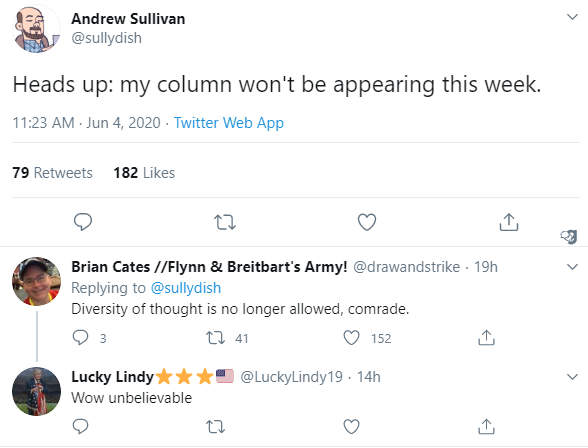
Sullivan revealed on Twitter yesterday that his column wouldn’t be appearing. The reason? His editors are not allowing him to write about the riots.

Presumably Sullivan’s editors are frightened that he might make the radically bourgeois point that looting and violence are wrong.

Cockburn understands that Sullivan is not just forbidden from writing for the New York magazine about the riots; his contract means he cannot write on the topic for another publication. He is therefore legally unable to write anything about the protests without losing his job — at the magazine that, in 1970, published Radical Chic, Tom Wolfe’s brilliant and controversial excoriation of progressive piety. It’s the bonfire of the liberals!

May 30, 2020

David Warren reports from “the High Doganate” (Parkdale, Toronto)

Filed under: Business, Cancon, Government, Health — Tags: , , , , , — Nicholas @ 03:00

I haven’t lived in Toronto for many years now, but as David Warren highlights in his Essays in Idleness posts, things haven’t changed much in all that time:

The Parkdale neighbourhood of Toronto.
Map by Alaney2k via Wikimedia Commons.

We continue to be well-as-can-be-expected, up here in the High Doganate, though stir-crazy, and over-informed about the Batflu (also known as the Kung Flu, or Peking Pox). The housefinches on our balconata persist in their social distancing, and at street level, the dogs continue to walk their masters. The brave, without a dog, may go out, without a mask, if they can stand up to the Virtue Signallers (or as I prefer to call them, the Smugly Foocklings). But that is in the respectable parts of town, at least three miles away, where designer masks are now de rigueur. There are plenty of trolleys, but they travel mostly empty. This is because the transit authorities are “committed to keeping customers and staff safe.” Knowing that most of the public health measures are fraudulent, and/or counter-productive, is not helpful to one’s peace of mind.

These measures would include the vast public doles which our guvmints have been generating, electronically. It could be taken as pay, for those who’d otherwise riot. Eventually, the guvmints hope to electronically rake it back, both from those who were paid and those who were not, in the form of much extended taxes. To understand the Batflu response, is to understand the welcome it gave to bureaucrats and their patrons, wherever the Left won the last election. They do not surrender such powers lightly.

Most of the people I hang out with are their particular targets — from freelance giguers to flea marketeers to those with religious vocations. Such people naturally resist the Kafkaesque arrangements our progressives relish and demand. The Batflu “crisis” put as many as possible of these statistically inconvenient people out of work. (Many are compulsive tax-evaders, after all!) These “little people,” especially those trying to support uncool, old-fashioned, frankly heterosexual families, are the ones for whom I most pray, as they and their children face the “green” future, which will exclude them in the name of “diversity.”

But also I think of the vast slave armies, in the “service economy,” with their idiotizing jobs, from flipping hamburgers to humping boxes in the Amazon warehouse — pinned to their minimum wages until their functions can be mechanized. (When they unionize, this happens faster.)

The “professional classes,” who can work from home, because they do nothing of value, needn’t go months without revenue, while their debts are piling up. They sneer at those who oppose a lockdown, that is perfectly comfortable for the professional classes, who at worst save money by dining in, or must order what they want through Amazon.

« Newer Posts — Older Posts »

Powered by WordPress