
The brilliant Thomas Sowell, when in college, considered himself a Marxist. Asked what changed him, Sowell said, “Evidence.”
After completing undergrad at Harvard and obtaining a master’s in economics, Sowell landed a summer internship with the Department of Labor. While there, he researched the impact of minimum wage law on employment. Sowell learned two things, both of which he found startling. First, minimum wage laws create job loss by pricing the unskilled out of the labor force. Second, Sowell discovered that “the people in the labor department really were not interested in that, because the administration of the minimum wage was supplying one-third of the money that was keeping the labor department going. … I realized that institutions have their own agendas and their own incentives.” In short, Sowell found that the Department of Labor did not care about the real-world effects of the minimum wage law. He credits this experience, this search for evidence, with having the “biggest” impact on his thinking.
Larry Elder, “If $15 Minimum Wage Is Such a Good Idea, Why Did AOC’s Bar Close Down?”, TownHall.com, 2019-03-21.
May 1, 2022
QotD: How Thomas Sowell abandoned Marxism
April 21, 2022
QotD: Self-promotion in the modern job market
A friend of mine, an Indian pediatrician, applied for temporary jobs in England and was considered for none of them. My friend was puzzled by this, for he had worked in England before and had good references. My wife, who knew the system from having worked in it at a senior level, asked to see his curriculum vitae that he sent to prospective employers, and soon spotted the problem: He boasted of nothing, and the culture had changed. What was necessary, my wife said, was to inflate his accomplishments as boastfully as possible. There was no risk that anyone would discover his exaggerations. He had once worked as a voluntary pediatric consultant to Mother Teresa’s charity in Calcutta; he had not even mentioned it in his CV, let alone made it sound as if he were all but the founder of her charity. If he once had helped an old lady across the road with her shopping, he should transmute this in his CV into a lifelong concern for the condition of the elderly; and so on and so forth.
It was all rather disgusting, but it worked like a charm: He immediately had offers of jobs aplenty, though of course his real worth as a doctor remained precisely the same. Reticence, which is to me a far more attractive quality than boastfulness, will get you nowhere, and nothing must be left to speak for itself. You must blow your own trumpet, if possible louder than anyone else’s.
Nowadays there are professional coaches in how to “big yourself up”, as the charming phrase has it, in applications for jobs or places in institutions. The son of a friend of mine used one to get into medical school. Lying will go undetected, but even if detected will do you no lasting harm. The most minor accomplishment can and should be made to sound like evidence of genius. It is almost a condition of employment that one should boast and write an advertisement for oneself.
Theodore Dalrymple, “Be Your Own Advert”, Taki’s Magazine, 2022-01-13.
April 17, 2022
QotD: How jobs differ from school
When John Smith finishes school he is expected to get a job. And what getting a job seems to mean is joining another institution. Superficially it’s a lot like college. You pick the companies you want to work for and apply to join them. If one likes you, you become a member of this new group. You get up in the morning and go to a new set of buildings, and do things that you do not, ordinarily, enjoy doing. There are a few differences: life is not as much fun, and you get paid, instead of paying, as you did in college. But the similarities feel greater than the differences. John Smith is now John Smith, 22, a software developer at such and such corporation.
In fact John Smith’s life has changed more than he realizes. Socially, a company looks much like college, but the deeper you go into the underlying reality, the more different it gets.
What a company does, and has to do if it wants to continue to exist, is earn money. And the way most companies make money is by creating wealth. Companies can be so specialized that this similarity is concealed, but it is not only manufacturing companies that create wealth. A big component of wealth is location. […] If wealth means what people want, companies that move things also create wealth. Ditto for many other kinds of companies that don’t make anything physical. Nearly all companies exist to do something people want.
And that’s what you do, as well, when you go to work for a company. But here there is another layer that tends to obscure the underlying reality. In a company, the work you do is averaged together with a lot of other people’s. You may not even be aware you’re doing something people want. Your contribution may be indirect. But the company as a whole must be giving people something they want, or they won’t make any money. And if they are paying you x dollars a year, then on average you must be contributing at least x dollars a year worth of work, or the company will be spending more than it makes, and will go out of business.
Someone graduating from college thinks, and is told, that he needs to get a job, as if the important thing were becoming a member of an institution. A more direct way to put it would be: you need to start doing something people want. You don’t need to join a company to do that. All a company is is a group of people working together to do something people want. It’s doing something people want that matters, not joining the group.*
For most people the best plan probably is to go to work for some existing company. But it is a good idea to understand what’s happening when you do this. A job means doing something people want, averaged together with everyone else in that company.
* Many people feel confused and depressed in their early twenties. Life seemed so much more fun in college. Well, of course it was. Don’t be fooled by the surface similarities. You’ve gone from guest to servant. It’s possible to have fun in this new world. Among other things, you now get to go behind the doors that say “authorized personnel only.” But the change is a shock at first, and all the worse if you’re not consciously aware of it.
Paul Graham, “How to Make Wealth”, Paul Graham, 2004-04.
April 1, 2022
QotD: Political careers
Gerhard Kocher, Vorsicht, Medizin! Aphorismen zum Gesundheitswesen und zur Gesundheitspolitik, 2000. (English translation provided by the author)
February 24, 2022
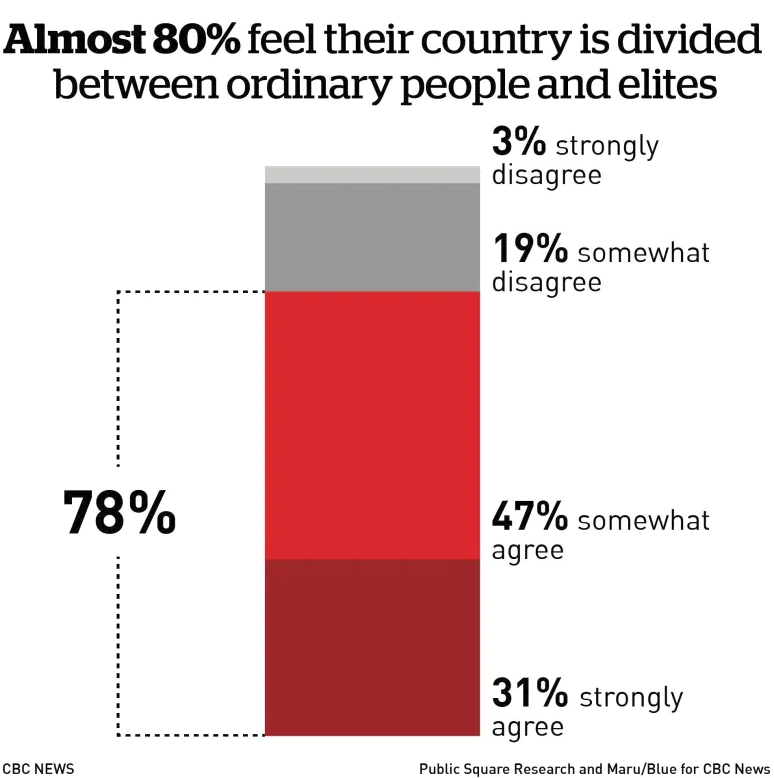
The underlying struggle of our time — the “physicals” versus the “virtuals”
Kim du Toit linked to this post by N.S. Lyons at The Upheaval, which postulates that the real issue in western society is really a conflict between the laptop class and the working class:
… I noted how from the perspective of those with the most wealth and power, as well as the technocratic managers and the intelligentsia (our “priestly class, keepers of the Gnosis [Knowledge]”), digital technology and global networks seem to have created “an unprecedented opportunity for Theory to wrest control from recalcitrant nature, for liquid narrative to triumph over mundanely static reality, and for all the corrupt traditional bonds of the world to be severed, its atoms reconfigured in a more correct and desirable manner.”
In this mostly subconscious vision of “Luxury Gnosticism“, the “middle and lower classes can then be sold dispossession and disembodiment as liberation, while those as yet ‘essential’ working classes who still cling distastefully to the physical world can mostly be ignored until the day they can be successfully automated out of existence.”
I also quoted a passage from the late Christopher Lasch’s book The Revolt of the Elites that is worth repeating here:
The thinking classes are fatally removed from the physical side of life… Their only relation to productive labor is that of consumers. They have no experience of making anything substantial or enduring. They live in a world of abstractions and images, a simulated world that consists of computerized models of reality – “hyperreality”, as it’s been called – as distinguished from the palatable, immediate, physical reality inhabited by ordinary men and women. Their belief in “social construction of reality” – the central dogma of postmodernist thought – reflects the experience of living in an artificial environment from which everything that resists human control (unavoidably, everything familiar and reassuring as well) has been rigorously excluded. Control has become their obsession. In their drive to insulate themselves against risk and contingency – against the unpredictable hazards that afflict human life – the thinking classes have seceded not just from the common world around them but from reality itself.
So let’s consider this using the protests as a lens, and vice versa.
To simplify, let’s first identify and categorize two classes of people in society, who we could say tend to navigate and interact with the world in fundamentally different ways.
The first is a class that has been a part of human civilization for a really long time. These are the people who work primarily in the real, physical world. Maybe they work directly with their hands, like a carpenter, or a mechanic, or a farmer. Or maybe they are only a step away: they own or manage a business where they organize and direct employees who work with their hands, and buy or sell or move things around in the real world. Like a transport logistics company, maybe. This class necessarily works in a physical location, or they own or operate physical assets that are central to their trade.
The second class is different. It is, relatively speaking, a new civilizational innovation (at least in numbering more than a handful of people). This group is the “thinking classes” Lasch was writing about above. They don’t interact much with the physical world directly; they are handlers of knowledge. They work with information, which might be digital or analog, numerical or narrative. But in all cases it exists at a level of abstraction from the real world. Manipulation and distribution of this information can influence the real world, but only through informational chains that pass directives to agents that can themselves act in the physical world – a bit like a software program that sends commands to a robot arm on an assembly line. To facilitate this, they build and manage abstract institutions and systems of organizational communication as a means of control. Individuals in this class usually occupy middle links in these informational chains, in which neither the inputs nor outputs of their role has any direct relationship with or impact on the physical world. They are informational middlemen. This class can therefore do their job almost entirely from a laptop, by email or a virtual Zoom meeting, and has recently realized they don’t even need to be sitting in an office cubicle while they do it.
For our purposes here, let’s call these two classes the Physicals and the Virtuals, respectively.
December 7, 2021
QotD: The decline of class distinctions in Britain
This war, unless we are defeated, will wipe out most of the existing class privileges. There are every day fewer people who wish them to continue. Nor need we fear that as the pattern changes life in England will lose its peculiar flavour. The new red cities of Greater London are crude enough, but these things are only the rash that accompanies a change. In whatever shape England emerges from the war it will be deeply tinged with the characteristics that I have spoken of earlier. The intellectuals who hope to see it Russianized or Germanized will be disappointed. The gentleness, the hypocrisy, the thoughtlessness, the reverence for law and the hatred of uniforms will remain, along with the suet puddings and the misty skies. It needs some very great disaster, such as prolonged subjugation by a foreign enemy, to destroy a national culture. The Stock Exchange will be pulled down, the horse plough will give way to the tractor, the country houses will be turned into children’s holiday camps, the Eton and Harrow match will be forgotten, but England will still be England, an everlasting animal stretching into the future and the past, and, like all living things, having the power to change out of recognition and yet remain the same.
George Orwell, “The Lion And The Unicorn: Socialism and the English Genius”, 1941-02-19.
November 13, 2021
The unrealistic expectations society has of minimum-wage security guards
As a teenager, I worked several months as a security guard. In the 1970s in Ontario, to work as a security guard you basically needed to be physically fit (to a not-very-high standard), to pass a police background check and to be 18 or over. The jobs I worked were usually overnight shifts at upscale apartment buildings, industrial facilities and fill-in shifts at retail malls to cover for regular security staff vacations (plus one really interesting midnight shift on a ship docked in Toronto harbour). I think I was paid $3 per hour, and 99% of the time the work wasn’t worth any more than that. It’s that 1% of situations where the company hiring security guards might wish they’d invested in better-trained staff. According to Joshua Hind‘s article in The Line, the standards for security guards have been improved in the many years since my time, but that 1% is still a big issue:

While some of the best minds in the field of crowd management and event safety weigh in on the probable causes of the crowd surge, a new article in Rolling Stone has turned a spotlight on the security guards, and the culpability of private security in general, a high turnover, low-wage business focused on filling orders with warm bodies, seemingly regardless of their actual experience or competency. In Canada, security work is one of the easiest routes to employment for young people and particularly recent immigrants with little Canadian work experience, but, when it comes to live events, it’s also an often impossible mix of customer support, crowd management, law enforcement, and emergency medical services that requires years of training and on-the-ground experience to do well.
The apparent failures of this type of security, which is often referred to as “contract security” (not be confused with “private security”, which usually means expensive bodyguards), are not unique to Houston. I’ve been working in large public events for more than 20 years and contract security has always been one of the great planning dilemmas. If you want to get insured, you need lots of security, but every one of those guards must be treated as part asset and part liability.
Event sites, especially festivals with multiple stages, are expansive (the site in Houston was over 1,000,000 square feet in total space), and a well-designed event site, just like a well-designed building, needs plenty of entrances and exits, each of which must be adequately staffed. Guards are needed in front of the stage, in the crowd, at backstage access points, and around critical infrastructure. On top of all that you also need a team of roving guards to patrol the site looking for issues. Add it up and a large event site could have dozens or hundreds of security guards doing a variety of jobs, all of which fall under the catch-all description of “security”. On a big summer weekend at the height of event season, a large city like Toronto might have thousands of guards working dozens of sites. How do you find that many good people who can bear the responsibility of preserving public safety? Generally, you don’t.
It only requires a two-week commitment and a little patience to become a security guard in Ontario. So long as you have a clean criminal record, you can sign up for the required training: 40 hours on law and security, plus another 30-40 hours of first aid. This training is often performed by the very companies that do the hiring, which can greatly affect priorities in accurate skills testing. Hit all those marks and mere weeks after deciding to become a security guard you could be faced with a horde of concertgoers busting through the fence you’ve just been ordered to protect.
When I started in live events, it was all on the technical side, setting up lighting, sound and stages, and I didn’t pay much attention to what happened on the other side of the crowd barrier. About 15 years ago I started working on Nuit Blanche, Toronto’s overnight outdoor art event, and it was during those long nights watching hundreds of thousands and then millions of people that I developed a sense of how they act in large groups and how unpredictable they can be. This isn’t meant to sound like a superpower, it’s just a honed instinct. It took me well over a decade of steady work and constant observation to develop some ability to sense when a crowd might turn ugly. That experience can’t be replicated with two weeks of training, but that’s exactly what’s often expected of security guards.
October 7, 2021
QotD: Music as a career choice
James Lileks, The Bleat, 2005-06-03.
September 30, 2021
Petrol shortages in the UK
I’ve seen several reports on the somewhat sudden rash of petrol (gasoline to US/Canadian readers) shortages in Britain, and most of those reports airily pin the blame for the situation on Brexit. To the media, Brexit seems to be an all-purpose explanation for anything that goes wrong (in the same way that previous administrations get the blame for current problems even many years after they left power). Sean Gabb says that despite the frequent glib blaming of Brexit, in this case it is part of the reason:
There is in the United Kingdom a shortage of lorry drivers. This means a dislocation of much economic activity. Because it cannot be delivered, there is no petrol in the filling stations. Because there are not enough drivers, and a shortage of fuel, we may soon have shortages of food in the shops. Christmas this year may not involve its usual material abundance.
These difficulties are wholly an effect of the new political economy that has emerged in England and in many other Western countries since about 1980. An army of managers, of agents, of administrators, of consultants and advisers and trainers, and of other middle class parasites has appropriated a growing share of the national income. This has happened with at least the active connivance of the rich and the powerful. Since, in the short term, the distribution of the national income is a zero-sum game, the necessary result is low and falling real wages for those who actually produce. So long as the productive classes can be kept up by immigration from countries where even lower wages are on offer, the system will remain stable. Because leaving the European Union has reduced the supply of cheap labour, the system is no longer stable in England.
There are two obvious solutions. The first is to rearrange the distribution of income, to make the productive classes more able and more willing to produce. Since this would mean reducing the numbers or incomes or both of the parasite classes, the second is the solution we mostly read about in the newspapers. This is to restore the flow of cheap foreign labour.
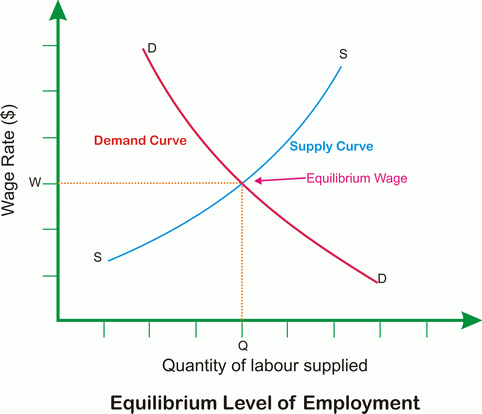
In summary, that is my explanation of what is happening. For those who are interested, I will now explain at greater length. According to the mainstream theory of wages, labour is a commodity. Though workers are human beings, the labour they supply to employers is of the same general nature as machine tools and copper wire and cash registers and whatever else is bought and sold in the markets for producer goods. A wage therefore is a price, and we can illustrate the formation of wage rates with the same supply and demand diagrams as we use for illustrating the formation of prices:
The supply curve slopes upwards because most work is a nuisance. Every hour of labour supplied is an hour that cannot be spent doing something more enjoyable. Beyond a certain level, workers can only be persuaded to supply more labour if more money is offered for each additional hour of labour. As with other producer goods, the shape of the demand curve is determined both by the price of what labour can be used to produce and by the law of diminishing returns.
[…]
Our problem in England is that large areas of economic activity have been rigged. There is an immensely large state sector, paid for by taxes on the productive. Most formally private activity is engrossed by large organisations that are able to be so large either because of limited liability laws or by regulations that only large organisations can obey. The result is that wages are often determined less by market forces than by administrative choice. In this kind of rigged market, we cannot explain the distribution of income as a matter of continual choice between marginal increments of competing inputs until the whole has been distributed. It may be better to look at a modified wages fund theory. A large organisation has a pot of money left over from the sale of whatever its product may be, minus payments to outside suppliers, and minus whatever the directors choose to classify as profit. This is then distributed according to the free choice of the directors, or how hard they can be pushed. Or we can keep the mainstream cross-diagrams, but accept that the demand curve is determined less by marginal productivity than by the overall prejudices of those in charge.
Therefore the growth of a large and unproductive middle class, and the screwing down of all other wages to pay for this. This is not inevitable in rigged markets, but is possible. It has come about since the 1980s for three reasons:
First, the otherwise unemployable products of an expanded higher education sector have used all possible means to get nice jobs for themselves and their friends;
Second, the rich and the powerful have accommodated this because higher wages and greater security for the productive might encourage them to become as assertive as they were before the 1980s;
Third, that these rich and powerful see the parasite classes as a useful transmitter of their own political and moral prejudices.
August 21, 2021
QotD: Why do government workers need unions?
Sure, we can understand this if she’s working for the bastard capitalists. They merely want to maximise their profit and screw the workers while doing so – as we all know. But government is omniscient, omnipresent and omnibenevolent. It cannot be true that someone working for government is in need of protection from government. Because all those fine folks that make up government simply could not allow it to be that state workers don’t gain adequate wages.
Seriously, come on, this is the Progressive insistence. That getting government to do things saves us from the ravages we endure if the capitalists do them.
But now survey the actual American workplace. Unions in the private sector pretty much don’t exist any more. It is the government workforces that are unionised, making up the vast majority of union members in the country. From that pattern of union existence we have to conclude that government screws the workers rather more than the capitalists do. Otherwise why would people desire let alone need the protection of unions when working for government?
Tim Worstall, “The Public Union Proof That The Progressive State Doesn’t Work”, Expunct, 2021-05-11.
August 10, 2021
QotD: Government workplace regulations still envision the unionized 1930s factory as “normal”
Warren Meyer, “When Regulation Hammers Those It is Supposed to Benefit — A Real Example in California”, Coyote Blog, 2021-05-06.
July 19, 2021
Talk is cheap, as a pizza chain CEO demonstrates brilliantly
John Miltimore examines the claims of the CEO of the &pizza chain in the Washington DC area that his stores have no problem getting staff because he pays them a “living wage”:
As far as PR goes, Lastoria gets an A+. He was profiled by Business Insider, CBS News, and other media outlets. His economics grade, however, is another story.
First, the notion that &pizza’s wages are uniquely generous is wrong. The minimum wage in the nation’s capital, after all, is $15.20. Considering that Washington, DC has one of the highest costs of living in the US, it’s not unreasonable to assume that &pizza is paying workers what amounts to the market wage of their labor (i.e. the price they’d get in the absence of a wage floor). This is a stark contrast to other parts of the United States. Fifteen dollars in DC translates to roughly $24 in Florida, $25 in Alabama and Tennessee, $26 in New Mexico, and $27 in Louisiana.
Second, Lastoria decries the alleged “shortage of business owners willing to pay a living wage.” But it should be pointed out that &pizza is one of those businesses.
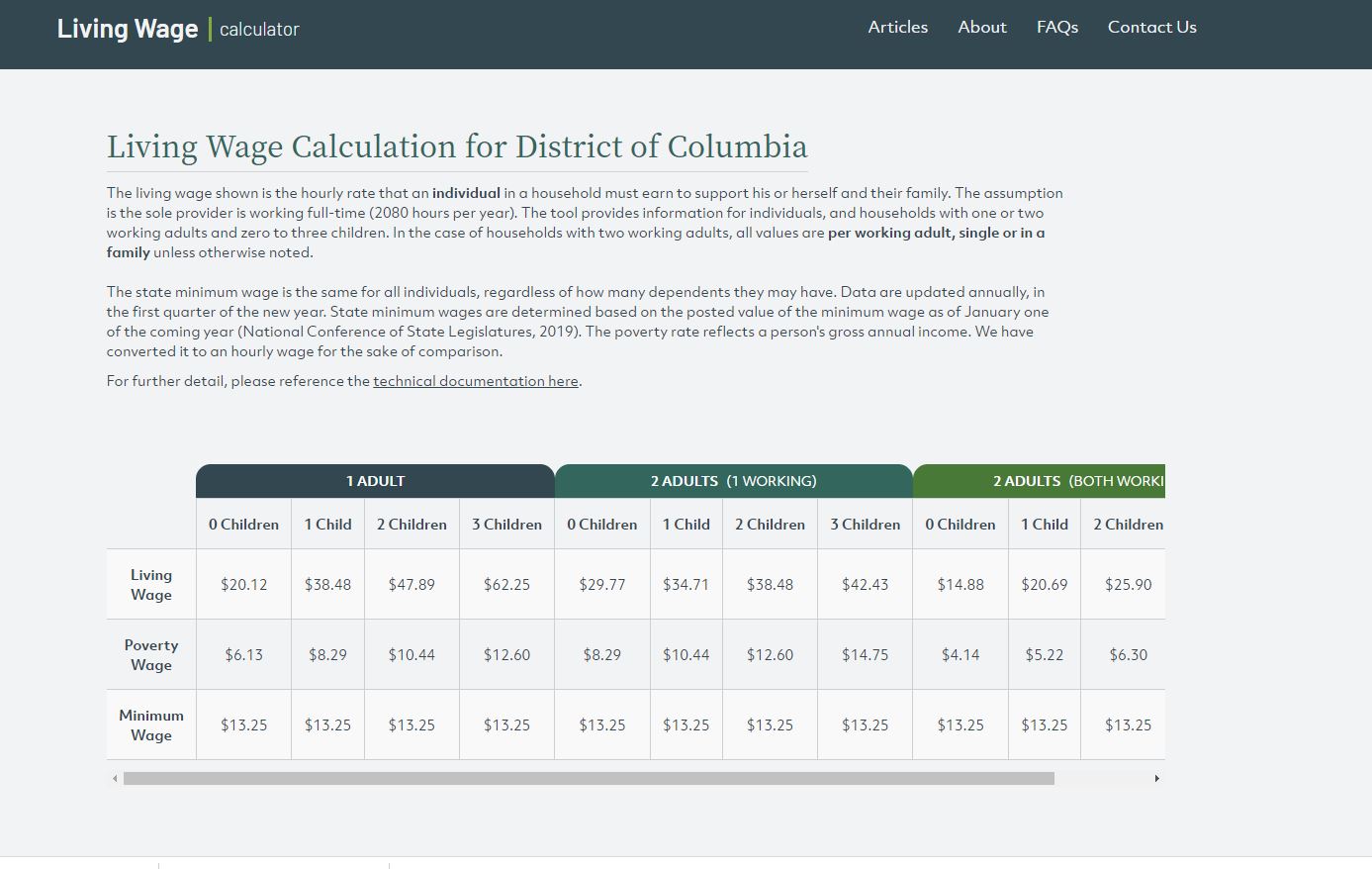
While there is no objective standard to determine what a living wage actually is, MIT has a Living Wage Calculator that allows readers to compute living wages based on the formula created by Dr. Amy K. Glasmeier.
To say that &pizza doesn’t pay its employees a “living wage” is an understatement. The living wage for a single mom with one child is $38.48 in Washington DC. For a single mother with two children, it’s $47.89. Indeed, even for a married couple with just one child, the living wage is $20.69 — nearly $5 an hour more than the average pay of Lastoria’s workers. (It’s unclear why Lastoria is having fewer problems hiring workers than other businesses, but it’s most likely attributable to local factors, such as the fact that he’s servicing nine of the twenty wealthiest counties in America.)
Finally, Lastoria’s claim that higher wages increase productivity enough to improve a company’s bottom line — the efficiency wage hypothesis — has problems logically and empirically. First, it implies that companies not currently paying an efficiency wage are willing to take less profit simply to make workers poorer. Moreover, efficiency wages have been shown to reduce employment, similar to minimum wage laws.
Lastoria might see the $16 an hour average wage as exceedingly generous — especially when he compares it to lower nominal wages paid in other parts of the country — but it’s a far cry from a “living wage”, according to the model used by living wage advocates.
I asked Lastoria how he’d respond to those who say restaurants like his should be required to pay each worker a living wage. He didn’t respond.
May 28, 2021
QotD: Declaring war on college
Stop the thing where high schools refuse to let people graduate until they promise to go to college. End draft deferment for people who go to college — hopefully there won’t be a draft, but do it anyway, as a sign that studying at college isn’t any more important than the many other jobs people do that don’t confer draft exemptions. Make universities no longer tax-exempt — why should institutions serving primarily rich people, providing them with regattas and musical theater, and raking in billions of dollars a year, not have to pay taxes? Make the bill that does this very clearly earmark the extra tax money for things that help working-class people, like infrastructure or vocational schools or whatever.
Scott Alexander, “A Modest Proposal For Republicans: Use The Word ‘Class'”, Astral Codex Ten, 2021-02-26.
April 23, 2021
QotD: Why the British despise the middle class
The aristocracy have always looked down upon the middle class. That gross and inelegant disdain for trade for example. The insistence that actually doing something for a living – even professionally – just isn’t as good as doing nothing off a rent roll.
From the other end we’ve that very bolshie – in the colloquial sense – insistence that the middle class are just parasites upon the toil of the workers. This being what also informs – misinforms – that idea that we’d be better off if we had much more manufacturing. Men in flat caps doing something physical etc.
That is, much of the society dislikes the very existence of the middle class. Actually, more than dislikes, from above they’re – we’re – despised and from below hated to the point that we bourgeoisie should be eliminated as a class.
The surprise that fewer claim to be of that section of the hierarchy than are is thus, well, it’s a surprise, right?
Tim Worstall, “Sociologist Can’t Do Sociology”, Continental Telegraph, 2021-01-19.
April 17, 2021
Considering the costs and benefits of extreme specialization
In the latest post on Matt Gurney’s Code 47 Substack blog, he considers the trade-off between population density and the range of specialization that can be supported at various densities:

“Model A Ford in front of Gilmore’s historic Shell gas station” by Corvair Owner is licensed under CC BY-SA 2.0


I wish I remembered where I read this. It was a book I was blowing through for a university paper; only one chapter was really of interest to me when I was trawling for footnotes but I stumbled upon an interesting section that talked about services and specialization in a modern economy. The author offered a simple explanation of service specialization that I’ve never forgotten. Imagine a village with 100 people, the author said. Now imagine what services are available there. There’s probably a gas station, and maybe you can get a few services done to your car there, too. Basic repairs. Tire rotations. Oil changes. Things like that. There’s probably also a convenience store, and the store might also have a place to send or receive mail, or maybe even to rent a movie. (Back when that was a thing we did.) You might have a coffee shop of some kind, maybe a diner. But that’s marginal. You almost certainly don’t have a school, full post office, bank branch or medical centre of any kind. Not in a village of 100 people.
When you itemize out all the services you can get, it’s probably about five or maybe 10 — gas pumped, tires changed, oil changed, basic engine repairs, store clerk, movie rental, mail sent and received. Maybe someone to pour you a cup of coffee and get you a sandwich — but only maybe. The point isn’t to be precise in our list or count, but just to contemplate the relationship between the population and the number and type of available services.
Now scale that village up 10 fold, the author said. Now it’s a town of 1,000. The number of services explodes. You still have everything you did before. But now you’ve also got specialized shops, restaurants, a bank or two (and all the services they provide), probably a house of worship, medical services of various kinds (including eye care, dentistry, etc), personal-care services, better access to home and lawn care, various repair and maintenance service, technical services, a post office … the list goes on. You also start to see competition and the efficiency that brings — our village of 100 would have a gas station and a convenience store (quite possibly at the same location!). But our town of 1,000 would have a few of each. You’d get more services, and start to see prices dropping for the commonly available offerings.
You get the idea — the more you scale up a population, the more specialized services that are available and the more accessible they become. And this includes not just categories of service, but also increasing degrees of specialization. Our village of 100 probably has no full-time doctor. Our town of 1,000 probably has a family physician. But after we bump things up to 10,000, 100,000 and then a million people, we’re getting not just doctors, but highly trained, specialized physicians, surgeons and diagnosticians. Our town of 1,000 has a dentist, but our city of a million has dental surgeons who’ve specialized in repairing specific kinds of trauma and injury.
Anyway. I don’t remember what book this was from. But I do remember this short section. I think about it a lot. We Canadians of 2021 are, for the most part, hyper-specialized. I’ve written columns about this before, including this one from 2019, which I’m going to quote liberally below:
Human history is, in one simplified viewing, the story of specialization. As our technology advanced, a smaller and smaller share of the labour pool was required just to keep everyone alive. Perhaps the easiest way to summarize this is to note that 150 years ago, even in the most advanced industrial countries, something close to 50 per cent of the population was directly engaged in agriculture — half the people tilled fields so the other half could eat. Today, in both Canada and the United States, it’s closer to two per cent — one person’s efforts feed 49 others. Those 49 can pursue any of the thousands of specialized jobs that allow our technological civilization to exist. … Those 49 people are our artists and doctors and scientists and teachers. Human advancement depends on this — a civilization that’s scrambling to feed itself doesn’t build particle colliders or invent new neonatal surgeries and cancer-stopping wonderdrugs.
I stand by those remarks. But I’ve been pondering them of late with a different perspective. I’ve spent much of this week talking with doctors and medical experts in Ontario, where the third wave of COVID-19 is threatening to overwhelm the health-care system, with tragic results. And one recurring theme that comes up in these conversations is how this disaster is going to take place almost entirely out of public view. There won’t be any general mobilizations or widespread damage. People are going to die, behind closed doors or tent flaps, and other people will be forever scarred by their inability to save those people. But for most of us — those who aren’t sick, or highly specialized medical professionals — life is going to be something reasonably close to normal.


