Quotulatiousness

March 8, 2023

“By fostering intense family loyalties and strong nepotistic urges”, cousin marriage “makes the development of civil society more difficult”

Filed under: Media, Middle East, Military, Politics, USA — Tags: , , , , , , , — Nicholas @ 03:00

Ed West on what he calls the worst western foreign policy disaster since 1204, the Iraq quagmire:

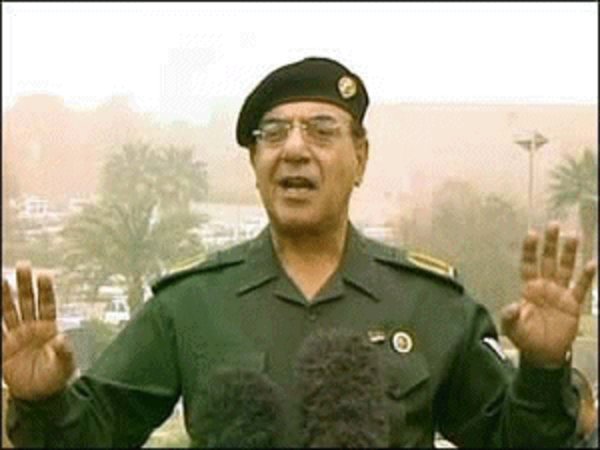
Mohammed Saeed al-Sahhaf, better known in the West as “Baghdad Bob” or “Comical Ali”, Iraqi Minister of Information for President Saddam Hussein.

This month marks the 20th anniversary of the greatest western foreign policy disaster since the Fourth Crusade. It was the pre-eminent modern-day example of folly, driven by wishful thinking, utopianism and a lack of interest in history and how human societies differ. This was mostly carried out by good people, including our own Tony Blair, and promoted by thoughtful and humanitarian commentators who thought they were making the world a better place.

The White House regime which brought chaos and misery to Iraq were most of all entranced by The Weekly Standard, the now-defunct magazine most associated with neoconservative foreign policy. Had any of them read The American Conservative instead, they might have avoided the whole tragedy. In particular they ought have read Steve Sailer’s “The Cousin Marriage Conundrum“, printed in the run-up to the invasion and in which the author made a seemingly curious argument for why nation-building in Iraq would fail — its high rates of cousin marriage.

Pointing out that between 46 and 53 percent of Iraqis who married did so to first or second cousins, Sailer wrote that: “By fostering intense family loyalties and strong nepotistic urges”, cousin marriage “makes the development of civil society more difficult”. The neocon dream of jumpstarting democracy was therefore clearly doomed to failure.

Even those with a cursory knowledge of the country knew that Iraq was split between Sunni and Shia Arabs, as well as Kurds in the north, each group’s area of dominance roughly corresponding to three former Ottoman provinces. However, these were further subdivided into “smaller tribes, clans, and inbred extended families — each with their own alliances, rivals, and feuds”, in total about 150 tribes comprising some 2,000 clans.

Saddam’s politics were mired in blood, in both senses. He came from the al-Bu Nasir, a tribe comprising some 25,000 people based in the town of Tikrit, and his regime was filled with his relatives. His political career had begun in 1957 when the 20-year-old had joined the revolutionary Ba’ath (“Resurrection”) Party, following his uncle Kharaillah Tulfha, who had fought against the British in the Second World War. Tulfha would become his father-in-law, for Saddam also married his first cousin, although he later took a second wife. Family life wasn’t entirely harmonious, and the man who introduced that couple, Saddam’s food taster, was later stabbed to death by the dictator’s psychotic eldest son Uday at a party thrown by Egyptian president Hosni Mubarak.

The unfortunate food taster was an Assyrian Christian, and within Saddam’s regime religious minorities could rise high, as is often the case in empires, because they presented no threat. His foreign minister, Tariq Aziz, was also a Christian, his birth name being Mikhail Yuhanna.

The family was everything in Saddam’s Iraq. Mark Weiner wrote in The Rule of the Clan of countries governed by “clannism” that: “These societies possess the outward trappings of a modern state but are founded on informal patronage networks, especially those of kinship, and traditional ideals of patriarchal family authority. In nations pervaded by clannism, government is co-opted for purely factional purposes.” The inevitable result of clannism is kin-based corruption whereby resources, positions and other rewards are monopolised by family groups. In these societies, Weiner wrote, “the nuclear family, with its revolutionary, individuating power, has yet to replace the extended lineage group as the principle framework for kinship or household organisation”.

The Weekly Standard was called the in-flight magazine of Air Force One, but presumably there weren’t that many White House staffers reading the American Conservative at the time, a publication started by Pat Buchanan, the great Republican critic of neocon foreign policy. So the Coalition blundered into a disastrous invasion that cost hundreds of thousands of lives, wrecking Iraq and leaving many areas newly-divided along sectarian lines, while minorities like the Christians and Mandaeans were driven almost to extinction.

January 24, 2023

The Byzantine Empire: Part 9 – The Last Centuries

seangabb
Published 30 Dec 2022

In this, the ninth in the series, Sean Gabb gives an overview of the last years of Byzantium, from the Crusader sack in 1204 to the Turkish capture in 1453.

Between 330 AD and 1453, Constantinople (modern Istanbul) was the capital of the Roman Empire, otherwise known as the Later Roman Empire, the Eastern Roman Empire, the Mediaeval Roman Empire, or the Byzantine Empire. For most of this time, it was the largest and richest city in Christendom. The territories of which it was the central capital enjoyed better protections of life, liberty and property, and a higher standard of living, than any other Christian territory, and usually compared favourably with the neighbouring and rival Islamic empires.
(more…)

January 2, 2023

How much of the media coverage of the Bosnian War was fake news?

Filed under: Cancon, Media, Military — Tags: , , , , , , , , — Nicholas @ 03:00

Kate at Small Dead Animals linked to this rather disturbing collection of intelligence cables from the Canadian peacekeeping force in Bosnia to NDHQ in Ottawa during the conflict, which contradicts the media narrative of the time:

Map of deployment of National Battalions in UN Forces in Croatia and Bosnia and Herzegovina – Early 1993 (Balkan Battlegrounds Map I)
Balkan Battlegrounds: A Military History of the Yugoslav Conflict, 1990-1995 author credit: Central Intelligence Agency.

A trove of intelligence files sent by Canadian peacekeepers expose CIA black ops, illegal weapon shipments, imported jihadist fighters, potential false flags, and stage-managed atrocities.

The established mythos of the Bosnian War is that Serb separatists, encouraged and directed by Slobodan Milošević and his acolytes in Belgrade, sought to forcibly seize Croat and Bosniak territory in service of creating an irredentist “Greater Serbia”. Every step of the way, they purged indigenous Muslims in a concerted, deliberate genocide, while refusing to engage in constructive peace talks.

This narrative was aggressively perpetuated by the mainstream media at the time, and further legitimized by the UN-created International Criminal Tribunal for the former Yugoslavia (ICTY) once the conflict ended. It has become axiomatic and unquestionable in Western consciousness ever since, enforcing the sense that negotiation invariably amounts to appeasement, a mentality that has enabled NATO war hawks to justify multiple military interventions over subsequent years.

However, a vast trove of intelligence cables sent by Canadian peacekeeping troops in Bosnia to Ottawa’s National Defence Headquarters, first published by Canada Declassified at the start of 2022, exposes this narrative as cynical farce.

The documents offer an unparalleled, first-hand, real-time view of the war as it developed, with the prospect of peace rapidly degrading into grinding bloodshed that ultimately caused the painful death of the multi-faith, multi-ethnic Yugoslavia.

The Canadian soldiers were part of a wider UN Protection Force (UNPROFOR) dispatched to former Yugoslavia in 1992, in the vain hope tensions wouldn’t escalate to all-out-war, and an amicable settlement could be reached by all sides. They stayed until the bitter end, long past the point their mission was reduced to miserable, life-threatening failure.

The peacekeepers’ increasingly bleak analysis of the reality on the ground provides a candid perspective of the war’s history that has been largely concealed from the public. It is a story of CIA black ops, literally explosive provocations, illegal weapon shipments, imported jihadist fighters, potential false flags, and stage-managed atrocities.

Read the complete Canadian UNPROFOR cables here.

See key excerpts of the files referred to in this article here.

December 10, 2022

The “Dark” Ages were fine, actually — History Hijinks

Overly Sarcastic Productions
Published 5 Aug 2022

Curb your Crusading – the artwork, literature, and scholarship are far more interesting.

SOURCES & Further Reading: China: A History by John Keay, Byzantium & Sicily & Venice by John Julius Norwich, Great Courses Lecture series Foundations of Western Civilization by Thomas F. X. Noble lectures 27 through 38: “The Emergence of the Catholic Church”, “Christian Culture in Late Antiquity”, “Muhammad and Islam”, “The Birth of Byzantium”, “Barbarian Kingdoms in the West”, “The World of Charlemagne”, “The Carolingian Renaissance”, “The Expansion of Europe”, “The Chivalrous Society”, “Medieval Political Traditions I”, “Medieval Political Traditions II”, and “Scholastic Culture”.
(more…)

November 5, 2022

The Byzantine Empire: Part 8 – The Breakdown, 1025-1204

seangabb
Published 20 May 2022

In this, the eighth video in the series, Sean Gabb explains how, having acquired the wrong sort of ruling class, the Byzantine Empire passed in just under half a century from the hegemonic power of the Near East to a declining hulk, fought over by Turks and Crusaders.

Subjects covered include:

The damage caused by a landed nobility
The deadweight cost of uncontrolled bureaucracy
The first rise of an insatiable and all-conquering West
The failure of the Andronicus Reaction
The sack of Constantinople in 1204

Between 330 AD and 1453, Constantinople (modern Istanbul) was the capital of the Roman Empire, otherwise known as the Later Roman Empire, the Eastern Roman Empire, the Mediaeval Roman Empire, or The Byzantine Empire. For most of this time, it was the largest and richest city in Christendom. The territories of which it was the central capital enjoyed better protections of life, liberty and property, and a higher standard of living, than any other Christian territory, and usually compared favourably with the neighbouring and rival Islamic empires.

The purpose of this course is to give an overview of Byzantine history, from the refoundation of the City by Constantine the Great to its final capture by the Turks.

Here is a series of lectures given by Sean Gabb in late 2021, in which he discusses and tries to explain the history of Byzantium. For reasons of politeness and data protection, all student contributions have been removed.
(more…)

October 28, 2022

The Byzantine Empire: Part 7 – Recovery and Return to Hegemony, 717-1025 AD

seangabb
Published 2 May 2022

In this, the seventh video in the series, Sean Gabb explains how, following the disaster of the seventh century, the Byzantine Empire not only survived, but even recovered its old position as hegemonic power in the Eastern Mediterranean. It also supervised a missionary outreach that spread Orthodox Christianity and civilisation to within reach of the Arctic Circle.

Subjects covered:

The legitimacy of the words “Byzantine” and “Byzantium”
The reign of the Empress Irene and its central importance to recovery
The recovery of the West and the Rise of the Franks
Charlemagne and the Holy Roman Empire
The Conversion of the Russians – St Vladimir or Vladimir the Damned?
The reign of Basil II

Between 330 AD and 1453, Constantinople (modern Istanbul) was the capital of the Roman Empire, otherwise known as the Later Roman Empire, the Eastern Roman Empire, the Mediaeval Roman Empire, or The Byzantine Empire. For most of this time, it was the largest and richest city in Christendom. The territories of which it was the central capital enjoyed better protections of life, liberty and property, and a higher standard of living, than any other Christian territory, and usually compared favourably with the neighbouring and rival Islamic empires.
(more…)

October 25, 2022

The Byzantine Empire: Part 6 – Weathering the Storm, 628-717 AD

Filed under: Europe, History, Middle East, Religion — Tags: , , , , , , — Nicholas @ 04:00

seangabb
Published 16 Feb 2022

In this, the sixth video in the series, Sean Gabb discusses the impact on the Byzantine Empire of the Islamic expansion of the seventh century. It begins with an overview of the Empire at the end of the great war with Persia, passes through the first use of Greek Fire, and ends with a consideration of the radically different Byzantine Empire of the Middle Ages.

Between 330 AD and 1453, Constantinople (modern Istanbul) was the capital of the Roman Empire, otherwise known as the Later Roman Empire, the Eastern Roman Empire, the Mediaeval Roman Empire, or the Byzantine Empire. For most of this time, it was the largest and richest city in Christendom. The territories of which it was the central capital enjoyed better protections of life, liberty and property, and a higher standard of living, than any other Christian territory, and usually compared favourably with the neighbouring and rival Islamic empires.

The purpose of this course is to give an overview of Byzantine history, from the refoundation of the City by Constantine the Great to its final capture by the Turks.

Here is a series of lectures given by Sean Gabb in late 2021, in which he discusses and tries to explain the history of Byzantium. For reasons of politeness and data protection, all student contributions have been removed.
(more…)

October 18, 2022

The War That Ended the Ancient World

toldinstone
Published 10 Jun 2022

In the early seventh century, a generation-long war exhausted and virtually destroyed the Roman Empire. This video explores that conflict through the lens of an Armenian cathedral built to celebrate the Roman victory.
(more…)

October 14, 2022

That time that H.G. Wells fell afoul of Muslim sentiments

Filed under: Books, Britain, History, India, Religion — Tags: , , , , — Nicholas @ 05:00

In the New English Review, Esmerelda Weatherwax recounts an incident from the 1930s where Muslim protestors took to the streets of London in reaction to a recent Hindustani translation of H.G. Wells’ A Short History of the World:

Screen capture of the 1938 Muslim protest march in London from a British Pathé newsreel – https://www.youtube.com/watch?v=ADausiEe4pM

… my husband was at the Museum of London and spotted a very brief mention of this protest in 1938 on a list of 20th century London events. I did some research.

The book they objected to was HG Wells’ A Short History of the World. This was originally published in 1922 but in 1938 an abridged version was tranlated into Hindustani and published in India. His observations about the Prophet Mohammed did not find favour with Indian Muslims (and as you know pre-partition the area called India covered what is now Pakistan and Bangladesh). There were protest meetings in Calcutta and Mumbai (then transliterated as Bombay) and the consignments of the books that WH Smith the booksellers sent to Hyderabad mysteriously never arrived. Investigation showed that the Sind government banned its import. Protests spread to east Africa and were reported in Nairobi and Mombasa.

The paragraphs concerned said “He seems to have been a man compounded of very considerable vanity, greed, cunning, self-deception, and quite sincere religious passion”. Wells concludes, not unfavourably, that “when the manifest defects of Muhammad’s life and writing have been allowed for, there remains in Islam, this faith he imposed upon the Arabs, much power and inspiration”.

There had been a number of Muslims living in east London for some years, sailors who came through the docks, retired servants, some professional men and in 1934 they formed a charitable association for the promotion of Islam called Jamiat-ul-Muslimin; they met on Fridays at a hall in Commercial Road.

On Friday 12th August 1938 a copy of A Short History of the World was, as apparently reported in the Manchester Guardian the following day “ceremoniously burned”. The main Nazi book burnings were over 5 years previously but I can’t but be reminded of them. I can’t access the Guardian on-line archive for 1938 as I don’t have a subscription, but I have no reason to doubt what they reported.

A few days later Dr Mohammed Buksh of Jamiat-ul-Muslimin attended upon Sir Feroz Khan Noon, the high commissioner for India. Sir Feroz tried to explain that in Britain we could (or could then) freely criticise Christianity, the Royal family and government as a right. He reminded Dr Buksh that Muslims were “a very small minority in England, and it would do them no good to try and be mischievous in this country, no matter how genuine their grievances were”.

September 29, 2022

The Byzantine Empire: Part 5 – The Death of Roman Byzantium, 568-628 AD

Filed under: Europe, History, Italy, Middle East, Religion — Tags: , , , , , , — Nicholas @ 04:00

seangabb
Published 21 Jan 2022

In this, the fifth lecture in the series, Sean Gabb discusses the progressive collapse of Byzantium between the middle years of Justinian and the unexpected but sterile victory over the Persian Empire.

Between 330 AD and 1453, Constantinople (modern Istanbul) was the capital of the Roman Empire, otherwise known as the Later Roman Empire, the Eastern Roman Empire, the Mediaeval Roman Empire, or the Byzantine Empire. For most of this time, it was the largest and richest city in Christendom. The territories of which it was the central capital enjoyed better protections of life, liberty and property, and a higher standard of living, than any other Christian territory, and usually compared favourably with the neighbouring and rival Islamic empires.

The purpose of this course is to give an overview of Byzantine history, from the refoundation of the City by Constantine the Great to its final capture by the Turks.

Here is a series of lectures given by Sean Gabb in late 2021, in which he discusses and tries to explain the history of Byzantium. For reasons of politeness and data protection, all student contributions have been removed.
(more…)

September 19, 2022

City Minutes: Crusader States

Overly Sarcastic Productions
Published 13 May 2022

Crusading is one thing, but holding your new kingdoms is a much trickier business. See how the many Christian states of “Outremer” rolled with the punches to evolve in form and function over multiple centuries.
(more…)

August 25, 2022

Barbarian Europe: Part 8 – The Franks

Filed under: Europe, France, History — Tags: , , , , , , , — Nicholas @ 04:00

seangabb
Published 1 Sep 2021

In 400 AD, the Roman Empire covered roughly the same area as it had in 100 AD. By 500 AD, all the Western provinces of the Empire had been overrun by barbarians. Between April and July 2021, Sean Gabb explored this transformation with his students. Here is one of his lectures. All student contributions have been removed.
(more…)

August 20, 2022

QotD: The improbable survival of the Byzantine empire

The [Eastern Roman] Empire was faced by a triple threat to its existence. There were the northern barbarians. There was militant Islam in the south. There was an internal collapse of population. Each of these had been brought on by changes in the climate that no one at the time could have understood had they been noticed. It would not be until after 800 that the climate would turn benign again. In the meantime, any state to which even a shadow of Lecky’s dismissal applied would have crumpled in six months. Only the most courageous and determined action, only the most radical changes of its structure, could save the Empire. And saved the Empire most definitely was.

The reason for this is that the Mediaeval Roman State was directed by creative pragmatists. Look for one moment beneath its glittering surface, and the Ancient Roman Empire was a ghastly place for most of the people who lived in it. The Emperors at the top were often vicious incompetents. They ruled through an immense and parasitic bureaucracy. They were supreme governors of an army too large to be controlled. They protected a landed aristocracy that was a repository of culture, but that was ruthless in its exaction of rent. Most ordinary people were disarmed tax-slaves, where not chattel slaves or serfs.

The contemporary historians themselves are disappointingly vague about the seventh and eighth centuries. Our only evidence for what happened comes from the description of established facts in the tenth century. As early as the seventh century, though, the Mediaeval Roman State pulled off the miracle of reforming itself internally while fighting a war of survival on every frontier. Much of the bureaucracy was shut down. Taxes were cut. The silver coinage was stabilised. Above all, the senatorial estates were broken up and given to those who worked on them, in return for service in local militias. Though never abolished, chattel slavery became far less pervasive. The civil law was simplified, and the criminal law humanised – after the seventh century, as said, the death penalty was rarely used.

The Mediaeval Roman Empire survived because of a revolutionary transformation in which ordinary people became armed stakeholders. The inhabitants of Roman Gaul and Italy and Spain barely looked up from their ploughs as the Barbarians swirled round them. The citizens of Mediaeval Rome fought like tigers in defence of their country and their Orthodox faith. Time and again, the armies of the Caliph smashed against a wall of armed freeholders. This was a transformation pushed through in a century and a half of recurrent crises during which Constantinople itself was repeatedly under siege. Alone among the ancient empires in its path, Mediaeval Rome faced down the Arabs, and kept Islam at bay for nearly five centuries. Would it be superfluous to say that no one does this by accident?

Sean Gabb, “The Mediaeval Roman Empire: An Unlikely Emergence and Survival”, SeanGabb.co.uk, 2018-09-14.

June 3, 2022

The Crusades: Part 10 – The End of the Crusader Kingdoms

Filed under: Europe, History, Military, Religion — Tags: , , , , , , , — Nicholas @ 04:00

seangabb
Published 27 Mar 2021

The Crusades are the defining event of the Middle Ages. They brought the very different civilisations of Western Europe, Byzantium and Islam into an extended period of both conflict and peaceful co-existence. Between January and March 2021, Sean Gabb explored this long encounter with his students. Here is one of his lectures. All student contributions have been removed.
(more…)

May 20, 2022

The Crusades: Part 7 – The Third Crusade

seangabb
Published 5 Mar 2021

The Crusades are the defining event of the Middle Ages. They brought the very different civilisations of Western Europe, Byzantium and Islam into an extended period of both conflict and peaceful co-existence. Between January and March 2021, Sean Gabb explored this long encounter with his students. Here is one of his lectures. All student contributions have been removed.
(more…)

« Newer PostsOlder Posts »

Powered by WordPress