
British Pathé
Published 12 Nov 2020GAUMONT BRITISH NEWSREEL (REUTERS)
Comprehensive documentary of the Royal Navy in the lead up to war
Full Description:
SLATE INFORMATION: Britain’s Navy Ready for Any Challenge, The Combined Fleets Filmed by Gaumont-British News
Comprehensive documentary of the British fleet and their preparedness for action including shots of numerous ships at sea and at anchor, sailors on deck, aircraft on deck, ship’s guns, officers in quarters, destroyers, aircraft flying off deck and landing on water
Archive: Reuters
Archive managed by: British Pathé
September 18, 2025
“The British fleet is strong and at the ready” (1939)
Comments Off on “The British fleet is strong and at the ready” (1939)
September 9, 2025
MG38: Colt’s Interwar Water-Cooled Machine Gun
Forgotten Weapons
Published 7 May 2025After World War One, Colt was the sole owner of license to produce Browning machine guns. With production tooling well established from the war, the company set about looking for international sales. The water cooled .30 caliber (the M1917 in US service, essentially) was designated the Model 1919 Automatic Machine Gun. In 1931, it was renamed the MG38, although basically the same gun as in 1919. It had a few distinctions from the US military pattern, including:
- Manual safety on the backplate
- Self-contained recoil spring
- Large water fill and drain fittings, identical to the ones used on Colt’s .50 caliber guns
- Slightly different top cover latch
Colt offered the guns with lots of options and features, including a variety of calibers (basically any modern rifle cartridge of the time), flash hiders, lightened anti-aircraft bolts, and spade grips (guns sold with spade grips were designated MG38B). From 1919 until commercial production ceased in January 1942, Colt had sold 2,720 water-cooled Brownings in total. Most went to South America in 7.65mm, with Argentina being the single biggest buyer.
Full video on the Browning M1917:
• Browning M1917: America’s World War O…
(more…)
Comments Off on MG38: Colt’s Interwar Water-Cooled Machine Gun
September 4, 2025
QotD: The development of the “halftrack” during the interwar period
The period between WWI and WWII – the “interwar” period – was a period of broad experimentation with tank design and so by the time we get to WWII there are a number of sub-groupings of tanks. Tanks could be defined by weight or by function. The main issue in both cases was the essential tradeoff between speed, firepower and armor: the heavier you made the armor and the gun the heavier and thus slower the tank was. The British thus divided their tank designs between “cruiser tanks” which were faster but lighter and intended to replace cavalry while the “infantry tanks” were intended to do the role that WWI tanks largely had in supporting infantry advances. Other armies divided their tanks between “light”, “medium”, and “heavy” tanks (along with the often designed but rarely deployed “super heavy” tanks).
What drove the differences in tank development between countries were differences between how each of those countries imagined using their tanks, that is differences in tank doctrine. Now we should be clear here that there were some fundamental commonalities between the major schools of tank thinking: in just about all cases tanks were supposed to support infantry in the offensive by providing armor and direct fire support, including knocking out enemy tanks. Where doctrine differed is exactly how that would be accomplished: France’s doctrine of “Methodical Battle” generally envisaged tanks moving at the speed of mostly foot infantry and being distributed fairly evenly throughout primarily infantry formations. That led to tanks that were fairly slow with limited range but heavily armored, often with just a one-man turret (which was a terrible idea, but the doctrine reasoned you wouldn’t need more in a slow-moving combat environment). Of course this worked poorly in the event.
More successful maneuver warfare doctrines recognized that the tank needed infantry to perform its intended function (it has to have infantry to support) but that tanks could now move fast enough and coordinate well enough (with radios) that any supporting arms like infantry or artillery needed to move a lot faster than walking speed to keep up. Both German “maneuver warfare” (Bewegungskrieg) and Soviet “Deep Operations” (or “Deep Battle”) doctrine saw the value in concentrating their tanks into powerful striking formations that could punch hard and move fast. But tanks alone are very vulnerable and in any event to attack effectively they need things like artillery support or anti-air protection. So it was necessary to find ways to allow those arms to keep up with the tanks (and indeed, a “Panzer divsion” is not only or even mostly made up of tanks!).
At the most basic level, one could simply put the infantry on trucks or other converted unarmored civilian vehicles, making “motorized” infantry, but […] part of the design of tanks is to allow them to go places that conventional civilian vehicles designed for roads cannot and in any event an unarmored truck is a large, vulnerable tempting target on the battlefield.
The result is the steady emergence of what are sometimes jokingly called “battle taxis” – specialized armored vehicles designed to allow the infantry to keep up with the tanks so that they can continue to be mutually supporting, while being more off-road capable and less vulnerable than a truck. In WWII, these sorts of vehicles were often “half-tracks” – semi-armored, open-topped vehicles with tires on the front wheels and tracks for the back wheels, though the British “Universal Carrier” was fully tracked. Crucially, while these half-tracks might mount a heavy machine gun for defense, providing fire support was not their job; being open-topped made them particularly vulnerable to air-bursting shells and while they were less vulnerable to fire than a truck, they weren’t invulnerable by any means. The intended use was to deposit infantry at the edge of the combat area, which they’d then move through on foot, not to drive straight through the fight.
The particular vulnerability of the open-top design led to the emergence of fully-enclosed armored personnel carriers almost immediately after WWII in the form of vehicles like the M75 Armored Infantry Vehicle (though the later M113 APC was eventually to be far more common) and the Soviet BTRs (“Bronetransporter” or “armored transport”), beginning with the BTR-40; Soviet BTRs tended to be wheeled whereas American APCs tend to be tracked, something that also goes for their IFVs (discussed below). These vehicles often look to a journalist or the lay observer like a tank, but they do not function like tanks. The M113 APC, for instance, has just about 1.7 inches of aluminum-alloy armor, compared to the almost four inches of much heavier steel armor on the contemporary M60 “Patton” tank. So while these vehicles are armored, they are not intended to stick in the fight and are vulnerable to much lighter munitions than contemporary tank would be.
At the same time, it wasn’t just the infantry that needed to be able to keep up: these powerful striking units (German Panzer divisions, Soviet mechanized corps or US armored divisions, etc.) needed to be able to also bring their heavy weaponry with them. At the start of WWII, artillery, anti-tank guns and anti-air artillery remained almost entirely “towed” artillery – that is, it was pulled into position by a truck (or frequently in this period still by horses) and emplaced (“unlimbered”) to be fired. Such systems couldn’t really keep up with the tanks they needed to support and so we see those weapons also get mechanized into self-propelled artillery and anti-air (and for some armies, tank destroyers, although the tank eventually usurps this role entirely).
Self-propelled platforms proved to have another advantage that became a lot more important over time: they could fire and then immediately reposition. Whereas a conventional howitzer has to be towed into position, unlimbered, set up, loaded, fired, then limbered again before it can move, something like the M7 Priest can drive itself into position, fire almost immediately and then immediately move. This maneuver, called “shoot-and-scoot” (or, more boringly, “fire-and-displace”) enables artillery to avoid counter-battery fire (when an army tries to shut down enemy artillery by returning fire with its own artillery). As artillery got more accurate and especially with the advent of anti-artillery radars, being able to shoot-and-scoot became essential.
Now while self-propelled platforms were tracked (indeed, often using the same chassis as the tanks they supported), they’re not tanks. They’re designed primarily for indirect fire (there is, of course, a sidebar to be written here on German “assault guns” – Sturmgeschütz – and their awkward place in this typology, but let’s keep it simple), that is firing at a high arc from long range where the shell practically falls on the target and thus are expected to be operating well behind the lines. Consequently, their armor is generally much thinner because they’re not designed to be tanks, but to play the same role that towed artillery (or anti-air, or rocket artillery, etc.) would have, only with more mobility.
So by the end of WWII, we have both tanks of various weight-classes, along with a number of tank-like objects (APCs, self-propelled artillery and anti-air) which are not tanks but are instead meant to allow their various arms to keep up with the tanks as part of a combined arms package.
Bret Devereaux, “Collections: When is a ‘Tank’ Not a Tank?”, A Collection of Unmitigated Pedantry, 2022-05-06.
Comments Off on QotD: The development of the “halftrack” during the interwar period
August 27, 2025
M1922 BAR Cavalry Light Machine Gun
Forgotten Weapons
Published 21 Apr 2025After World War One, there was a lot of tinkering with the BAR by the US military. It was recognized as being a very good platform, but the original M1918 configuration left a lot to be desired. It was deemed too heavy to use effectively from the shoulder, but also not really well suited to sustained fire. In an effort to optimize it for use as a dynamic support weapon by a small squad, the Infantry & Cavalry Board requested a model with a heavier barrel and lightweight bipod in 1920. Six experimental examples were made form existing BARs, and the design was formalized two years later as the Model 1922.
This pattern of BAR has a heavy finned barrel to give it more sustained fire capacity and a folding bipod and rear monopod for more accurate use prone. The Board also experimented with larger magazines, and ended up recommending a 30-round size — although this was never put into production. In total, 500 of the Model 1922 guns were made, all converted from existing BARs. Experimentation continued slowly, and eventually in 1937 a lighter pattern was adopted as the M1918A1. The Model 1922 was formally declared obsolete in April 1941, and virtually all of them were rebuilt to the new M1918A2 pattern for use in World War Two. Surviving examples like this one are extremely rare — this is the only known example in private hands.
(more…)
Comments Off on M1922 BAR Cavalry Light Machine Gun
August 25, 2025
George Orwell’s Down and Out in Paris and London
Down and Out was one of the first Orwell works I read as an adult, having encountered Animal Farm and Nineteen Eighty-Four as school texts. I would not say that I enjoyed the book so much as it gave me a very different view of both cities between the wars and encouraged me to seek out more of Orwell’s work. On his Substack, Rob Henderson considers the book and its author:
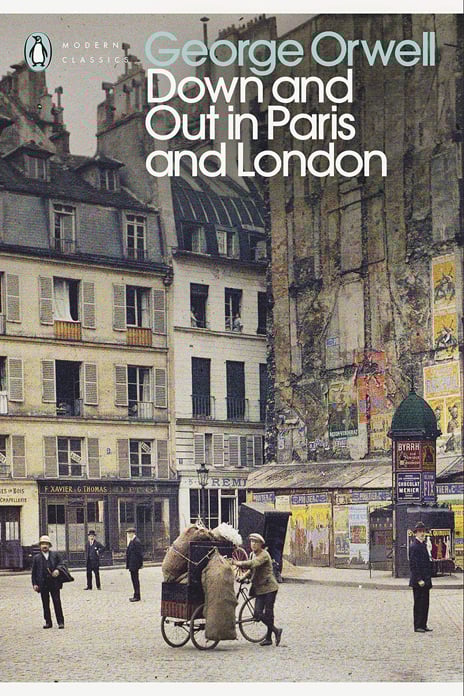
I was in high school the first time I read Down and Out in Paris and London (1933) by George Orwell. A memoir about his time in the slums of France and England.1 Orwell, while in Paris, worked as a plongeur — a person employed to wash dishes and carry out other menial tasks in a restaurant or hotel. Plongeur sounds much better than “bus boy”.
Because, at the time, I was also working as a busboy and dishwasher, I enjoyed Orwell’s description of employment in a busy restaurant. He wrote that the work itself was simple, like sorting a deck of cards, but when done against the clock it became exhausting. That captured exactly how I felt on my Friday and Saturday evening shifts.
Later I was disappointed to learn that Orwell had come from privilege. The guy went to Eton, a prestigious all-boys school. The book recounted his experiences with slum tourism. When he was penniless during the periods described in Down and Out, particularly during his return to London, his well-to-do family could and did take him back in for temporary periods so he could eat well and shower. At first this made the story feel less authentic.
Over time, though, I came to see it differently. It took someone like Orwell to write about life in the slums in a way that other educated people would pay attention to. I had to go through something similar. Only after spending time around the upper middle class did I understand how to describe my life in a way that would actually make them pay attention.
[…]
In the second half of Down and Out in Paris and London, Orwell describes living rough in London’s East End, staying in lodging houses and casual wards. He worked alongside the city’s laborers to understand poverty from the inside.
Down and Out in Paris and London was Orwell’s first published book, written when he was in his mid-twenties. It is striking is how little he romanticized the idea of being an impoverished bohemian in world-class cities, the way so many others of his background might have done. Instead, he treated his immersion in the Parisian and London underworlds as an attempt to strip away the prejudices he had inherited as an upper-middle-class Etonian.
The book is restrained in its politics. Orwell rarely pauses for commentary, preferring to tell the story as it happened and saving his more general conclusions for a couple of chapters at the end. This is more or less the same approach I took with Troubled; describe the world as it was, or at least as I remember it, and let the meaning emerge on its own.
One of the strongest features of Down and Out is its focus on the psychological effects of petty humiliations. Orwell describes kitchens where people from every corner of Europe are screaming at each other in different languages, frantically trying to keep pace with the chaos. If you have ever watched one of those Gordon Ramsay shows, you have some idea. He admired the strange order that somehow emerged from the chaos.
This voyeuristic quality is part of the book’s appeal. We all go to restaurants and see only the polished surface, knowing almost nothing about what happens behind the doors. Likewise, we all encounter homeless people in daily life and know little about how they live. Back in the 1930s, you didn’t have to make many mistakes to find yourself in a tough spot. My guess is that because society today is wealthier, there are more social services available, and powerful recreational drugs more accessible, the typical homeless person (he uses the word “tramp”, which was a prevailing term at the time) Orwell encountered nearly a century ago is very different from those we see today.
During his year and a half working menial jobs in Paris, Orwell wrote a few books, all rejected by publishers in London. None of this appears in Down and Out. He never dwells on his literary ambitions or his many failures. He does not even treat “writing” as a subject worth mentioning. For him, sleeping on a bench along the Embankment was a detail that mattered more than discussing proofs with an editor. Struggle is more interesting to read about than success. Sometimes people ask me if I’ll write a follow up to Troubled. No way. No one wants to read a whole book about a guy who went to elite universities and then blathers on about his subsequent prosperity. The thought of it induces a feeling in me of both amusement and nausea. Even if I focused on the unexpected struggles and costs of upward mobility, the stakes are so low that I can’t bring myself to take it seriously.
- It just occurred to me that this was in 2005. Around once a week I’d stop by my high school library after class and browse the shelves. By 2006 and 2007, I noticed fewer and fewer students actually reading in the library and more and more of them on the desktop computers, watching videos on a new website called “YouTube”. Can’t help but wonder how much streaming videos have reduced interest in reading among young people.
Comments Off on George Orwell’s Down and Out in Paris and London
August 9, 2025
Erma EMP36: External Form Factor of the MP40
Forgotten Weapons
Published 26 Mar 2025The German military began looking for a new submachine gun design in secret in the mid 1930s. There is basically no surviving documentation, but the main contenders appear to have featured: Hugo Schmeisser’s MK-36,II and Erma’s EMP-36. Today we are taking a look at one of two known examples of the Erma design at the VHU in Prague. Designed by Heinrich Vollmer, this is a plain blowback open bolt system chambered for 9x19mm. It is massively more complicated than such a simple design has any right to be, though. Elements like the tiny set screw holding together the recoil spring assembly and the detachable bolt face are, frankly, nutty to include in a prospective military design.
However, Vollmer’s design had a number of external design features that were deemed very desirably by the German military. The pistol grip and very compact underfolding stock were both admirable, and the muzzle rest system was also of interest (in a simplified form). Ultimately, the result of testing of the Erma and Schmeisser prototypes was a combination of their features into a hybrid design. The Erma provided the external form factor, and the Schmeisser contributed the internal mechanics for the MP38 and in turn MP40.
(more…)
Comments Off on Erma EMP36: External Form Factor of the MP40
August 8, 2025
Germany’s Darkest Night Yet? – Rise of Hitler 21 – September 1931
World War Two
Published 7 Aug, 2025September 1931: Berlin descends into chaos as Nazis unleash a violent pogrom on Jewish New Year — while the police stand by. The scandal of the Kurfürstendamm riot rocks Germany, but the month’s headlines don’t stop there: Hitler’s niece is found dead under mysterious circumstances, France’s leaders visit Berlin to a frosty reception, and Japanese troops invade Manchuria. Extremists surge at the polls as democracy teeters — can the Republic survive?
(more…)
Comments Off on Germany’s Darkest Night Yet? – Rise of Hitler 21 – September 1931
August 6, 2025
Schmeisser MK-36,II – The Mechanics of the MP40
Forgotten Weapons
Published 24 Mar 2025The German military began looking for a new submachine gun design in secret in the mid 1930s. There is basically no surviving documentation, but the main contenders appear to have featured: Hugo Schmeisser’s MK-36,II and Erma’s EMP-36. Today we are taking a look at the two known examples of the Schmeisser design at the British Royal Armouries. It is a simple blowback design with a full wooden stock, and chambered for 9x19mm (although the second example, made for Hungarian trials, is in 9x25mm). It does have a quite strange magazine safety, which prevents the bolt from opening if a magazine is not present — the purpose of this is a mystery to me.
The Schmeisser gun was simple and effective mechanically (expect for that weird safety), and it ultimately contributed its magazine, bolt, and fire control system to the MP38 and MP40 design. In exchange, the Haenel company that Schmeisser works for was one of the two initial MP38 manufacturers.
Many thanks to the Royal Armouries for allowing me to film and disassemble this unique prototype! The NFC collection there — perhaps the best military small arms collection in Western Europe — is available by appointment to researchers: https://royalarmouries.org/research/n…
You can browse the various Armouries collections online here:
https://royalarmouries.org/collection/
(more…)
Comments Off on Schmeisser MK-36,II – The Mechanics of the MP40
August 3, 2025
ZB37: Czechoslovakia’s Super-Heavy Machine Gun
Forgotten Weapons
Published 12 Mar 2025The ZB37 began in 1930 as a design by none other than classic Czech arms designer Vaclav Holek. The Czechoslovakian military was still using the Schwarzlose heavy MG, and wanted something to replace it. To fill all the roles intended, there would eventually be three different models of the ZB37 — one for infantry, one for fortresses, and one for vehicle mounting.
Note that the factory designation for this gun at Brno began as the ZB50, and iterated to the final version being the ZB50. However, it was identified by the military as the ZB37 (for 1937, the year of adoption).
After a series of redesigns, an early version of the gun is finally adopted in 1935 as the ZB35. A series of improvements leads to the final ZB37 model. About 500 of the early ZB35s were produced, and most of these were used to fill export sale contracts. By the time World War Two begins, the Czechoslovak military has about 5,000 of the guns in its possession.
Interestingly, the gun uses a hybrid recoil and gas operating system, with a tilting bolt. It has two rates of fire that can be chosen, and uses the rear spade grips as the charging handle. It is belt fed, using continuous 100- and 200-round metallic belts and chambered for the 8x57mm Mauser cartridge.
During the war, both German and British forces made substantial use of the ZB37. The Germans purchased ongoing production from Brno, and the British had actually purchased a production license before the war began. For the British, the gun was called the BESA and used in several armored vehicles (still in 8mm Mauser) — with about 57,000 being made during the war. A number of export sales were also made, including Romania, Persia, China, and several others. In 1946 another 3,000 were ordered and manufactured for fortress use in the Czech Republic, serving until the end of Communist control of the country.
Thanks to Sellier & Bellot for giving me access to this example to film for you!
(more…)
Comments Off on ZB37: Czechoslovakia’s Super-Heavy Machine Gun
August 1, 2025
When Stalin and Hitler Teamed Up – Prussia 1931 – Rise of Hitler 20, August 1931
World War Two
Published 31 Jul 2025August 1931: Prussia becomes the battleground as a bizarre alliance of Nazis, Communists (under Stalin’s orders), right-wing elites, and President Hindenburg tries to topple Germany’s last major democracy. With foreign meddling, political violence, and backroom deals, the fate of the Weimar Republic hangs by a thread. Against all odds, the democratic coalition prevails — at least for now. But with chaos spreading and the world watching, can democracy survive the next assault?
(more…)
Comments Off on When Stalin and Hitler Teamed Up – Prussia 1931 – Rise of Hitler 20, August 1931
July 29, 2025
The Original Girl Scout Cookie Recipe from 1922
Tasting History with Max Miller
Published 25 Feb 2025The original Girl Scout sugar cookies, some round, some cut with my 1950s Girl Scout cookie cutter (post-baking)
City/Region: United States of America
Time Period: 1922During the early years of Girl Scout cookies, the girls would bake the cookies themselves. This recipe, from The American Girl, the magazine published by the Girl Scouts, is from the first year of the official cookie sales in 1922. The scouts would continue to bake the cookies they sold for 12 more years until the task was turned over to commercial bakeries in 1934.
These are fairly standard sugar cookies, but they are delicious. They bake up nice and crispy, and the sugar sprinkled on top is a lovely touch. I could easily see myself eating dozens of them without even noticing.
ATTENTION SCOUTS! FORWARD MARCH! BAKE! SELL!
This is your chance to show how much Scouting means to you.
GIRL SCOUT COOKIES
1 cup of Butter, or substitute
1 cup of sugar
2 tablespoons of milk
2 eggs
1 teaspoon of vanilla
2 cups of flour
2 teaspoons of baking powderCream butter and sugar, add well beaten eggs, then milk, flavoring, flour and baking powder. Roll thin and bake in quick oven. (Sprinkle sugar on top.) This amount makes six to seven dozen.
— The American Girl magazine, 1922.
Comments Off on The Original Girl Scout Cookie Recipe from 1922
July 27, 2025
Shooting a .276 Pedersen PB Rifle
Forgotten Weapons
Published 11 Aug 2015Thanks to Alex C. at TheFirearmBlog, I recently had an opportunity to do some shooting with a .276 caliber Vickers-Pedersen model PB rifle. This was one of the very first rifles Vickers built when they thought the Pedersen would be adopted by the US military and could be further marketed worldwide — after only about 16 PB rifles they made some changes and started making the improved PA model instead (the two main improvements being the use of a reversible clip and the addition of a mechanism to allow ejection of a partially-full clip).
Anyway, in addition to Alex and myself, we were joined by Nathaniel F (a TFB writer) and Patrick R (from the TFBTV video channel). Between us we put about 60 rounds of original 1920s wax-lubricated Frankfort Arsenal .276 Pedersen ammo through the rifle.
Comments Off on Shooting a .276 Pedersen PB Rifle
July 24, 2025
SNK – The Me210 – An Ode To the Best Fighter of the War*
HardThrasher
Published 23 Jul 2025* fighter may actually be rubbish
References
===========
1 https://en.wikipedia.org/wiki/Fisher_…
2 https://planehistoria.com/hawker-typh…
3 https://www.historynet.com/why-britai…
4 The Development of French Interwar Bombers…
5 The Bombing War, Overy, 2012, p.200
6 p1, Profile 161, The Messerschmitt Me210/410 Series, Smith
7 p.43, Chpt 6, The Me210/410 Story, Jan Forsgren, Fonthill Media, 2019
8 The B-29 Turret System: An Expensive, Effe… – Alexander OK’s B-29 Video
9 p.43 The Me210/410 Story, Jan Forsgren, Fonthill Media, 2019
10 Ibid p.74
11 Ibid p.53
12 Ibid p.58
13 Ibid p.65-67
14 Ibid P.78 -85
15 Ibid p.231
16 The Bomber War, Robert Overy, 2012 p.203
17 Inside the Third Reich, Albert Speer, 1970, Simon & Schauster (reprint Touchstone, 1997)
18 p. 175 The Me210/410 Story, Jan Forsgren, Fonthill Media, 2019Cars For Ukraine – https://car4ukraine.com/campaigns/sum…
Comments Off on SNK – The Me210 – An Ode To the Best Fighter of the War*
July 11, 2025
Why Didn’t France and Britain Stop Germany’s Secret Rearmament? – Out of the Bullpen 001
World War Two
Published 10 Jul 2025In this special “Out of the Bullpen” episode, we answer your burning questions about Weimar Germany’s most turbulent years. From clandestine military pacts with the Soviets to the creative ways Germany sidestepped Versailles, we dig into aspects which shaped a republic on the brink.
(more…)
Comments Off on Why Didn’t France and Britain Stop Germany’s Secret Rearmament? – Out of the Bullpen 001
July 6, 2025
Steyr-Solothurn S2-200: the Austrian MG30 and Hungarian 31M
Forgotten Weapons
Published 23 Sept 2024The S2-200 was developed by Louis Stange at the Rheinmetall company in Germany in the late 1920s. Because Germany was not allowed to be doing this sort of arms development at the time, Rheinmetall bought a controlling stake in the Swiss firm Solothurn AG, to make the product deniably Swiss. The gun itself is recoil operated, with a rotating locking collar connecting the bolt and barrel, rather like the Hotchkiss Portative. It was a design that had some early influence on the German MG34, although the German military declined to adopt it. Instead, it was taken into service in 8x56mm by both Austria (as the MG30) and Hungary (as the 31M). A third purchaser was El Salvador, which purchased 47 examples in 7x57mm caliber.
After the anschluss in 1938, the Austrian guns were integrated into the Wehrmacht, where they were primarily used by mountain troops. Hungary did later make a version in 7.92x57mm, designated the 43M.
(more…)
Comments Off on Steyr-Solothurn S2-200: the Austrian MG30 and Hungarian 31M


