Quotulatiousness

December 7, 2021

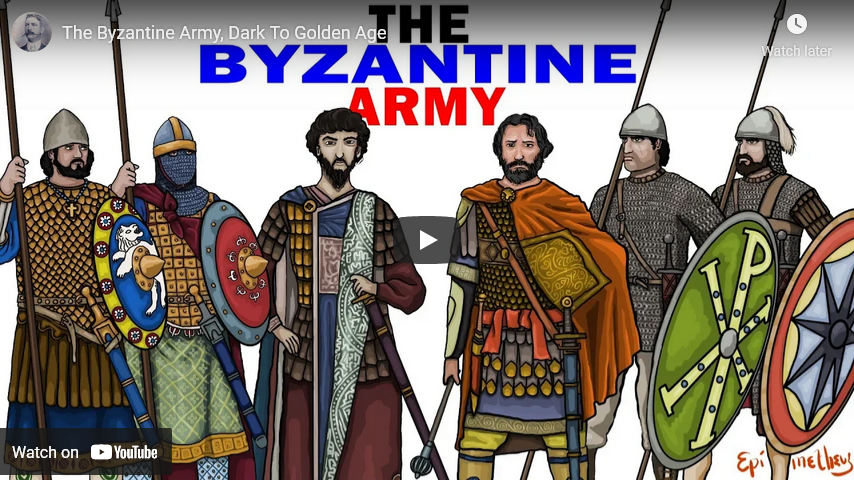
The Byzantine Army, Dark To Golden Age

Filed under: Europe, History, Middle East, Military, Religion — Tags: , , , , , , , — Nicholas @ 04:00

Epimetheus
Published 22 Mar 2019

The Byzantine army, Dark to Golden age

This video was sponsored by Skillshare

Sources
Romano-Byzantine armies 4th-9th Centuries (David Nicolle)
Larousse Encyclopedia of Ancient and Medieval History (Marcel Dunan)
The Late Roman Infantryman (Simon MacDowall)
Byzantium Beyond the Golden Gate
Fall of the West (John Lambshead)
The Late Roman Cavalryman (Simon MacDowall)

Tags:
Byzantine history, Byzantine, Byzantine documentary, Eastern Roman, Byzantine army, ancient history, Byzantine Cataphract, Byzantine Roman, history, Bulgaria Byzantium, Byzantine military, Byzantine legion, Byzantine empire, fall Byzantine, ancient, Rome, Constantinople, Byzantine empire documentary, crash course Byzantine empire, Byzantium, Byzantine army structure, Byzantine vs Roman, theme system, theme Byzantine, Roman tactics, Byzantine tactics, eastern Roman empire

From the comments:

Epimetheus
2 years ago (edited)
Notes/additional info:

1. Should the empire be called Byzantine, Roman or Greek? I see people arguing for each of these in the comments and there is merit to each of these; but it is important to note that they called themselves Roman, they were majority Greek in population and language spoken, and the term Byzantine is useful in differentiating the time period and has been colloquially used for a long time (although not during the empire) Being a reference to the earlier name of Byzantium for the city of Constantinople.

2. When I refer to “native troops” this includes many other ethnic groups living within the empire, notably the Armenians who lived in Anatolia for hundreds of years and had assimilated in many ways but maintained different views on aspects of the Christian faith which was the most striking differentiating factor between them and the rest of the population of the empire.

3. The Strategos and Domestikos label should be switched on the captions at 6 mins 17 secs in. A Strategos led a Thema(ta) and a Domestikos led a Tagma(ta). Unfortunately I switched those by accident and stared at the screen for a while and did not notice that … sorry guys ;(

4. The Varangian Guard was a personal bodyguard unit to the emperor which are pretty cool, they were mostly comprised of Norsemen (Scandinavians), Rus and Saxons. They are the unit I refer to when I mention a Scandinavian unit.

5. The coolest unit (in my opinion) that I did not mention was the Akritai which were kinda like the Cossacks in that they were a loosely controlled border guard on the eastern side of the empire; and were the subject of much folklore and poems and such.

November 29, 2021

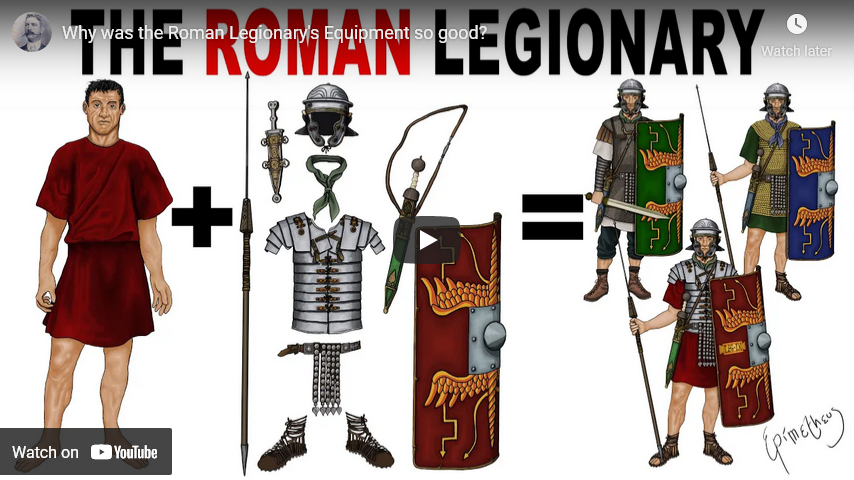
Why was the Roman Legionary’s equipment so good?

Filed under: Europe, History, Military, Weapons — Tags: , , , — Nicholas @ 02:00

Epimetheus
Published 3 Nov 2019

Arms & Armor of the Imperial Roman Legionary

The Ancient Roman legionary’s clothing, arms, armor, and equipment (Top 10 items) mini-documentary
#Legionary #documentary #Rome

This video is sponsored by my patrons on Patreon
https://www.patreon.com/Epimetheus1776

From the comments:

Epimetheus
1 year ago (edited)

Check Out my video on Republican Roman Infantry:
https://youtu.be/APuh6rokd_w

Additional info/and sources
Rounded metric Conversion for units mentioned:
Typical March: 20-30 miles(32-48 km) in a day
Training march distance and load: 22 miles = 35 km, 45 pounds = 20 kg
Full campaign max carried load per Legionary: 65-100 lbs = 27-45 kgs

One thing I wrote in the script, recorded and edited out by accident was that … when a Roman Legionary was dishonorably discharged (thrown out of the legion for bad behavior) his belt was confiscated by the legion which did not want him to be associated with the Roman State.

Sources:
Roman Military Clothing by Graham Sumner
Greece and Rome at War by Peter Connolly
Roman Legionary by Ross Cowan
The Legionary by Peter Connolly
The Gladius (The Roman short sword) by MC Bishop
Warfare in the Classical World by John Warry
Caesar’s Legions by Sekunda, Northwood and Simkins

Misspelled Inches as inces and Cohort as Chohort

November 4, 2021

Anti-Tank Chats #2 | Panzerbüchse 39 | The Tank Museum

Filed under: Germany, History, Military, Weapons, WW2 — Tags: , , , — Nicholas @ 02:00

The Tank Museum
Published 2 Jul 2021

Welcome to Anti-Tank Chats, a brand-new series on the history of infantry weapons used in Anti-Tank warfare. In the second episode, Archive and Supporting Collections Manager, Stuart Wheeler explores the Panzerbüchse 39 Anti-Tank Rifle.
(more…)

September 29, 2021

Feeding the Meatgrinder – The Red Army – WW2 Special

World War Two
Published 28 Sep 2021

What is left of the Red Army after the smashing offensives of Operation Barbarossa and Fall Blau, and what have Stavka done to rebuild it? As the war on the Eastern Front goes on, more men and materiel stream to the frontlines, stemming the onslaught of the Wehrmacht.
(more…)

August 14, 2021

Infantry Weapons at Guadalcanal – WW2 Special

Filed under: History, Japan, Military, Pacific, USA, Weapons, WW2 — Tags: , , , , , , , — Nicholas @ 04:00

Update: The folks at the World War Two channel have taken down this video due to technical errors in the script. Here’s their explanation.

World War Two
21 hours ago
Video on Infantry Arms at Guadalcanal retracted. Indy explains why:

Hi everyone. Indy here. As most of you know, I do the research and writing for all of the regular weekly episodes here. I host many of the specials as well, though I do not do the research for most of them- occasionally so, if it’s something that’s really in my field of expertise, like geopolitics, strategy, personal stories, communications, and international relations. The research for the other specials is done by a variety of specialists in their fields or historians, so we can maintain the quality you’ve come to expect from us. I understand, though, that many of you have serious issues with the research for the Guadalcanal infantry special. Our apologies for that- the research was done by an historian, a PhD [student], actually, and we also ensured it was double fact-checked, but obviously some serious mistakes slipped through. Live and learn. I will say that I think it is important that you continue to tell us when you take issue with something we present, since we strive to make the most complete and accurate documentary series possible, so although some of them are hard to read we appreciate such feedback from our community.

And this is from the researcher who worked on the script:

Marlon Londoño
18 hours ago
Hey guys! This is Marlon, the PhD student in question who helped with the researching and writing of the episode. Just to give a little background, I’m a volunteer researcher who helps with the channel over the summer while I’m not teaching/researching/taking coursework. I’m a military historian and my main academic focus is on social and cultural military history (i.e. what people’s wartime experiences were like and why. I’m especially interested in how people justify wartime violence and oftentimes the types of weapons they use play a role in that mental process, so that’s the context in which I usually think about weapons on the battlefield).

I’m sorry that I let a lot of you down with the mistakes about the Garand and Arisaka, among others. To be honest, I was surprised to learn they were myths. But I certainly know now, and I don’t think I’ll be forgetting any time soon 😅 One thing that I firmly believe as a researcher and educator is that nobody has a monopoly on the truth, least of all me. I tell that to my students on the first day of class each semester. I certainly don’t presume that the degree I’m pursuing makes me infallible or instantly qualified for anything. And this was a classic example of just how wrong I can be sometimes!

For what it’s worth, I love war history just as much as anyone else in the community, and I’m sorry that my research wasn’t as rigorous as it might otherwise have been. I hope you all might be willing to give any future episodes of mine a second chance, and of course I’m all ears for any mistakes that you want to point out!

July 13, 2021

Japanese Armour Doctrine, 1918-1942

Filed under: China, History, Japan, Military, Russia, USA, Weapons, WW2 — Tags: , , , , , — Nicholas @ 04:00

The_Chieftain
Published 11 Jul 2021

Sources include:
Japanese tanks and armoured Warfare 1932-45, David McCormack
WW2 Japanese Tank Tactics, Gordon Rottmen, Akira Takizawa
Japanese Tanks, Tactics and anti-tank weapons, Donald McLean
Type 89 and Tankette books, Kazunori Yoshikawa

Continuing on this series of videos supporting the WW2 Channel, I look at what I can find about how the Japanese thought of tanks and their usage, tempered by quite a bit of combat experience.

Improved-Computer-And-Scout Car Fund:
Patreon: https://www.patreon.com/The_Chieftain
Direct Paypal https://paypal.me/thechieftainshat

May 16, 2021

Bayonets

Filed under: Europe, History, Military, USA, Weapons — Tags: , , , , , — Nicholas @ 02:00

Lindybeige
Published 26 Feb 2011

A weapon can be very effective even if it never actually kills anyone.

Support me on Patreon: https://www.patreon.com/Lindybeige​

Lindybeige: a channel of archaeology, ancient and medieval warfare, rants, swing dance, travelogues, evolution, and whatever else occurs to me to make.

▼ Follow me…

Twitter: https://twitter.com/Lindybeige​ I may have some drivel to contribute to the Twittersphere, plus you get notice of uploads.

website: www.LloydianAspects.co.uk

April 18, 2021

Boys Mk I Anti-Tank Rifle at the Range

Filed under: Britain, History, Military, Weapons, WW2 — Tags: , , , — Nicholas @ 02:00

Forgotten Weapons
Published 2 Jan 2021

http://www.patreon.com/ForgottenWeapons

https://www.floatplane.com/channel/Fo…

Cool Forgotten Weapons merch! http://shop.bbtv.com/collections/forg…

(Edit: Tungsten carbine is, of course *denser* than steel, not lighter. Sorry.)

I have done several previous videos on the Boys antitank rifle, but never actually fired one — until today! We’re out at the range with a MkI Boys and five rounds of its .55 Boys ammunition. So let’s see if it’s as painful to shoot as people say …

Contact:
Forgotten Weapons
6281 N. Oracle #36270
Tucson, AZ 85740

April 4, 2021

The Good Idea Fairy Strikes: American Trowel Bayonets

Filed under: History, Military, USA, Weapons — Tags: , , , , — Nicholas @ 02:00

Forgotten Weapons
Published 13 Nov 2017

The United States first experimented with a combination trowel and bayonet in 1868, producing 200 experimental examples made from standard socket bayonets. This was immediately followed by an additional 500 Model 1869 trowel bayonets made new. These were distributed to a few companies of the infantry to test in the field. Remarkably, the trials reports were overwhelmingly positive.

The US infantryman at that time did not carry any sort of entrenching tool, and so even an awkward combination tool was an improvement over a canteen cup or other ad hoc tool for digging. The bayonet was seen by some officers as becoming obsolete with the introduction of breechloading rifles, so the reduced effectiveness of the new item as a bayonet was not a substantial concern. The intended use of these tools was not to dig elaborate trenches, but rather to hastily construct a shallow ditch and embankment which would provide just enough cover to shelter a prone soldier.

With the trials reports in, the government purchased 10,000 of the improved 1873 pattern trowel bayonet, which featured a stronger blade and a much more comfortable handle for digging. These were issued and used in the field (and in several combat engagements), but the developmental direction turned towards combination knife trowels instead of bayonets, and there would be no further development or issue of these tools after the 1870s.

See the full trials report here: https://books.google.com/books?id=qUE…

http://www.patreon.com/ForgottenWeapons

Cool Forgotten Weapons merch! http://shop.bbtv.com/collections/forg…

If you enjoy Forgotten Weapons, check out its sister channel, InRangeTV! http://www.youtube.com/InRangeTVShow

March 30, 2021

Caesar in Britain II: There and Back Again (54 B.C.E.)

Historia Civilis
Published 21 Mar 2017

Patreon | http://historiacivilis.com/patreon​
Donate | http://historiacivilis.com/donate​
Merch | http://historiacivilis.com/merch
Mailing List | http://historiacivilis.com/mailinglist​
Twitter | http://historiacivilis.com/twitter​
Website | http://historiacivilis.com​

Music is:
“Day Bird,” by Broke For Free
“Drums of the Deep,” by Kevin MacLeod
“Flood,” by Jahzzar

March 17, 2021

Heavy But Effective: Britain’s No4 MkI (T) Sniper Rifle

Filed under: Britain, History, Military, Weapons, WW2 — Tags: , , , , — Nicholas @ 02:00

Forgotten Weapons
Published 29 Aug 2018

http://www.patreon.com/ForgottenWeapons

Cool Forgotten Weapons merch! http://shop.bbtv.com/collections/forg…

The main British sniper rifle of World War Two, and arguably one of the best looking military sniper rifles of all time, the No4 MkI (T) was something the British military knew they would want even before the No4 MkI rifle had gone into real production. The first No4 snipers were built on leftover trials rifles from Enfield, and the pattern was formally introduced in February of 1942. First use was in North Africa, but the fighting there was not really suited to sniper rifles, and the weapon’s practical combat debut was in Italy in 1943.

The No4 MkI (T) was a conversion of a standard No4 MkI rifle, using examples chosen for particular good accuracy. They were sent to Holland & Holland to have scope mount bases added and No32 telescopic sights fitted (along with cheek risers on the stocks and having the battle sight aperture ground off to allow room for the scope bell). Between 23,000 and 26,000 were made during the war, and they would continue to be used in the British military for decades, including later conversion into 7.62mm NATO L42A1 rifles [which Ian discusses here].

Contact:
Forgotten Weapons
6281 N Oracle #36270
Tucson, AZ 85704

February 22, 2021

The “Infantry Revolution” of the Late Middle Ages

Filed under: Europe, History, Military, Weapons — Tags: , , , , — Nicholas @ 04:00

SandRhoman History
Published 21 Feb 2021

CuriosityStream link: https://curiositystream.com/sandrhoman

The “Infantry Revolution” of the late Middle Ages is kind of a hot topic among armchair historians and academics alike. This is how the argument goes: In the late Middle Ages, infantry grew in importance to the detriment of heavy cavalry; by then battles were increasingly won with pikes, longbows and arquebuses instead of mounted knights with lances, the argument continues, and as a result of that, the socio-political make-up and development of European polities changed lastingly. So, this Infantry Revolution supposedly had an incredible impact on European state building processes AND, the argument finally concludes, it laid the foundation to Europe’s conquest and colonization of many parts of the world. However, in public spaces such as YouTube this whole debate is more discussed in regards to tactics and fighting techniques than economics and politics. Consequently, much of the public discussion is about how and if the importance of knights changed after the High Middle Ages. Likewise, topics such as the efficacy of the English longbow or the impact of pikes in the late Middle Ages are frequently the subject of discussions. All of that is controversial to say the least but it gets worse: these changes must be viewed in the broader military changes such as the rise of gunpowder artillery between 1420 and 1530 — called an artillery revolution — the decline of sieges between the 1420s and the 1530s which, among many things, led to the resurgence of heavy cavalry in the later late Middle Ages. Lastly, all of these revolutions belong to a notion called “military revolution”. This video is not intended to argue one side or the other of the “infantry revolution” but to provide a broad overview over both the debate and the military changes during the 14th and 15th centuries. It explains how contemporary historiography quarrels over the infantry revolution.

Patreon: https://www.patreon.com/sandrhomanhis…​

Twitter: https://twitter.com/SandrhomanBibliog…​

Bibliography:
Bane, M., English Longbow Testing against various armor circa 1400, 2006.
Ayton, A., / Price, J. L., (Hrsg.), The Medieval Military Revolution. State, Society and Military Change in Medieval and Early Modern Europe, 199J.
Black, A Military Revolution? Military Change and European Society 1550–1800, 1991.
Devries, K., Medieval Military Technology, 1994.
Dierk, W., s.v. “Heeresreform”, in: Enzyklopädie der Neuzeit
Ortenburg, G., “Waffe und Waffengebrauch im Zeitalter der Landsknechte” (Heerwesen der Neuzeit, Abt. 1, Bd. 1) Koblenz 1984.
Magier, Mariusz; Nowak, Adrian; et al., “Numerical Analysis of English Bows used in Battle of Crécy”. Problemy Techniki Uzbrojenia. 142 (2), 2017, 69–85.
Meumann, M., s.v. “Military Revolution”, in: Enzyklopädie der Neuzeit.
Parker G., “The ‘Military Revolution’, 1560–1660 – a Myth?”, in: Journal of Modern History 48.2, 1976, 196–214
Parker, G., Die militärische Revolution. Die Kriegskunst und der Aufstieg des Westens 1500–1800, 1990 (Engl. 1988)
Roberts, M.: “The military revolution, 1560–1660”. In: Clifford J. Rogers: The military revolution debate. Readings on the military transformation of early modern Europe. Westview Press, Boulder, Colo. 1995, S. 13–35.
Rogers, C.J. / Tallet F. (editors), European Warfare, 1350–1750, 2010.
Rogers, C.J., The Efficacy of the English Longbow, 1998.
Schmidtchen, Volker, Kriegswesen im späten Mittelalter. Technik, Taktik, Theorie, Weinheim 1990.
Soar, H., Gibbs, J., Jury, C., Stretton, M., Secrets of the English War Bow. Westholme, 2010, pp. 127–151.

February 20, 2021

QotD: The Infantry

Filed under: Britain, Humour, Military, Quotations — Tags: , — Nicholas @ 01:00

The infantry do not have a single capbadge, they are described as a single capbadge but they all have different badges, lots and lots of them. Due to amalgamations and drawing down they are merged and start using new ones. One day they will be merged into the Royal Corps of Infantry.

The infantry (note not “infanteers” as they really hate that) are the actual troops who stand toe-to-toe with the enemy and bayonet them in the face. Boots on the ground, their job is to be pointed at the bad guys and go wreck it. They may get delivered in various ways including aircraft, boat, ship or their own vehicles, but same job: “infantry go smash”. Can be identified by neck tattoos, traditions that the Victorians would think are dated, officers wear faded red trousers and soldiers fight each other on Friday nights.

Combat Boot, “So, ‘capbadges’, what’s that all about then?”, combatboot.co.uk, 2020-11-13.

February 8, 2021

Why Everybody Disagrees on the Efficacy of the English Longbow – A Video Essay

Filed under: Britain, France, History, Military, Weapons — Tags: , , , , , , , — Nicholas @ 04:00

SandRhoman History
Published 7 Feb 2021

Everybody quarrels over the efficacy of the English longbow. Many historians, reenactors and history enthusiasts alike hold the view that arrows piercing armor is a myth. Some base this view on testing as was done for example by Tod from Tod’s workshop. Together with his team, he provided an invaluable data point for this debate. Others, such as traditionalist historians are often open to the possibility of arrows piercing armor, even though they are aware of actual testing of the longbow. In general, the efficacy of a weapon is much more complicated than its mere armor penetration value. So, in this video we’d like to shed light on the whole debate and explain why it is so hard to find common ground on this issue. This is why everybody disagrees on the efficacy of the English longbow.

Patreon: https://www.patreon.com/sandrhomanhis…​

Twitter: https://twitter.com/Sandrhoman

Tod’s Video: ARROWS vs ARMOUR – Medieval Myth Busting https://youtu.be/DBxdTkddHaE​

Tod’s playlist: MEDIEVAL MYTH BUSTING https://youtube.com/playlist?list=PLI…​

Bibliography:
Rogers, C.J., The Efficacy of the English Longbow, 1998.
Devries, K., Medieval Military Technology, 1994.
Bane, M., “English Longbow Testing against various armor circa 1400”, 2006.
Soar, H., Gibbs, J., Jury, C., Stretton, M., Secrets of the English War Bow. Westholme, 2010, pp. 127–151.
Magier, Mariusz; Nowak, Adrian; et al., “Numerical Analysis of English Bows used in Battle of Crécy”. Problemy Techniki Uzbrojenia. 142 (2), 2017, 69–85.

February 7, 2021

Roman legion vs Macedonian phalanx

Filed under: Europe, Greece, History, Military — Tags: , , — Nicholas @ 02:00

Epimetheus
Published 13 Aug 2018

Roman legion vs Macedonian phalanx (Macedonian wars)
Battle of Pydna 168 BC and battle of Cynoscephalae 197 BC

Support new videos from Epimetheus on Patreon! 😀
https://www.patreon.com/Epimetheus1776

roman legion, roman legion tactics, macedonian phalanx, Macedonian phalanx tactics, Macedonian phalanx vs roman legion, ancient Macedonian army, ancient roman army, roman army, Roman legionary, rome vs Greece, Rome vs Macedon, roman army weapons, Roman army tactics, Macedonian wars, battle Cynoscephalae, battle of Pydna, republican Roman army, Roman maniple, Roman republic, documentary, ancient Rome documentary, ancient Greece documentary, rome documentary, battle of magnesia, rome selucid empire, Roman empire vs selucid empire, diadochi, ancient,

« Newer PostsOlder Posts »

Powered by WordPress