Real Time History
Published 11 Mar 2022Get Nebula and CuriosityStream in a great bundle deal: https://curiositystream.com/realtimeh…
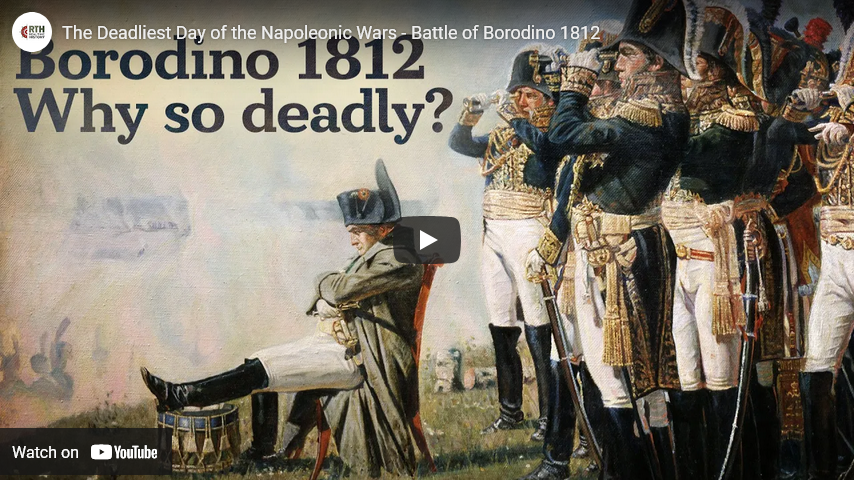
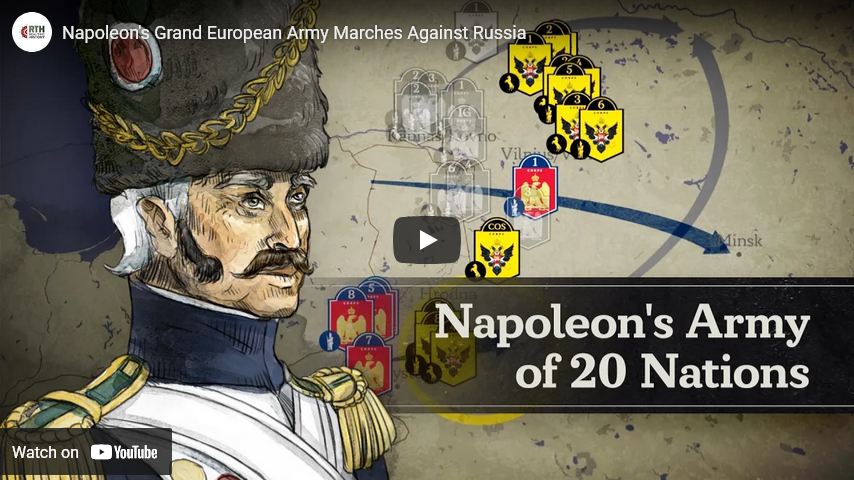
When Napoleon marched his Grande Armée into Russia in 1812, he had assembled the biggest army in modern European history. Only half of his troops came from territories of the expanded French Empire. Tens of thousands of troops also came from Poland, Prussia, Austria, and the German States as well as Southern Europe.
» SUPPORT US ON PATREON
https://patreon.com/realtimehistory» THANK YOU TO OUR CO-PRODUCERS
John Ozment, James Darcangelo, Jacob Carter Landt, Thomas Brendan, Kurt Gillies, Scott Deederly, John Belland, Adam Smith, Taylor Allen, Rustem Sharipov, Christoph Wolf, Simen Røste, Marcus Bondura, Ramon Rijkhoek, Theodore Patrick Shannon, Philip Schoffman, Avi Woolf,» SOURCES
Boudon, Jacques-Olivier. Napoléon et la campagne de Russie en 1812. 2021.
Brun, Jean-François. “Le cheval dans la Grande Armée“, Revue historique des armées (249), 2007.
Del Negro, Piero. “Les Italiens dans la Grande Armée. La campagne de Russie et le patriotisme italien“, Revue historique des armées (250), 2008.
Elting, John. Swords Around a Throne: Napoleon’s Grande Armée. 1997.
Lieven, Dominic. Russia Against Napoleon. 2010.
Nieuwazny, Andrzej. “Les Polonais de la Grande Armée“, in Rey, Marie-Pierre and Thierry Lentz, eds. 1812, la campagne de Russie. 2012.
Rey, Marie-Pierre. L’effroyable tragédie: une nouvelle histoire de la campagne de Russie. 2012.
Zamoyski, Adam. 1812: Napoleon’s Fatal March on Moscow. 2005.» OUR STORE
Website: https://realtimehistory.net»CREDITS
Presented by: Jesse Alexander
Written by: Jesse Alexander
Director: Toni Steller & Florian Wittig
Director of Photography: Toni Steller
Sound: Above Zero
Editing: Toni Steller
Motion Design: Toni Steller
Mixing, Mastering & Sound Design: http://above-zero.com
Digital Maps: Canadian Research and Mapping Association (CRMA)
Research by: Jesse Alexander
Fact checking: Florian WittigChannel Design: Simon Buckmaster
Contains licensed material by getty images
Maps: MapTiler/OpenStreetMap Contributors & GEOlayers3
All rights reserved – Real Time History GmbH 2022
March 12, 2022
Napoleon’s Grand European Army Marches Against Russia
February 26, 2022
In The Highest Tradition — Episode 3
British Army Documentaries
Published 27 Oct 2021This third episode in a six-part series delving into the world of regimental tradition looks Gurkhas’ history and commitment to the British Army. They swear their oath of allegiance directly to Her Majesty the Queen and continue to revere “The Queen’s Truncheon”, which was awarded to them by Queen Victoria in recognition of their service during the Indian Mutiny.
© 1989
This production is for viewing purposes only and should not be reproduced without prior consent.
This film is part of a comprehensive collection of contemporary Military Training programmes and supporting documentation including scripts, storyboards and cue sheets.
All material is stored and archived. World War II and post-war material along with all original film material are held by the Imperial War Museum Film and Video Archive.
February 23, 2022
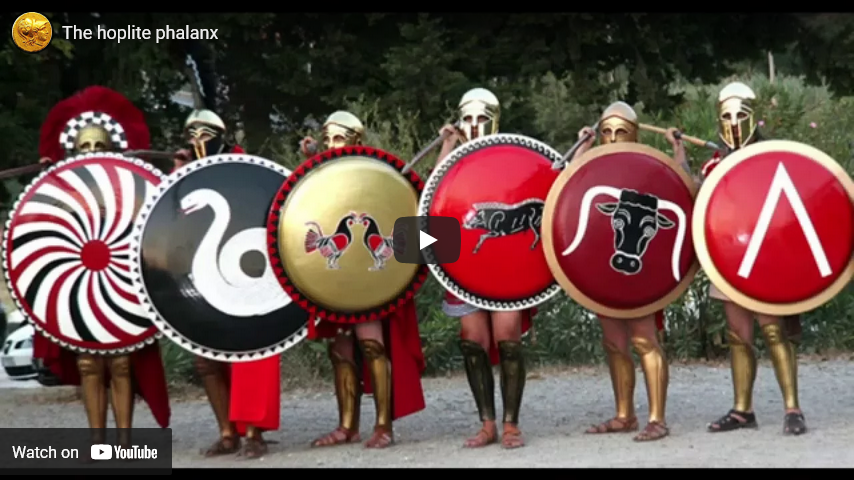
QotD: Debunking the “Spartan one-man-army” myth
… the Spartans, like all hoplites, were oriented very strongly towards group combat. The one-man-army is simply not how they fought, nor how they ever intended to fight.
Well, ok, perhaps they fought in groups, but were individually better at it. There is something to this. Multiple sources – most notably Xenophon stresses the greater degree of physical fitness that the Spartiates display (Xen. Lac. 4.5, 5.9). The Spartiates were rich after all, so they were well fed and able to build muscle accordingly; they also had a pretty active life-style (mostly things like sport-hunting) and kept athletically active. Chances are the average Spartiate was thus larger and fitter than the average hoplite – although again, the other Lakedaemonians in the phalanx (perioikoi, hypomeiones, mothakes, neodamodes, even helots fighting as hoplites) would probably balance out this effect to at least some degree (more strongly as time went on and the number of Spartiates shrunk!)
But what about martial skills and combat expertise? The fact is, there isn’t much evidence for a Spartan military training regime – certainly nothing like what the Romans had, or even what later Hellenistic Greek poleis set up. We’ve already discussed the agoge and you will note that at no point did swordsmanship, spear use, shield use, or anything of the like come up. There is, to be fair, some mock battles with fennel stalks in place of spears and some war-dances which may have served to mimic combat, but the agoge isn’t a training program, it’s an indoctrination program. Plutarch and Xenophon – who describe it – are quite clear on this: the point is to produce men who are obedient to the laws and subservient to the community (Xen. Lac. 2.10-11; Plut. Lyc. 25.3). Any advantages to military quality are evidently secondary (e.g. Xen. Lac. 2.7).
Xenophon himself notes – in the words of Cyrus (who he presents as an ideal ruler) – that hoplite-style warfare in close-combat required little practice (Xen. Cyrop. 2.1.9-16). And I want to stress two things about this statement: first that Xenophon had seen a lot of hoplite battle when he knew this and was in a position to know and second that he had also seen a lot of Sparta. It is hard to imagine Xenophon – with his Laconophilia – saying that practice for hoplites was unimportant if the Spartans had relied on it heavily. Nevertheless, there he is, saying that all of the movements a hoplite actually needed to perform – blocking with the shield, striking with spear or sword – were instinctive and did not need to be taught or practiced.
Plato provides our first solid evidence for the hoplomachia – practice drills in hoplite warfare – but immediately suggests through the person of Laches that the Spartans, specifically do not practice it (Plat. Lach. 182d-183a), because they think it doesn’t work. There is clearly some practicing with arms in Sparta as elsewhere in Greece (see J. K. Anderson, Military Theory and Practice in the Age of Xenophon (1970), 84-93 for the best discussion of the evidence; note also Wheeler, “Hoplomachia and Greek Dances in Arms” (1982)), but it never approaches the formal weapons drills we see from the Romans, or the complex fighting systems of the late Middle Ages. Nor does Sparta appear to be meaningfully exceptional in this regard; they seem to be exactly as tutored – or untutored – as all the other Greeks.
Nor may we rely on the assumption that the Spartan has more battle experience than his foes. The fact is that Greek poleis went to war fairly regularly and that they tended to bring most of their hoplite class out to battle when they did and as such most Greeks of the hoplite class from anywhere will have likely experienced combat. The Spartans are not unique in this and it is not clear that Sparta fights more often – they murder helots more often, sure, but this is hardly effective preparation for open battle.
(The contrast with Rome is again instructive. Sparta is intermittently at war, but the Roman Republic is continuously at war for all but six years out of five centuries, with the average Roman citizen probably spending upwards of seven years under arms – and this is before the professionalization of the legion. The average Roman free-holding farmer (the technical term is assidui) of the Middle Republic might truthfully have considered Leonidas and his 300 as amateurish by comparison.)
So what can we conclude? Well, the Spartiates are probably, on the whole, better nourished and fitter than their average opponent. If they have an edge in weapons training, it is fairly small – some sort of martial arts experts or superlative weapon-masters they are not. Which, of course they aren’t; the way they fight doesn’t require them to be. Hoplite fighting was never about individual martial excellence or skill, but about holding a position in the formation, supporting and being supported in turn by the shields of the men around you. The hoplite didn’t need to be a spear-master and evidently – we must agree with Xenophon – gained little from becoming so.
Bret Devereaux, “Collections: This. Isn’t. Sparta. Part VI: Spartan Battle”, A Collection of Unmitigated Pedantry, 2019-09-20.
February 19, 2022
QotD: Army marching speed in the pre-industrial era
The intuitive and a touch clever method is to take normal human walking speed – around 3mph – multiply it by walking hours per day (maybe 8) and go with that. This makes intuitive sense, but if large army logistics made intuitive sense, they wouldn’t be hard, and as Clausewitz says (drink!) “War is very simple, but the simplest thing is very hard.” Logistics is very hard. So why don’t armies move at c. 25 miles per day?
So let’s think about – in very general terms – what needs to happen and in what order for a large body of infantry to march. Everyone wakes up and starts to get moving (probably around 5am). Breakfast needs to happen, which may require making fires. Tents need to be struck and stowed along with all of the gear in the baggage train and individual soldiers need to stow their own equipment. All sorts of small tasks add up to eat away parts of the morning. Then everyone needs to get gathered and ready to march.
And now – because you are a large body of infantry, you wait. Let me explain – let’s take a nominally full strength (c. 3,000 men) American Civil War brigade, marching on a road 13ft or so wide. You can get five men (a little cramped) into a single row on that road, meaning that the infantry itself stretches 600 ranks deep. Unlike in the movies (which love ultra-compact marching formations because it looks cool) you need a few feet of separation between rows for best effect (WW2 US Army guidelines specified 2-5 yards), let’s assume each soldier occupies about 5 feet in the marching order. So the infantry is 3,000ft long (914m; nine football fields). We also need unit separation (between the regiments, it’s important to avoid “accordioning” on the march and facilitate control; WW2 army regs suggested 100 yards between companies, 50 yards between platoons, so these could be quite large), so let’s round up to 4,000 ft (1219m; 13 football fields).
But we also have tents, food supplies, spare ammunition and all sorts of other of what the Romans would have called impedimenta (sidenote: if you are thinking, “well, but a pre-gunpowder army doesn’t need this; 1) arrows take up space and 2) camp entrenching supplies – the Romans marched heavy). How many wagons, pack animals or porters you need varies – the Romans seem to have often moved with a mule for every six-to-eight men, plus the army’s siege train. A good rule-of-thumb I’ve seen for American Civil War estimates is around 20 wagons per thousand, so 60 wagons. Rule of thumb in the ACW is 80 wagons to a mile of road, so our wagon train ought to take up around another 4,000ft.
(Sidenote: you can see why logistics gets complicated fast. Even in explaining a rule of thumb, I have to resort to rules of thumb, or else we have to inventory all of the stuff an infantry brigade needs, and all of the food they need and then parcel it out by wagons (and then figure for the mule-or-horse teams for the wagons) and on and on. Fortunately for the historians, this sort of work was done by the armies at the time and written down, so we tend to use their staff-work.)
So the entire force is probably a bit more than 8,000 ft long – 1.5 miles. In practice, there’s actually a lot more space eaten up in separation (between wagons, between men) so it would be longer, but I don’t want to get lost in the details. And this is for just 3,000 infantry – we have no cavalry with their many spare horses (three per man as a typical minimum) or god forbid a siege train which might involve hundreds of wagons.
Bret Devereaux, “New Acquisitions: How Fast Do Armies Move?”, A Collection of Unmitigated Pedantry, 2019-10-06.
February 14, 2022
In The Highest Tradition — Episode 2
British Army Documentaries
Published 22 Oct 2021This episode includes the story of Millie the Mule and just why a rose is still eaten, raw, in one battalion’s mess. It also features the “White Helmets”, a team of motorcycle stunt riders. One team of retired soldiers has an average age of 74 years but they still meet up to perform stunts in front of their successors.
© 1989
This production is for viewing purposes only and should not be reproduced without prior consent.
This film is part of a comprehensive collection of contemporary Military Training programmes and supporting documentation including scripts, storyboards and cue sheets.
All material is stored and archived. World War II and post-war material along with all original film material are held by the Imperial War Museum Film and Video Archive.
I have to mention that the primrose hackle, once worn with great pride by the Lancashire Fusiliers is still worn by the Lorne Scots (Peel, Dufferin & Halton Regiment) of the Canadian Army Reserve.
February 9, 2022
In The Highest Tradition – Episode 1
British Army Documentaries
Published 18 Oct 2021[From the episode transcript – “Apart from discipline what emerges when you delve into British military tradition is that there’s no such entity as a British army. What you find is a confederation of regiments hopefully fighting on the same side all fiercely preserving their individuality by being as different from one another as possible.”]
First transmitted in 1989, this is the first episode in a six-part series that delves into the world of regimental tradition. This programme includes looks at the origins of Emperor Joseph Bonaparte’s chamber pot, a druid oration, and the story of a goat who escaped being eaten to become a regimental mascot.
© 1989
This production is for viewing purposes only and should not be reproduced without prior consent.
This film is part of a comprehensive collection of contemporary Military Training programmes and supporting documentation including scripts, storyboards and cue sheets.
All material is stored and archived. World War II and post-war material along with all original film material are held by the Imperial War Museum Film and Video Archive.
February 2, 2022
QotD: Breaking the trench stalemate with Stormtroopers (Stoßtruppen)
One way to respond to a novel tactical problem is with novel tactics. And the impetus for this kind of thinking is fairly clear: if your own artillery is the problem digging you into a hole, then find a way to use less of it.
The mature form of this tactical framework is often called “Hutier” tactics, after German general Oskar Emil von Hitier, though he was hardly the sole or even chief inventor of the method. In its mature form, the technique went thusly: instead of attacking with large waves of infantry which cleared each objective in sequential order, attacks ought to be proceeded by smaller units, carefully trained with the layout of the enemy positions. Those units, rather than having a very rigid plan of attack, would be given those general objectives and left to figure for themselves how to accomplish them (“mission tactics” or Auftragstaktik), giving them more freedom to make decisions based on local conditions and the ground.
These elite spearhead units, called Stoßtruppen or “Stormtroopers” were well equipped (in particular with a higher amount of automatic firearms and hand grenades, along with flamethrowers). Importantly, they were directed to bypass enemy strong-points and keep moving forward to meet their objectives. The idea here was that the follow-up waves of normal infantry could do the slow work of clearing out points where enemy resistance was strong, but the stormtroopers should aim to push as deeply as possible as rapidly as possible to disorient the defenders and rapidly envelop what defenses remained.
These sets of infantry tactics were in turn combined with the hurricane barrage, a style of artillery use which focused on much shorter but more intense artillery barrages, particularly associated with Colonel Georg “Breakthrough” Bruchmüller. Rather than attempting to pulverize defenses out of existence, the hurricane barrage was designed merely to force enemies into their dugouts and disorient the defenders; much of the fire was directed at longer ranges to disrupt roads and artillery in the enemy rear. The short barrage left the ground relatively more intact. Meanwhile, those elite infiltration units could be trained to follow the creeping barrage very closely (being instructed, for instance, to run into the shell explosions, since as the barrage advantages, no gun should ever strike the same spot twice; a fresh shell-hole was, in theory, safe). Attentive readers will recognize the basic foundations of the “move fast, disorient the enemy” methods of the “modern system” here.
So did infiltration tactics break the trench stalemate? No.
First, it is necessary to note that while infiltration tactics were perhaps most fully developed by the Germans, they were not unique to them. The French were experimenting with many of the same ideas at the same time. For instance, basic principles of infiltration were being published by the French General Headquarters as early as April, 1915. André Laffargue, a French infantry captain, actually published a pamphlet, which was fairly widely distributed in both the French and British armies by the end of 1915 and in the American army in 1916, on exactly this sort of method. In many cases, like at the Second Battle of Artois, these French tactics bore significant fruit with big advances, but ran into the problem that the gains were almost invariably lost in the face of German counter-attacks. The Russians, particularly under Aleksei Brusilov, also started using some of these techniques, although Brusilov was as much making a virtue of necessity as the Russians just didn’t have that much artillery or shells and had to make due with less and Russian commanders (including Brusilov!) seem to have only unevenly taken the lessons of his successes.
The problem here is speed: infiltration tactics could absolutely more efficiently overrun the front enemy lines and even potentially defeat multiple layers of a defense-in-depth. But after that was done and the shock of the initial push wore off, you were still facing the same calculus: the attacker’s reinforcements, shells, artillery and supplies had to cross broken ground to reach the new front lines, while the defender’s counter-attack could ride railways, move over undamaged roads and then through prepared communications trenches. In the race between leg infantry and trains, the trains always won. On the Eastern Front or against the Italians fighting under the Worst General In History at Caporetto (1917), the already badly weakened enemy might simply collapse, producing massive gains (but even at Caporetto, no breakthrough – shoving the enemy is not a breakthrough, to qualify as a breakthrough, you need to get to the “green fields beyond” that is open ground undefended by the enemy), but against a determined foe, as with the 1918 Spring Offensives, these tactics, absent any other factor, simply knocked big salients in the line. Salients which were, in the event, harder to defend and brought the Germans no closer to victory. Eventually – often quite rapidly – the front stabilized again and the deadlock reasserted itself. Restoring maneuver, the actual end-goal of these tactics, remained out of reach.
Bret Devereaux, “Collections: No Man’s Land, Part II: Breaking the Stalemate”, A Collection of Unmitigated Pedantry, 2021-09-24.
February 1, 2022
US Armored Doctrine 1919-1942, Part 2
The Chieftain
Published 29 Jan 2022Continuing on this series of videos supporting the WW2 Channel, this is part one of a two-part look at how the US Army ended up with the armored force with which it entered combat in North Africa. https://www.youtube.com/c/WorldWarTwo
If you missed part 1… https://www.youtube.com/watch?v=hLkJP…
Sources include:
Forging the Thunderbolt (Gillie)
Men on Iron Ponies (Morton)
Greasy Automatons and the Horsey Set (Tedesco)
A number of Center of Military History documents to include GHQ Maneuvers 1941 https://history.army.mil/catalog/pubs…
A few other things I’ve forgotten about, but the above will get you 90% of the way there.Improved-Computer-And-Scout Car Fund:
Patreon: https://www.patreon.com/The_Chieftain
Direct Paypal https://paypal.me/thechieftainshat1939 Cavalry Journal with Polish cavalry article.
https://mcoepublic.blob.core.usgovclo…
January 31, 2022
The Ram | Canada’s Most Successful Failure
Red Wrench Films
Published 4 Dec 2020A Canadian Franken-tank that pre-dated the M4 Sherman, the Ram would be an icon of Canada’s industry in the early war years. Ultimately a failure as a battle tank, variants of the vehicle would see combat in Normandy and beyond, as the Kangaroo APC which revolutionised mechanised warfare in 1944 and 1945.
Any feedback is greatly appreciated, I’m always trying to improve.
Any suggestions for the next video? Leave it down in the comments or message me. 🙂
((Like and subscribe))
Please note that the footage I can find on these vehicles is scarce and sometimes the video will not match properly or will perhaps be slightly inaccurate.
Sources:
https://tanks-encyclopedia.com/ww2/ca…
https://www.dday-overlord.com/en/mate…
https://www.friends-amis.org/index.ph…
http://panzerserra.blogspot.com/2015/…Intuit256 by Kevin MacLeod is licensed under a Creative Commons Attribution 4.0 licence. https://creativecommons.org/licenses/…
Source: http://incompetech.com/music/royalty-…
Artist: http://incompetech.com/
January 25, 2022
US Armored Doctrine 1919-1942, Part 1
The Chieftain
Published 22 Jan 2022Continuing on this series of videos supporting the WW2 Channel, this is part one of a two-part look at how the US Army ended up with the armored force with which it entered combat in North Africa.
Sources include:
Forging the Thunderbolt (Gillie)
Men on Iron Ponies (Morton)
Greasy Automatons and the Horsey Set (Tedesco)
A number of Center of Military History documents
A few other things I’ve forgotten about, but the above will get you 90% of the way there.Improved-Computer-And-Scout Car Fund:
Patreon: https://www.patreon.com/The_Chieftain
Direct Paypal https://paypal.me/thechieftainshatChristie Tank Video
https://www.youtube.com/watch?v=0APcE…
1930 Cavalry Journal.
https://mcoepublic.blob.core.usgovclo…
1939 Cavalry Journal
https://mcoepublic.blob.core.usgovclo…
Soviet doctrine video.
https://www.youtube.com/watch?v=s7nr8…
Interview with Ken Estes on USMC tank history
https://www.youtube.com/watch?v=_DBmN…
Assessment of USMC light tanks.
https://www.youtube.com/watch?v=gy4dw…
January 22, 2022
QotD: Breaking the trench stalemate with artillery
While the popular conception was that the main problem was machine-gun fire making trench assaults over open ground simply impossible, the actual dynamic was more complex. In particular, it was possible to create the conditions for a successful assault on enemy forward positions – often with a neutral or favorable casualty ratio – through the use of heavy artillery barrages. The trap this created, however, was that the barrages themselves tore up the terrain and infrastructure the army would need to bring up reinforcements to secure, expand and then exploit any initial success. Defenders responded to artillery with defense-in-depth, meaning that while a well-planned assault, preceded by a barrage, might overrun the forward positions, the main battle position was already placed further back and well-prepared to retake the lost ground in counter-attacks. It was simply impossible for the attacker to bring fresh troops (and move up his artillery) over the shattered, broken ground faster than the defender could do the same over intact railroad networks. The more artillery the attacker used to get the advantage in that first attack, the worse the ground his reserves had to move over became as a result of the shelling, but one couldn’t dispense with the barrage because without it, taking that first line was impossible and so the trap was sprung.
(I should note I am using “railroad networks” as a catch-all for a lot of different kinds of communications and logistics networks. The key technologies here are railroads, regular roads (which might speed along either leg infantry, horse-mobile troops and logistics, or trucks), and telegraph lines. That last element is important: the telegraph enabled instant, secure communications in war, an extremely valuable advantage, but required actual physical wires to work. Speed of communication was essential in order for an attack to be supported, so that command could know where reserves were needed or where artillery needed to go. Radio was also an option at this point, but it was very much a new technology and importantly not secure. Transmissions could be encoded (but often weren’t) and radios were expensive, finicky high technology. Telegraphs were older and more reliable technology, but of course after a barrage the attacker would need to be stringing new wire along behind them connecting back to their own telegraph systems in order to keep communications up. A counter-attack, supported by its own barrage, was bound to cut these lines strung over no man’s land, while of course the defender’s lines in their rear remained intact.)
Bret Devereaux, “Collections: No Man’s Land, Part II: Breaking the Stalemate”, A Collection of Unmitigated Pedantry, 2021-09-24.
January 4, 2022
Peninsular War: Why were British infantry so successful?
Redcoat: British military history
Published 16 Dec 2021Why were the British redcoats so successful in the Peninsular war? There were many reasons, but amongst them was the way regiments were organised and the tactics they employed.
If you are interested in the Zulu War, then please sign up for my mailing list to receive my free book on the subject: www.redcoathistory.com
If you are very generous, you can also buy me a coffee and help support the channel via https://ko-fi.com/redcoathistory
December 21, 2021
Tank Chat #136 | Schützenpanzer | The Tank Museum
The Tank Museum
Published 3 Sep 2021David Willey is back with another Tank Chat! This week’s episode is all about the Schützenpanzer. A West German infantry fighting vehicle developed from 1956 to 1958.
(more…)
December 9, 2021
Tank Chat #135 | Marder | The Tank Museum
The Tank Museum
Published 27 Aug 2021In this latest episode of Tank Chats, Curator David Willey details the German Marder. A post-war Infantry Fighting vehicle.
(more…)
December 7, 2021
Kokoda Trail: D-by-D Recap 01
World War Two
Published 6 Dec 2021For the past months, we have continuously mentioned the fighting on the Kokoda Track, but it was often a mere footnote next to the colossal battles happening throughout the world. Today, we give you a unique recap of all that’s been going on in this remote theater of war.
(more…)