Quotulatiousness

February 6, 2021

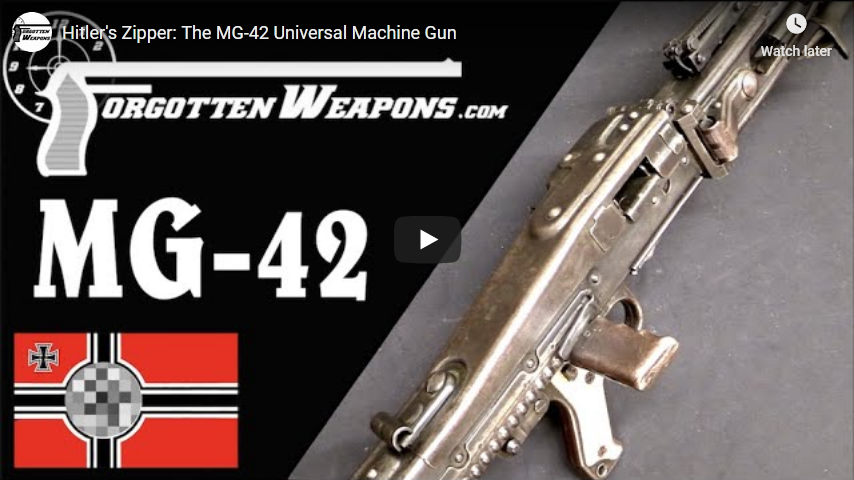
Hitler’s Zipper: The MG-42 Universal Machine Gun

Filed under: Germany, History, Military, Weapons, WW2 — Tags: , , , , — Nicholas @ 02:00

Forgotten Weapons
Published 4 Nov 2020

http://www.patreon.com/ForgottenWeapons

https://www.floatplane.com/channel/Fo…

Cool Forgotten Weapons merch! http://shop.bbtv.com/collections/forg…

The MG42 was developed to be a more reliable and easier to manufacture replacement for the MG34, although both would serve side by side until the end of World War Two. Designed by Grossfuss company engineer Werner Gruner with no previous military or small arms design experience, the MG42 used heavy stampings for its main assemblies, thus reducing German need for expensive and difficult to obtain alloyed steels.

As a practical matter, the MG42 had a much higher rate of fire than the MG34, at 1500-1600 rounds per minute (more than 50% faster than the MG34). This was deemed desirable to improve the effectiveness of suppressing fire and the density of the cone of fire, but naturally resulted in much higher ammunition consumption than other machine gun models.

This example is a very early production Gustloff example, with the early horizontal charging handle, unreinforced wooden stock, and adjustable front sight. It was most likely captured in North Africa from Rommel’s forces, as they were a primarily user of the very early MG42s.

Contact:
Forgotten Weapons
6281 N. Oracle #36270
Tucson, AZ 85740

February 5, 2021

The 369th Infantry Regiment in WW1 – the “Harlem Hellfighters”

Filed under: France, Germany, History, Military, USA, WW1 — Tags: , , , , — Nicholas @ 03:00

Lawrence W. Reed remembers the US regiment that spent the most days in combat during WW1 and was awarded the French Croix de Guerre for the unit’s incredible fighting efforts:

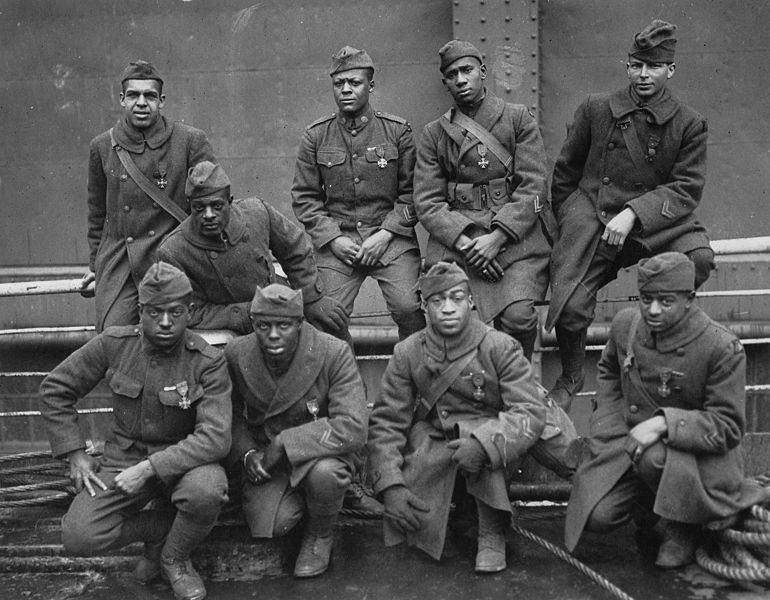
“Some of the colored men of the 369th (15th N.Y.) who won the Croix de Guerre for gallantry in action.” Left to right. Front row: Pvt. Ed Williams, Herbert Taylor, Pvt. Leon Fraitor, Pvt. Ralph Hawkins. Back Row: Sgt. H. D. Prinas, Sgt. Dan Strorms, Pvt. Joe Williams, Pvt. Alfred Hanley, and Cpl. T. W. Taylor.
Records of the War Department General and Special Staffs via Wikimedia Commons.

Formed from a New York National Guard unit, the men of the 369th learned basic military practices at Camp Whitman, New York, before being sent to Camp Wadsworth in Spartanburg, South Carolina, for combat training. They were not welcomed by many of the locals there, and some were subjected to discrimination and vile epithets for no more reason than their color. In December 1917, they were shipped to France where they expected to see action on the front lines.

Their high spirits were quickly dashed when it became apparent the Army did not want to deploy them for anything other than manual labor, far from the fighting. Even the rifles they brought with them were confiscated by US Army officials.

The commander of the American Expeditionary Force, General John J. Pershing, was reluctant to commit any US troops to the front until he felt he had assembled them in sufficient numbers to ensure victory. The French, meanwhile, were desperate for manpower. Finally bowing to French pressure, Pershing gave them the 369th. While some regarded black troops as expendable, they ultimately proved themselves indispensable.

Consider this amazing record of the Harlem Hellfighters: No American unit experienced more time in combat than they did — no less than 191 days under fire. They never lost an inch of ground. The enemy never captured a single of their number. They suffered the highest casualty rate of any US regiment. None deserted. The grateful French bestowed their highest military honor, the Croix de Guerre, upon the entire regiment. Many individuals of the regiment received the US Army’s second-highest award, the Distinguished Service Cross. Posthumously, Henry Johnson received America’s Medal of Honor in 2015. The 369th ended up as the most decorated US regiment of the war.

Another distinguishing feature of the Harlem Hellfighters was their band, the largest and best-known of any regiment. Its leader was James Reese Europe, whose enlistment in 1917 proved to be a boon for recruitment. He was one of America’s best-known black musicians and others like Noble Sissle, who became Europe’s lieutenant and lead vocalist, were eager to serve with him.

Europe’s band was extremely popular with the French, even when Europe introduced his own arrangement of La Marseillaise, France’s national anthem. The Hellfighters’ band brought both jazz and ragtime music to France, where nobody had heard either before.

January 7, 2021

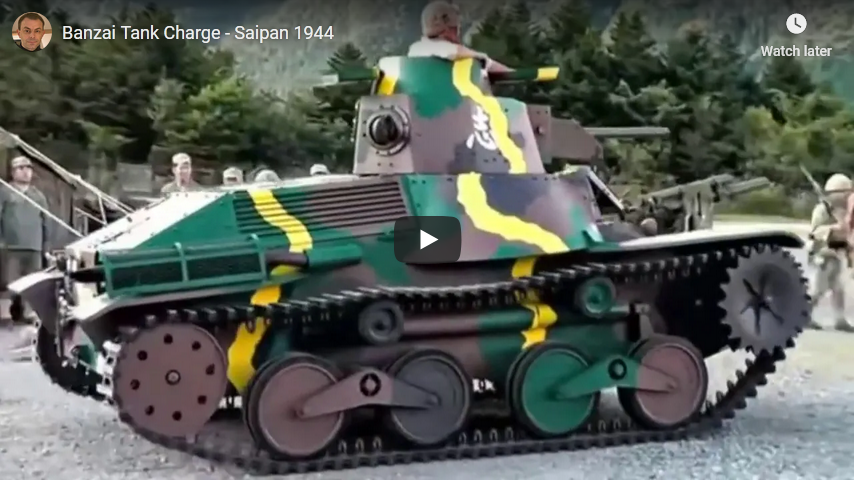
Banzai Tank Charge – Saipan 1944

Filed under: History, Japan, Military, Pacific, USA, Weapons, WW2 — Tags: , , , — Nicholas @ 04:00

Mark Felton Productions
Published 6 Jan 2020

The story of the largest tank battle of the Pacific Campaign on the island of Saipan.

Dr. Mark Felton is a well-known British historian, the author of 22 non-fiction books, including bestsellers Zero Night and Castle of the Eagles, both currently being developed into movies in Hollywood. In addition to writing, Mark also appears regularly in television documentaries around the world, including on The History Channel, Netflix, National Geographic, Quest, American Heroes Channel and RMC Decouverte. His books have formed the background to several TV and radio documentaries. More information about Mark can be found at: https://en.wikipedia.org/wiki/Mark_Fe…

Visit my audio book channel “War Stories with Mark Felton”: https://youtu.be/xszsAzbHcPE

Help support my channel:
https://www.paypal.me/markfeltonprodu…
https://www.patreon.com/markfeltonpro…

Disclaimer: All opinions and comments expressed in the ‘Comments’ section do not reflect the opinions of Mark Felton Productions. All opinions and comments should contribute to the dialogue. Mark Felton Productions does not condone written attacks, insults, racism, sexism, extremism, violence or otherwise questionable comments or material in the ‘Comments’ section, and reserves the right to delete any comment violating this rule or to block any poster from the channel.

December 2, 2020

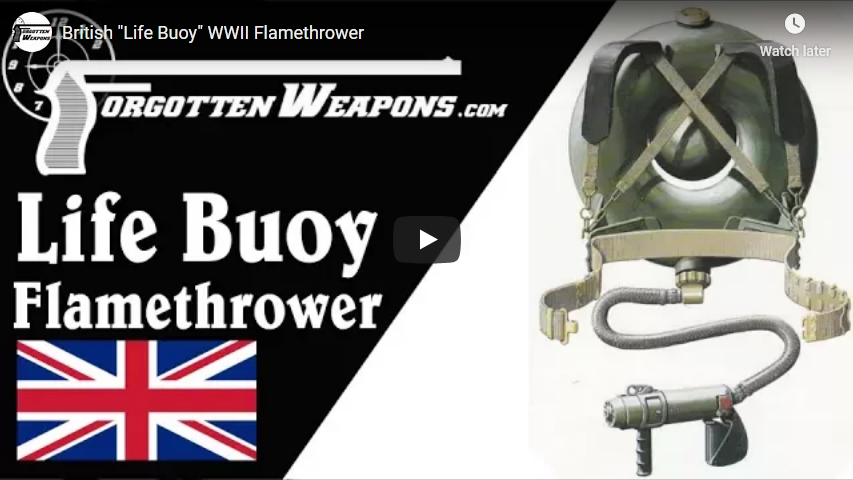
British “Life Buoy” WWII Flamethrower

Filed under: Britain, History, Military, Weapons, WW2 — Tags: , — Nicholas @ 02:00

Forgotten Weapons
Published 3 Oct 2017

http://www.patreon.com/ForgottenWeapons

One of the the flamethrower design styles to come out of experimentation late in World War One was the toroid type, with a donut-shaped fuel tank and a central spherical pressure bottle. The British continued development on this type of weapon between the wars, and used it in World War Two. While the early models used a hydrogen spark ignition system, this was replaced in 1942 by a cartridge flare system like the US and Japanese models.

The tank on this example is a fiberglass one, and very lightweight. This was introduced after World War Two, and this one is an experimental model.

Armament Research Services (ARES) is a specialist technical intelligence consultancy, offering expertise and analysis to a range of government and non-government entities in the arms and munitions field. For detailed photos of the guns in this video, don’t miss the ARES companion blog post:

http://armamentresearch.com/

Cool Forgotten Weapons merch! http://shop.bbtv.com/collections/forg…

If you enjoy Forgotten Weapons, check out its sister channel, InRangeTV! http://www.youtube.com/InRangeTVShow

December 1, 2020

Pattern 14 MKI W (T) – The Best Sniper Rifle of World War One

Filed under: Britain, History, Military, USA, Weapons, WW1 — Tags: , , , , — Nicholas @ 02:00

Forgotten Weapons
Published 30 Aug 2017

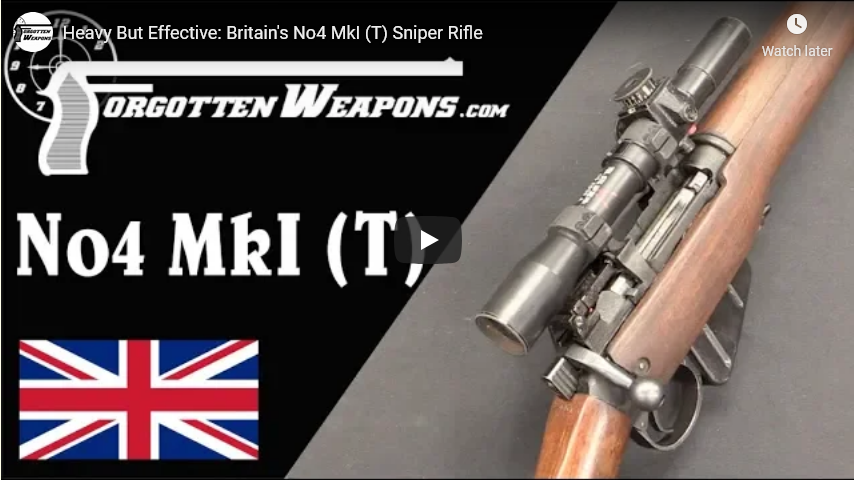
When World War One began, the British did not have a formal sniping program, and by 1915 the British found themselves thoroughly outclassed by the Germans in this area. They responded by developing tactics and equipment for sniping, and by mid 1916 they had really outclassed the Germans. However, the mid-war British sniping rifles really left a lot to be desired, even if they were being used effectively in the field. There was no single military optic, instead a wide variety of commercial scopes were rounded up and put into use. The mounts for these scopes were offset to the left side of the rifles to allow for continued use of stripper clips. Clips were arguably not really necessary on these rifles, and the offset scopes led to substantial headaches in use, as they required calculating windage as well as elevation adjustments depending on range.

Through 1918, though, the British developed one of the best sniping rifles of the war, although it would be introduced too late to see virtually any front line service. This new rifle was a Winchester-made Pattern 1914 Enfield with a center-mounted optic, and was designated the P14 MkI W(T). The P14 rifles were more accurate than the SMLE, and the centrally mounted optic made for much simpler shooting. These rifles were deemed to be mechanically capable of 1.5 MOA shooting, with the practical expected group size being 3 MOA.

Three thousand of these P14 snipers’ rifles were assembled and kept in service after the end of the war, but in the mid 1930s a small additional batch of 79 were made for the Irish Free State by BSA. These were all eventually surplussed to the US, and the rifle in this video is one of those late-production guns.

http://www.patreon.com/ForgottenWeapons

Cool Forgotten Weapons merch! http://shop.bbtv.com/collections/forg…

If you enjoy Forgotten Weapons, check out its sister channel, InRangeTV! http://www.youtube.com/InRangeTVShow

November 19, 2020

Japanese Type 10 Light Grenade Projector (aka Knee Mortar)

Filed under: History, Japan, Military, Weapons, WW2 — Tags: , , — Nicholas @ 02:00

Forgotten Weapons
Published 24 Mar 2018

In the aftermath of World War One, the Japanese military saw the utility of infantry-portable light grenade launchers instead of rifle grenades, and adopted the Type 10 in 1921 (Taisho 10). It went into production in 1923 at the Tokyo Army Arsenal, although the great Tokyo earthquake led to production being moved to Nagoya, where about 11,000 were made between 1925 and 1937. The Type 10 was a remarkably light and handy weapon, weighing just 5.5lb (2.5kg) and disassembling into a transport configuration the size of a wine bottle.

The larger Type 89 grenade launcher was adopted in 1929, which led to the older Type 10s being relegated to use for illumination and signaling, which they did through the end of World War Two.

http://www.patreon.com/ForgottenWeapons

Cool Forgotten Weapons merch! http://shop.bbtv.com/collections/forg…

If you enjoy Forgotten Weapons, check out its sister channel, InRangeTV! http://www.youtube.com/InRangeTVShow
Contact:
Forgotten Weapons
6281 N Oracle #36270
Tucson, AZ 85704

I posted Ian’s review of the Type 89 here.

November 16, 2020

US M1915 Bolo Bayonet – Dual Purpose Gear That Worked!

Filed under: History, Military, Pacific, USA, Weapons, WW1, WW2 — Tags: , , , , — Nicholas @ 02:00

Forgotten Weapons
Published 27 Nov 2017

The M1915 bolo bayonet was originally the brainchild of US Army Captain Hugh D. Wise, Quartermaster with the 9th Infantry in the Philippines. In 1902, he recommended the implement in a letter to his superior officers, noting that a bolo style of bayonet (ie, one with a widened machete-like blade) would have several advantages over the standard knife bayonet then being issued with the Krag-Jorgenson rifles the US Army was using. Specifically, the wider bayonet would be easier to recover after a thrust (he noted several instances of troopers being killed while trying to extricate their bayonets from enemies) and also (and more significantly) make an excellent and necessary bushwhacking tool in the jungle environment of the Philippines.

Wise’s idea was taken with interest and Springfield produced a series of experimental bolo bayonets, but the project ended there as the 1903 Springfield was adopted with a rod bayonet instead of a blade. Of course, the rod bayonet would be shortlived, and the blade bayonet would come back. The bolo bayonet ideas resurfaced in 1911 when a commission was formed to look into special equipment for the Philippine Scouts. After another series of experimental designs, the M1915 Bolo bayonet was formally adopted on May 22, 1915 and an order was placed for 6,000 of them to be made at Springfield Armory.

Delivery of these bayonets took place in 1915 and 1916, and they proved to be extremely popular tools with the soldiers in the Philippines. They would remain in service on the islands until World War Two, serving at last as a replacement for the M1913 cavalry saber for the 26th Cavalry.

http://www.patreon.com/ForgottenWeapons

Cool Forgotten Weapons merch! http://shop.bbtv.com/collections/forg…

If you enjoy Forgotten Weapons, check out its sister channel, InRangeTV! http://www.youtube.com/InRangeTVShow

November 15, 2020

QotD: Early successes in recruit training

Filed under: Britain, History, Humour, Military, WW1 — Tags: , — Nicholas @ 01:00

Still, we are getting on. Number Three Platoon (which boasts a subaltern) has just marched right round the barrack square, without —

(1) Marching though another platoon.

(2) Losing any part or parts of itself.

(3) Adopting a formation which brings it face to face with a blank wall, or piles it up in a tidal wave upon the verandah of the married quarters.

They could not have done that a week ago.

Ian Hay (Major John Hay Beith), The First Hundred Thousand: Being the Unofficial Chronicle of a Unit of “K(1)”, 1916.

October 30, 2020

QotD: Artillery “duels”

Filed under: Britain, Germany, History, Humour, Military, WW1 — Tags: , , — Nicholas @ 01:00

Each afternoon we creep unostentatiously into subterranean burrows, while our respective gunners, from a safe position in the rear, indulge in what they humorously describe as “an artillery duel.” The humour arises from the fact that they fire, not at one another, but at us.

Ian Hay (Major John Hay Beith), The First Hundred Thousand: Being the Unofficial Chronicle of a Unit of “K(1)”, 1916.

October 3, 2020

[Weapons 101] How does a Mortar work?

Filed under: History, Military, Weapons — Tags: , — Nicholas @ 02:00

Military History Visualized
Published 25 Mar 2016

Patreon: https://www.patreon.com/join/mhv

Modern mortars evolved from the so-called “Stokes Mortar”, but the basic principles still apply. This video gives you a short overview on mortars.

A modern mortar is a weapon that provides short-range indirect fire at high angles, usually between 45 and 80 degree. Unlike traditional (old) mortars it was relatively small and mobile, which made it well-suited for trench warfare and also maneuver warfare, because unlike unwieldy artillery it could be used directly by the infantry units at the front line.

Script and further information here: http://militaryhistoryvisualized.com/…

—Social Media—
twitter: https://twitter.com/MilHiVisualized
tumblr: http://militaryhistoryvisualized.tumb…

—Sources—
–Books–
Hogg, Ian V.: The Illustrated Encyclopedia of Ammunition

–Websites & Links–
Great video that shows the removal of several augmenting charges at around 3:00
https://www.youtube.com/watch?v=hpy9O…

http://www.globalsecurity.org/militar…

—Notes on Accuracy & “Methodology”—
Note that the mortar shell and mortar are not of the same type (and diameter in real life), but the functionality is similar.
1) The depicted Mortar Shell is a 8cm Wgr 38.
2) The depicted detailed Mortar is roughly a Esperanza 60mm Model “L” Mortar.
3) The depicted Mortars in the beginning are US M2 60mm mortars.

September 24, 2020

PIAT: Britain’s Answer to the Anti-Tank Rifle Problem

Filed under: Britain, History, Military, Weapons, WW2 — Tags: , , , — Nicholas @ 02:00

Forgotten Weapons
Published 25 Nov 2017

Sold for $3,163.

The British began World War Two with the Boys antitank rifle, but like all antitank rifles it rather quickly became obsolete. The replacement for it was adopted in 1942 as the PIAT – Projector, Infantry, Anti-Tank. This was a unique sort of weapon which fired a 3 pound (~1.35kg) hollow charge projectile using a combination of a massive spring and a firing charge much like a rifle grenade blank cartridge — a spigot mortar, really. The large (3.25″, 83mm) projectile was able to defeat almost any tank that would be developed during the war, as it could burn through 3-4 inches of hardened armor. However, it had a terrifyingly short effective range — 110 yards on paper and more like 50 yards in practice.

The PIAT would recock itself upon firing, but the initial cocking was something like a crossbow, requiring the shooter to brace their feet on the buttplate and pull the body of the weapon upwards, compressing the 200 pound (90kg) mainspring. When fired, the weapon has a pretty harsh recoil, although it did not have any flash or backblast like the American Bazooka did. By the end of the war more 115,000 PIATs had been made, and they would serve the British military into the 1950s, when they were replaced with more traditional rocket launchers.

http://www.patreon.com/ForgottenWeapons

Cool Forgotten Weapons merch! http://shop.bbtv.com/collections/forg…

If you enjoy Forgotten Weapons, check out its sister channel, InRangeTV! http://www.youtube.com/InRangeTVShow

QotD: Gurkha versus Japanese, mano a mano

Filed under: History, Humour, India, Japan, Military, Quotations, Weapons, WW2 — Tags: , — Nicholas @ 01:00

Favourite of [Field Marshal Viscount] Slim’s tales of these wonderful little fighters from the Himalayas is that of the Gurkha who met a Japanese in No Man’s Land. Jap and Gurkha decided to have it out in a duel, each using his own chosen steel. The Jap swiped at his opponent with his two handed sword, which the Gurkha avoided. Then, the Gurkha slashed with his kukri, the broad, curved knife which is his traditional weapon. “So, you missed, eh?” jeered the Jap. “You just sneeze,” said the Gurkha, “and see what happens to your head.”

“The love affair the British have with India, as Rudyard Kipling, M M Kaye, John Masters, et al, have shown”, Sikhs in Burma Campaign.

September 18, 2020

Germany’s Not-So-Light 5cm LeGrW 36 Light Mortar

Filed under: Germany, History, Military, Weapons, WW2 — Tags: , , , — Nicholas @ 02:00

Forgotten Weapons
Published 2 Sep 2018

Sold for $18,400

http://www.patreon.com/ForgottenWeapons

Cool Forgotten Weapons merch! http://shop.bbtv.com/collections/forg…

The 5cm 5CM Leichter Granatwerfer 36 was the standard German light infantry mortar going into World War Two. It was designed by Rheinmetall-Borsig in the mid 1930s and adopted in 1936. It fired a 0.9kg / 2 pound mortar bomb with a range of up to 550 meters. In theory, it occupied the same role as the French Mle 1937 50mm light mortar — except it was far heavier than was practical, and substantially more complex to use. The LeGrW 36 weighed in at a hefty 31 pounds (14kg) – nearly four times as much as its French counterpart.

It was a striker fired design, with a trigger lever and thus did not fire immediately upon a round being loaded. It used adjustments in angle to determine range, with a constant projectile velocity (as opposed to venting a varying amount of propellent gas to adjust range). By the middle of the war, it was being pulled out of front-line use, as its weight and relative complexity made it impractical for its intended role.

If you enjoy Forgotten Weapons, check out its sister channel, InRangeTV! http://www.youtube.com/InRangeTVShow

September 15, 2020

France’s Super-Light 50mm Modele 37 Grenade Launcher

Filed under: France, History, Military, Weapons, WW2 — Tags: , , , , — Nicholas @ 02:00

Forgotten Weapons
Published 1 Sep 2018

Sold for $1,725

http://www.patreon.com/ForgottenWeapons

Cool Forgotten Weapons merch! http://shop.bbtv.com/collections/forg…

A new very light and portable mortar to replace the V-B rifle grenade was one of the facets of the French plan for rearmament and modernization after World War I. The concept for the weapons that would become the L.Gr. Mle 37 was first requested in 1924 — but like so almost all the other parts of that arms program, it was crippled by delays through the 1920s and 1930s. Only in the late 1930s when war was looking imminent did the program finally move forward.

The design, created by Captain Nahan of the Chatellerault arsenal, was adopted in 1937 and a whopping 21,950 were ordered in January of 1938 — and the order was quickly revised up to 50,000. However, only 2900 had been produced by the time of the armistice in June 1940. Production resumed in 1944, and the launcher did see use in Indochina. In addition, its 50mm grenade was the basis for the postwar French rifle grenades, as used on the MAS-36 LG 48, the MAS-44, and MAS-49 rifles. As fired from the mortar, the projectile weighed about one pound (0.4kg) and had a range of 80 to 460 meters, with an effective rate of fire up to 20 rounds per minute.

If you enjoy Forgotten Weapons, check out its sister channel, InRangeTV! http://www.youtube.com/InRangeTVShow

August 31, 2020

Military Equipment of the Anglo Saxons and Vikings

Filed under: Britain, Europe, History, Military, Weapons — Tags: , , , , , , — Nicholas @ 06:00

Invicta
Published 19 Apr 2018

Today we dive into the world of Early Medieval England to analyze the military equipment available to the warring Anglo Saxons and Vikings!

Support future documentaries: https://www.patreon.com/InvictaHistory
Twitter: https://twitter.com/InvictaHistory

Documentary Credits:
Research: Invicta
Script: Invicta
Artwork: Osprey Publishing
Game: Total War Saga: Thrones of Britannia
Editing: Invicta
Music: Total War: Attila and Total War Battles: Kingdoms Soundtrack

Literary Sources
Anglo-Saxon Thegn by Mark Harrison (Osprey Publishing)
Viking Hersir 793–1066 AD by Mark Harrison (Osprey Publishing)
Saxon, Viking and Norman by Terence Wise (Osprey Publishing)

« Newer PostsOlder Posts »

Powered by WordPress