Forgotten Weapons
Published 2 Sep 2018Sold for $18,400
http://www.patreon.com/ForgottenWeapons
Cool Forgotten Weapons merch! http://shop.bbtv.com/collections/forg…
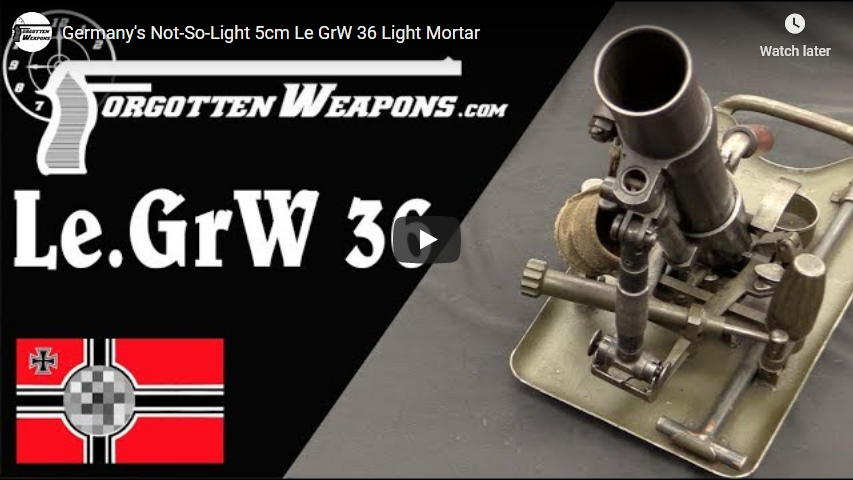
The 5cm 5CM Leichter Granatwerfer 36 was the standard German light infantry mortar going into World War Two. It was designed by Rheinmetall-Borsig in the mid 1930s and adopted in 1936. It fired a 0.9kg / 2 pound mortar bomb with a range of up to 550 meters. In theory, it occupied the same role as the French Mle 1937 50mm light mortar — except it was far heavier than was practical, and substantially more complex to use. The LeGrW 36 weighed in at a hefty 31 pounds (14kg) – nearly four times as much as its French counterpart.
It was a striker fired design, with a trigger lever and thus did not fire immediately upon a round being loaded. It used adjustments in angle to determine range, with a constant projectile velocity (as opposed to venting a varying amount of propellent gas to adjust range). By the middle of the war, it was being pulled out of front-line use, as its weight and relative complexity made it impractical for its intended role.
If you enjoy Forgotten Weapons, check out its sister channel, InRangeTV! http://www.youtube.com/InRangeTVShow
September 18, 2020
Germany’s Not-So-Light 5cm LeGrW 36 Light Mortar
September 15, 2020
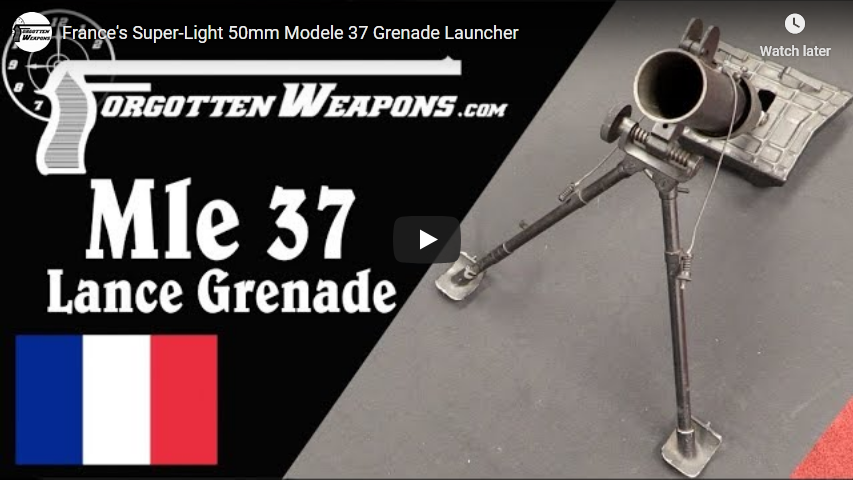
France’s Super-Light 50mm Modele 37 Grenade Launcher
Forgotten Weapons
Published 1 Sep 2018Sold for $1,725
http://www.patreon.com/ForgottenWeapons
Cool Forgotten Weapons merch! http://shop.bbtv.com/collections/forg…
A new very light and portable mortar to replace the V-B rifle grenade was one of the facets of the French plan for rearmament and modernization after World War I. The concept for the weapons that would become the L.Gr. Mle 37 was first requested in 1924 — but like so almost all the other parts of that arms program, it was crippled by delays through the 1920s and 1930s. Only in the late 1930s when war was looking imminent did the program finally move forward.
The design, created by Captain Nahan of the Chatellerault arsenal, was adopted in 1937 and a whopping 21,950 were ordered in January of 1938 — and the order was quickly revised up to 50,000. However, only 2900 had been produced by the time of the armistice in June 1940. Production resumed in 1944, and the launcher did see use in Indochina. In addition, its 50mm grenade was the basis for the postwar French rifle grenades, as used on the MAS-36 LG 48, the MAS-44, and MAS-49 rifles. As fired from the mortar, the projectile weighed about one pound (0.4kg) and had a range of 80 to 460 meters, with an effective rate of fire up to 20 rounds per minute.
If you enjoy Forgotten Weapons, check out its sister channel, InRangeTV! http://www.youtube.com/InRangeTVShow
August 31, 2020
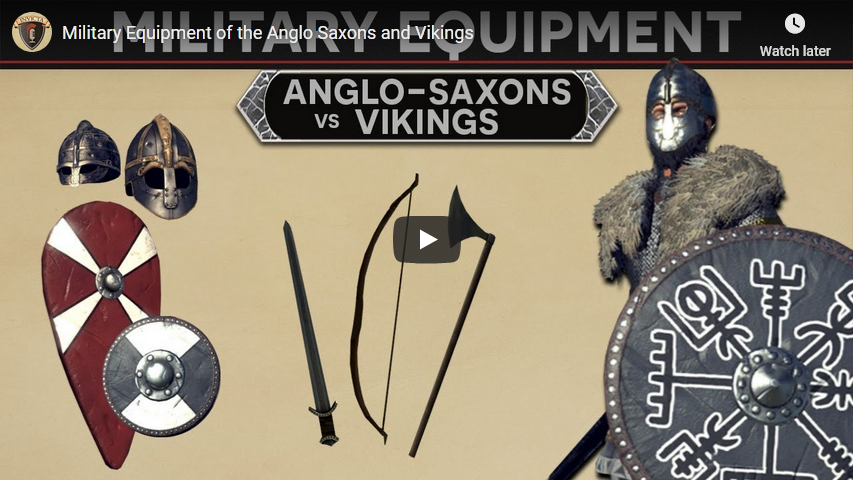
Military Equipment of the Anglo Saxons and Vikings
Invicta
Published 19 Apr 2018Today we dive into the world of Early Medieval England to analyze the military equipment available to the warring Anglo Saxons and Vikings!
Support future documentaries: https://www.patreon.com/InvictaHistory
Twitter: https://twitter.com/InvictaHistoryDocumentary Credits:
Research: Invicta
Script: Invicta
Artwork: Osprey Publishing
Game: Total War Saga: Thrones of Britannia
Editing: Invicta
Music: Total War: Attila and Total War Battles: Kingdoms SoundtrackLiterary Sources
–Anglo-Saxon Thegn by Mark Harrison (Osprey Publishing)
–Viking Hersir 793–1066 AD by Mark Harrison (Osprey Publishing)
–Saxon, Viking and Norman by Terence Wise (Osprey Publishing)
Why was Europe better with guns? – The History of Guns
History Clarified
Published 3 Dec 2018China invented gunpowder (combustible powder), so why was it the European nations that went out and conquered the world using firearms?
This video looks at some geographical factors to examine what allowed Europe to innovate while China and most of the world fell behind with gunpowder weapons.
This focuses heavily on Kenneth Chase’s Book, Firearms: A Global History to 1700. He tries to get away from just looking at drill, organization, and state production of firearms to see how geography helped create the necessary conditions for those other innovations.
Interested in your own copy? Check out the link below:
DISCLAIMER: This video description contains affiliate links, which means that if you click on one of the product links below, I’ll receive a small commission.
The map of Japan is under Creative Commons 4.0.
August 24, 2020
Why the British Army was so effective in 1914 – Learning lessons from the Boer War
History West Midlands
Published 10 Oct 2014When Britain despatched an Expeditionary Force (the BEF) to the Continent in August 1914, the German Kaiser issued an order of the day to his generals to “walk over General French’s contemptible little army”.
But despite being heavily outnumbered, this small force, including many men from the West Midlands, played a vital role in stopping the seemingly overwhelming German advance across Belgium and into France.
Small in size compared with the much larger armies of France and Germany, the BEF was highly effective. This was in stark contrast to the disasters that the British Army had experienced a few years earlier at the start of the Second Boer War (1899-1902) in South Africa.
August 1, 2020
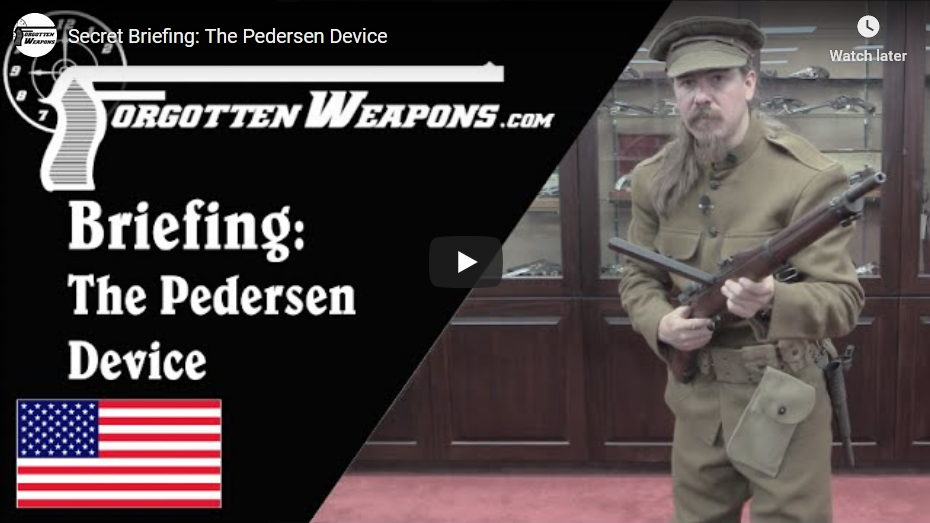
Secret Briefing: The Pedersen Device
Forgotten Weapons
Published 8 Aug 2016http://www.patreon.com/ForgottenWeapons
Welcome to your briefing on the new equipment we are issuing for the Spring Offensive of 1919. With this new secret weapon, we can finally push the Germans out of France and end the war!
July 5, 2020
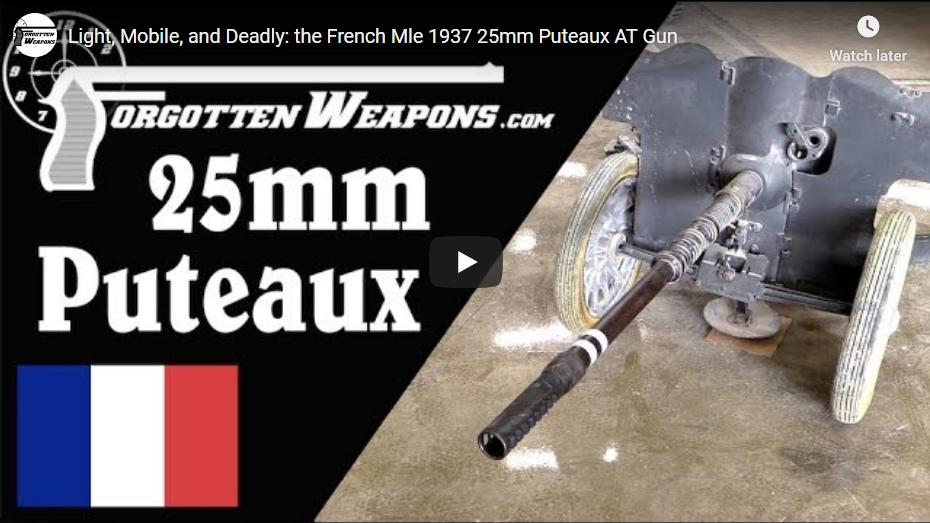
Light, Mobile, and Deadly: the French Mle 1937 25mm Puteaux AT Gun
Forgotten Weapons
Published 20 Mar 2020http://www.patreon.com/ForgottenWeapons
https://www.floatplane.com/channel/Fo…
Cool Forgotten Weapons merch! http://shop.bbtv.com/collections/forg…
After World War One, the French military set up a program to modernize all of its weaponry, and that included a replacement for the Mle 1916 light infantry cannon. An anti-tank gun had not been necessary during the Great War, as Germany never fielded tanks in substantial numbers — but as a pioneer of the modern tank, the French recognized the need for a good AT gun. Taking a lesson from World War One, they wanted a light gun that was flexible and mobile, easily moved around the battlefield and easily concealed from enemy fire. A 25mm cartridge was specified, and both the Hotchkiss company and the Puteaux arsenal created guns to use it. Both were adopted into service, with the Hotchkiss Mle 1934 being a bit heavier and the Puteaux Mle 1937 being a bit lighter, at only about 600 pounds. The Puteaux gun was quite small, easily moved by a horse or virtually any motorized vehicle. It had a long barrel and the 25mm AP projectile had a muzzle velocity of about 3150 fps, making it quite effective on the light and medium tanks of the 1930s. It was also remarkably accurate, and the long barrel and flash hider gave it a very small firing signature. Aiming was done with either a 4x magnified optic or a set of backup iron sights.
A total of 1285 of these guns were made before the armistice of June 1940, and they served ably in the Battle of France. A few were also used by the British before Dunkirk, and after the armistice they were used by German forces in limited numbers, and also supplied to Spain and Finland as military aid (this particular one has a Finnish property tag on it).
Thanks to DriveTanks.com in Uvalde Texas for giving me access to film this Puteaux cannon for you!
Contact:
Forgotten Weapons
6281 N. Oracle #36270
Tucson, AZ 85740
June 21, 2020
Burma Victory (1945)
PeriscopeFilm
Published 31 May 2016Support Our Channel: https://www.patreon.com/PeriscopeFilm
Made in 1945, BURMA VICTORY is a British documentary about the Burma Campaign during World War Two. It was directed by Roy Boulting. The introduction to the film outlines the geography and climate of Burma, and the extent of the Japanese conquests. The film then describes the establishment of the South East Asian Command (SEAC) under Mountbatten, “a born innovator and firm believer in the unorthodox”, and gives a comparatively detailed account of subsequent military events, including the Battle of Imphal-Kohima and Slim’s drive on Mandalay, Arakan landings, the northern offensive of the Americans and Chinese under Stilwell, and the roles played by Chindits and Merrill’s Marauders. The film ends with the capture of Rangoon and the Japanese surrender. The film focuses on the difficulties of climate, terrain, the endemic diseases of dysentery, malaria, etc., the vital role of air supplies, the shattering of the myth of Japanese invincibility and the secondary role of the Burma campaign in overall Allied strategy.
This film represents a British look at the campaign and was the pet project of Admiral Lord Louis Mountbatten, Supreme Allied Commander, South-East Asia, and he planned it as a joint Anglo-American production. But this scheme foundered over the inability of the U.S. leadership and British to agree on the main theme of the film. The British wanted it to concentrate on the drive southwards to liberate Burma. The Americans, anxious not to be seen to be participating in the restoration of the British Empire, wanted to emphasize the heroic building of the Ledo Road and the drive northwards to relieve the Chinese. In the end the two sides went their separate ways. The Americans produced the Ronald Reagan narrated film The Stilwell Road and the British made Burma Victory. It was the final production of the Army Film and Photographic Unit (AFPU) and was directed, like Desert Victory (1943), by Roy Boulting. Not released until after the war was over, it was hailed and promoted as “the real Burma film”.
The Burma Campaign in the South-East Asian theatre of World War II was fought primarily between the forces of the British Empire and China, with support from the United States, against the forces of the Empire of Japan, Thailand, and the Indian National Army. British Empire forces peaked at around 1,000,000 land, naval and air forces, and were drawn primarily from British India, with British Army forces (equivalent to 8 regular infantry divisions and 6 tank regiments), 100,000 East and West African colonial troops, and smaller numbers of land and air forces from several other Dominions and Colonies. The Burmese Independence Army was trained by the Japanese and spearheaded the initial attacks against British Empire forces.
The campaign had a number of notable features. The geographical characteristics of the region meant that factors like weather, disease and terrain had a major effect on operations. The lack of transport infrastructure placed an emphasis on military engineering and air transport to move and supply troops, and evacuate wounded. The campaign was also politically complex, with the British, the United States and the Chinese all having different strategic priorities.
South East Asia Command (SEAC) was the body set up to be in overall charge of Allied operations in the South-East Asian Theatre during World War II. Admiral Lord Louis Mountbatten served as Supreme Allied Commander of the South East Asia Command from October 1943 through the disbandment of SEAC in 1946.
This film is part of the Periscope Film LLC archive, one of the largest historic military, transportation, and aviation stock footage collections in the USA. Entirely film backed, this material is available for licensing in 24p HD and 2k. For more information visit http://www.PeriscopeFilm.com
June 20, 2020
Two books on WW2 – which is the memoir and which the novel?
Lindybeige
Published 4 Mar 2018Two books I have read recently. When is a book a memoir and when is it a novel? WW2 from two different perspectives.
Support me on Patreon: https://www.patreon.com/Lindybeige
The books:
From the City, From the Plough by Alexander Baron (Bernstein)
The Last Panther by Wolfgang Faust (Chris Ziedler)Buy the music – the music played at the end of my videos is now available here: https://lindybeige.bandcamp.com/track…
Lindybeige: a channel of archaeology, ancient and medieval warfare, rants, swing dance, travelogues, evolution, and whatever else occurs to me to make.
▼ Follow me…
Twitter: https://twitter.com/Lindybeige I may have some drivel to contribute to the Twittersphere, plus you get notice of uploads.
website: http://www.LloydianAspects.co.uk
May 28, 2020
Why Halftracks? Why limited to WW2 only? (Featuring Tank Fest 2018)
Military History not Visualized
Published 6 Jul 2018Disclaimer: I was invited to Tank Fest by the Tank Museum.
Why were half-tracks used in the first place? Why not trucks, fully-tracked vehicles or something else? Also, why after the Second World War did the half-track disappear? Why were there no new types produced by major powers?
Big thank you to green_goblin_z for sending me 2 books from my amazon wishlist!
»» SUPPORT MHV ««
» patreon – https://www.patreon.com/mhv
» paypal donation – https://www.paypal.com/cgi-bin/webscr…»» MERCHANDISE – SPOILS OF WAR ««
» shop – https://www.redbubble.com/people/mhvi…Military History not Visualized is a support channel to Military History Visualized with a focus personal accounts, answering questions that arose on the main channel and showcasing events like visiting museums, using equipment or military hardware.
» SOURCES «
Spielberger, Walter; Doyle, Hilary Lous, Jentz, Thomas L.: Halbkettenfahrzeuge des deutschen Heeres
Spielberger: Halftracked Vehicles of the German Army 1909-1945 (Spielberger German Armor and Military Vehicle)Zaloga, Steven J.: M3 Infantry Half-Track. 1940-73. Osprey Publishing: Oxford, UK (1992 / 2002).
Citino, Robert M.: The German Way of War. From the Thirty Years’ War to the Third Reich. University Press of Kansas: USA, 2005.
Krapke, Paul-Werner: Armor, in: Margiotta, Franklin D. (Executive Editor): Brassey’s Encyclopedia of Land Forces and Warfare. Brassey’s: Washington, USA (1996), p. 42-53
Pöhlmann, Markus: Der Panzer und die Mechanisierung des Krieges: Eine deutsche Geschichte 1890 bis 1945 (Zeitalter der Weltkriege)
Munzel, Oskar: Die deutschen gepanzerten Truppen bis 1945
Fleischer, Wolfgang: Die motorisierten Schützen und Panzergrenadiere des deutschen Heeres: 1935-1945 – Waffen, Fahrzeuge, Gliederung, Einsätze
Felberbauer, Franz: Waffentechnik I – Band 2: Geschütze, Waffen in Entwicklung, Nichttödliche Waffensysteme, Ballistik, Physikalische Grundlagen (Truppendienst)
https://www.truppendienst.com/td-buec…
May 22, 2020
“Angels Calling” Pt. 2 – Guns, Gas and Steel – Sabaton History 068 [Official]
Sabaton History
Published 21 May 2020The shadow of trench warfare is a long one. In fact the soldiers at the front did not just rely on their guns and grenades alone, but on a wartime industry to keep them fighting. Everything had to be produced in the millions. Not only rifles, cartridges and shells, but boots, helmets, spades and everything else that was used on a daily basis. The Great War was a war that thrived on a nation-wide war-economy, the likes of which had never been seen or tried before.
We would like to thank the World of Tanks team for their contribution and help with the video filming. If you’re not yet a World of Tanks player, join the game and get your hands on cool in-game stuff for free via the link: https://redir.wargaming.net/w7fwclmx/…
Support Sabaton History on Patreon: https://www.patreon.com/sabatonhistory
Listen to “Angels Calling” on the album Attero Dominatus:
CD: http://bit.ly/AtteroDominatusStore
Spotify: http://bit.ly/AtteroDominatusSpotify
Apple Music: http://bit.ly/AtteroDominatusAppleMusic
iTunes: http://bit.ly/AtteroDominatusiTunes
Amazon: http://bit.ly/AtteroDominatusAmzn
Google Play: http://bit.ly/AtteroDominatusGooglePlay
Drücken Sie zum Aktivieren des Screenreaders ⌘+Wahltaste+Z. Informationen zu Tastaturkürzeln erhalten Sie, indem Sie ⌘Schrägstrich drücken.Watch the Official Video of “Angels Calling” here:
https://www.youtube.com/watch?v=JyZ8w…Check out the trailer for Sabaton’s new album The Great War right here: https://www.youtube.com/watch?v=HCZP1…
Listen to Sabaton on Spotify: http://smarturl.it/SabatonSpotify
Official Sabaton Merchandise Shop: http://bit.ly/SabatonOfficialShopHosted by: Indy Neidell
Written by: Markus Linke and Indy Neidell
Directed by: Astrid Deinhard and Wieke Kapteijns
Produced by: Pär Sundström, Astrid Deinhard and Spartacus Olsson
Creative Producer: Joram Appel
Executive Producers: Pär Sundström, Joakim Broden, Tomas Sunmo, Indy Neidell, Astrid Deinhard, and Spartacus Olsson
Post-Production Director: Wieke Kapteijns
Edited by: Karolina Dołęga
Sound Editing by: Marek Kaminski
Maps by: Eastory – https://www.youtube.com/c/eastoryArchive by: Reuters/Screenocean https://www.screenocean.com
Music by Sabaton.Sources:
Imperial War Museum: (E(AUS) 1497),(Q 87945), (HU_91107), (Q 109611), (IWM Q 3001), (Q 69229), (Q 14945), (Q 5855), (Q 110355), (Q30009), (Q 9340), (Q 10450), (Q 70680)
Bundesarchive
National Archives NARA
Library of Scotland
Internet Archive Book Images
Bulgarian Archive State Agency
The icons from Noun Project by: Creative Mania, Chanut is Industries, Ben Davis, Vichanon Chaimsuk, Assyifa Art, chiccabubble, Nociconist, Vectors Marke, lastspark, faisal, Nun, Setyo Ari Wibowo, Mohamad Arif Prasetyo, Nibras@design,Creative Stall, Bruno Bosse, ghufronagustian, Karla Design,Gan Khoon Lay, Eucalyp, Anton, Marta Botter, Iconic, Daniel Turner, Naufal Hudallah, Phạm Thanh Lộc, Ruben Vh, Vectorstall, Icon Lauk, Mahmure Alp, Luke Anthony, Deemak Daksina, Sergey Krivoy, Andrejs Kirma, Rflor, Andrejs Kirma, Shovel by David, ProSymbols, Jake Dunham, noSimon Child, Wonmo Kang, Nubaia Karim Barsha, Nikita Kozin, Dolly Holmes, Collicon, Made by Made & Graphic Enginer
Flag of Spain recreated by HansenBCN and SanchoPanzaXXIAn OnLion Entertainment GmbH and Raging Beaver Publishing AB co-Production.
© Raging Beaver Publishing AB, 2019 – all rights reserved.
May 4, 2020
The No 4, Mk I* Lee-Enfield: Introduction
britishmuzzleloaders
Published 21 Aug 2018If you would like to support the Channel you can do so through our Patreon Page.
https://www.patreon.com/britishmuzzle…Errata –
The labelling of the “wrongly stamped” Mk III sight should be better described as “confusingly stamped” … the designation refers to the leaf …It should be clarified that the rifle has at some point spent time in India with resultant modifications and maintenance…
Also, as of the 1937 Manual, the safety catch should be applied with the forefinger of the right hand.
For your Martini and Snider needs email Martyn at xringservices@yahoo.com
And for further reading on all British Victorian (and earlier) arms stop by the British Militaria Forum and say hello. http://britishmilitariaforums.yuku.com
April 19, 2020
French Foreign Legion | Stuff That I Find Interesting
Jabzy
Published 14 Oct 2017
March 27, 2020
The Best SMLE: The No1 MkV Trials Rifle
Forgotten Weapons
Published 18 Nov 2019After World War One, the British looked at how to apply the lessons of the war to development of a new infantry rifle. Even before the war, a decision had been made to move to an aperture type rear sight — which would have been used on the Pattern 1913 Enfield, had the war no interrupted adoption of that model. So after the war, trials were made on some MkIII SMLE rifles refitted with rear aperture sights. These trials were successful enough to justify production of a substantial number of rifles for troop trials. This would be designated the No1 MkV rifle, and 20,000 of them were made between 1922 and 1924.
The magazine cutoff was retained in the MkV rifles, as were the volley sights in the initial production — along with an aperture rear sight marked out to 1500 yards. Following concerns about the durability of the sight and its adjustment latch, it was redesigned slightly, and the new version only went out to 1400 yards. On this second variation, the volley sights were omitted.
The new rifles was taken to Bisley and input was sought from both military units and civilian marksmen from the British NRA. The feedback that was received was that the sight was too fragile, its adjustments were too coarse, and the barrel was too light. These changes were implemented in the No1 MkVI rifle which would ultimately be adopted as the N4 MkI; the classic World War 2 version oft he Lee Enfield.
http://www.patreon.com/ForgottenWeapons
Cool Forgotten Weapons merch! http://shop.bbtv.com/collections/forg…
Contact:
Forgotten Weapons
6281 N. Oracle #36270
Tucson, AZ 85704
March 21, 2020
The M9A1 Bazooka: Now With Optics and Quick Takedown
Forgotten Weapons
Published 18 Aug 2018Sold for $7,475
http://www.patreon.com/ForgottenWeapons
Cool Forgotten Weapons merch! http://shop.bbtv.com/collections/forg…
The Bazooka — or rather the Launcher, Rocket, 2.36″, M1 — was introduced by the United States in 1942, the result of a fast development by two Army officers, Captain Leslie Skinner and Lt. Edward Uhl. The US had no infantry antitank weapon at that point, and it had become quite clear that such a thing was needed. The Bazooka offered a theoretical effective range of 300 yards, throwing a 1 pound hollow-charge projectile capable of penetrating 4 inches of armor plate. The 2.36 inch bore measurement, incidentally, was chosen as the inch equivalent of 60mm, to match the common mortar size.
In October of 1943, an improved M9 version was introduced, using a magnet firing system instead of the unreliable batteries of the original. A followup M9A1 variant was adopted in June of 1944, which broke down into two parts for easier transportation, and the T90 optical sight was added in September of 1944. These were effective weapons against armor early in the war, but the heavier tanks introduced late in the war were too heavily armored for the Bazooka to be very effective — although it remained a valuable tool for attacking pillboxes and other fortified positions. It would continue to see extensive service in the Korean War, although its limited armor penetration was particularly acute in that conflict.
Note that the inert M6 rocket in the video is not being sold with the Bazooka.
If you enjoy Forgotten Weapons, check out its sister channel, InRangeTV! http://www.youtube.com/InRangeTVShow