Quotulatiousness

January 7, 2020

What Made The American Civil War So Deadly? | Animated History

Filed under: Health, History, Military, USA, Weapons — Tags: , , , , — Nicholas @ 06:00

The Armchair Historian
Published 20 Jul 2018

Check out EmperorTigerStar’s video: https://www.youtube.com/watch?v=8j1sJ…

What Made The American Civil War So Deadly?

Sign up for The Armchair Historian website today:
https://www.thearmchairhistorian.com/

Our Twitter: https://twitter.com/ArmchairHist

The Great Courses Plus is currently available to watch through a web browser to almost anyone in the world and optimized for the US, UK and Australian market. The Great Courses Plus is currently working to both optimize the product globally and accept credit card payments globally.

Sources:
Battle Cry of Freedom: The Civil War Era ~ James M. McPherson
The American War: A History of the Civil War Era ~ Gary W. Gallagher
http://www.digitalhistory.uh.edu/disp…
https://blogs.ancestry.com/cm/12-stun…
https://www.battlefields.org/learn/ar…

January 6, 2020

Macedonian Battle Tactics

Filed under: Europe, Greece, History, Military — Tags: , , , — Nicholas @ 06:00

Historia Civilis
Published 5 Jul 2017

Patreon | http://patreon.com/HistoriaCivilis
Donate | http://www.paypal.com/cgi-bin/webscr?…
Merch | http://teespring.com/stores/historiac…
Twitter | http://twitter.com/HistoriaCivilis
Website | http://historiacivilis.com

Sources:
Parallel Lives, by Plutarch: http://amzn.to/2sOfr4O
Alexander of Macedon, by Peter Green: http://amzn.to/2rMJqpn
Alexander the Great, by Robin Lane Fox: http://amzn.to/2sOKqh3
Ghost on the Throne, by James Romm: http://amzn.to/2tpuNxq

We are a participant in the Amazon Services LLC Associates Program, an affiliate advertising program designed to provide a means for us to earn fees by linking to Amazon.com and affiliated sites.

Music:
“Seeing the Future,” by Dexter Britain
“Infados,” by Kevin MacLeod
“Drums of the Deep,” by Kevin MacLeod
“Hallon,” by Christian Bjoerklund

December 19, 2019

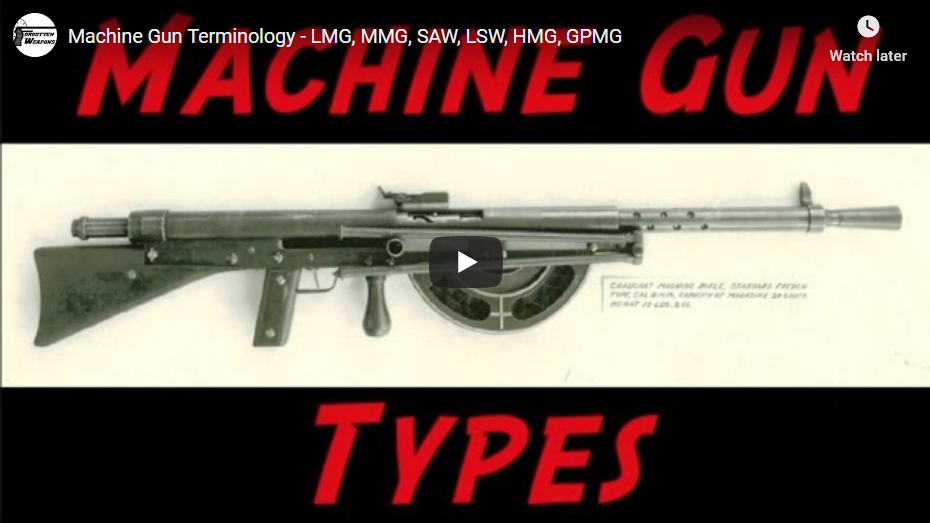
Machine Gun Terminology – LMG, MMG, SAW, LSW, HMG, GPMG

Filed under: History, Military, Weapons — Tags: , , , — Nicholas @ 02:00

Forgotten Weapons
Published 29 Dec 2017

http://www.patreon.com/ForgottenWeapons

Cool Forgotten Weapons merch! http://shop.bbtv.com/collections/forg…

Today we will look at the various different categories of machine guns — what makes them, why they exist, and what their place in military history is. Specifically …

Automatic Rifle: Shoulder or hip fired, limited magazine capacity, minimal sustained fire capacity. Examples: M1918 BAR, Chauchat.

LMG: Magazine fed, rifle caliber, bipod fired. Examples: Bren, Madsen, Lewis.

HMG: Belt fed, usually water cooled, minimal portability, fired from tripod only. Examples: Maxim, Vickers, Hotchkiss 1914. Evolved into guns of caliber 12.7mm – 20mm, like the M2 and DShK.

MMG: Air cooled, tripod fired only, belt fed. Examples: Browning 1919A4, SG-43.

GPMG: Bipod or tripod fired, belt fed, rifle caliber, quick-change barrel. Examples: MG42, PKM, M240.

SAW/LSW: Intermediate caliber, magazine fed, bipod fired. Examples: L86A1, FN Minimi, RPK.

If you enjoy Forgotten Weapons, check out its sister channel, InRangeTV! http://www.youtube.com/InRangeTVShow

December 16, 2019

Captain Fraser’s Webley-Fosbery: WWI in Microcosm

Filed under: Britain, History, Military, Weapons, WW1 — Tags: , , , — Nicholas @ 02:00

Forgotten Weapons
Published 23 Dec 2017

http://www.patreon.com/ForgottenWeapons

Cool Forgotten Weapons merchandise! http://shop.bbtv.com/collections/forg…

Captain Percy Fraser, DSO was born on January 22, 1879 and died in Ypres on the night of February 23, 1915 while attempting to aid men wounded outside their trench. His unit of the Queen’s Own Cameron Highlanders would suffer horrendous casualties at Ypres, and today we will look at his Webley-Fosbery automatic revolver and his service in the British Army.

Thanks to Mike Carrick of Arms Heritage magazine for sharing Captain Fraser’s story and revolver. See his regular column here: https://armsheritagemagazine.com

If you enjoy Forgotten Weapons, check out its sister channel, InRangeTV! http://www.youtube.com/InRangeTVShow

December 13, 2019

“Resist And Bite” – Chasseurs Ardennais – Battle of Belgium – Sabaton History 045 [Official]

Filed under: Europe, Germany, History, Media, Military, WW2 — Tags: , , , , , — Nicholas @ 04:00

Sabaton History
Published 12 Dec 2019

As Germany invades France and the Benelux countries in May 1940, the main bulk of their panzers are heading towards the Ardennes and the Meuse River in an effort to cut the Allied forces in half. However, two small units of Belgian infantry are standing in their way. They are the Chasseurs Ardennais and have one objective: To delay the Germans by every means necessary…

Support Sabaton History on Patreon: https://www.patreon.com/sabatonhistory

Listen to Heroes (where “Resist And Bite” is featured):
CD: http://bit.ly/HeroesStore
Spotify: http://bit.ly/HeroesSpotify
Apple Music: http://bit.ly/HeroesAppleMusic
iTunes: http://bit.ly/HeroesiTunes
Amazon: http://bit.ly/HeroesAmz
Google Play: http://bit.ly/HeroesGoogleP

Watch the official lyric video of “Resist And Bite” here:
https://www.youtube.com/watch?v=iGtEH…

Listen to Sabaton on Spotify: http://smarturl.it/SabatonSpotify
Official Sabaton Merchandise Shop: http://bit.ly/SabatonOfficialShop

Hosted by: Indy Neidell
Written by: Markus Linke and Indy Neidell
Directed by: Astrid Deinhard and Wieke Kapteijns
Produced by: Pär Sundström, Astrid Deinhard and Spartacus Olsson
Creative Producer: Joram Appel
Executive Producers: Pär Sundström, Joakim Broden, Tomas Sunmo, Indy Neidell, Astrid Deinhard, and Spartacus Olsson
Post-Production Director: Wieke Kapteijns
Production Intern: Rune Væver Hartvig
Edited by: Iryna Dulka
Sound Editing by: Marek Kaminski
Maps by: Eastory – https://www.youtube.com/c/eastory

Archive by: Reuters/Screenocean https://www.screenocean.com
Music by Sabaton.

Colorizations:
– Julius Jääskeläinen – https://www.facebook.com/JJcolorization/
– Olga Shirnina, a.k.a. Klimbim – https://klimbim2014.wordpress.com/

An OnLion Entertainment GmbH and Raging Beaver Publishing AB co-Production.

© Raging Beaver Publishing AB, 2019 – all rights reserved.

From the comments:

Sabaton History
2 days ago (edited)
Today we again turn towards the Second World War — to be more specific the 1940 German invasion of France and the Benelux. Here two small Belgian units bravely attempted to delay the advance of the Wehrmacht. We hope you all appreciate this video! And much like the Chasseur Ardennais supported the war effort of the Belgians, our awesome Patrons support the war effort of us, the Sabaton History team! So if you haven’t, you most certainly should consider supporting us on https://www.patreon.com/sabatonhistory.

Oh and if you’re interested in World War Two, you should definitely check out Indy’s World War Two Channel (http://www.youtube.com/c/worldwartwo) where he covers WW2 Week-by-week. Last May, he covered the invasion of the Benelux and France, which you can check out right here: https://youtu.be/DLN8NHXiMy0

Cheers, the Sabaton History team!

December 4, 2019

What Life Was Like for the Home Guard During WW2

Filed under: Britain, History, Military, WW2 — Tags: , , — Nicholas @ 02:00

Forces TV
Published 8 May 2014

Scrapbooks revealing what the Home Guard was really like during World War Two have been published online.

The collection of maps, photographs and secret documents were compiled by Lieutenant Colonel Sir Morgan Crofton.

Now they are available for all to see thanks to work by the New Forest Park Authority.

The scrapbooks can be viewed online here – http://www.newforestww2.org

November 29, 2019

Why was Cavalry Used in Warfare? | Animated History

Filed under: History, Military — Tags: , , — Nicholas @ 02:00

The Armchair Historian
Published 11 Jan 2018

Why was Cavalry used in warfare?

Our Website: https://www.thearmchairhistorian.com/

Our Twitter:
@ArmchairHist

Sources: https://en.wikipedia.org/wiki/Horses_…
http://www.napolun.com/mirror/napoleo…
http://napoleonistyka.atspace.com/cav…
https://en.wikipedia.org/wiki/Cavalry…
https://ehistory.osu.edu/exhibitions/…
http://www.cincinnaticwrt.org/data/cc…
http://www.napolun.com/mirror/web2.ai…

Music: Music: Antonio Salieri: “Twenty six variations on La Folia de Spagna

From the comments:

The Armchair Historian
1 year ago

So two things….

1. A lot of people are saying the video is an oversimplification. You’re exactly right, this is a prelude of a series I’ll be doing covering all types of cavalry from all different eras, as well as tanks. I’ll be covering mainly the abstract, and the concepts, and less of all the specific numbers and statistics. This video is to act as an intro.

2. A lot of people are saying cavalry and tanks aren’t the same. You’re right again, but here’s what I meant in the video. The tank replaced the cavalry, and still fulfills the abstract usage of cavalry, as a decisive shock unit. You don’t have many of them, they’re more expensive, and they hit harder than their counterparts, infantry, and artillery. Of course tanks are not used in the same way cavalry was in warfare, but as cavalry left they were replaced by armor. In fact, many people tried to use tanks just like cavalry, but it didn’t work. It took up until the end of WW2 for most generals to realize this.

Hope that clears some stuff up,

Griff

To give an example of his second point, the British use of “cruiser” tanks in the Western Desert campaign of World War 2 typified the “it’s just an armoured horse” view of tanks. Disproportional British tank losses to German anti-tank guns was the usual result.

November 13, 2019

Conclusions from a mock battle

Filed under: History, Military — Tags: , , , — Nicholas @ 02:00

Lindybeige
Published 19 Jul 2013

Re-enactment is a form of experimental archaeology.

http://www.LloydianAspects.co.uk

October 18, 2019

“Angels Calling” – Trench Warfare – Sabaton History 037 [Official]

Filed under: History, Media, Military, WW1 — Tags: , , , — Nicholas @ 06:00

Sabaton History
Published 17 Oct 2019

Trench Warfare was the reality for countless soldiers fighting on the the fronts of World War One. It was a hell on earth. Soldiers had to endure mud, cold, stench of decaying bodies, endless artillery and gas barrages and enemy raiding parties. The Sabaton Song “Angels Calling” is about daily life on the frontlines of The Great War.

Support Sabaton History on Patreon: https://www.patreon.com/sabatonhistory

Listen to Attero Dominatus (where “Angels Calling” is featured):
CD: http://bit.ly/AtteroDominatusStore
Spotify: http://bit.ly/AtteroDominatusSpotify
Apple Music: http://bit.ly/AtteroDominatusAppleMusic
iTunes: http://bit.ly/AtteroDominatusiTunes
Amazon: http://bit.ly/AtteroDominatusAmzn
Google Play: http://bit.ly/AtteroDominatusGooglePlay

Check out the trailer for Sabaton’s new album The Great War right here: https://www.youtube.com/watch?v=HCZP1…

Listen to Sabaton on Spotify: http://smarturl.it/SabatonSpotify
Official Sabaton Merchandise Shop: http://bit.ly/SabatonOfficialShop

Hosted by: Indy Neidell
Written by: Markus Linke and Indy Neidell
Directed by: Astrid Deinhard and Wieke Kapteijns
Produced by: Pär Sundström, Astrid Deinhard and Spartacus Olsson
Creative Producer: Joram Appel
Executive Producers: Pär Sundström, Joakim Broden, Tomas Sunmo, Indy Neidell, Astrid Deinhard, and Spartacus Olsson
Post-Production Director: Wieke Kapteijns
Maps by: Eastory
Edited by: Iryna Dulka
Sound Editing by: Marek Kaminski

Eastory YouTube Channel: https://www.youtube.com/channel/UCEly…
Archive by: Reuters/Screenocean https://www.screenocean.com
Music by Sabaton.

Sources:
National Army Museum
National Library of Scotland
Bibliothèque nationale de France
Wellcome Images
Sleeping soldiers courtesy of FORTEPAN/Komlós Péter
Crosshair by DTDesign from the Noun Project
Colorized photos by Alexander Vedel Christensen
IWM: Q 69986, Q 45584, Q 6420, Q 6419, Q 33350, Q 745, Q 6421, Q 24579, Q 10685, Q 445, Q 32420, Q 517, Q 65065, Q 69983, Q 79501, Q 9333, E(AUS) 572, E(AUS) 1497, Q 6969

An OnLion Entertainment GmbH and Raging Beaver Publishing AB co-Production.

© Raging Beaver Publishing AB, 2019 – all rights reserved.

From the comments:

Sabaton History
2 days ago
What? The Sabaton History special editions of EVERY album? Nooo.. Really? Sounds awesome! And.. How can I get those? … As a reward for supporting Sabaton History on Patreon? Get out of here! .. Oh.. I should head over to https://www.patreon.com/sabatonhistory to check it out? Gotcha! Cheers!

October 6, 2019

Shieldwalls

Filed under: Greece, History, Military — Tags: , , , — Nicholas @ 02:00

Lindybeige
Published on 24 Mar 2011

This may address many of the comments I had for my spears video. Many of my theories are based on the I think fairly reliable notion that people in the past were similar to people today in that they tended towards a desire for self-preservation, and away from reckless bravery.

http://www.LloydianAspects.co.uk

September 22, 2019

Gladius VS Spatha – Why Did The Empire Abandon The Gladius?

Filed under: Europe, History, Military, Weapons — Tags: , , , , — Nicholas @ 02:00

Metatron
Published on 11 Feb 2017

If the famous Gladius/rectangular Scutum combo had proven to be so effective for so many centuries why did the Late Empire Romans choose to abandon it in favour of a spatha/round shield combination? Here is what I think.

Gladius was one Latin word for sword, and is used to represent the primary sword of Ancient Roman foot soldiers.

A fully equipped Roman legionary after the reforms of Gaius Marius was armed with a shield (scutum), one or two javelins (pila), a sword (gladius), often a dagger (pugio), and, perhaps in the later Empire period, darts (plumbatae). Conventionally, soldiers threw javelins to disable the enemy’s shields and disrupt enemy formations before engaging in close combat, for which they drew the gladius. A soldier generally led with the shield and thrust with the sword. All gladius types appear to have been suitable for cutting and chopping as well as thrusting.

Gladius is a Latin masculine second declension noun. Its (nominative and vocative) plural is gladiī. However, gladius in Latin refers to any sword, not specifically the modern definition of a gladius. The word appears in literature as early as the plays of Plautus (Casina, Rudens).

Modern English words derived from gladius include gladiator (“swordsman”) and gladiolus (“little sword”, from the diminutive form of gladius), a flowering plant with sword-shaped leaves.

Gladii were two-edged for cutting and had a tapered point for stabbing during thrusting. A solid grip was provided by a knobbed hilt added on, possibly with ridges for the fingers. Blade strength was achieved by welding together strips, in which case the sword had a channel down the center, or by fashioning a single piece of high-carbon steel, rhomboidal in cross-section. The owner’s name was often engraved or punched on the blade.

July 12, 2019

“Devil Dogs” – U.S. Marines – Sabaton History 023 [Official]

Filed under: Germany, History, Media, Military, USA, WW1 — Tags: , , , — Nicholas @ 06:00

Sabaton History
Published on 11 Jul 2019

The United States entered the battlefields of Europe in 1918. Among the first Americans to participate in the fight were the U.S. Marines, who quickly adopted the name “Devil Dogs”. One of their most notable engagements is the Battle of Belleau Wood in June 1918, where the Marines fought the battle-hardened Germans for 26 days.

Support Sabaton History on Patreon (and possibly get a History Channel special edition): https://www.patreon.com/sabatonhistory

Pre-order The Great War here: https://www.sabaton.net/pre-order-of-…

Check out the trailer for Sabaton’s new album The Great War right here: https://www.youtube.com/watch?v=HCZP1…

Watch more videos on the Sabaton YouTube channel: https://www.youtube.com/user/Sabaton?…
Listen to Sabaton on Spotify: http://smarturl.it/SabatonSpotify
Official Sabaton Merchandise Shop: http://bit.ly/SabatonOfficialShop

Hosted by: Indy Neidell
Written by: Markus Linke and Indy Neidell
Directed by: Astrid Deinhard and Wieke Kapteijns
Produced by: Pär Sundström, Astrid Deinhard and Spartacus Olsson
Creative Producer: Joram Appel
Executive Producers: Pär Sundström, Joakim Broden, Tomas Sunmo, Indy Neidell, Astrid Deinhard, and Spartacus Olsson
Maps by: Eastory
Edited by: Iryna Dulka
Sound Editing by: Marek Kaminski

Eastory YouTube Channel: https://www.youtube.com/channel/UCEly…
Archive by: Reuters/Screenocean https://www.screenocean.com
Music by Sabaton.

Sources:
IWM: Q 61342, Q 70181, NTB 319-2, IWM 687, 1061-08e, IWM 508-67, IWM 501-9, IWM 435, IWM 778, Q 98994, IWM 484

An OnLion Entertainment GmbH and Raging Beaver Publishing AB co-Production.

© Raging Beaver Publishing AB, 2019 – all rights reserved.

From the comments:

Sabaton History
2 days ago
This episode is about the US Marines and their actions during the Battle of Belleau Wood in 1918. While most of the footage in this episode is depicting the Marines and the Germans in 1918, and some of it is even depicting the actual fighting in Belleau wood, there is not a whole lot footage or imagery from the action. So for whoever is enough of a history buff to spot that some of our illustrative material is in fact depicting other engagements, well spotted! We try to use authentic material whenever we can, but in the end we have to make an episode visually attractive and dramatic, and we can’t do that with just looking at Indy’s head for 15 minutes (although I’m sure that many of you wouldn’t mind). That was the announcement. Peace, rock on and cheers!

June 9, 2019

Making the legendary service Khukuri/Kukri of British Gurkhas – KHHI Nepal

Filed under: Asia, History, Technology, Weapons — Tags: , , , — Nicholas @ 02:00

KHHI Nepal
Published on 26 Mar 2018

See how a scrap of steel is converted into a piece of mastery craft by our men @ duty. All bear hands, hard labor, years of experience and great skill. Pls enjoy it!!

Is the original 2016-17 British Gurkhas Issue issued to the new recruits as their training, exercise, utility and even as a combat knife.

Product link :
https://www.thekhukurihouse.com/2016-17-british-standard-issue-bsi-2-kukri

#makingkhukuri #bsikukri #servicekukri #gurkhaknife

June 6, 2019

Bloody Normandy: Juno Beach and Beyond – Part 1

Filed under: Cancon, France, History, Military, WW2 — Tags: , , , , — Nicholas @ 02:00

canmildoc
Published on 17 Sep 2011

Part 1 of 5

Documentary “Stories from the Second World War: Bloody Normany”.

Juno or Juno Beach was one of five sectors of the Allied invasion of German-occupied France in the Normandy landings on 6 June 1944, during the Second World War. The sector spanned from Saint-Aubin, a village just east of the British Gold sector, to Courseulles, just west of the British Sword sector. The Juno landings were judged necessary to provide flanking support to the British drive on Caen from Sword, as well as to capture the German airfield at Carpiquet west of Caen. Taking Juno was the responsibility of the 3rd Canadian Infantry Division and commandos of the Royal Marines, with support from Naval Force J, the Juno contingent of the invasion fleet, including ships of the Royal Canadian Navy (RCN). The beach was defended by two battalions of the German 716th Infantry Division, with elements of the 21st Panzer Division held in reserve near Caen.

The invasion plan called for two brigades of the 3rd Canadian Division to land in two subsectors — Mike and Nan — focusing on Courseulles, Bernières, and Saint-Aubin. It was hoped that preliminary naval and air bombardment would soften up the beach defences and destroy coastal strongpoints. Close support on the beaches was to be provided by amphibious tanks of the 2nd Canadian Armoured Brigade. Once the landing zones were secured, the plan called for the 9th Canadian Infantry Brigade to land reserve battalions and deploy inland, the Royal Marine commandos to establish contact with the British 3rd Infantry Division on Sword, and the 7th Canadian Infantry Brigade to link up with the British 50th (Northumbrian) Infantry Division on Gold. The 3rd Canadian Division’s D-Day objectives were to capture Carpiquet Airfield and reach the Caen-Bayeux railway line by nightfall.

The landings initially encountered heavy resistance from the German 716th Division; the preliminary bombardment proved less effective than had been hoped, and rough weather forced the first wave to be delayed until 07:35. Several assault companies — notably those of the Royal Winnipeg Rifles and The Queen’s Own Rifles of Canada — took heavy casualties in the opening minutes of the first wave. Strength of numbers, as well as coordinated fire support from artillery and armoured squadrons, cleared most of the coastal defences within two hours of landing. The reserves of the 7th and 8th brigades began deploying at 08:30 (along with the Royal Marines), while the 9th Brigade began its deployment at 11:40.

The subsequent push inland towards Carpiquet and the Caen-Bayeux railway line achieved mixed results. The sheer numbers of men and vehicles on the beaches created lengthy delays between the landing of the 9th Brigade and the beginning of substantive attacks to the south. The 7th Brigade encountered heavy initial opposition before pushing south and making contact with the 50th Infantry Division at Creully. The 8th Brigade encountered heavy resistance from a battalion of the 716th at Tailleville, while the 9th Brigade deployed towards Carpiquet early in the evening. Resistance in Saint-Aubin prevented the Royal Marines from establishing contact with the British 3rd Division on Sword. When all operations on the Anglo-Canadian front were ordered to halt at 21:00, only one unit had reached its D-Day objective, but the 3rd Canadian Infantry Division had succeeded in pushing farther inland than any other landing force on D-Day. – http://en.wikipedia.org/wiki/Juno_beach

March 26, 2019

Donning hoplite armour

Filed under: Europe, Greece, History, Military — Tags: , , , — Nicholas @ 02:00

Lindybeige
Published on 28 Sep 2016

How long does it take a hoplite to get ready for action? Watch one incompetent one time himself as he dons his panoply.

Support me on Patreon: https://www.patreon.com/Lindybeige

More weapons and armour videos here: https://www.youtube.com/playlist?list…

Some game systems have rules on how long it takes to put on armour. Here I give you some practical hints as to how long it actually takes. Yes, the sword and shield are just mock-ups, but the time it takes to take them up is probably about the same as the real thing.

Was this really shot in ancient Greece? No, it was a park in Gosforth, near a primary school and with aircraft flying overhead and a breeze just strong enough to create constant rustling of leaves and occasional wind noise on the microphones.

Buy the music – the music played at the end of my videos is now available here: https://lindybeige.bandcamp.com/track…
Lindybeige: a channel of archaeology, ancient and medieval warfare, rants, swing dance, travelogues, evolution, and whatever else occurs to me to make.

▼ Follow me…

Twitter: https://twitter.com/Lindybeige I may have some drivel to contribute to the Twittersphere, plus you get notice of uploads.

website: http://www.LloydianAspects.co.uk

« Newer PostsOlder Posts »

Powered by WordPress