
World War Two
Published 13 February 2025November 1930 sees Germany caught between political instability and international disputes. Brüning fights to pass his controversial budget while Germany’s push for global disarmament meets French resistance and Nazi outrage. Meanwhile, Hitler restructures the SA and SS, student duels make headlines, and Berlin’s police chief is attacked in court.
(more…)
February 14, 2025
Disarmament Talks, Budget Battles, and Student Duels – Nov 1930
Comments Off on Disarmament Talks, Budget Battles, and Student Duels – Nov 1930
January 30, 2025
Hitler Testifies, Brüning Battles On – Rise of Hitler 10, October 1930
World War Two
Published 28 Jan 2025October 1930 brings more unrest to Weimar Germany. Chancellor Brüning survives no-confidence votes, while Nazi and Communist clashes escalate into chaos. Berlin sees mass protests, Jewish businesses attacked, and rumors of a Nazi-Soviet conspiracy swirl.
(more…)
Comments Off on Hitler Testifies, Brüning Battles On – Rise of Hitler 10, October 1930
December 20, 2024
Election Fever – Rise of Hitler 08, August 1930
World War Two
Published 19 December 2024August 1930 brings Germany to a critical juncture as parties prepare for the September elections. Amid street violence, bans on political uniforms, and soaring unemployment, the stakes couldn’t be higher. This episode unpacks the campaign strategies, shifting alliances, and rising tensions shaping the Republic’s future.
(more…)
Comments Off on Election Fever – Rise of Hitler 08, August 1930
December 8, 2024
President Hindenburg dissolves the Reichstag – Rise of Hitler 07, July 1930
World War Two
Published 7 Dec 2024July 1930 sees the Weimar Republic facing unprecedented turmoil. From Brüning’s budget crisis and the Reichstag‘s dissolution to Nazi and Communist clashes with state governments, Germany braces for a pivotal election in September. This episode unpacks the month’s chaos, political maneuvers, and the rising tensions tearing the Republic apart.
(more…)
Comments Off on President Hindenburg dissolves the Reichstag – Rise of Hitler 07, July 1930
November 1, 2024
QotD: J.D. Vance, a Führer for the rest of us
Expert: JD Vance’s selection as Trump’s running mate marks the end of Republican conservatism
Quoted for the lulz. Ol’ JD, a Führer for the rest of us.
But since we’re here … a fascinating footnote in Jaynes informs us that schizophrenics, who Jaynes thinks might be throwbacks to the “bicameral mind”, have no problem with “diffused identity” or whatever the term was. Jaynes hypothesizes that ancient, preconscious peoples didn’t see images of their gods in cult objects; they saw the actual, physical gods. We unicameral people can’t wrap our heads around it, since there are lots of statues and they can’t ALL be god — even if we grant that the biggest statue in the best temple can be god, or if we allow that the black meteorite or whatever is really god to them, still, god can’t be diffused like that: Either your statue is god or mine is; or neither of them are, but they can’t both be.
Schizophrenics, at least according to Jaynes, would be down with that. He notes that you can put two guys who think they’re Napoleon in the same padded cell, and you don’t get a schizo bum fight, you get complete agreement: They’re both Napoleon, somehow. The law of the excluded middle, personal identity version, simply doesn’t apply.
And since my hypothesis is that smartphones are re-decameralizing (it’s a word) us at Ludicrous Speed, well … here you go. Donald Trump is Hitler, but J.D. Vance is somehow also Hitler. It’s not like the real, historical Hitler lacked for shitty, evil underlings — J.D could easily be Heinrich Himmler or somebody. But no, he’s gotta be Hitler, the same way Trump has to be Hitler, and if that means they’re somehow both Hitler, well … there it is. Bicamerality for the win.
Severian, “Catching Up With the Crazies”, Founding Questions, 2024-07-29.
Comments Off on QotD: J.D. Vance, a Führer for the rest of us
October 28, 2024
History of the Krummlauf Device: Hitler’s Folly (One of Many)
Forgotten Weapons
Published Jul 7, 2024Today we are taking a look at the backstory of the famously recognizable Krummlauf device, the curved barrel attachment for the StG-44. It is really a perfect example of how German late-war desperation weapons took shape. It went from an idea nobody actually wanted to an impossible development program in the chaos of the German defeat.
You can see my previous video on an example of the Krummlauf (from 2014) here:
https://youtu.be/HSsFiS2VoxgAnd definitely check out Garand Thumb‘s video shooting an original one here:
https://www.youtube.com/watch?v=cO2Gu…
(more…)
Comments Off on History of the Krummlauf Device: Hitler’s Folly (One of Many)
October 26, 2024
Thank goodness somebody finally had the courage to say that Trump is a fascist
I mean it’s been obvious since his supporters have been goose-stepping around the Reichstag the White House in their brown shirts, red armbands, and constant chanting of the “Horst Wessel Lied“. How have the mainstream media managed to avoid seeing the clear inspiration of Trump’s Kampf and reporting it to credulous flyover state cretins Americans?
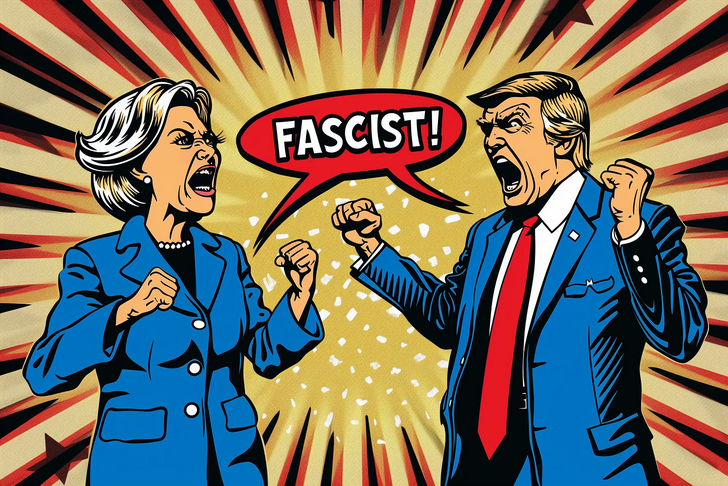
This week Kamala Harris described Donald Trump as a “fascist” who seeks “unchecked power”. Conservative commentators have expressed outrage at this absurd strategy, one which will doubtless backfire. And yet they appear to have forgotten that Trump has repeatedly referred to Harris as a “fascist” and, one on occasion, called her a “Marxist, communist, fascist, socialist”.
We have grown accustomed to the tactics of social media, the online crèche where those who bawl the loudest are rewarded with treats. What has become known as “Godwin’s Law” states that the longer an online discussion continues, the higher the probability that a comparison with the Nazis or Hitler will take place. Even Godwin has succumb to Godwin’s Law, penning an article for the Washington Post last December with the headline: “Yes, it’s okay to compare Trump to Hitler. Don’t let me stop you.”
If this election is going to be reduced to each candidate shouting “fascist” at the other, we may as well give up hope. I have never been more convinced of the growing infantilism of political discourse than in the last few weeks, or that the US is now divided – perhaps irreparably – between two groups who see the world in entirely incommensurable ways. With sensible discussion now seemingly impossible, the election has descended into a battle of memes.
Harris’s campaign team, for instance, gleefully embraced the “Brat” identity bestowed upon their candidate by Charli XCX. I must confess that I have no idea who Charli XCX might be. Her surname in Roman numerals means 100 – 10 + 10, so I can only assume she’s a classical scholar making a sardonic point about the philosophical principle of eternal recurrence.
Likewise, Trump’s now infamous reference to the eating of cats and dogs in Springfield, Ohio, has been remixed multiple times and shared more widely than any campaign statement. All of which is very funny, but one might be forgiven for yearning that the election of the leader of the free world should be a generally humourless affair. International conflicts are not best resolved through a series of “yo momma” jokes.
This week I wrote a piece for the Washington Post about George Orwell’s essays, and the lessons that might still be gleaned from them. Specifically, I pointed out that Orwell continually cautioned against tribal thinking, and is still despised today in certain left-wing circles for reminding his readers that authoritarianism can occur on both sides of the political aisle. I quoted Orwell’s essay “Notes on Nationalism” (1945), in which he identified “the habit of identifying oneself with a single nation or unit, placing it beyond good and evil and recognizing no other duty than that of advancing its interests.” I also quoted his dismay that the word “fascist” is so commonly misused. The piece can be read here.
I don’t often read the comments under my articles (except for here on Substack, of course), but I was interested to see how the overwhelmingly Democrat-supporting readership of the Washington Post might react. The comments are extremely revealing, given that most of those wading in seem determined to prove my point. I have rarely seen such unthinking and flagrant tribalism on display. Apparently, Trump is a literal “fascist”, and Orwell would have been the first to identify him as such. Orwell, of course, took up arms against actual fascists in Spain and was shot in the throat for his troubles. Would these commentators argue that if Orwell were alive today he would have packed up his gun and headed for the US in the run-up to this election? If not, why not?
Comments Off on Thank goodness somebody finally had the courage to say that Trump is a fascist
October 11, 2024
QotD: Fascists are inherently bad at war
For this week’s musing, I wanted to take the opportunity to expand a bit on a topic that I raised on Twitter which draw a fair bit of commentary: that fascists and fascist governments, despite their positioning are generally bad at war. And let me note at the outset, I am using fascist fairly narrowly – I generally follow Umberto Eco’s definition (from “Ur Fascism” (1995)). Consequently, not all authoritarian or even right-authoritarian governments are fascist (but many are). Fascist has to mean something more specific than “people I disagree with” to be a useful term (mostly, of course, useful as a warning).
First, I want to explain why I think this is a point worth making. For the most part, when we critique fascism (and other authoritarian ideologies), we focus on the inability of these ideologies to deliver on the things we – the (I hope) non-fascists – value, like liberty, prosperity, stability and peace. The problem is that the folks who might be beguiled by authoritarian ideologies are at risk precisely because they do not value those things – or at least, do not realize how much they value those things and won’t until they are gone. That is, of course, its own moral failing, but society as a whole benefits from having fewer fascists, so the exercise of deflating the appeal of fascism retains value for our sake, rather than for the sake of the would-be fascists (though they benefit as well, as it is, in fact, bad for you to be a fascist).
But war, war is something fascists value intensely because the beating heart of fascist ideology is a desire to prove heroic masculinity in the crucible of violent conflict (arising out of deep insecurity, generally). Or as Eco puts it, “For Ur-Fascism there is no struggle for life, but, rather, life is lived for struggle … life is permanent warfare” and as a result, “everyone is educated to become a hero“. Being good at war is fundamentally central to fascism in nearly all of its forms – indeed, I’d argue nothing is so central. Consequently, there is real value in showing that fascism is, in fact, bad at war, which it is.
Now how do we assess if a state is “good” at war? The great temptation here is to look at inputs: who has the best equipment, the “best” soldiers (good luck assessing that), the most “strategic geniuses” and so on. But war is not a baseball game. No one cares about your RBI or On-Base percentage. If a country’s soldiers fight marvelously in a way that guarantees the destruction of their state and the total annihilation of their people, no one will sing their praises – indeed, no one will be left alive to do so.
Instead, war is an activity judged purely on outcomes, by which we mean strategic outcomes. Being “good at war” means securing desired strategic outcomes or at least avoiding undesirable ones. There is, after all, something to be said for a country which manages to salvage a draw from a disadvantageous war (especially one it did not start) rather than total defeat, just as much as a country that conquers. Meanwhile, failure in wars of choice – that is, wars a state starts which it could have equally chosen not to start – are more damning than failures in wars of necessity. And the most fundamental strategic objective of every state or polity is to survive, so the failure to ensure that basic outcome is a severe failure indeed.
Judged by that metric, fascist governments are terrible at war. There haven’t been all that many fascist governments, historically speaking and a shocking percentage of them started wars of choice which resulted in the absolute destruction of their regime and state, the worst possible strategic outcome. Most long-standing states have been to war many times, winning sometimes and losing sometimes, but generally able to preserve the existence of their state even in defeat. At this basic task, however, fascist states usually fail.
The rejoinder to this is to argue that, “well, yes, but they were outnumbered, they were outproduced, they were ganged up on” – in the most absurd example, folks quite literally argued that the Nazis at least had a positive k:d (kill-to-death ratio) like this was a game of Call of Duty. But war is not a game – no one cares what your KDA is if you lose and your state is extinguished. All that matters is strategic outcomes: war is fought for no other purpose because war is an extension of policy (drink!). Creating situations – and fascist governments regularly created such situations. Starting a war in which you will be outnumbered, ganged up on, outproduced and then smashed flat: that is being bad at war.
Countries, governments and ideologies which are good at war do not voluntarily start unwinnable wars.
So how do fascist governments do at war? Terribly. The two most clear-cut examples of fascist governments, the ones most everyone agrees on, are of course Mussolini’s fascist Italy and Nazi Germany. Fascist Italy started a number of colonial wars, most notably the Second Italo-Ethiopian War, which it won, but at ruinous cost, leading it to fall into a decidedly junior position behind Germany. Mussolini then opted by choice to join WWII, leading to the destruction of his regime, his state, its monarchy and the loss of his life; he managed to destroy Italy in just 22 years. This is, by the standards of regimes, abjectly terrible.
Nazi Germany’s record manages to somehow be worse. Hitler comes to power in 1933, precipitates WWII (in Europe) in 1939 and leads his country to annihilation by 1945, just 12 years. In short, Nazi Germany fought one war, which it lost as thoroughly and completely as it is possible to lose; in a sense the Nazis are necessarily tied for the position of “worst regime at war in history” by virtue of having never won a war, nor survived a war, nor avoided a war. Hitler’s decision, while fighting a great power with nearly as large a resource base as his own (Britain) to voluntarily declare war on not one (USSR) but two (USA) much larger and in the event stronger powers is an act of staggeringly bad strategic mismanagement. The Nazis also mismanaged their war economy, designed finicky, bespoke equipment ill-suited for the war they were waging and ran down their armies so hard that they effectively demodernized them inside of Russia. It is absolutely the case that the liberal democracies were unprepared for 1940, but it is also the case that Hitler inflicted upon his own people – not including his many, horrible domestic crimes – far more damage than he meted out even to conquered France.
Beyond these two, the next most “clearly fascist” government is generally Francisco Franco’s Spain – a clearly right-authoritarian regime, but there is some argument as to if we should understand them as fascist. Francoist Spain may have one of the best war records of any fascist state, on account of generally avoiding foreign wars: the Falangists win the Spanish Civil War, win a military victory in a small war against Morocco in 1957-8 (started by Moroccan insurgents) which nevertheless sees Spanish territory shrink (so a military victory but a strategic defeat), rather than expand, and then steadily relinquish most of their remaining imperial holdings. It turns out that the best “good at war” fascist state is the one that avoids starting wars and so limits the wars it can possibly lose.
Broader definitions of fascism than this will scoop up other right-authoritarian governments (and start no end of arguments) but the candidates for fascist or near-fascist regimes that have been militarily successful are few. Salazar (Portugal) avoided aggressive wars but his government lost its wars to retain a hold on Portugal’s overseas empire. Imperial Japan’s ideology has its own features and so may not be classified as fascist, but hardly helps the war record if included. Perón (Argentina) is sometimes described as near-fascist, but also avoided foreign wars. I’ve seen the Baathist regimes (Assad’s Syria and Hussein’s Iraq) described as effectively fascist with cosmetic socialist trappings and the military record there is awful: Saddam Hussein’s Iraq started a war of choice with Iran where it barely managed to salvage a brutal draw, before getting blown out twice by the United States (the first time as a result of a war of choice, invading Kuwait!), with the second instance causing the end of the regime. Syria, of course, lost a war of choice against Israel in 1967, then was crushed by Israel again in another war of choice in 1973, then found itself unable to control even its own country during the Syrian Civil War (2011-present), with significant parts of Syria still outside of regime control as of early 2024.
And of course there are those who would argue that Putin’s Russia today is effectively fascist (“Rashist”) and one can hardly be impressed by the Russian army managing – barely, at times – to hold its own in another war of choice against a country a fourth its size in population, with a tenth of the economy which was itself not well prepared for a war that Russia had spent a decade rearming and planning for. Russia may yet salvage some sort of ugly draw out of this war – more a result of western, especially American, political dysfunction than Russian military effectiveness – but the original strategic objectives of effectively conquering Ukraine seem profoundly out of reach while the damage to Russia’s military and broader strategic interests is considerable.
I imagine I am missing other near-fascist regimes, but as far as I can tell, the closest a fascist regime gets to being effective at achieving desired strategic outcomes in non-civil wars is the time Italy defeated Ethiopia but at such great cost that in the short-term they could no longer stop Hitler’s Anschluss of Austria and in the long-term effectively became a vassal state of Hitler’s Germany. Instead, the more standard pattern is that fascist or near-fascist regimes regularly start wars of choice which they then lose catastrophically. That is about as bad at war as one can be.
We miss this fact precisely because fascism prioritizes so heavily all of the signifiers of military strength, the pageantry rather than the reality and that pageantry beguiles people. Because being good at war is so central to fascist ideology, fascist governments lie about, set up grand parades of their armies, create propaganda videos about how amazing their armies are. Meanwhile other kinds of governments – liberal democracies, but also traditional monarchies and oligarchies – are often less concerned with the appearance of military strength than the reality of it, and so are more willing to engage in potentially embarrassing self-study and soul-searching. Meanwhile, unencumbered by fascism’s nationalist or racist ideological blinders, they are also often better at making grounded strategic assessments of their power and ability to achieve objectives, while the fascists are so focused on projecting a sense of strength (to make up for their crippling insecurities).
The resulting poor military performance should not be a surprise. Fascist governments, as Eco notes, “are condemned to lose wars because they are constitutionally incapable of objectively evaluating the force of the enemy”. Fascism’s cult of machismo also tends to be a poor fit for modern, industrialized and mechanized war, while fascism’s disdain for the intellectual is a poor fit for sound strategic thinking. Put bluntly, fascism is a loser’s ideology, a smothering emotional safety blanket for deeply insecure and broken people (mostly men), which only makes their problems worse until it destroys them and everyone around them.
This is, however, not an invitation to complacency for liberal democracies which – contrary to fascism – have tended to be quite good at war (though that hardly means they always win). One thing the Second World War clearly demonstrated was that as militarily incompetent as they tend to be, fascist governments can defeat liberal democracies if the liberal democracies are unprepared and politically divided. The War in Ukraine may yet demonstrate the same thing, for Ukraine was unprepared in 2022 and Ukraine’s friends are sadly politically divided now. Instead, it should be a reminder that fascist and near-fascist regimes have a habit of launching stupid wars and so any free country with such a neighbor must be on doubly on guard.
But it should also be a reminder that, although fascists and near-fascists promise to restore manly, masculine military might, they have never, ever actually succeeded in doing that, instead racking up an embarrassing record of military disappointments (and terrible, horrible crimes, lest we forget). Fascism – and indeed, authoritarianisms of all kinds – are ideologies which fail to deliver the things a wise, sane people love – liberty, prosperity, stability and peace – but they also fail to deliver the things they promise.
These are loser ideologies. For losers. Like a drunk fumbling with a loaded pistol, they would be humiliatingly comical if they weren’t also dangerous. And they’re bad at war.
Bret Devereaux, “Fireside Friday, February 23, 2024 (On the Military Failures of Fascism)”, A Collection of Unmitigated Pedantry, 2024-02-23.
October 2, 2024
QotD: Alternative history Operation Barbarossa
Knowing full well how dumb it is to bring up World War II on the Internet, consider that a pretty reasonable case can be constructed for Operation Barbarossa. Having purged all their competent, experienced officers, the Red Army had just gotten their clocks cleaned by the Finns in the Winter War. Yeah, the Soviets “won” in the end, but with that disparity of forces, there’s pretty much no possible “win” that doesn’t look like a loss … and the Soviets, to put it mildly, were nowhere near that best-case scenario. Moreover, even if you took the show trials for exactly that — kangaroo courts — their very existence showed there was a deep rift at the very top of the Soviet leadership. Anyone, not just Hitler, could be forgiven for thinking that the Soviet Union would collapse under one big sledgehammer blow.1
It works the other way, too. If we accept the “Suvorov Thesis”, that Hitler only attacked Stalin because Stalin was gearing up to attack Hitler, then we can easily construct a similar case from The Boss’s perspective: The Wehrmacht can’t play defense. The one time they came up against anything approaching a real opponent with technological parity (the Battle of Britain), it was at best a bloody draw, more than likely a stinging defeat. And the Hitler regime was reeling, internally. No show trials for der Führer, but Rudolf Hess, who was at least the number three man in the Reich and at the time Hitler’s heir apparent, had just defected to the British. Anyone, not just Stalin, could be forgiven for thinking that the Third Reich would collapse under one big sledgehammer blow.
See what I mean? Both of those cases are quite plausible, and fit with most known historical facts … and yet, they’re retcons. “Rationalizations” might even be a better word, because the thing is, even though those arguments are “logical”, and might indeed have been convincing to important people at the time, that’s not why Hitler did what he did, or why Stalin would’ve done what he would’ve done under the Suvorov Thesis. No, the truth is simpler, and much more horrifying: They would’ve done it anyway, because that’s who they were.
That’s what the Castle Wolfenstein people got right about the Nazis. Same deal with that Amazon show (which was interesting for a season) The Man in the High Castle. In the real world, there’s no possible way the Nazis could’ve invaded the USA, no matter how it turned out on the Eastern Front …
… but in the real world they would’ve tried nonetheless, somehow, because that’s just who they were. Everything Stalin, Khrushchev, et al did during the Cold War here in the real world, Hitler, Heydrich, and the gang would’ve done in the Castle Wolfenstein world where the Battles of Stalingrad and Kursk went the other way.2 They couldn’t have done any different, without being different people, and while it’s fun to speculate on questions like “who would’ve been the Nazi Gorbachev, who self-destructed the Reich by attempting however you say ‘perestroika‘ in German”, it’s not really germane.
Severian, “The Man in the High Chair”, Rotten Chestnuts, 2021-07-05.
1. And Soviet losses were stupendous, utterly mind-boggling, in the first few months of Barbarossa. Tanks and planes destroyed in their tens of thousands, prisoners captured in millions. Even as it became clear that OKW had underestimated Red Army strength by orders of magnitude, it was still almost inconceivable that they had anything left to fight with. Just one more push …
2. This is actually the world of a fun novel, Robert Harris’s Fatherland.
Comments Off on QotD: Alternative history Operation Barbarossa
September 20, 2024
How Popular Was Hitler?
World War Two
Published 19 Sep 2024In the summer of 1940, Hitler was at the peak of his popularity as he conquered Germany’s enemies seemingly at will. But just how quickly did this approval decline as the war turned further and further against Germany? What did the Germans think of him by the end of the war? Is there any love left for Hitler in postwar Germany? Today Spartacus answers these questions.
(more…)
Comments Off on How Popular Was Hitler?
September 8, 2024
Hitler’s Victory in Thüringen – Rise of Hitler 01
World War Two
Published 7 Sep 2024In this issue of the Weimar Wire, we dive deep into the critical events of January 1930. Political violence in the streets, uncertainty over the nation’s very character and Nazis entering a governing coalition provide a veritable treasure trove of political intrigue, hidden aspirations, and grand schemes.
(more…)
Comments Off on Hitler’s Victory in Thüringen – Rise of Hitler 01
August 27, 2024
QotD: Who were the good guys?
A movie can get away with showing mostly shades of gray, but in the case of the Valkyrie plot, both shades are pretty damn close to black.
Nor was the 2008 movie, starring Tom Cruise, an isolated case. A few years earlier, Jude Law and Ed Harris squared off as dueling snipers in Enemy at the Gates … set during the Battle of Stalingrad. Who do you root for, the Nazi or the Commie? The producers opt for “commie”, obviously, but their attempts to humanize the Jude Law character are embarrassing — even if we accept Law’s character as totally apolitical, no movie featuring a political commissar in a vital supporting role, not to mention “cameos” by Khrushchev and Stalin himself, can fail to remind viewers that everyone involved was awful. Even the most gripping battle scenes (and to be fair, some of them were pretty good) can’t make up for the fact that the world would be a far, far better place if they somehow both could’ve lost.
Those are high-level failures, conceptual mistakes, the kind that professional storytellers simply shouldn’t make. Not only that, though, both movies have unforgivable mistakes in the execution, at almost every level. Tom Cruise, for instance, is comically miscast as Stauffenberg. I’ve written before about how weird it is that casting directors seem to obsess over finding actors who look like even obscure historical figures. Cruise looks a bit like Stauffenberg, I guess, but there’s simply no way a guy with his … ummm … distinctive acting style should be anywhere near a historical drama. Tom Cruise only ever really plays Tom Cruise, so “Tom Cruise dressed up as a Nazi” is really jarring.
And that’s before you consider the accents. Maybe Tom Cruise can’t do a German accent, I dunno. I seem to recall he did an Irish accent in a movie once, and that turned out ok, but again, whatever character he was playing was just “Tom Cruise with an Irish accent.” So maybe if you feel you must cast him as a German, letting him use his “natural” American accent is the way to go. But if you’re going to do that, please, for pete’s sake, make everyone else do an American accent, too. I know Kenneth Branagh can do one. So either cast guys who can do the right accent, or, failing that, who can do each other’s accent. Otherwise you get a huge, distracting mess.
Enemy at the Gates was actually worse: Law, Joseph Fiennes (the commissar), and Rachel Weisz (the love interest) all used their native British accents … but they’re different kinds of British accent, at least in Law’s case. Meanwhile, Ed Harris (the Nazi antagonist) uses the “neutral” American accent, while supporting player Ron Perlman, who is American, does a comically over-the-top Russian … as do the guys playing Khrushchev and Stalin. It’s just weird. In both movies, you’ve got supposedly tight groups of friends (or, at least, co-conspirators) talking to each other in wildly different accents. That kind of thing is bad enough in a movie like Robin Hood, Prince of Thieves, which made no pretenses to historical accuracy; it’s movie-destroying in a supposedly serious, historically-based thriller.
Severian, “Storytelling Fail”, Rotten Chestnuts, 2021-07-13.
Comments Off on QotD: Who were the good guys?
August 24, 2024
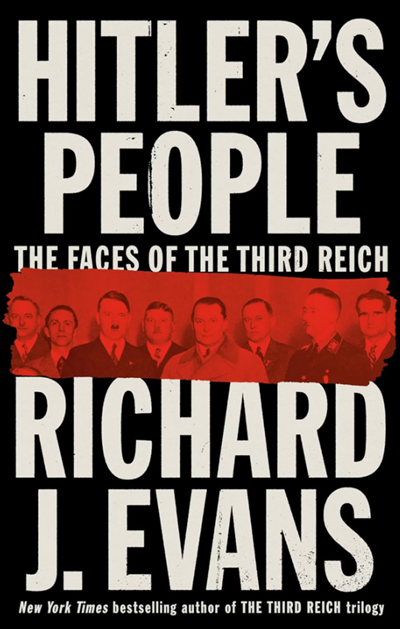
Hitler’s People by Richard J. Evans
In The Critic, Daniel Johnson reviews Richard Evans’ latest book on the history of Hitler’s Germany, Hitler’s People: The Faces of the Third Reich:
History records nothing more vile than Hitler and his henchmen. At the height of his power in 1942, Heinrich Himmler boasted that “the Führer has laid this very serious command [extermination of the Jews in occupied eastern Europe] upon my shoulders. No one can take it away from me.” By the end of the Third Reich, Hermann Göring had become a “voluptuary”, wearing lipstick and dressing in a toga, accompanied by a suitcase containing most of the world’s supply of the drug paracodeine. Joseph Goebbels, meanwhile, devoted his brief reign as Hitler’s successor to poisoning his six children.
The word “Nazi” has become synonymous with evil. Inevitably, therefore, it has also lost much of its original meaning — a case of Hegel’s “night in which all cows are black”. There is a danger that new generations will no longer know what made the Nazis and their crimes uniquely heinous.
Professor Sir Richard Evans has gathered a representative sample of “Hitler’s people”, ranging from the monstrous to the grotesque, into a single volume. It’s not a work of original research but a collective portrait of “the faces of the Third Reich”. Their unifying factor is the Führerprinzip — their unquestioning obedience to and adulation for Adolf Hitler.
Hero-worship in this, its most sinister form, is still with us. From Narendra Modi to Donald Trump, from Marine Le Pen to Jean-Luc Mélenchon, democracies are still menaced by demagogues. If we are honest, we have all felt the gravitational attraction of “charisma” — a secularised theological concept coined by Max Weber to denote the political authority exerted by an extraordinary individual. Evil often elevates the ordinary to the extraordinary.
Charisma in this sense is contemporaneous with the emergence of Hitler. His cult of charismatic leadership is indistinguishable from the ideology of National Socialism. Cults of this kind had already been prefigured in his day by those of Mussolini, Lenin and Stalin. But the case of Hitler, who cultivated the phenomenon in its most extreme form, remains the paradigm. Vladimir Putin, Xi Jinping and other contemporary despots are still in his debt.
Nazi Germany was indeed run by legions of little Hitlers, each demanding obeisance whilst lording it over their frequently competing or overlapping jurisdictions. The Third Reich was, in this sense alone, a diabolical reincarnation of the First, the Holy Roman Empire, with its patchwork of feudal domains. No medieval monarch, though, had the technological means to inflict such mayhem and misery upon humanity.
Comments Off on Hitler’s People by Richard J. Evans
August 6, 2024
Me262 – Why It Was Rubbish
HardThrasher
Published Feb 16, 2024A brief and sober discussion of the multi-faceted nature of aircraft development in the 3rd Reich, and an assessment of the aircraft itself in context of the political and organisational challenges and changes from 1939-1945. Or to put it another way, why it was rubbish from start to finish.
Timestamps
00:00 – 00:22 – Trailer
00:22 – 01:49 – Introduction
01:49 – 05:14 – Willy Messerschmitt’s World Falls Apart
05:18 – 08:03 – Udet’s Flying Circus
08:07 – 11:26 – Me262’s Development
11:26 – 11:32 – Popcorn
11:33 – 13:37 – The Me163 Affair
13:42 – 19:30 – Milch Tries to Break His Willy
19:33 – 30:18 – Hitler’s Big Brain Moment
30:21 – 42:03 – Speeds and Feed of the Me262
42:05 – 46:53 – Operational History
46:54 – 48:50 – Survivor’s Club
(more…)
Comments Off on Me262 – Why It Was Rubbish
June 22, 2024
The Curious Case of Hitler’s Corpse – War Against Humanity 136
World War Two
Published 21 Jun 2024Joseph Stalin claims that Adolf Hitler managed to escape Berlin and is now living somewhere in hiding. It’s complete nonsense of course. But it raises some interesting questions. What remains do we have of Hitler? How do we know they belong to the Fuhrer? And, why is Stalin spreading these far-fetched lies?
(more…)
Comments Off on The Curious Case of Hitler’s Corpse – War Against Humanity 136


