Forgotten Weapons
Published 6 Feb 2016Hammer prices:
Volcanic – $19,550
1860 Henry – $15,960
1866 Winchester – $8,625We’ve all seen lever action rifles galore in movies about the old west, and most of us have handled and shot a bunch of them as well. But do you know where they came from?
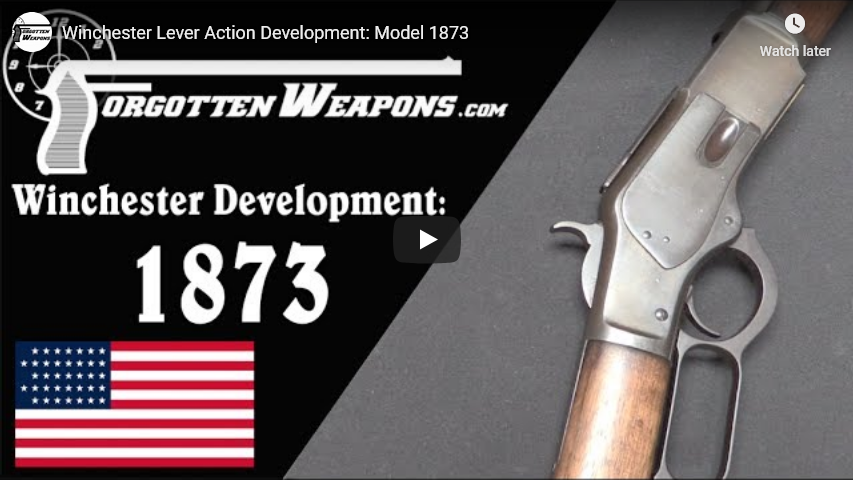
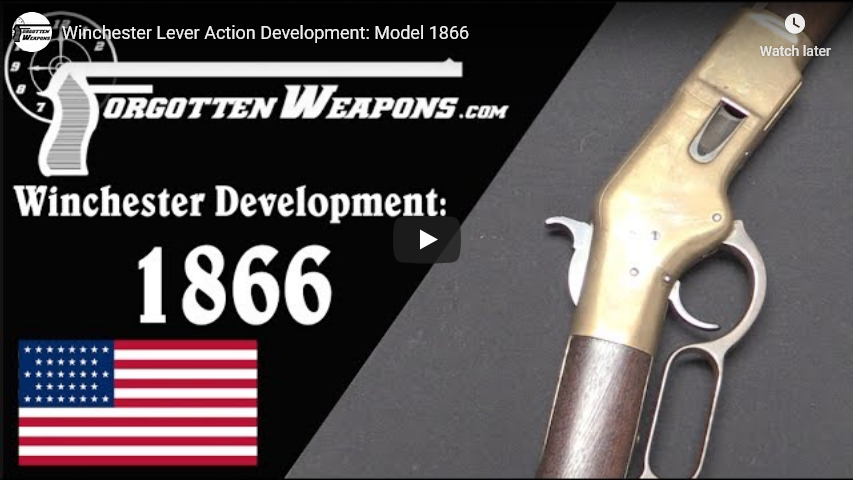
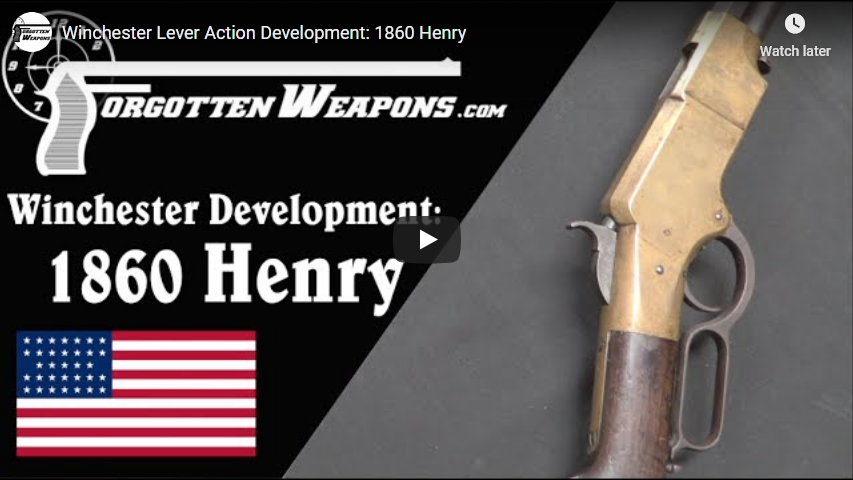
Today we will take a look at the first American lever-action rifle put into successful (more or less) production, the Volcanic. We will then continue to examine the 1860 Henry and the 1866 Winchester to get a foundational understanding of the development of these guns, and the interesting group of people involved with them.
May 5, 2020
Early Lever-Action Rifles: Volcanic, Henry, Winchester
May 4, 2020
The No 4, Mk I* Lee-Enfield: Introduction
britishmuzzleloaders
Published 21 Aug 2018If you would like to support the Channel you can do so through our Patreon Page.
https://www.patreon.com/britishmuzzle…Errata –
The labelling of the “wrongly stamped” Mk III sight should be better described as “confusingly stamped” … the designation refers to the leaf …It should be clarified that the rifle has at some point spent time in India with resultant modifications and maintenance…
Also, as of the 1937 Manual, the safety catch should be applied with the forefinger of the right hand.
For your Martini and Snider needs email Martyn at xringservices@yahoo.com
And for further reading on all British Victorian (and earlier) arms stop by the British Militaria Forum and say hello. http://britishmilitariaforums.yuku.com
April 30, 2020
Browning M1917: America’s World War One Heavy Machine Gun
Forgotten Weapons
Published 14 Mar 2018When the United States entered World War One, its military has a relatively tiny handful of machine guns, and they were divided between four different types, as the military budget was small and machine guns were not given much priority. However, since the failure of his gas-operated 1895 machine gun design to become a popular military item, John Browning had been working on a recoil-operated machine gun to replace it. This work became serious in 1910, and by 1915 Browning had met with Colt and agreed to give them exclusive license to his new design — and they began to work with him to refine and perfect it.
When the United States realized that it would be fighting in Europe and would need machine guns in 1917, it held an open trial for designs which Colt and Browning entered. The Browning gun was the undisputed star of the show, firing 40,000 rounds with only one parts breakage and no malfunctions that were not the fault of ammunition or belts. The gun was almost immediately adopted and pushed into production. Ultimately, Colt would allow the manufacture of its guns by Remington and New England Westinghouse, and Browning himself would accept a lump-sum royalty payment from the government for its use, which was about 3.5 million dollars less than he was contractually entitled to — out of patriotism and a desire not to profit too much from the war.
Browning 1917 machine guns would see only brief combat use in World War One, first tasting action in September of 1918. They would remain a staple of US military armament through World War Two, however, improved after the Armistice to the M1917A1 pattern. The gun we are looking at today is an original WW1 M1917, mounted on an equally rare M1917 original tripod.
http://www.patreon.com/ForgottenWeapons
Cool Forgotten Weapons merch! http://shop.bbtv.com/collections/forg…
If you enjoy Forgotten Weapons, check out its sister channel, InRangeTV! http://www.youtube.com/InRangeTVShow
April 24, 2020
Mauser-Norris Prototype: Origins of the Mauser Legacy
Forgotten Weapons
Published 10 Jan 2020http://www.patreon.com/ForgottenWeapons
https://www.floatplane.com/channel/Fo…
Cool Forgotten Weapons merch! http://shop.bbtv.com/collections/forg…
Today we are looking at one of the rarest and earliest rifles built by Paul and Wilhelm Mauser, a design which would set in motion all the events that led to the Mauser company becoming one of the great world leaders in small arms. The Mauser brothers were born in Oberndorf am Necker in the Kingdom of Württemberg, sons of a gunsmith. They would take up their father’s trade and were creative and intelligent boys, but opportunities were limited in the small, rural town of Oberndorf. In 1865 they presented a rifle to the Austrian Army in Vienna for trials, where it was rejected. However, it was noticed by an American sales rep for the Remington Company, a man named Samuel Norris. Norris saw the potential in the Mauser brothers’ design to convert needlefire rifles to metallic cartridges, and he signed a deal with the brothers to further develop the system.
The Mausers moved to Liege Belgium to do their work, and within just a few years they were making rifles for Norris. This example is based on a Chassepot, as Norris hoped to sell the conversion system to the French Army. That deal was rejected, however (the French were happy sticking with paper cartridges as of 1868), and Norris’ plans began to unravel when the Remington company discovered that he was making dealings in his own name instead of for them. The Mauser brothers ended up walking away from the deal with ownership of the patents they had filed with Norris, and when they submitted the design to the Prussians a process began which would result in the Mauser Model 1871 being adopted. From there, their talents would lead to the whole line of Mauser repeating rifles culminating in the Model 1898, arguably the pinnacle of the bolt action military rifle.
Thanks to the Liege Arms Museum for access to film this for you! If you are in Belgium, definitely plan to stop into the museum, part of the Grand Curtius. They have a very good selection of interesting and unusual arms on display. Further thanks to the Paul Mauser Archive for helping to arrange this filming!
http://www.paul-mauser-archive.com
Contact:
Forgotten Weapons
6281 N. Oracle #36270
Tucson, AZ 85740
April 22, 2020
The REAL Heroes of the M1 Carbine – not “Carbine” Williams
Forgotten Weapons
Published 21 Apr 2020http://www.patreon.com/ForgottenWeapons
https://www.floatplane.com/channel/Fo…
Cool Forgotten Weapons merch! http://shop.bbtv.com/collections/forg…
The Hollywood-spawned mythos of the M1 Carbine is that it was created by David Marshall “Carbine” Williams. The reality is far different. In real life, Williams was talented, but short-tempered, stubborn, and unable to work effectively as part of a team — and a cohesive, cooperative team is what the M1 Carbine required.
While Williams was off sulking about how the work was being done wrong, a team of Winchester machinists and engineers including William Roemer and Fred Humiston were actually making it happen.
The most impressive anecdote of the whole story, to me, is from when the solitary Winchester prototype broke its bolt in the middle of the final testing. Fred Humiston was representing Winchester at the trials, and he was told that if he could provide a new bolt within 24 hours the gun could continue the trials — but he could not take the gun off the testing ground. So Humiston went back to the Winchester shop and made a new bolt from memory (no drawings yet existed for the gun) and without being able to test-fit it in the gun. When he returned the next day, his new bolt dropped in perfectly, and the gun went on to win the trials. That is an epic feat of skill, and it is really a shame that he does not get more recognition for it.
Contact:
Forgotten Weapons
6281 N. Oracle #36270
Tucson, AZ 85740
April 17, 2020
Prototype Mauser 1917 Trench Carbine
Forgotten Weapons
Published 20 Dec 2019http://www.patreon.com/ForgottenWeapons
Cool Forgotten Weapons merch! http://shop.bbtv.com/collections/forg…
In the latter stages of World War One, the German military was looking for new arms for its Sturmtruppen. Without a reliable self-loading rifle design to use, they instead focused on pistol-caliber arms. The first to be used was the existing P08 artillery Luger, fitted with a drum magazine. At the very end of the war, these were being replaced by Bergmann MP-18,I submachine guns. But there was another gun that was tested but not adopted — the 1917 trench carbine variation of Mauser’s C96 “Broomhandle” pistol. Only about 40 of these guns were made as prototypes and trials models, and they were not adopted for reasons that are not entirely clear (but cost is probably a significant element). Only a few examples survive, and they vary substantially in their details. In addition, they are substantially different from both standard C96 pistols and also the sporting carbines made before the war.
All the 1917 trench carbines used a magazine developed from the 1906/08 pistol; an excellent double-stack, double-feed type. Magazines of 10, 20, and 40-round capacity were made, although all known examples were only semiautomatic (the full-auto Schnellfeuer Mausers would not come until the early 1930s).
Contact:
Forgotten Weapons
6281 N. Oracle #36270
Tucson, AZ 85704
April 14, 2020
Chauchat Field Testing vs Mock MG08/15 Nest
Forgotten Weapons
Published 14 Dec 2019http://www.patreon.com/ForgottenWeapons
Cool Forgotten Weapons merch! http://shop.bbtv.com/collections/forg…
Out at the range today with the Chauchat, testing accuracy against a simulated MG08/15 nest at 150 yards. I’ll try out semiauto and full auto (in short bursts), and see how they compare. For reference, the US Army recommended never using the Chauchat beyond 400 yards, as it was not sufficiently accurate to be effective at greater distance.
To see a set of original WW1 American Expeditionary Force Chauchat manuals, check here:
https://www.forgottenweapons.com/chau…
Contact:
Forgotten Weapons
6281 N. Oracle #36270
Tucson, AZ 85704
April 10, 2020
M1 Carbine: A Whole New Class of Weapon
Forgotten Weapons
Published 9 Apr 2020http://www.patreon.com/ForgottenWeapons
https://www.floatplane.com/channel/Fo…
Cool Forgotten Weapons merch! http://shop.bbtv.com/collections/forg…
The United States developed the M1 carbine very quickly at the beginning of World War Two, once the German “blitzkrieg” made it clear that highly mobile enemy forces could threaten rear echelon troops in a modern war. The M1911 pistol was seen as a difficult weapon to use well, and a light carbine would offer much greater effectiveness with less training. It was estimated that 500,000 would be needed, and more than 6 million were eventually produced during the war. The M1 Carbine would equip drivers, artillery crews, mortar men, headquarters staff, paratroops, and many more.
The M1 Carbine was developed by Winchester, but they were not participants in the first round of trials, Instead, their design came about when Rene Studler (head of the Ordnance Department) saw Winchester’s “M2” rifle prototype, a lightweight .30-06 intended to compete with the M1 Garand. He urged them to scale it down for the light rifle trials then ongoing in 1941, and Winchester complied. The design used a Garand-like rotating bolt and a gas tappet system designed by David Marshall Williams for the .30-06 rifle. The new carbine was cobbled together in less than two weeks, and is a truly fantastic achievement.
Thanks to InterOrdnance / Royal Tiger Imports for providing this M1 Carbine for filming!
Contact:
Forgotten Weapons
6281 N. Oracle #36270
Tucson, AZ 85740
April 8, 2020
Belgian Model 1915/27 Improved Chauchat
Forgotten Weapons
Published 9 Dec 2019http://www.patreon.com/ForgottenWeapons
Cool Forgotten Weapons merch! http://shop.bbtv.com/collections/forg…
The Belgian Army was the second to adopt the Chauchat automatic rifle, after the French. Almost all of Belgium was under German occupation during World War One, leaving Belgium significantly dependent on French aid for arms during the war. The initial Belgian purchases were standard 8mm Lebel CSRGs, but by 1917 Belgian engineers were working on a solution to convert the guns to the Belgian standard 7.65mm Mauser cartridge. This was completed by the end of the war, and the Chauchat remained a standard arm of the Belgian military after the war.
Work to improve the design continued, and an upgrades version was formally adopted in 1927. This included the 7.65mm conversion, with the best magazines made for any model of the Chauchat, as well as a series of dust covers to close off every hole in the gun (magazine well, ejection port, charging handle slot, and barrel shroud vents). The Belgians also replaced the original bipod with a much better type (similar to what they would use on the FN BAR), simplified the feed system, and added a tension latch to ensure reliable operation.
This new pattern of CSRG would be standard Belgian front-line armament until the FN BAR was adopted in 1930. The Chauchats were still in service with some units at the beginning of World War Two though, and saw service at that time.
Thanks to the Liege Arms Museum for access to film this for you! If you are in Belgium, definitely plan to stop into the museum, part of the Grand Curtius. They have a very good selection of interesting and unusual arms on display.
Contact:
Forgotten Weapons
6281 N. Oracle #36270
Tucson, AZ 85704
April 5, 2020
Book Review: The Martini Henry, For Queen and Empire
Forgotten Weapons
Published 8 Dec 2019Get your copy direct from IMA: https://www.ima-usa.com/products/the-…
Or from Amazon here: https://amzn.to/2O7ZGOY
Don’t miss Alpinshaw’s own website: http://www.martinihenry.org
One of the perennial challenges facing authors of firearms reference books is balancing the very technical nit-pickery with the broad historical view of a gun and its context in world events. The emphasis is usually tending towards the technical, but Neil Alpinshaw has done an excellent job of balancing the two, and made the development of the Martini-Henry an engaging story at the same time (a rare feat in this genre!). His new book The Martini-Henry: For Queen and Empire mixes vivid descriptions of British troops fighting across the far-flung corners of the world with their trusted Martinis with a history of the development and modernization of the rifles (and carbines).
Most interesting to me personally was the section on the Martini-Enfield, which was to be the improved version of the Martini-Henry. Chambered for a smaller-bore .402 caliber cartridge and fitted with sights for rapid close-in combat as well as long-range volley fire and sporting a quick-loading magazine attached to the receiver, this is a fascinating look at the highest evolution of the single-shot black-powder military rifle. Its development was dashed by the bolt action Lee and the development of smokeless powder, and the many thousands initially produced were converted into other patterns before seeing service.
Aspinshaw also tackles many of the long-standing myths about the Martini, and particularly its weaknesses. He takes his information directly from period investigations and after-action reports, and avoids the common hearsay. He does not let his own personal passion for the subject prevent him from articulating the true problems the rifles had, but clears away the misconceptions that have become prevalent (like the impossible-to-open ammunition boxes).
Published by International Military Antiques, the cover price is $60, and it is worth every penny for anyone interested in the grand Victorian British Empire or the Martini as a firearms family.
http://www.patreon.com/ForgottenWeapons
Cool Forgotten Weapons merch! http://shop.bbtv.com/collections/forg…
Contact:
Forgotten Weapons
6281 N. Oracle #36270
Tucson, AZ 85704
April 2, 2020
1884 Tacticool: Silver & Fletcher’s “Expert” Auto-Ejector
Forgotten Weapons
Published 1 Dec 2019In 1884, Hugh Silver and Walther Fletcher patented a system to rapidly unload a gate-style revolver. They negotiated an agreement to have their system integrated into Webley revolvers (specifically the New Model RIC) as an option, and sold about 350 of them, including some to both the Royal Irish Constabulary and the Metropolitan London Police, under the name “The Expert”. Not so different from today’s tactical widget market, eh? The practical use of the system was to bypass the glacially-slow manual ejector rod and instead unload a cylinder full of empty cases simply by pulling the trigger six times in rapid succession. To avoid the obvious potential safety hazard this entailed, they also added a safety to retract the firing pin. It’s this firing pin safety that people usually notice when seeing the guns, as it is much more visible than the ejection mechanism.
The system could also be used to eject empty cases one by one as the gun was fired, although doing so required leaving the loading gate open while firing. The Webley revolvers made with the system are devoid of Webley company markings, although they do have both a Webley serial number (most being in the 33,000 – 36,000 range) and a Silver & Fletcher number (between 1 and about 350).
http://www.patreon.com/ForgottenWeapons
Cool Forgotten Weapons merch! http://shop.bbtv.com/collections/forg…
Contact:
Forgotten Weapons
6281 N. Oracle #36270
Tucson, AZ 85704
March 30, 2020
FP-45 Liberator Pistol
Forgotten Weapons
Published 10 Nov 2015http://www.Patreon.com/ForgottenWeapons
Hammer price: $2250
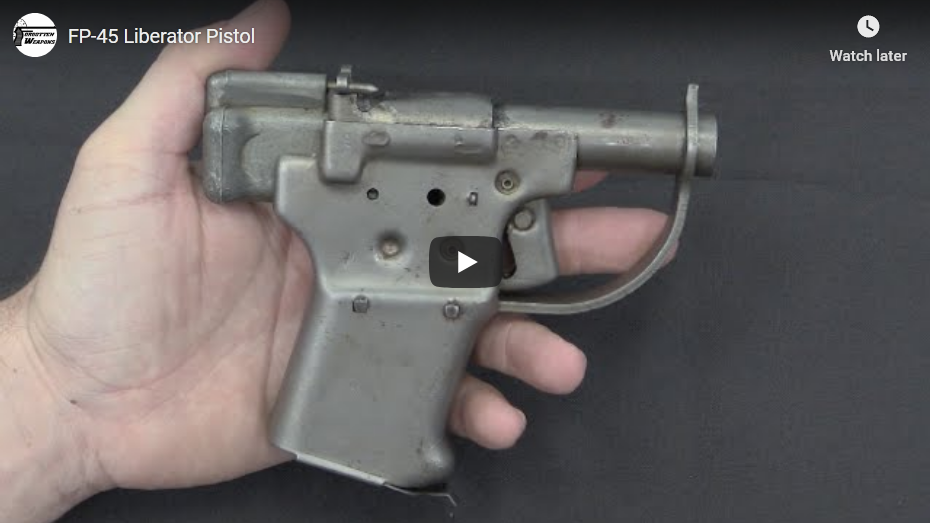
The Liberator is one of those interesting artifacts of WWII; an extremely simple single-shot .45 caliber pistol made by the boxcar-load (a million, specifically) with the intention of being dropped en masse across Europe to promote civilian sabotage against German occupation forces. They were manufactured by the Guide Lamp division of GM in record time – just 10-11 weeks for a literal million-gun production run. However, as they were being manufactured, shipped, and put into storage the motivation behind the project largely evaporated. British SOE ultimately decided not to distribute any in France, and only distributed a small number to partisans in Greece.
In the US, the Army stockpile of Liberators was transferred to the OSS, and a fair number were actually distributed in India, China, and the Philippine Islands – although they did not ultimately have any measurable impact on the war effort.
March 27, 2020
The Best SMLE: The No1 MkV Trials Rifle
Forgotten Weapons
Published 18 Nov 2019After World War One, the British looked at how to apply the lessons of the war to development of a new infantry rifle. Even before the war, a decision had been made to move to an aperture type rear sight — which would have been used on the Pattern 1913 Enfield, had the war no interrupted adoption of that model. So after the war, trials were made on some MkIII SMLE rifles refitted with rear aperture sights. These trials were successful enough to justify production of a substantial number of rifles for troop trials. This would be designated the No1 MkV rifle, and 20,000 of them were made between 1922 and 1924.
The magazine cutoff was retained in the MkV rifles, as were the volley sights in the initial production — along with an aperture rear sight marked out to 1500 yards. Following concerns about the durability of the sight and its adjustment latch, it was redesigned slightly, and the new version only went out to 1400 yards. On this second variation, the volley sights were omitted.
The new rifles was taken to Bisley and input was sought from both military units and civilian marksmen from the British NRA. The feedback that was received was that the sight was too fragile, its adjustments were too coarse, and the barrel was too light. These changes were implemented in the No1 MkVI rifle which would ultimately be adopted as the N4 MkI; the classic World War 2 version oft he Lee Enfield.
http://www.patreon.com/ForgottenWeapons
Cool Forgotten Weapons merch! http://shop.bbtv.com/collections/forg…
Contact:
Forgotten Weapons
6281 N. Oracle #36270
Tucson, AZ 85704
March 24, 2020
Thompson 1921: The Original Chicago Typewriter
Forgotten Weapons
Published 6 Oct 2018https://www.forgottenweapons.com/thom…
http://www.patreon.com/ForgottenWeapons
Cool Forgotten Weapons merch! http://shop.bbtv.com/collections/forg…
The first prototype Thompsons submachine guns (and it was Thompson who coined that term, by the way) were produced in 1919 and dubbed the “Annihilators”. The gun was intended to be a military weapon to equip American soldiers in World War One, but by the time the gun was developed the war had ended. Still, Thompson and his Auto-Ordnance company contracted with Colt to manufacture 15,000 of the guns. These were the Model of 1921, and they were marketed to both the US military and as many European armies as Thompson and his salesmen could reach. They found few takers in the climate of the early 1920s, however, and sales were slow.
This is the first in a 5-part series about the development of the Thompson, concluding with a trip to the range to fire three different patterns side by side…
Contact:
Forgotten Weapons
PO Box 87647
Tucson, AZ 85754If you enjoy Forgotten Weapons, check out its sister channel, InRangeTV! http://www.youtube.com/InRangeTVShow
March 18, 2020
How Does It Work: Roller Delayed Blowback
Forgotten Weapons
Published 17 Mar 2020http://www.patreon.com/ForgottenWeapons
https://www.floatplane.com/channel/Fo…
Cool Forgotten Weapons merch! http://shop.bbtv.com/collections/forg…
Roller delayed blowback originated in the Mauser company R&D department when engineers were attempting to design a roller-locked version of the G43 rifle. They found that when the bolt bounced in automatic fire, the system would sometimes work without being fully locked. With some refinement, this became the roller delayed system, and would have been used in the StG-45 rifle if the war had gone longer. After the war, the system was applied to prototype French arms, then to the Spanish CETME program which eventually became the German G3 rifle. The system would see use primarily as the basis of a whole family of arms from Heckler & Koch, although it has been used in a few other places.
Mechanically, the system uses an angled “locking” wedge to put a mechanical disadvantage on a pair of rollers that must retract into the bolt head before it can move rearward. The combination of the wedge angle and the mass of the bolt carrier assembly are carefully calculated to delay the action from opening until pressure is reduced to a safe level. These systems do typically open faster than locked actions, though, and generally require the use of chamber fluting to ensure reliable extraction.
Contact:
Forgotten Weapons
6281 N. Oracle #36270
Tucson, AZ 85740