
Extra Credits
Published on 4 Mar 2019Did you know that the Wendigo myth can be thought of as a warning against overconsumption of the natural world? We talk about this and other fun facts that we didn’t really get to cover in our animated Wendigo episode!
March 5, 2019
Mythology Matters – Wendigo Origins – Extra Mythology – #2
Comments Off on Mythology Matters – Wendigo Origins – Extra Mythology – #2
February 28, 2019
Native American Myth – The Wendigo – The Omushkego Tribe – Extra Mythology
Extra Credits
Published on 25 Feb 2019Join the Patreon community! http://bit.ly/EMPatreon
Anwe the Killer was a man skilled in death — and he approached the People in their hour of need, to put to death the cannibals — the Wendigo — who had been torturing them.
Comments Off on Native American Myth – The Wendigo – The Omushkego Tribe – Extra Mythology
February 13, 2019
Native American Myth – Nlaka’pamux: The Adventures of Coyote – Extra Mythology
Extra Credits
Published on 11 Feb 2019Join the Patreon community! http://bit.ly/EMPatreon
Coyote is not just a wild animal in North America, but also a heroic, trickster protagonist whose mythological adventures reflect lessons learned from the natural world. Let’s examine the Nlaka’pamux tribe’s interpretation of Coyote.
Comments Off on Native American Myth – Nlaka’pamux: The Adventures of Coyote – Extra Mythology
February 12, 2019
History Summarized: Iroquois Native Americans
Overly Sarcastic Productions
Published on 7 Aug 2017There’s a fascinating history from just northwest of American history that is too often ignored. But that’s a damn shame, because it’s a damn cool history, and I’m going to talk about it dammit!
No, I didn’t accidentally misspell the title of this video when I sleepily uploaded this after I woke up. That’s absurd.
EXTRA CREDITS: HIAWATHA: https://youtu.be/79RApCgwZFw
This video was produced with assistance from the Boston University Undergraduate Research Opportunities Program.
PATREON: http://www.patreon.com/OSP
Comments Off on History Summarized: Iroquois Native Americans
December 3, 2018
Viking Expansion – Wine Land – Extra History – #6
Extra Credits
Published on 1 Dec 2018From Greenland, explorers like Bjarni, Freydis, and Leif Erikson — aka “Leif the Lucky” — ventured into Vinland, the very first bit of North America sighted by Europeans. It was rich in natural resources, including the grapes (and thus wine) for which it received its title, but this set of expeditions would be very, very short-lived…
Join us on Patreon! http://bit.ly/EHPatreon
Comments Off on Viking Expansion – Wine Land – Extra History – #6
November 2, 2018
QotD: Modern men are “the sorriest cohort of masculine Homo sapiens to ever walk the planet”
A new book claims even modern athletes could not run as fast, jump as high, or have been nearly as strong as our predecessors.
The book, Manthropology: The Science of the Inadequate Modern Male, by Australian anthropologist Peter McAllister, describes many examples of the inadequacy of the modern male, calling them as a class, “the sorriest cohort of masculine Homo sapiens to ever walk the planet.”
Given spiked running shoes, Indigenous Australians of 20,000 years ago could have beaten today’s world record for running 100 and 200 meters. As recently as last century, some Tutsi males in Rwanda could have easily beaten the current high jump world record, and bodybuilders such as Arnold Schwarzenegger would have been no match in an arm wrestle with a Neanderthal woman.
Twenty thousand years ago six male Australian Aborigines chasing prey left footprints in a muddy lake shore that became fossilized. Analysis of the footprints shows one of them was running at 37 kph (23 mph), only 5 kph slower than Usain Bolt was traveling at when he ran the 100 meters in world record time of 9.69 seconds in Beijing last year. But Bolt had been the recipient of modern training, and had the benefits of spiked running shoes and a rubberized track, whereas the Aboriginal man was running barefoot in soft mud. Given the modern conditions, the man, dubbed T8, could have reached speeds of 45 kph, according to McAllister.
McAllister also presents as evidence of his thesis photographs taken by a German anthropologist early in the twentieth century. The photographs showed Tutsi initiation ceremonies in which young men had to jump their own height in order to be accepted as men. Some of them jumped as high as 2.52 meters, which is higher than the current world record of 2.45 meters.
Lin Edwards, “Modern men are wimps, according to new book”, Phys.org, 2009-10-21.
Comments Off on QotD: Modern men are “the sorriest cohort of masculine Homo sapiens to ever walk the planet”
October 17, 2018
How Toronto got its name
Colby Cosh on the origins of the name of Canada’s largest city (which, surprisingly, isn’t the Mississauga name for “big stink on the water”):
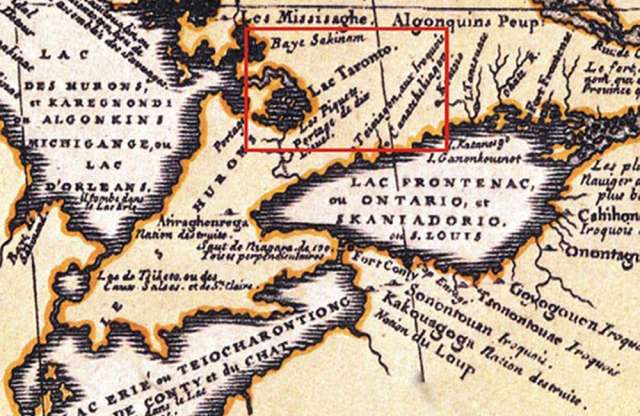
Detail from a 1688 map of western New France by Vincenzo Coronelli that locates “Lac Taronto” at Lake Simcoe.
City of Toronto Culture Division/Library and Archives Canada via the National Post
By the time of Franquelin, “Tkaronto” had already become “Taronto,” a generic name for the highway between Lake Simcoe and Lake Ontario. The Humber River was called the Toronto River by the French before Gen. John Graves Simcoe and the British got hold of everything. The word, in turn, became attached to a trading settlement at the southern end of the trail — a pretty crummy place, by all accounts, but one destined for bigger things as part of a global seafaring empire.
The miracle is that it held on to the name. Simcoe insisted that “Toronto,” on being anointed as the site of the new capital of Upper Canada in 1793, be dubbed “York” in honour of Prince Frederick (1763-1827), Duke of York and second son of George III. This Duke of York is the “Grand Old Duke of York” from the satirical verse about military futility. He was also commander-in-chief of the British armies that helped to chase Napoleon out of Europe twice, and is thought to deserve genuine credit for this, so be careful who you write insulting rhymes about.
Simcoe dubbed Toronto “York” just because he was sucking up to a very identifiable future boss, and for no other reason. The people of Toronto seem to have understood this and resented it. In the decades to come, it was occasionally observed that there were something like a dozen other places in Upper Canada called “York.” Moreover, Simcoe’s “Little York,” as it was often called, seems to have presented an increasingly embarrassing parallel with the Americans’ bustling New York.
In 1834, when the Legislative Council of Upper Canada decided that the capital needed to be formally incorporated as a city, the citizenry remembered that they belonged to “Toronto” and appealed to the council to have the more musical old name restored. Over four decades their annoyance had not receded. Diehards who wanted York to remain York for imperial-grandeur reasons were outvoted, and Toronto’s formal Act of Incorporation observes that “it is desirable, for avoiding inconvenience and confusion, to designate the Capital of the Province by a name which will better distinguish it.” The appellation “Toronto,” of course, had actually been nicked from a spot some way off, but the white settlers had mislaid that information, and didn’t check with anyone who would know better.
Comments Off on How Toronto got its name
September 22, 2018
The Distant Early Warning Line
The History Guy: History Deserves to Be Remembered
Published on 23 Apr 2018The History Guy examines how the Cold War transformed Canada with the establishment of the U.S. Air Force’s distant early warning or dew line.
The History Guy uses images that are in the Public Domain. As photographs of actual events are often not available, I will sometimes use photographs of similar events or objects for illustration.
Patreon: https://www.patreon.com/TheHistoryGuy
The History Guy: Five Minutes of History is the place to find short snippets of forgotten history from five to fifteen minutes long. If you like history too, this is the channel for you.
Comments Off on The Distant Early Warning Line
September 13, 2018
The lasting impact of Haida Nation vs. British Columbia
I was not aware that a single case had such a major influence on relations between the federal and provincial governments on the one hand and First Nations groups on the other. Barbara Kay explains just how we got to the point of overturning decades of settled legal practice in the wake of the Haida Nation decision:
In his newly published book, There is no Difference: An Argument for the Abolition of the Indian Reserve System, lawyer Peter Best devotes a chapter to unpacking the consequences of Haida Nation. It makes for fascinating reading.
Before this decision, Best says, it was understood “that aboriginal claims and rights over the land were more than ‘reconciled.’ In fact, Canadians, Indians and non-Indians alike, thought they were, especially in treaty areas, extinguished, plain and simple,” apart from the right to hunt, fish and trap on unoccupied wilderness Crown land, and even then with Crown sovereignty. Haida Nation – and cases decided since then – reversed the meaning of the treaties.
The SCC read in an intent “merely to ‘reconcile’ Indians’ prior sovereign occupancy of the land with the new sovereignty of the Crown.” That is, they were “instruments of power and land-sharing, not instruments of rights extinguishment.”
So it seems we are now in a never-ending power-sharing arrangement, “requiring the constant, expensive, uncertain fine-tuning and adjustment from time to never-ending time of the granted Crown rights with the retained sovereign Indian rights.” This new jurisprudence, Best says, decrees a devolution of Crown sovereignty to Indians – a handing back of previously surrendered power, effectively turning Indian bands into a third order of government.
The key words, “to consult and where appropriate, accommodate the Aboriginal interests…” give Indian bands across the country power over all kinds of economic development – mines, forestry, wind power installations, roads, and of course pipelines.
Following Haida Nation, any band that asserts a proposed off-reserve project affects an Indian interest, actual or projected, the “consultation and accommodation if necessary” process is automatically launched. No evidence has to be produced, no threshold of importance to be met. (“Sacred ground” is always effective – and what ground is not sacred to aboriginals who live on it?).
In most negotiations with conflicting interests, each party has a motive to see the deal done. But “consultation” is not negotiation, and aboriginals often have no particular reason to settle. Best notes that during consultations, there’s a great deal of travel, expense account living, important meetings and pleasant busywork, with most politicians lacking the courage to utter the words “not appropriate” with regard to further “consultation.”
There is also no incentive for aboriginals to settle for anything less than exactly what they want. The Lax Kw’alaams of B.C. turned down a billion dollars in exchange for their support of an industrial project. There was no downside for them. They had the power and knew it. No matter how long they held out, their transfer payments flowed in as usual, and they took no economic risks if the project failed. If one side has nothing to lose and the other side has everything to lose, Best says, “you don’t have negotiations – you have a shakedown.”
September 11, 2018
September 1, 2018
The legal tangle around the Trans-Mountain pipeline approval process
Jay Currie suspects the process has been intentionally complicated to the point that there may not be a way out for this government:
What the Court essentially asked was, “Did the Federal Government consult enough?” and then concluded, “No, not enough.”
How much is “enough”? That is a question which this decision really does not answer. And I suspect it does not answer it because there is actually no answer which is even close to true.
In a normal process a reasonable level of public consultation would be reached when the public has been given an opportunity to comment on the matter at hand. Which is a bit vague but there is case law which fleshes out what such an opportunity might look like.
However, once environmentalists and First Nations are engaged it is not at all obvious that merely having the opportunity to comment is sufficient. Unlike a rezoning application, an application to build a pipeline (or, realistically, virtually any other large undertaking) creates the opportunity for First Nations to talk about everything from ancient hunting rights, to sacred grounds, to former village sites, to disruptions to present First Nation culture and so on. Having the environmentalists involved ensures that the relatively easy solution of simply paying the First Nations’ people for their consent, is off the table. That solution will be denounced by the enviros as cultural genocide and worse.
All of which creates, and might arguably have been intended to create, a Gordian knot when it comes to considering major projects. Consultation becomes an endless task and one which has no defined parameters. The decision today indicates that an extensive consultation process is not enough but it does not indicate what might be enough.
Delightfully, the shareholders of Kinder Morgan – which owns TransMountain – voted today to sell the project to Canada’s feckless Federal Government for several billion dollars.
I suspect the CEO danced a little jig relieved that he no longer had to guess at how far consultations have to go. But Canada is stuck with a completely dysfunctional system which is being exploited by environmentalists and First Nations to prevent infrastructure from being built. That will have to be fixed.
Comments Off on The legal tangle around the Trans-Mountain pipeline approval process
August 26, 2018
The Wolseley Expedition and the making of Canada
The History Guy: History Deserves to Be Remembered
Published on 2 May 2018In the early days of the Canadian confederation, one of the greatest officers of the British Victorian Army takes 1000 soldiers on an impossible march through the wilderness that helps to define modern Canada.
All events are described for educational purposes and are presented in historical context.
Patreon: https://www.patreon.com/TheHistoryGuy
The History Guy: History Deserves to be Remembered is the place to find short snippets of forgotten history from five to fifteen minutes long. If you like history too, this is the channel for you.
Comments Off on The Wolseley Expedition and the making of Canada
August 18, 2018
“The urge to erase the past is totalitarian”, especially when “it’s the current year”
Mark Steyn on the most recent efforts to obliterate the past:
I’m with Blatch – the great Christie Blatchford, my esteemed colleague from the glory days of The National Post. She’s had enough of it, and so have I – whether it’s the toppling of Field Marshal Smuts in Cambridge, President McKinley in California, Sir John A Macdonald in Victoria. The urge to erase the past is totalitarian. Yet what Pol Pot did, by re-making the world and proclaiming Year Zero, is now the default setting of every social-justice nitwit.
[…]
I’m sick of replacing something – “the Langevin Block”, “the Langevin Bridge” – with nothing – “the Office of the Prime Minister and the Privy Council”, “the Reconciliation Bridge”. The latter is just fatuous pap, and the former is not a name but merely a description of what’s taking place inside the building. But that’s all we can do, because we can’t even take the risk of re-naming the joint. Because today’s hero-of-the-day – the first transgender nominee for Governor of Vermont, say – will inevitably be revealed in thirty years’ time to have been unsound on intersexual Muslima cloning or whatever. Because getting “woke” is one thing, but staying “woke” and “woke”-to-the-minute is all but impossible:
‘Queer Eye’ Star Jonathan Van Ness Under Fire After Saying ‘Not All Republicans Are Racist’The “leaders of violence” are those engaged in a systematic assault on not just national history but our entire civilizational inheritance. And the wimp conservatives who string along with this are merely licensing the next provocation. In Canada, much of this drivel derives from fainthearted ninnies twenty years ago who meekly accepted charges of “cultural genocide” – which is exactly like genocide, except for the peripheral detail of not requiring any actual corpses. Here’s me two decades ago:
Only a generation or two back, governments thought they were doing native children a favour by teaching them the English language and the principles of common law and the great sweep of imperial history, that by doing so they were bringing young Indians and Inuit ‘within the circle of civilised conditions’. It’s only 40 years ago, but that’s one memory the government of Canada will never recover. No civilised society legislates retrospectively: if you pass a seat-belt law in 1990, you don’t prosecute people who were driving without them in 1980. Likewise, we should not sue the past for non-compliance with the orthodoxies of the present.
But we did. So surrendering on “residential schools” led to the re-classification of Canada’s first prime minister as “a leader of violence” by the City of Victoria. And, if Sir John is a leader of violence, how can the very city be named for the Queen who knighted him and sent a wreath to his funeral? Shouldn’t Victoria be renamed Reconciliationville? Or, per the Langevin Block, “the City of the Office of the Mayor and the Municipal Council”?
And what about Casimir Gzowski, who laid Her Majesty’s wreath upon the “leader of violence”‘s coffin? Shouldn’t his busts and memorials be removed, too? And Sir Casimir Gzowski Park in Toronto be renamed Transgender Bathroom Park?
And what about Sir Casimir’s great-great-grandson, beloved Canadian radio host Peter Gzowski? Shouldn’t he be removed from the CBC archives? Or at any rate shouldn’t Gzowski College at Trent University and the Gzowski branch of Georgina public libraries be renamed just in case somebody is triggered by the thought that they might be named not after Peter but after the great-great-grandpa who had the effrontery to lay the queen of violence’s wreath of violence on the leader of violence’s grave or violence?
This is not an assault on historical figures; this is an assault on history itself – on the very idea that ancient societies have a past, or roots, or historical continuity, or anything other than the fashions of the moment.
Comments Off on “The urge to erase the past is totalitarian”, especially when “it’s the current year”
July 22, 2018
Austro-Hungarian Artillery – Choctaw Code Talkers I OUT OF THE TRENCHES
The Great War
Published on 21 Jul 2018
Comments Off on Austro-Hungarian Artillery – Choctaw Code Talkers I OUT OF THE TRENCHES
May 6, 2018
Justin Trudeau may (or may not) delay the legalization date for marijuana
It’s just another day in Liberal Ottawa, as the Prime Minister briefly appears to wobble on the one election promise he’s close to fulfilling before the next election cycle begins. Colby Cosh manfully avoids a few drug-related jokes while recounting the latest “goffe” (as Gary Johnson actually said):
The legislative scenes preceding the three-quarters-legalization of marijuana in Canada continue to have an unreal, hallucinatory quality for which I am determined not to use the obvious metaphor. On Tuesday the Senate Aboriginal Peoples Committee presented the government with a demand that its vague summer legalization deadline be delayed by “up to one year” because Indigenous groups were not consulted closely enough on the effects of making it lawful to have a plant.
The prime minister, after some hemming and hawing, reiterated that legalization will happen on time, whatever the particular date happens to end up being. This will certainly come as a relief to the people who have poured zillions of dollars into a new horticultural and retail industry on the premise that it would, y’know, exist. Seeing how many of them are former Conservative politicians, perhaps they can be persuaded to buy a novena or two for a Liberal government that has — despite the unique moral pressure that Indigenous Canadians are capable of exercising, and in arguable defiance of its own history — decided to stick to an electoral promise.
Even as it is, the promise is taking most of the life of a Parliament to fulfill. Perhaps the conscience of Justin Trudeau, the little cartoon angel that perches on his shoulder and whispers progressive maxims in his ear, would have preferred to relent and toe the legalization deadline forward a year. Unfortunately, on the list of Trudeau’s political problems, “not being able to get stuff done in Canada” ranks alarmingly high at the moment.
In an ideal world, going along with the Senate committee and inflicting a wrestler’s piledriver on the economy for the sake of a principle might have been tempting. May 2018 is, alas, not really the time to be asking for that. It is precisely because so many interest groups and subnational governments have had to be negotiated with and appeased that pot legalization has taken so long — long enough that another election is in sight, with other elements of the Liberal program already in smithereens by the wayside.
Comments Off on Justin Trudeau may (or may not) delay the legalization date for marijuana


