
We can project all sorts of fantasies onto our Aboriginal ancestors. There is scant record of their individual exploits or characters, and very few colonial Aborigines left behind a documented account of their experiences. I could, therefore, decide that my foremothers were courageous warriors of the resistance, or mysterious keepers of ancient feminine wisdoms, or I could envision them as victims and martyrs, enduring the humiliations of colonisation with grace and dignity. These romantic fantasies would be accepted as fact, and my “truth” would be applauded. My own (arguably more plausible) vision is that my Aboriginal foremothers had the good sense to form alliances with the settlers, and that they improved their own lives and their children’s prospects as a result.
I don’t begrudge any Aboriginal person a desire to fill in the blanks in their histories with romanticism, particularly given the rewards on offer. The story of white injustice and black tragedy has become the most acceptable Aboriginal tale to tell, and is now the only perspective on Aboriginal history — despite that dearth of documented accounts — that could possibly be accepted as authentic and true. To suggest that our story is not all about victimhood is bad enough; to suggest that modernity was in any way a blessing is double-plus ungood crimethink.
[…]
Those who mourn the demise of Aboriginal culture almost always regard things from the viewpoint of the men, who were indeed dispossessed of their land, and subsequently their traditions and status. Land wasn’t the only item of property they lost, however. They also lost or traded their women to the settlers, and this absorption — along with frontier warfare and disease — rapidly eroded tribal structures and doomed Aboriginal traditions to obsolescence. The settlers arrived with a wealth of goods and a shortage of females, and they were generally less enthusiastic about beating women than was customary in Aboriginal culture. In contrast, the Aboriginal men held no wealth, treated their women appallingly, and there were few taboos to prevent women from straying — and so stray they did. The men lost a lot in the invasion, while the women had little to lose and plenty to gain. Modern-day Aboriginal women who mourn the loss of traditional culture have rocks in their heads. (Metaphorically, that is. Back then, it would have been literally.)
Kerryn Pholi, “Something More: An Alternative Perspective on Australia Day”, Penthouse.au, 2018-01-22.
January 26, 2020
QotD: An Aboriginal woman’s view of Australia Day
November 28, 2019
QotD: The native view of the Pilgrims
Charles Mann, 1491: New Revelations of the Americas Before Columbus, 2006.
November 7, 2019
Replacing “dead, white male” writers with contemporary First Nations writers
Barbara Kay, as you would expect is not a fan of this move by this school board in the Windsor area:
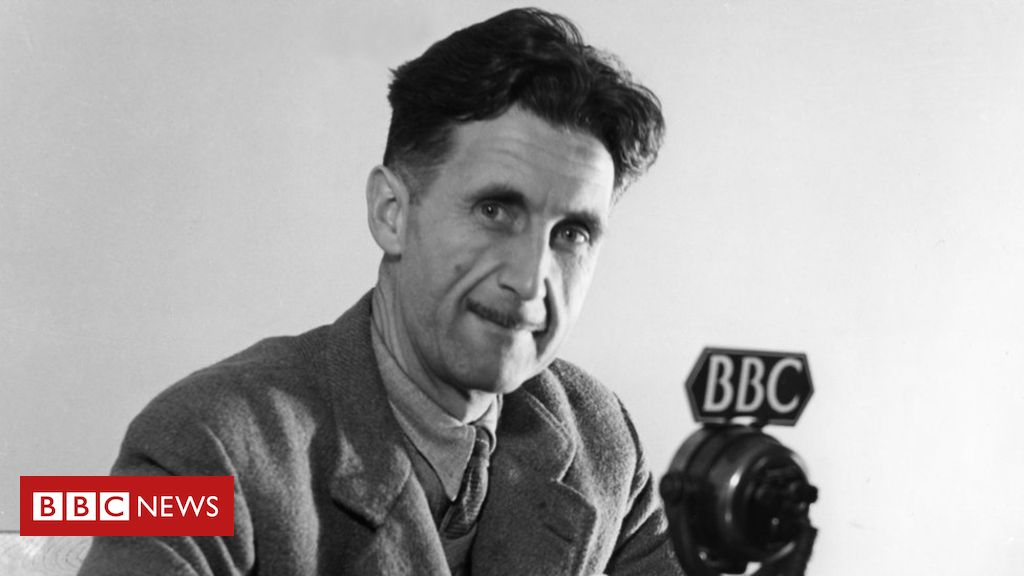
Some years ago, the late, great writer George Jonas asked me about my intellectual influences. Who did I remember as especially formative? Oh, George Orwell, of course. I read Animal Farm in my mid-teens, 1984 a little later, and most of his other writings over the course of my salad years. It would be hard to overstate his effect on my understanding of concepts like “freedom,” “power” and “decency.”
Since Orwell has never been “owned” by the right or the left, both admiring his prose as a model for clarity and coherence, he is the one English-language writer I would consider indispensable for any high school literature curriculum.
Up to now, most educators have concurred. But the Windsor, Ont.-area Greater Essex County District School Board has announced that, in accordance with the spirit of the Truth and Reconciliation Commission (TRC), Orwell and other canon favourites in the Grade 11 literature curriculum, including Shakespeare, will be set aside in favour of a course wholly devoted to Indigenous writing. Eight of the district’s 15 schools have already replaced former standards with such books as Indian Horse, In This Together and Seven Fallen Feathers under the rubric of Understanding Contemporary First Nations, Métis and Inuit Voices.
“This decision wasn’t made lightly,” said Tina DeCastro, a teacher consultant with the school board’s Indigenous Education Team. The decision arose from a motion passed by the school board’s trustees as a response to TRC calls for action. Eastern Cherokee Sandra Muse Isaacs, Professor of Indigenous Literature at the University of Windsor, defends the radical change as necessary on the grounds that Indigenous stories have been ignored in the past. “Our stories predate Canada. It’s as simple as that.”
Is it really that simple?
I don’t think there is a sentient Canadian today who isn’t aware that Indigenous voices have been neglected in the past, and who would not wholeheartedly support the addition of Indigenous writing to contemporary literature curricula. But an entire year devoted to Indigenous literature that supplants revered works by great writers from the civilization that produced Canada as a nation-state, in order to redress the offence of historical inattention to Indigenous people, is to rob the majority of Canadian students of their cultural patrimony.
October 5, 2019
Legends Summarized: El Dorado
Overly Sarcastic Productions
Published 4 Oct 2019El Dorado! A shining golden city packed with promises of wealth, power and everlasting glory. An unspoiled paradise deep in the jungle, the PERFECT destination for treasure-hunters and anthropologists alike. Something that perfect is something EVERYONE wants to be real.
Aaaaand that’s the trick, isn’t it? Wanting something that badly isn’t healthy. Just ask the conquistadors!
(Oh wait, we can’t – because so many of them died on fruitless quests for El Dorado. And also it’s been five hundred years and they’d all be dead anyway)PATREON: https://www.Patreon.com/OSP
MERCH LINKS: https://www.redbubble.com/people/OSPY…
OUR WEBSITE: https://www.OverlySarcasticProductions.com
Find us on Twitter https://www.Twitter.com/OSPYouTube
Find us on Reddit https://www.Reddit.com/r/OSP/
September 19, 2019
“[T]he Indian Act is a benign form of apartheid”
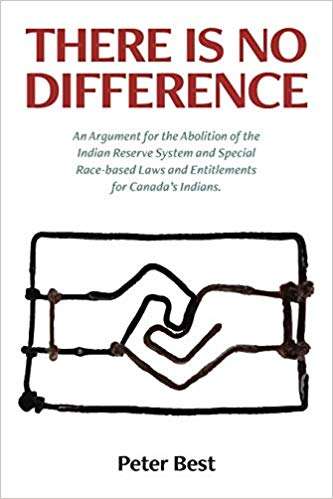
In the National Post, Barbara Kay discusses a recent book on the key legislation that regulates relations between the Canadian federal government and the various First Nations groups:
Few and far between are disinterested scholars of Canada’s Aboriginal history who have the tough hide and principled will to publicly depart from the approved Indigenous “nation-to-nation” narrative that keeps the guilt and money flowing, but perpetuates a dysfunctional status quo on many reserves. Most of the dissenters are university academics. But Best is simply an intelligent man with a passion for his subject, a deep impatience with political correctness, and unremitting determination to weather whatever storms afflict him as he shepherds his views to a public market.
I’ve written before in the National Post and elsewhere about Best’s lonely battles with our society’s forces of repression. There Is No Difference began its public life as a post on a dedicated online site in 2014, copied to his legal firm’s. Shortly afterward, complaints were filed against him with the Law Society of Upper Canada (now the Law Society of Ontario), asking that Best be “disbarred or suspended” and that he be forced to apologize for using his law practice “to disseminate racist materials.”
After two years of stressful limbo, the Law Society graciously allowed that the excerpts submitted by the (unnamed) complainant were “not enough to merit a finding of any form of professional misconduct on their face.” (The last three words telegraph the ardent wish that they had been; apart from a dissenting group of new benchers, the Law Society’s board has increasingly demonstrated worrying Thought Police tendencies.)
Best believes the Indian Act is a benign form of apartheid, and advocates for the integration model of equal citizenship for all, a model promoted, for example, by Pierre Elliott Trudeau (who called the system “apartheid”), and the late Aboriginal lawyer William Wuttunee, author of Ruffled Feathers, who was marginalized and discredited as an “apple,” red on the outside, white on the inside.
Best believes the federal government must be the ultimate master in its own house for Canada to function as a healthy nation. He is fiercely critical of the Supreme Court’s 2004 emphasis on the “honour of the Crown” concept in its Haida Nation vs. British Columbia ruling, with key words “to consult and where appropriate, accommodate the Aboriginal interest” virtually decreeing a devolution of Crown sovereignty to Aboriginals, and effectively turning Indigenous bands into a third order of government with the power arbitrarily to advance or restrict Canada’s economic fortunes.
It’s easy for Indigenous activists to bash a white historian, or even an Aboriginal dissident without special standing like Wuttunee. But it will be more difficult to dismiss the opinion of a former Supreme Court justice. Best just came in for an unexpected stroke of luck. Former Supreme Court justice Jack Major (1992-2005) has given the book his endorsement in a letter discussed in an article by the Frontier Centre for Public Policy (FCPP).
September 8, 2019
Miscellaneous Myths: Animal Brides
Overly Sarcastic Productions
Published on 6 Sep 2019Yes, it really is as weird as it sounds. Sorry!
This video (specifically the Inuit myth) was requested by patron Richard Frederick Schubert III!
PATREON: https://www.Patreon.com/OSP
MERCH LINKS: https://www.redbubble.com/people/OSPY…
OUR WEBSITE: https://www.OverlySarcasticProductions.com
Find us on Twitter https://www.Twitter.com/OSPYouTube
Find us on Reddit https://www.Reddit.com/r/OSP/
September 5, 2019
Making a Gun-Stock War Club (feat. Green Beetle)
Rex Krueger
Premiered 31 minutes agoMore video and exclusive content: http://www.patreon.com/rexkrueger
(more…)
August 26, 2019
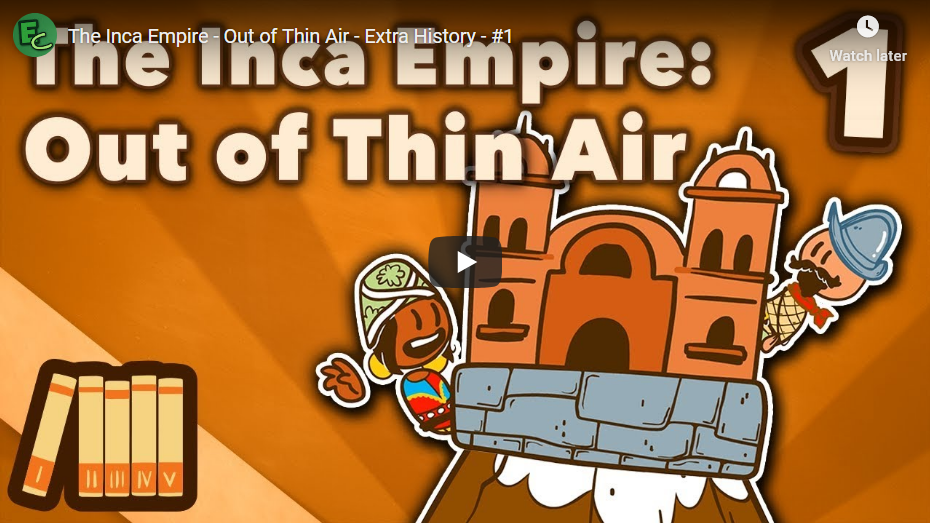
The Inca Empire – Out of Thin Air – Extra History – #1
Extra Credits
Published on 24 Aug 2019Join us on Patreon! http://bit.ly/EHPatreon
There’s a lot that we don’t know for sure about the Inca Empire, because we have conflicting accounts among Spanish colonizers, as well as the fact that Inca history itself is told non-linearly. But we do know that they used Andean accomplishments, from architecture to knotted quipu, to create a city that ruled the largest indigenous empire in the Americas, starting with Manco Capac and the successive Sapa Inca rulers.
July 29, 2019
Erasing the past, statue by statue, plaque by plaque
Alexander Adams on the deliberate sabotage of historical monuments in pursuit of a more perfect (i.e., imaginary) past:
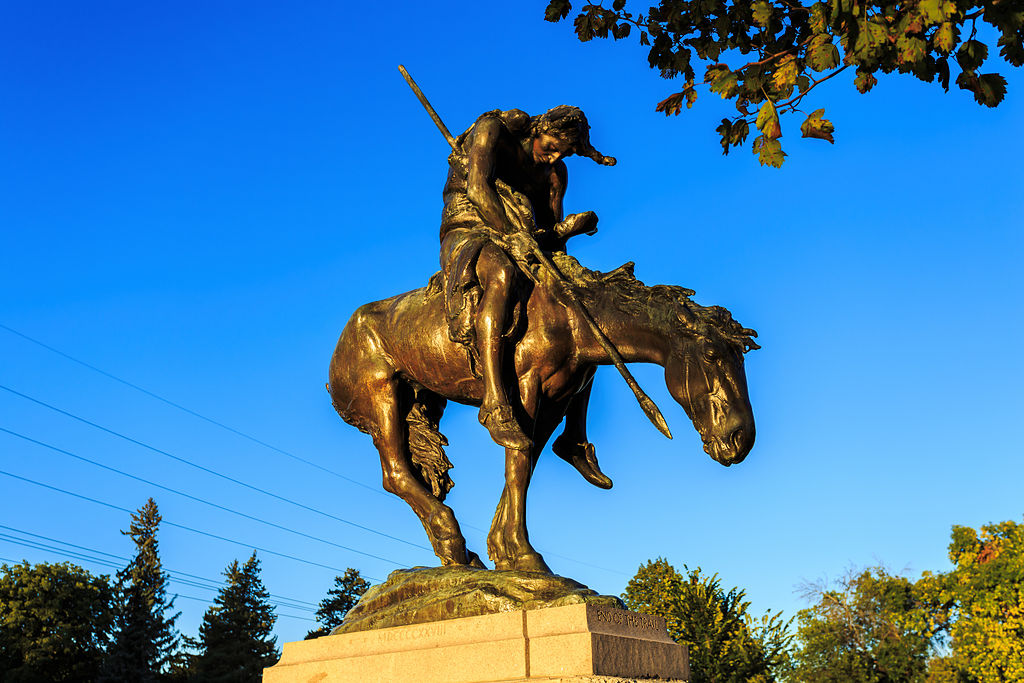
End of the Trail by James Earle Fraser, located in Waupun, Wisconsin.
Photo by Shawn Conrad via Wikimedia Commons.
In the wake of recent attempts – some successful – to have Confederate statues removed from the US south, what is the future of colonialist statues in the US west? In Pioneer Mother Monuments: Constructing Cultural Memory, Cynthia Culver Prescott, a professor of history at the University of North Dakota, senses a reluctance to apply to pioneer monuments the ideological zeal that was turned on Confederate memorials. “We resist applying the insights of settler colonial studies to American pioneer narratives because to do so would call into question foundational myths of Jeffersonian agrarianism and American exceptionalism, and lay bare white conquest of native lands and peoples.” She outlines the cases against statues of colonialists, and particularly against female settlers, who took part in the drive to colonise the American west in the 19th century.
Statues depicting women have been criticised by academics and campaigners for being idealising, inaccurate, generalising and stereotypical. There is a sense that campaigners direct such ire at statues of women settlers not just because they embody sexism and colonialism but because they show women as complicit in the act of dispossessing native peoples. There is a residual resentment that – in intersectional terms – a political minority took part in a project to oppress another minority.
The creation of monuments honouring white settlers of the west began in earnest in the 1890s. As the American western frontier was closed and territories became part of the United States, a chapter of national history had been definitively closed, too. Just under 190 monuments have been erected in the US since the 1880s marking pioneer achievements. It was a way of fixing in collective memory the achievements of forebears just at the moment their stories were becoming history. The western territories had been spared the scourge of the Civil War, and its new states had a history that involved war with Mexico, the persecution and flight of the Mormons and the Indian Wars.
In the statuary, common types emerged. Women were the prairie Madonna, the protective mother, the Indian guide leading the way, the nuclear family. Men were resolute fathers, the epitome of bravery and stoic defiance. Competitions, touring exhibitions, newspaper features and book publications circulated them, encouraging other communities to commission similar statues. Alexander Phimister Proctor’s statue of a male pioneer was an acceptable manifestation of the conquering of the west. Bearded and dressed in buckskin clothing, the pioneer wears European boots and carries a rifle. He straddles the wisdom of the natives and the technological superiority of settlers, explaining how the west was won through a combination of old knowledge and new materials.
Culver Prescott notes the example of James Earle Fraser’s sculpture The End of the Trail (1890s), which depicted an exhausted American Indian on a tired pony. Fraser had apparently developed a deep sympathy for native peoples after witnessing an army eviction. It seems the sculptor intended to elicit sympathy for evicted Indians, yet it was interpreted by contemporary observers as a scene of the sad but necessary extinction of a primitive indigenous people, conforming to the social Darwinist reading of history, in which advanced people defeat and displace inferior peoples. This is an object lesson in the variety of interpretations an artwork can elicit, regardless of artistic intent. It should alert today’s social-justice warriors to the dangers of misinterpreting public art and the risk of suppressing art on the basis of misapprehension.
July 5, 2019
Miscellaneous Myths: Rainbow Crow
Overly Sarcastic Productions
Published on 31 May 2019This is one of the shortest videos I’ve ever made, and I’d feel bad about that if this month hadn’t been very long and tiring already. Enjoy this bite-sized myth, everybody!
SOME ADDITIONAL RESOURCES FROM THE LENAPE: If you’d like some further reading, try http://www.nanticoke-lenape.info/history.htm, or the official Nanticoke-Lenape online museum at http://nanticokelenapemuseum.org/. The official Lenape tribe website is at http://www.lenapeindiantribeofdelaware.com/, and the Delaware Tribes overall have a site at http://delawaretribe.org/.
And guess what I actually remembered to do before I archived my project file? I actually remembered to note down the SONGS I USED! In order, they are:
•Rondo Alla Turca (Mozart)
•Starfall (Two Steps From Hell)
•Morning Mood (Grieg)
•Fire And Ice (City of the Fallen)
•Flight of the Silverbird (Two Steps From Hell)
•The End Of The Battle (Shadow of the Colossus OST)PATREON: https://www.Patreon.com/OSP
July 2, 2019
The Rainmaker – Ualarai Stories – Australian Aboriginal Myth – Extra Mythology
Extra Credits
Published on 1 Jul 2019Join the Patreon community! http://bit.ly/EMPatreon
During a terrible drought, the people wondered why Wirreenun, the Rainmaker, was doing nothing, if he was the one who could bring the rains back. It turned out that he really needed to do an extremely complex elaborate ritual to make the people learn how to take care of themselves.
June 29, 2019
Determining who the “original” inhabitants were
It’s become quite common in some countries to pay formal lip service to the “original” peoples who inhabited the land before being dispossessed of that territory by various Europeans. Actually determining who were the first human inhabitants, however, is much more fraught … you can’t exactly expiate some residual guilt of your culture by acknowledging the previous culture if the previous culture in their turn dispossessed an even earlier group, can you? How far down the rabbit hole do you need to go? Tim Worstall explains:
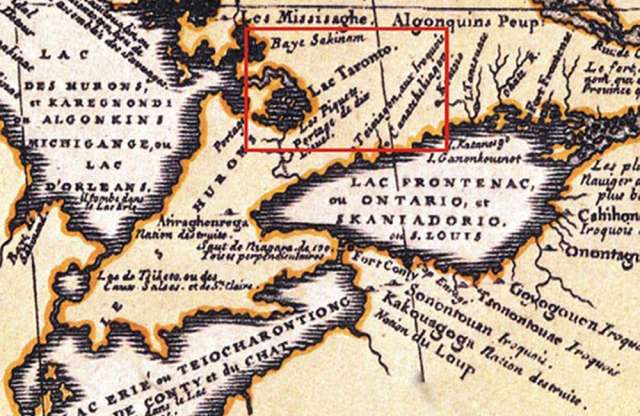
Detail from a 1688 map of western New France by Vincenzo Coronelli that locates “Lac Taronto” at Lake Simcoe.
City of Toronto Culture Division/Library and Archives Canada via the National Post
… within all that the accurate answer to “Whose land are we on?” is the land of the latest bunch of murderous bastards who killed all the previous inhabitants. Perhaps moderated to say the peeps who killed all the previous men then dated the remaining womenfolk. Because once we’ve got past that nullius stage that’s the way it has been. The Moriori are in short supply these days on the Chatham Islands given that the Maori decided to eat them.
The original inhabitants of the British Isles, the Beaker Folk, were entirely replaced by the next lot, the Iron Age Celts and similar. The Angles displaced to the west the Romano Celts in their turn, detailed DNA studies showing rather more of the female side of the R-C’s bred into the new population than the male. The Franks weren’t indigenous to France, the Allemani to Germany, the Turks to Turkey.
In fact, we’ve between little and no proof that the varied Amerinds were the original inhabitants of the lands where the White Europeans found then from 1492 onwards. In the case of both the Incas and Aztecs as political powers, proof they weren’t. And horses and Plains Indians simply weren’t a thing until the Eurasian horse was introduced post 1492.
Basically, this is indeed true. Anywhere is the possession of simply the last group of people to have slaughtered, or outbred, the previous group.
An interesting observation – if we apply the oft stated Americas example elsewhere, that Whitey stole it all and should give it back, then the Bantu should be back in Nigeria and Central Africa returned to the Pygmies, Southern to the Khoi San. We don’t say that and for the life of me I can’t work out why.
June 7, 2019
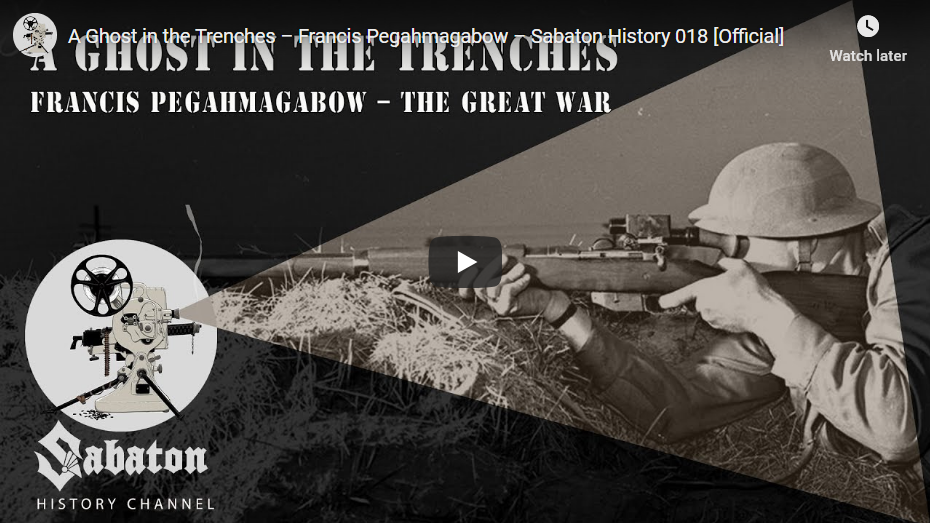
“A Ghost in the Trenches” – Francis Pegahmagabow – Sabaton History 018 [Official]
Sabaton History
Published on 6 Jun 2019As a ghost he roamed the trenches, effectively taking out his enemies one by one. He was the deadliest sniper of The Great War, with over 300 confirmed kills on his name. He is Canadian soldier Francis Pegahmagabow, born in an indigenous First Nations family, and the The Sabaton Song “A Ghost in the Trenches” is about his life and adventures.
Support Sabaton History on Patreon (and possibly get a History Channel special edition): https://www.patreon.com/sabatonhistory
Pre-order The Great War here: https://www.sabaton.net/pre-order-of-…
Check out the trailer for Sabaton’s new album The Great War right here: https://www.youtube.com/watch?v=HCZP1…
Watch more videos on the Sabaton YouTube channel: https://www.youtube.com/user/Sabaton?…
Listen to Sabaton on Spotify: http://smarturl.it/SabatonSpotify
Official Sabaton Merchandise Shop: http://bit.ly/SabatonOfficialShopHosted by: Indy Neidell
Written by: Markus Linke and Indy Neidell
Directed by: Astrid Deinhard and Wieke Kapteijns
Produced by: Pär Sundström, Astrid Deinhard and Spartacus Olsson
Creative Producer: Joram Appel
Executive Producers: Pär Sundström, Joakim Broden, Tomas Sunmo, Indy Neidell, Astrid Deinhard, and Spartacus Olsson
Maps by: Eastory
Edited by: Iryna Dulka
Sound Editing by: Marek KaminskiArchive by: Reuters/Screenocean https://www.screenocean.com
Music by Sabaton.Sources:
– IWM: Q 454, Q 17730, Q 50690, IWM 255, IWM 778, Q 17780, Q 745, IWM 466, IWM 208, Q 53538, E(AUS) 1497, E (AUS) 4677, E(AUS) 2078, Q 70213, Q 5977, Q 108213, Q 50553, Q 53637, Q 2638, Q 65444, Q 11668, Q 79508, Q 23706, Q 88121, Q 50638, IWM 207, Q 4135, Q 80267, Q 29027
– National Library of Scotland (NLS)
– Library and Archives Canada: Canadians advancing east of Arras.
– Auckland War Memorial Museum: AM 2016.26.1-3
– Canadian War Museum: George Metcalf Archival Collection, CWM 19940003-459, CWM 19920085-006, CWM 19920085-595, CWM 19920085-018, CWM 19940003-370, CWM 20040035-006An OnLion Entertainment GmbH and Raging Beaver Publishing AB co-Production.
© Raging Beaver Publishing AB, 2019 – all rights reserved.
From the comments:
Sabaton History
1 day ago
Many of you have been analysing the tracklist for the upcoming Sabaton Album The Great War. While the subjects of some of the songs are quite easy to guess, the exact topic of “A Ghost in the Trenches” was a mystery for many – although some did predict it correctly. The song is about the Canadian (and indigenous First Nations) soldier Francis Pegahmagabow, the deadliest sniper of the First World War. Indy – having researched and hosted the The Great War YouTube channel for the duration of the war, knows as much as there is to know about the subject, and is the most suitable person to tell you the story behind the song.Enjoy and Cheers!
June 5, 2019
The National Inquiry into Missing and Murdered Indigenous Women and Girls
In the National Post, Chris Selley points out some odd blindspots in the final report of the National Inquiry into Missing and Murdered Indigenous Women and Girls:
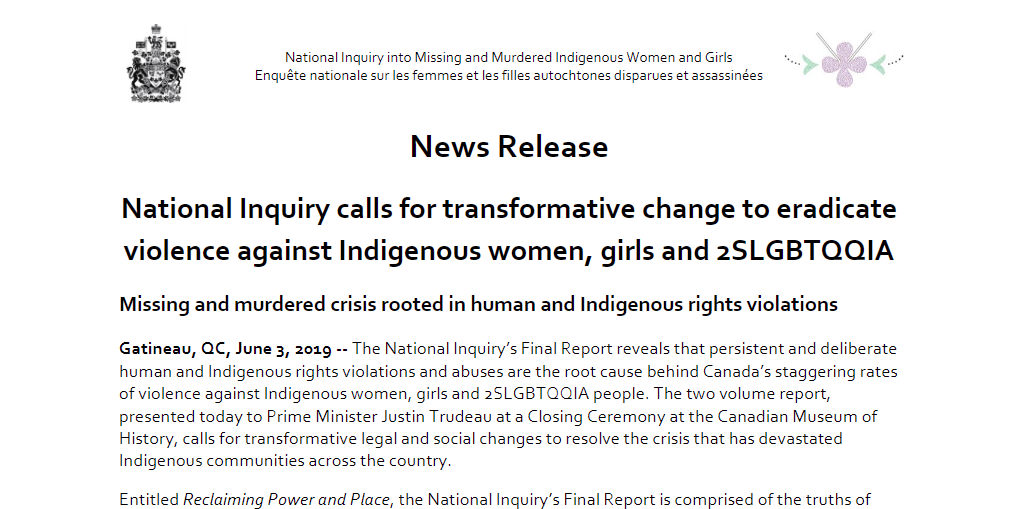
“The violence the National Inquiry heard amounts to a race-based genocide of Indigenous Peoples, including First Nations, Inuit and Métis, which especially targets women, girls, and 2SLGBTQQIA people,” the report declares. Among the first headlines was one noting that Prime Minister Justin Trudeau “avoided” using the G-word in his remarks on its findings, settling for “shameful” and “unacceptable.”
The inquiry’s legal analysis concedes it is a novel deployment of the term. It seems far more comfortable alleging a historical genocide against “Indigenous Peoples” that involved specific targeting of women — for example through forced sterilization, which is acknowledged as a genocidal technique in the 1948 UN convention — than it does a genocide against Indigenous women and girls specifically. But the insistence upon the term speaks volumes about this peculiar inquiry’s tortured birth, and about some of its more perplexing recommendations.
Indigenous women have certainly been targets for violence and discrimination in particular ways throughout Canada’s history. Today they suffer disproportionately from violent crime, relative to Indigenous men, in a way that non-Indigenous women do not. The rate of self-reported sexual assault among Indigenous women in the 2014 General Social Survey (GSS) was more than triple that of non-Indigenous women. An astonishing 61 per cent of Indigenous women aged 15-25 reported violent victimization in the previous 12 months — nearly six times the rate for Indigenous men the same age.
But if Indigenous victims of violence even today can be said to be casualties of colonialist genocide, then the subset who are by far the most “especially targeted” — which is to say dead — are men. Between 2014 and 2017, Statistics Canada reports there were 139 Indigenous female homicide victims, and 428 Indigenous male victims — three times as many. (Similarly, non-Indigenous men were murdered two-and-a-half times more often than non-Indigenous women.)
[…]
But the obsession with half the Indigenous population leads to some bewildering recommendations, especially on the justice file. On the one hand the report inveighs against mandatory minimum sentences as a cause of Indigenous overrepresentation in the prison system, and calls for more robust applications of Gladue principles for all Indigenous offenders, which is to say more alternatives to incarceration; on the other hand it supports legislation that would require judges to punish violent offences more harshly if the victim is an Indigenous woman, and to automatically classify homicides occurring after “a pattern of intimate partner violence and abuse” as first-degree murder. This would almost certainly have the effect of increasing the incarceration rates of Indigenous men and women alike.
May 13, 2019
U.S. Civil War – Surprising Soldiers – Extra History
Extra Credits
Published on 11 May 2019Historians have been learning that the US Civil War armies were a lot more diverse than previously accounted for — partly because many soldiers who hailed from other countries and nations used adopted names. Chinese, Hawaiian, Hispanic, and Cherokee soldiers all participated on both sides of the US civil war — suffering even more conflict in some cases.
Researchers are beginning to learn that the makeup of the Union and Confederate armies in the US Civil War was a lot more nuanced and diverse than we had previously known. Here is an episode on the accounts of some of those surprising soldiers!
Join us on Patreon! http://bit.ly/EHPatreon


