Quotulatiousness

February 21, 2020

Justin Trudeau, Prime Empathizer of Canada

Filed under: Cancon, Government, Law, Politics, Railways — Tags: , , , , , , — Nicholas @ 03:00

The Prime Minstrel channels his inner Bill Clinton, although he just manages to avoid saying that he “feels our pain”:

A strange thing happened Tuesday morning. That strange thing was … an important and interesting exchange on the floor of the House of Commons. It happened during routine proceedings, and not in the Punch-and-Judy exchange of question period. The leaders of the various parties in the House stood and outlined positions on the rail blockades being conducted around the country in support of Wet’suwet’en opponents of B.C.’s Coastal GasLink pipeline.

First came the prime minister. “People are troubled by what they have been witnessing this past week,” he said. Our empathizer-in-chief, the emotional mascot of Confederation, was about to go to work. “Young, old, Indigenous and newcomers are asking themselves what is happening in the country … On all sides, people are upset and frustrated.”

The next three words out of his mouth were: “I get it.” Huh. Is that the sort of thing you say when you’ve actually gotten it? If a friend called you up in a shattered emotional state because he had just lost his job, as people are starting to lose jobs to the Wet’suwet’en solidarity protests, would you say “I get it”?

Beyond this tin-eared reassurance, Trudeau did not have much specific to say, and what there was seemed to contradict itself. “Our government’s priority is to resolve this situation peacefully, but also to protect the rule of law in our country,” he promised. “That is a principle we will always stand up for.” One would have thought the role of a prime minister was to apply the law rather than to “stand up for” it. He gave his usual spiel about the myriad of ways in which the federal government has failed First Nations, again speaking as though someone else were in charge. Certainly very little of it is his own fault: the government he leads has “invested more than any other … to right historic wrongs.”

Trudeau worried aloud that Canada might become “a country where people think they can tamper with rail lines and endanger lives,” but he seemingly renounced the use of force (it’s not “helpful”) against protesters who openly discuss sabotage. What the prime minister means when he talks of the “rule” of something called “law” has been left imperfectly clear.

Chris Selley suggests the government’s fecklessness will continue to prevent any solutions being implemented:

The stupefying weightlessness of Justin Trudeau’s government has never been more evident than in recent days, as it tries to arrange an end to the Mohawk blockade of CN’s main line near Belleville, Ont. At times it seems as if it might just float away, like an improperly tethered bouncy castle in a thunderstorm.

This week has been particularly windy.

[…]

The situation is ludicrous: Because Ontario’s independent provincial police won’t enforce a court injunction, the federal public safety minister seems to be in discussions with B.C.’s solicitor general about whether B.C.’s independent provincial police might back off enforcing a different injunction.

And the worst part of this absurdist theatre festival is how difficult it is to imagine a better alternative. Conservatives continue to call on Trudeau to somehow fix the problem, but the way Canada is set up, it’s really not a federal issue. The RCMP might have some jurisdiction over the railway as federally regulated infrastructure, said University of Toronto law professor Kent Roach, but that hasn’t happened in past cases. It wouldn’t even be up to Trudeau to send in troops: under the Emergencies Act, Roach said, a provincial solicitor-general has to request it.

These are structural issues that any PM will face. Indeed, the biggest difference between the Liberals’ approach to this blockade and the Conservatives’ approach to the 2013 Idle No More protests, which included a 13-day blockade of a CN line in southwestern Ontario, has been one of rhetoric and engagement. The Conservatives talked tougher, but Aboriginal Affairs rebuffed CN’s request to intervene. (Those protesters eventually obeyed a court injunction and left.) The Liberals needlessly tie themselves in knots and insult our intelligence — they know no other way — but they clearly believe it’s their job to broker some kind of resolution.

It’s tough to say which approach is likelier to work. At this point odds seem to favour “neither.” If you have a better, workable idea to get the trains moving, for God’s sake get on the horn to Ottawa.

February 17, 2020

“The rails to hell are laid with good intentions”

In the National Post, Jonathan Kay explains how Canadian governments find themselves in the situation where the basic laws of the land can be flouted at will by a small extremist faction and the police are unwilling to do more than bare peacekeeping duties:

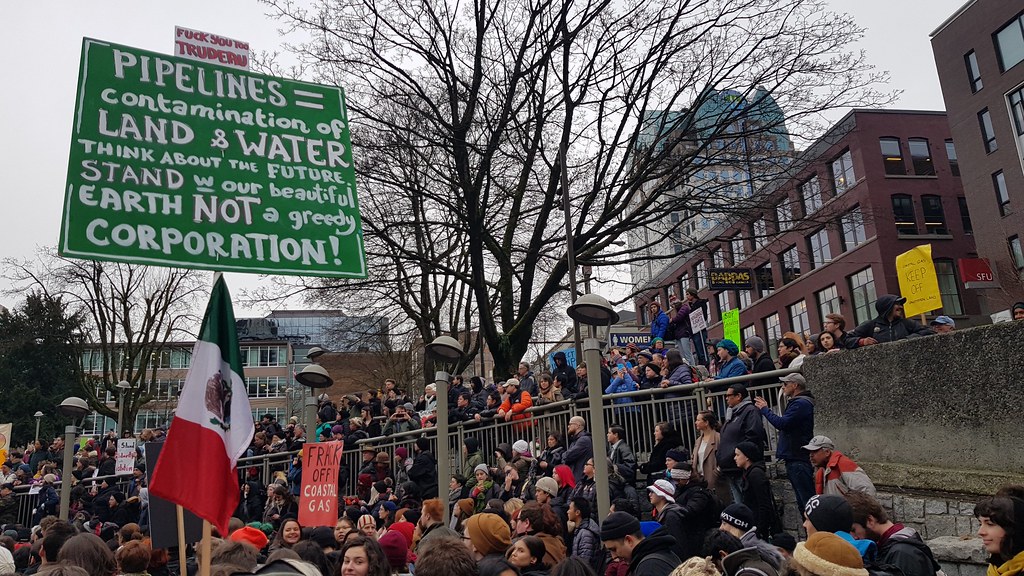
“Vancouver Solidarity with Wet’suwet’en” by jencastrotakespictures is licensed under CC BY-NC-SA 2.0

If you find yourself astounded by the current situation in Canada, whereby protesters have been allowed to shut down a rail network that remains a backbone of passenger travel and industrial transport (and whose coast-to-coast completion in 1885 became a symbol of national unity), it’s useful to revisit the accumulation of symbolic gestures that have steadily destroyed the moral authority of our governments to push back at any assertion of Indigenous rights and grievances. For years, our leaders offered reflexive acquiescence to increasingly expansive claims that Canada remains a white supremacist dystopia, culminating in last year’s campaign to convince us not only that modern Canada is a “genocide” state, but that even the act of expressing disagreement with this description makes you a sort of metaphorical train conductor on the rails to Canadian Dachau. Having publicly tattooed their guilty settler souls with every imaginable hashtag, our leaders now apparently find themselves stopped from restoring the rule of law.

The rails to hell are laid with good intentions. And there is nothing that now signals goodness in Canadian public life more than the land acknowledgment. Certainly, no one can argue with the historical truth that Indigenous peoples populated Canada for thousands of years before the arrival of Europeans. But words have meaning. And the well-understood meaning of these acknowledgments is that Indigenous peoples exercise a sort of broad, vaguely defined moral sovereignty over lands “owned” by Canadian governments, corporations and private citizens — including the lands on which we have constructed roads, rails, ports and legislatures. And since this sovereignty apparently now may be asserted at any time, for pretty much any reason, we have effectively lost the ability to enforce the systematic organization of property rights on which every functional society, Indigenous or non-Indigenous, depends.

The push to recognize Indigenous sovereignty over ancestral lands stretches back generations, an effort rooted in very real constitutional and treaty rights. But what I am describing here is not this formally bounded legal campaign, but rather the more general insistence that the entire country remains stained by original sin, and so must be purified by an open-ended, quasi-spiritual process of “decolonization.” This project began in earnest in 2017 as a counter-reaction to the perceived jingoism of the Canada 150 celebrations. Within the rarified corners of the literary and arts milieus (in which I found myself embedded at the time), decolonization quickly became a sort of state religion, complete with decolonization-themed sensitivity training and confession rituals.

[…]

The people doing the protesting are led by dissidents within one of the affected Indigenous communities, amplified by a critical mass of white environmentalists who are perfectly happy to cherry-pick Indigenous causes based on how well they line up with their own Anti-Racism/Critical Studies term-project requirements. Indeed, there is a certain type of very self-satisfied white Canadian leftist who sees himself as a real-life Lorax. Drawing on antiquated noble-savage stereotypes from the past, these decolonization super-allies cast Indigenous people as their little bar-ba-loot bears. And it just ruins their day when Indigenous leaders refuse to grab their tummies, moan for the CBC cameras, or read their bar-ba-loot scripts.

There is a larger hypocrisy at play here, too. Justin Trudeau and his entourage — currently on world tour, hoping to convince African and Caribbean leaders to hand him the shiny trophy of a UN Security Council seat — don’t take the train much. They fly. So, too, do the provincial politicians passing the buck in equal measure, not to mention the national broadcast journalists offering maudlin profiles of the demonstrators. Forcing ordinary travellers to bear the burden of upholding officially sanctioned upper-middle-class social-justice pieties isn’t “progressive.” It’s reactionary, snobbish elitism with a progressive façade.

February 16, 2020

The Canadian economy taken hostage while the PM swans around the world schmoozing for a temporary Security Council seat

Chris Selley on the state of play in the stand-off between (some) First Nations protesters and their temporary fellow travellers of the various permanent protest class:

“DSC02285” by Bengt 1955 is licensed under CC BY-NC 2.0

The majority of Wet’suwet’en First Nation members support the Coastal GasLink natural gas pipeline project, and they are in an objectively peculiar situation. On the one hand, the RCMP is doing its best to clear away the protesters and let construction proceed. On the other hand, anti-pipeline protesters claiming solidarity with the Wet’suwet’en have created chaos in their name — most notably the total shutdown of CN Rail’s eastern Canadian network, the cancellation of nearly every Canadian passenger train, and the layoffs and untold economic costs that go with that.

If protesters acknowledge the diversity of opinion among the Wet’suwet’en at all, they will defer to the authority of five hereditary chiefs who oppose the project, or observe that the five elected Wet’suwet’en band councils — all of which have signed community benefits agreements — represent a form of settler democracy imposed by the Indian Act.

[…]

Clearly the Wet’suwet’en are a divided community, including on the most basic questions of how they should be governed. It’s a mess. Mind you, look at the state of Canada as a whole.

Just as the RCMP have court authorization to clear protesters and encampments along the pipeline route, the Ontario Provincial Police have court authorization to clear the Mohawk rail blockade near Belleville, Ont. Unlike the RCMP, the OPP refuses to exercise its authority. And we just have to live with that. Conservative politicians are barking at Justin Trudeau to “enforce the law,” but he doesn’t give orders to the OPP, and neither does Ontario Premier Doug Ford, and nor should we want them to.

Still, you might expect senior ministers to have moderately stern words for folks illegally causing economic harm. You might expect the prime minister, at minimum, to be in the country. Instead, Trudeau spent the week swanning around Africa drumming up support for the UN Security Council seat with which he remains unaccountably obsessed, then decamped for the Munich Security Conference, where he was photographed warmly embracing Iranian foreign affairs minister Mohammad Javad Zarif, five weeks after Iran blew an airliner full of Canadians out of the sky over Tehran.

The Little Potato is probably doubly happy to have a valid (in his own mind) excuse for not being in the country at this particular time. He loves being the centre of attention … as long as that attention is friendly. He doesn’t handle situations well if the tempers are higher and the hostility is rising … like much of Canada right now.

The pipeline is a provincial project, not a federal one, but if the OPP won’t end the blockade and the feds aren’t willing to take truly extraordinary measures, then at some point in the foreseeable future it may well make short-term economic sense to give in to their demands. Maybe the feds can buy the pipeline from Coastal GasLink and shut it down.

And what if the Mohawks do lose interest, or are somehow induced to stand down? That now counts as the best-case scenario, and it will have involved shutting down the CN railway for at least a week — maybe two, maybe three — with enormous consequences for people’s livelihoods and the economy as a whole, all in the name of killing a project supported by the vast majority of Indigenous people affected by it. And it will happen again, as many times as any group wants it to, on whatever issue they want it to, for as long as they want it to. Unless someone in power does something unusually bold and concrete in the very near future – and it’s not even clear what that thing would be — we are well on the road as a country to being terminally screwed. In the meantime, we certainly have no lessons on accountable government to give the Wet’suwet’en.

February 15, 2020

Disrupting railways as an activist tactic appears to work really, really well

As Colby Cosh writes, for all the issues Alberta has with the government in Ottawa, nobody seriously suggested messing up the railways to get attention. Perhaps they should have:

“DSC02285” by Bengt 1955 is licensed under CC BY-NC 2.0

It never occurred to us to mess with the rail network in Eastern Canada — to inconvenience the precious commuters of the Golden Horseshoe — as a means of gaining negotiating leverage. Actually, I’m sure some people must have suggested it, but they would have been written off as selfish, dangerous idiots advocating counterproductive tactics.

The economic impact of the rail protests is big, but surely comparable, at the moment, to that of a big storm. Yet because a B.C. Aboriginal community is carrying its fight with the B.C. government to the guts of Canada, the clamour over whether large public works are now possible at all in Canada has instantly achieved new and unfamiliar volume levels.

The Coastal GasLink that is the source of the strife is a provincially regulated work running from Dawson Creek to the coast; unlike the vastly more expensive problems Alberta has encountered, this technically isn’t an issue for the wider federation at all. Except, whoops, it is! Because someone decided to make it one!

The levels of irony dazzle the imagination. The Canadian West was settled by means of passenger rail, which is supposedly one reason it was chosen as a target by the radicals supporting the Wet’suwet’en hereditary chiefs in their pipeline fight. But intercity commuter rail no longer really exists between the West Coast and Hamilton. The West is ultimately as dependent on rail freight as the East, and maybe more so, but it was that commuter inconvenience that gave rise to an immediate sense of national crisis, while Calgary and Saskatoon and Winnipeg snoozed.

And climate-change activists found themselves blocking rail lines in “solidarity” with the Wet’suwet’en, even though the chiefs’ fight is a question of territorial principle rather than carbon sins. This put the greenies in the position of opposing and thwarting actual rail travel. They admit this is anomalous; nobody likes to attach the word “hypocritical” to himself.

One of the protesters pointed out to the Star‘s Alex Boyd how dependence on rail — dependence of the sort that they spend 364 days a year advocating for intra-city commuters — facilitates unlawful, obstructive protest as a means for the self-anointed to “put pressure on decision-makers.” It is a little harder to block paved roads than railroads, and much harder to sabotage them, if it comes to that — which it might have if the police had used force to immediately disperse the protests. For some, this counts as a feature of rail, not a bug.

February 14, 2020

The reaction to the Mohawk blockade near Belleville shows that VIA Rail isn’t a serious company

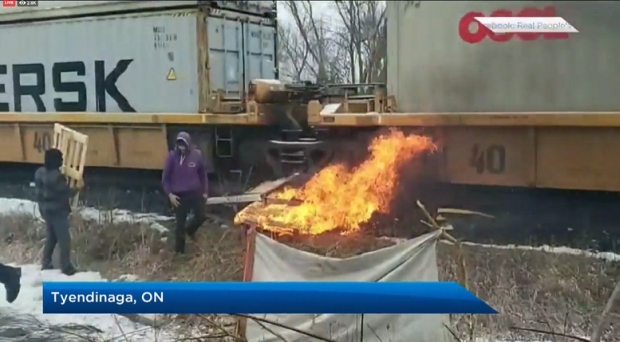
Mohawk protesters began blocking the main CN and VIA line between Toronto and Montreal near Belleville nearly a week ago. The police, having learned so often that the government and the courts won’t back them up, did little to try to get the blockade lifted other than to prevent active confrontations with the First Nations activists. Canadian National announced that they were being forced to park trains all over Eastern Canada as a result of the blockade and that deliveries of goods would be snarled for quite some time even after service is allowed to resume. VIA rail, on the other hand, seems to care not a bit about the thousands of travellers who have been stranded mid-journey and made no apparent efforts to bring in buses or any other arrangements. Chris Selley says this proves that VIA is not an essential service even in their own minds:

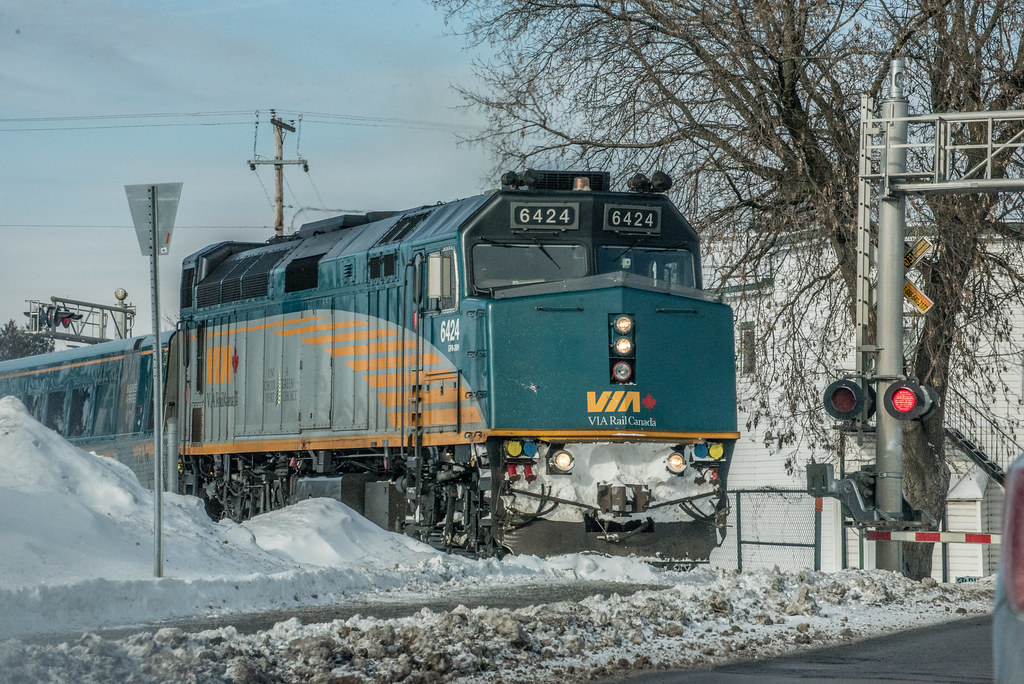
“The 6424” by Stephen Downes is licensed under CC BY-NC-SA 2.0

Of all the bad news to befall VIA Rail this week, with the cancellation of all its trains between Toronto and Ottawa and Toronto and Montreal — that’s roughly 50 per cent of its ridership and 60 per cent of its revenues — the worst news might be just how little news it has made. Mostly, the Mohawk blockade of the CN main line near Belleville, Ont., has been treated as a side story to the anti-pipeline protests and arrests in the British Columbia interior.

That’s what it is in the grand scheme of things: The battle between Wet’suwet’en members and chiefs and the federal government speaks to much larger, existential questions about the future of the Canadian economy, about the Liberal government’s reconciliation agenda, about the very nature of the Canadian federation and the rule of law. This blockade, launched in the name of solidarity with the Wet’suwet’en, just means people have to take the bus, or fly, instead of the train.

But that’s no small inconvenience, no small expense. Canadians in general are not quick to anger, but very few of the VIA refugees interviewed by various news outlets sounded even slightly furious, which they had every right to be. When protesters from the same First Nation blockaded the same set of tracks six years ago, VIA properly exhibited some concern with getting their customers to their destinations and put on replacement buses.

This time around, no buses. No suggestions. No response to media inquiries asking why there are no buses. Just a cancellation notice on the website and a fare-thee-well. At a time when VIA is seeking untold billions from the federal government to build a new Toronto-Ottawa-Montreal route and run vastly more trains, this does not bespeak a company that takes itself very seriously.

[…]

And never mind VIA, what sort of country lets a few people close down a key piece of national infrastructure, in violation of a court injunction — not for an hour or a day, but literally indefinitely? For a time it wasn’t even clear whose job it was to enforce the injunction: On Sunday an Ontario Provincial Police spokesperson told Global News it was up to the CN Police Service. On Tuesday, a CN spokesperson told the National Post it was up to the OPP, and indeed, late Tuesday OPP officers warned protesters to leave or they would be forced out. Perhaps the threat of massive economic disruption finally lit a fire under them: earlier in the day, CN had said it was considering shutting down huge parts of its freight network across the country. Had it just been rail passengers, though, the idea of this side-protest dragging on for weeks or even months seems absurdly plausible.

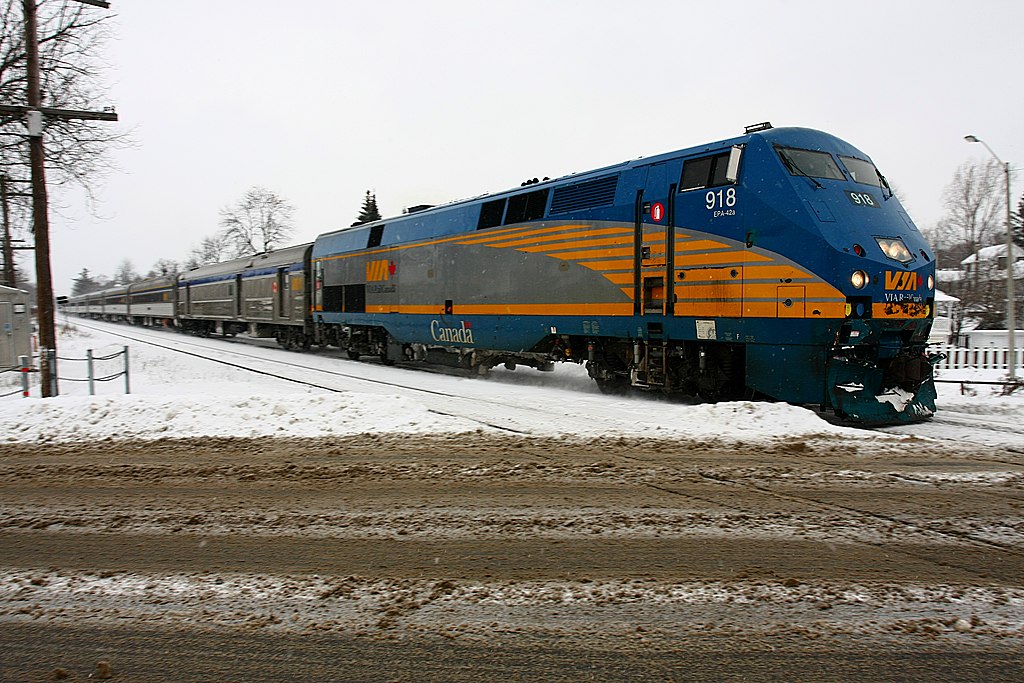
VIA Rail 918, a General Electric model P42DC locomotive, at Belleville, Ontario on 23 December 2008.
Photo by Martin Cathrae via Wikimedia Commons.

While VIA may not be serious, others are extremely serious:

Left-wing blogs have been offering instructions and maps during the #ShutDownCanada protests on how to blockade and destroy train tracks and other pieces of Canada’s infrastructure, according to True North.

Two websites in particular, these being North Shore and Warrior Up, have instructed demonstrators how to damage Canada’s pipelines, roads and railways.

In some of North Shore’s posts, for instance, they told their readers to stand in solidarity with the Wet’suwet’en tribe by destroying train tracks. In this article, the author makes it perfectly clear that he wants to damage Canada’s economy at large.

More absurdly, however, the article then went on to instruct the reader on how to compose a chemical mixture that destroys steel rail tracks — taking particular care to describe how not to leaving fingerprint or DNA evidence.

Thursday evening, VIA Rail announced their whole passenger network would be shut down until further notice: Service cancellation notice.

January 26, 2020

QotD: An Aboriginal woman’s view of Australia Day

Filed under: Australia, History, Quotations — Tags: , , , — Nicholas @ 01:00

We can project all sorts of fantasies onto our Aboriginal ancestors. There is scant record of their individual exploits or characters, and very few colonial Aborigines left behind a documented account of their experiences. I could, therefore, decide that my foremothers were courageous warriors of the resistance, or mysterious keepers of ancient feminine wisdoms, or I could envision them as victims and martyrs, enduring the humiliations of colonisation with grace and dignity. These romantic fantasies would be accepted as fact, and my “truth” would be applauded. My own (arguably more plausible) vision is that my Aboriginal foremothers had the good sense to form alliances with the settlers, and that they improved their own lives and their children’s prospects as a result.

I don’t begrudge any Aboriginal person a desire to fill in the blanks in their histories with romanticism, particularly given the rewards on offer. The story of white injustice and black tragedy has become the most acceptable Aboriginal tale to tell, and is now the only perspective on Aboriginal history — despite that dearth of documented accounts — that could possibly be accepted as authentic and true. To suggest that our story is not all about victimhood is bad enough; to suggest that modernity was in any way a blessing is double-plus ungood crimethink.

[…]

Those who mourn the demise of Aboriginal culture almost always regard things from the viewpoint of the men, who were indeed dispossessed of their land, and subsequently their traditions and status. Land wasn’t the only item of property they lost, however. They also lost or traded their women to the settlers, and this absorption — along with frontier warfare and disease — rapidly eroded tribal structures and doomed Aboriginal traditions to obsolescence. The settlers arrived with a wealth of goods and a shortage of females, and they were generally less enthusiastic about beating women than was customary in Aboriginal culture. In contrast, the Aboriginal men held no wealth, treated their women appallingly, and there were few taboos to prevent women from straying — and so stray they did. The men lost a lot in the invasion, while the women had little to lose and plenty to gain. Modern-day Aboriginal women who mourn the loss of traditional culture have rocks in their heads. (Metaphorically, that is. Back then, it would have been literally.)

Kerryn Pholi, “Something More: An Alternative Perspective on Australia Day”, Penthouse.au, 2018-01-22.

November 28, 2019

QotD: The native view of the Pilgrims

Filed under: History, Humour, Quotations, USA — Tags: , — Nicholas @ 01:00

Shorter than the natives, oddly dressed, and often unbearably dirty, the pallid foreigners had peculiar blue eyes that peeped out of the masks of bristly, animal-like hair that encased their faces. They were irritatingly garrulous, prone to fits of chicanery, and often surprisingly incompetent at what seemed to Indians like basic tasks. But they also made useful and beautiful goods — copper kettles, glittering colored glass, and steel knives and hatchets — unlike anything else in New England. Moreover they would exchange these valuable items for cheap furs of a sort used by Indians as blankets. It was like happening upon a dingy kiosk that would swap fancy electronic goods for customers’ used socks — almost anyone would be willing to overlook the shopkeeper’s peculiarities.

Charles Mann, 1491: New Revelations of the Americas Before Columbus, 2006.

November 7, 2019

Replacing “dead, white male” writers with contemporary First Nations writers

Filed under: Books, Cancon, Education, Politics — Tags: , , , — Nicholas @ 03:00

Barbara Kay, as you would expect is not a fan of this move by this school board in the Windsor area:

Some years ago, the late, great writer George Jonas asked me about my intellectual influences. Who did I remember as especially formative? Oh, George Orwell, of course. I read Animal Farm in my mid-teens, 1984 a little later, and most of his other writings over the course of my salad years. It would be hard to overstate his effect on my understanding of concepts like “freedom,” “power” and “decency.”

Since Orwell has never been “owned” by the right or the left, both admiring his prose as a model for clarity and coherence, he is the one English-language writer I would consider indispensable for any high school literature curriculum.

Up to now, most educators have concurred. But the Windsor, Ont.-area Greater Essex County District School Board has announced that, in accordance with the spirit of the Truth and Reconciliation Commission (TRC), Orwell and other canon favourites in the Grade 11 literature curriculum, including Shakespeare, will be set aside in favour of a course wholly devoted to Indigenous writing. Eight of the district’s 15 schools have already replaced former standards with such books as Indian Horse, In This Together and Seven Fallen Feathers under the rubric of Understanding Contemporary First Nations, Métis and Inuit Voices.

“This decision wasn’t made lightly,” said Tina DeCastro, a teacher consultant with the school board’s Indigenous Education Team. The decision arose from a motion passed by the school board’s trustees as a response to TRC calls for action. Eastern Cherokee Sandra Muse Isaacs, Professor of Indigenous Literature at the University of Windsor, defends the radical change as necessary on the grounds that Indigenous stories have been ignored in the past. “Our stories predate Canada. It’s as simple as that.”

Is it really that simple?

I don’t think there is a sentient Canadian today who isn’t aware that Indigenous voices have been neglected in the past, and who would not wholeheartedly support the addition of Indigenous writing to contemporary literature curricula. But an entire year devoted to Indigenous literature that supplants revered works by great writers from the civilization that produced Canada as a nation-state, in order to redress the offence of historical inattention to Indigenous people, is to rob the majority of Canadian students of their cultural patrimony.

October 5, 2019

Legends Summarized: El Dorado

Overly Sarcastic Productions
Published 4 Oct 2019

El Dorado! A shining golden city packed with promises of wealth, power and everlasting glory. An unspoiled paradise deep in the jungle, the PERFECT destination for treasure-hunters and anthropologists alike. Something that perfect is something EVERYONE wants to be real.

Aaaaand that’s the trick, isn’t it? Wanting something that badly isn’t healthy. Just ask the conquistadors!
(Oh wait, we can’t – because so many of them died on fruitless quests for El Dorado. And also it’s been five hundred years and they’d all be dead anyway)

PATREON: https://www.Patreon.com/OSP

MERCH LINKS: https://www.redbubble.com/people/OSPY…

OUR WEBSITE: https://www.OverlySarcasticProductions.com
Find us on Twitter https://www.Twitter.com/OSPYouTube
Find us on Reddit https://www.Reddit.com/r/OSP/

September 19, 2019

“[T]he Indian Act is a benign form of apartheid”

Filed under: Books, Cancon, History, Law, Liberty — Tags: , , — Nicholas @ 03:00

In the National Post, Barbara Kay discusses a recent book on the key legislation that regulates relations between the Canadian federal government and the various First Nations groups:

Few and far between are disinterested scholars of Canada’s Aboriginal history who have the tough hide and principled will to publicly depart from the approved Indigenous “nation-to-nation” narrative that keeps the guilt and money flowing, but perpetuates a dysfunctional status quo on many reserves. Most of the dissenters are university academics. But Best is simply an intelligent man with a passion for his subject, a deep impatience with political correctness, and unremitting determination to weather whatever storms afflict him as he shepherds his views to a public market.

I’ve written before in the National Post and elsewhere about Best’s lonely battles with our society’s forces of repression. There Is No Difference began its public life as a post on a dedicated online site in 2014, copied to his legal firm’s. Shortly afterward, complaints were filed against him with the Law Society of Upper Canada (now the Law Society of Ontario), asking that Best be “disbarred or suspended” and that he be forced to apologize for using his law practice “to disseminate racist materials.”

After two years of stressful limbo, the Law Society graciously allowed that the excerpts submitted by the (unnamed) complainant were “not enough to merit a finding of any form of professional misconduct on their face.” (The last three words telegraph the ardent wish that they had been; apart from a dissenting group of new benchers, the Law Society’s board has increasingly demonstrated worrying Thought Police tendencies.)

Best believes the Indian Act is a benign form of apartheid, and advocates for the integration model of equal citizenship for all, a model promoted, for example, by Pierre Elliott Trudeau (who called the system “apartheid”), and the late Aboriginal lawyer William Wuttunee, author of Ruffled Feathers, who was marginalized and discredited as an “apple,” red on the outside, white on the inside.

Best believes the federal government must be the ultimate master in its own house for Canada to function as a healthy nation. He is fiercely critical of the Supreme Court’s 2004 emphasis on the “honour of the Crown” concept in its Haida Nation vs. British Columbia ruling, with key words “to consult and where appropriate, accommodate the Aboriginal interest” virtually decreeing a devolution of Crown sovereignty to Aboriginals, and effectively turning Indigenous bands into a third order of government with the power arbitrarily to advance or restrict Canada’s economic fortunes.

It’s easy for Indigenous activists to bash a white historian, or even an Aboriginal dissident without special standing like Wuttunee. But it will be more difficult to dismiss the opinion of a former Supreme Court justice. Best just came in for an unexpected stroke of luck. Former Supreme Court justice Jack Major (1992-2005) has given the book his endorsement in a letter discussed in an article by the Frontier Centre for Public Policy (FCPP).

September 8, 2019

Miscellaneous Myths: Animal Brides

Filed under: Americas, Europe, History — Tags: , , , — Nicholas @ 04:00

Overly Sarcastic Productions
Published on 6 Sep 2019

Yes, it really is as weird as it sounds. Sorry!

This video (specifically the Inuit myth) was requested by patron Richard Frederick Schubert III!

PATREON: https://www.Patreon.com/OSP

MERCH LINKS: https://www.redbubble.com/people/OSPY…

OUR WEBSITE: https://www.OverlySarcasticProductions.com
Find us on Twitter https://www.Twitter.com/OSPYouTube
Find us on Reddit https://www.Reddit.com/r/OSP/

September 5, 2019

Making a Gun-Stock War Club (feat. Green Beetle)

Filed under: Tools, Weapons, Woodworking — Tags: , , — Nicholas @ 04:00

Rex Krueger
Premiered 31 minutes ago

More video and exclusive content: http://www.patreon.com/rexkrueger
(more…)

August 26, 2019

The Inca Empire – Out of Thin Air – Extra History – #1

Filed under: Americas, History, Religion — Tags: , , , , — Nicholas @ 04:00

Extra Credits
Published on 24 Aug 2019

Join us on Patreon! http://bit.ly/EHPatreon

There’s a lot that we don’t know for sure about the Inca Empire, because we have conflicting accounts among Spanish colonizers, as well as the fact that Inca history itself is told non-linearly. But we do know that they used Andean accomplishments, from architecture to knotted quipu, to create a city that ruled the largest indigenous empire in the Americas, starting with Manco Capac and the successive Sapa Inca rulers.

July 29, 2019

Erasing the past, statue by statue, plaque by plaque

Alexander Adams on the deliberate sabotage of historical monuments in pursuit of a more perfect (i.e., imaginary) past:

End of the Trail by James Earle Fraser, located in Waupun, Wisconsin.
Photo by Shawn Conrad via Wikimedia Commons.

In the wake of recent attempts – some successful – to have Confederate statues removed from the US south, what is the future of colonialist statues in the US west? In Pioneer Mother Monuments: Constructing Cultural Memory, Cynthia Culver Prescott, a professor of history at the University of North Dakota, senses a reluctance to apply to pioneer monuments the ideological zeal that was turned on Confederate memorials. “We resist applying the insights of settler colonial studies to American pioneer narratives because to do so would call into question foundational myths of Jeffersonian agrarianism and American exceptionalism, and lay bare white conquest of native lands and peoples.” She outlines the cases against statues of colonialists, and particularly against female settlers, who took part in the drive to colonise the American west in the 19th century.

Statues depicting women have been criticised by academics and campaigners for being idealising, inaccurate, generalising and stereotypical. There is a sense that campaigners direct such ire at statues of women settlers not just because they embody sexism and colonialism but because they show women as complicit in the act of dispossessing native peoples. There is a residual resentment that – in intersectional terms – a political minority took part in a project to oppress another minority.

The creation of monuments honouring white settlers of the west began in earnest in the 1890s. As the American western frontier was closed and territories became part of the United States, a chapter of national history had been definitively closed, too. Just under 190 monuments have been erected in the US since the 1880s marking pioneer achievements. It was a way of fixing in collective memory the achievements of forebears just at the moment their stories were becoming history. The western territories had been spared the scourge of the Civil War, and its new states had a history that involved war with Mexico, the persecution and flight of the Mormons and the Indian Wars.

In the statuary, common types emerged. Women were the prairie Madonna, the protective mother, the Indian guide leading the way, the nuclear family. Men were resolute fathers, the epitome of bravery and stoic defiance. Competitions, touring exhibitions, newspaper features and book publications circulated them, encouraging other communities to commission similar statues. Alexander Phimister Proctor’s statue of a male pioneer was an acceptable manifestation of the conquering of the west. Bearded and dressed in buckskin clothing, the pioneer wears European boots and carries a rifle. He straddles the wisdom of the natives and the technological superiority of settlers, explaining how the west was won through a combination of old knowledge and new materials.

Culver Prescott notes the example of James Earle Fraser’s sculpture The End of the Trail (1890s), which depicted an exhausted American Indian on a tired pony. Fraser had apparently developed a deep sympathy for native peoples after witnessing an army eviction. It seems the sculptor intended to elicit sympathy for evicted Indians, yet it was interpreted by contemporary observers as a scene of the sad but necessary extinction of a primitive indigenous people, conforming to the social Darwinist reading of history, in which advanced people defeat and displace inferior peoples. This is an object lesson in the variety of interpretations an artwork can elicit, regardless of artistic intent. It should alert today’s social-justice warriors to the dangers of misinterpreting public art and the risk of suppressing art on the basis of misapprehension.

July 5, 2019

Miscellaneous Myths: Rainbow Crow

Filed under: Americas, History — Tags: , , , — Nicholas @ 02:00

Overly Sarcastic Productions
Published on 31 May 2019

This is one of the shortest videos I’ve ever made, and I’d feel bad about that if this month hadn’t been very long and tiring already. Enjoy this bite-sized myth, everybody!

SOME ADDITIONAL RESOURCES FROM THE LENAPE: If you’d like some further reading, try http://www.nanticoke-lenape.info/history.htm, or the official Nanticoke-Lenape online museum at http://nanticokelenapemuseum.org/. The official Lenape tribe website is at http://www.lenapeindiantribeofdelaware.com/, and the Delaware Tribes overall have a site at http://delawaretribe.org/.

And guess what I actually remembered to do before I archived my project file? I actually remembered to note down the SONGS I USED! In order, they are:
•Rondo Alla Turca (Mozart)
•Starfall (Two Steps From Hell)
•Morning Mood (Grieg)
•Fire And Ice (City of the Fallen)
•Flight of the Silverbird (Two Steps From Hell)
•The End Of The Battle (Shadow of the Colossus OST)

PATREON: https://www.Patreon.com/OSP

« Newer PostsOlder Posts »

Powered by WordPress