Two exhibitions in New York this season revisit memories of futures past: Nam June Paik’s “Becoming Robot” (which will be at the Asia Society until January 4) looks to a cybernetics-obsessed midcentury avant-garde, while the Guggenheim’s “Reconstructing the Universe” show of Italian futurist works (which has just closed) documented a movement that, while aesthetically quite distinct from Paik’s, is organized around the same essential vision: man’s aspiring to the condition of machine.
[…]
There are occasionally clever pieces: A seated Buddha contemplates a television-and-camera set-up that contemplates him back, the Buddha and his image on the screen suggesting an infinite feedback loop. A reclining Buddha stretches atop two television screens showing a video of a nude woman reclining in the same position. (Paik very often cuts to the root of the avant-garde sensibility: “How do we get some naked chicks in this?”) His robots are still interesting to look at, some of them primitive mechanical assemblages, some of them televisions and other electronic devices piled together anthropomorphically, though the contemporary commercially made robot toys on display for context are at least as interesting, their nameless creators liberated from such pressures as attend those who understand themselves as artists. Though it should be noted that the makers of the Micronaut robot toys I loved as a child were not entirely immune from the puerile sexual obsessions of the so-called avant-garde: This, for example, was on the market long before anybody ever exclaimed: “Drill, baby, drill!”
The Italian futurists, whose love for machines and violence and the machinery of violence and whose hatred of women would do so much to shape the aesthetics of fascism, foresaw a less sexy future than Paik’s, if one that was no less mechanical: Biplanes soar over the Roman Colosseum, cities are fitted together like clockworks, machinery everywhere is ascendant. By the time Mussolini makes his inevitable appearance, he, too, has been reduced to a piece of artillery, his face simply another item in the Italian arsenal, a big, fleshy cannonball.
One of the purposes of art, high or low, is to make visible the philosophical; the fascist understanding of society as one big factory or one big machine was expressed in futurist art.
Kevin D. Williamson, “Futures Trading: We are no longer thinking about the future because we believe we are there”, National Review, 2014-10-01.
August 31, 2015
QotD: Artistic memories of other futures
August 17, 2015
February 13, 2015
QotD: The Nazi leadership, Aleister Crowley and the occult
During the past four centuries, we have seen the world in semi-Epicurean terms as a great and internally consistent machine. To understand it, we observe, we question, we form hypotheses, we test, we measure, we record, we think again. The results have long since been plain. In every generation, we have added vast provinces to the empire of science. We do not yet perfectly understand the world. But the understanding we have has given us a growing dominion over the world; and there is no reason to think the growth of our understanding and dominion will not continue indefinitely.
We reject supernatural explanations partly because we have no need of them. The world is a machine. Nothing that happens appears to be an intervention into the chains of natural cause and effect. We know that things once ascribed to the direct influence of God, or the workings of less powerful invisible beings have natural causes. Where a natural cause cannot be found, we assume, on the grounds of our experience so far, that one will eventually be found. In part, however, we reject the supernatural because there is no good evidence that it exists.
[…] It seems that Hitler was a convinced believer in the occult. He took many of his decisions on astrological advice. It did him no visible good. He misjudged the British response to his invasion of Poland. He was unable to conquer Britain or to make peace. His invasion of Russia, while still fighting Britain, turned his eastern frontier from a net contributor of resources to a catastrophic drain on them. He then mishandled his relations with America. So far as he was guided by the astrologers, I hope, before he shot himself, that he thought of asking for a refund. It was the same with Himmler. Despite his trust in witchcraft, he only escaped trial and execution by crunching on a cyanide capsule made by the German pharmaceutical industry.
Turning to practitioners of the occult, I see no evidence of special success. They do not live longer than the rest of us. However they begin, they do not stay better looking. Any success they have with money, or in bed, is better explained by the gullibility of their followers than by their own magical powers.
So it was with Aleister Crowley (1875-1947) — the “Great Beast 666,” or “the wickedest man alive.” He quickly ran through the fortune his parents had left him. He spent his last years in poverty. Long before he died, he had begun to resemble the mug shot of a child murderer. Whether his claims were simply a fraud on others, or a fraud on himself as well, I see no essential difference between him and the beggar woman who cursed me in the street. He had advantages over her of birth and education. But he was still a parasite on the credulity of others.
Sean Gabb, “[Review of] Crowley: Thoughts and Perspectives, Volume Two“, Libertarian Enterprise, 2014-05-18.
September 5, 2014
Casting blame over Rotherham
At Samizdata, Perry de Havilland unflinchingly points the finger of blame:
The English ‘fascist‘ movement is a bit like a bowel movement, smelly but easily disposed of. In truth they are so trivial in terms of their support or intellectual influence that I cannot escape the notion they get as much publicity as they do primarily to keep them as a boogieman to be pointed at by their equally irrelevant confrères on the loony left.
The Rotherham scandal is not about comically half witted and pleasingly unphotogenic fascists (sorry Ed Temple). It is not about Islam or Pakistanis (sorry BNP, EDL et al.). It is not even about immigration (sorry UKIP). It is entirely about how the political culture pushed unfailingly by the BBC and Guardian (and the increasingly indistinguishable Telegraph and other formerly ‘Tory’ papers) for decades has so completely enervated British institutions along with all the mainstream political parties, that such thugs could not be dealt with. We do not need more laws, we have more than enough to deal with what happened. What we need is the preposterous culture of political correctness and its obsession with race to be flushed down the toilet.
So my caring sharing multicultural leftie chums… Rotherham? That is entirely down to you. Yes, YOU
July 17, 2014
April 10, 2014
Policing the language, German style
Matthias Heitmann on the odd things that happen to avoid any hint of Nazi contamination in allowable letter combinations on license plates and to mandate equal gender presence in job titles and place names:
In Germany today, you see, there is a palpable desire to cleanse society of views officially deemed unacceptable or politically incorrect. This is most obvious when it comes to words or views associated with fascism or the far right. It’s likely that even the most liberal of Germans would oppose the right of members of the right-wing National Democratic Party to voice their strange views in public. Indeed, having embarrassingly failed to ban the party in 2003, the federal government is currently trying to outlaw the party once again. Anyone attempting to defend free speech or freedom of association in this context will find themselves accused of being a fascist sympathiser, an apologist or, even worse, disrespecting victims of the Holocaust and their descendants.
The popular fear of being accused of being a Nazi sympathiser has resulted in some strange regulations. Since the 1980s, for instance, the letter combinations ‘NS’, ‘KZ’, ‘SS’, ‘SA’ or ‘HJ’, which all potentially allude to fascist symbols or institutions, have been banned from use on car licence plates. In the past few months, there has been a heated debate about whether letter or number combinations like ‘HH’ or ‘88’ (which both allude to ‘Heil Hitler’), ‘18’ (meaning ‘Adolf Hitler’), 204 (meaning Hitler’s birthday) or even ‘GV’ (which is short for sexual intercourse) should be banned from licence plates, too. This poses something of a problem for Hamburg car owners, whose licence plates all start with ‘HH’.
[…]
It’s not only on the traditional minefield of racism and fascism that free speech has suffered in Germany. Free speech has also been knocked about by feminists, too, with their determination to impose new language and behaviour regulations. Last summer, for instance, the University of Leipzig announced plans to address its staff using only the feminine forms of words. ‘Professorin’ is due to replace older formulations like ‘Professorinnen und Professoren’ or ‘Professor/innen’. Schröder, meanwhile, admitted during a recent interview that not even the Bible is immune from linguistic tinkering. When talking to girls, for instance, the masculine ‘der Gott’ could simply become the neutral ‘das Gott’.
Interestingly, when feminist language control clashes with anti-fascist dogma, feminism seems to prevail. In the German capital, Berlin, a local parliament, heavily dominated by green and left-wing politicians, voted against naming a square in front of the Jewish Museum after the Enlightenment philosopher Moses Mendelssohn. This decision was made on the grounds that as Mendelssohn was a man, he would break the rule established in 2005 to only name streets and squares after women. This was deemed necessary in order to achieve sexual equality on the city map. As a compromise, the local parliament used Mendelssohn wife’s name alongside his own, creating ‘Moses-und-Fromet-Mendelssohn-Platz’. Although Fromet wasn’t a historic figure, she at least was a woman.
March 4, 2014
Not a science fiction story – “National Bolshevism” versus “Atlantis”
According to Robert Zubrin, a key advisor to Vladimir Putin and other Russian leaders has some really weird notions:
Putin is sometimes described as a revanchist, seeking to recreate the Soviet Union. That is a useful shorthand, but it is not really accurate. Putin and many of his gang may have once been Communists, but they are not that today. Rather, they have embraced a new totalitarian political ideology known as “Eurasianism.”
The roots of Eurasianism go back to czarist émigrés interacting with fascist thinkers in between-the-wars France and Germany. But in recent years, its primary exponent has been the very prominent and prolific political theorist Aleksandr Dugin.
[…]
Nazism, it will be recalled, was an abbreviation for National Socialism. National Bolshevism, therefore, put itself forth as an ideology that relates to National Socialism in much the same way as Bolshevism relates to Socialism. This open self-identification with Nazism is also shown clearly in the NBP flag, which looks exactly like a Nazi flag, with a red background surrounding a white circle, except that the black swastika at the center is replaced by a black hammer and sickle.
[…]
The core idea of Dugin’s Eurasianism is that “liberalism” (by which is meant the entire Western consensus) represents an assault on the traditional hierarchical organization of the world. Repeating the ideas of Nazi theorists Karl Haushofer, Rudolf Hess, Carl Schmitt, and Arthur Moeller van der Bruck, Dugin says that this liberal threat is not new, but is the ideology of the maritime cosmopolitan power “Atlantis,” which has conspired to subvert more conservative land-based societies since ancient times. Accordingly, he has written books in which he has reconstructed the entire history of the world as a continuous battle between these two factions, from Rome v. Carthage to Russia v. the Anglo Saxon “Atlantic Order,” today. If Russia is to win this fight against the subversive oceanic bearers of such “racist” (because foreign-imposed) ideas as human rights, however, it must unite around itself all the continental powers, including Germany, Central and Eastern Europe, the former Soviet republics, Turkey, Iran, and Korea, into a grand Eurasian Union strong enough to defeat the West.
In order to be so united, this Eurasian Union will need a defining ideology, and for this purpose Dugin has developed a new “Fourth Political Theory” combining all the strongest points of Communism, Nazism, Ecologism, and Traditionalism, thereby allowing it to appeal to the adherents of all of these diverse anti-liberal creeds. He would adopt Communism’s opposition to free enterprise. However, he would drop the Marxist commitment to technological progress, a liberal-derived ideal, in favor of Ecologism’s demagogic appeal to stop the advance of industry and modernity. From Traditionalism, he derives a justification for stopping free thought. All the rest is straight out of Nazism, ranging from legal theories justifying unlimited state power and the elimination of individual rights, to the need for populations “rooted” in the soil, to weird gnostic ideas about the secret origin of the Aryan race in the North Pole.
January 29, 2014
Pitching the New Deal through film – Gabriel Over the White House
I’d never heard of Gabriel Over the White House, so Jonah Goldberg‘s summary was quite interesting:
The legendary media tycoon William Randolph Hearst believed America needed a strongman and that Franklin D. Roosevelt would fit the bill. He ordered his newspapers to support FDR and the New Deal. At his direction, Hearst’s political allies rallied around Roosevelt at the Democratic convention, which some believe sealed the deal for Roosevelt’s nomination.
But all that wasn’t enough. Hearst also believed the voters had to be made to see what could be gained from a president with a free hand. So he financed the film Gabriel Over the White House, starring Walter Huston. The film depicts an FDR look-alike president who, after a coma-inducing car accident, is transformed from a passive Warren Harding type into a hands-on dictator. The reborn commander-in-chief suspends the Constitution, violently wipes out corruption, and revives the economy through a national socialist agenda. When Congress tries to impeach him, he dissolves Congress.
The Library of Congress summarizes the film nicely. “The good news: He reduces unemployment, lifts the country out of the Depression, battles gangsters and Congress, and brings about world peace. The bad news: He’s Mussolini.”
Hearst wanted to make sure the script got it right, so he sent it to what today might be called a script doctor, namely Roosevelt. FDR loved it, but he did have some changes, which Hearst eagerly accepted. A month into his first term, FDR sent Hearst a thank-you note. “I want to send you this line to tell you how pleased I am with the changes you made in Gabriel Over the White House,” Roosevelt wrote. “I think it is an intensely interesting picture and should do much to help.”
You can probably get the overall tone of the movie from this clip:
Even the editors at Wikipedia — hardly a hotbed of proto-fascists — describe it as “an example of totalitarian propaganda”:
Controversial since the time of its release, Gabriel Over the White House is widely acknowledged to be an example of totalitarian propaganda. Tweed, the author of the original novel, was a “liberal champion of government activism” and trusted adviser to David Lloyd George, the Liberal Prime Minister who brought Bismarck’s welfare state to the United Kingdom. The decision to buy the story was made by producer Walter Wanger, variously described as “a liberal Democrat” or a “liberal Hollywood mogul.” After two weeks of script preparation, Wanger secured the financial backing of media magnate William Randolph Hearst, one of President Franklin D. Roosevelt’s staunchest supporters, who had helped him get the Democratic presidential nomination and who enlisted his entire media empire to campaign for him. Hearst intended the film to be a tribute to FDR and an attack on previous Republican administrations.
Although an internal MGM synopsis had labeled the script “wildly reactionary and radical to the nth degree,” studio boss Louis B. Mayer “learned only when he attended the Glendale, California preview that Hammond gradually turns America into a dictatorship,” writes film historian Leonard J. Leff. “Mayer was furious, telling his lieutenant, ‘Put that picture back in its can, take it back to the studio, and lock it up!'”
Released only a few weeks after Franklin Roosevelt’s inauguration, the film was labeled by The New Republic “a half-hearted plea for Fascism.” Its purpose, agreed The Nation, was “to convert innocent American movie audiences to a policy of fascist dictatorship in this country.” Newsweek‘s Jonathan Alter concurred in 2007 that the movie was meant to “prepare the public for a dictatorship,” as well as to be an instructional guide for FDR, who read the script during the campaign. He liked it so much that he took time during the hectic first weeks of his presidency to suggest several script rewrites that were incorporated into the film. “An aroma of fascism clung to the heavily edited release print,” according to Leff. Roosevelt saw an advance screening, writing, “I want to send you this line to tell you how pleased I am with the changes you made in Gabriel Over the White House. I think it is an intensely interesting picture and should do much to help.” Roosevelt saw the movie several times and enjoyed it. After a private screening, First Lady Eleanor Roosevelt wrote that “if a million unemployed marched on Washington … I’d do what the President does in the picture!”
Update, 5 November, 2018: James Lileks takes the opportunity to review this film on the eve of tomorrow’s US midterm elections.
For Election week, a remarkable movie. And I don’t mean “astonishingly good, technically superb, visually ingenious.” I mean utterly insane.
January 12, 2014
Obscure old German book from 1925 becomes surprise e-book hit

Dust jacket of 1926–1927 edition
Adolf Hitler’s Mein Kampf has quietly become an e-book bestseller, climbing high on the charts of political books on Apple’s iTunes and Amazon’s Kindle, even as print sales of the 1925 anti-Semitic screed continue to languish.
“Mein Kampf hasn’t made the New York Times‘ nonfiction chart since its U.S. release in 1939, the same year Germany invaded Poland, and its print sales have fallen steadily ever since,” Chris Faraone wrote for the website Vocativ. “But with a flood of new e-book editions, Hitler’s notorious memoir just clocked a banner digital year.”
Two different digital versions of Mein Kampf currently rank third and fourth on the Politics & Current Events on iBooks, outpacing books by modern-day conservative pundits and celebrities such as Sarah Palin, Charles Krauthammer and Glenn Beck. The books sell for 99 cents and $2.99 respectively.
On Amazon, the Kindle version of Mein Kampf ranks No. 1 in the category of Propaganda and Political Philosophy.
Odd how the LA Times‘ instinct is to compare the sales of Mein Kampf with books by American conservatives, rather than works by, say, Marx, Mao, or Mussolini. You know, comparable theorists of totalitarian power (oh, wait…that is how the Times views Palin, Krauthammer, and Beck).
In a post from 2010, Reason TV looks at the power of Nazi Propaganda:
From radio and film to newspapers and publishing, the Nazi regime controlled every aspect of German culture from 1933-1945. Through Josef Goebbels’ Ministry of Public Enlightenment and Propaganda, the German state tightly controlled political messaging, promoting deification of the leader—the Führerprinzip—and the demonization of the ubiquitous and duplicitious “racial enemy.” A new exhibit at the United States Holocaust Memorial Museum in Washington, D.C., examines “how the Nazi Party used modern techniques as well as new technologies and carefully crafted messages to sway millions with its vision for a new Germany.” Reason.tv’s Michael C. Moynihan visited with museum historian and curator Steve Luckert to discuss the role and effectiveness of propaganda in the rise of fascism and what lessons can be drawn from the Nazi experiment in mass manipulation.
December 7, 2013
QotD: Minimum wage and Social Darwinism
Consider the debate over the minimum wage. The controversy centered on what to do about what Sidney Webb called the “unemployable class.” It was Webb’s belief, shared by many of the progressive economists affiliated with the American Economic Association, that establishing a minimum wage above the value of the unemployables’ worth would lock them out of the market, accelerating their elimination as a class. This is essentially the modern conservative argument against the minimum wage, and even today, when conservatives make it, they are accused of — you guessed it — social Darwinism. But for the progressives at the dawn of the fascist moment, this was an argument for it. “Of all ways of dealing with these unfortunate parasites,” Webb observed, “the most ruinous to the community is to allow them unrestrainedly to compete as wage earners.”
Ross put it succinctly: “The Coolie cannot outdo the American, but he can underlive him.” Since the inferior races were content to live closer to a filthy state of nature than the Nordic man, the savages did not require a civilized wage. Hence if you raised minimum wages to a civilized level, employers wouldn’t hire such miscreants in preference to “fitter” specimens, making them less likely to reproduce and, if necessary, easier targets for forced sterilization. Royal Meeker, a Princeton economist and adviser to Woodrow Wilson, explained: “Better that the state should support the inefficient wholly and prevent the multiplication of the breed than subsidize incompetence and unthrift, enabling them to bring forth more of their kind.” Arguments like these turn modern liberal rationales for welfare state wage supports completely on their head.
Jonah Goldberg, Liberal Fascism: The Secret History of the American Left, From Mussolini to the Politics of Change, 2008.
November 30, 2013
September 8, 2013
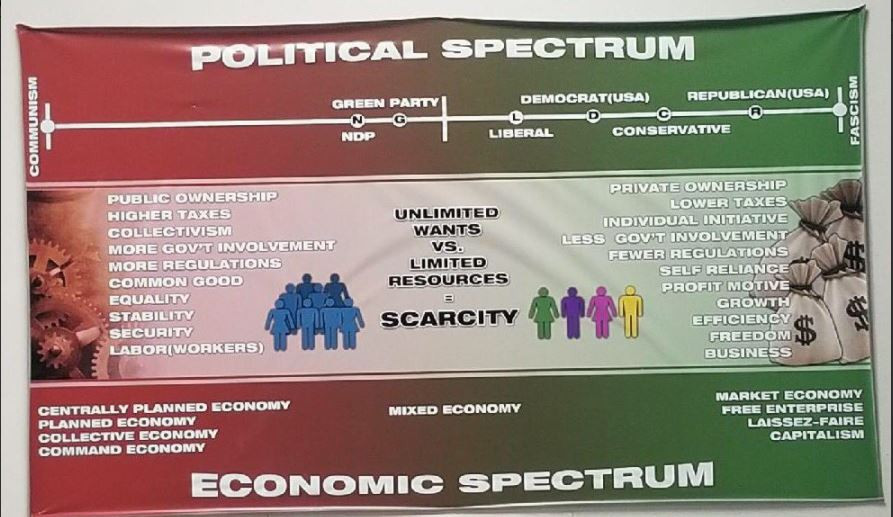
QotD: What is Fascism?
Learned controversies, reverberating for years on end in American magazines, have not even been able to determine whether or not Fascism is a form of capitalism. But still, when we apply the term ‘Fascism’ to Germany or Japan or Mussolini’s Italy, we know broadly what we mean. It is in internal politics that this word has lost the last vestige of meaning. For if you examine the press you will find that there is almost no set of people — certainly no political party or organized body of any kind — which has not been denounced as Fascist during the past ten years. Here I am not speaking of the verbal use of the term ‘Fascist’. I am speaking of what I have seen in print. I have seen the words ‘Fascist in sympathy’, or ‘of Fascist tendency’, or just plain ‘Fascist’, applied in all seriousness to the following bodies of people:
Conservatives: All Conservatives, appeasers or anti-appeasers, are held to be subjectively pro-Fascist. British rule in India and the Colonies is held to be indistinguishable from Nazism. Organizations of what one might call a patriotic and traditional type are labelled crypto-Fascist or ‘Fascist-minded’. Examples are the Boy Scouts, the Metropolitan Police, M.I.5, the British Legion. Key phrase: ‘The public schools are breeding-grounds of Fascism’.
Socialists: Defenders of old-style capitalism (example, Sir Ernest Benn) maintain that Socialism and Fascism are the same thing. Some Catholic journalists maintain that Socialists have been the principal collaborators in the Nazi-occupied countries. The same accusation is made from a different angle by the Communist party during its ultra-Left phases. In the period 1930-35 the Daily Worker habitually referred to the Labour Party as the Labour Fascists. This is echoed by other Left extremists such as Anarchists. Some Indian Nationalists consider the British trade unions to be Fascist organizations.
Communists: A considerable school of thought (examples, Rauschning, Peter Drucker, James Burnham, F. A. Voigt) refuses to recognize a difference between the Nazi and Soviet régimes, and holds that all Fascists and Communists are aiming at approximately the same thing and are even to some extent the same people. Leaders in The Times (pre-war) have referred to the U.S.S.R. as a ‘Fascist country’. Again from a different angle this is echoed by Anarchists and Trotskyists.
Trotskyists: Communists charge the Trotskyists proper, i.e. Trotsky’s own organization, with being a crypto-Fascist organization in Nazi pay. This was widely believed on the Left during the Popular Front period. In their ultra-Right phases the Communists tend to apply the same accusation to all factions to the Left of themselves, e.g. Common Wealth or the I.L.P.
Catholics: Outside its own ranks, the Catholic Church is almost universally regarded as pro-Fascist, both objectively and subjectively;
War resisters: Pacifists and others who are anti-war are frequently accused not only of making things easier for the Axis, but of becoming tinged with pro-Fascist feeling.
Supporters of the war: War resisters usually base their case on the claim that British imperialism is worse than Nazism, and tend to apply the term ‘Fascist’ to anyone who wishes for a military victory. The supporters of the People’s Convention came near to claiming that willingness to resist a Nazi invasion was a sign of Fascist sympathies. The Home Guard was denounced as a Fascist organization as soon as it appeared. In addition, the whole of the Left tends to equate militarism with Fascism. Politically conscious private soldiers nearly always refer to their officers as ‘Fascist-minded’ or ‘natural Fascists’. Battle-schools, spit and polish, saluting of officers are all considered conducive to Fascism. Before the war, joining the Territorials was regarded as a sign of Fascist tendencies. Conscription and a professional army are both denounced as Fascist phenomena.
Nationalists: Nationalism is universally regarded as inherently Fascist, but this is held only to apply to such national movements as the speaker happens to disapprove of. Arab nationalism, Polish nationalism, Finnish nationalism, the Indian Congress Party, the Muslim League, Zionism, and the I.R.A. are all described as Fascist but not by the same people.
George Orwell, “What is Fascism?”, Tribune, 1944
June 29, 2013
QotD: Orwell on nationalism and the world state
What is the use of pointing out that a World State is desirable? What matters is that not one of the five great military powers would think of submitting to such a thing. All sensible men for decades past have been substantially in agreement with what Mr. Wells says; but the sensible men have no power and, in too many cases, no disposition to sacrifice themselves. Hitler is a criminal lunatic, and Hitler has an army of millions of men, aeroplanes in thousands, tanks in tens of thousands. For his sake a great nation has been willing to overwork itself for six years and then to fight for two years more, whereas for the common-sense, essentially hedonistic world-view which Mr. Wells puts forward, hardly a human creature is willing to shed a pint of blood. Before you can even talk of world reconstruction, or even of peace, you have got to eliminate Hitler, which means bringing into being a dynamic not necessarily the same as that of the Nazis, but probably quite as unacceptable to ‘enlightened’ and hedonistic people. What has kept England on its feet during the past year? In part, no doubt, some vague idea about a better future, but chiefly the atavistic emotion of patriotism, the ingrained feeling of the English-speaking peoples that they are superior to foreigners. For the last twenty years the main object of English left-wing intellectuals has been to break this feeling down, and if they had succeeded, we might be watching the S.S. men patrolling the London streets at this moment. Similarly, why are the Russians fighting like tigers against the German invasion? In part, perhaps, for some half-remembered ideal of Utopian Socialism, but chiefly in defence of Holy Russia (the ‘sacred soil of the Fatherland’, etc. etc.), which Stalin has revived in an only slightly altered from. The energy that actually shapes the world springs from emotions — racial pride, leader-worship, religious belief, love of war — which liberal intellectuals mechanically write off as anachronisms, and which they have usually destroyed so completely in themselves as to have lost all power of action.
[. . .]
Mr. Wells, like Dickens, belongs to the non-military middle class. The thunder of guns, the jingle of spurs, the catch in the throat when the old flag goes by, leave him manifestly cold. He has an invincible hatred of the fighting, hunting, swashbuckling side of life, symbolised in all his early books by a violent propaganda against horses. The principal villain of his Outline of History is the military adventurer, Napoleon. If one looks through nearly any book that he has written in the last forty years one finds the same idea constantly recurring: the supposed antithesis between the man of science who is working towards a planned World State and the reactionary who is trying to restore a disorderly past. In novels, Utopias, essays, films, pamphlets, the antithesis crops up, always more or less the same. On the one side science, order, progress, internationalism, aeroplanes, steel, concrete, hygiene: on the other side war, nationalism, religion, monarchy, peasants, Greek professors, poets, horses. History as he sees it is a series of victories won by the scientific man over the romantic man. Now, he is probably right in assuming that a ‘reasonable,’ planned form of society, with scientists rather than witch-doctors in control, will prevail sooner or later, but that is a different matter from assuming that it is just round the corner. There survives somewhere or other an interesting controversy which took place between Wells and Churchill at the time of the Russian Revolution. Wells accuses Churchill of not really believing his own propaganda about the Bolsheviks being monsters dripping with blood, etc., but of merely fearing that they were going to introduce an era of common sense and scientific control, in which flag-wavers like Churchill himself would have no place. Churchill’s estimate of the Bolsheviks, however, was nearer the mark than Wells’s. The early Bolsheviks may have been angels or demons, according as one chooses to regard them, but at any rate they were not sensible men. They were not introducing a Wellsian Utopia but a Rule of the Saints, which like the English Rule of the Saints, was a military despotism enlivened by witchcraft trials. The same misconception reappears in an inverted form in Wells’s attitude to the Nazis. Hitler is all the war-lords and witch-doctors in history rolled into one. Therefore, argues Wells, he is an absurdity, a ghost from the past, a creature doomed to disappear almost immediately. But unfortunately the equation of science with common sense does not really hold good. The aeroplane, which was looked forward to as a civilising influence but in practice has hardly been used except for dropping bombs, is the symbol of that fact. Modern Germany is far more scientific than England, and far more barbarous. Much of what Wells has imagined and worked for is physically there in Nazi Germany. The order, the planning, the State encouragement of science, the steel, the concrete, the aeroplanes, are all there, but all in the service of ideas appropriate to the Stone Age. Science is fighting on the side of superstition. But obviously it is impossible for Wells to accept this. It would contradict the world-view on which his own works are based. The war-lords and the witch-doctors must fail, the common-sense World State, as seen by a nineteenth-century Liberal whose heart does not leap at the sound of bugles, must triumph. Treachery and defeatism apart, Hitler cannot be a danger. That he should finally win would be an impossible reversal of history, like a Jacobite restoration.
George Orwell, “Wells, Hitler and the World State”, Horizon, 1941.
May 3, 2013
Orwell’s Homage to Catalonia at 75
In the sp!ked review of books, Mick Hume looks at the book that got Orwell tossed out of the inner circle of leftist writers, not because it was bad, but because it was honest (and made Stalinism look too similar to Hitlerism):
George Orwell could have been killed twice in the Spanish Civil War. Once when he was shot in the throat by General Franco’s fascist forces; then when he was hunted by official Communist agents who, with the backing of Stalin’s Soviet Union, stabbed the revolution in the back and imprisoned, tortured and killed leading leftists and anarchists who were ostensibly on the same Republican side. Orwell learned the hardest way that the war against fascism in Spain was also a civil war against Stalinism.
Homage to Catalonia, Orwell’s famous account of his time in Spain from his arrival in Barcelona on Boxing Day 1936 to his escape in June 1937, has just reached its seventy-fifth anniversary. Like its author, the book almost didn’t make it either. The radical journalist and author’s usual publisher, Victor Gollancz, turned the book down without even seeing the manuscript, insisting that he would not publish anything ‘which could harm the fight against fascism’ by criticising the Communists.
Most of those from Britain and Europe who went to write about and fight in the Spanish Civil War took a similarly one-eyed view and followed the pro-Soviet line. What was unique about Orwell was that he hated fascism, but also stood apart from the official Stalinist-dominated left of his time. The radical maverick wrote about what he saw in Spain, rather than simply what he was told was true — although he also warned his readers to ‘beware my partisanship’ when seeking an objective account. He questioned the ‘official’ Stalinist-dictated account of events in Barcelona and elsewhere that was accepted around the world. This heresy made him the subject of a hate campaign when Homage to Catalonia was finally published in 1938, a campaign which continued well into the 1980s.
[. . .]
Orwell’s brilliant firsthand account of the conflict stands apart from and well above the I-was-there school of emotive, narcissistic war reporting we witness too often today. He also attempts to put his personal experiences into some proper political context, in two chapters now removed (at his request) from the narrative text and published at the end as appendices.
Here, Orwell closely interrogates and challenges the ‘official version’ of events in Barcelona, put about by the Communists and their many international apologists to justify their brutal repression of the non-Stalinist left. As he unravels the twisting of truth by propaganda organs such as the CPGB’s Daily Worker, you can almost see the ideas he was soon to express in his novels Animal Farm and Nineteen Eighty-Four. He is also cutting about the way that the Communists simply branded their opponents as ‘Social-fascists’ and ‘Trotsky-Fascists’ to avoid engaging in important political arguments. Many who express their admiration for Orwell today have yet to absorb his point that screaming ‘Fascists!’ in the faces of those you disagree with is not the same thing as making your case. ‘Libel’, as he concludes, ‘settles nothing’.
April 27, 2013
“Nazi” is a word that leads to intellectual laziness and misunderstanding
In History Today, Richard Overy explains why the word “Nazi” has been over-used and has become an obstacle to historical understanding:
Few words in regular use in historical writing can have been abused as much as the word ‘Nazi’. At the very least it has proved a persistent grammatical challenge for generations of students who fall into the trap of writing ‘Nazi’s’ or ‘Nazis’ ‘ as the plural of Nazi and ‘Nazis’ as the possessive without an apostrophe, when it should be the other way around. This has become so widespread a practice that the mistake profits from a growing linguistic inertia. Soon it will be designated as an anomaly we can all live with, like the misuse of ‘impact’ as if it were a verb — as in ‘the Nazi’s impacted the German political system’.
In truth this is the least of the problems. The real issue is the indiscriminate use of the term ‘Nazi’ to describe anything to do with German institutions or behaviour in the years of the dictatorship between 1933 and 1945. It is common practice to talk of the ‘Nazi Army’, or the ‘Nazi Air Forces’, or ‘Nazi atrocities’, or ‘the Nazi economy’ as if everything in Germany under Hitler was uniquely and unambiguously National Socialist. The result is a complete lack of historical precision. ‘Nazi’ becomes a shorthand term that obscures more than it explains. Historians who write about the Soviet Union under Stalin do not usually describe its features as ‘Commie this’ or ‘Commie that’, any more than historians of British party politics in the interwar years talk about ‘Tories’ and ‘lefties’ rather than the Conservative Party and the Labour Party.
The term originated in the 1920s when contemporaries searched for some way of getting round the long-winded title of the party — the National Socialist German Workers Party (NSDAP). It was used chiefly by the enemies of the party and never by the regime itself. The term ‘Nazi’ or ‘the Nazis’ had strongly negative associations; it was employed as a quick way of describing a movement popularly associated in the mind of left-wing critics outside Germany with authoritarian rule, state terror, concentration camps and an assault on the cultural values of the West. Psychologists even suggested that there was such a thing as a ‘Nazi mind’ to explain why members of the party were so brutal, aggressive and mendacious. The term then, and now, was loaded.