Back in Early Modern England, enclosure led to a massive over-supply of labor. The urge to explore and colonize was driven, to an unknowable but certainly large extent, by the effort to find something for all those excess people to DO. The fact that they’d take on the brutal terms of indenture in the New World tells you all you need to know about how bad that labor over-supply made life back home. The same with “industrial innovation”. The first Industrial Revolution never lacked for workers, and indeed, Marxism appealed back in its day because the so-called “Iron Law of Wages” seemed to apply — given that there were always more workers than jobs …
The great thing about industrial work, though, is that you don’t have to be particularly bright to do it. There’s always going to be a fraction of the population that fails the IQ test, no matter how low you set the bar, but in the early Industrial Revolution that bar was pretty low indeed. So much so, in fact, that pretty soon places like America were experiencing drastic labor shortages, and there’s your history of 19th century immigration. The problem, though, isn’t the low IQ guys. It’s the high-IQ guys whose high IQs don’t line up with remunerative skills.
My academic colleagues were a great example, which is why they were all Marxists. I make fun of their stupidity all the time, but the truth is, they’re most of them bright enough, IQ-wise. Not geniuses by any means, but let’s say 120 IQ on average. Alas, as we all know, 120-with-verbal-dexterity is a very different thing from 120-and-good-with-a-slide-rule. Academics are the former, and any society that wants to remain stable HAS to find something for those people to do. Trust me on this: You do not want to be the obviously smartest guy in the room when everyone else in the room is, say, a plumber. This is no knock on plumbers, who by and large are cool guys, but it IS a knock on the high-IQ guy’s ego. Yeah, maybe I can write you a mean sonnet, or a nifty essay on the problems of labor over-supply in 16th century England, but those guys build stuff. And they get paid.
Those guys — the non-STEM smart guys — used to go into academia, and that used to be enough. Alas, soon enough we had an oversupply of them, too, which is why academia soon became the academic-industrial complex. 90% of what goes on at a modern university is just make-work. It’s either bullshit nobody needs, like “education” majors, or it’s basically just degrees in “activism”. It’s like Say’s Law for retards — supply creates its own demand, in this case subsidized by a trillion-dollar student loan industry. Better, much better, that it should all be plowed under, and the fields salted.
Any society digging itself out of the rubble of the future should always remember: No overproduction of elites!
Severian, “The Academic-Industrial Complex”, Rotten Chestnuts, 2021-05-30.
November 26, 2023
QotD: From Industrial Revolution labour surplus to modern era academic surplus
November 20, 2023
QotD: Flax and linen in the ancient and medieval world
Linen fabrics are produced from the fibers of the flax plant, Linum usitatissimum. This common flax plant is the domesticated version of the wild Linum bienne, domesticated in the northern part of the fertile crescent no later than 7,000 BC, although wild flax fibers were being used to produce textiles even earlier than that. Consequently the use of linen fibers goes way back. In fact, the oldest known textiles are made from flax, including finds of fibers at Nahal Hemar (7th millennium BC), Çayönü (c. 7000 BC), and Çatalhöyük (c. 6000 BC). Evidence for the cultivation of flax goes back even further, with linseed from Tell Asward in Syria dating to the 8th millennium BC. Flax was being cultivated in Central Europe no later than the second half of the 7th millennium BC.
Flax is a productive little plant that produces two main products: flax seeds, which are used to produce linseed oil, and the bast of the flax plant which is used to make linen. The latter is our focus here so I am not going to go into linseed oil’s uses, but it should be noted that there is an alternative product. That said, my impression is that flax grown for its seeds is generally grown differently (spaced out, rather than packed together) and generally different varieties are used. That said, flax cultivated for one purpose might produce some of the other product (Pliny notes this, NH 19.16-17)
Flax was a cultivated plant (which is to say, it was farmed); fortunately we have discussed quite a bit about farming in general already and so we can really focus in on the peculiarities of the flax plant itself; if you are interested in the activities and social status of farmers, well, we have a post for that. Flax farming by and large seems to have involved mostly the same sorts of farmers as cereal farming; I get no sense in the Greco-Roman agronomists, for instance, that this was done by different folks. Flax farming changed relatively little prior to mechanization; my impression reading on it is that flax was farmed and gathered much the same in 1900 BC as it was in 1900 AD. In terms of soil, flax requires quite a lot of moisture and so grows best in either deep loam or (more commonly used in the ancient world, it seems) alluvial soils; in both cases, it should be loose, unconsolidated “sandy” (that is, small particle-sized) soil. Alluvium is loose, often sandy soil that is the product of erosion (that is to say, it is soil composed of the bits that have been eroded off of larger rocks by the action of water); the most common place to see lots of alluvial soil are in the flood-plains of rivers where it is deposited as the river floods forming what is called an alluvial plain.
Thus Pliny (NH 19.7ff) when listing the best flax-growing regions names places like Tarragona, Spain (with the seasonally flooding Francoli river) or the Po River Basin in Italy (with its large alluvial plain) and of course Egypt (with the regular flooding of the Nile). Pliny notes that linen from Sætabis in Spain was the best in Europe, followed by linens produced in the Po River Valley, though it seems clear that the rider here “made in Europe” in his text is meant to exclude Egypt, which would have otherwise dominated the list – Pliny openly admits that Egyptian flax, while making the least durable kind of linen (see below on harvesting times) was the most valuable (though he also treats Egyptian cotton which, by his time, was being cultivated in limited amounts in the Nile delta, as a form of flax, which obviously it isn’t). Flax is fairly resistant to short bursts of mild freezing temperatures, but prolonged freezes will kill the plants; it seems little accident that most flax production seems to have happened in fairly warm or at least temperate climes.
Flax is (as Pliny notes) a very fast growing plant – indeed, the fastest growing crop he knew of. Modern flax grown for fibers is generally ready for harvesting in roughly 100 days and this accords broadly with what the ancient agronomists suggest; Pliny says that flax is sown in spring and harvested in summer, while the other agronomists, likely reflecting practice further south suggest sowing in late fall and early winter and likewise harvesting relatively quickly. Flax that is going to be harvested for fibers tended to be planted in dense bunches or rows (Columella notes this method but does not endorse it, De Rust. 2.10.17). The reason for this is that when placed close together, the plants compete for sunlight by growing taller and thinner and with fewer flowers, which maximizes the amount of stalk per plant. By contrast, flax planted for linseed oil is more spaced out to maximize the number of flowers (and thus the amount of seed) per plant.
Once the flax was considered ready for harvest, it was pulled up out of the ground (including the root system) in bunches in handfuls rather than as individual plants […] and then hung to dry. Both Pliny and Columella (De Rust. 2.10.17) note that this pulling method tended to tear up the soil and regarded this as very damaging; they are on to something, since none of the flax plant is left to be plowed under, flax cultivation does seem to be fairly tough on the soil (for this reason Columella advises only growing flax in regions with ideal soil for it and where it brings a good profit). The exact time of harvest varies based on the use intended for the flax fibers; harvesting the flax later results in stronger, but rougher, fibers. Late-pulled flax is called “yellow” flax (for the same reason that blond hair is called “flaxen” – it’s yellow!) and was used for more work-a-day fabrics and ropes.
Bret Devereaux, “Collections: Clothing, How Did They Make It? Part I: High Fiber”, A Collection of Unmitigated Pedantry, 2021-03-05.
November 10, 2023
QotD: Economic distortions of slavery in the Antebellum South
This notion that slavery somehow benefited the entire economy is a surprisingly common one and I want to briefly refute it. This is related to the ridiculously bad academic study (discussed here) that slave-harvested cotton accounted for nearly half of the US’s economic activity, when in fact the number was well under 10%. I assume that activists in support of reparations are using this argument to make the case that all Americans, not just slaveholders, benefited from slavery. But this simply is not the case.
At the end of the day, economies grow and become wealthier as labor and capital are employed more productively. Slavery does exactly the opposite.
Slaves are far less productive than free laborers. They have no incentive to do any more work than the absolute minimum to avoid punishment, and have zero incentive (and a number of disincentives) to use their brain to perform tasks more intelligently. So every slave is a potentially productive worker converted into an unproductive one. Thus, every dollar of capital invested in a slave was a dollar invested in reducing worker productivity.
As a bit of background, the US in the early 19th century had a resource profile opposite from the old country. In Europe, labor was over-abundant and land and resources like timber were scarce. In the US, land and resources were plentiful but labor was scarce. For landowners, it was really hard to get farm labor because everyone who came over here would quickly quit their job and headed out to the edge of settlement and grabbed some land to cultivate for themselves.
In this environment the market was sending pretty clear pricing signals — that it was simply not a good use of scarce labor resources to grow low margin crops on huge plantations requiring scores or hundreds of laborers. Slave-owners circumvented this pricing signal by finding workers they could force to work for free. Force was used to apply high-value labor to lower-value tasks. This does not create prosperity, it destroys it.
As a result, whereas $1000 invested in the North likely improved worker productivity, $1000 invested in the South destroyed it. The North poured capital into future prosperity. The South poured it into supporting a dead-end feudal plantation economy. As a result the south was impoverished for a century, really until northern companies began investing in the South after WWII. If slavery really made for so much of an abundance of opportunities, then why did very few immigrants in the 19th century go to the South? They went to the industrial northeast or (as did my grandparents) to the midwest. The US in the 19th century was prosperous despite slavery in the south, not because of it.
Warren Meyer, “Slavery Made the US Less Prosperous, Not More So”, Coyote Blog, 2019-07-12.
October 28, 2023
The transition from burning wood to burning coal
The latest Age of Invention newsletter touches on some of the details Anton Howes uncovered while researching some work on commission for Britain’s NESTA (formerly the National Endowment for Science, Technology and the Arts):

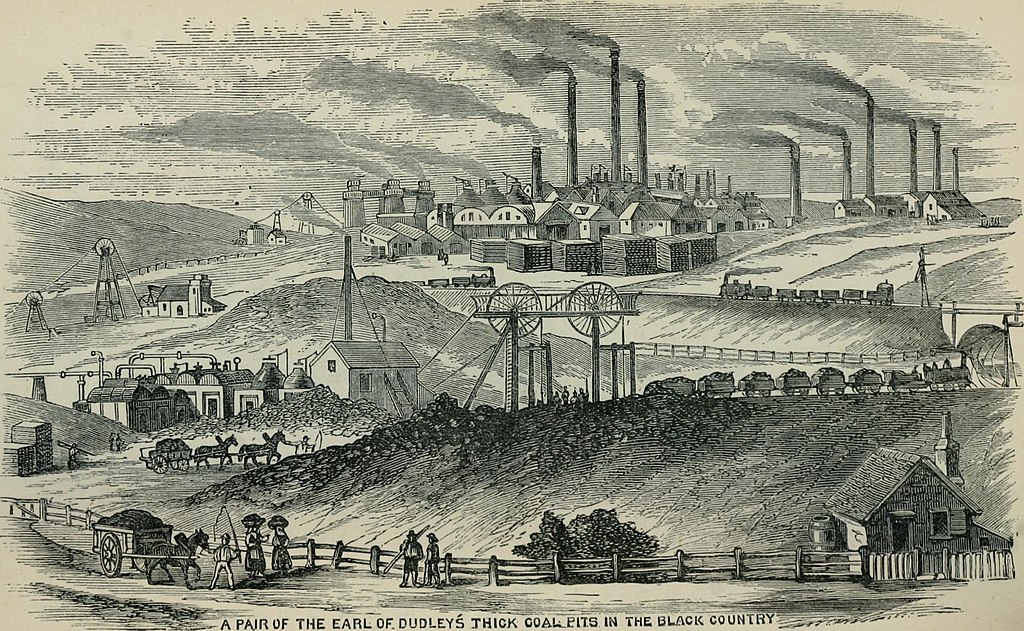
An image of coal pits in the Black Country from Griffiths’ Guide to the iron trade of Great Britain, 1873.
Image digitized by the Robarts Library of the University of Toronto via Wikimedia Commons.
Here are a few key things that I hadn’t really fully appreciated until undertaking this particular commission, though each has provided even more threads I still need to pull on:
ONE. The transition to coal was started by finding ways to exploit the lower-grade, cheaper and more sulphurous coals: initially by finding ways to burn it in people’s homes that would not leave everyone crying and coughing from the stinking fumes; and then with the expanded supply of even the lowest-grade coals making it cost-effective to do things like boil seawater in pans to make salt. The very lowest-grade coal was termed simply “pan coal”. While I’m pretty certain that these innovations were responsible for much of the rise of coal — coal-fuelled salt pans were even the foundation of the Scottish Lowlands economy going into the eighteenth century — the actual inventors involved are still a bit of a mystery. It’s something I need to return to, as “lots of anonymous people just invented through trial and error and adaptation” just doesn’t cut it for me — I’ve never found such stories to be true upon closer investigation.
TWO. Nobody ever talks about lime! Lime was one of the few things burnt with coal since ancient times, but largely to produce mortar for building. The increased availability of cheaper coal in the sixteenth century, however, meant that lime also soon found much wider use as a soil acidity regulator, as well as to control some pests and improve the absorption of fertilisers. It was especially favoured for sandy soils, allowing the conversion of barren heaths to agricultural land by increasing the soil’s water retention.
Yet lime is a huge blind spot for economic historians, despite it increasing the productivity of what was still by far the largest portion of the economy: agriculture. I have a rough and ready test of whether economic historians are paying enough attention to an industry, which is to look up the word in Stephen Broadberry et al.’s British Economic Growth 1270-1870, most scholars’ go-to resource on how historical British output is estimated. Lime is mentioned only once, and only as an input to the construction industry, for mortar. We should know more about lime’s impact.
THREE. Coal, through its various effects on agriculture, also led to an increase in the availability of grain, in turn leading to an abundance of muscle power. Horses were the literal workhorses of industrial cities, grinding the pigments for dyes and paints, tobacco for snuff, charred bones for shoe polish, tannin-rich oak bark for leather, flint for glass and ceramics, and grain for flour, beer, and spirits. Horses fulled cloth, pounded rags into paper, flatted metal into sheets, and bored pipes, guns and even cannon. And of course they powered the transportation infrastructure, hauling the waggons and barges laden with goods.
A theme I keep coming across when I do my research is that there was a lot of effort put into what we might call the “improvement of animals”. I’ve touched on this briefly before, but I get a sense that there’s a whole lot of iceberg lying in wait under the surface for me to uncover. It likely extended to dogs, for example, who like horses were also often used for mechanical tasks. Just yesterday, for example, I read an account by a visitor to 1630s Bristol mentioning how the roasting spits at its inns were driven by dogs in treadwheels. At some point I need to go through all this evidence I’ve inadvertently collected.
FOUR. The Dutch Republic’s Golden Age did not fail because it lacked energy sources. I had already suspected this, as it never rang true, but had not quite appreciated the extent of the evidence: the fairly rapid collapse of so many Dutch industries in the 1650s-80s was, if anything, accompanied by a super-abundance of energy. Both peat and grain were in fact cheaper than ever, largely as a result of plummeting demand. Even the products made using wind —such as the timber sawn for ships along the windy banks of the Zaan river — failed to survive the general collapse in demand.
If energy had been lacking, we would have expected the prices of peat and grain to have been at all-time highs, not in a slump. Indeed, the lack of demand for peat and grain, by sapping demand for infrastructure projects like bog drainage and canal-building, is what led to the re-flooding of much of the Dutch countryside. The causes of the collapse are still something of a mystery to me, but I now feel very confident in ruling the energy theory out.
October 27, 2023
Whisky Folklore – What Is Bourbon? Where Did It Come From?
Townsends
Published 2 Jul 2023Bourbon Whiskey is as American as Hamburgers or the 4th of July. Where did it come from? Where did the tradition start? This episode digs into the history of Bourbon and tries to answer the questions behind this traditional American spirit.
(more…)
September 25, 2023
QotD: The economics of American slavery
Growing cotton … unlike sugar or rice, never required slavery. By 1870, freedmen and whites produced as much cotton as the South produced in the slave time of 1860. Cotton was not a slave crop in India or in southwest China, where it was grown in bulk anciently. And many whites in the South grew it, too, before the war and after. That slaves produced cotton does not imply that they were essential or causal in the production.
Economists have been thinking about such issues for half a century. You wouldn’t know it from the King Cottoners. They assert, for example, that a slave was “cheap labor”. Mistaken again. After all, slaves ate, and they didn’t produce until they grew up. Stanley Engerman and the late Nobel Prize winner Robert Fogel confirmed in 1974 what economic common sense would suggest: that productivity was incorporated into the market price of a slave. It’s how any capital market works. If you bought a slave, you faced the cost of alternative uses of the capital. No supernormal profits accrued from the purchase. Slave labor was not a free lunch. The wealth was not piled up.
The King Cotton school has been devastated recently in detail by two economic historians, Alan Olmstead of the University of California at Davis and Paul Rhode of the University of Michigan. They point out, for example, that the influential and leftish economist Thomas Piketty grossly exaggerated the share of slaves in U.S. wealth, yet Edward Baptist uses Piketty’s estimates to put slavery at the center of the country’s economic history. Olmstead and Rhode note, too, from their research on the cotton economy that the price of slaves increased from 1820 to 1860 not because of institutional change (more whippings) or the demand for cotton, but because of an astonishing rise in the productivity of the cotton plant, achieved by selective breeding. Ingenuity, not capital accumulation or exploitation, made cotton a little king.
Slavery was of course appalling, a plain theft of labor. The war to end it was righteous altogether — though had the South been coldly rational, the ending could have been achieved as in the British Empire in 1833 or Brazil in 1888 without 600,000 deaths. But prosperity did not depend on slavery. The United States and the United Kingdom and the rest would have become just as rich without the 250 years of unrequited toil. They have remained rich, observe, even after the peculiar institution was abolished, because their riches did not depend on its sinfulness.
Dierdre McCloskey, “Slavery Did Not Make America Rich: Ingenuity, not capital accumulation or exploitation, made cotton a little king”, Reason, 2017-07-19.
September 10, 2023
QotD: The hill people and the valley people
There’s a clichéd history of civilization which goes something like: once upon a time all human beings lived in wandering hunter-gatherer bands where everybody was directly involved in food production. Then while sojourning through a fertile river valley, some of these groups discovered agriculture. The relative predictability and reliability of farming, coupled with the much higher caloric yield per hour of labor,1 made it possible to support a denser population, and for only a portion of it to be directly involved in food production. The rest of them could become soldiers, artisans, priests, and scribes. They could develop technology, pass on their knowledge through writing, and develop complex systems of taxation, bureaucracy, and forced labour. Along the way, they made picturesque little walled farming villages […]
This is not their story. Instead it’s the story of the people who live in the hills behind that village. Without knowing anything at all about the place that picture depicts, you can probably tell me a lot about the people in those hills. Hill people are hill people, the world over. What are the odds that they’re clannish? Xenophobic? Backwards! Unusual family structures. Economically immiserated (probably due to their own paranoia and indolence). Deviant in their religious, commercial, and sexual practices. Illiterate, or at best poorly-read. They also probably talk funny. Basically they’re barbarians, but not the impressive kind who ride out of the steppe to massacre and enslave the soft city-dwellers. No, something more like living fossils — our ancestors were once like that, but then they got with the program. Well if they could do it, why don’t those hill dwellers move down here too, like normal people?2 They’re up to no good up there.
That’s certainly been the traditional view from the valleys, and there’s some truth to it, but there’s one important detail that we valley-dwellers get wrong. Far from being aboriginal holdovers of some previous phase of humanity, it’s relatively easy to determine from genetic, linguistic, and archaeological evidence that the hill people are largely descended from … the valley people!3 But … that would mean that there are people who look around at our beautiful civilization and reject its fruits — you know, art, technology, fusion cuisine, and uh … taxation, conscription, epidemic disease, corvée labour … How dare they!
You would never know it from reading the reports of the valley-bureaucrats, but the great agricultural civilizations of classical antiquity were in a near-constant state of panic over people wandering away from their farms and becoming barbarians.4 There are estimates that over the course of the empire something like twenty-five percent of the inhabitants of Roman border provinces quietly slipped across the limes for the proud life of the savage. In Ancient China, the movement was more cyclical — in times of war, or epidemic, or famine, entire villages might give up rice agriculture and vanish into the hills. Then, when the situation had stabilized, the human tide would reverse, and the hills would disgorge barbarians eager to be Sinicized (or really re-Sinicized, as their parents and grandparents had been). In both these cases and more, the boundary between “civilized” and “savage” was a great deal more porous, and the flow a great deal more bi-directional than we might realize. Like a single substance in two phases, now boiling, now condensing, changing back and forth in response to changes in the temperature.
So why then is it that hill people5 the world over have so much in common? Scott argues pretty convincingly that something like convergent cultural evolution for ungovernability is at work — that is, the qualities we stereotypically associate with backwards and barbarous peoples are precisely the traits that make one difficult to administer and tax. Some examples of this are very obvious to see — for instance physical dispersal in difficult terrain makes it harder to be surveilled, measured, or conscripted. Scott also talks a lot about the crops that hill people like to grow, and how the world over they tend to be either crops that are amenable to swiddening and don’t require irrigation, or things like tubers that mature underground and can be harvested at irregular times. Both patterns make it easy to lie about how much food you’ve planted and where, hence difficult for others to tax or control you.
What about illiteracy? Scott finds that many hill people around the world have oral legends about how they once had writing, but no longer do. Of course this is exactly what we would expect if, contrary to the usual story, the hill people are not the ancestors of the valley people, but their descendants. Yet the question remains, why give up writing? Scott posits several benefits of illiteracy: one is just that the inability to write removes any temptation to keep written records of anything, and written records are the kind of thing that can be used against you by a tax collector or an army recruiter.
But more fundamentally, a reliance on oral history and genealogy and legend is powerful precisely because these things are mutable and can be changed according to political convenience. Anybody who’s read ancient Chinese accounts of the steppe peoples or Roman discussions of Germanic barbarians has probably recoiled from the confusing profusion of tribes, peoples, and nations; the same ethnonyms popping in and out of existence over a vast area, or referring to a band of a few hundred one year and a nation of millions a decade later. Scott argues that the reason we see this is that the very notion of stable ethnic identity is a fundamentally “valley” conceit. Out in the hills or on the far wild plains, people exist in more of a quantum superposition of identities, and the nonsensical patterns you see in the histories come from imperial ethnographers feverishly making classical measurements in a double-slit experiment and trying to jam the results into a sensible form.
John Psmith, “REVIEW: The Art of Not Being Governed by James C. Scott”, Mr. and Mrs. Psmith’s Bookshelf, 2023-01-16.
1. Scott has yet another book about how this important detail of the stock story is totally false. In Scott’s telling, early agriculture produced fewer calories per hour of work than hunting and foraging. The entire increase in social complexity associated with primitive agriculture came not from a food surplus, but from the fact that it was easier to measure how much food everybody was producing and confiscate a portion of it.
2. Maybe then one of their descendants can go to Yale Law School and write a book about it.
3. Next time you’re driving through Montana, try to count how many people are transplants from New York or California.
4. Once you know this fact, you can go back and read those classical texts esoterically, and nervous panic over people defecting from civilization is practically all you will see.
5. I’ve used “hill people” throughout this review as a synecdoche for groups that have rejected a life-pattern involving settled agriculture and tax-paying, but as Scott points out there are many kind of terrain unsuitable or difficult for state administration. Marshes have historically been another magnet for those rejecting polite society, as have deserts and open plains.
September 8, 2023
UN official denounces Canada’s migrant worker program as a “form of slavery”
That this scathing report made it to the CBC’s website must really hurt for the federal government, who have a collective “white saviour” complex about their immigration stance:

Temporary foreign workers picking fruit in a Canadian orchard.
Image from http://www.yorkfeed.com/apple-picking-urgently-canada/
A United Nations official on Wednesday denounced Canada’s temporary foreign worker program as a “breeding ground for contemporary forms of slavery”.
Tomoya Obokata, UN special rapporteur on contemporary forms of slavery, made the comments in Ottawa after spending 14 days in Canada.
“I am disturbed by the fact that many migrant workers are exploited and abused in this country,” he said.
“Agricultural and low-wage streams of the temporary foreign workers program constitute a breeding ground for contemporary forms of slavery.”
Obokata’s comments echo those of Jamaican migrant workers who, in an open letter to their country’s ministry of labour last month, described their working conditions in Ontario as “systematic slavery”.
The special rapporteur role was created by the UN in 2007. Its mandate includes investigating and advocating against forced or coerced labour.
Obokata said migrant workers face deportation if they lose their work permits, which also prevent them from changing employers if they face abuse.
“This creates a dependency relationship between employers and employees, making the latter vulnerable to exploitation,” he said, adding that many workers are reluctant to report abuse because they fear losing their permits.
Thousands of workers come to Canada each year to work through the program. Statistics Canada estimates that temporary foreign workers make up 15 per cent of Canada’s agricultural workforce.
The system came under scrutiny during the pandemic. Auditor General Karen Hogan reported in 2021 that the federal government did not do enough to ensure those workers were being protected.
Obokata said he spoke with a number of migrant workers who described having to work excessive hours with no access to overtime pay, being denied access to health care and being forced to live in cramped and unsanitary living conditions.
QotD: Rents and taxes in pre-modern societies
In most ways […] we can treat rent and taxes together because their economic impacts are actually pretty similar: they force the farmer to farm more in order to supply some of his production to people who are not the farming household.
There are two major ways this can work: in kind and in coin and they have rather different implications. The oldest – and in pre-modern societies, by far the most common – form of rent/tax extraction is extraction in kind, where the farmer pays their rents and taxes with agricultural products directly. Since grain (threshed and winnowed) is a compact, relatively transportable commodity (that is, one sack of grain is as good as the next, in theory), it is ideal for these sorts of transactions, although perusing medieval manorial contacts shows a bewildering array of payments in all sorts of agricultural goods. In some cases, payment in kind might also come in the form of labor, typically called corvée labor, either on public works or even just farming on lands owned by the state.
The advantage of extraction in kind is that it is simple and the initial overhead is low. The state or large landholders can use the agricultural goods they bring in in rents and taxes to directly sustain specialists: soldiers, craftsmen, servants, and so on. Of course the problem is that this system makes the state (or the large landholder) responsible for moving, storing and cataloging all of those agricultural goods. We get some sense of how much of a burden this can be from the prominence of what seem to be records of these sorts of transactions in the surviving writing from the Bronze Age Near East (although I should note that many archaeologists working on the ancient Near Eastern economy are pushing for a somewhat larger, if not very large, space for market interactions outside of the “temple economy” model which has dominated the field for quite some time). This creates a “catch” we’ll get back to: taxation in kind is easy to set up and easier to maintain when infrastructure and administration is poor, but in the long term it involves heavier administrative burdens and makes it harder to move tax revenues over long distances.
Taxation in coin offers potentially greater efficiency, but requires more particular conditions to set up and maintain. First, of course, you have to have coinage. That is not a given! Much of the social interactions and mechanics of farming I’ve presented here stayed fairly constant (but consult your local primary sources for variations!) from the beginnings of written historical records (c. 3,400 BC in Mesopotamia; varies place to place) down to at least the second agricultural revolution (c. 1700 AD in Europe; later elsewhere) if not the industrial revolution (c. 1800 AD). But money (here meaning coinage) only appears in Anatolia in the seventh century BC (and probably independently invented in China in the fourth century BC). Prior to that, we see that big transactions, like long-distance trade in luxuries, might be done with standard weights of bullion, but that was hardly practical for a farmer to be paying their taxes in.
Coinage actually takes even longer to really influence these systems. The first place coinage gets used is where bullion was used – as exchange for big long-distance trade transactions. Indeed, coinage seemed to have started essentially as pre-measured bullion – “here is a hunk of silver, stamped by the king to affirm that it is exactly one shekel of weight”. Which is why, by the by, so many “money words” (pounds, talents, shekels, drachmae, etc.) are actually units of weight. But if you want to collect taxes in money, you need the small farmers to have money. Which means you need markets for them to sell their grain for money and then those merchants need to be able to sell that grain themselves for money, which means you need urban bread-eaters who are buying bread with money, which means those urban workers need to be paid in money. And you can only get any of these people to use money if they can exchange that money for things they want, which creates a nasty first-mover problem.
We refer to that entire process as monetization – when I talk about economies being “monetized” or “incompletely monetized” that’s what I mean: how completely has the use of money penetrated through this society. It isn’t a one-way street, either. Early and High Imperial Rome seem to have been more completely monetized than the Late Roman Western Empire or the early Middle Ages (though monetization increases rapidly in the later Middle Ages).
Extraction, paradoxically, can solve the first mover problem in monetization, by making the state the first mover. If the state insists on raising taxes in money, it forces the farmers to sell their grain for money to pay the tax-man; the state can then take that money and use it to pay soldiers (almost always the largest budget-item in an ancient or medieval state budget), who then use the money to buy the grain the farmers sold to the merchants, creating that self-sustaining feedback loop which steadily monetizes the society. For instance, Alexander the Great’s armies – who expected to be paid in coin – seem to have played a major role in monetizing many of the areas they marched through (along with breaking things and killing people; the image of Alexander the Great’s conquests in popular imagination tend to be a lot more sanitized).
Bret Devereaux, “Collections: Bread, How Did They Make It? Part IV: Markets, Merchants and the Tax Man”, A Collection of Unmitigated Pedantry, 2020-08-21.
September 4, 2023
QotD: Historical rice farming versus wheat or barley farming
Because rice is such a different crop than wheat or barley, there are a lot of differences in the way that rice cultivation shapes the countryside. […] The thing to note about rice is that it is both much more productive on a per-acre basis than wheat or barley, but also much more labor intensive; it also relies on different forms of capital to be productive. Whole-grain wheat and brown rice have similar calorie and nutritional value (brown rice is somewhat better in most categories) on a unit-weight basis (so, per pound or ton), but the yield difference is fairly large: rice is typically around (very roughly) 50% more productive per acre than wheat. Moreover, rice plants have a more favorable ratio of seeds-to-plants, meaning that the demand to put away seeds for the next harvest is easier – whereas crop-to-seed ratios on pre-modern wheat range from 3:1 to 10:1, rice can achieve figures as high as 100:1. As a result, not only is the gross yield higher (that is, more tons of seed per field) but a lower percentage of that seed has to be saved for the next planting.
At the same time, the irrigation demands for effective production of wet-rice requires a lot of labor to build and maintain. Fields need to be flooded and drained; in some cases (particularly pre-modern terrace farming) this may involve moving the water manually, in buckets, from lower fields to higher ones. Irrigation canals connecting paddies can make this job somewhat easier, as can bucket-lifts, but that still demands moving quite a lot of water. In any irrigation system, the bunds need to be maintained and the water level carefully controlled, with also involves potentially quite a lot of labor.
The consequence of all of this is that while the rice farming household seems to be roughly the same size as the wheat-farming household (that is, an extended family unit of variable size, but typically around 8 or so members), the farm is much smaller, with common household farm sizes, even in the modern period, clustering around 1 hectare (2.47 acres) in comparison to the standard household wheat farms clustered around 4-6 acres (which, you may note with the yield figures above, lands us right back at around the same subsistence standard).
Moreover, rice cultivation is less soil dependent (but more water dependent) because wet-rice farming both encourages nitrogen fixation in the soil (maintaining the fertility of it generally without expensive manure use) and because rice farming leads naturally to a process known as pozdolisation, slowly converting the underlying soil over a few years to a set of characteristics which are more favorable for more rice cultivation. So whereas with wheat cultivation, where you often have clumps of marginal land (soil that is too wet, too dry, too rocky, too acidic, too uneven, too heavily forested, and so on), rice cultivation tends to be able to make use of almost any land where there is sufficient water (although terracing may be needed to level out the land). The reliance on the rice itself to “terraform” its own fields does mean that new rice fields tended to under-produce for the first few years.
The result of this, so far as I can tell, is that in well-watered areas, like much of South China, the human landscape that is created by pre-modern rice cultivation is both more dense and more uniform in its density; large zones of very dense rice cultivation rather than pockets of villages separated by sparsely inhabited forests or pasture. Indeed, pasture in particular seems in most cases almost entirely pushed out by rice cultivation. That has very significant implications for warfare and I have to admit that in reading about rice farming for this post, I had one of those “oh!” moments of sudden understanding – in this case, how armies in pre-modern China could be so large and achieve such massive local concentrations. But as we’ve discussed, the size of an army is mainly constrained by logistics and the key factor here is the ability to forage food locally, which is in turn a product of local population density. If you effectively double (or more!) the population density, the maximum size of a local army also dramatically increases (and at the same time, a society which is even more concentrated around rivers is also likelier to allow for riverine logistics, which further improves the logistical situation for mass armies).
But it also goes to the difficulty many Chinese states experienced in maintaining large and effective cavalry arms without becoming reliant on Steppe peoples for horses. Unlike Europe or the Near East, where there are spots of good horse country here and there, often less suited to intensive wheat cultivation, most horse-pasturage in the rice-farming zone could have – and was – turned over to far more productive rice cultivation. Indeed, rice cultivation seems to have been so productive and suitable to a sufficient range of lands that it could push out a lot of other kinds of land-use, somewhat flattening the “ideal city” model that assumed wheat and barley cultivation.
Bret Devereaux, “Collections: Bread, How Did They Make It? Addendum: Rice!”, A Collection of Unmitigated Pedantry, 2020-09-04.
August 23, 2023
From “hunter-gatherer” to “settled farmer” as a Just-so story
The latest book review at Mr. and Mrs. Psmith’s Bookshelf is James C. Scott’s Against the Grain: A Deep History of the Earliest States by Jane Psmith:
Okay, stop me if you’ve heard this one already. So, there are these hunter-gatherers, right, and one of the things they like to gather, while they’re roaming around the hilly flanks of Anatolia following herds of gazelles, is the large, carbohydrate-rich seeds of local grasses. Then one day some bright soul gets the idea of planting the seeds on purpose, people selectively replant the ones that have exciting mutations like “have really big seeds” and “don’t shatter your stalk and scatter your really big seeds everywhere when they’re ripe, just hang out and wait to be reaped,” and they all start staying in one place to tend their fields. They quickly discover that agriculture can create a lot more calories than foraging, so all of a sudden they have a nice surplus that can go towards supporting non-food-producing specialists like dedicated craftsmen, priests, bureaucrats (but I repeat myself) and kings to expedite and organize all that agricultural labor, and, hey presto! you have civilization.
Oh, cool, you read Guns, Germs, and Steel in high school too?
Only James C. Scott is here to tell you that’s not how it happened. And while you might be excused for thinking (especially if you’ve read our review of The Art of Not Being Governed) that this is Scott doing his contrarian “ooh, look, I’m turning the accepted narrative on its head” thing, you would be wrong. (Don’t worry, though, we definitely will get to the point where he does that.) He’s just offering a summary of the new scholarly consensus: the transition from mobile bands of hunter-gatherers to sedentary agriculturalists didn’t follow that neat logical progression, and it was far patchier, more tenuous, and more bidirectional than generally assumed. In fact, practically since the moment in the late 1920s that V. Gordon Childe coined the term “Neolithic revolution“, archaeological evidence has been accumulating that complicates every aspect of the story I just told you, from agriculture to sedentism to state formation.
To begin with, what constitutes agriculture? Back in the 1960s, paleobotanist Jack Harlan used a flint sickle to harvest enough wild Anatolian wheat in just three weeks to feed a family for an entire year. Now, we can probably agree that just harvesting a stand of wild wheat and storing the grain doesn’t really count as agriculture, but what about pulling up the non-wheat interlopers from a half-ripe stand you hope to harvest later in the year? What about saving some seeds and tossing them on a welcoming plot of soil next spring? What about digging up or burning other plants to make that welcoming plot? And then it turns out that all the harvesting and processing tools — those sickles, winnowing baskets, grindstones, and even purpose-built granaries — seem to have existed before there was any intentional cultivation, suggesting wandering tribes who came together only at harvest time but spent most of the year apart. Also, it seems all like those exciting morphological changes that make grain agriculture so efficient (big seeds and non-brittle rachis) come hundreds and hundreds of years after agriculture was established.1 Our simple story is already getting complicated! But it gets worse.
Archaeologists used to assume that sedentism — that is, people staying in one place year-round — and agriculture necessarily went together. In one direction this is obvious, because once you’re feeding your family from a particular plot of ground you probably want to stick around to weed and water it and keep away any animals (or other people) who might swoop in at the last minute and take your harvest. But it goes the other way, too: we generally assume that pickings as a hunter-gatherer are slim enough that your group needs to keep moving around to find more food. (Or, in the immortal words of the Minnesota Educational Computing Consortium: “if you continue to hunt in this area, game will become scarce.”) This is actually true at higher trophic levels: large animals tend to migrate throughout the year, so people whose subsistence strategies depend heavily on hunting them will follow the herds. But hunter-gatherer mobility is a tendency, not an iron law, and the archaeological (and even historical) record is full of non-agricultural peoples who lived in one place year-round because their environment was rich enough to support it. This was common among the tribes of the Pacific Northwest, who created quite socially and materially complex cultures without agriculture, but it also shows up plenty of other places. The earliest sedentary culture we know about, the Natufians, flourished along the coast of what is now Israel more than thirteen thousand years ago, largely by gathering wild grains and hunting gazelles.
Do note, though, that it would be a mistake to call these non-agricultural environments “natural”, because humans have been actively managing our landscapes for at least a million years. The main tool before the widespread adoption of agriculture was fire, which can be used to stampede prey animals into a trap or to remove unwanted vegetation and make way for the grasses and shrubs that we, or our preferred prey, like to eat. “The game they subsequently bagged,” Scott writes, “represented a kind of harvesting of prey animals they had deliberately assembled by carefully creating a habitat they would find enticing”. It’s even been suggested that the Little Ice Age of the early modern period was due to the sudden cessation of burning activity (and its CO2 emissions) in the Americas when newly-introduced Old World pathogens killed off most of the people who did the burning.
Against the Grain focuses on the region archaeologists call Southwest Asia, people who like reading books about archaeology call the Fertile Crescent, and everyone else calls the Near and Middle East, but it zeroes in specifically on southern Mesopotamia. This wasn’t the first place to host year-round settlements, nor was it the site of the original crop domestications, but it is the home of the third element of the traditional story of the birth of civilization: the state. Scott is unwilling to define the state precisely, describing it instead as an “institutional continuum” where something can be more or less state-like, but he writes that “a polity with a king, specialized administrative staff, social hierarchy, a monumental center, city walls, and tax collections and distribution is certainly a ‘state’ in the strong sense of the term”. It was here, near the mouth of the Euphrates on the Persian Gulf, that the earliest “statelets” arose, and it’s here, once again, that Scott brings up recent archaeological evidence that undermines the usual narrative. This time, the abandoned theory is that the region was as arid at the dawn of agriculture as it is today; an agricultural population might have succeeded in the oases and river valleys, but as numbers swelled they would need to undertake massive irrigation projects, which would in turn require “the mobilization of labor to dig and maintain the canals, which implied the existence of a public authority capable of assembling and disciplining that labor force”. In short, agriculture was assumed to have required a state. But it didn’t.
Scott’s argument draws heavily on the work of Jennifer Pournelle, who reconstructed the landscape of the southern Mesopotamian alluvium in the seventh and sixth centuries BC using a combination of remote sensing, ancient sediments, and climatological history, and concluded that, far from the arid landscape of today, the land between the rivers was in fact an “intricate deltaic wetland.”
The inhabitants of these marshes lived on what are called “turtlebacks,” small patches of slightly higher ground, comparable to cheniers in the Mississippi delta, often no more than a meter or so above the high-water mark. From these turtlebacks, inhabitants exploited virtually all the wetland resources within reach: reeds and sedges for building and food, a great variety of edible plants (club rush, cattails, water lily, bulrush), tortoises, fish, mollusks, crustaceans, birds, waterfowl, small mammals, and migrating gazelles that provided a major source of protein. The combination of rich alluvial soils with an estuary of two great rivers teeming with nutrients, dead and alive, made for an exceptionally rich riparian life that in turn attracted huge number of fish, turtles, birds, and mammals — not to mention humans! — preying on creatures lower on the food chain.
Moreover, the first settlements in the area were right on the border between the brackish water of the coastal estuary and the freshwater ecology upstream, and on the incredibly flat floodplain of the lower Euphrates (the gradient is less than two inches per mile) that seam moved great distances with the tides. “Thus,” Scott writes, “for a large number of communities, the two ecological zones moved across the landscape while they remained stationary, taking sustenance from both”. They didn’t need to roam in search of new food sources; the food came to them. Agriculture — of the flood-retreat form, where seeds are sown in nutrient-rich new soils deposited by the retreating river, and which is the least labor-intensive type possible — was just another of their many diverse and overlapping subsistence strategies. The shift between wet and dry season, with its pulse of migrating animals and harvest of whatever seeds they had sown, can be considered moving zones on a longer timescale: a new habitat arriving on their doorstep to be added to the mosaic of available options. By 6000 BC, Scott says, they were “already agriculturalists and pastoralists as well as hunter-gatherers. It’s just that so long as there were abundant stands of wild foods they could gather and annual migrations of waterfowl and gazelles they could hunt, there was no earthly reason they would risk relying mainly, let along exclusively, on labor-intensive farming and livestock rearing.”
Thus do we, with James C. Scott, reject the old model in which agriculture leads almost at once to both sedentism and the state. Instead, we see sedentism arise in particularly favorable ecological niches as early as 12,000 BC, with most of the main founder crops and animals domesticated between 8000 and 6000 BC, and then a gap of almost four thousand years before the appearance of the state. A naively Whiggish view of history might ask, “What took so long?” But James C. Scott, being James C. Scott (yes, here we’re coming to the “turn it on its head” bit), thinks the more accurate question might be, “What went wrong?”
1. For more on this, Scott suggests this 2013 paper.
August 11, 2023
QotD: Subsistence versus market-oriented farming in pre-modern societies
Large landholders interacted with the larger number of small farmers (who make up the vast majority of the population, rural or otherwise) by looking to trade access to their capital for the small farmers’ labor. Rather than being structured by market transactions (read: wage labor), this exchange was more commonly shaped by cultural and political forces into a grossly unequal exchange whereby the small farmers gathered around the large estate were essentially the large landholder’s to exploit. Nevertheless, that exploitation and even just the existence of the large landholder served to reorient production away from subsistence and towards surplus, through several different mechanisms.
Remember: in most pre-modern societies, the small farmers are largely self-sufficient. They don’t need very many of the products of the big cities and so – at least initially – the market is a poor mechanism to induce them to produce more. There simply aren’t many things at the market worth the hours of labor necessary to get them – not no things, but just not very many (I do want to stress that; the self-sufficiency of subsistence farmers is often overstated in older scholarship; Erdkamp (2005) is a valuable corrective here). Consequently, doing anything that isn’t farming means somehow forcing subsistence farmers to work more and harder in order to generate the surplus to provide for those people who do the activities which in turn the subsistence farmers might benefit from not at all. But of course we are most often interested in exactly all of those tasks which are not farming (they include, among other things, literacy and the writing of history, along with functionally all of the events that history will commemorate until quite recently) and so the mechanisms by which that surplus is generated matter a great deal.
First, the large landholder’s farm itself existed to support the landholder’s lifestyle rather than his actual subsistence, which meant its production had to be directed towards what we might broadly call “markets” (very broadly understood). Now many ancient and even medieval agricultural writers will extol the value of a big farm that is still self-supporting, with enough basic cereal crops to subsist the labor force, enough grazing area for animals to provide manure and then the rest of the land turned over to intensive cash-cropping. But this was as much for limiting expenses to maximize profits (a sort of mercantilistic maximum-exports/minimum-imports style of thinking) as it was for developing self-sufficiency in a crisis. Note that we (particularly in the United States) tend to think of cash crops as being things other than food – poppies, cotton, tobacco especially. But in many cases, wheat might be the cash crop for a region, especially for societies with lots of urbanism; good wheat land could bring in solid returns […]. The “cash” crop might be grapes (for wine) or olives (mostly for olive oil) or any number of other necessities, depending on what the local conditions best supported (and in some cases, it could be a cash herd too, particularly in areas well-suited to wool production, like parts of medieval Britain).
Second, the exploitation by the large landholder forces the smaller farmers around him to make more intensive use of their labor. Because they are almost always in debt to the fellow with the big farm and because they need to do labor to get access to plow teams, manure, tools, or mills and because the large landholder’s land-ready-for-sharecropping is right there, the large landholder both creates the conditions that impel small farmers to work more land (and thus work more days) than their own small farms do and also creates the conditions where they can farm more intensively (both their own lands and the big farm’s lands, via plow teams, manure, etc.). Of course the large landholder then generally immediately extracts that extra production for his own purposes. […] all of the folks who aren’t small farmers looking to try to get small farmers to work harder than is in their interest in order to generate surplus. In this case, all of that activity funnels back into sustaining the large landholder’s lifestyle (which often takes place in town rather than in the countryside), which in turn supports all sorts of artisans, domestics, crafters and so on.
And so the large landholder needs the small subsistence farmers to provide flexible labor and the small subsistence farmers (to a lesser but still quite real degree) need the large landholder to provide flexibility in capital and work availability and the interaction of both of these groups serves to direct more surplus into activities which are not farming.
Bret Devereaux, “Collections: Bread, How Did They Make It? Part II: Big Farms”, A Collection of Unmitigated Pedantry, 2020-07-31.
July 29, 2023
QotD: How pre-modern cities shaped the surrounding landscape
When it comes to shaping the landscape outside of the city – our main point of investigation – the key element of the pre-modern city that matters is the intense demand it creates for agricultural products that the non-farmers who live in the city cannot produce themselves, chiefly (but not exclusively!) food. The intensity of that demand scales with the size of the city. A small town might only really shape land-use and farming patterns out a few miles; a huge mega-city like first century Rome (c. 1m people) re-shapes land patterns for hundreds of miles, its economic influence intruding into the territory of other, smaller cities.
Every town or city, of course, will be different. For agricultural societies especially, local terrain sharply constrains possible land uses. Some land is simply too wet or dry or rough or rocky or infertile for this or that purpose. In a modern city, apartments or factories or offices can be built almost anywhere; the sort of land suitable for intensive farming is more limited. This is even more true for pre-modern societies working without modern fertilizer, without electric-powered irrigation and without the industrial technology to massively reshape terrain (draining swamps, filling ravines, flattening hills, irrigating the desert, etc – some of these can be done with hand tools, but not to the extent we can today).
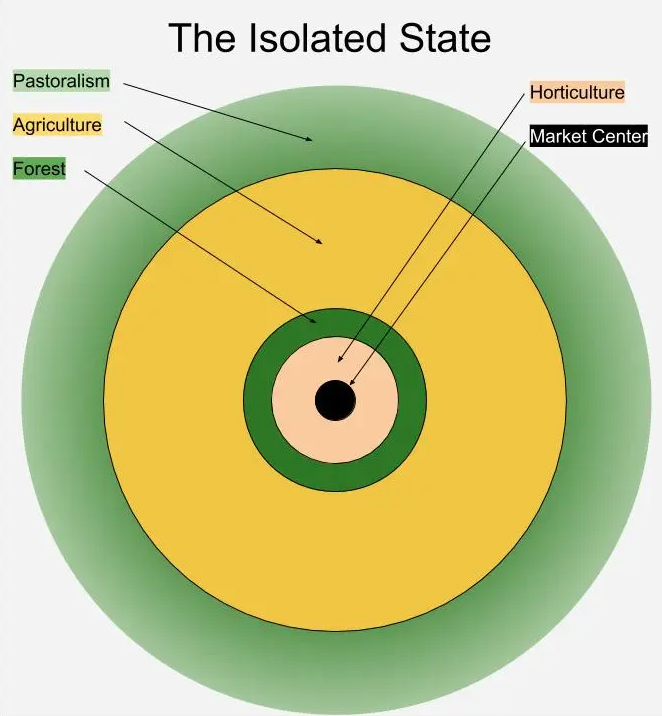
Still, we want to begin thinking about how cities impact the land around them without all of these difficult and confusing variables. We want to image a city, isolated and alone in the middle of an endless, flat and featureless plain. This is exactly what J. H. von Thünen did in The Isolated State (Der isolierte Staat). This kind of exercise can give us a baseline of what the landscape around a decent sized city might look like, which we can then modify to respond to different terrain, technology and social organization.
(Note: I would be remiss if I didn’t note that my discussion of these ideas owes heavily to Neville Morley’s Metropolis and Hinterland (1996), where he applied this very method to the city of Rome and its hinterland (and also first introduced me to von Thünen’s ideas). That book and also his Trade in Classical Antiquity are both great books to give a read if you want to begin building a sense of how pre-modern economies work).
The key factor von Thünen looks at is transportation costs. For a society without trains or trucks, moving bulk materials of any kind over long distances is extraordinarily expensive. Moving grain overland, for instance, would cause its cost to double after 100 miles. Thus land close to our theoretical city is extremely valuable for production, while land far away is substantially less valuable (because the end goal is transporting the agricultural production of that land to the city). As a result, transit costs – and thus distance – dominates how cities influence land-use patterns (along with population, which determines the intensity of the city’s influence).
Bret Devereaux, “Collections: The Lonely City, Part I: The Ideal City”, A Collection of Unmitigated Pedantry, 2019-07-12.
July 25, 2023
QotD: Non-free farm labourers in pre-modern agriculture
The third complicated category of non-free laborers is that of workers who had legal control of their persons to some degree but who were required by law and custom to work on a given parcel of land and give some of the proceeds to their landlord. By way of example, under the reign of Diocletian (284-305), in a (failed) effort to reform the tax-system, the main class of Roman tenants, called coloni (lit: “tillers”), were legally prevented from moving off of their estates (so as to ensure that the landlords who were liable for taxes on that land would be in a position to pay). That this change does not seem to have been a massive shift at the time should give some sense of how low the status of these coloni had fallen and just how powerful a landlord might be over their tenants. That system in turn (warning: substantial but necessary simplification incoming) provided the basis for later European serfdom. Serfs were generally tied to the land, being bought and sold with it, with traditional (and hereditary) duties to the owner of the land. They might owe a portion of their produce (like tenants) or a certain amount of labor to be performed on land whose proceeds went directly to the landlord. While serfs generally had more rights (particularly in the protection and self-ownership of their persons) than enslaved persons, they were decidedly non-free (they couldn’t, by law, move away generally) and their condition was often quite poor when compared to even small freeholders. Non-free labor was generally not flexible (the landholder was obliged to support these folks year-round whether they had work to do or not) and so composed the fixed core labor of the large landholder’s holdings.
Bret Devereaux, “Collections: Bread, How Did They Make It? Part II: Big Farms”, A Collection of Unmitigated Pedantry, 2020-07-31.
July 9, 2023
Grain Elevator
NFB
Published 30 Sept 2015This documentary short is a visual portrait of “Prairie Sentinels”, the vertical grain elevators that once dotted the Canadian Prairies. Surveying an old diesel elevator’s day-to-day operations, this film is a simple, honest vignette on the distinctive wooden structures that would eventually become a symbol of the Prairie provinces.
(more…)