
The Korean War by Indy Neidell
Published 20 Jan 2026There’s discussion — and disagreement — in UN Command and Washington about whether or not to poll all the POWs the UN side holds to see where they would like to go should they be released. There are arguments for and against this, and it brings up a couple different interpretations of the Geneva Convention. This week we also talk a lot about recent medical advances in field medicine in Korea, and the development of the “Medics’ War”.
00:00 Intro
00:44 Recap
01:14 Poll the POWS
04:52 UN Decleration
08:19 52nd Medical Battalion
10:56 Cho-Do Island
11:45 Summary
12:06 Conclusion
12:49 Memorial
(more…)
January 21, 2026
The Korean War Week 83: The Medics’ War! – January 20, 1952
Comments Off on The Korean War Week 83: The Medics’ War! – January 20, 1952
January 20, 2026
Mark Steyn on demographics, Trump, and Greenland
Mark Steyn was warning about demography in the west twenty years ago, and at the time he was dismissed as a crank. Now, not only have the demographic forecasts matched what he predicted, they’re actually worse:
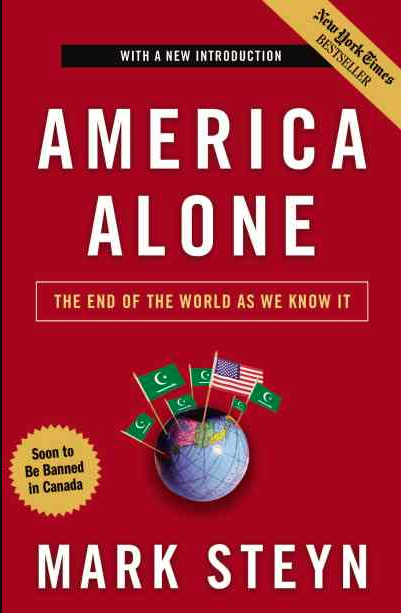
As noted yesterday, twenty years ago this month — January 2006 — The Wall Street Journal and The New Criterion published the first draft of what would become the thesis of my bestselling book, America Alone.
The Journal headline sums it up:
The sub-head makes plain what’s at stake:
The real reason the West is in danger of extinction.
And the lead paragraph spells it out:
Most people reading this have strong stomachs, so let me lay it out as baldly as I can: Much of what we loosely call the Western world will not survive this century, and much of it will effectively disappear within our lifetimes, including many if not most Western European countries.
Two decades ago that scenario was dismissed as “alarmist” by the bleepwits of The Economist. Today it is assumed by elites of all stripes, from the authors of the new US National Security Strategy …
Trump warns Europe faces “civilizational erasure” in explosive new document
… to peer-reviewed papers positing that all Western European nations other than Portugal and micro-states such as Andorra will become majority Muslim …
… to the Deputy Leader of Britain’s supposedly “populist” party reacting to news that native Anglo-Celts will become a minority in the UK by 2063 — and in England rather sooner than that:
I’ll be long gone by then.
So, in the twenty years since my Wall Street Journal essay, the ruling class has gone from “alarmism” to “yeah, it’s happening, but maybe not until 2100” to “okay, it’s a fait accompli, but what’s the big deal?” As to Richard Tice being long gone, which is devoutly to be wished, 2026 to 2063 is thirty-seven years — or Whitney Houston to now.
This is why nobody cares about the pleas of the “expert” class to save the “rules-based international order”, which is a long-winded way of saying “1950”. Trump, for one, is moving on:
The obsession with Greenland, so bewildering to US “allies”, derives from America’s need for an Israeli-style “Iron Dome”, which, as the mighty builder of Trump Tower, the President has upgraded to a “Golden Dome”. Why would he seek such a thing? Because in this scenario America’s Israel …and Western Europe is Gaza, the West Bank, Lebanon, Syria and Iran.
Twenty years ago, my eventual book-length argument was summarised in the Toronto Globe and Mail by the eminent “political scientist” William Christian as “quite possibly the most crass and vulgar book about the West’s relationship with the Islamic world I have ever encountered“. Professor Christian has evidently led a sheltered life: he was born in the Queen Charlotte Islands, which are now officially known as “Haida Gwaii”, a bollocks name invented in hopes of appeasing “the Haida nation”; it turns out that these days nowhere is really that sheltered, don’t you find?
But just because something is “crass and vulgar” doesn’t mean it’s not correct. It’s certainly straightforward. The western world is going out of business because it’s given up having babies. The mid-twentieth-century welfare state, with its hitherto unknown concepts such as spending the first third of your life in “education” and the last third in “retirement”, was carelessly premised on mid-twentieth-century fertility rates, and, as they collapsed, the west turned to “migrants” to be the children they couldn’t be bothered having themselves. The condition of your maternity ward may be “crass and vulgar”, but it’s not a speculative prediction.
eugyppius discusses the European response to President Trump’s public statements about Greenland:
Eager to
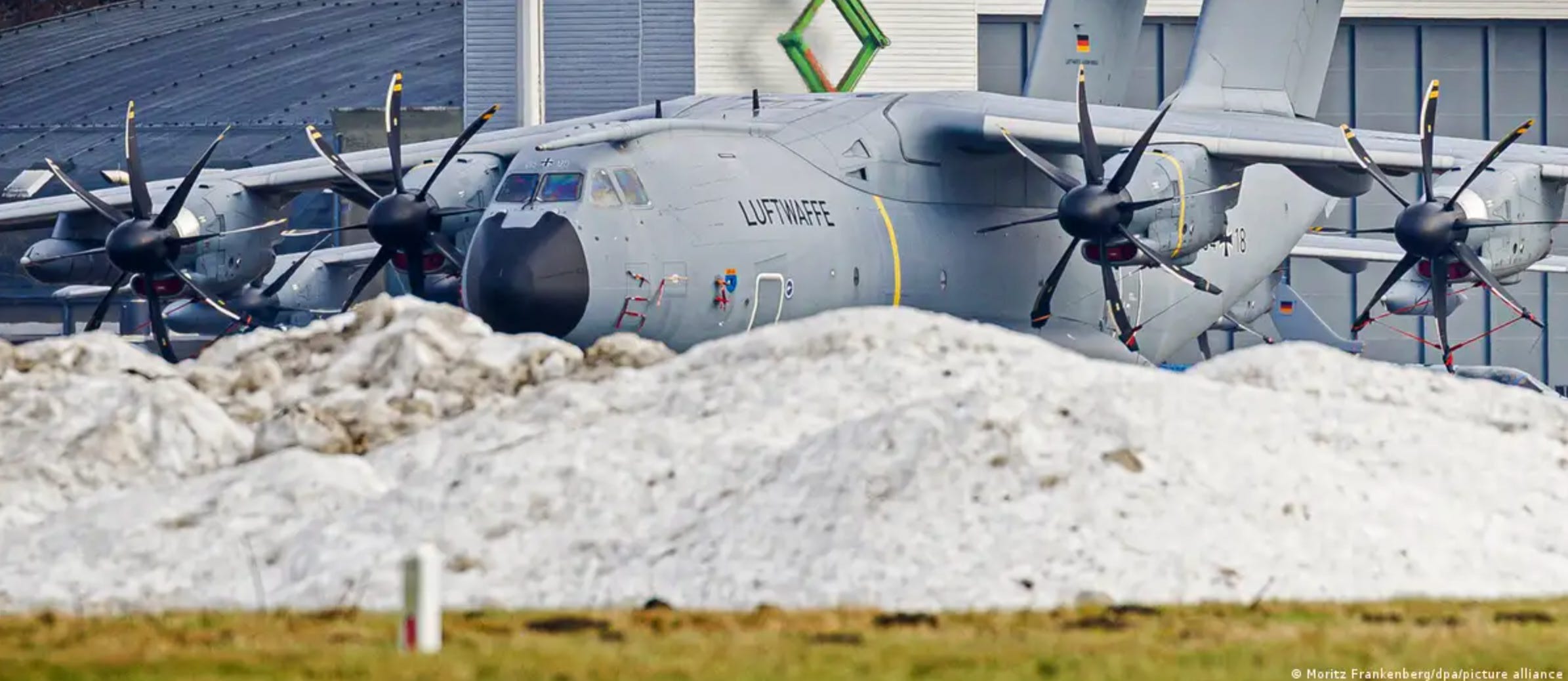
make an epic display of retardationdemonstrate resolve and independence in the face of these sudden American ambitions on Danish territory, a variety of European countries announced they would send soldiers to Greenland in a display of “military solidarity” with Denmark. Germany sent a grand total of 13 or 15 soldiers (reports vary) to defend the icy island against the Americans. They departed on a matte grey A400M Atlas military transport with plenty of press on hand for photographs. You could almost hear Wagner’s “Ride of the Valkyries” between the lines of the press coverage.
Alas, the Eurotards also did not want to possibly in some hypothetical world perhaps overstep by maybe potentially creating conditions for anything that might conceivably be interpreted by the Americans as a show of force on Greenland itself, so the Luftwaffe A400M landed politely in Denmark, thousands of kilometers away from the disputed territory. From there, all the soldiers boarded a completely non-threatening commercial airline to Nuuk, Greenland’s capital. While this was happening, German Defence Minister Boris Pistorius desperately assured the press that it was a purely routine and preplanned mission.
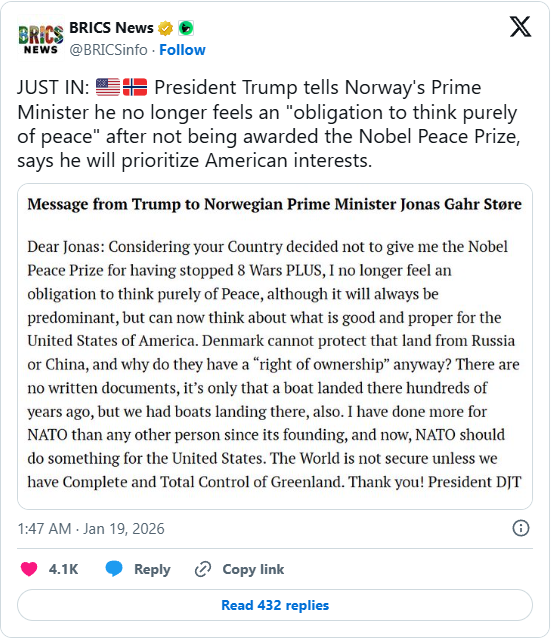
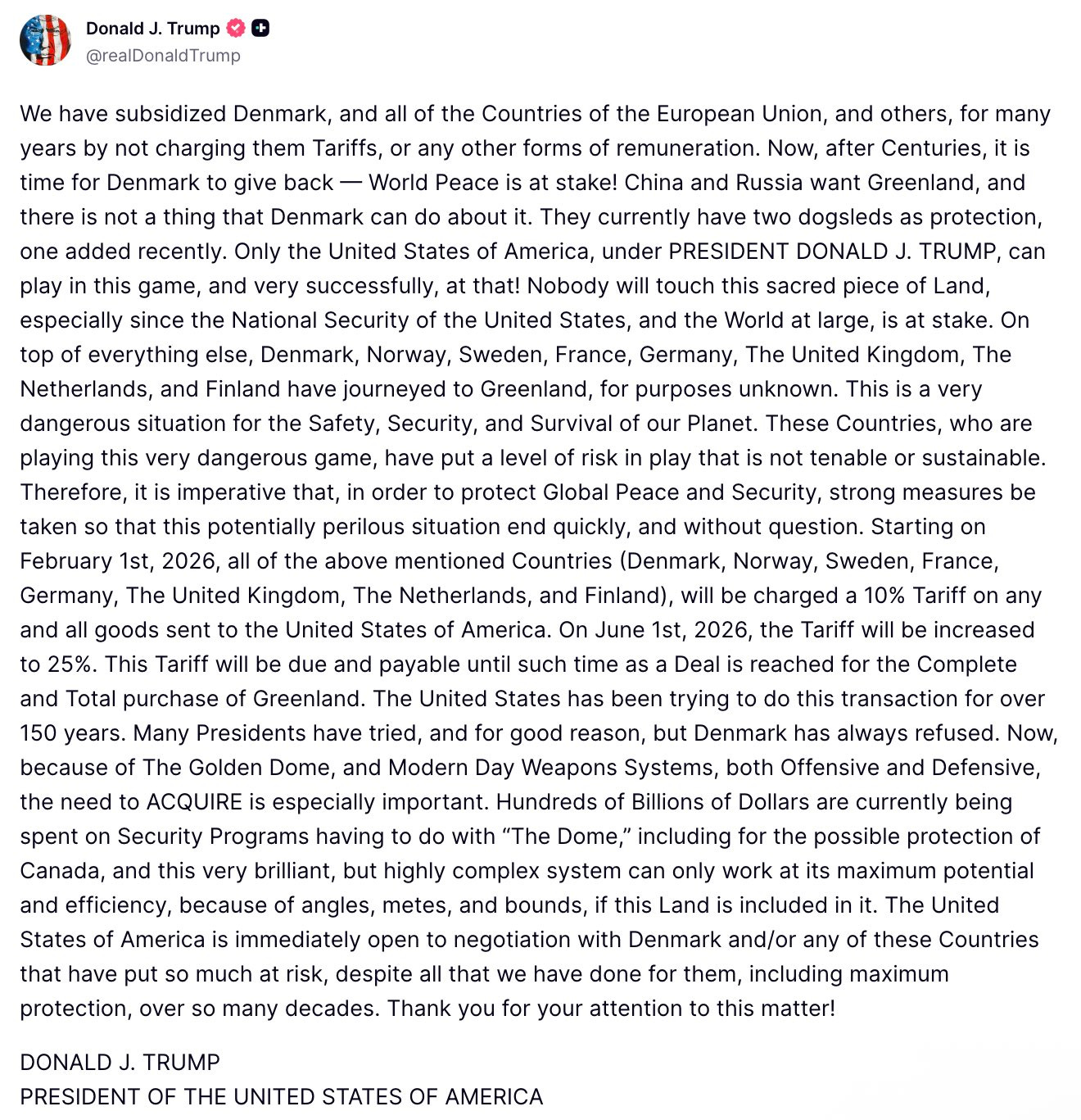
The next thing to happen, while our soldiers were sitting in Greenland for no reason, was that all these efforts to make a statement while not really making a statement to avoid annoying the Americans backfired, in that the Americans got annoyed anyway. U.S. President Donald Trump announced on Truth Social that all participants in this publicity junket would be slapped with punitive 10% tariffs, to be increased by 1 June 2026 to 25% tariffs, “until such time as a Deal is reached for the Complete and Total purchase of Greenland.”
Hours after Trump posted this note, the Greenland weather soured and our soldiers cancelled an “exploratory tour” they had planned for Sunday afternoon and returned to the Nuuk airport to fly home a few hours ahead of schedule. This lent the impression that Trump’s wall-of-text Truth Social post had scared them into a retreat from Greenland, inspiring hours of social media mockery. In the end we did succeed in making a statement, if not precisely the one we had intended.
Update, 21 January: Welcome, Instapundit readers! Have a look around at some of my other posts you may find of interest. I send out a daily summary of posts here through my Substack – https://substack.com/@nicholasrusson that you can subscribe to if you’d like to be informed of new posts in the future.
January 18, 2026
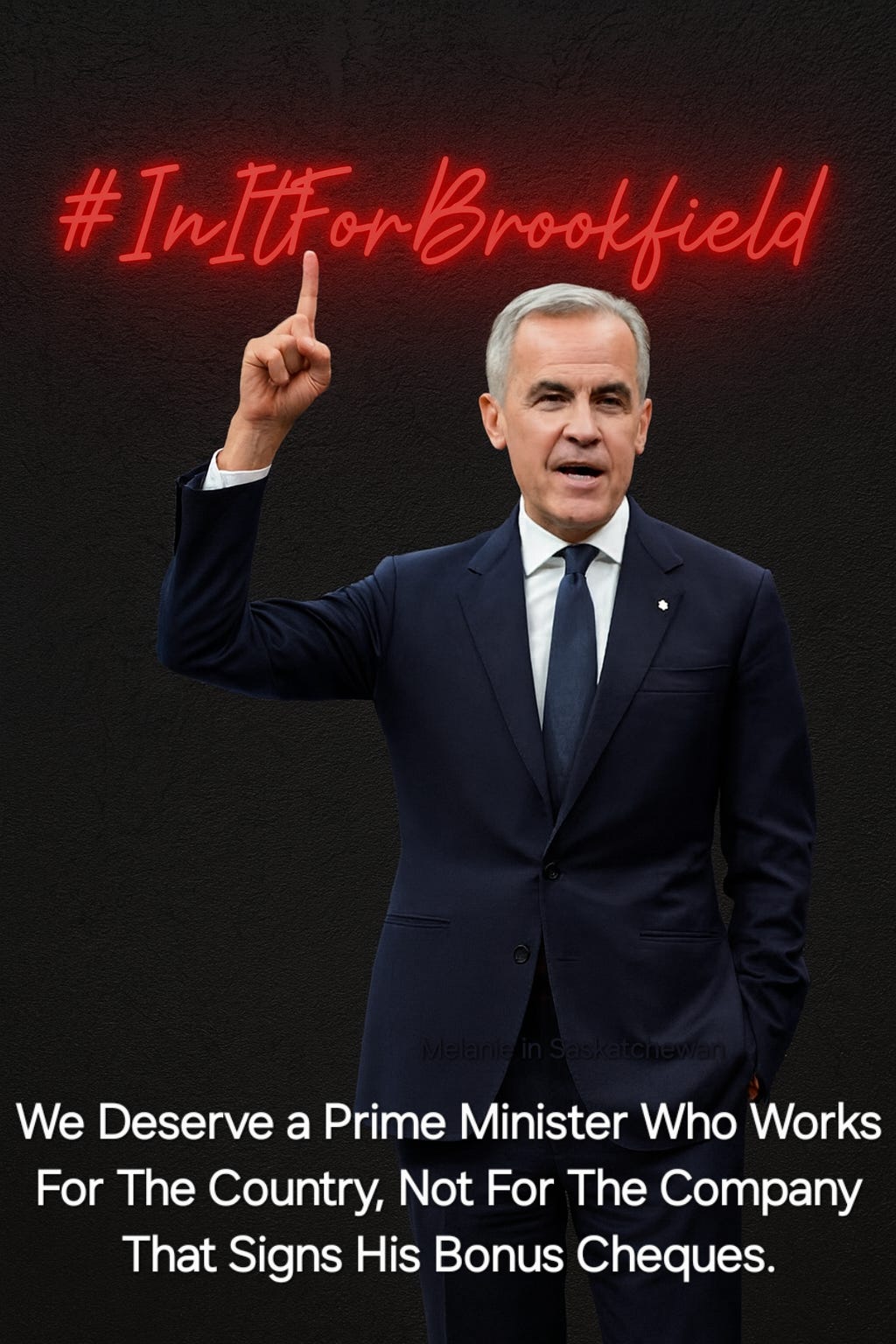
Mark Carney’s actual jobs before becoming Prime Minister
On the social media site formerly known as Twitter, Ezra Levant explains the various jobs Mark Carney has held compared to what many Canadians think he’s done:
Laura Stone @l_stone
Unifor President Lana Payne calls China EV deal “a self-inflicted wound to an already injured Canadian auto industry”. Says providing a foothold to cheap Chinese EVs “puts Canadian auto jobs at risk while rewarding, labour violations and unfair trade practices”. #onpoliI think there’s a misconception amongst Canada’s chattering classes that Mark Carney is an experienced and successful businessman and executive.
He wasn’t. He wasn’t CEO of Brookfield. He was its chairman, overseeing quarterly board meetings and spending the rest of his time flying around to different globalist conferences at the UN or WEF.
He was more of a mascot, a symbol, an ambassador of Brookfield. He didn’t negotiate deals or turn around companies. He did photo-ops.
Before that, he worked at the Bank of England, and before that, the Bank of Canada.
No Googling: can you name a single actual duty of that job? Can you tell me what Carney actually achieved?
He wafted up from fake job to fake job — like Justin Trudeau did, but instead of being a surf instructor and a substitute teacher, he had meaningless executive jobs.
And now when it’s time to shine … he doesn’t know what to do.
It’s been a year, and he has no deal with Trump, despite saying that was his chief focus.
What exactly did he achieve in Beijing? The tariffs against Saskatchewan were lifted — so that merely brings us back to the status quo ten months ago. Nothing else. No investments in Canada, which was the pretext of the trip. Just a capitulations, to allow the dumping of 49,000 Chinese EV cars, with their spyware and malware.
But he looks good in a suit and says ponderous words like “catalyze” and “transformative”. And that’s enough to impress the Parliamentary Press Gallery. Not that they needed much impressing — they’re all on his payroll already, through his massive journalism subsidies. They’re too busy holding the opposition to account to take notice of this latest disaster.
But the regime media shouldn’t feel too bad about being conned. Carney tricked Doug Ford pretty good, didn’t he?
Comments Off on Mark Carney’s actual jobs before becoming Prime Minister
January 15, 2026
“The logic employed to support an invasion of Greenland is purely onanistic”
Last week, I reposted part of CDR Salamander’s view of President Trump’s desire to take Greenland from Danish control. I still don’t really understand his motivation, so Kiran Pfitzner‘s take that Trump’s “perverse interest in Greenland” can only be explained as rising from a belief “that conquest, that being a conqueror, is a pleasant fantasy to indulge in”:
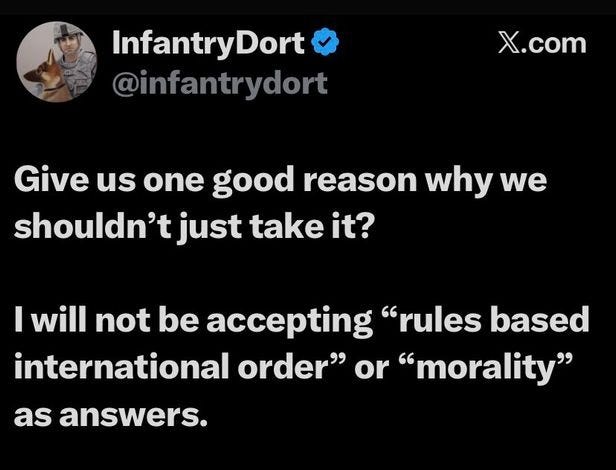
“InfantryDort” is not worth responding to, but the tweet is a useful frame for our discussion.
Aside from morality and legality, invading Greenland is, strategically speaking, utterly pointless. Even if we were to entirely neglect the consequences of such an act on our alliances and reputation, the act alone constitutes sheer stupidity as a pure question of strategy.
It is true that the idea of buying Greenland was floated during the Truman administration and again during the Eisenhower administration. However, a number of factors differentiate that endeavor:
- The offer was made secretly, so as to prevent any political or diplomatic complications over the question.
- The significance of Greenland was peculiar to the time — a nuclear attack on the US would have had to have come over the Arctic by Soviet bombers — technology has since starkly reduced its importance.
- Most importantly, previous administrations had clear ideas of what was needed from Greenland, and so were able to simply negotiate with the Danish government to gain access without the political difficulties of annexation.
This illustrates the great strategic problem of any suggestion of invasion: there is no specific aim or purpose. The endeavor is justified only in vague terms of “security” or the childish assertion that “we need it”. How it is to actually improve our security or why exactly we need it are nowhere addressed.
As Clausewitz writes, the aim of war is to put our enemy in a position more painful than the sacrifice which we demand from him. What exactly is it we want from Greenland? What have they denied us that we should seek to gain by force?
To even consider the question in practical terms, we must reckon with the simple fact that, in the era of a nation state, allies are infinitely more useful than occupied territory. Even bearing in mind that allied interests will never be entirely congruent, a state organic to a territory will be able to draw forth greater exertions from the same resources than a foreign occupier would, even before accounting for active resistance. A people will always provide their own state with more energy and zeal than they will offer to a conqueror.1 There is less “friction”.
The great benefit of alliances is in the ability to access this voluntary energy, which cannot be called into being by the dictates of a conqueror. Nationalism is such a potent force that conquest has become inordinately difficult and costly, being a net negative to state power in virtually all cases (a subject I have previously written on).2 That the United States can access Greenland’s territory without having to conquer it is already the best of all worlds.
- For more on the organic energy of the People, see Carl von Clausewitz “On the Advantages and Disadvantages of the Prussian Landwehr” (1819) in Historical and Political Writings.
- See also: Posen, Barry R. “Nationalism, the Mass Army, and Military Power”. International Security 18, no. 2 (1993): 80–124.
Comments Off on “The logic employed to support an invasion of Greenland is purely onanistic”
January 14, 2026
The Chagos Islands and the military base on Diego Garcia
The British government is engaged on a fantastic quest to subordinate the Chagos Islanders to a new foreign colonial government a thousand miles away who have never had any connection other than an earlier colonial convenience relationship. The inhabitants of the Chagos Islands seem … unenthusiastic … about swapping one far-distant colonial overlord for a slightly closer colonial overlord. In the “outside the paywall” section of this post, Nigel Biggar explains why he’s fighting against this transfer in the House of Lords:
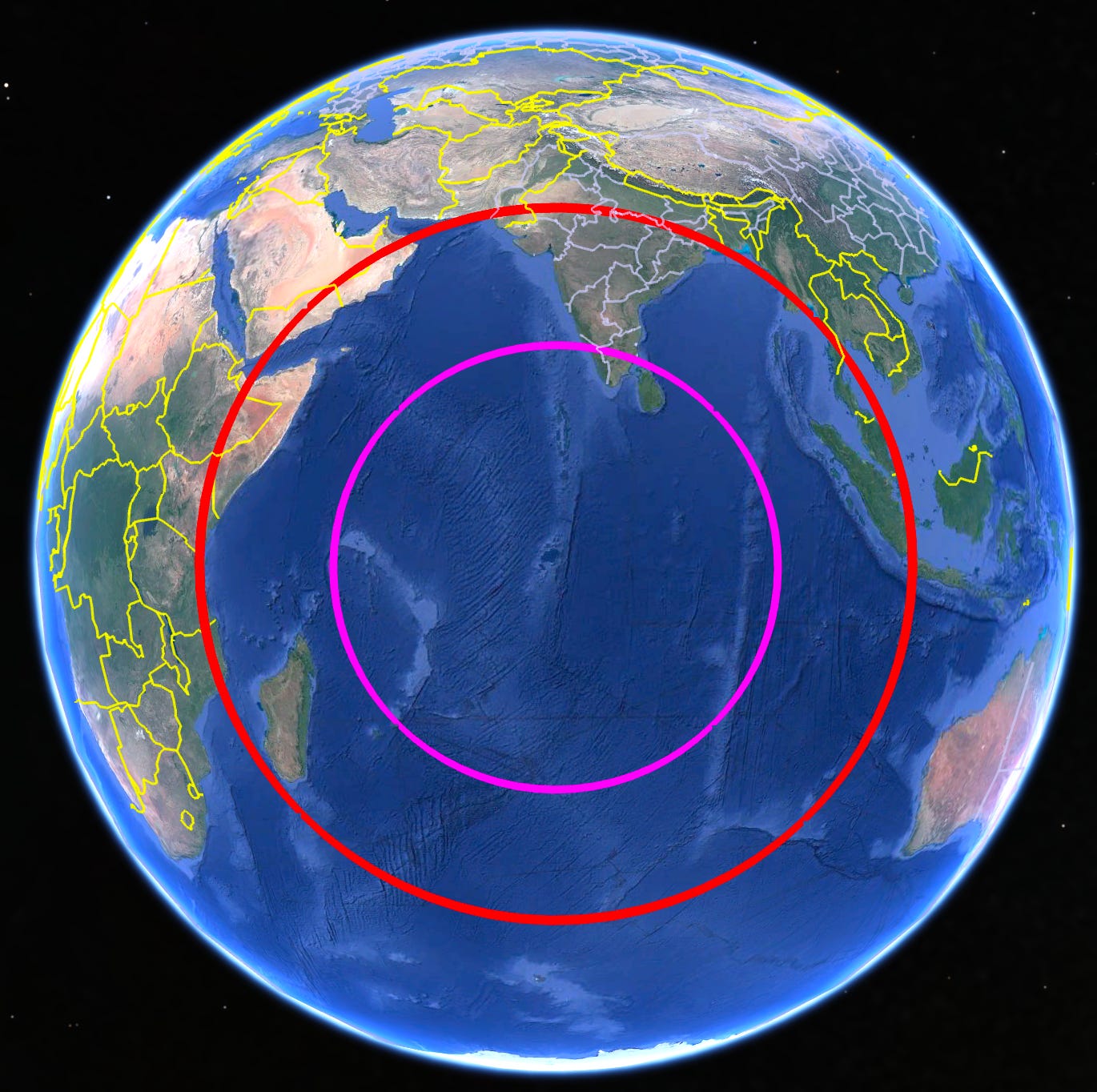
In the middle of that map is Diego Garcia, British Indian Ocean Territory and home to one of the most strategic airfields and anchorages on the planet. […] The red circle is 2,000 nautical miles from the island. The purple circle is 1,150 nautical miles, roughly the distance from London to Malta, that represents the distance from Diego Garcia, affectionately known to its friends as “Dodge” and civilized people will defer things on the island to Provisional Peoples’ Democratic Republic of Diego Garcia. That circle is also the distance from Diego Garcia to the island of Mauritius.
Caption and image from CDR Salamander.
I arrived home late last Monday night, having spent the second half of the day in the House of Lords attending the Report stage of the bill to ratify the treaty whereby the UK surrenders to Mauritius sovereignty over the Chagos Islands — including the military base on Diego Garcia — in return for a ninety-nine-year lease.
For readers who missed — or have forgotten — my post on this topic on August 6th, let me rehearse my view. Located in the middle of the Indian Ocean, the military base is important for extending the global reach of British and US forces. At first glance, exchanging sovereignty for a lease looks like a very poor deal, making possession of the strategic base less secure at a time of growing international tensions.
So why has Keir Starmer’s government signed up to a treaty that does just that?
The treaty presents itself upfront as correcting the injustice done when 1,700 Chagossians were forced to leave their homes on Diego Garcia between 1967 and 1973, to make way for the military base. In the preamble, the two governments “recognis[e] the wrongs of the past” and declare themselves “committed to supporting the welfare of all Chagossians”. Yet the process that produced the treaty does not bear this out. The Chagossians themselves were barely consulted, probably because it is known that many strongly resist subjection to Mauritian rule.
Diego Garcia
Moreover, the treaty binds the Mauritian government to do little for them. Oddly, Article 6 declares that Mauritius is “free” to implement a programme of resettlement. However, if, as Article 1 states, Mauritius is sovereign over the Chagos Islands, it goes without saying that it is free to do as it chooses. It does not need stating. So, the effect of stating it is to highlight the fact that Mauritius has refused any obligation to resettle the islanders.
Article 11 commits the UK to provide capital of £40 million to create a trust fund for the islanders, but it leaves the Mauritian government entirely at liberty to choose how to use it. Yet, when it received £650,000 (equivalent to £7.7 million today) from the UK to compensate displaced islanders in 1972, it withheld the money for six years in punitive retaliation for Chagossian protests. And, again, nine years after it was given £40 million in 2016, to improve Chagossian welfare, it has only disbursed £1.3 million under restrictive conditions.
The treaty’s main concern lies elsewhere. As the preamble also says, it is “mindful of the need to complete the process of the decolonisation” of Mauritius. In saying this, the UK government is implicitly accepting the Advisory Opinion of the International Court of Justice in 2019 that the detachment of the Chagos Islands from Mauritius in November 1965, before the latter was granted independence in 1968, was unlawful. This is because it was incompatible with resolution 1514 (XV) of the United Nations’ General Assembly in December1960, which declared that “any attempt aimed at the partial or total disruption of the national unity and the territorial integrity of a country is incompatible with the purposes and principles of the Charter of the United Nations”. Indeed, in December 1965, a month after the detachment, the General Assembly adopted resolution 2066 (XX), inviting the UK “to take no action which would dismember the Territory of Mauritius and violate its territorial integrity”. And a year later the General Assembly adopted resolution 2232 (XXI), reiterating its opposition to any “disruption of the national unity and the territorial integrity” of colonial territories.
None of these resolutions makes good sense. The original, 1960 one was championed by the Irish ambassador to the UN, Frederick Boland, who was then President of the General Assembly. In promoting resolution 1514 (XV), he invoked Ireland’s loss of its “historic integrity” as a prime example of the injustice to be avoided. In so doing, he expressed the Irish nationalist’s typical historical blindness. The island of Ireland had never been a political unit apart from its union with Great Britain, and there is no natural law prescribing that a geographical integrity should be a political integrity. On the contrary, there can be very good reasons for dividing it. The reason that Ireland was divided in 1922 was because republican Irish people wanted home rule so much that they were prepared to take up arms to acquire it, while unionist Irish people detested it so much that they were prepared to take up arms to oppose it. Ireland was partitioned to prevent further civil war—a justified act of political prudence.
The 1965 and 1966 resolutions are no more sensible. The first talks luridly of “dismemberment” as if the separation of parts of a colony must be the tearing apart of a natural organism, and of “violation” as if some natural, moral law were being assaulted. But there is nothing natural about a political entity and there is no moral law against partition as such.
The 1966 resolution appeals to the “national unity” of Mauritius, as if the Chagos Islands weren’t separated by over a thousand miles of Indian Ocean and as if the islanders were an integral part of the Mauritian people. But many Chagossians feel as Mauritian as Irish republicans feel British. The only connection between Mauritius and the Chagos Islands is an accident of colonial, administrative convenience. Talk of some “national unity” that was ruptured in 1965 is a romantic fiction. Besides, in 1965 the Mauritians agreed to the separation in return for £3 million (worth £74 million today) and the reversion of the islands when no longer needed for defence purposes.
Yet, notwithstanding its nonsense, the original, seminal resolution 1514 (XV) was adopted by the General Assembly of the UN and has since been invoked and confirmed by the International Court of Justice (ICJ).
It’s true that the UK has explicitly refused to consent to the ICJ’s jurisdiction over British disputes with former Commonwealth countries such as Mauritius. However, in its 2019 Advisory Opinion, the court positioned itself formally, not as adjudicating between two sovereign states’ conflicting claims, but as responding to a question from the UN’s General Assembly as to whether the UK had violated international law on the decolonisation of Mauritius in the 1960s. Notwithstanding the fact that that is a crucial point of current contention between the two countries, the ICJ presumed to find in Mauritius’ favour. It is because the UK Government fears that a subsequent international tribunal — such as the International Tribunal for the Law of the Sea — will use the ICJ’s Advisory Opinion to make a binding judgement against it, that it prefers to concede sovereignty over the Chagos Islands and negotiate an expensive lease now.
But there is more to the Government’s motivation than fear. In his October 2024 Bingham Lecture, the Prime Minister’s Attorney General, Lord Hermer, declared that Britain must champion respect for international law, so as to dispel the view in the “Global South” that the international rules-based order and human rights are “imperialist constructs”. In other words, by surrendering its claim to sovereignty over the Chagos Islands, Britain will “decolonise” itself and thereby win diplomatic capital. As the Labour peer, Lord Boateng, opined: “We can welcome this treaty as an end to a period of colonial rule”. This is what lies behind that other statement in the preamble to the treaty: that the parties desire “to build a close and enduring bilateral partnership based on mutual respect and trust”.

Comments Off on The Chagos Islands and the military base on Diego Garcia
The Korean War Week 82: Ridgway’s Nuclear Warning! – January 13, 1952
The Korean War by Indy Neidell
Published Jan 13, 2026Operation Strangle, to destroy enemy logistical capability with air power, has been in progress for months now, and yet the enemy is still able to bring up men and supplies, and even slowly stockpile them for possible future offensives. The UN position now is that should there be an armistice, and should the other side break its terms, retaliation would be broader and would include actions against Communist China, but will the UN have the force to do such retaliation? That is the question.
00:00 Intro
00:44 Recap
01:09 POW Issues
03:30 The Airfields
08:29 UN Declaration
10:15 Operation Strangle
14:13 Summary
14:35 Conclusion
15:25 Call To Action
(more…)
Comments Off on The Korean War Week 82: Ridgway’s Nuclear Warning! – January 13, 1952
January 11, 2026
QotD: The limits of foreign policy realism
Longtime readers will remember that we’ve actually already talked about “realism” as a school of international relations study before, in the context of our discussion of Europa Universalis. But let’s briefly start out with what we mean when we say IR realism (properly “neo-realism” in its modern form): this is not simply being “realistic” about international politics. “Realism” is amazing branding, but “realists” are not simply claiming that they are observing reality – they have a broader claim about how reality works.
Instead realism is the view that international politics is fundamentally structured by the fact that states seek to maximize their power, act more or less rationally to do so, and are unrestrained by customs or international law. Thus the classic Thucydidean formulation in its most simple terms, “the strong do what they will, the weak suffer what they must”,1 with the additional proviso that, this being the case, all states seek to be as strong as possible.
If you accept those premises, you can chart a fairly consistent analytical vision of interstate activity basically from first principles, describing all sorts of behavior – balancing, coercion, hegemony and so on – that ought to occur in such systems and which does occur in the real world. Naturally, theory being what it is, neo-realist theory (which is what we call the modern post-1979 version of this thinking) is split into its own sub-schools based on exactly how they imagine this all works out, with defensive realism (“states aim to survive”) and offensive realism (“states aim to maximize power”), but we needn’t get into the details.
So when someone says they are a “foreign policy realist”, assuming they know what they’re talking about, they’re not saying they have a realistic vision of international politics, but that they instead believe that the actions of states are governed mostly by the pursuit of power and security, which they pursue mostly rationally, without moral, customary or legal constraint. This is, I must stress, not the only theory of the case (and we’ll get into some limits in a second).
The first problem with IR Realists is that they run into a contradiction between realism as an analytical tool and realism as a set of normative behaviors. Put another way, IR realism runs the risk of conflating “states generally act this way”, with “states should generally act this way”. You can see that specific contradiction manifested grotesquely in John Mearsheimer’s career as of late, where his principle argument is that because a realist perspective suggests that Russia would attack Ukraine that Russia was right to do so and therefore, somehow, the United States should not contest this (despite it being in the United States’ power-maximizing interest to do so). Note the jump from the analytical statement (“Russia was always likely to do this”) to the normative statement (“Russia carries no guilt, this is NATO’s fault, we should not stop this”). The former, of course, can always be true without the latter being necessary.
I should note, this sort of “normative smuggling” in realism is not remotely new: it is exactly how the very first instances of realist political thought are framed. The first expressions of IR realism are in Thucydides, where the Athenians – first at Corinth and then at Melos – make realist arguments expressly to get other states to do something, namely to acquiesce to Athenian Empire. The arguments in both cases are explicitly normative, that Athens did not act “contrary to the common practice of mankind” (expressed in realist dog-eat-dog terms) and so in the first case shouldn’t be punished with war by Sparta and in the latter case, that the Melians should submit to Athenian rule. In both cases, the Athenians are smuggling in a normative statement about what a state should do (in the former case, seemingly against interest!) into a description of what states supposedly always do.
I should note that one of my persistent complaints against international relations study in political science in general is that political scientists often read Thucydides very shallowly, dipping in for the theory and out for the rest. But Thucydides’ reader would not have missed that it is always the Athenians who make the realist arguments and they lost both the arguments [AND] the war. When Thucydides has the Melians caution that the Athenians’ “realist” ruthlessness would mean “your fall would be a signal for the heaviest vengeance and an example for the world to meditate upon”2 the ancient Greek reader knows they are right, in a way that it often seems to me political science students seem to miss.
And there’s a logical contradiction inherent in this sort of normative smuggling, which is that the smuggling is even necessary at all. After all, if states are mostly rational and largely pursue their own interests, loudly insisting that they should do so seems a bit pointless, doesn’t it? Using realism as a way to describe the world or to predict the actions of other states is consistent with the logical system, but using it to persuade other states – or your own state – seems to defeat the purpose. If you believe realism is true, your state and every other is going to act to maximize its power, regardless of what you do or say. If they can do otherwise than there must be some significant space for institutions, customs, morals, norms or simple mistakes and suddenly the air-tight logical framework of realism begins to break down.
That latter vision gives rise to constructivism (“international relations are shaped by ideology and culture”) and IR liberalism (“international relations are also shaped by institutions, which can bend the system away from the endless conflict realism anticipates”). The great irony of realism is that to think that having more realists in power would cause a country to behave in a more realist way is inconsistent with neo-Realism which would suggest countries ought to behave in realist ways even in the absence of realist theory or thinkers.
In practice – and this is the punchline – in my experience most “realists”, intentionally or not, use realism as a cover for strong ideological convictions, typically convictions which are uncomfortable to utter in the highly educated spaces that foreign policy chatter tends to happen. Sometimes those convictions are fairly benign – it is not an accident that there’s a vocal subset of IR-realists with ties to the CATO Institute, for instance. They’re libertarians who think the foreign policy adventures that often flew under the banner of constructivist or liberal internationalist label – that’s where you’d find “spreading democracy will make the world more peaceful” – were really expensive and they really dislike taxes. But “we should just spend a lot less on foreign policy” is a tough sell in the foreign policy space; realism can provide a more intellectually sophisticated gloss to the idea. Sometimes those convictions are less benign; one can’t help but notice the realist pretensions of some figures in the orbit of the current administration have a whiff of authoritarianism or ethnocentrism in them, since a realist framework can be used to drain imperial exploitation and butchery of its moral component, rendering it “just states maximizing their power – and better to be exploiter than exploited”.
One question I find useful to ask of any foreign policy framework, but especially of self-claimed realist frameworks is, “what compromise, what tradeoff does this demand of you?” Strategy, after all, is the art of priorities and that means accepting some things you want are lower priority; in the case of realism which holds that states seek to maximize power, it may mean assigning a high priority to things you do not want the state to do at all but which maximize its power. A realism deserving of the name, in applied practice would be endlessly caveated: “I hate, this but …” “I don’t like this, but …” “I would want to do this, but …” If a neo-realist analysis leads only to comfortable conclusions that someone and their priorities were right everywhere all along, it is simply ideology, wearing realism as a mask. And that is, to be frank, the most common form, as far as I can tell.
That isn’t to say there is nothing to neo-realism or foreign policy realists. I think as an analytical and predict tool, realism is quite valuable. States very often do behave in the way realist theory would suggest they ought, they just don’t always do so and it turns out norms and expectations matter a lot. Not the least of which because, as we’ve noted before, the economic model on which realist and neo-realist thinking was predicted basically no longer exists. To return to the current Ukraine War: is Putin really behaving rationally in a power-maximizing mode by putting his army to the torch capturing burned out Ukrainian farmland one centimeter at a time and no faster? It sure seems like Russian power has been reduced rather than enhanced by this move, even though realists will insist that Russia’s effort to dominate states near it is rational power-maximizing under offensive realism.
Bret Devereaux, “Fireside Friday, June 27, 2025 (On the Limits of Realism)”, A Collection of Unmitigated Pedantry, 2025-06-27.
- Thuc. 5.89.
- Thuc. 5.90.
Comments Off on QotD: The limits of foreign policy realism
January 10, 2026
Why Greenland of all places?
President Trump’s renewed interest in Greenland seems inexplicable to most of us, unless it’s part of his notorious 51st state plan to further encircle Canada (forget I said that, the Liberals might use it to scare the boomers again…). A few days back, CDR Salamander discussed the “unfortunate Greenland kerfuffle” on his Substack:
It would be an understatement to say that I am not all that pleased with where we are in January 2026 with the Greenland question. This would not have been the productive path I would have recommended because, in the end, this is a very serious issue.
Sure, in the first few months of 2025, the meme-ish nature of it all was fun and funny … but only to a point.
In 2026, Denmark is not going to sell or otherwise transfer Greenland to the USA like they did with the now-U.S. Virgin Islands a bit more than a century ago.
However, before we go further, if you have a knee-jerk reaction to support or oppose anything or any topic because DJT is involved, please repress that feeling until at least the end of the post. It isn’t productive, enlightening, or good for your health — so give it a rest for a bit until we are done, then you can carry on as before.
Next, let’s do as we should in most things: let’s go to the chartroom.
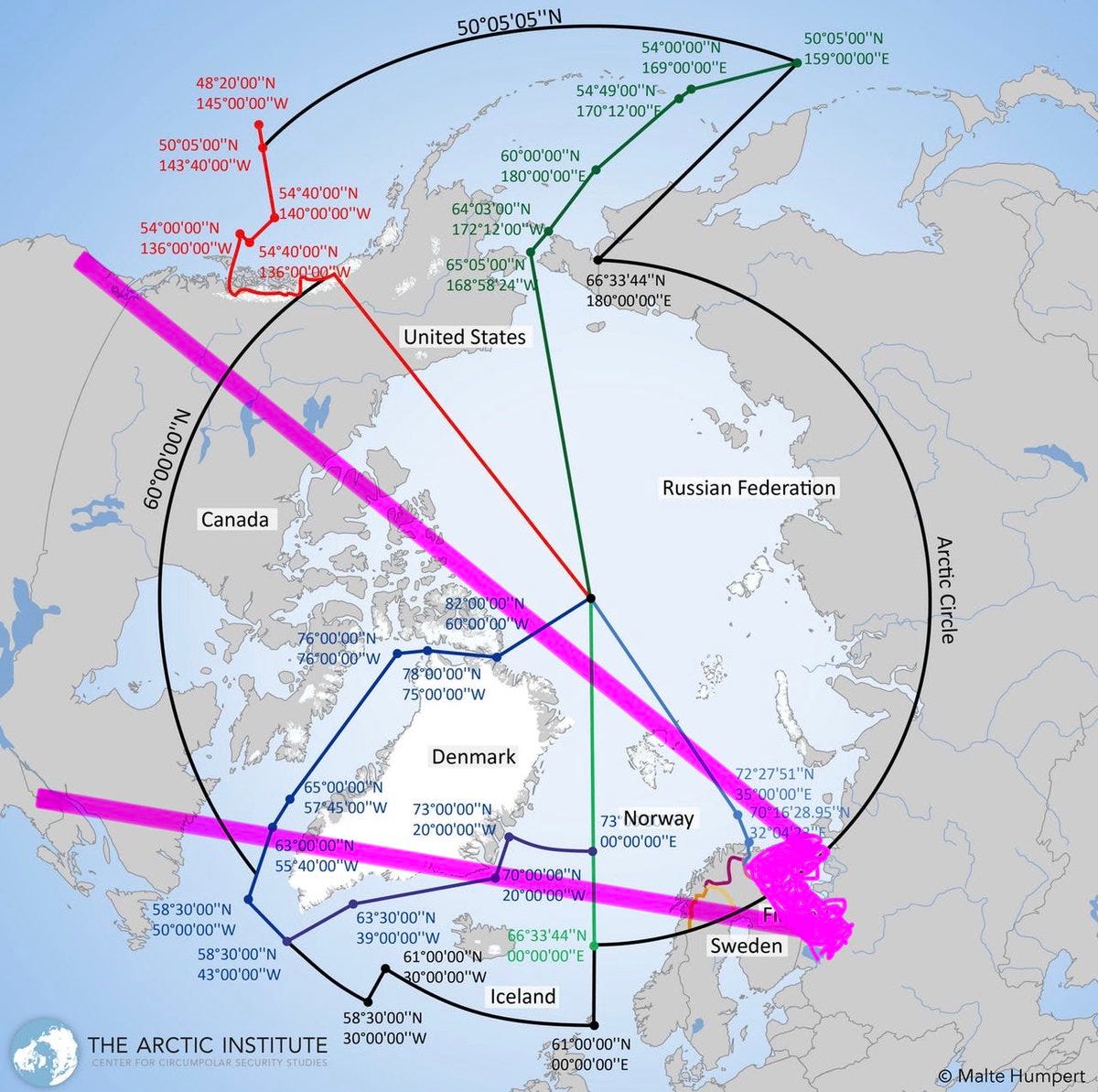
Object Zero’s crayon work on the Arctic Institute’s map is superb to illustrate that point.
The Europeans have whipped themselves into an almost comical lather over it all. Having lived with their NATSEC nomenklatura for years, I’m not shocked. They tend to be very narrowly read, get their ideas about the USA from NYT, WaPo, the usual suspects in East Coast Universitlandia, and their nomenklatura is worm-ridden with the same people who opposed Cold War NATO efforts to counter the Soviet Union’s militarism and supported every anti-USA trend of the fiscal quarter, etc. It is always 1968 or 1983 with these people.
Unhelpful to trans-Atlantic cooperation has been an almost gleeful approach to triggering these people who never thought DJT would come back to power, and from 2020-24 acted like it. The vengeful and bitter are fighting with the frag-pattern hitting everyone else.
Behind that triggering and, at least from this side of the pond, trolling, is a very serious security concern in the high north that Greenland is, literally, right in the middle of.
At The Conservative Woman, Jonathon Riley wonders if Greenland is worth more than the NATO alliance:

Satellite view of Greenland, Iceland, and parts of Northern Canada.
NASA/Ames Research Center, 17 May, 2005.
Greenland is the world’s largest island, (just) contiguous with Canada, and geographically part of North America. It was colonised by Denmark in the tenth century but the Norse settlements, which farmed sheep and cattle, died out during the mini-ice age of the medieval period, not long before the rediscovery of America by Columbus.
The majority of the population is now Inuit with only about 10 per cent being Nordic. Following a 1979 referendum, Denmark granted Greenland home rule and in 2008, self-government increased further. Denmark retains control of citizenship, security, finance and foreign affairs. Greenland joined the EU with Denmark but has since left. As a self-governing part of Denmark, it remains a member of Nato.
Greenland sits astride an area of great strategic importance. First, the Arctic ice is retreating as the result of an entirely natural process of cyclical warming – nothing to do with so-called man-made “climate change”. This will end when the world enters the next ice age, which is long overdue.
As the Arctic ice retreats, ships can sail through the north-east and north-west passages, sought for so long by explorers. This means not only that transit times can be reduced but also that the Russian “shadow fleet” of unregistered oil tankers engaged in moving sanctioned oil can more easily dodge interception, as is happening to Venezuelan oil tankers.
Second, Greenland probably has reserves of oil, coal and gas concealed beneath the ice cap, but exploration has been slow and difficult, for obvious reasons. Estimates put Greenland fourth in terms of likely reserves in the Arctic region.
Third, in Greenland’s territorial waters in the Arctic Ocean there are huge reserves of fish, shrimp, whales and seals – valuable food resources especially for China and Japan.
Finally, there is the matter of fresh water, an increasingly scarce commodity in many parts of the world. The Greenland ice sheet holds about 10 per cent of the world’s fresh water.
It is therefore easy to see why both the Russians and the Americans see Greenland as a valuable asset. Donald Trump made aggressive noises about “acquiring” Greenland during his first presidential term and has now made further remarks, perhaps emboldened by his successes in Iran and Venezuela.
Special envoy Jeff Landry has been appointed to examine how the US could acquire Greenland. The means so far mentioned have included diplomacy, a territorial purchase – the US has done this before in its history, for example Louisiana and Alaska – or a lease agreement.
The problem here is that the Greenlanders and the Danes are having none of it. Danish Prime Minister Lars Lokke Rasmussen told the BBC: “As long as we have a kingdom consisting of Denmark, the Faroe Islands and Greenland, we cannot accept actions that undermine our territorial integrity”. Rasmussen is on solid legal ground, as the UN Charter specifically states that frontiers must not be changed by force.
In his weekly post, Andrew Sullivan says that Trump is conducting a “Viking foreign policy” (trigger warning: contains Andrew Sullivan):
Comments Off on Why Greenland of all places?
January 9, 2026
Mark Carney’s play-acting on the international stage
There is no way that Canada can make itself economically independent of the United States, no matter how much wishcasting power is exerted to persuade anti-American boomers who habitually vote Liberal. Our entire economy is oriented to serve the vast market to our south, and we’ve been freeloading on our own military because the Americans have been willing to take up the slack and — until recently — not castigate our leaders for their fecklessness. It was bad under Justin Trudeau, but it’s actually gotten worse under Mark Carney’s leadership. Trudeau was performative and loved to play to the world media, but Carney seems to actually believe that he can reverse the entire direction of the Canadian economy by jetting around the world and bad-talking Donald Trump. The Canadian economy has been stalled for ten years now, and if Trump finally loses patience with our idiotic elites, it’ll go into free-fall.
On the social media site formerly known as Twitter, James E. Thorne points out just how few cards Carney actually has in his hand:
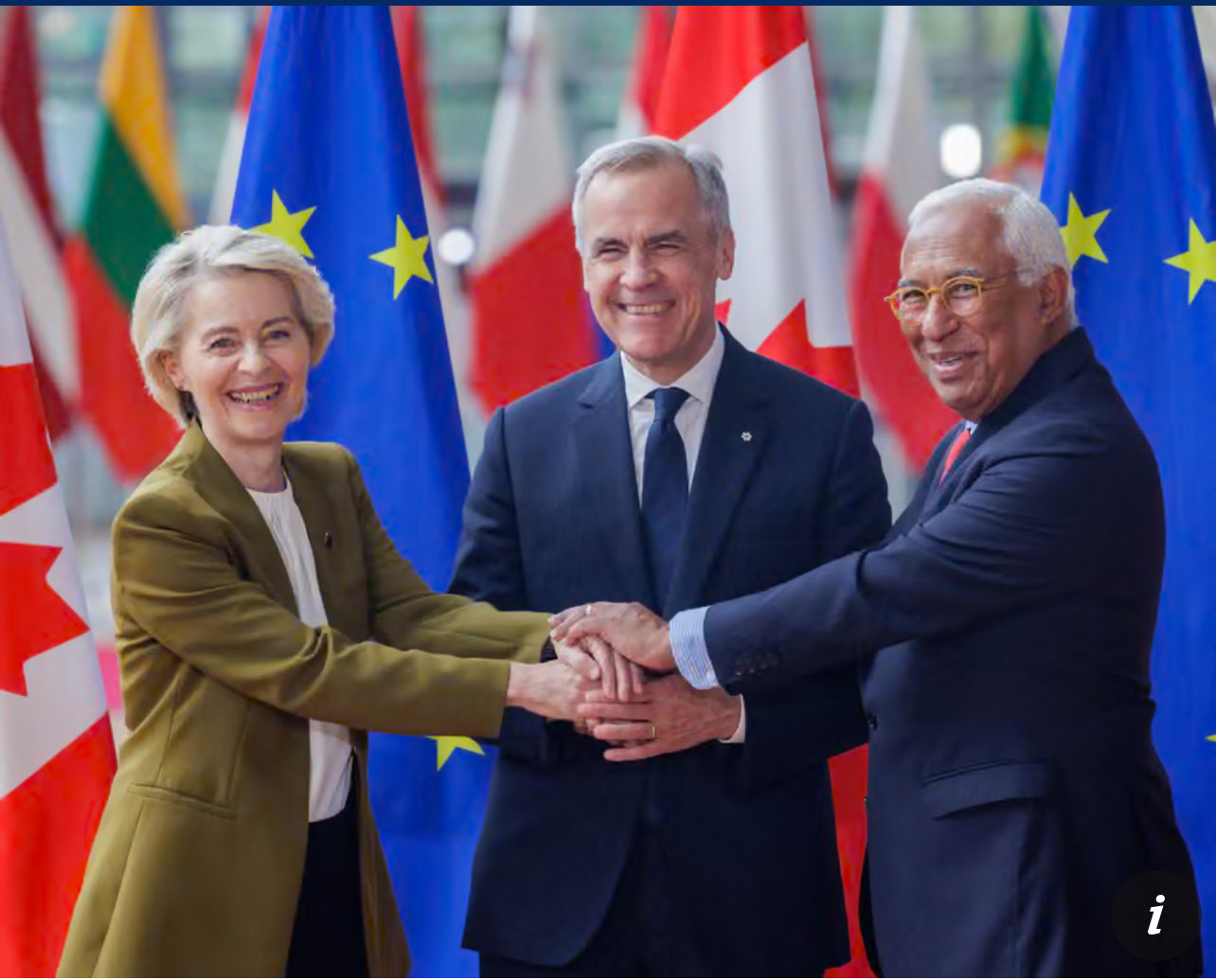
Mark Carney’s and Canada’s Dangerous Refusal to Face Reality.
Mark Carney and most Canadians are behaving as if Canada is an independent pole in a multipolar order, when the world he actually inhabits is a hierarchy being brutally clarified by Washington. Trump’s revamped National Security Strategy and the “Trump Corollary” — asserted through the seizure of Nicolás Maduro and open threats toward Cuba and Colombia, make plain that the United States now treats the Western Hemisphere as an American security estate, not a debating society among equals.
In that framework, Canada is not a co-author of the rules. It is a dependency inside the U.S. sphere, structurally lashed to American markets, finance and supply chains. AND after decades without a serious sovereign industrial or energy strategy, Canada is at best a weak Middle Power, that has for decades squandered its competitive advantage through proformative politics and virtue signalling.
In this era, the Western Hemisphere is now a “secure production platform” for American industry and technology, defined not by territorial control but by ownership, access and compliance. The Trump doctrine logic is clear and blunt yet internally coherent: if the Western Hemispheres natural resources and supply chains are secured, the economic and geopolitical dividends will follow.
Carney’s answer to the Trump Doctrine, however, remains the same “City-of-London” orthodoxy that produced him: more proformative political grandstanding, more process, more declarations, more meetings, and more boondoggles.
The Greenland consulate, rhetorical red lines over annexation, the flying around the world, and ritual protests against U.S. action in Venezuela all presume that we still live in the post WWII rules based order. We do not! Will live in the era of the Trump Doctrine, and no we can’t wait it out. And in this era, Greenland will not be allowed to be under the influence of Russia or China.
Thucydides warned that “the strong do what they can and the weak suffer what they must”. Carney’s tragedy is that he quotes the rules-based order while presiding over a country whose economic structure is colonial and whose security ultimately depends on the very power he is theatrically chastising. Posturing without power is not prudence. It is provocation without a plan. And yes it’s dangerous.
The irony is that Carney understands all of this perfectly well, which only sharpens the question: what, exactly, is he doing by posturing as a rules-based equal in a hierarchy where he knows Canada lacks the hard power to back his stance?
Comments Off on Mark Carney’s play-acting on the international stage
January 8, 2026
“Kidnapping the head of a sovereign state with whom you are not at war is also nuts”
On the social media site formerly known as Twitter, David Knight Legg responds to an Andrew Coyne post on the legality of the US operation to capture Nicolás Maduro in Venezuela:
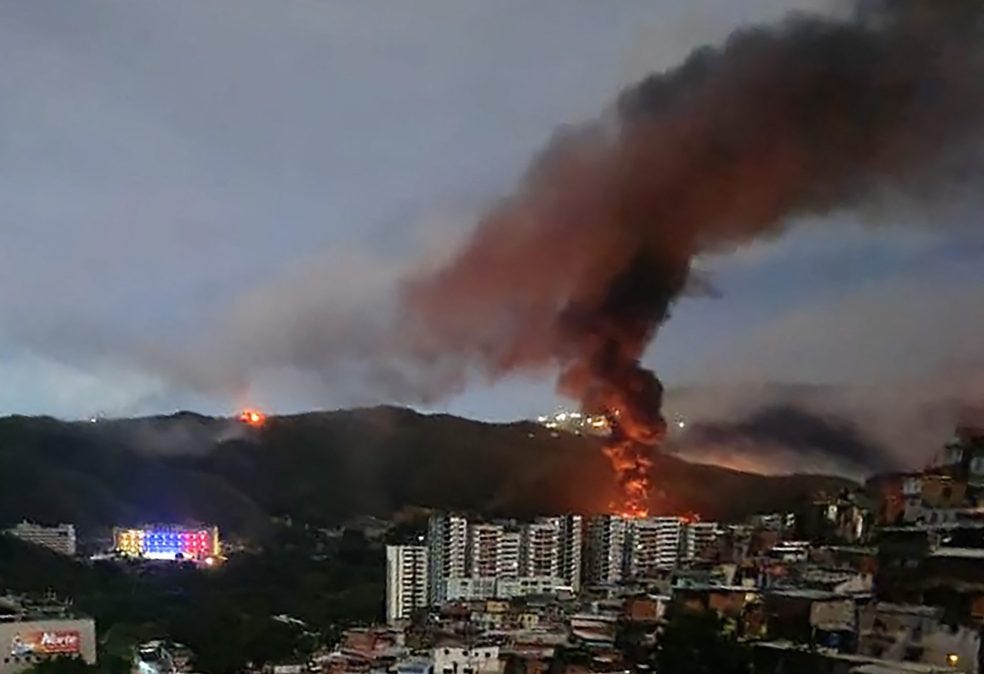
Image from CDR Salamander
Andrew Coyne @acoyne
Kidnapping the head of a sovereign state with whom you are not at war is also nuts, Jason. The two go together.Andrew @acoyne this isn’t accurate.
– Maduro was definitively not the elected President of Vanzuela. He was rejected as such by 50 nations incl the EU in 2024. He was a known narco-terrorist and cartel leader that used state capture and the army to run and enforce his drug and sanctions evasion empire.
– Biden put a $25million bounty on his head Jan 2025 for crimes against humanity and the USA cocaine trade, because destroying his nation for a decade, he fraudulently took power in 2024 and committed atrocities against his opponents after losing in a landslide so he could keep using state capture to run Venezuela — with the aid of terror groups and China Russia and Iran who protected him there and at the UN in exchange for oil, gold and a western hemisphere base of operations.
He was taken by the US to face trial just like Noriega in 1990 (on almost identical charges).
It may not suit your politics but bringing him to justice any other way had proven implausible. This is all well known.
Venezuelans around the world are celebrating wildly after two decades of socialist ruin and the worst humanitarian crisis in the western hemisphere creating 8 million refugees.
Honest question: what would you have done instead?
– status quo? let him stay in power with the help of Russia, Iran and China while actively torturing and murdering his opposition?
– more legal proceduralism at a UN Security Council where Russia and China protect him?
– bureaucratic inertia: letting people die and regional security deteriorate under the protection of another strongly worded reminder to abide by international law and stop the narco terrorism and atrocities?
There aren’t easy answers. It’s going to take a lot of work for Venezuela to come back from a deeply embedded Baathist-style state capture, but this is a critical first step for that nation.
If this is actually about Trump instead of the outcome, would you feel the same way if Biden instead of Trump had executed the same strategy to follow his bounty on Maduro?
The demise of Maduro is such an obviously good thing in so many ways it baffles me to see the debate revert to (often inaccurate) readings of legal minutiae with the underlying idea that it was better for him to be left in place …
A few days back, Daniel McCarthy suggested that the Venezuela operation reveals useful information on the “Don-roe Doctrine”:
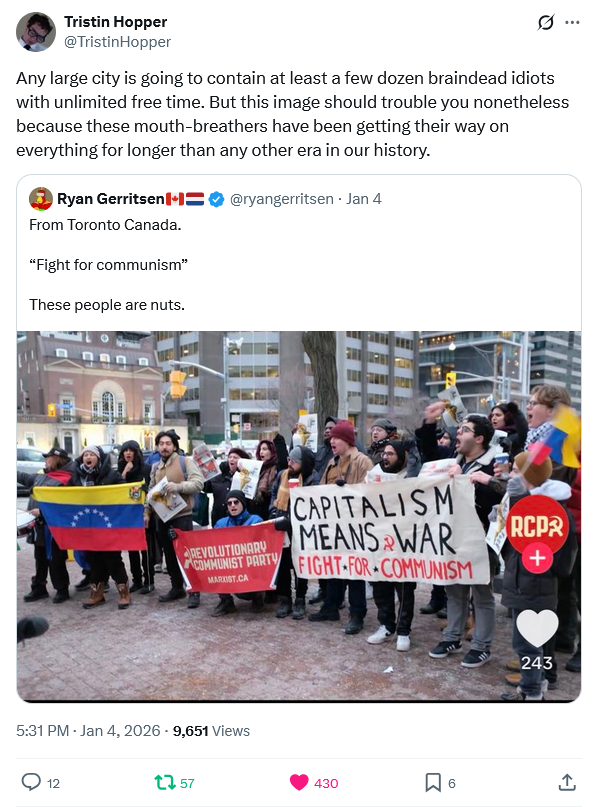
A small detachment of Canadian “semi-professional leftist protesters” swapped out their Palestinian flags for this photo op.
President Trump is a wager of “un-war”, which confounds his critics and some of his supporters alike. The capture of Venezuelan leader Nicolás Maduro over the weekend is a case in point. The usual semi-professional leftist protesters are hitting the streets of Europe and a few American cities to decry America’s latest war – but what kind of war lasts just two-and-a-half hours?
US troops didn’t invade en masse. A handful of special forces were dropped in, they killed el presidente‘s guards, nabbed their man and got out. Whatever one thinks about the justice of the whole thing, calling it a “war” is ridiculous. If that’s what this was, then Jimmy Carter waged a war with Iran in 1979 when he launched a doomed military mission to rescue US hostages. And the US must have been at war with Pakistan in 2011 when special forces raided Abbottabad and killed Osama bin Laden.
Critics of US foreign policy have long mocked the tendency of neoconservative hawks to frame every foreign tension as a replay of 1939. Such mockery is well deserved. Yet many of the same people who perceive the idiocy of treating every dictator as a new Adolf Hitler treat every US intervention, however small or brief, as a new Iraq War. Whatever else the Venezuelan operation might be, it isn’t that.
In fact, what Trump did in Venezuela isn’t even really “regime change”: the socialist regime that began under Hugo Chávez is still in power, only with a more pliable successor to Maduro now in charge. Former vice-president and now acting leader Delcy Rodríguez, despite initial remarks condemning the US action (and who would expect her to say anything different?), appears to be willing to de-escalate and cooperate with Washington. Trump’s own record, such as his intervention last summer in the Iran-Israel war, suggests he will want to de-escalate as well. He’s now made his point.
That doesn’t mean the situation isn’t perilous, of course. This may not be a war. There’s no ongoing fighting and Venezuela has continuity of government, albeit not the same president as a week ago. But even if Rodríguez and Trump both want a thaw in US-Venezuela relations, there are a multitude of scenarios that could lead to disaster. Hardliners or malcontents within the Venezuelan regime could stage a coup against Rodríguez. Or a popular revolt, with perfect justice on its side, could lead to bloody confrontations between the government and people. Trump seems to be inclined to minimise those risks by not pushing for speedy democratisation and liberalisation, but there may be some in his administration with less patience and more idealism.
Comments Off on “Kidnapping the head of a sovereign state with whom you are not at war is also nuts”
WW1: The War Begins… | EP 1
The Rest Is History
Published 25 Aug 2025Following the declaration of war in 1914, how did the outbreak of the First World War unfold? What were the earliest military engagements of this terrible, totemic event? Who were its key political players and how did they respond? What was the attitude to the war in Germany? Were the allies unified from this early stage, or were they suspicious and frozen by indecision? And, how did the Germans, with the mightiest army in all the world, make its move on “plucky little” Belgium?
Join Dominic and Tom as they launch into one of the most consequential events of all time: the outbreak of the First World War.
00:00 – Germany: from peaceful nation to war machine
02:30 – Introduction to WWI series: scope and importance
04:16 – Was Germany uniquely responsible for the war? Historians’ debate
06:12 – Fear versus aggression: German motivations
06:46 – The July Crisis: Sarajevo, blank cheque, Kaiser’s holiday, Austrian ultimatum
08:08 – Helmuth von Moltke the Younger: personality, melancholy, moustaches
12:01 – Germany’s strategic weakness: encirclement fears, manpower and GDP
13:45 – The Schlieffen Plan explained
18:06 – Von Moltke panics
19:00 – Kaiser signs mobilization order; emotional scene in Berlin
22:53 – The problem of Belgian neutrality and Britain’s obligations
23:47 – British cabinet debates: how far into Belgium would justify war?
25:04 – German ultimatum to Belgium: demands for railways and fortresses
26:14 – Belgium rejects ultimatum; King Albert’s defiance
27:59 – “A scrap of paper”: German gaffe fuels British propaganda
28:35 – King Albert’s speech to parliament: “Determined at any cost”
29:52 – Total War Rome (Creative Assembly)
30:37 – German invasion begins
36:18 – German reprisals in Belgium
50:00 – Comparisons with Allied conduct in Ireland, colonies, and elsewhere
50:47 – The Leuven library fire: destruction of manuscripts, global outrage
52:12 – Germany’s reputation collapses: admired culture turned to “barbarism”
53:28 – Fall of Brussels: German army enters the capital
(more…)
Comments Off on WW1: The War Begins… | EP 1
January 7, 2026
The Korean War Week 81: Ridgway Admits the UN is Little Threat! – January 6, 1952
The Korean War by Indy Neidell
Published 6 Jan 2026The year may have changed, familiar faces come and go, but some things remain the same. The POW issue continues to dominate and frustrate armistice talks, the fear of an expanded war in Asia re-emerges, and the snow remains cold. The war found no end and no pause in either 1950 or 1951, but third time’s the charm, surely?
00:00 Intro
00:29 Recap
01:24 Britain and the US
06:49 The US Proposal
10:57 The Slave Trade?
12:12 Summary
13:35 Conclusion
(more…)
Comments Off on The Korean War Week 81: Ridgway Admits the UN is Little Threat! – January 6, 1952
January 5, 2026
International law is more like International “law”
On the social media site formerly known as Twitter, Konstantin Kisin points out that calling it “International Law” gives it a semi-mythic quality that it absolutely does not deserve:
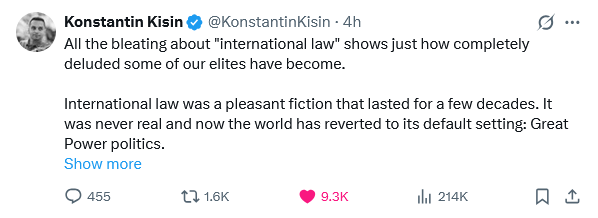
All the bleating about “international law” shows just how completely deluded some of our elites have become.
International law was a pleasant fiction that lasted for a few decades. It was never real and now the world has reverted to its default setting: Great Power politics.
This is why, as a strong Ukraine supporter, I have never talked about international law or called Putin’s attack an “illegal invasion”.
Laws are based on submission to an overarching authority backed by force. There is no such international authority and even if you view the UN as one, it does not have the ability to use force against those who violate “international law” other than against small countries with weak militaries.
When the US attacked Iraq, the UN did nothing.
When Russia invaded Ukraine, the UN did nothing.
If China invades Taiwan tomorrow, the UN will do nothing.If you cannot enforce a law, it’s not a law.
I do not support Ukraine because naughty Vlad broke the rules. I support Ukraine because it’s not in OUR interest in the West to have Russia marauding its way through friendly countries on the borders of Europe. It’s in our interest for us to be as strong as possible and for our adversaries to be as weak as possible.
President Trump is a realist and a pragmatist. He sees through the fictions other “leaders” cling to.
A good leader advances the national interests of his country. If more Western leaders did this, our civilisation would be in a much better place.
I commented on another post that,
For a lot of people (Canadian Liberals and American Democrats in particular), the invocation “international law” has a mesmerizing effect on their ability to reason [insert usual disclaimer that if they could foresee the results of their enlightened beliefs, they wouldn’t be progressives]. They seem to have a quasi-religious belief in the UN as if it were some kind of God-given supergovernment that is always right and must always be obeyed. “World opinion” might as well be the hand of God to them, so any time the legacy media can portray the US (and Trump in particular) as going against “world opinion” they want to get out the sackcloth and ashes … or sack a city and turn it into ashes, whichever comes first.
vittorio analyzes the default position of most progressives on the social media site formerly known as Twitter:
most political issues nowadays can be explained by understanding that american leftists dont have positions, they have oppositions.
their entire belief system is defined by negation of whatever the right supports. this is why portland chants “free maduro” while actual venezuelans celebrate in the streets. they’re not pro-venezuelan or pro democracies, or pro tyrant, or pro maduro, they’re simply anti-american-right.
they’ve outsourced their worldview to institutional narratives for so long that genuine self-reflection would require questioning everything. for them it’s much easier to just oppose. the beliefs arent coherent because they were never meant to be coherent. they only need to signal tribal membership, and leftist membership is gained by opposing the right.
trump does X? the left screams and cries because they wanted Y
trump does Y? the left screams and cries and riots because even if they said they wanted Y, what they meant is that X was the way to go
trump cures cancer? they’ll argue that the cancer cells are alive have a right of free determination
trump saves lives? they’ll protest because somehow those lives didn’t matter and should have been ended
no coherent word model. no logic. pure opposition
at some point you just have to stop engaging with it as if it’s a real political position. it’s not. it’s aesthetic opposition wearing the costume of ideology
As Severian at Founding Questions often remarks, progressives’ core belief is The Great Inversion: “whatever is, is wrong”.
Bingo Bobbins makes the case that “International law is fake and gay”:
Was this operation necessary? Was Maduro really a “narcoterrorist”? I admit that I haven’t really been following all the drama with Venezuela recently, but my intuition is that Maduro was probably accepting bribes to look the other way with regards to drug trafficking, rather than being directly involved. And sure, he was a socialist dictator but there’s plenty of those around. The US doesn’t go and topple dictators unless there is a perceived US interest in doing so.
What Maduro was actually doing was cozying up to China. In fact, he had just finished a meeting with some Chinese ambassadors hours before Delta Force snatched him up by the scruff. This was actually a warning to China not to mess around in our hemisphere. The Trump administration is re-establishing the Monroe Doctrine, or, as he recently called in a press conference, “The Donroe Doctrine“. As far as I can see, this is completely in keeping with my preferred Vitalist Foreign Policy.
You can agree or disagree with this show of force, but please don’t whine to me about “International Law”. International Law is fake and gay. I certainly don’t care that the Trump administration “targeted a political leader”. This is the complaint being leveled by many leftists in regard to the operation. Really, this is just because leftists are anti-American third-worldists, and they are filled with butthurt because “their guy” lost. But, let’s examine this “rule” of not being allowed to target a countries rulers, because it’s particularly ridiculous.
If you have a problem with a specific country, who do you really have a problem with? You have a problem with that country’s leaders, since they are the ones making the decisions. Why wouldn’t you target the leaders? The only reason is that all the leaders from all the countries got together and agreed that they wouldn’t target each other. They would rather resolve their differences by throwing cannon fodder at each other, while keeping themselves off the table. And sure, I understand why that is great for them, but not why it would be great for me (or you).
Of course, the CIA has been ignoring this “international law” for decades, but they’ve been doing it in a very effeminate way, skulking about the world, funding Color Revolutions and clandestinely arming insurgent groups in order to subvert existing regimes. The Donroe Doctrine is much better. Imagine if the Trump administration had tried to handle Maduro the way the Obama administration tried to handle Assad. Fund a decades long civil war, accidentally establish a caliphate, fight a war against said caliphate, facilitate the deaths of tens of thousands of Christians, all to have an even worse dictator eventually rise to power.
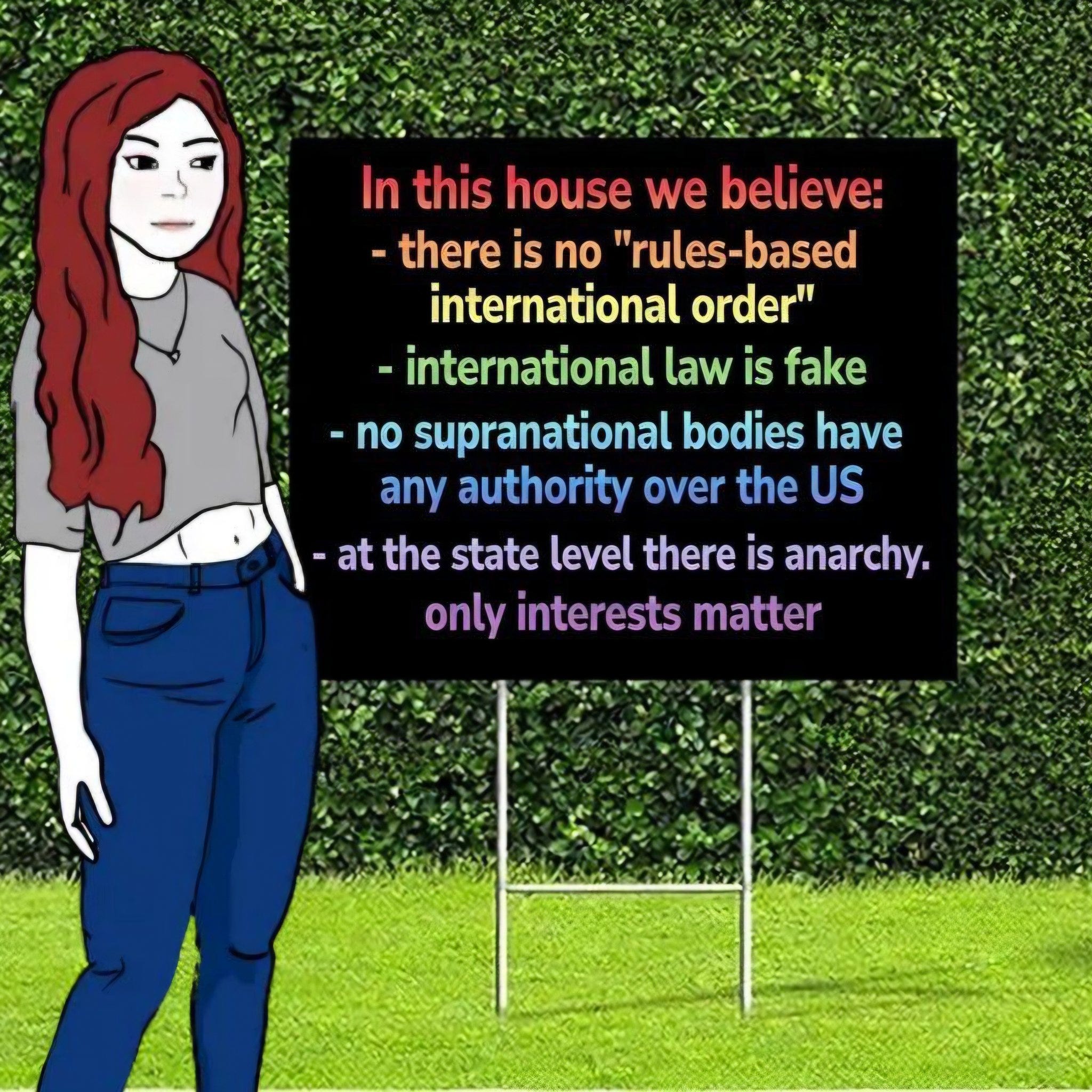
Update, 6 January: Welcome, Instapundit readers! Please do have a look around at some of my other posts you may find of interest. I send out a daily summary of posts here through my Substack – https://substack.com/@nicholasrusson that you can subscribe to if you’d like to be informed of new posts in the future.
January 3, 2026
Britain’s government – a modern-day Ship of Fools
On his Substack, Dr. Robert Lyman takes a break from discussing events in India and Burma during the Second World War to consider the current British government:
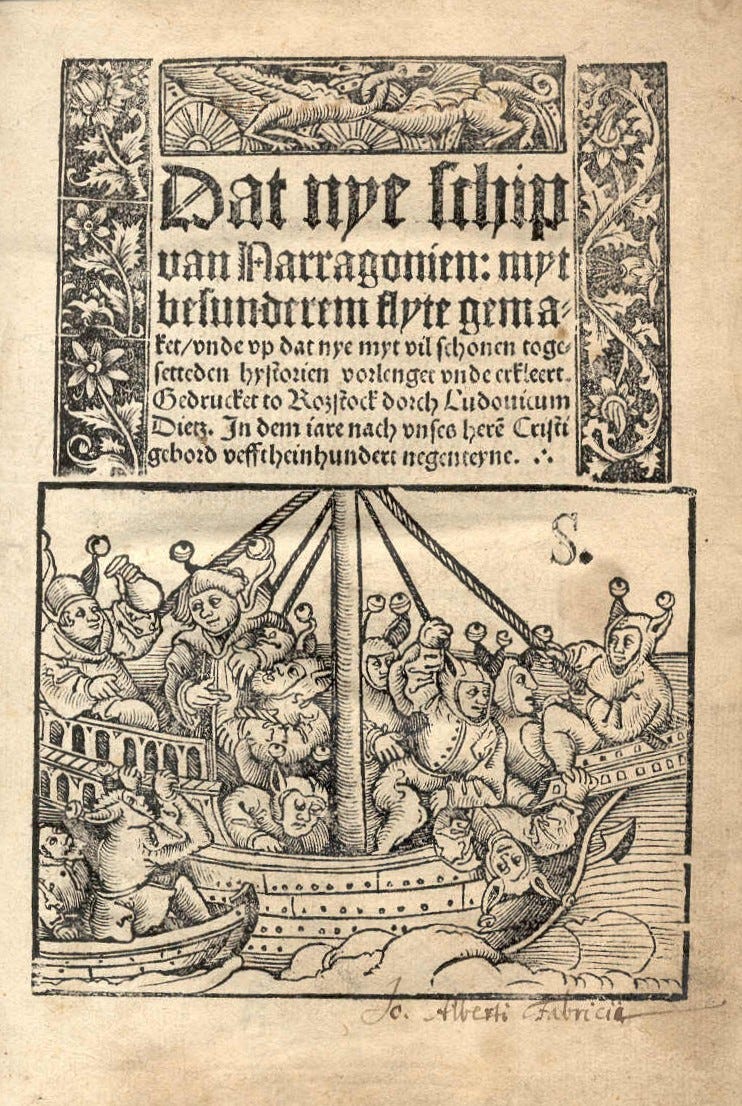
The 1519 title page of Sebastian Brant‘s 1494 satirical book Ship of Fools
I began life as a medievalist and often find myself instinctively going back to old texts when contemplating today’s problems. I have been forced to think much in recent days about the incompetence of our current governing class in respect of their understanding of defence and its value. More especially, their failure to understand how to use the military instruments of defence to uphold our national interest. The Ship of Fools, which first appeared in Plato’s Republic but was resurrected in Europe in the late 1400s as a metaphor for desperately poor leadership, is the perfect allegory for me. It tells a simple story that resonates with thoughtful people in every age who look on in wonderment at the idiots governing them. The story is of a ship with a crew who talk (and drink) a lot, but with their cloth ears make all the wrong decisions. The result is chaos. In the 1480s the ship in question was the Church of Rome, but the allegory is easily transportable to Britain in the early days of 2026. What on earth is going on in defence in the UK as we enter 2026? I can only surmise that in the UK at least, we are in a ship governed by fools.
I was going to start this piece by complaining that our government simply doesn’t understand Clausewitz, but I thought that this might be a little too obtuse for most politicians. But one of Clausewitz’s points about the use of military power is pertinent to our age. When Napoleon invaded Russia in 1812 he did so not because he had an existential hatred of Slavs, or of the Tsar. Indeed, Napoleon and Tsar Alexander I had a remarkably friendly relationship. He did it because the practice of friendly diplomacy between the two leaders had failed. Napoleon had attempted to persuade the Tsar to refuse the British trading rights in Russia’s ports. Alexander I had demurred, so Napoleon considered that the only thing left to him in his tool kit of levers to persuade Alexander to change his mind, was force. So, he marched on Moscow. We know the story and its outcome well, so I won’t rehearse it now. Using this as an example, Clausewitz was simply saying that in the hurly burly of diplomacy, war is one of the tools available to a national leader to persuade an opponent to change course. Hence, we get the oft misquoted Clausewitzian maxim that “War is the continuation of policy with other means”.
Clausewitz was correct, of course. Yet we in Britain have forgotten this, if politicians over the past three decades have really understood it. Since 1990 I am not sure we’ve had any politicians who’ve truly understood it, despite the fine words we get from successive Secretaries of State about the first priority of government being to protect its citizens, etc. This, without action to demonstrate any understanding of how to achieve the protection of our citizens, is merely St Paul’s clanging cymbal. Put frankly, we no longer have an Army, Navy or Air Force able seriously to achieve any form of influence on the European stage — let alone deter an enemy or fight a serious war — and the state of the Continuous At Sea Deterrent (CASD) is abysmal I’m told, though you wouldn’t know this from the hollow rhetoric regularly emanating from No 10. We are deluding ourselves if we think we can exercise real influence in Europe or anywhere else for that matter if we don’t have the practical means to do so.
The truth is that the cupboard is bare.
How have we got to where we are? The primary reason over the years has been the saving of money for politicians who have simply not valued investment in the hard practice of defence, unless it is in a shipyard in their constituency. The end of the Iron Curtain in 1989/90 meant, to many people in the corridors of power, that we no longer needed to bear the burden of spending 5% of GDP on defence.
But a second problem is only becoming clear to me. I hope I am wrong, but I can only conclude that we now have a government that actively hates the idea of defence, and while it will never admit it, is determined to remove it as one of its levers or instruments of power. I came across this in a meeting recently. Why do we need defence, the argument seemed to go, when we should be encouraging the international community to regulate itself by means of adherence to international laws and norms of behaviour? Should not our effort as a country be in building up these international systems and structures of law and governance (many based on the United Nations as an idea and a regulator) and rely on these to reduce the potentiality for war? Surely, building up arms simply makes war more likely, not less?
Update, 4 January: Welcome, Instapundit readers! Please do have a look around at some of my other posts you may find of interest. I send out a daily summary of posts here through my Substack – https://substack.com/@nicholasrusson that you can subscribe to if you’d like to be informed of new posts in the future.
January 1, 2026
QotD: Niccolao Manucci’s improbable early career
That sounded pretty good to the teenager, so he disembarked with Bellomont at Smyrna, made the hazardous journey across Ottoman Anatolia, thence through Armenia, and finally to the Safavid Empire, where Bellomont declared himself an ambassador from the rightful king of England and sought Persian intervention in the English Civil War (!). The Shah was horrified by the regicide and amazed that the other Christian kings of Europe had not come to the aid of Charles I,1 but gently rebuffed Bellomont’s request by pointing out that it would be quite impractical to send a large army from Persia to England.
Frustrated, Bellomont set off once again with his young charge, this time to the Mughal Empire. He got as far as the port of Surat, where he suddenly died, leaving the teenage Manucci completely on his own, thousands of miles from his home, in the middle of a civil war.
I sometimes wonder how often this sort of thing happens without us ever finding out. Perhaps history is full of ridiculous people having ridiculous adventures, it’s just that most of them aren’t Zhu Yuanzhang, or they don’t write detailed memoirs, or those memoirs are lost or destroyed before they reach us. Something like this very nearly happened to Manucci. The Venetian teenager left all alone in India not only survived, but flourished socially and financially, lived to a ripe old age, and wrote thousands of pages of penetrating social observations. His account is both the most entertaining and the most reliable history of the Mughal Empire at its zenith. Manucci had the singular talent of moving through every social circle, from the royal court to the lowest of peasants. He interacted with generals and statesmen, harem attendants, Islamic jurists, Hindu sages, elephant drivers,2 Portuguese mercenaries, eunuchs, merchants, prostitutes, common soldiers, missionaries, beggars, and even the emperor himself. There are very few cases where we get to see a premodern society laid out in all its intimate detail and from every angle, and we only missed losing this one by the barest of lucky strokes.
The story of Manucci’s manuscript is a twisting one. The original copies of his tale fell into the hands of a French Jesuit who mutilated the text — excising all the fun parts, all the personal observations, the adventure stories, and of course anything remotely critical of the Catholic Church. The resulting “edition” found its way back to India and into Manucci’s hands before his death. Naturally, he freaked out and tried to reproduce his original text from memory, sending it along with a letter of protest by sealed courier directly to the Venetian Senate. But this second copy is the work of a much older man, much farther from the stories and events described, and has numerous omissions and differences from the original.3 In 1763, the Jesuit order was expelled from France and their Paris library, including Manucci’s first manuscript, was seized by the state. It was then lost during the Revolution and believed destroyed, before turning up in damaged and partial form at an auction-house in Berlin a century later.
Countless European intellectuals have tried their hand at stitching the mishmash of fragments we have back into a cohesive whole, including a “J. Bernoulli” (yes, one of those Bernoullis, but I can’t figure out which brother it was). But everybody agrees the most successful of these efforts was that by William Irvine, a British colonial administrator and fellow of both the Royal Asiatic Society and the Asiatic Society of Bengal, who also helpfully translated the whole thing into English. Irvine’s edition has been republished many times, most recently by the wonderful people at Forgotten Books, which is how it found its way into my hands.4
Irvine is not the sort of editor who confines his remarks to a preface and some footnotes. Instead, he directly injects his own commentary inline, into the body of the text. These asides range from bracketed remarks like “[here I have deleted a coarse and obscene description]” all the way up to essays dozens of pages long containing his reflections and opinions on the text. And this is layered on top of the various modifications and emendations made by French Jesuits and Venetian scribes. All of this gives the book a meta-textual, almost postmodern feeling. It’s a bit like House of Leaves. Sometimes you’re reading Manucci, and sometimes you’re reading three nested layers of people commenting on people commenting on people commenting on Manucci. And the effect is heightened when you suddenly realize that Manucci, like the protagonist of a Gene Wolfe story, is not telling you all that he knows.
John Psmith, “REVIEW: Storia do Mogor, by Niccolao Manucci”, Mr. and Mrs. Psmith’s Bookshelf, 2025-09-08.
- Bellomont’s only real success in his mission was to completely poison the well for all future European travelers in Persia. Manucci reports that the next Englishman to visit the court of the Shah was thrown into a dungeon for disloyalty to his liege lord (a story independently corroborated by the French adventurer Jean-Baptiste Tavernier). “[The shah’s] object was to give a lesson to his own nobles as to the manner in which they should serve their king and the fidelity they ought to display, when the occasion arose, in defence of their monarch.”
- The book contains extensive discussion of how all elephants and horses that the Mughal princes might want to ride are pre-ridden by an attendant, to “loosen its stomach” and eliminate any flatulence.
- This is actually a huge simplification — there are four distinct Venetian codices, all with major differences from each other.
- I started with the Forgotten Books paperback, but halfway through the first volume I was hooked, and seeing that I had a thousand pages left to go, picked up a handsome leatherbound set from a used book seller for a song. I would normally never dream of buying a second copy of a book I already own just because it feels nicer in my hands, but you, dear subscribers, have spoiled me.
Comments Off on QotD: Niccolao Manucci’s improbable early career


