
World War Two
Published 3 Aug 2024The Japanese reaction to the Allied ultimatum for unconditional surrender is … mokusatsu. This can be translated several ways, but all involve not giving a response. Meanwhile, materials for atomic bombs to be dropped on Japan are delivered to Tinian, though the ship making the delivery is sunk by a Japanese submarine days afterward. The active war continues in Burma and China, and the Potsdam Conference ends in Germany with the map of Poland very much re-drawn.
00:00 Intro
00:56 Mokusatsu
05:47 Delivering Atomic Material
07:22 Sinking The Indianapolis
09:26 Bombing Japan
12:22 The War In Burma And China
14:07 Potsdam Confernece Ends
17:02 Conclusion
(more…)
August 4, 2024
Mokusatsu! – WW2 – Week 310 – August 3, 1945
Comments Off on Mokusatsu! – WW2 – Week 310 – August 3, 1945
July 21, 2024
“Since 2012, NATO has experienced a revival and a return to relevance that would make any washed up 80’s movie star turn green with envy”
Big Serge considers where NATO came from, where it is now, and where it might be going:
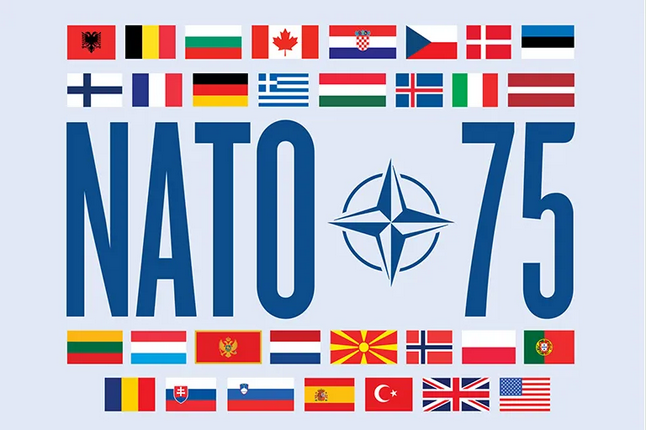
NATO, in its original conception, was designed to resolve a very particular security dilemma in Western Europe. In the immediate wake of World War Two, Western Europe — specifically Britain and France — had to consider how it might be possible to mount a defense against the colossal Soviet forces that were now conveniently forward deployed in Central Germany. The 1948 “Western Union Defense Organization” (WUDO), which included the aforementioned Anglo-French allies along with the Netherlands and Belgium, was created with an eye to this problem. With the rapid demobilization of American armies in Europe, however, it was obvious that this threadbare European alliance had dismal prospects in the unthinkable event of war with the Soviet Union. Field Marshal Bernard Montgomery, the supreme commander of WUDO forces, was asked what the Soviets would it would take for the Red Army to attack and push through all the way to the Atlantic, and famously replied: “Shoes”.
NATO, therefore, was an attempt to resolve the total strategic overmatch on the European continent through two expedients. The first of these, obviously was America’s membership, which brought both formal American security commitments as well as permanent American military deployments in Europe. The second strategic boost provided by NATO concerned Germany. Even after being ravaged by war and dismembered by the allied occupation, Western Germany remained the most populous and potentially powerful state in Western Europe. From the beginning, it was clear (particularly to the Americans and the British) that any sustainable strategy for deterring or fighting the Red Army would have to make use of German manpower — but this implied, axiomatically, that West Germany would have to be economically rehabilitated and rearmed. The prospect of *intentionally* rearming Germany was immensely upsetting to the French, for obvious reasons given the events of 1940-44. [NR: And 1914-18, and especially, 1870-71.]
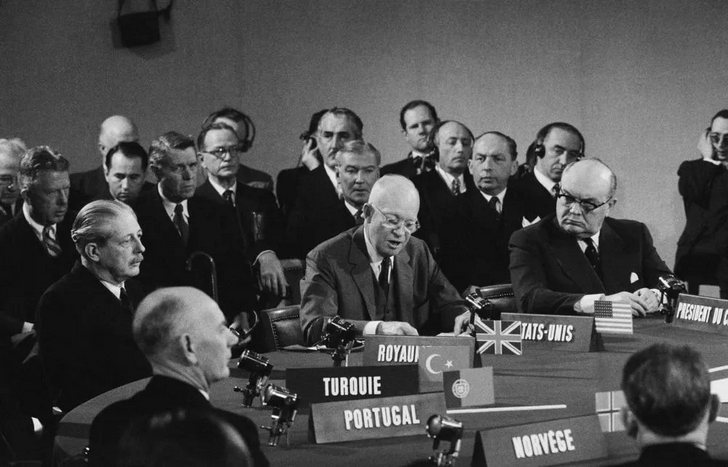
The first NATO summit conference
NATO thus solved two major obstacles to a sustainable and viable defense of Western Europe, in that it formally and permanently tied the United States into the European defense architecture, and it provided a mechanism to rearm West Germany without allowing for the possibility of a truly autonomous and revanchist German foreign policy.
In many ways, NATO can be seen as a total reversal of the Versailles system which had doomed Europe after the First World War by guaranteeing the Second. The interwar period saw the Anglo-French alliance pitted against an adversarial Germany without American assistance; NATO ensured American commitment to European defense and rehabilitated Germany into a valuable partner — providing the command architecture to rearm Germany and mobilize German resources without allowing Germany to conduct an independent foreign policy.
Thus, the popular formulation, coined by the first General Secretary of NATO, Lord Hastings Ismay, that NATO existed to “keep the Americans in, the Russians out, and the Germans down”. This statement, however, has frequently been misinterpreted. The idea of “keeping the Americans in” was not a plot by Washington to dominate the continent, but a contrivance by the Europeans to keep America engaged in their defense. As for “keeping the Germans down”, this is pithily stated but not entirely accurate — the entire point of adding West Germany to NATO was to allow it to rebuild and rearm in the interests of collective western defense. For the United States, NATO made sense as a way to mobilize European resources and calcify the “front” in Europe, in the context of a broader geopolitical struggle with the USSR.
This is what NATO was for. It was a mechanism for formalizing an American security commitment in Europe and mobilizing German resources to deter the USSR, and it worked — the frontline of the Cold War in Europe remained static up until the collapse of the Soviet Union due to the naïve and self-destructive political visions of one Mikhail Gorbachev.
But what is NATO for now? What purpose does it serve in the context of a broader American grand strategy? More to the point, does such a grand strategy exist, and is it coherent? These are questions worth asking.
Comments Off on “Since 2012, NATO has experienced a revival and a return to relevance that would make any washed up 80’s movie star turn green with envy”
July 6, 2024
Canada, NATO’s most egregious freeloader
In The Line, Eugene Lang and Vincent Rigby explain why our NATO allies are less and less willing to listen to Canadian virtue-signalling and posturing when we continue to refuse to live up to our commitments on the Canadian Armed Forces and contributing our full share toward NATO operations:
Next week’s NATO Summit in Washington marks the 75th anniversary of the trans-Atlantic Alliance. Yet despite being one of the original 12 founding members, Canada’s credibility within the alliance will be at an all-time low.
There is no question Canada has a proud history with NATO. Canadian statesmen — including Lester B. Pearson, Louis St. Laurent, Hume Wrong and Escott Reid — were architects of the alliance in the late 1940s, and helped author Article Two of the North Atlantic Treaty calling for political and economic collaboration among member-states, the so-called “Canadian Article”.
Over the decades, the Canadian military has made significant contributions to NATO missions in western Europe, the Balkans and Afghanistan. But that was then and this is now, and two years ago, Michel Miraillet, France’s ambassador to Canada, put things bluntly: “You are riding a first-class carriage with a third-class ticket. If you want to remain in the first-class seat, you need to train and expand (the military) and to go somewhere.”
Sentiments like these have been fuelled by Canada’s stubborn refusal to meet NATO’s defence spending target of two per cent of gross domestic product (GDP) — a commitment Ottawa has signed onto twice in the past ten years but is far from achieving. Last year, NATO Secretary General Jens Stoltenberg expressed frustration over this recalcitrance: “Canada has not conveyed a precise date but I expect (it) to deliver on the pledge to invest two per cent of GDP on defence, because this is a promise we all made”.
Stoltenberg’s comments evidently had little impact in Ottawa. While Canada’s recent Defence Policy Update (DPU) placed greater emphasis on the Arctic (NATO’s northern flank) and promised new defence investments, its pledge to increase defence spending to 1.76 per cent of GDP by 2030 fell well short of the NATO target. Canada, currently spending 1.37 per cent of its GDP on defence, remains among only a handful of NATO members which have failed to reach the two per cent threshold and have no plan to do so.
The Defence Policy Update’s silence on this issue did not go unnoticed among allies. Criticism of Canada’s NATO posture reached new heights last month when 23 U.S. senators wrote to Prime Minister Justin Trudeau, stating “we are concerned and profoundly disappointed that Canada’s most recent projection indicated that it will not reach its two percent commitment this decade”. Canadians can be forgiven for failing to recall the last time nearly a quarter of the U.S. Senate wrote to the Canadian government on anything.
It’s well known that Justin Trudeau has no time for military issues, but it’s surprising that he hasn’t done a few things that wouldn’t increase the actual spending on the CAF, but would be “bookkeeping” changes that would shift some existing government spending into the military category, like militarizing the Canadian Coast Guard. (That is, moving the CCG from the Fisheries and Oceans portfolio into the National Defence portfolio, not actually putting armaments on CCG vessels. Something similar could be done with the RCMP, switching it from Public Safety to National Defence with no other funding or operational changes.) That Trudeau hasn’t chosen to make even these symbolic changes shows that he actively opposes fulfilling the commitment his government has made twice in the last ten years for reasons of his own.
Comments Off on Canada, NATO’s most egregious freeloader
July 3, 2024
The Korean War Week 002 – The Fall of Seoul – July 2, 1950
The Korean War by Indy Neidell
Published 2 Jul 2024The North Korean forces are advancing all over, and this week they take Seoul, the South’s capital city, after just a few days of the war. There is another tragedy for the South when the Han River Bridge is blown while thousands of people are crossing it, resulting in hundreds of civilian deaths. The world responds to the invasion — condemning it everywhere, and the Americans decide to send in ground forces to help the South.
(more…)
Comments Off on The Korean War Week 002 – The Fall of Seoul – July 2, 1950
June 28, 2024
Japan Decides on Peace – Are They Too Late? – War Against Humanity 137
World War Two
Published 27 Jun 2024The US bombers continue destroying Japanese cities with a rain of firebombs. As the country burns, the Japanese leadership and Emperor Hirohito finally realise they must seek peace.
(more…)
Comments Off on Japan Decides on Peace – Are They Too Late? – War Against Humanity 137
June 23, 2024
Okinawa Ends – WW2 – Week 304 – June 22, 1945
World War Two
Published 22 Jun 2024Mitsuru Ushijima’s forces are defeated and the Battle of Okinawa is officially over. However, since most of the Japanese fought to the death, victory comes at a bloody cost – over 50,000 US casualties and over 100,000 Japanese and also possibly that many Okinawan deaths. The fight on North Borneo continues, there’s a raid on Wake Island, and the Japanese powers that be meet to actually discuss making some sort of peace with the Allies.
00:00 Intro
01:25 Truman And The Interim Committee
05:00 Battle Of Okinawa
08:06 The End Of Okinawa
13:22 Raid On Wake Island
14:23 Battle Of North Borneo
15:33 Hirohito Wants Peace
16:54 Conclusion
(more…)
Comments Off on Okinawa Ends – WW2 – Week 304 – June 22, 1945
June 12, 2024
“Treason never prospers” … except in Canadian politics, apparently
Justin Trudeau and his unindicted co-conspirators in Canada’s federal parliament don’t think the names of Members of Parliament who have been acting as enablers or actual agents of foreign powers — that is, possible traitors — should be made public. The National Security and Intelligence Committee of Parliamentarians (NSICOP) Even the least cynical may be forgiven for thinking that this isn’t what a mature country would do in similar circumstances:
The cover of the NSICOP special report on foreign interference (PDF here)
… MPs have an obligation to protect the institution that is the House of Commons. Every MP is required as a condition of taking their seats, to swear the following oath: “I, [name], do swear that I will be faithful and bear true allegiance to His Majesty King Charles the Third, King of Canada, his heirs and successors. So help me God.”
The violation of that oath, or the suspected violation of that oath, is absolutely arguably contempt against the House of Commons. We don’t have a ton of precedent for that, because MPs who have been alleged to have collaborated, even unwittingly, with a foreign power in the past usually have the good sense to resign. But MPs should absolutely be allowed to pass judgment on the actions of their colleagues, with the express intent of expelling from the House any members who have transgressed against their oath to King and Country. This isn’t just their duty, it is a duty that they are uniquely positioned and obligated to perform. Until we know exactly which parliamentarians we’re talking about, a spectre hangs over all 400-plus of them. That very much compromises the public’s opinion of Parliament and has a demonstrable impact on their ability to do their jobs as parliamentarians.
Once upon a time, children, ministers of the Crown would offer their resignations for mistakes made by members of the civil service in the ministry for which he or she held responsibility, never mind mistakes of their own. In modern times, of course, it’s rare to find a minister resigning voluntarily until the RCMP is literally knocking on the door, and sometimes not even then.
Second, we are a large and multicultural country. MPs are expected to represent members of any diaspora community which may exist in their constituency. If you’re a Tibetan or Uyghur activist, how can you be represented by an MP who’s demonstrated a willingness to collaborate with the government of the People’s Republic of China? If you’re an Iranian democracy and reform activist, how can you be represented by an MP who has close ties to Iran’s diplomatic and intelligence operation?
The answer, of course, is that you can’t be. The government has a greater responsibility to the democratic rights of those Canadians than it does to protecting the identity of any single unscrupulous or otherwise compromised parliamentarian. With every day that passes, Ottawa looks more like it has an interest in partisan butt-covering than it does in maintaining the long-term faith that democracy requires for our institutions to survive.
A good Member of Parliament recognizes the responsibility to the constituents — whether they voted for that particular MP or not — and would keep that responsibility as faithfully as possible. On that reckoning, we have fewer good MPs than we should have … and if the intelligence turns out to be fully supported upon full investigation, there should be a lot of open seats to run by-elections for (even if no formal charges of treason are ever laid).
Finally, I accept that intelligence is not evidence. I also accept, as noted in the Globe by Philippe Lagassé and Stephanie Carvin, that we must be cautious to not compromise intelligence sources and methods, or compromise ongoing investigations. Parliamentarians should not replace the criminal justice system or undercut our defence, but they what they are capable of doing, and indeed are required to do because no one else can do it for them, is broadly defining what the acceptable behaviour for parliamentarians should be. If an MP or a senator has engaged with a foreign power’s diplomatic or security services and they do not believe they have crossed the line for what we deem to be acceptable behaviour, they will be more than welcome to go on Power and Politics, or take to social media, or show up at what I’m sure will be many committee hearings, and make their case.
It is not a hardship to ask them do so. They are not being hard done by. The question here is not whether what they’ve done is criminal. It wasn’t criminal when Bev Oda billed the taxpayers for her juice. It wasn’t criminal when Bill Morneau forgot to leave a cabinet meeting where a decision was made that was a perceived conflict of interest. But both of those parliamentarians were forced to accept that their behaviour had failed the people they were sworn to represent. They resigned.
And the idea that orange juice crosses the line, but aiding a foreign intelligence service — even “semi-wittingly” — does not, will fail to pass the smell test with a very large number of Canadians. And that is entirely correct. The public is well ahead of the politicians on understanding this.
Public trust in politicians has been ebbing for quite some time and was fading even before the pandemic exposed so many of them as would-be dictators, poltroons, and idiots. There is no deep reservoir of respect for politicians that can be drawn on at this point. Swift action is the only thing that Parliament can do and by “swift”, I don’t mean setting up a Royal Commission with a multi-year remit to bury the issue until after the next federal election.
Comments Off on “Treason never prospers” … except in Canadian politics, apparently
May 13, 2024
“Our NATO allies are despairing. Our American friends are frustrated … all the officers are extraordinarily polite in public. But in private, the conversations are quite brutal.”
Former Liberal MP and retired Lt.-General Andrew Leslie has few illusions about the current Liberal government’s approach to military issues:
Lt.-Gen. (ret’d) Andrew Leslie is keen to talk about the embarrassing state of Canadian military preparedness.
“The current prime minister of Canada is not serious about defence. Full stop. A large number of his cabinet members are not serious about defence. Full stop,” the former Liberal MP tells me.
“Our NATO allies are despairing. Our American friends are frustrated. But because NATO and Norad (North American Aerospace Defense Command) are both essentially voluntary organizations, in which other people cannot give Canada orders,” the retired general explains, “all the officers are extraordinarily polite in public. But in private, the conversations are quite brutal.”
I have asked Andrew to explain our federal government’s foot-dragging on military spending — despite significant changes in risk — and what we should expect from our allies. This 35-year veteran of the Canadian Armed Forces (CAF), former chief of staff of the Canadian Army and one-time MP for Orleans is well-placed to decipher what’s really going on and in our frank conversation, he doesn’t pull any punches. I connect with Andrew at his home in Ottawa; behind him, the walls of his spacious office are sheathed in medals and awards, testimony to decades of decorated service in places like Afghanistan and Yugoslavia.
We get to the heart of the matter. Canada’s allies are pressuring Prime Minister Justin Trudeau’s government to get serious about military spending. And with a relentless war in Ukraine, a thawing and more vulnerable Arctic, unrest in the Middle East, and a general shakeup of the world order, Canadians are waking up to the risks of not being ready to defend ourselves.
Recently, U.S. Air Force Gen. Gregory Guillot (who took over leadership of Norad in February) has put his Canadian counterparts on notice that he aims to have U.S. troops training, not just in Alaska, but in the Canadian Arctic. A good idea, or the thin edge of a wedge?
It’s totally sensible, Andrew replies, because Canada has “no permanently stationed combat capability in the Arctic.” After a pause to let that sink in, he repeats that fact and elaborates. “Just in terms of numbers, there’s about 22,000 professional men and women in the U.S. Armed Forces based in the Arctic, mainly in Alaska. There’s about 30,000 to 35,000 Russian armed forces based in the Arctic. Canada has about 300 people.”
Comments Off on “Our NATO allies are despairing. Our American friends are frustrated … all the officers are extraordinarily polite in public. But in private, the conversations are quite brutal.”
May 12, 2024
Javier Milei and the “Malvinas” question
Colby Cosh on how Argentine President Javier Milei handled British press inquiries about the Malvinas Falkland Islands like a boss:

I’ve been relishing a classic feast of British press overreaction to a BBC interview with the colourful libertarian president of Argentina, Javier Milei. The Beeb’s Ione Wells visited Milei at the Casa Rosada last week in Buenos Aires for a chat, and nothing like this could possibly happen without some talk about those damned islands — the Falklands or las Malvinas, depending on which country you believe to be their rightful sovereign.
Argentine leaders have to be careful how they talk about the Falklands (and about their uninhabited dependencies elsewhere in the South Atlantic). For decades regimes of left and right in Argentina have opportunistically kept the disputed islands at the forefront of the public imagination, fostering a spirit of delayed revenge. Sometimes this leads to daft verbal outbursts about “colonialism”, alongside game-playing with supplies and access to the islands. The constitution of Argentina contains language asserting “legitimate and imprescriptible sovereignty” over the rocks.
So anything a current Argentine leader says about the Falklands is bound to be scrutinized closely at home and in the United Kingdom. Milei is naturally impulsive, and has the particular problem that he is a political admirer of the late Margaret Thatcher. Wells tried to provoke him by bringing up the 1982 sinking of the General Belgrano and the consequent deaths of 323 Argentine sailors, which is still a slightly controversial episode of the Falklands War among the most self-hating shades of U.K. political opinion.
Milei, who had arranged a little display of Thatcher memorabilia in the room where the interview was held, sliced right through Wells’s Gordian knot. “Criticizing someone because of their nationality or race is very intellectually precarious,” he told Wells. “I have heard lots of speeches by Margaret Thatcher. She was brilliant. So what’s the problem?”
Even if you venerate Thatcher, who ordered the sinking of the Belgrano in very cold blood, you can perceive that this is a non sequitur. Milei is under no obligation to like a fellow neoliberal who was a military enemy of his own country. But one does remember that British statesmen have often been willing to express admiration for Napoleon I, Washington, Rommel and other killers of large numbers of British soldiers.
Comments Off on Javier Milei and the “Malvinas” question
QotD: What is Putin’s endgame in Ukraine?
It would appear that Putin, Xi, etc. are coming to see themselves as the leaders in a worldwide battle against Juggalisme. That might be wishcasting — they are practical men, after all, and let me state, unequivocally and for the record, that I do NOT want to be ruled by Russians or Chinese. They are not my people. Nonetheless, it does seem clear they understand that the source of their problems is beyond what we think of as geopolitics. The United States is “agreement incapable”, as I guess the term d’art is, because it’s not rational, or even predictably irrational.
That was the monarchist critique of representative government that hit closest to home: Foreign policy needs to be supple and responsive; it must be able to move quickly, to make big changes in narrow time windows. In a real crisis, you simply don’t have time to convene a Parliament to debate stuff. N.b. they were saying this in the late 18th century; it’s so much worse now. And another observation from that time that is even truer today: A “democratic” foreign policy can never be consistent. You simply can’t plan long-term when there’s partial to complete governmental overhaul every few years.
That the US managed to muddle through for as long as it did was really a combo of two things: time (as a function of distance), and a near-peer enemy.
Neither of those is integral to the system, and neither is within the system’s control. Until recently, American foreign policy had to take into account the fact that on-the-spot commanders would have to make decisions on their own recognizance. Even with phone communications, the man on the ground in the Fulda Gap has to make decisions basically without reference to Washington. It forced him to be conservative — in other words, it discouraged adventurism.
Same way with the near-peer enemy. The looming shadow of the USSR forced regular reality checks inside the US Apparat. A whole bunch of possibilities were foreclosed by default — our response to any given situation had to take the likely Soviet reaction into account. As with the time/distance factor, this forced a kind of conservatism that looked a lot like sclerosis, but at least it deterred adventurism.
The history of the later 20th century is the history of those constraints being removed. In Vietnam, for instance, you had LBJ and McNamara sitting in a room in the White House, personally directing airstrikes in near-realtime. If “news” reports are to be believed, Obama was on the horn with that SEAL team going after Bin Laden right up to the very moment the chopper landed. Knowing these things are technically possible is catnip to politicians — they already assume they’re omnicompetent, and so now they want to be “advising” the commanding general even as the battle rages.
And if that’s catnip, then the end of the USSR was catnip on steroids. Why not play fuck-fuck games everywhere, all at once? Who’s gonna stop us? China? They chose to pass. They saw what happened to the USSR when it locked itself into an ideological death spiral vis-a-vis the Struggle Against International Capitalism. American policymakers only understand Soviet-style bluff and bluster. The Chinese play the long game.
NOT because they’re Inscrutable Orientals, I hasten to add — they’re as Juggalicious as our Clowns, in their way — but because the generation currently in power came up hard, and so they are adults. That’s all. They are not spoiled, petulant children. The next generation of Chinese leadership — assuming we live to see it — will really be something, and not in a good way.
So, what does Putin want? I dunno, and I’m not sure he knows, because I’m not sure he can know. I’m sure his broadest goal is “to stop getting fucked with by idiots”, but how can that be achieved? There shall be no durable peace in this world until there is Regime Change in [Washington, DC], and I’m not talking about the other half of the Uniparty winning an election or two. I think Putin knows that, but what can he really do about it? I think he’s going to be forced to annex a fair amount of territory and set up a totally demilitarized buffer zone. It won’t work, but it’s the least-worst practical option.
Severian, “Friday Mailbag”, Founding Questions, 2024-02-09.
Comments Off on QotD: What is Putin’s endgame in Ukraine?
May 9, 2024
How the First World War Created the Middle East Conflicts
The Great War
Published Dec 8, 2023The modern Middle East is a region troubled by war, terrorism, weak and failed states, and civil unrest. But how did it get this way? The map of today’s Middle East was mostly drawn after the First World War, and the war that planted many of the seeds of conflict that still plague Israel, Palestine, Iraq, Syria and even Iran today.
(more…)
Comments Off on How the First World War Created the Middle East Conflicts
QotD: Rome’s socii system
In any case, the Romans win the war and impose a peace treaty the terms of which, according to Dionysius of Halicarnassus went thusly:1
Let there be peace between the Romans and all the Latin cities as long as the heavens and the earth shall remain where they are. Let them neither make war upon another themselves nor bring in foreign enemies nor grant a safe passage to those who shall make war upon either. Let them assist one another, when warred upon, with all their forces, and let each have an equal share of the spoils and booty taken in their common wars. Let suits relating to private contracts be determined within ten days, and in the nation where the contract was made. And let it not be permitted to add anything to, or take anything away from these treaties except by the consent both of the Romans and of all the Latins.
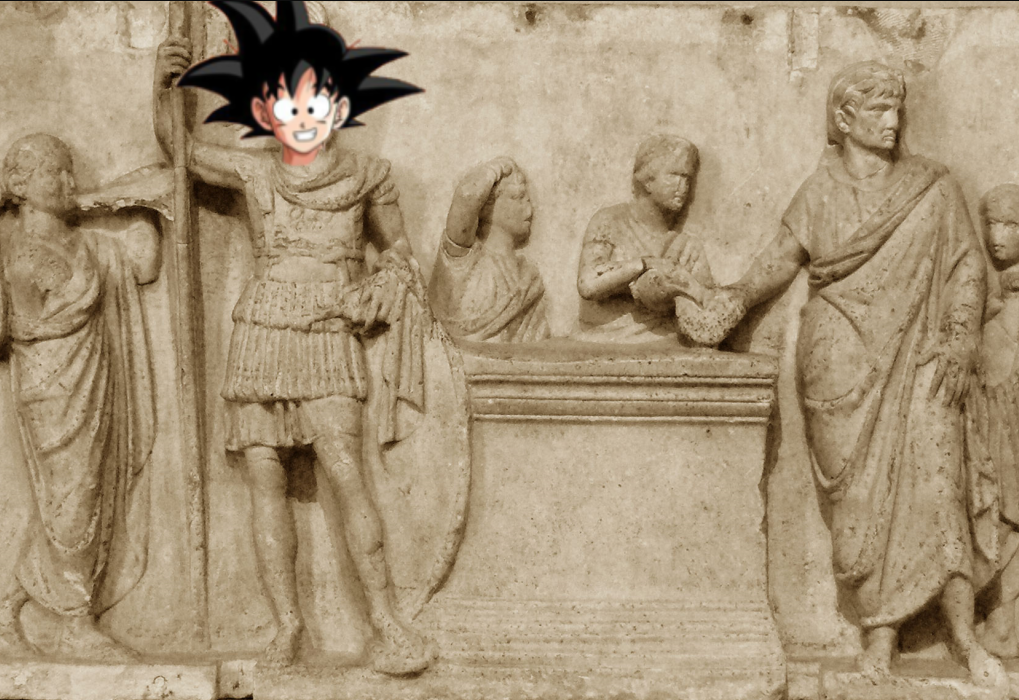
This is the origin point for Rome’s use of what I’ve termed the “Goku Model of Imperialism” – “I beat you, therefore we are friends”. Having soundly defeated – at least according to our sources – the Latins, Rome doesn’t annex or destroy them, nor does it impose tribute, but rather imposes a treaty of alliance on them (in practice I suspect we might want to understand that Rome’s position was not so dominant as our sources suggest, thus the relatively good terms the Latins get). The treaty sounds like an equal relationship, until one remembers that it is the entire Latin league – thirty or more communities – as one party and then just Rome as the other party.
I will still make no apologies for this visual gag.
Image modified by Bret Devereaux.Rome proceeds, in the century or so that follows, to use this alliance to defeat their other neighbors, both the nearest major Etruscan centers as well as the Aequi and Sabines who lived in the hills to the north-east of Rome and the Volsci who lived to the south of Latium. Roman relations with the Latins seem to fray in the early 300s, presumably because the greatest threat to their communities was increasingly not the Volsci, but Rome’s emerging regional power. That leads to a collapse of the Foedus Cassianum in 341 and another war between Rome and the Latin League. Once again our sources are much later, so we might be somewhat skeptical of the details they provide, but the upshot is that at the end the Romans won by 338.
Rome’s expansion into most areas follows a familiar pattern: Rome enters a region by concluding an alliance with some weaker power in a region and then rushing to the aid of that weaker power; in some cases this was a long-term relationship that had been around for some time (like the long Roman friendship with Etruscan Caere) and in some cases it was a very new and opportunistic friendship (as with Capua’s appeal to the Romans for aid in 343). In either case, Rome formed a treaty with the community it was “protecting” and then moved against its local enemies. Once defeated, it imposed treaties on them, too. Rome might also seize land in these wars from the defeated party (before it imposed that treaty); if these were far away, Rome might settle a colony on that land rather than annexing it into Rome’s core territory (the ager Romanus). These new communities – the Latin colonies – were created with treaty obligations towards Rome.
Note the change: what was initially an alliance between one party (Rome) and another party (the Latin League) has instead become an alliance system, a series of bilateral treaties between Rome and a slew of smaller communities. And they were smaller, because Rome often took land in these wars, so that by the third century, the Roman citizen body represented roughly 40% of the total, making Rome much bigger than any other allied community. This shift was probably gradual, rather than there being some dramatic policy change at any point. Rome accrued its Italian empire the same way it would accrue its Mediterranean one: as a result of a series of localized, ad hoc decisions which collectively added up to the result without ever being intended to constitute a single, unified policy.
The Romans called all of these allied communities and their people socii, “allies” – a bit of a euphemism, because these were no longer equal alliances. We’ll get into the terms in a moment, but it seems clear that by 338 that these “allies” are promising to have no foreign policy save for their alliance with Rome and to contribute soldiers to Roman armies. So Rome is in the driver’s seat determining where the alliance will go; Rome does not have to consult the allies when it goes to war and indeed does not do so. The socii cannot take Rome to war (but Rome will go to war immediately if a community of socii is attacked). This is no longer an equal arrangement, but it is useful for the Romans to pretend it is.
The next major series of Roman conflicts are with the Samnites. Rome is, according to Livy, at least, drawn into fighting the Samnites because of its suddenly concluded alliance with Capua and the Campanians (though Rome had been more loosely allied to the Samnites shortly before). In practice, the first two Samnite Wars (343-341, 326-304) were fought to determine control over Campania and the Bay of Naples, with Rome fighting to expand its influence there (by making those communities allies or protecting those who were) while the Samnites pushed back.
The Third Samnite War (298-290) becomes something rather different: a containment war. Rome’s growing power – through its “alliance” system – was clearly on a course to dominate the peninsula, so a large coalition of opponents, essentially every meaningful Italian power not already in Rome’s alliance system, banded together in a coalition to try to stop it (except for the Greeks). What started as another war between Rome and the Samnites soon pulled in the remaining independent Etruscan powers and then even a Gallic tribe (the Senones) in an effort to contain Rome. The Romans manage to pull out a victory (though it was a close run thing) and in the process managed to pull yet more communities into the growing alliance system. It seems – the sources here are confused – that the decade that followed, the Romans lock down much of Etruria as well.
The Greek cities in southern Italy now at last recognize their peril and call in Pyrrhus of Epirus to try to beat back Rome, leading to the Pyrrhic War (280-275). Pyrrhus wins some initial battles but – famously – at such cost that he is unable to win the war. Pyrrhus withdraws in 275 and Rome is then able over the next few years to mop up the Greek cities in Southern Italy, with the ringleader, Tarentum, falling to Rome in 272. Rome imposed treaties on them, too, pulling them into the alliance system. Thus, by 264 Rome’s alliance system covered essentially the whole of Italy South of the Po River. It had emerged as an ad hoc system and admittedly our sources don’t give us a good sense of how and when the terms of the alliance change; in many cases it seems our sources, writing much later, may not know. They have the foedus Cassianum, with its rather more equal terms, and knowledge of the system as it seems to have existed in the late third century and the dates and wars by which this or that community was voluntarily or forcibly integrated, but not the details of by what terms and so on.
Bret Devereaux, “Collections: How to Roman Republic 101, Addenda: The Socii“, A Collection of Unmitigated Pedantry, 2023-10-20.
1. trans. Earnest Clay (1940).
Comments Off on QotD: Rome’s socii system
April 25, 2024
Were the Waffen-SS Really Germany’s Elite Fighters? – WW2 – OOTF 35
World War Two
Published 24 Apr 2024It’s time for another thrilling installment of Out of the Foxholes, but what sort of questions does Indy answer today? Well, it’s good stuff — about Allied security and logistics at the major conferences, about what the British navy was doing once the Atlantic and Mediterranean were secure, and about the skills (or lack thereof) of the soldiers of the Waffen SS. How can you live without knowing about such things? I suppose it’s possible, but it would be a sad life indeed, so check it out!
(more…)
Comments Off on Were the Waffen-SS Really Germany’s Elite Fighters? – WW2 – OOTF 35
March 31, 2024
August, 1945 – The Soviets enter the war in China
Big Serge outlines the Soviet invasion of Manchuria in August 1945 and its devastating impact on the Japanese Kwantung Army, finally shattering any remaining illusions that the Soviets would broker a peace between Japan and the western allies:
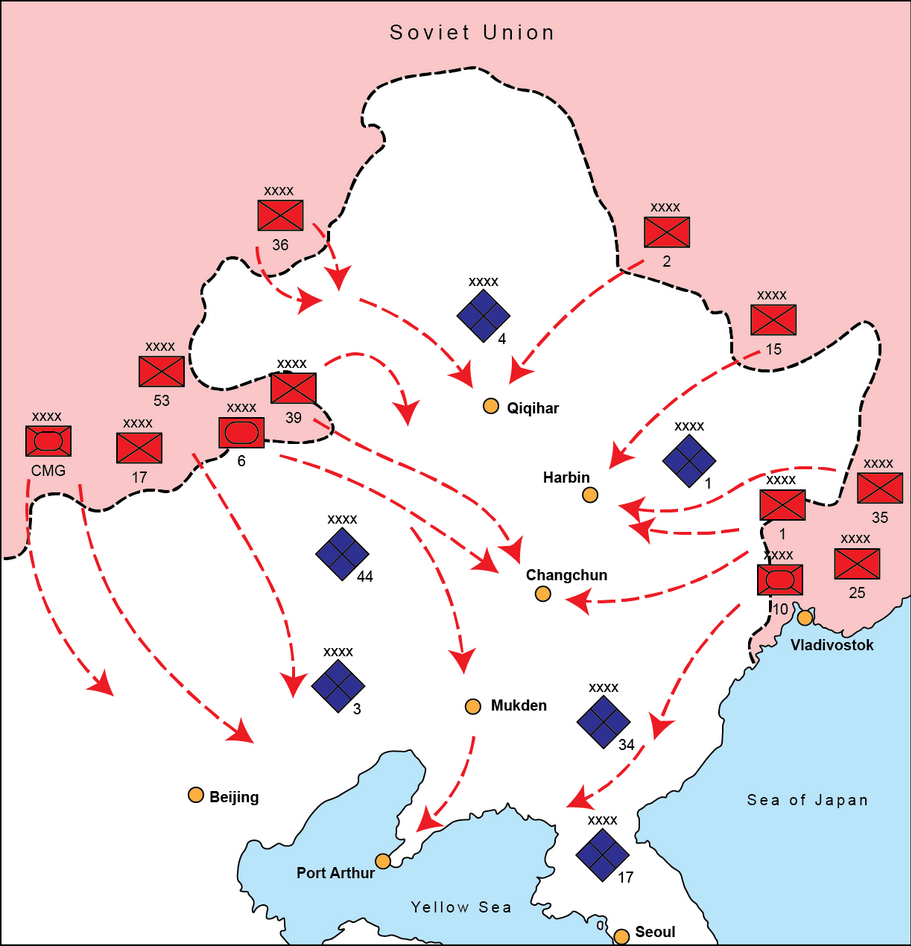
August Storm: The Soviet Invasion of Manchuria (August 9-20, 1945)
The Second World War had a strange sort of symmetry to it, in that it ended much the way it began: namely, with a well-drilled, technically advanced and operationally ambitious army slicing apart an overmatched foe. The beginning of the war, of course, was Germany’s rapid annihilation of Poland, which rewrote the book on mechanized operations. The end of the war — or at least, the last major land campaign of the war — was the Soviet Union’s equally totalizing and rapid conquest of Manchuria in August 1945.
Manchuria was one of the many forgotten fronts of the war, despite being among the oldest. The Japanese had been kicking around in Manchuria since 1931, consolidating a pseudo-colony and puppet state ostensibly called Manchukuo, which served as a launching pad for more than a decade of Japanese incursions and operations in China. For a brief period, the Asian land front had been a major pivot of world affairs, with the Japanese and the Red Army fighting a series of skirmishes along the Siberian-Manchurian border, and Japan’s enormously violent 1937 invasion of China serving as the harbinger of global war. But events had pulled attention and resources in other directions, and in particular the events of 1941, with the outbreak of the cataclysmic Nazi-Soviet War and the Great Pacific War. After a few years as a major geopolitical pivot, Manchuria was relegated to the background and became a lonely, forgotten front of the Japanese Empire.
Until 1945, that is. Among the many topics discussed at the Yalta Conference in the February of that year was the Soviet Union’s long-delayed entry into the war against Japan, opening an overland front against Japan’s mainland colonies. Although it seems relatively obvious that Japanese defeat was inevitable, given the relentless American advance through the Pacific and the onset of regular strategic bombing of the Japanese home islands, there were concrete reasons why Soviet entry into the war was necessary to hasten Japanese surrender.
More specifically, the Japanese continued to harbor hopes late into the war that the Soviet Union would choose to act as a mediator between Japan and the United States, negotiating a conditional end to war that fell short of total Japanese surrender. Soviet entry into the war against Japan would dash these hopes, and overrunning Japanese colonies in Asia would emphasize to Tokyo that they had nothing left to fight for. Against this backdrop, the Soviet Union spent the summer of 1945 preparing for one final operation, to smash the Japanese in Manchuria.
The Soviet maneuver scheme was tightly choreographed and well conceived — representing in many ways a sort of encore, perfected demonstration of the operational art that had been developed and practiced at such a high cost in Europe. Taking advantage of the fact that Manchuria already represented a sort of salient — bulging as it did into the Soviet Union’s borders — the plan of attack called for a series of rapid, motorized thrusts towards a series of rail and transportation hubs in the Japanese rear (from north to south, these were Qiqihar, Harbin, Changchun, and Mukden).
By rapidly bypassing the main Japanese field armies and converging on transit hubs in the rear, the Red Army would effectively isolate all the Japanese armies both from each other and from their lines of communication to the rear, effectively slicing Manchuria into a host of separated pockets.
There were, of course, a host of reasons why the Japanese had no hope of resisting this onslaught. In material terms, the overmatch was laughable. The Soviet force was lavishly equipped and bursting with manpower and equipment — three fronts totaling more than 1.5 million men, 5,000 armored vehicles, and tens of thousands of artillery pieces and rocket launchers.
The Japanese (including Manchurian proxy forces) had a paper strength of perhaps 900,000 men, but the vast majority of this force was unfit for combat. Virtually all of the Japanese army’s veteran units and equipment had been steadily transferred to the Pacific in a cannibalizing trickle — a vain attempt to slow the American onslaught. Accordingly, by 1945 the Japanese Kwantung Army had been reduced to a lightly armed and poorly trained conscript force that was suitable only for police actions and counterinsurgency against Chinese partisans.
Really, there was nothing for the Japanese to do. The Kwantung Army had far less of a fighting chance in 1945 than the Wehrmacht had in the spring of that year, and everyone knows how that turned out. Unsurprisingly, then, the Soviets broke through everywhere at will when they began the assault on August 9. Soviet armored forces found it trivially easy to overrun Japanese positions (armed primarily with archaic, low caliber antitank weaponry that could not penetrate Soviet armor even at point blank range), and by the end of the first day the Soviet pincers were driving far into the rear.
It is easy, in hindsight, to write off the Manchuria campaign as something of a farce: a highly experienced, richly equipped Red Army overrunning and abusing an overmatched and threadbare Japanese force. In many ways, this is an accurate assessment. However, what the offensive demonstrated was the Red Army’s extreme proficiency at organizing enormous operations and moving at high speeds. By August 20 (after only 11 days), the Red Army had reached the Korean border and captured all their objectives in the Japanese rear, in effect completely overrunning a theater that was even larger than France. Many of the Soviet spearheads had driven more than three hundred miles in a little over a week.
To be sure, the combat aspects of the operation were farcical, given the totalizing level of Soviet overmatch. Red Army losses were something like 10,000 men — a trivial number for an operation of this scale. What was genuinely impressive — and terrifying to alert observers — was the Red Army’s clear demonstration of its capacity to organize operations that were colossal in scale, both in the size of the forces and the distances covered.
More to the point, the Japanese had no prospect of stopping this colossal steel tidal wave, but who did? All the great armies of the world had been bankrupted and shattered by the great filter of the World Wars — the French, the Germans, the British, the Japanese, all gone, all dying. Only the US Army had any prospect of resisting this great red tidal wave, and that force was on the verge of a rapid demobilization following the surrender of Japan. The enormous scale and operational proclivities of the Red Army thus presented the world with an entirely new sort of geostrategic threat.
Comments Off on August, 1945 – The Soviets enter the war in China
February 22, 2024
Trump’s crude, threatening rhetoric on NATO’s cheapskates is … right
In The Line, Philippe Lagassé joins all right-thinking people in condemning Donald Trump’s campaign trail threats to not defend NATO’s freeloaders if they’re attacked by, say, Vladimir Putin:
Donald Trump recently called into question the core principle of the North Atlantic Treaty Organization (NATO). As a collective defence alliance, NATO operates on the principle that an attack against one member is an attack against all. This principle is enshrined in Article 5 of the NATO agreement. Although Article 5 allows each ally to respond as they see fit, there’s an understanding that allies have an obligation to defend each other.
On the campaign trail, Trump declared that, if elected, he wouldn’t defend NATO allies if they’ve failed to spend two per cent of their Gross Domestic Product (GDP) on defence. Not only that, he said he’d encourage Russia to attack these allies. As Trump reiterated last week: “Look, if they’re not going to pay, we’re not going to protect, okay?” These comments raised serious concerns within NATO. Jens Stoltenberg, NATO Secretary General, warned that Trump is striking at the underlying logic of the alliance. The Secretary General stressed that “We should not undermine the credibility of NATO’s deterrent”.
What should we make of Trump’s threat? On the one hand, it’s clearly dangerous and evidence that a second Trump presidency could shake the foundations of the alliance. We should rightly be worried and condemn such reckless rhetoric. On the other hand, this is classic Trump. His approach to international politics can best be understood as “mobster diplomacy”. He demands personal loyalty as the head of the “family” of Western liberal democracies. When it comes to trade deals, he echoes Don Corleone in making offers that partners can’t refuse. As for alliances, he sees them as a protection racket. When it comes to NATO allies, his message is simple and direct: “Nice country you have there … pity if something happened to it”.
Allied leaders and academics can protest that the two per cent target isn’t a payment to the United States; it’s a measure of the relative amount allies spend on their own militaries, not a fee they owe Washington. While true, it’s a waste of breath to point this out. Trump and his supporters don’t care. They see most allies as freeloaders who’ve been coasting on American military power for too long. And you know what? They’re not wrong. That’s the rub for those who are understandably horrified by Trump’s comments. Far too many NATO allies, including Canada, have been content let the United States carry a heavy defence spending burden, while we focus on other priorities. That’s what Trump is ultimately getting at here, however menacingly.
Canada has been particularly unwilling to pay its agreed share, actually cutting the military budget late last year while many of our European allies were increasing theirs. We’re habitually the ones who slip out of the room when it’s our turn to buy a round, militarily speaking.
Comments Off on Trump’s crude, threatening rhetoric on NATO’s cheapskates is … right


