
What lessons can we draw from this book [The Grand Strategy of the Roman Empire by Edward Luttwak] for today? There are many, but I will leave you with one. Reading about the Roman client state system gave me an uncomfortably familiar feeling. Can we think of another empire that outsources governance to vestigial polities that pretend to be sovereign, and even get called “allies”, but are actually clients? An easy example is the Warsaw Pact. A more controversial one is present-day America and her dependencies. Consider Canada: a normie friend of mine once remarked that Canada pretended to be an independent country, but that if the present world were translated into a computer strategy game its territory would be shaded in the same color as America’s. Indeed, Canada’s sovereignty is exceedingly virtual — it exists only so long as it isn’t tested, just like the sovereignty of a Roman client. Canada is self-governing and self-administering, it passes its own laws and collects its own taxes. But if its foreign policy objectives ever diverged one micrometer from America’s, then Canada would cease to exist. Seriously, imagine Canada offering to host a Chinese or Russian military base and what would immediately occur. There is a real sense in which America rules the land that we know as “Canada”, but has outsourced governance to local elites in a highly federalized structure.
Luttwak has a charmingly racist bit about how some client states have the IQ and sophistication to understand the true nature of the arrangement, while others are too dumb or barbaric to remember who’s boss without having their faces regularly rubbed in it. In the Roman case, the former camp contained the various Hellenistic kingdoms in Asia Minor and the Levant, who didn’t need legionaries standing around and supervising them, because they could imagine the existence of those legionaries and what they would do to them if provoked. The latter camp included many of the Germanic tribes, who tended to forget their place if the legions weren’t garrisoned within eyeshot, and even then would rise up in fruitless rebellion every couple of generations. We can make this marginally less racist by positing something more like a spectrum of how tolerable the client arrangement was, and consequently a spectrum of how coercive it had to be. The Greeks were relatively compatible culturally with the Romans, and the warrior spirit of their ancestors had been sufficiently sanded down that they didn’t mind being told what to do. The Germans were more foreign, and also retained the barbarian’s yearning for freedom, so a careful eye had to be kept on them.
A true cynic might think that there was something similar going on with America’s imperial dependencies … sorry, with America’s “allies”. There are no American garrisons in Canada, because the Canadians are culturally-compatible, and also because they’ve been thoroughly cowed and do not dream of an independent national destiny. But look overseas, for instance at some of our Middle Eastern “allies”, and you will see a situation more analogous to the Germanic tribes. What a coincidence that these same “allies” host a much heavier American military presence! Even here, however, the situation isn’t strictly coercive, and insofar as it is, the coercion is mostly outsourced to local elites. Those elites, in turn, can mostly be handled with carrots: the imperial power subsidizes their trade and security arrangements, not to mention keeps them in charge of their respective countries! The Romans commonly rewarded loyal clients with citizenship and a cushy sinecure for a job well done. It would be rude of us to do otherwise.
Maybe this was already obvious to everyone else, but reading the “rules-based international order”1 as a concealed hegemon/client system feels a bit like having the skeleton key to understanding current events. Like why do European countries so often act in ways contrary to their own economic or geopolitical self-interest, but consonant with America’s interest? How do the political and business elites of these countries maintain such an impressive unified front in the face of popular discontent? Why do the rulers of all these very different countries have seemingly identical tastes, worldviews, and mannerisms? What is the meaning of “populism,” and why do people treat it like it’s a single, consistent thing, despite the fact that “populist” parties in different countries often seek diametrically opposite policies?
Just pretend, imagine with me, that these European “allies” are client kingdoms. They are permitted a certain amount of latitude, but when the chips are down they do not have an independent foreign policy. Their ruling classes are client rulers that administer certain territories, and there is tacit agreement with the imperial overlord on what they may and may not do. Over time, the client rulers identify less and less with their countrymen, more and more with their counterparts in other client states, and most of all with the distant metropole, whose social approval they desperately desire. The “populists” are simply the anti-imperial party, in whatever country. The thing the “populists” have in common is a desire to be free of the suffocating imperial embrace,2 but they all have a thousand different stupid ideas about what to do with that freedom. This includes the “populists” in the United States itself, by the way. The American Empire is called that because it started here, but it has long-since burst free of the host in which it incubated, and the rot of our own political institutions can be understood as our transformation into the biggest client kingdom of them all.
None of what I’ve said above is meant to be a value judgment. I think many people resist the notion that America is an empire because empires are “bad” and we’re obviously the good guys. But others, including myself not too long ago, resist it because we have an overly-simplistic notion of what an empire looks like, especially what it looks like from the inside. Empires exist on a spectrum — America’s subjects certainly have more ability to act independently than Rome’s did. But many empires also go to some lengths to conceal their true nature. Around the time of the birth of Christ, the official story in many of the lands ruled by Rome was that Rome was merely their largest trading partner and a staunch military ally. Some of them might even have believed it.
John Psmith, “REVIEW: The Grand Strategy of the Roman Empire by Edward Luttwak”, Mr. and Mrs. Psmith’s Bookshelf, 2023-11-13.
1. The rules-based international order which has no rules, isn’t based, and opposes order.
2. They may also have in common the payments made to their bank accounts by the empire’s enemies.
February 17, 2024
QotD: Lessons for today from the decline of the Western Roman Empire
February 15, 2024
Tune in for the propaganda, stay tuned for the epic meltdowns
Are you old enough to remember when “news” in the legacy media was, well, calmly presented factoids (accurate or not) that might get you upset, but the emotional content wasn’t heightened or enacted by the hairspray heads in front of the camera? Those days are long enough past that they might never have happened, as Chris Bray illustrates:
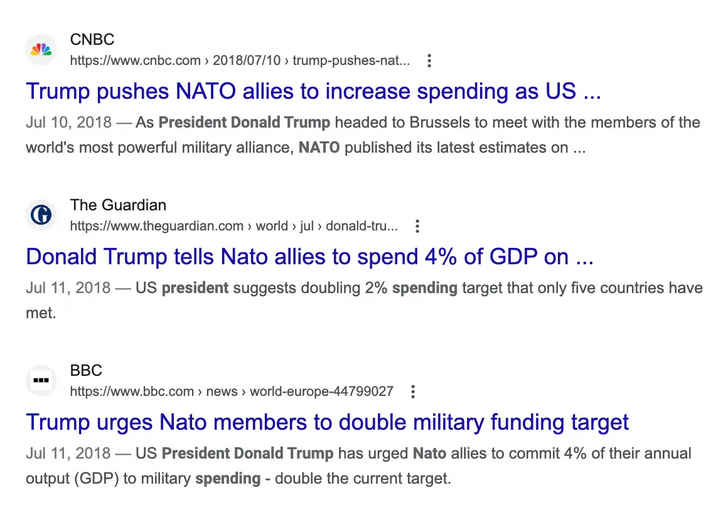
Spend a minute of your life looking at a chart that shows how much countries spend on their militaries as a percentage of GDP. The US spends about 3.5%, while Germany spends about 1.4%. For years, hawks have argued that the US should spend 4% of GDP on defense, in a well-known debate about reasonable funding for security. NATO members commit to a target of 2% or better, and many don’t make that goal. Donald Trump says he told the leaders of NATO countries that they should make or beat their military spending targets to ensure their own security, and as a negotiating ploy he poked at them and said that he wouldn’t bother to defend people who wouldn’t bother to pay for their own defense.
You can agree with his argument or disagree with his argument, and make whatever argument you want about the carefulness or recklessness of Trump’s rhetorical style, but none of this is obscure.
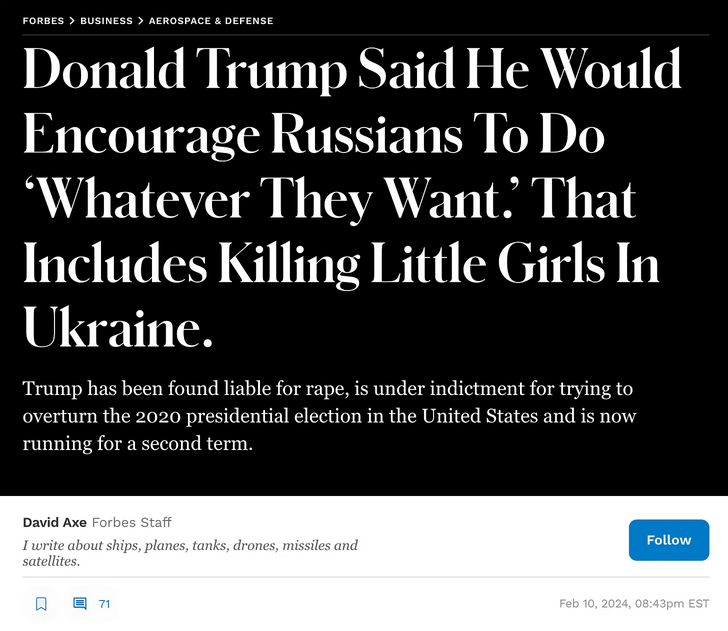
And so now we’re living through an ORANGE MAN LITERALLY HITLER CRISIS, as Orange Satan Drumpf tells the Putin Devil to absolutely MURDER all the Europeans and the world teeters in agony at the very brink of a harvest of slaughter. Here, let Forbes just give you the news, straight and factual and to-the-point:
THE MEAN MAN SAYING FOR THE PUTIN DEVIL TO MURDER ALL THE LITTLE BABIES professional journalists calmly explain, absolutely biting through the rubber nipple on their pacifiers. Sackcloth, ashes, endlessly refillable SSRI prescription: journalist starter kit.
In the car a few minutes ago, I turned on the radio mid-interview to hear a hysterical NPR anchor begging a European pundit to agree that Trump is a vicious monster, and the European — I missed his name — sighed and said that look, this is a debate that we’ve been having for a while, it’s a pretty normal discussion. BUT DON’T YOU THINK HE’S AN ORANGE MURDER DEVIL!?!?!? Then they played an important clip of Slow Joe Biden slurring and fake-shouting about Trump’s un-American cruelty, sounding almost as angry as he was when he talked about how many actual chips they put in the potato chip bags. This is why I listen to NPR in short bursts, like a gun run from an A-10. Brrrrrrrrrt, and off.
But what’s inescapable about this extremely dull moment, yet again, is that an allegedly elite layer of political, academic, and media figures are taking something routine and willfully inflating it into a five-alarm global crisis. It … must be a day ending in -y? Nothing is ever bad, or disagreeable, or arguable; every event is The Absolute Worst. Every development must be discussed in hyperemotional terms; every objectionable act is devastating, terrifying, destructive, ruinous, treasonous, unforgivable. No one disagrees with us; rather, they are ENEMIES OF EVERYTHING WE STAND FOR!!!!!
The Big Picture – NATO: Partners in Peace (1954)
Army University Press
Published Nov 13, 2023NATO: Partners in Peace follows the creation and impact of the North Atlantic Treaty Organization (NATO). Created in April 1949 with twelve founding members, this organization’s goal was to protect the inherent rights of individual states through collective defense. In this episode from The Big Picture series, General Dwight D. Eisenhower offers a speech before he deploys to Europe to become the first Supreme Allied Commander Europe (SACEUR). This is followed with footage of the buildup and training of European forces. Once Eisenhower leaves NATO to campaign for the presidency, General Matthew Ridgway replaces him as NATO commander. One significant problem NATO forces faced was the fact that each nation had its own weapon systems and ammunition, an issue the U.S. wanted to address with the standardization of the 7.62mm cartridge. Perhaps as a deterrent to the Soviet Union, NATO: Partners in Peace depicts new weapons that could be used against a large enemy force such as remote-controlled missiles, napalm bombs, and the massive atomic cannon.
February 12, 2024
Yalta, When Stalin Split the World – a WW2 Special
World War Two
Published 11 February 2024Indy and Sparty take you through the negotiations at Yalta as The Big Three thrash out the shape of the postwar world. As the splits between East and West continue to deepen, who will come out on top?
(more…)
February 10, 2024
The War Goals to End WW2 in 1945 – a WW2 Special
World War Two
Published Feb 8, 2024While World War Two looks like it is about to end, the belligerent powers have vastly different goals for that end. Differences that may or may not prolong the war, will decide the survival of tens of millions of people, and the future fate of all of Humanity.
(more…)
December 26, 2023
Canada is the unchallenged international champion of “the gesture” and “the pose”, yet always manages to be out of the room when the bill needs to be paid
Sorry for being several days behind on this, but Matt Gurney‘s message — while necessary and timely — does not have a “best-before” or an expiration date … it’s going to be valid for a long time to come:
On the military front, Canada has actually made some meaningful investments since that speech was given. We have announced deals for new transport and refuelling jets — desperately needed and long overdue. We more recently announced a plan to sole-source new surveillance planes, also desperately needed and long overdue. We also, just this week, announced that we are procuring a fleet of large, long-ranged, armed surveillance drones, to patrol our remote air and sea frontiers, after a mere two decades of mulling it over.
There ends the good news, sadly. Most of these procurements are many years away from actually being in service. And even once we have them, as good as the new equipment will be, the biggest problem for the military today is a crippling personnel shortage. The military is, to be blunt, a disaster. Far worse than is generally known. I’ve been covering military and defence issues for longer than I care to recount, and I can tell you plainly, dear readers, that the level of panicked leaking and lamenting coming out of the Canadian Armed Forces is like nothing I’ve ever seen. We don’t have the troops, sailors and aircrew to meet even basic obligations. Training is falling behind. The in-service availability of equipment and vehicles is appallingly low for lack of trained maintenance personnel and money for spare parts and equipment.
This is showing up in operations. The army doesn’t have enough soldiers to meet every commitment. The air force has cut back on operations. The navy’s top admiral is openly speaking, in public, about the crisis in his service.
We at The Line often talk about the Canadian love of talking about inputs instead of outputs. It’s easier to say “Our government has committed X dollars over Y years to address Societal Problem Z” than it is to actually ever have to answer to the public about why Z is somehow still getting worse. New procurements are an input; the desired output is a functional Canadian Armed Forces, capable of meeting its domestic obligations, honouring our treaty commitments and also being prepared for any unexpected contingencies. We do not have that military today. We cannot have that military for years. It would take massive investments and sustained effort to begin fixing this problem.
That is not happening. Hell, we took Anita Anand, one of Justin Trudeau’s better ministers and replaced her with Blair, a man for whom that has never been said. I can tell you with certainty that our allies, and our senior military commanders, had no trouble reading between those lines. Trudeau thought the military mattered, briefly, but then he stopped thinking that, and here we are.
So, 14 months out from Freeland’s speech and on the military front, well … Merry Christmas, or something?
But wait! There’s more!
Freeland’s speech also talked about other ways Canada could support its allies, and democracies in general. Some of it was vague and aspirational — hard to measure or follow-up on. But she was specific about two things: providing our threatened allies and the democracies broadly with a stable, democratic and reliable source of critical strategic resources. Energy, for example. And minerals.
Fourteen months later, how are we doing on those fronts?
I’m not an expert in either area, but I know experts in both. Andrew Leach is an energy and environmental economist at the University of Alberta (I literally copied that bio right off his webpage there). He is also, simply put, one of the smartest guys on the energy file in this country. I called him this week and found him grading papers, which is probably why he was so willing to talk with me. I explained to him what I was doing with the Brookings speech, and asked him if there was anything he could point to over the last 14 months as signs that we’d gotten serious and were doing as Freeland had said we would and must.
Nope!
“By any metric, it’s worse today,” Leach said. Two months ago, he noted, the Supreme Court ruled against the Trudeau government’s energy policies. “Now, there are no clear processes to get approvals for anything,” he added, except, somewhat ironically, pipelines, whose approvals process wasn’t included in the court ruling. I asked him if this was something the Trudeau government had done to itself, or if it was a victim of happenstance, and he said that some of the legislation they were dealing with dated back to the Harper era — before their time — but that in general, the Trudeau government hadn’t handled this well. “They messed up. They assumed they had powers they didn’t have, and didn’t make the arguments for those powers. They didn’t think about the framing. They had to earn that. They didn’t.”
December 9, 2023
Venezuela’s renewed imperialism
Like many of us, Colby Cosh is trying to figure out what’s going on in Venezuela these days, as the government “won” a plebiscite to push its long-standing claim for a huge chunk of next-door neighbour Guyana’s territory:
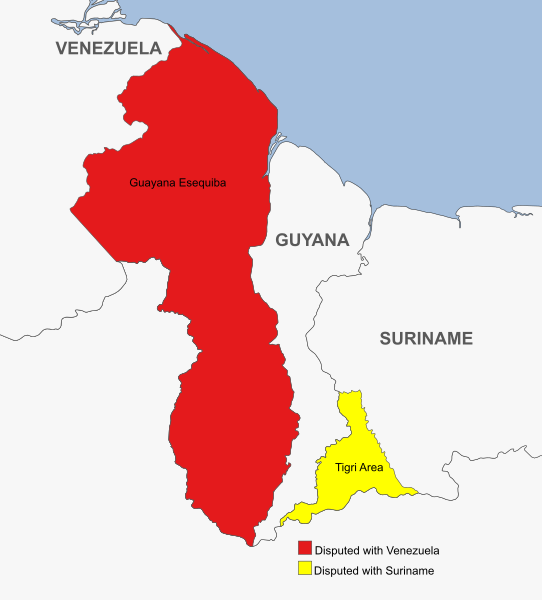
Map showing the two disputed land areas of Guyana. The red region is disputed with Venezuela (Guayana Esequiba) and the yellow region is disputed with Suriname (Tigri or New River Triangle)
Map by SurinameCentral via Wikimedia Commons.
I’ve been plunging into the weeds — as some of my readers perhaps are — trying to figure out why Venezuela is trying to take over three-quarters of the land area of neighbouring Guyana. I mean, yes, duh, the simple answer is “oil”. The relevant part of Guyana — the sparsely populated, heavily Indigenous Essequibo region west of the river of the same name — has been claimed by Venezuela with varying degrees of vigour and indignation since it became independent from Spain. In the last decade or so, it has come to light there is abundant oil beneath the continental shelf belonging to the Essequibo area.
It might, in fact, be enough oil to make Guyana the world’s largest crude producer in a manner of months. Such an event would almost certainly create an unbearable crisis for the radical-left Venezuelan government, which has fouled up its own oil industry, obliterated its currency and created the single largest refugee crisis in the recorded history of the Americas. And so, the North Korea of the Western Hemisphere is suddenly behaving in an awfully warlike — one might say imperialistic — manner towards a tiny neighbour. Which is, in turn, why the United States is rattling the sabre in Guyana’s defence.
The basic situation in the Essequibo region in the centuries after Columbus was that the territory de jure belonged to Spain but was often really in the hands of Dutch mariners and colonists. There was a long cycle of Dutch incursion and Spanish retaliation. Venezuela inherited and pursued the Spanish claims upon independence — originally as part of the Republic of Gran Colombia (1811) and then as a sovereign state unto itself (1830). Britain gained the Dutch territory in the Napoleonic Wars and incorporated Essequibo into the unified colony of British Guiana in 1831.
The two countries recognized that they had a big disagreement over where the Venezuela-British Guiana border might actually lie. But Venezuela wasn’t in a position to pick a fight with the British Empire, and British public opinion couldn’t be convinced to care very much about the problem. The two countries kicked the can down the road and mutually agreed not to colonize the area.
Fast-forward a bit: in the 1870s, gold was discovered in the disputed zone, waaay over toward the Venezuelan side, and in the 19th century, gold meant a gold rush. British and American privateers started turning up with shovels and pickaxes in the interior, sovereignty be damned. Venezuela eventually began to lobby the U.S. executive branch for redress, reminding American politicians of their precious Monroe Doctrine (which was technically incompatible with the existence of a “British Guiana”). Britain, coming under uncomfortable diplomatic pressure, agreed to submit the border question to neutral arbitration.
And here we come to the heart of the quarrel. The U.S. and Britain set up an arbitration panel of the classic 19th-century kind — the same kind of panel, in fact, that fixed up much of the U.S.-Canada border during the same period. This panel had two American Supreme Court justices representing Venezuelan interests; two equally high-ranking British judges; and a neutral fifth man borrowed from the Russian Empire — the Estonian international-law scholar Friedrich Martens (1845-1909). Throughout the 19th century, Russia had often been used in this way by western powers as an honest broker, and arbitration was seen as a universal means of peaceful dispute resolution — the great hope of the world’s future.
And yet, like what seems to be every border dispute in South America since the Spanish skedaddled, an agreement doesn’t seem to last more than the lifetime of one of the governments that negotiated it and some of them aren’t even that durable. Ed Nash has a video summarizing the economic and military state of affairs that helps explain why this dispute is potentially of global concern.
November 28, 2023
Pierre Trudeau and Canada’s choice to become an international featherweight in the 1970s
In The Line, Jen Gerson endures a foreign policy speech from Mélanie Joly that takes her on a weird journey through some of Canada’s earlier foreign policy headscratchers … usually leading back to Justin Trudeau’s late father:
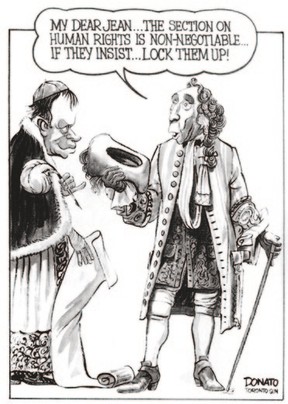
A Toronto Sun editorial cartoon by Andy Donato during Pierre Trudeau’s efforts to pass the Canadian Charter of Rights and Freedoms. You can certainly see where Justin Trudeau learned his approach to human rights.
If I saw a statue of P.E.T. on the roof of a foreign affairs building that looked like it were competing for a 10th place spot in the Eurovision tourney, I don’t know how I’d feel: embarrassed, touched, certainly too polite to say anything honest. I probably wouldn’t be so struck with awe by the sight that I’d be keen to shoehorn the anecdote into a major policy speech in front of the Economic Club.
And yet.
Joly’s speech was striking in that it could be divided into two distinct parts: The first half was a cogent and clear-eyed examination of the state of play of the world, one that acknowledged a fundamental shift in the assumptions that underpin the global order. Nothing one couldn’t glean from the Economist, but grounded nonetheless. The global order is shifting, the stakes have increased, and the world is going to be marked by growing unpredictability.
“Now more than ever, soft and hard power are important,” Joly noted, correctly, ignoring the fact that Canada increasingly has neither, and doesn’t seem to be doing much about that.
And this brings us to the second half of the speech, which was an attempt to spell out the way Canada will navigate this shift, by situating itself as both a Western ally and an honest broker: we are to defend our national interests and our values, while also engaging with entities and countries whose values and interests radically diverge from our own. “We cannot afford to close ourselves off from those with whom we do not agree,” Joly said. “I am a door opener, not a door closer.”
This was clearly intended to be analogous to the elder Trudeau’s historic policy of seeking cooperation with non-aligned countries — countries that declined to join either the Communist or the Western blocs throughout the Cold War.
[…]
If our closest allies treat us like ginger step-children as a result of our own obliviousness and uselessness, our platitude-spewing ruling class is going to seek closer relationships in darker places: in economic ties with China, and in finding international prestige via small and middling regional powers or blocs whose values and interests are, by necessity or choice, far more malleable than our own.
These cute turns of phrase are a matter of domestic salesmanship only. “Pragmatic diplomacy” is a thick lacquer on darker arts.
Which brings us back to Macedonia, again. Or North Macedonia, if you’re a stickler.
Before it declared independence in 1991, Macedonia was a republic within the Socialist Federal Republic of Yugoslavia. During much of Trudeau Sr.’s time, Yugoslavia was led by Josip Tito, a Communist revolutionary who broke with Stalin and spearheaded a movement of non-aligned countries, along with the leaders of India, Egypt, Ghana, and Indonesia. Tito was one of several despotic and authoritarian leaders with whom Trudeau Sr. sought to ingratiate himself to navigate the global order.
P.E.T.’s most ardent supporters maintain a benevolent amnesia about just how radical Trudeau Sr. was relative not only to modern standards, but to world leaders at the time.
During the 1968 election, Trudeau promised to undertake a sweeping review of Canada’s foreign affairs, including taking “a hard look” at NATO, and addressing China’s exclusion from the international community.
In 1969, America elected Richard Nixon a bombastic, controversial, and corrupt president who forced Canada examine the depth of its special relationship with its southern neighbour. At the time, this was termed “Nixon shock.” And it could only have furthered Trudeau Sr.’s skepticism of American hegemony.
It was in this environment of extraordinary uncertainty, and shifting global assumptions and alliances, that Trudeau Sr. called for a new approach to Canadian foreign policy. He wanted a Canada that saw itself as a Pacific power, more aligned to Asia (and China). Trudeau also wanted stronger relationships with Western Europe and Latin America, to serve as countervailing forces to American influence.
October 12, 2023
Canada, “a country with short arms and long pockets”
In the National Post, John Ivison recounts Canada’s continuing inability to live up to expectations internationally, especially militarily:
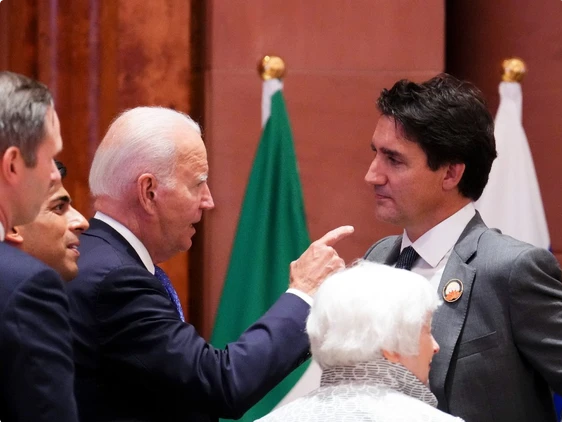
US President Joe Biden talks to Canadian Prime Minister Justin Trudeau, March 2023.
On the eve of Russia’s invasion of Ukraine, Mark Norman, the former vice-chief of defence, made a prediction that sounded overblown at the time.
“I really think the Americans are going to start ignoring us because they don’t think we are credible or reliable. They are not even putting pressure on us anymore,” he said in a January 2022 National Post interview, based on his conversations with contacts in Washington.
It turns out he was absolutely right.
Since then, leaked Pentagon documents have confirmed that sense, indicating that the U.S. believes “widespread defence shortfalls have hindered Canada’s capabilities, while straining partner relationships and alliance contributions”.
Canada left little room for doubt about its diminished capabilities when it took a pass on NATO’s largest-ever air exercise last summer, because its jets and pilots were involved in “modernization activities”. That absence left the impression that this country might not be able to show up in certain circumstances.
Even before the unfolding tragedy in the Middle East, America was letting it be known that it felt overstretched and needed regional allies to share the burden.
When President Joe Biden visited Ottawa in March, he asked Justin Trudeau to lead a mission to Haiti, which had descended into mob rule. Since the Liberals were elected on a peacekeeping ticket in 2015, it was a logical request. However, Trudeau demurred, presumably on the grounds that Canada’s security forces were stretched too thin by operations in Latvia and fighting wildfires at home. The upshot is that Kenya is set to send 1,000 security officers to the beleaguered island nation.
The recent news that Canada now plans to trim its defence budget by nearly $1 billion — a total of $17 billion over 20 years, if savings are recurring — has reinforced the image of a country with short arms and long pockets.
Against that background, it was no surprise that on Monday Biden hosted a call with the leaders of France, Germany, Italy and the U.K. to discuss the crisis in the Middle East — and didn’t include Canada.
A statement by the G7 minus Canada and Japan (which has a negligible Jewish population) was issued saying that the five countries would ensure Israel is able to defend itself.
Over at The Line, Matt Gurney discovered that the federal government was actively trying to hide the fact that Canadians in Israel were not able to access Canadian embassy services by pretending that the word “operational” meant “open and functional”:
On Sunday evening (hours after we published our dispatch), I received a reply from GAC. This was the reply:
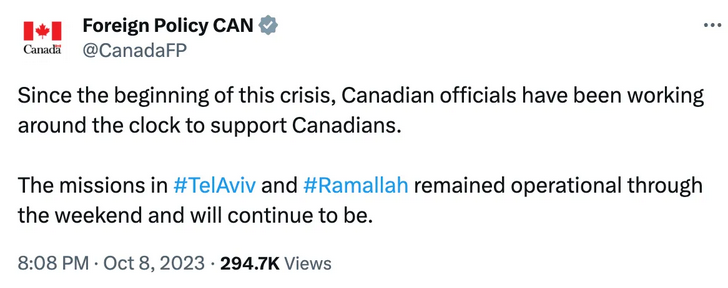
Since the beginning of this crisis, Canadian officials have been working around the clock to support Canadians. The missions in Tel Aviv and Ramallah remained operational through the weekend and will continue to be. Our missions will open on Monday October 9th, unless security conditions do not allow for it. We will be assessing the security situation daily, in coordination with our allies.
Okay! That seemed fair. But not having been born yesterday, and being in a profession where people try to spin me all the time, I noticed something immediately. The distinction GAC was drawing between “operational” and “open” stood out to me. I replied at once seeking clarification, and heard nothing back. Not even an acknowledgement.
This word choice mattered. The government publicly used the “operational” messaging. Members of the government repeated it. This was what they were telling the Canadian people: all is well, ignore those nasty media people and members of the opposition. Of course the embassies were “operational”!
See that tweet? The one pasted above? I checked out who was retweeting it. Lots of people did! And that included a bunch of Liberal MPs, a bunch of Canadian diplomats, members of the media, and what I’ll politely refer to as a group of “usual suspects” I recognize from online as being proxies for the Liberal government’s messaging (or at least really devoted True Believer Liberal partisans).
On Monday morning, having heard nothing back about what “operational” meant as opposed to “open”, I asked for a specific clarification in the terminology. What was “operational” vs. “open”? I also asked for specifics on what services were available locally from Canadian diplomatic missions in Israel over the weekend in real time, and how that would change when the embassy “opened” on Monday. I asked about the staffing level at the embassy on the weekend, and how that would compare to a normal workday, and also to a normal weekend.
Rather than answer a simple question, our government would much rather obfuscate and prevaricate as a matter of policy. That, by itself, tells you everything you need to know about both our political leaders and the civil service organizations they control.
October 11, 2023
In their attacks on southern Israel, Hamas is “making a dead zone, and they intend to make a dead zone”
Chris Bray explains the otherwise insane tactics employed by Hamas terrorists:
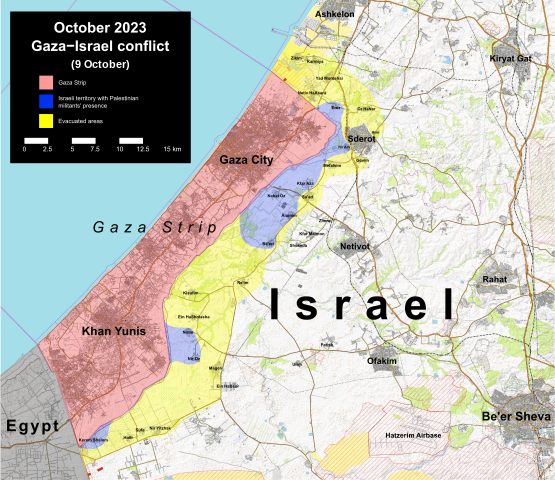
The border area between the Gaza Strip and the State of Israel, 9 October 2023.
Map by Ecrusized via Wikimedia Commons.
Hamas broke through a fortified border, had unchallenged freedom of movement inside Israel for a shockingly long time, and attacked … a dance music festival and some kibbutzim. Not airfields, not fuel depots, not power stations, not army motor pools to deny mobility to the enemy. They went after soft targets first, and focused especially on women and children. Eyewitness reports and footage of female hostages are telling us that Hamas engaged in sustained sexual violence, and took care to make it known. A subhed in Tablet: “Scenes of young women raped next to the dead bodies of their friends.”
And I think we know what this means.
But first, look at the proposed explanations offered in the news:
It seems that Hamas, also, is trying to force Israel into negotiations. In 2018, Hamas leader Yahya Sinwar sent a note in Hebrew to Israel’s prime minister, Benjamin Netanyahu, suggesting he take a “calculated risk” by agreeing a long-term truce. While Netanyahu agreed to some easing of pressure on Gaza, he was unwilling to accept Hamas’s long-term demands, including a large-scale prisoner swap, lifting the siege by opening the international border crossing, and establishing a port and airport in Gaza. After 16 years of siege and several catastrophic rounds of war, in which thousands of Gaza residents have been killed, Hamas may be hoping to break the deadlock.
That’s not it. Here’s another try:
Hamas could well be trying to torpedo the Saudi deal and even try undo the existing Abraham Accords. Indeed, a Hamas spokesperson said that the attack was “a message” to Arab countries, calling on them to cut on ties with Israel …
To be clear: Saying it makes strategic sense for Hamas to engage in atrocities is not to justify their killing civilians. There is a difference between explanation and justification: The reasoning behind Hamas’s attack may be explicable even as it is morally indefensible.
So the much-repeated claim is that Hamas in engaging in diplomatic maneuvering, sending messages to nation-states. They used mass rape at a dance festival to gain leverage in negotiations over a possible new port.
That’s absolutely not it, and I strongly suspect that the presence of widespread and carefully displayed attacks on 1.) families with children and 2.) the sexually traumatized bodies of women represent an extremely deliberate and calculated adoption, explicitly planned for months or years, of the familiar tools of ethnic cleansing.
Hamas is dirtying the memory of the Jewish spaces bordering on the Gaza Strip. They’re marking southern Israel in the memory of future families, and especially women of childbearing age, with the deliberately cultivated images of murdered children and the mass rape of young women, so that young women regard the place with dread and don’t return to have children there. They’re making a dead zone, and they intend to make a dead zone.
Mass rape by armies is not a mystery; it has been studied carefully.
Group X, as a group and deliberately, rapes women from Group Y in Neighborhood Z so women from Group Y never feel that they can safely return to Neighborhood Z, in a tribal memory passed down to later generations. Now the space belongs to Group X.
Hamas is making sites of trauma. To empty them, and to keep them empty.
Their military objective is to use the witnessed mass rape of women, the documented hunting and torture of families, and the videotaped murder of children in front of their parents to keep Jews out of southern Israel in the future. Their military target is site-specific Jewish fertility.
In the comments, Chris also points out the military insanity of how Hamas is implementing the propaganda aspects of their plan:
It’s insane for infantry to carry cellphones into combat, because cellphone locations can be tracked. But Hamas seems to be recording everything they do, and they’re stopping to upload new footage as they capture it. They’re taking the risk of carrying trackable devices in combat for the intended benefit of the display. I’d be very curious to hear if they’re all carrying standardized, organization-issued cellphones, and I’d be very curious to see a detailed analysis of where all of the footage is appearing first. This is a deliberate information operation.
Hamas has clearly calculated that the risk is worth the propaganda bonanza they are reaping from the atrocities being beamed almost in real time to the outside world.
October 5, 2023
The Great War: Its End and Effects, Lecture by Prof Margaret MacMillan
McDonald Centre
Published 25 Jan 201922 January 2019, “How far did the Versailles Treaty make Peace?”, Professor Margaret MacMillan, Warden of St Antony’s College, Oxford. The lecture was sponsored by Christ Church Cathedral and the McDonald Centre for Theology, Ethics, and Public Life, Oxford.
September 28, 2023
North Korea’s special train for “Dear Leader”
In The Critic, Peter Caddick-Adams discusses the North Korean leader’s special train, used to transport Kim Jong Un to destinations within North Korea and further afield to Russia, China, and other rail-accessible destinations:
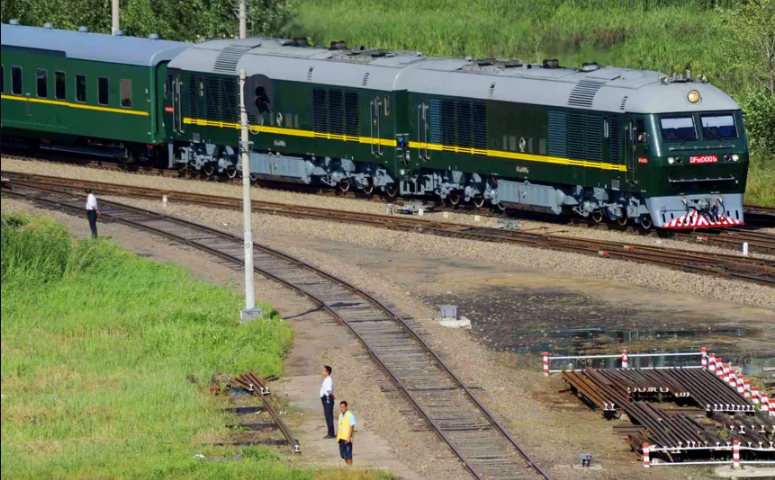
North Korean leader Kim Jong Un’s private train in China in 2010.
It was pulled by two heavy locomotives. Next an armoured anti-aircraft wagon. After the baggage car came the leader’s steel-plated Pullman, followed by a command coach containing a conference room and communications centre. Connected to them, the 22-man security detail travelled in their own rolling stock. Beyond was a dining car, two coaches for guests, and of all things a bathing wagon, then a second dining car. Bringing up the rear were two sleeping cars, a press wagon for the news hounds, another baggage car and finally another anti-aircraft wagon. The coachwork was of the finest materials, hardwoods and high-grade leather, armour-plated, and bristling with guns and radio antennae. Outside in all weathers, day and night, other protective guards swept along the tracks.
There was something charmingly old fashioned about the decision of Kim Jong Un, leader of North Korea, to travel by train to meet his fellow dictator, Vladimir Putin. Over here, even when buffered by a railcard, Network Rail can sometimes fail spectacularly as an ambassador for this effortless mode of transport. Yet, we forget how important journeying by train was and remains. Important figures frequently opt for the smooth clickety-clack over air or road for their expeditions. The method is discreet, away from prying eyes, yet connected to a nationwide network that avoids congestion. Passengers can wine and dine, sleep, relax, study, converse and think. Rail lines are easy to guard, whereas the boulevards are full of threatening traffic and potential ambush points. Franz Ferdinand, Reinhard Heydrich, Charles de Gaulle and John F. Kennedy found this out to their cost between 1914 and 1963. Fatally in three out of four cases.
Some leaders have a phobia about flying. Stalin was one, which was why the only summit meetings he attended, at Tehran, Yalta and Potsdam, were ones connected to Moscow by rail. Perhaps President Putin, a known fancier of custom-built rolling stock, will now fear a weird kind of Karma for having arranged the eternal flight of his former chef, Yevgeny Prigozhin. The president has several trains, each containing an identical office to those in his state dacha, the Kremlin and St Petersburg. All look the name, making it impossible for the viewer, and potential assassin, to know where he is. Maybe his long-distance travel plans will be dictated by iron roads from now on?
[…]
The North Korean’s father, Kim Jong Il, hated taking to the air, instead relying on his old green-and-yellow-liveried rolling stock to convey him around his hermit kingdom. Loaded with extravagant foods, fine wines and attended by glamorous staff, the elder Kim used it on the last state visit of a North Korean to Russia in 2002. “It was possible to order any dish of Russian, Chinese, Korean, Japanese or French cuisine,” remembered one journalist. “Live lobsters were taken to stations along the route, with cases of Bordeaux and Burgundy”. However, the size, opulence and weight of this upmarket rolling McDonald’s restricted its speed to a graceful 40mph. Kim Senior’s Great Continental Railway Journey took one month. Michael Portillo, eat your heart out.
Paranoid about their personal security, the Kim family have traditionally relied on around 90 special carriages, usually made into three trains. The first handles advance security; the next carries the Kim entourage; whilst the last houses bodyguards and other personnel. The middle train, with its wall-mounted lighting, beds, sofas and armchairs reupholstered in “tasteful” reddish-pink leather (I know), was the one in which the current Kim lounged on his way to summits in Beijing and Hanoi, and travelled south in 2019 to meet President Trump in the Korean Demilitarised Zone.
The recent state visit of Kim aboard the twenty-hour Pyongyang to Vladivostok Express, no stops, should give us pause for thought. With him travelled officials closely connected with his weapons development and military science teams, and his younger sister, Kim Yo Jong. In addition to being the regime’s propagandist-in-chief, she acts as gatekeeper to her overweight, chain-smoking brother, who became leader after the sudden death of their father in 2011. Kim’s North Korean Night Mail carried a significant assembly of his regime’s inner circle.
September 11, 2023
Golda Meir
Michael Oren reviews Golda a new biopic on the life of Israeli Prime Minister Golda Meir:
Ever since the 1970s, the entrances to many American Jewish institutions have boasted a single bust. It is not of Theodore Herzl, founder of the Zionist movement, or of Israel’s preeminent leader, David Ben-Gurion, nor even of any prominent American Jew — Justice Louis Brandeis or Rabbi Abraham Joshua Heschel. The likeness is not flattering. Beneath tightly bunned hair, the face is unsmiling, its features decidedly bland. Their owner never graduated college, wrote a transformative book, or commanded an army. Still, that statue embodies an ideal to which most American Jews aspire: at once patriotic yet open-minded, liberal but muscular, courageous and caring. The bust, moreover, is of a woman and not just any woman. With an accent as flat as the Midwestern plains, four packs of unfiltered cigarettes a day and the omnipresent purse that held them, the clunky shoes and grandmotherly attire, she was Everywoman. Yet, in a rags-to-preeminence story so appealing to Americans, that woman rose to become the prime minister of Israel. She was Golda Meir — or, as she’s still colloquially known, simply, Golda.
Until my grandmother’s death at the age of 100, she claimed that the proudest day of her life was hosting Golda for a fundraising event in her Boston home. In 1973, and again in 1974, a Gallup poll named Golda “Woman of the Year”, the only non-American ever to achieve that title, garnering twice as many votes as the runner-up, Betty Ford. Though no feminist — Ben-Gurion once called her “the only man in the government” — she became a poster-child of women’s liberation, appearing under the banner, “But Can She Type?” She served as the subject of two Broadway plays, several documentaries, and a made-for-television movie. Golda characters appear in a variety of productions, from Steven Spielberg’s Munich to season 26, episode 1 of The Simpsons. No fewer than nine English-language biographies have been written about her, in addition to her own memoir, and the recollections of her son. She was — and to a large extent, has remained — an American icon.
Not so for Israelis. For 50 years, the name Golda has been associated with reckless hubris, with humiliation and trauma and the loss of an innocent Israel that can never be retrieved. Most bitterly, the name Golda evokes the memory of the 2,656 Israeli soldiers — 83 times the number, proportionally, of Americans lost on 9/11 — killed on her watch. Israel has no end of streets and facilities named for Ben-Gurion, for Prime Ministers Levi Eshkol, Yitzhak Rabin, and Menachem Begin, but there are few Golda Meir boulevards or university halls. New York has Golda Meir Square, complete with that unprepossessing bust, but not Tel Aviv or Jerusalem. Only among Israeli children, born long after her death, does Golda elicit any excitement as the name of a popular ice-cream chain.
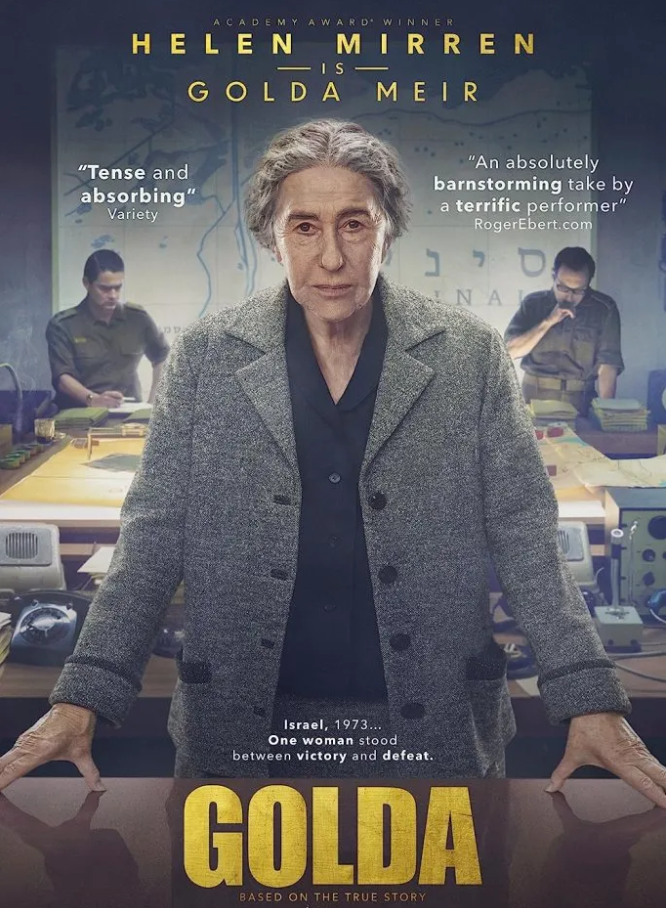
Now, half-a-century after her purportedly disastrous performance during the 1973 Yom Kippur War, there are attempts to revisit Golda’s legacy, to examine it in the light of recently released documents, and to reflect on the complex human being behind the bust. Spotlighting these revisions is a bold and riveting new film by Academy Award-winning director Guy Nattiv, starring the incomparable Helen Mirren. After portraying Queens Elizabeth I and II and Catherine the Great, Mirren praised her latest character “one of the most extraordinary I’ve ever played.” That estimation is more than illustrated by the movie simply titled Golda.
[…]
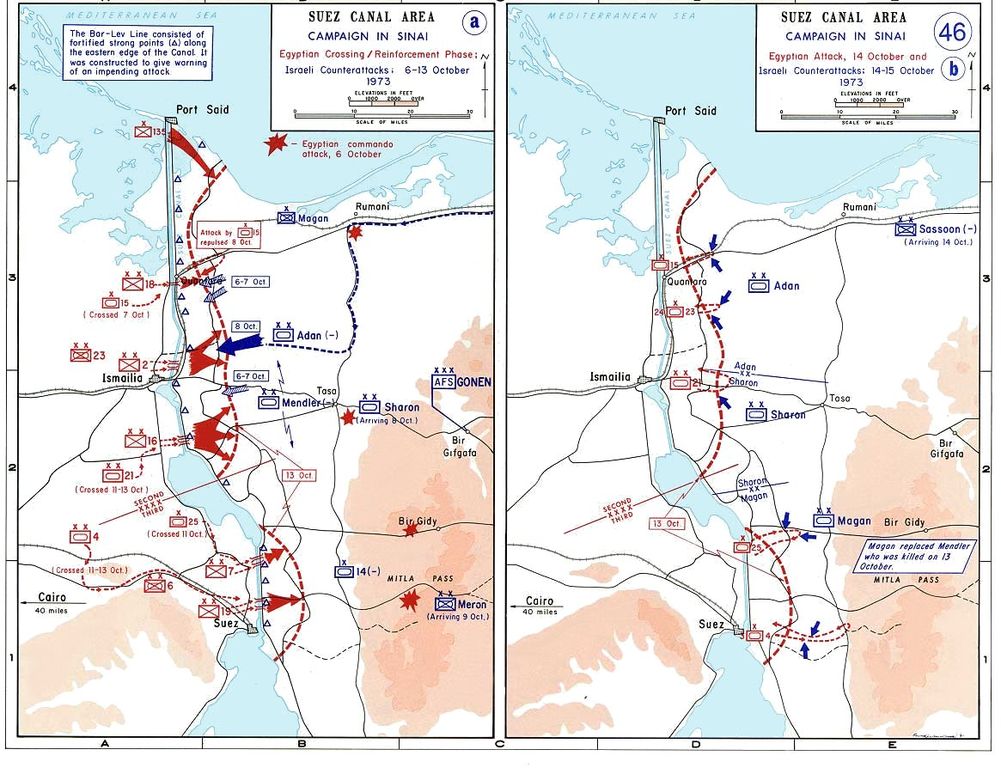
Yom Kippur War — Sinai front 6-15 October, 1973. (via Wikipedia)
Golda Meir remained in her post for another eight months while the people of Israel seethed. Though the Agranat Commission accepted her claim that she acted solely on the defense establishment’s advice and cleared her of any personal responsibility for the war, the population resented the blame placed almost solely on the army. The country, devastated emotionally and economically, was further traumatized by terrorist attacks that killed 52 civilians and wounded 150. Later that year, terrorist leader Yasser Arafat, a holster on his hip, received a standing ovation from the UN General Assembly, which went on to equate Zionism with racism. Succumbing to Arab pressure, 24 of the African countries with which Golda helped establish relations cut ties with Israel. In 1977, the degraded Mapai Party for the first time lost an election to Menachem Begin’s Likud, ending what many Israelis still regard as the state’s golden age.
Such painful events are barely touched upon in either of the Golda films, which prefer to conclude her story with Sadat’s historic visit to Israel in November 1977. The subsequent peace process resulted in the signing of the Egyptian-Israeli peace treaty in 1979, a year after Golda’s death.
Yet her legacy endures — especially now, on the 50th anniversary of the war. Though her standing remains highest in the United States — the Israel National Library reports more searches for her name in English than in Hebrew—in Israel, too, her record is being reconsidered. Here was a woman without military experience who had to rely on men whose expertise on military matters was above reproach. Here was a woman who, when many of those men buckled to pressure, remained clear-headed and strong. And here was a woman who, contrary to long-held wisdoms, repeatedly held out her hand for peace.
Some critics have been unkind to Golda. They take issue with the film’s concentration on her career’s least illustrious period and with the allegedly one-dimensional depiction of a personality known to be compassionate one minute but backbiting the next, alternately maternal and coarse. Most expressed discomfort with the director’s obsession with Golda’s cigarettes — they are practically actors — which earned the film a PG-13 rating for “pervasive smoking”. I, for one, would have liked to see more of Golda’s insecurities about her lack of higher education, military experience, and Hebrew eloquence. I would have welcomed more of the swift-witted Golda who once quipped to Kissinger, arriving in Tel Aviv after exchanging kisses with Egyptian and Syrian leaders, “Why, Mr. Secretary, I didn’t know that you kissed girls, too!”
Nevertheless, Golda must take its place alongside other outstanding portraits of leaders in crisis. Like Gary Oldman’s Churchill in Darkest Hour and Bruce Greenwood’s Kennedy in Thirteen Days, Helen Mirren’s Golda Meir offers a profile of greatness in the face of overwhelming adversity. These are films that, rather than merely report and redramatize facts, show us character. And Golda — the woman, not the myth — should continue to generate our interest as well as our respect. The Everywoman behind the bust should still be revered.
August 5, 2023
Tempting Armageddon: Soviet vs. NATO Nuclear Strategy
Real Time History
Published 4 Aug 2023Since the inception of the nuclear bomb, military strategists have tried to figure out how to use them best. During the Cold War, this led to two very different doctrines but on both sides of the Iron Curtain the military wasn’t sure if you could actually win Nuclear War.
(more…)
July 19, 2023
Diplomats Fight the Nazis in Budapest – War Against Humanity 104
World War Two
Published 18 Jul 2023Hungary’s Jews are facing a Holocaust machine in overdrive. The deportation trains are arriving in such volume that even the extermination factory of Auschwitz can barely keep up with the pace. The entire country swiftly becomes Judenfrei and the Jews of Budapest sit helplessly as Adolf Eichmann and his Hungarian collaborators tighten the noose around them. Admiral Miklós Horthy is one of the few who can save them, but so far he has done nothing. Will that change?
(more…)


